reSee.it - Tweets Saved By @Bryce_Nickels

@Bryce_Nickels - Bryce Nickels
"They should be retracted...but of course I don't think these people have the courage or the decency to do so..." Virologist Simon Wain-Hobson calls for retraction of the key publications that misled the world on the origin of COVID (“Proximal Origin” & "The Lancet letter") https://t.co/fFh0UZsNfg
@Bryce_Nickels - Bryce Nickels
🧵1/ RESOURCE - Anthony Fauci "highlights" "They're really criticizing science, because I represent science" https://t.co/EuM96Qgl31
@Bryce_Nickels - Bryce Nickels
2/ "I have to laugh at that... I should be prosecuted" https://t.co/M9ELj4c2Ej
@Bryce_Nickels - Bryce Nickels
3/ "I have to laugh at that... I should be prosecuted...what happened on January 6th, Senator?" https://t.co/aOhtGXcq8O
@Bryce_Nickels - Bryce Nickels
4/ "The divisiveness in this country, to me, is the biggest mistake that supersedes everything that we're talking about...and you have divisiveness that is pulling away from doing the right thing to get the outbreak under control...but they're really criticizing science, because I represent science"
@Bryce_Nickels - Bryce Nickels
5/ Bonus: "But any prosecution of Fauci seems highly unlikely to pass muster in a Biden Justice Department... which, in America's ongoing cold civil war, is on the same side as Fauci" Doug McKelway Washington Examiner Nov 2021 https://t.co/oxEo9f8YCB
@Bryce_Nickels - Bryce Nickels
6/ source: https://www.youtube.com/watch?v=XAEsD-bPmoU
@Bryce_Nickels - Bryce Nickels
🧵The COVID Cover-Up: Calls for Retraction of 4 Key Papers Mainstream media & scientific journals have chosen not to report on calls for retraction of four key papers on the origin of COVID-19. This decision has enabled virologists to continue misleading the public. (1/n)
@Bryce_Nickels - Bryce Nickels
The four papers that should be retracted are based on invalid premises and conclusions, or are potentially products of scientific misconduct - including fraud. (2/n)
@Bryce_Nickels - Bryce Nickels
The first paper that should be retracted is: "No credible evidence supporting claims of the laboratory engineering of SARS-CoV-2" published online in Emerging Microbes & Infections on February 26, 2020. (3/n)
@Bryce_Nickels - Bryce Nickels
The second paper that should be retracted is: "The proximal origin of SARS-CoV-2 ('Proximal Origins')," published in Nature Medicine on March 17, 2020. (4/n)
@Bryce_Nickels - Bryce Nickels
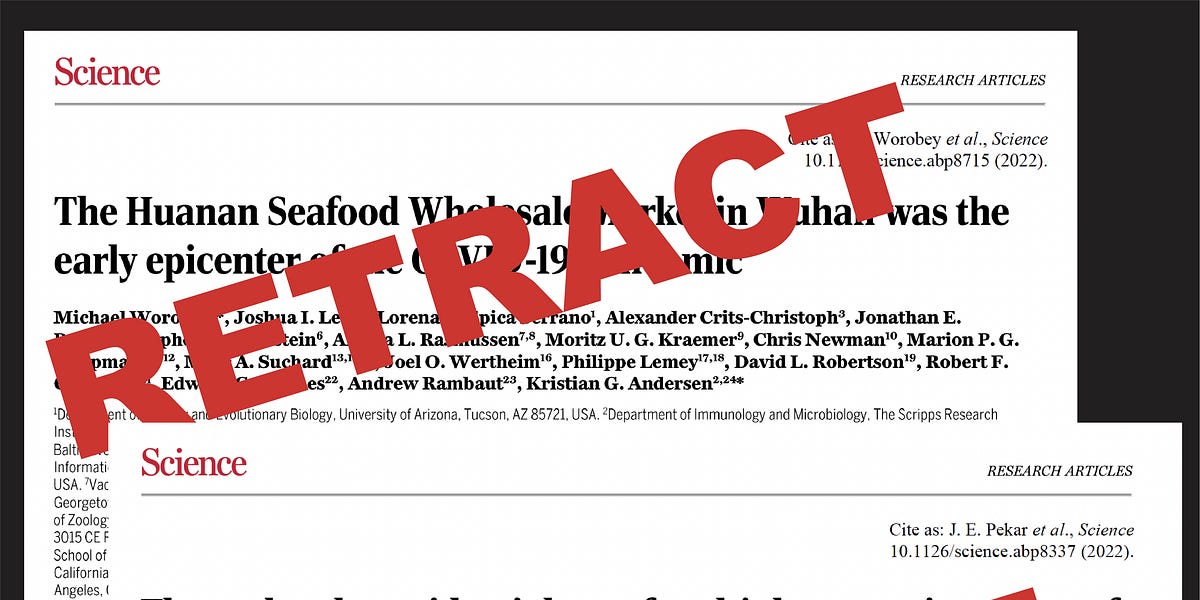
The third paper that should be retracted is: "The Huanan Seafood Wholesale Market in Wuhan was the early epicenter of the COVID-19 pandemic" published in Science on July 26, 2022. (5/n)
@Bryce_Nickels - Bryce Nickels
The fourth paper that should be retracted is: "The molecular epidemiology of multiple zoonotic origins of SARS-CoV-2” published in Science on July 26, 2022. (6/n)
@Bryce_Nickels - Bryce Nickels
A letter requesting the retraction of "The molecular epidemiology of multiple zoonotic origins of SARS-CoV-2" was sent to the editor in chief of Science on June 14, 2024. https://biosafetynow.substack.com/p/covid-origins-worobey-et-al-2022
@Bryce_Nickels - Bryce Nickels
🧵RESOURCE: 8 clips that confirm everyone's worst fears about bioweapons (from a 2020 interview with Tara O'Toole) clip 1: "Just a fact of life today"
@Bryce_Nickels - Bryce Nickels
🧵RESOURCE: 8 clips that confirm everyone's worst fears about bioweapons (from a 2020 interview with Tara O'Toole) clip 2: "you don't need a secret lab...It's all dual-use from stem to stern"
@Bryce_Nickels - Bryce Nickels
🧵RESOURCE: 8 clips that confirm everyone's worst fears about bioweapons (from a 2020 interview with Tara O'Toole) clip 3: "the truth is that today given the state of the technology virtually any nation state can make a biological weapon...a big, powerful, nuke-like bioweapon... and probably in a couple months"
@Bryce_Nickels - Bryce Nickels
🧵RESOURCE: 8 clips that confirm everyone's worst fears about bioweapons (from a 2020 interview with Tara O'Toole) clip 4: "we don't have a lot of insight into what Russia is doing today...there's a lot of concern that the Chinese have BW....and even rumors that the CoV came out of a lab in Wuhan"
@Bryce_Nickels - Bryce Nickels
🧵RESOURCE: 8 clips that confirm everyone's worst fears about bioweapons (from a 2020 interview with Tara O'Toole) clip 5: "the notion of a bioengineered weapon is a completely credible scientific possibility"
@Bryce_Nickels - Bryce Nickels
🧵RESOURCE: 8 clips that confirm everyone's worst fears about bioweapons (from a 2020 interview with Tara O'Toole) clip 6: "It is definitely possible to engineer pathogens to make them more virulent or more transmissible, etc., etc..."
@Bryce_Nickels - Bryce Nickels
🧵RESOURCE: 8 clips that confirm everyone's worst fears about bioweapons (from a 2020 interview with Tara O'Toole) clip 7: "there are parts of the former Soviet bioweapons complex that no Westerner has been in... and there is a working assumption that the Soviet Union still has military facilities that are thinking about and maybe even making biological weapons"
@Bryce_Nickels - Bryce Nickels
🧵RESOURCE: 8 clips that confirm everyone's worst fears about bioweapons (from a 2020 interview with Tara O'Toole) clip 8: "We had had our own very sophisticated biological weapons program from World War II through the 60s..most people don't understand how massive and sophisticated our own offensive weapons program was"
@Bryce_Nickels - Bryce Nickels
source: https://vimeo.com/562708015
@Bryce_Nickels - Bryce Nickels
🧵22 Highlights from Day 1 of the 2020 NSABB meeting (January 23, 2020) #1. “nothing’s ever eradicated as long as you have the sequence, right?” - Vincent Racaniello
@Bryce_Nickels - Bryce Nickels
🧵22 Highlights from Day 1 of the 2020 NSABB meeting (January 23, 2020) #2. “this is a panel to look at flu proposals, essentially” - Vincent Racaniello
@Bryce_Nickels - Bryce Nickels
🧵22 Highlights from Day 1 of the 2020 NSABB meeting (January 23, 2020) #3. “Would we be upset if we, for example, found out today that some other country was doing CoV research to create more pathogenic or more transmissible CoVs in the absence of some very clear international standards” - Tom Inglesby
@Bryce_Nickels - Bryce Nickels
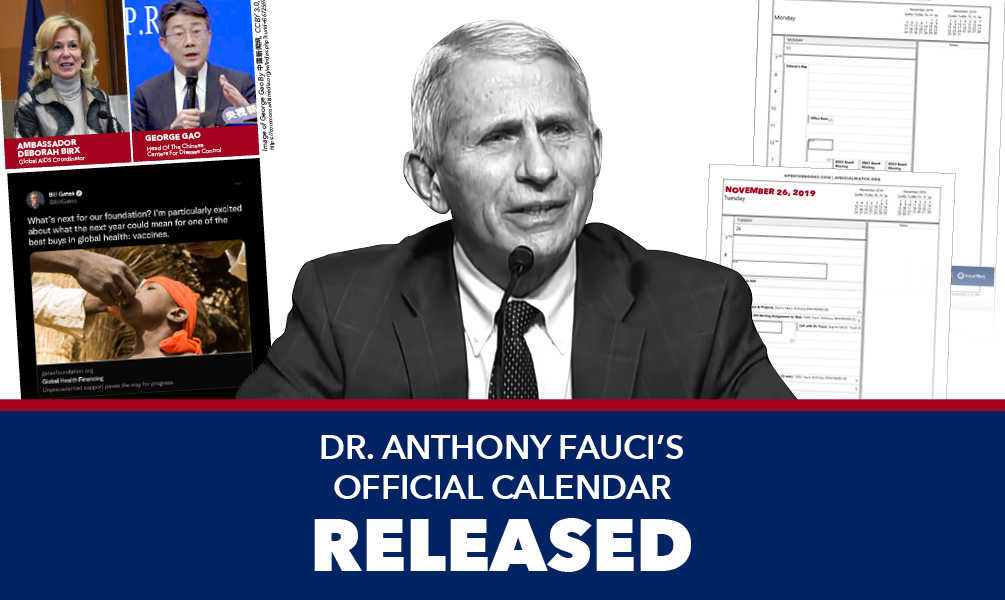
🧵22 Highlights from Day 1 of the 2020 NSABB meeting (January 23, 2020) #4. “by the look on your face maybe you and I should chat offline about it” Chris Hassell (chair of the P3CO review committee) responds to a question from James Le Duc about whether projects outside of the NIH are included in the P3CO review This exchange is noteworthy given when it occurred- January 23, 2020. Earlier that day, Le Duc and Anthony Fauci had an 8am, in-person meeting. At the time, LeDuc ran one of the few BSL-4 biocontainment labs in the US at the University of Texas Medical Branch. He also trained many Chinese scientists from the Wuhan Institute of Virology in BSL-4 biosafety procedures. Later in the day (~4:30 that afternoon) LeDuc and former Ft. Detrick BSL-4 biolab director Dave Franz had a conference call with Robert Kadlec (who was working at HHS at the time). source: https://www.openthebooks.com/substack-historic-release-dr-anthony-faucis-official-work-calendar-november-2019--march-2020/
@Bryce_Nickels - Bryce Nickels
🧵22 Highlights from Day 1 of the 2020 NSABB meeting (January 23, 2020) #5. “nothing that has gone on at the Dept of Defense would have fallen under [the P3CO framework]” Chris Hassell (chair of the P3CO review committee) responds to a question from Marie-Louise Hammarskjold about whether agencies other than NIH are performing ePPP research
@Bryce_Nickels - Bryce Nickels
🧵22 Highlights from Day 1 of the 2020 NSABB meeting (January 23, 2020) #6. Extended discussion between Mark Denison and Chris Hassell (chair of the P3CO review committee) on the difficulties of doing a risk/benefit analysis and the scope of the P3CO
@Bryce_Nickels - Bryce Nickels
🧵22 Highlights from Day 1 of the 2020 NSABB meeting (January 23, 2020) #7. Mark Denison mentions there may be a COVID case at Texas AM, which leads to a joke about the spread of the virus, followed by a “well-timed” cough at the end
@Bryce_Nickels - Bryce Nickels
🧵22 Highlights from Day 1 of the 2020 NSABB meeting (January 23, 2020) #8. Pamela Silver discusses an example of how the drive to publish in high-profile journals endangers us all
@Bryce_Nickels - Bryce Nickels
🧵22 Highlights from Day 1 of the 2020 NSABB meeting (January 23, 2020) #9. ePPP research enthusiast Jessica Belser expresses concerns with the way dangerous research is communicated to the public in the media and on TWiV
@Bryce_Nickels - Bryce Nickels
🧵22 Highlights from Day 1 of the 2020 NSABB meeting (January 23, 2020) #10. Ken Bernard makes an argument for secrecy in scientific review, which Marc Lipsitch counters (see clip #11, below)
@Bryce_Nickels - Bryce Nickels
🧵22 Highlights from Day 1 of the 2020 NSABB meeting (January 23, 2020) #11. Marc Lipsitch responds to Ken Bernard’s argument for secrecy in the review process. (see clip #10, above)
@Bryce_Nickels - Bryce Nickels
🧵22 Highlights from Day 1 of the 2020 NSABB meeting (January 23, 2020) #12. Ken Bernard claims that ~50% of the US NATO allies think the US has an offensive bioweapons program
@Bryce_Nickels - Bryce Nickels
🧵22 Highlights from Day 1 of the 2020 NSABB meeting (January 23, 2020) #13. “If Judy Miller wrote an article about it, it would like we were doing offensive bioweapons work” Ken Bernard mentions a project from 2004 that was stopped by the public affairs office because it would not pass the “NY Times test”
@Bryce_Nickels - Bryce Nickels
🧵22 Highlights from Day 1 of the 2020 NSABB meeting (January 23, 2020) #14. “just because there is a definition on a page doesn’t mean that’s how its being practiced in real life” - Jessica Belser
@Bryce_Nickels - Bryce Nickels
🧵22 Highlights from Day 1 of the 2020 NSABB meeting (January 23, 2020) #15. “The public health contributions resulting from research with enhanced potential pandemic pathogens--so called gain-of-function studies--are clear” - Jessica Belser
@Bryce_Nickels - Bryce Nickels
🧵22 Highlights from Day 1 of the 2020 NSABB meeting (January 23, 2020) #16. Marie-Louise Hammarskjold asks Gigi Gronvall about the lack of data for accidents to base risk assessments on (at 1.5x speed)
@Bryce_Nickels - Bryce Nickels
🧵22 Highlights from Day 1 of the 2020 NSABB meeting (January 23, 2020) #17. Ken Bernard mentions that the policies they are discussing don’t cover entities not taking money from the US government (at 1.5x speed)
@Bryce_Nickels - Bryce Nickels
🧵22 Highlights from Day 1 of the 2020 NSABB meeting (January 23, 2020) #18. Marie-Louise Hammarskjold discusses (1) prior concerns the panel had that any policy recommendations that had would be too broad and thus hamper MERS and SARS research and (2) concerns that the public will react negatively if there is not enough transparency in deliberations on risk-benefit analysis
@Bryce_Nickels - Bryce Nickels
🧵22 Highlights from Day 1 of the 2020 NSABB meeting (January 23, 2020) #19. Chris Hassell (chair of the P3CO review committee) mentions that not having a policy that applies to non-federally funded work may represent a vulnerability
@Bryce_Nickels - Bryce Nickels
🧵22 Highlights from Day 1 of the 2020 NSABB meeting (January 23, 2020) #20. Chris Hassell (chair of the P3CO review committee) claims that the emergence of COVID-19 emphasizes the need for more research that would qualify for review under P3CO (i.e. work that creates enhanced potential pandemic pathogens)
@Bryce_Nickels - Bryce Nickels
🧵22 Highlights from Day 1 of the 2020 NSABB meeting (January 23, 2020) #21. “The intention was to allow a deliberative process to make sure that some of those “seven deadly sins”…were not stopped” Ken Bernard, who was involved in writing the original charter for the NSABB, describes the origin of the NSABB, the Fink Report, and how the NSABB was not created to guard against the bad use of research but rather to make sure concerns over safety did not stop scientific progress
@Bryce_Nickels - Bryce Nickels
🧵22 Highlights from Day 1 of the 2020 NSABB meeting (January 23, 2020) #22. Gerald Parker (chair of NSABB) asks Chris Hassell (chair of the P3CO review committee) about transparency
@Bryce_Nickels - Bryce Nickels
Source: https://videocast.nih.gov/watch=35665
@Bryce_Nickels - Bryce Nickels
🚨RESOURCE🚨 Comments by Steven Quay @quay_dr at The Capitol Hill Lecture Series (June 18, 2024) Clip 1 - Dr Quay discusses the science behind why SARS-CoV-2 did not come from a wet market (1/9)
@Bryce_Nickels - Bryce Nickels
Comments by Steven Quay @quay_dr at The Capitol Hill Lecture Series (June 18, 2024) Clip 2 - Dr Quay discusses the furin cleavage site in SARS-CoV-2 (2/9) https://t.co/cpXB7Foxl5
@Bryce_Nickels - Bryce Nickels
Comments by Steven Quay @quay_dr at The Capitol Hill Lecture Series (June 18, 2024) Clip 3 - Dr Quay discusses why it is highly unlikely that SARS-CoV-2 came from nature (3/9) https://t.co/NmGTVsTWEL
@Bryce_Nickels - Bryce Nickels
Comments by Steven Quay @quay_dr at The Capitol Hill Lecture Series (June 18, 2024) Clip 4 - Dr Quay discusses the DEFUSE proposal (part 1) (4/9) https://t.co/pUMBH6NY9V
@Bryce_Nickels - Bryce Nickels
Comments by Steven Quay @quay_dr at The Capitol Hill Lecture Series (June 18, 2024) Clip 5 - "that's what they want you to believe" (5/9) https://t.co/nbgCTu03QA
@Bryce_Nickels - Bryce Nickels
Comments by Steven Quay @quay_dr at The Capitol Hill Lecture Series (June 18, 2024) Clip 6 - Dr Quay discusses the DEFUSE proposal (part 2) (6/9) https://t.co/0QwYGKl5ji
@Bryce_Nickels - Bryce Nickels
Comments by Steven Quay @quay_dr at The Capitol Hill Lecture Series (June 18, 2024) Clip 7 - "this think looks really like the virus we proposed to make.... maybe it came from a lab" (7/9) https://t.co/mqx0Fix1Ud
@Bryce_Nickels - Bryce Nickels
Comments by Steven Quay @quay_dr at The Capitol Hill Lecture Series (June 18, 2024) Clip 8 - "in 2019, 30 vials of the three most deadly viruses on the planet...are sent from Canada to the WIV" (8/9) https://t.co/hajabn3YBL
@Bryce_Nickels - Bryce Nickels
source: https://www.youtube.com/watch?v=uj-PtkM1_cU (9/9)
@Bryce_Nickels - Bryce Nickels
🚨 Request for Editorial Action for Liu et al. 2020 🚨 We are writing to bring to your attention significant breaches of publishing ethics regarding the paper titled "No credible evidence supporting claims of the laboratory engineering of SARS-CoV-2" by Liu et al.

@Bryce_Nickels - Bryce Nickels
June 14, 2024 Subject: Request for Editorial Action for Liu et al. 2020 Dear Editors, We are writing to bring to your attention significant breaches of publishing ethics regarding the paper titled "No credible evidence supporting claims of the laboratory engineering of SARS-CoV-2" by Shan-Lu Liu, Linda Saif, Susan Weiss, and Lishan Su, published online in Emerging Microbes & Infections on February 26, 2020 (1). The manuscript was handled by the Editor-in-Chief of Emerging Microbes & Infections, Shan Lu. The manuscript discussed the emergence of SARS-CoV-2, the virus responsible for the COVID-19 pandemic, and concluded "there is currently no credible evidence to support the claim that SARS-CoV-2 originated from a laboratory-engineered CoV" (1). The authors’ and editor's private email communications (2), obtained through an Ohio Public Records Act request, provide compelling evidence that there is clear basis to infer the paper may be the product of scientific misconduct, up to and including fraud (2-6). The authors' and editor's private email communications reveal the following: 1. On the day the authors reviewed the proofs of the paper (February 21, 2020), shortly before its publication, in email communications having the subject line "Your article proofs for review (ID# TEMI 1733440)," two authors, Susan Weiss and Shan-Lu Liu, made statements that show clearly that they knew that the title and conclusion of their paper were unsound (2-5). • Susan Weiss emails Shan-Lu Liu to express her concern that she does not understand how the furin cleavage site (“furin site”) ended up in the SARS-CoV-2 sequence naturally. Susan Weiss (February 21, 2020 at 5:42 AM): “[T]he RaTG13 spike does not include a furin sequence.... I find it hard to imagine how that sequence got into the spike of a lineage b betacoronavirus- not seen in SARS or any of the bat viruses. The BioRx preprint on Pangolin sequence is very weak- says the RBD from the pangolin virus is closer to SARS-CoV-2 than RaTG13 is. But again pangolin sequence lacks the furin site.” Susan Weiss (February 21, 2020 at 9:06 AM): “I remain concerned about the insertion of the furin site” • Shan-Lu responds that he agrees with her, but suggests that they should focus on denying the “rumor” that the furin site may not be natural. Shan-Lu Liu (February 21, 2020 at 9:50 AM): “Susan, I completely agree with you, but rumor says that furin site may be engineered.” • Susan Weiss responds by emphasizing her difficulties in understanding how the furin site emerged and expresses concern that it “may have been engineered.” Susan Weiss (February 21, 2020 at 10:13 AM): “Henry and I have been speculating- how can that site have appeared at S1/S2 border- I hate to think to was engineered- among the MHV strains, the cleavage site does not increaser pathogenicity while it does effect entry route (surface vs endosome). so for me the only significance of this furin site is as a marker for where the virus came from- frightening to think it may have been engineered.” 2. Ralph Baric and Shi Zhengli, despite clear conflicts of interest, made substantial contributions to the manuscript but were not credited as authors or acknowledged (2-6). Authorship policies for Taylor and Francis requires acknowledgement of all contributors and the source of their funding declared (7): “Contributions made by professional scientific, medical or technical writers, translators or anyone who has assisted with the manuscript content must be acknowledged and their source of funding declared. They should be included in an ‘Acknowledgments’ section with an explanation of their role, or they should be included in the author list if appropriate.” EMI Editor-in-Chief, Shan Lu (February 11 at 1:44 PM) “We don’t want to appear that we are defending Ralph [Baric] even though he did nothing wrong.” EMI Editor-in-Chief, Shan Lu (February 11 at 2:03 PM) “Sure, we are not saying we are trying to defend Ralph [Baric] but just don’t want to give others the wrong impression” Ralph Baric (February 12, 2020 at 10:02 AM) “sure, but don’t want to be cited in as having commented prior to submission.” Lishan Su (February 12, 2020 at 10:11 AM) “Hi Ralph: We are trying to finish it and had no plan to get you too involved, but I do value your input.” Ralph Baric (February 12, 2020 at 12:32 PM) “My comments. I’ve included an excel file comparing the differences in the genome length sequences of the parental and chimeric viruses. Also made some text changes. I think the community needs to write these editorials and I thank you for your efforts . ralph” Shan-Lu Liu (February 16, 2020 at 12:43 PM): “I agree to delete those two parts. One was added by me, based on Linda’s email, and another was also by me, based on Ralph [Baric]’s comments.” Shan-Lu Liu (February 16, 2020 at 9:49 PM): “See Zhengli’s comments. We may not need to make those changes, although some of those are good.” Lishan Su (February 21, 2020 at 1:40 PM): “I have noticed that too, probably happened when we tried to simplify the chimeric virus paragraph, and I think Ralph [Baric] had added the attenuation sentence relative to M15 in mice…” 3. While writing the paper, Shan Lu, Lu-Shan Su, and Shan-Lu Liu had privileged information about a SARS-CoV-2 infection in a Beijing lab in 2020. However, while they discussed it between themselves, they did not disclose this information to the other co-authors and minimized the possibility of a lab accident in the paper (2-5). Lishan Su (February 14, 2020 at 6:39 PM): “Your former colleague was infected with sars2 in the lab?” Shan-Lu Liu (February 14, 2020 at 6:46 PM): “Yes, he was infected in the lab!” EMI Editor-in-Chief, Shan Lu (February 14, 2020 at 7:02 PM): “I actually am very concerned for the possibility of SARS-2 infection by lab people. It is much more contagious than SARS-1. Now every lab is interested in get a vial of virus to do drug discovery. This can potentially a big issue. I don’t think most people have a clue.” 4. Shan Lu (not to be confused with Shan-Lu Liu), did not disclose his involvement in authoring the paper to Susan Weiss and Linda Saif, by carefully managing a separate paper drafting email thread with Shan-Lu Liu and Lishan Su (2-5). 5. The Editor-in-Chief of Emerging Microbes & Infections, Shan Lu accepted the manuscript on the day it was submitted with—in his own words —"basically no review," and even explained to authors Lu-Shan Su and Shan-Lu Liu that he had used his position as Editor-in-Chief to secure a superficial manuscript approval (2-5). Shan-Lu Liu (February 11, 2020 at 7:44 PM): “Shan: Are you sure that you prefer not to be included in the coauthorship?” EMI Editor-in-Chief, Shan Lu (February 11, 2020 at 12:44 PM): “Here is my new version based on SLL’s. highlighted areas are my new version (I did not leave tracking as it is too messy). Please take a look then we can focus on the chimeric one which needs more simplification as I can see. We may not need to go too deep in science as it can only confuse more people and found more issues from those who has suspicion. Shan” Shan-Lu Liu (February 12, 2020 at 6:04 PM): “Lishan: My understanding is that Shan does not want to be included as a coauthor… That is why I thought you would be the first author because you had the first draft” EMI Editor-in-Chief, Shan Lu (February 12, 2020 at 7:25 PM): “I definitely will not be an author as you guys did everything. It can also keep things somewhat independent as the editor.” EMI Editor-in-Chief, Shan Lu (February 16, 2020 at 12:30 PM): “See two attached documents: 1. Title of commentary: I agree that by removing “origin”, it is better. I also wonder if we can add “current” in it? 2. A slightly revised draft of commentary: I removed certain sentences (with tracking) to make the commentary more focused. For your reference” EMI Editor-in-Chief, Shan Lu (February 21, 2020 at 10:36 AM): “Yes, just a secret to you two and not share with others. When I put a super fast review and accept (basically no review), the [Journal Editorial Office of Taylor & Francis], became very suspicious and wanted her boss to check and approve. She probably wonder if we are actually just one person with three fake names” Lishan Su (February 21, 2020 at 10:22 PM): “Thanks for speeding it up, bro! We are doing wonders as three confusing/confused musketeers of Shan-Lu, Shan Lu and Lishan Su:)” Taken together, the authors’ and editor's private communications indicate the paper is a product of scientific misconduct, up to and including fraud, by the authors and by the Editor-in-Chief of Emerging Microbes & Infections, Shan Lu. The authors' and editor's private communications establishing these facts were not available at the time the paper was approved and published. Now that these documents have come to light, we urge Emerging Microbes & Infections to issue an Expression of Editorial Concern for this paper and to initiate a retraction process. Signatories (in alphabetical order) Colin D. Butler, Australian National University, Australia Gilles Demaneuf, Engineer and Data Scientist, New Zealand Joseph P. Dudley, University of Alaska Fairbanks, US Richard H. Ebright, Rutgers University, US Andre Goffinet, UCLouvain (Prof em), Belgium Edward Hammond, Prickly Research, US Neil L. Harrison, Columbia University, US Hideki Kakeya, University of Tsukuba, Japan Stephen Lagana, Columbia University Irving Medical Center, US Yanna Lambrinidou, Virginia Tech, US Jonathan Latham, The Bioscience Resource Project, US Milton Leitenberg, University of Maryland, US Bryce E. Nickels, Rutgers University, US Andrew Noymer, University of California, Irvine Steven Quay, Stanford University School of Medicine (Former Faculty), US Eric S. Starbuck, Biosafety Now, US Günter Theißen, Matthias Schleiden Institute, Germany Antonius VanDongen, Duke University, US Roland Wiesendanger, University of Hamburg, Germany Allison Wilson, The Bioscience Resource Project, US Mohamed E. El Zowalaty, Ahram Canadian University, Egypt References cited 1. Shan-Lu Liu, Linda J Saif, Susan R Weiss, Lishan Su. No credible evidence supporting claims of the laboratory engineering of SARS-CoV-2. Emerg Microbes Infect. 2020 Feb 26;9(1):505-507. https://doi.org/10.1080/22221751.2020.1733440 2. The released email messages are available at: https://usrtk.org/wp-content/uploads/2021/08/OSU-records-Shan-Lu-Liu-Aug-4.pdf 3. “Chinese-linked journal editor sought help to rebut Covid-19 lab origin hypothesis” by Sainath Suryanarayanan (April 7, 2021) https://usrtk.org/covid-19-origins/chinese-linked-journal-sought-to-rebut-covid-19-lab-origin-theory/ 4. “Scientists who authored article denying lab engineering of SARS-CoV-2 privately acknowledged possible lab origin, emails show” by Shannon Murray (August 11, 2021) https://usrtk.org/covid-19-origins/scientists-who-authored-article-denying-lab-engineering-of-sars-cov-2-privately-acknowledged-possible-lab-origin-emails-show/ 5. https://typefully.com/gdemaneuf/GP3bmOS 6. Why Do People Not “Trust the Science”? Because Like All People, Scientists Are Not Always Trustworthy (Paul Thacker, Jan 11, 2022) https://usrtk.org/covid-19-origins/scientists-who-authored-article-denying-lab-engineering-of-sars-cov-2-privately-acknowledged-possible-lab-origin-emails-show/ 7. https://authorservices.taylorandfrancis.com/editorial-policies/defining-authorship-research-paper/


@Bryce_Nickels - Bryce Nickels
THIS LETTER WAS SENT TO EMI EDITORIAL BOARD AT 1:29 EDT https://t.co/Rybi2Cha0S

@Bryce_Nickels - Bryce Nickels
Eddie Holmes chooses to amplify disinformation instead of face accountability for lying to the global public. Holmes is a disgrace to his profession. #RetractProximalOrigins https://t.co/eFkTlXTL6k

@Bryce_Nickels - Bryce Nickels
Markolin's thread is a smear campaign against USRTK followed by this laughable defense of PO. The fact that Holmes amplified the thread is #StrongEvidence that he has no defense for his actions. https://t.co/jN2MJ6Oyva
