reSee.it - Tweets Saved By @CCrowley100

@CCrowley100 - Chad Crowley
A planned “asylum center” burns in Loosdrecht, Netherlands. April 2026. The former town hall was set to be transformed into a shelter for so-called “asylum seekers,” foreign invaders imposed on the town by a Regime deaf to its own people. Local Dutch citizens objected. They protested. Police were deployed. The situation escalated. Then the planned site was reportedly set alight. Of course, Loosdrecht is not an isolated case. It is one of several Dutch towns, and one of countless places across the West, now fighting the same battle: citizens being told that their buildings, streets, and neighborhoods can be repurposed by an increasingly tyrannical political class that will never live with the consequences. This is what passes for “democracy” in the modern West: not rule by the people, but rule over the people, dressed in the rituals of consent. Native citizens may vote, petition, attend meetings, object, and protest. They may perform every ceremony of “self-government.” But when they say no to asylum centers in their own towns, or resist any policy advancing their demographic displacement and erasure, the state proceeds anyway. The choice was never theirs. Democracy is only the stage on which power performs.
@CCrowley100 - Chad Crowley
Hitler is merely one facet, or more precisely one tenet, of the founding religion of the post-1945 Western world: the religion of the Good War. Every civilization rests upon a sacred order, something that transcends the merely mortal and provides the framework through which value is arranged and meaning conferred. It is not a fiction but a sacred order that defines good and evil, memory and destiny, and determines what may be preserved and what must be condemned. For the modern West, that faith is the Second World War. It is remembered not as a conflict among nations but as the moment in which a new moral order was born. The war is treated as revelation, the event from which the moral legitimacy of the Western Regime descends. From it emerged a political theology that shaped institutions and public life, binding the Western world to a moral interpretation of its own survival. Within this framework, Hitler ceased to be a historical figure and became a moral archetype, a new antichrist whose memory must be condemned. He stands as the emblem through which modern virtue is defined and the warning through which conformity is maintained. His image serves as the foundation of the postwar faith, a reference point invoked to justify authority and to police the boundaries of thought. Through this transformation, a human tragedy was elevated into doctrine. The victors fashioned from their triumph a permanent narrative of righteousness that turned history into morality and memory into commandment. The faith endures because it explains the modern West to itself, granting coherence to its institutions and meaning to its exhaustion. It teaches that virtue lies in suppressing national will, that peace depends upon the renunciation of power, and that remembering the past too fully risks exposing the myths on which the present order rests. The cult of the war did not remain confined to remembrance. It grew into a civic religion, woven into the structures of power and instruction. Its language pervades public life, where law and policy alike are judged against its moral vision. The past is recalled less to understand than to admonish, and history itself has been moralized into a sermon. From this grew an orthodoxy that defines the limits of permissible thought. Nations may exist only as administrative zones and marketplaces, peoples as abstractions, and tradition as surface decoration. The religion grants the ruling order its moral immunity, for to question it is to profane what has been declared sacred. Under its influence, the doctrine of equality hardened into dogma. What had once been a legal principle became an article of faith, binding the West to the conviction that difference itself is evil. The war that destroyed Europe is said to have proved that hierarchy is tyranny, that identity rooted in anything higher than material or economic existence leads to violence, and that peace depends upon the abolition of distinction. Thus the religion of the Good War sustains the slavish cult of equality, and together they form the creed of a civilization that no longer remembers what it once was. The consequences of this creed have been destructive. Nationalism, once understood as the natural expression of collective will, was recast as the seed of catastrophe. Loyalty to one’s own became suspect, and pride in ancestry a moral defect. Moreover, anything that had been used or symbolized by the Axis powers, even when it had long preceded them in Western history, became condemned by association. The symbols of empire and the language of hierarchy were cast aside as relics of oppression, while the notion of spiritual order itself was treated as a threat. What earlier generations regarded as noble or sacred was redefined as the seed of tyranny. In this way, the West came to renounce not only its past but the principles that had once animated its greatness. The religion of the Good War transformed the instinct for belonging into a source of shame and reduced the nation to a tolerated mechanism of administration, stripped of its older dignity as the living form of a people. Borders persist chiefly for commerce, rarely for preservation. “Nations” of people have become “states” of populations, administrative shells devoid of conviction, while those within them drift without purpose. A civilization that once found destiny in creation now measures virtue through surrender. This inversion has left the West incapable of defending its own existence. It cannot speak of heritage without apology or affirm continuity without guilt. Its moral vocabulary condemns the instincts that sustain life, such as loyalty, hierarchy, and rootedness, and in the pursuit of universal peace, it has disarmed its spirit. That spiritual disarmament prepared the way for dissolution. Having denied the legitimacy of pride, the West lost the will to preserve itself. Mass immigration was welcomed not as policy but as penance. Demographic transformation was taken as proof of virtue. The replacement of native populations was celebrated as the consummation of moral progress. What began as a religion of redemption became an instrument of erasure. The collapse that followed was not merely political but spiritual. The West ceased to see itself as a civilization and began to regard its own survival as a problem to be managed. Its rulers converted guilt into a governing principle, while its people were taught that self-sacrifice is the highest form of virtue. This belief hollowed the inner life of nations, replacing the will to endure with the wish to be absolved. The effect upon mankind has been profound. A people cannot live without a vision of continuity or purpose. When memory is condemned, existence loses shape. What had once been a civilization of builders became a civilization of caretakers. It preserved fragments of greatness but forgot the source from which greatness sprang. The religion of the Good War, once a moral shield, has become a burden too heavy to bear. It cannot sustain a living order because it denies the instincts upon which life depends. No civilization can flourish while despising its fathers, nor guide the future while treating the past as a curse. It must now be seen for what it is: not a foundation, but a chain. Only by casting it off can the West once again stand among the nations of men, not as a penitent, but as a people who remember what they are.

@CCrowley100 - Chad Crowley
Reply #1: The Moral Order Preceded 1989 https://t.co/mMEe44zcUc
@CCrowley100 - Chad Crowley
Reply #2: Origin of an Idea & Why Write This I should begin with two points of clarification. This essay was first written in 2007, during a period when I was examining the long civilizational consequences of the Second World War and its elevation into a kind of sacred event. I sought to understand how a conflict once regarded as historical had become a moral revelation through which the modern West defines its legitimacy. At the time, I could not yet see how deeply that moral structure would come to penetrate every aspect of Western life. The idea itself is not mine. Its roots reach back to the 1940s, but it was first given clear expression by the postwar Continental Right, many of whose members were drawn from the earlier Conservative Revolution. Ernst von Salomon, author of The Outlaws and The Question, and Armin Mohler were among the first to interpret the war as a spiritual rupture that redefined the entire basis of Western authority. Mohler’s Die konservative Revolution in Deutschland traced this intellectual lineage directly, presenting the interwar Conservative Revolution as the movement whose defeat made possible the moral and political order that followed 1945. Carl Schmitt elaborated the same insight in Ex Captivitate Salus, describing how the victors’ moral self-justification became the new foundation of international order. Later writers such as Philippe Ariès, Ernst Nolte, and Rolf Peter Sieferle expanded upon this idea, identifying the Second World War as the founding “civil religion” of the modern West. In the English-speaking world, this idea has rarely been discussed, not because it lacks coherence, but because it unsettles the moral foundations upon which the postwar order rests. Only now, when that order shows the marks of exhaustion, has the idea returned to public awareness. Moreover, most writings of the Conservative Revolutionary movement, apart from those of Carl Schmitt, Ernst Jünger, Oswald Spengler, and Martin Heidegger, remain untranslated into English. I have been working to help rectify this. Please see the link below to a brief essay on the Conservative Revolution and its principal thinkers; further material will follow soon. Lastly, to clarify why Hitler is mentioned at all, this essay was presented with a slightly modified opening to contextualize it as a reply to a comment asserting that “Hitler was bad” is a sufficient basis for a civic religion. The remark was trivial yet revealing, for it expressed without irony the very theological instinct I describe: the transformation of wartime morality into the enduring religion of the modern West. https://chadcrowley.substack.com/p/the-german-conservative-revolution

@CCrowley100 - Chad Crowley
@wdhartley Thank you!
@CCrowley100 - Chad Crowley
Thank you, and I agree with your second point. It is only when we are surrounded, or more precisely besieged by the confusion and decay created by the other, that identity becomes clear. When we are confronted with what we are not, we begin to understand what we are. As for brevity, and with all due respect, I write for reflection, not for trend. I cannot write for the vulgar right or for applause. I write for myself and for those who still value the written word. This piece was first written in 2007, though I revised the opening to contextualize for the conversation on X. The idea itself, that the Second World War became the foundational myth of the modern West, goes back to the postwar European Right.
@CCrowley100 - Chad Crowley
That view confuses sequence with origin. The fall of the Berlin Wall did not create the moral order I describe; it merely revealed what had been established decades earlier and allowed it to act openly, without disguise or restraint. For clarity, I first wrote and published this essay in 2007, later revising its opening to make it relevant to the present discussion on X. The idea itself is not mine. It has existed since 1945 and was first articulated by the postwar European Right, particularly those on the Continent who recognized that the war had inaugurated a new moral framework for the West, one that redefined legitimacy through guilt and a sustained suspicion toward its own past. The moral structure that governs the West was born from victory. After the Second World War, power was justified not by destiny, divine order, or even by a genuine sense of self and national confidence, but by moral purity. That purity arose from a deliberate simplification of the conflict into absolute moral categories, simplistic binaries in truth, of good and evil, right and wrong. This reduction allowed the victors to claim not only success in war but moral authority over history itself. From that transformation emerged a theology of innocence that became the foundation of postwar legitimacy. The Cold War concealed this change beneath the rivalry of ideologies and the distractions of geopolitics, yet the same postwar theology persisted. The war was no longer remembered as a struggle among nations but revered as revelation. From that revelation came a code that judged all nations, including the victors, according to the innocence they claimed in their triumph. After 1989, the political balance that had restrained this moral order disappeared. The Soviet Union had served as both rival and mirror, allowing the West to define itself in opposition to another absolute. When that rival collapsed, the moral religion of the Good War stood alone as the foundation of legitimacy. Nothing new was created; what had already ruled was simply exposed in its pure form.
@CCrowley100 - Chad Crowley
@Matman28 Thank you! To be honest, I originally wrote this essay in 2007!
@CCrowley100 - Chad Crowley
@ShaneMa01033790 I do, and I worked as a director for the company that helped bring his works into the Anglo world.
@CCrowley100 - Chad Crowley
@Russell_Son_10 Thank you!
@CCrowley100 - Chad Crowley
I am not an anon, and this is my real name. If nobody in the United States thinks about the Second World War, it is curious that its moral code still shapes your institutions and habits of thought. Forgetting it does not mean it ended; it means you have mistaken the air you breathe for freedom. From the tone of your remark, I suspect the war continues to think for you.
@CCrowley100 - Chad Crowley
@Drsnytut Thank you. This is a segment from an old series of essays I wrote and published in 2007, with a few slight modifications to the opening to make it relevant to the present conversation on X.
@CCrowley100 - Chad Crowley
@proxima_thule Thank you for the kind words. I would wager that experience and discipline have something to do with it. I have been writing for many years; this essay itself was first written back in 2007!
@CCrowley100 - Chad Crowley
@SealOfTheEnd Originally written and published in 2007, with a modest revision to its opening to situate it within the present conversation on X.
@CCrowley100 - Chad Crowley
@Actsout It’s a direct reply to the tweet shown below. https://t.co/FA4Vim7Ran

@CCrowley100 - Chad Crowley
@GutzBorne No, I actually wrote this back in 2007. I just adjusted the opening to make it more relevant to the discussion on X today. The idea itself is much older, going back to the postwar European Right as early as 1948!
@CCrowley100 - Chad Crowley
What is Bioleninism? All politics are ultimately biological. A regime is not sustained by meaningless abstraction, but by men: their capacities, their instincts, and their loyalties. Institutions do not persist through idealism, but through the cooperation and reproduction of living beings; that is, through the preservation of order across generations. Hierarchy, meaning the natural structure by which men organize themselves, and order, the stability and effectiveness of any system, arise from the inherent differences between men: their capacities for leadership, their stake in the future, and their disposition to command or submit. When these biological foundations are subverted, politics does not disappear; it degenerates into manipulation and theater. It loses its form. It loses its continuity. Yet it retains its need to dominate. Bioleninism is the name given to a modern strategy of rule that emerges under conditions of decline. Coined by the writer “Spandrell,” the concept refers to a political logic by which faltering or hostile regimes abandon competent, independent men in favor of a coalition drawn from the biologically unfit: those who lack the physical, mental, or moral qualities that sustain natural hierarchy. Such individuals are not elevated for their excellence, but because their loyalty can be guaranteed through weakness, and thus through dependency. Lacking the capacity to endure outside the broken order of the present, they attach themselves to its survival and become its most fanatical defenders. This is not a novel phenomenon. In the Soviet Union, Lenin assembled his revolutionary vanguard from the resentful margins of society, the “spiteful mutants”: ethnic minorities, failed intellectuals, disaffected malcontents, and social deviants. These were not the aristocrats, farmers, or craftsmen who sustained tradition and order, but the dislocated, the embittered, and the dependent. They were the perfect material for a regime that offered neither future nor excellence, only an ideology sustained by the resentment and revenge of the degenerate. Bioleninism draws upon the same political logic—rule through the loyalty of the dependent—but adapts it to the conditions of modern liberalism. Where classical Leninism weaponized class resentment to mobilize the disaffected margins of a collapsing empire, Bioleninism expands the formula to encompass the full spectrum of modern dysfunction. It assembles its coalition from the sexually deviant, the mentally unstable, the chronically aggrieved, and the ra*ially embittered. The uglier, weaker, and more broken the individual, the more useful he becomes. His inability to succeed on merit ensures his total loyalty. His only path to status, wealth, and power lies through the favor of the regime. And the regime, in turn, uses this loyalty to suppress those who pose a threat: men of strength, beauty, pedigree, or competence. In this arrangement, merit in the true sense—ability evidenced by capacity—is not suppressed by accident; it is suppressed by design. The system cannot afford excellence, properly understood as effectiveness, because excellence breeds independence. It cannot tolerate beauty, because beauty affirms natural hierarchy. It cannot allow normalcy, because normal people do not require constant management. Instead, it must elevate the dependent and the deviant, so that power may be exercised without challenge or criticism. This is why the modern West is governed not by its best, but by its worst. The administrators of the present age do not aspire to glory or greatness; they seek only compliance. They do not rule through virtue, but through fear, distortion, and the calculated erosion of order. Their stability rests upon the loyalty of those who would be powerless in any natural or just world. Bioleninism is not a symptom. It is the governing logic of a regime that can no longer sustain itself through excellence, and must instead survive through entropy.

@CCrowley100 - Chad Crowley
More: https://t.co/2eYi5V657z
@CCrowley100 - Chad Crowley
No lie has been deadlier than the claim that man is interchangeable. If politics is ultimately biological, then the central problem with the immigration systems of the Western world, that is, the White European world, is that they operate on an artificial and ideologically enforced denial of biology. Immigration is treated as an economic variable or a moral imperative, not as a biopolitical act with lasting consequences for the survival and coherence of a people. First, modern Western regimes ignore the foundational truth that a nation is not a set of legal abstractions or shared ideals, but an extended kin group. It is a bios, a people, before it is a logos, an idea, as our forefathers understood in more honest times. Culture does not create a people; it emerges from them. When large numbers of outsiders are introduced, especially those distant in ancestry, temperament, and historical development, the result is not elevation but slow dissolution. The genetic and civilizational continuity upon which trust, order, and political cohesion depend begins to fray. What follows is fragmentation. The nation reduced to a managerial state is no longer sustained by organic loyalty and must instead rely on surveillance, coercion, and propaganda. It ceases to govern a people and begins to manage a population. Second, the elevation of economic rationale, “we need workers,” treats man as labor input rather than as a bearer of ancestry, and thus destiny. Demography is, in fact, destiny. Such thinking is profoundly liberal in the derogatory sense; it reduces politics to commerce, identity to utility, and sovereignty to administrative flow. But a high-IQ Somali is not a German. A Chinese engineer is not a Frenchman. No degree of acculturation or legal recognition can erase the biological and therefore cultural distinctions that shape behavior, trust, fertility patterns, and political instincts across generations. Third, and most importantly, our survival is a moral issue. We Whites have a right to exist, to endure as a people, and to shape the destiny of the civilizations our ancestors founded, cultivated, and passed down through generations. This is not a claim rooted merely in biology or economic contribution, but in the fundamental principle that a people has the right to continuity and to collective self-determination. Yet the system no longer recognizes such a right. It does not think in moral or identitarian terms. It functions instead on materialist logic, reducing man to economic input and political compliance. Immigration policy today does not aim to preserve a nation, but to sustain an economic apparatus and secure managerial control. It selects not for excellence or character, but for obedience and utility. It imports masses who are easier to govern and cheaper to employ, while the native White population is displaced, demoralized, and deprived of institutional power. White identity is not merely neglected; it is pathologized. The system no longer sees the White majority as a moral center, but as a liability to be managed, and ultimately replaced. But no regime that denies the founding population its right to exist can claim legitimacy. To survive is not an act of hatred, but of justice. To defend identity is not extremism, but responsibility. Any political order that ignores this truth, no matter how efficient or well-administered, is built on betrayal. Finally, the foundational error of Western immigration policy is the belief that political forms can survive the biological replacement of their founders. But no civilization in history has endured this experiment. The republic of Rome did not outlive the dissolution of Roman stock. The empires of Egypt, Persia, and India became hollow, and collapsed, when their native cores gave way to foreign majorities. Civilization is not cultural software; it cannot run on any biological hardware. It is an organic achievement, born of lineage, loyalty, and the accumulated instincts of a people. Blood matters. Biology is not simply the substrate of politics; it is its origin and its boundary. To deny this is not benevolence, but treason. To ignore it is not compassion, but surrender to oblivion. We must name it, fight it, and through our actions reverse it, lest we ourselves go the way of the dinosaurs.

@CCrowley100 - Chad Crowley
1/ Sean McMeekin’s "Stalin’s War" shatters the liberal myth of WWII as the "Good War," exposing Stalin as its true mastermind. The war didn’t save "democracy"—it empowered communism and accelerated the West’s decline. This is essential history. Let’s break it down. 🧵👇 https://t.co/I75mbZTWFC

@CCrowley100 - Chad Crowley
2/ World War II remains the central myth of liberalism, shaping modern morality and dictating the bounds of political discourse. Liberals invoke Hitler as a specter to silence nationalist opposition, warning that any deviation from their perverse worldview risks "another Auschwitz." Those who refuse to kneel before the liberal-humanist zeitgeist are branded as evil fascists, border security is hysterically likened to genocide, and Antifa thugs cosplaying as resistance fighters delude themselves into believing they are the rightful heirs of the soldiers who stormed Normandy’s beaches. This relentlessly propagandized historical narrative serves a clear purpose. It upholds the crude morality play that defines the modern West: "democracy" against "dictatorship," "tolerance" versus "racism," and "civilization" against "barbarism." Allied victory is framed as the ultimate vindication of liberal democracy, radical racial egalitarianism, and globalist ideology, ensuring that any nationalist alternative is permanently branded as an unforgivable evil. Sean McMeekin’s "Stalin’s War" dismantles these entrenched lies with devastating precision. Rather than blindly accepting Adolf Hitler as the war’s sole villain, McMeekin exposes Joseph Stalin as its true instigator and, relatedly, its ultimate victor, the ruthless manipulator who engineered global conflict to expand communist tyranny. This reframing fundamentally undermines the liberal historical consensus, tearing apart its moral pretensions and exposing the hypocrisy upon which it stands.

@CCrowley100 - Chad Crowley
3/ McMeekin convincingly argues that Stalin, rather than Hitler, dictated the course of World War II, exposing the liberal narrative of Soviet innocence as a deliberate fabrication. Unlike Hitler, who perished in Berlin, Stalin emerged as the war’s greatest victor, transforming half of Europe into a communist prison. Rejecting Lenin’s more restrained doctrine of socialism within national borders, Stalin pursued aggressive global revolution, exploiting international instability to secure Soviet hegemony. While mainstream historians frame Stalin as a reactive participant forced into war by Hitler’s aggression, McMeekin dismantles this fiction, revealing him as the true instigator who maneuvered the world into a conflict that served his expansionist aims. McMeekin establishes this point decisively in the book’s prologue by quoting Stalin’s chilling speech shortly before Operation Barbarossa, where Stalin openly described the Soviet Union as a predator waiting for the right moment to strike. Though McMeekin does not fully endorse Viktor Suvorov’s "Icebreaker" theory, which argues that Stalin was preparing a preemptive assault against Germany in summer 1941, he persuasively demonstrates that the Red Army was structured for offensive warfare at the moment Germany attacked. Stalin emerges not as a reluctant player dragged into war, but as a calculating force whose actions determined the war’s trajectory and reshaped Europe under communist rule.

@CCrowley100 - Chad Crowley
4/ McMeekin’s most powerful chapters expose Stalin’s calculated exploitation of liberal democracies, particularly Roosevelt’s America, ruthlessly highlighting the catastrophic consequences of liberal delusion. Franklin D. Roosevelt’s administration, thoroughly infiltrated by communist agents and sympathetic liberal fellow travelers, consistently placed Soviet interests above America’s own interests. Unlike Britain, which Roosevelt callously forced into humiliating concessions, Stalin enjoyed unconditional American industrial aid through the Lend-Lease program, effectively saving the Soviet regime from military collapse. Prominent figures within Roosevelt’s administration, most notably the influential Jewish Treasury official Harry Dexter White, actively promoted pro-Soviet policies such as the infamous Morgenthau Plan. This scheme explicitly aimed at crippling Germany permanently, destroying its industrial base, and reducing the German people to an impoverished servile existence that directly advanced Stalin’s postwar ambitions. Roosevelt himself displayed shocking moral corruption by seriously entertaining Stalin’s monstrous proposal for the mass execution of tens of thousands of German officers, underscoring liberalism’s willingness to ally itself with genocidal communism against European nationalism. McMeekin makes unmistakably clear that America’s vast industrial resources, instead of defending the West and its people, were cynically harnessed to empower Stalin and impose communist tyranny across half of Europe. Roosevelt emerges not merely as naïve, but as complicit in aiding the worst tyranny of the twentieth century.

@CCrowley100 - Chad Crowley
5/ McMeekin delivers an unsparing indictment of Western complicity in Stalin’s postwar conquest of Eastern Europe. Britain and America abandoned nationalist anti-communist resistance movements in favor of communist insurgents loyal to Stalin. Nowhere was this betrayal more evident than in Yugoslavia, where Western support for Tito’s communist partisans ensured the violent suppression of Serbian nationalism, setting the stage for the broader Soviet takeover of Eastern Europe. Even Churchill initially defended Soviet aggression in Poland, Finland, and the Baltic states, framing it as a necessary measure for Soviet security. Only later did he realize the extent of Stalin’s expansionist ambitions, but by then, he was powerless to counter Roosevelt’s staunchly pro-Soviet policies. Truman inherited this compromised legacy, and despite his anti-communist rhetoric, Soviet sympathizers remained embedded within American foreign policy, most notably influencing disastrous decisions in China. McMeekin reveals that the Allies were not simply naïve but played a direct role in cementing communist control over Eastern Europe. Rather than upholding their stated principles of self-determination, they abandoned nationalist resistance movements and paved the way for Soviet dominance, sacrificing the very nations and people they claimed to protect.

@CCrowley100 - Chad Crowley
6/ Perhaps the most distinctive element of "Stalin’s War" is its "revisionist" portrayal of Nazi-Soviet relations. Mainstream court historians portray Hitler as cynically exploiting Soviet trust, but McMeekin overturns this simplistic narrative, demonstrating Stalin’s strategic dominance in their partnership. Stalin skillfully leveraged the Molotov-Ribbentrop Pact to secure vast territorial and economic advantages, invading Poland only after German forces had decisively neutralized Polish resistance, thus maximizing Soviet gains at minimal cost. Importantly, McMeekin acknowledges a crucial truth largely ignored by mainstream scholarship: National Socialist Germany demonstrated genuine concern for the welfare of its soldiers, consistently seeking to recover captured troops, whereas Stalin showed ruthless disregard for Soviet lives, willingly sacrificing millions in reckless offensives. McMeekin’s honesty starkly contrasts the prevailing liberal narrative, vividly illustrating Stalin’s cold-blooded contempt for human life compared to Germany’s earnest attempts to protect its own people.

@CCrowley100 - Chad Crowley
7/ Ultimately, "Stalin’s War" delivers a devastating blow to the liberal mythology surrounding World War II. By exposing Stalin as the true victor and revealing the extent of Western complicity, McMeekin forces readers to reconsider the war’s moral legitimacy. Far from securing freedom, the war resulted in communist domination, cultural devastation, and the destruction of European nationalist movements. Liberal historians dismiss communism as a regrettable but forgivable mistake while endlessly portraying nationalism as an existential threat. McMeekin exposes this hypocrisy by forcing readers to confront uncomfortable questions: Was defeating Germany truly worth delivering half of Europe to Stalin’s totalitarian rule? Were the deaths of millions justified when the war’s outcome empowered communism’s rise rather than securing Western civilization? "Stalin’s War" is essential reading for those who refuse to accept the sanitized lies that uphold the modern world order. McMeekin systematically dismantles the liberal narrative, exposing Stalin’s ruthless maneuvering, the Western betrayal of nationalist forces, and the catastrophic consequences of Allied complicity. Instead of reinforcing the prevailing myths of WWII, this book forces a long-overdue reckoning with historical truth, tearing apart the ideological framework designed to delegitimize nationalism and sustain liberal hegemony.

@CCrowley100 - Chad Crowley
8/ A Reply: I'm not going to waste time dissecting the opening of your post because it's the usual mix of ideological absurdity, historical ignorance, and transparent bad faith. I also suspect you have an ethnic ax to grind. However, your patently false claims about "Lend-Lease" are so blatantly wrong that they demand correction. Your assertion that "Lend-Lease armed Britain, France, and the Pacific War" while only reaching the Soviets in 1944 when "the war was over" is flat-out incorrect. France had already fallen by June 1940, nearly a year before "Lend-Lease" began in March 1941. The Free French forces did receive aid, but only in 1944 when the Western Allies were already liberating France. By that point, France was a secondary player in its own war effort, completely dependent on Britain and the United States. Including France in this discussion is either deliberate dishonesty or proof of your ignorance. Your claim about Britain is equally misleading. Yes, Britain received the largest share of "Lend-Lease" at around $31.4 billion, but this came at a steep price. Before "Lend-Lease," Britain had to drain its gold reserves and sell off overseas assets just to purchase arms under the "cash and carry" system. When Britain ran out of money, Roosevelt demanded further concessions. In 1940, Britain was forced into the "Destroyers for Bases Agreement," handing over critical naval bases in the Caribbean and the Atlantic in exchange for fifty outdated American destroyers. This was not an act of generosity but a calculated move to strip Britain of strategic assets while ensuring American postwar dominance. In short, it was the beginning of the dismantling of Great Britain’s empire and, eventually, the colonial holdings of every European "ally." Unlike the Soviets, Britain was expected to pay back every cent of its debts, with payments continuing until 2006. Meanwhile, Stalin took everything and repaid virtually nothing. The Soviet Union received $11.3 billion in aid, worth over $180 billion today, and never settled its obligations. In 1972, the Soviets agreed to a token repayment of $722 million, but even that was never fully paid. The disparity could not be more glaring. Britain was bled out and shackled with debt, while Stalin was given a blank check to expand his empire. Your most ridiculous claim is that "Lend-Lease" only reached the Soviets in 1944 when "the war was over." This is an outright lie. The first shipments began arriving in October 1941, just months after Germany's invasion of the USSR. By 1942 and 1943, the Red Army was heavily dependent on American supplies. The Soviets received over 400,000 American trucks, which made up nearly two-thirds of their military transport, allowing them to sustain deep offensives. They were provided with 14,000 aircraft, 12,000 armored vehicles, 8,000 anti-aircraft guns, 4.5 million tons of food, 2.5 million tons of fuel, and vast quantities of steel, rubber, and chemicals, all of which they lacked the capacity to produce in sufficient numbers. Later Soviet offensives such as Kursk in 1943, "Operation Bagration" in 1944, and the final drive into Berlin would not have been possible without American support. The Red Army was fed with American food, fueled with American oil, and moved with American trucks. The idea that "the war was over" before "Lend-Lease" mattered is a blatant falsehood. Beyond the war itself, the terms of "Lend-Lease" expose the hypocrisy of Allied relations. Roosevelt deliberately used it to cripple Britain's financial independence, undermining its global position, while handing Stalin everything with no conditions. American industry propped up the Soviet war machine, ensuring its survival and expansion. In return, the Soviets turned against the very nations that had saved them, spending the next four decades subverting the West. Roosevelt never demanded repayment, never imposed restrictions, and never once held Stalin accountable.

@CCrowley100 - Chad Crowley
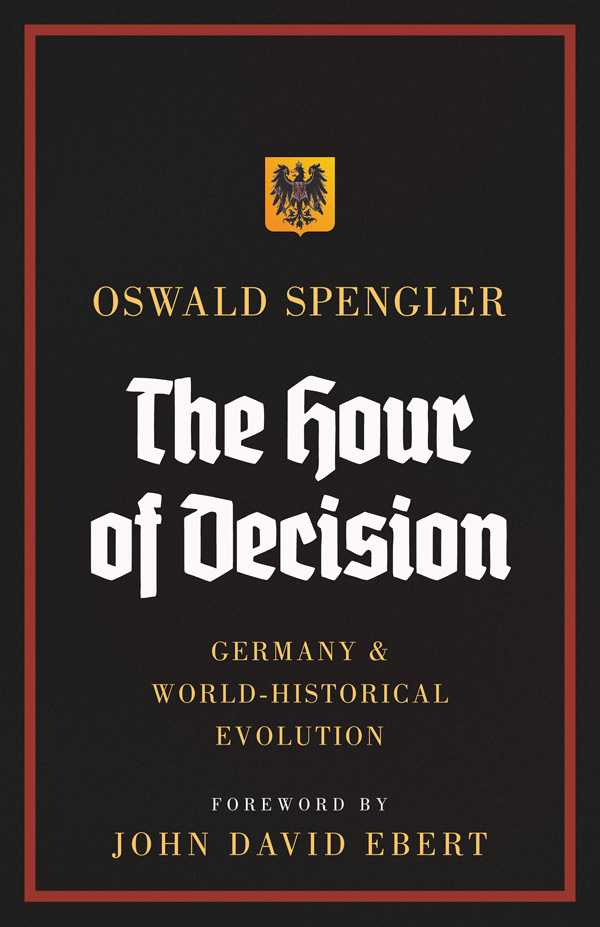
1/ In Oswald Spengler's final work, "The Hour of Decision," he warns of the "Colored Revolution," a global uprising fueled by hatred of the White race. Let's discuss! 🧵👇


@CCrowley100 - Chad Crowley
2/ As Western Civilization staggers under the weight of its own pacifism and decadence, rising non-White populations move with intent—to shatter its dominance and claim power. Spengler names this upheaval "hatred of the White race and an unconditional determination to destroy it," a force boundless in its reach, transcending nations and ideologies. It is no mere rebellion against colonialism or economics but a deeper, existential assault on the survival of the West itself. Spengler observes how the Colored Revolution assumes varied forms: "national, economic, social." Revolts against White colonial governments, attacks on aristocratic elites, and opposition to economic systems like "the power of the pound or the dollar" all serve as masks for a deeper purpose. At its core, Spengler asserts, lies a shared goal: the overthrow of White dominance. "The great historical question," he writes, "is whether the fall of the White powers will be brought about or not." This insight is prophetic in today’s world. The forms Spengler identified—nationalist uprisings, economic warfare, and social agitation—are alive in movements aimed at dismantling Western influence. Anti-colonial narratives dominate global institutions, while economic redistribution, veiled as "justice," disproportionately targets Western wealth. Socially, Western history and culture are demonized as oppressive, fueling calls to "decolonize" everything from education to public spaces. The unifying factor, as Spengler foresaw, is not the grievances themselves but the target: Western civilization. These movements are driven by resentment, not reform—a hatred that sees the West not as a flawed power but as one that must be eradicated. Spengler’s "great historical question" remains urgent: Will the West rise to confront this challenge, or descend further into submission?

@CCrowley100 - Chad Crowley
3/ Spengler draws chilling parallels between the Colored Revolution and past revolts against declining high cultures. "The peoples are weary of their Culture," he writes. "Spiritual substance has consumed itself in the fire of high form and the striving after inward perfection." In his view, the West mirrors these patterns of collapse: pacifism, decadence, and demographic decline have eroded its vitality, leaving it exposed to existential threats. As the West falters, Spengler contrasts its decay with the vitality of the Colored world. He observes, "In Africa the extraordinarily prolific Negro population will increase still more enormously now that European medicine has been introduced to check disease." Similarly, nations like Russia, Japan, and India experience demographic explosions, while Western populations stagnate. "The test of race," Spengler asserts, "is the speed with which it can replace itself." These historical patterns are strikingly relevant today. The West’s "weariness of Culture" is evident in its embrace of self-doubt, where pride in achievement has been supplanted by guilt and self-flagellation. The demographic crisis Spengler warned of is no longer a distant threat—it is unfolding now. European birth rates plummet, straining aging welfare systems, while immigration accelerates demographic and cultural transformation. Meanwhile, the energy and growth of rising powers echo Spengler’s observations of confidence and vitality abroad. The West stands at the same crossroads Spengler identified: rediscover the will to survive or surrender to history. Civilizations that ignored such warnings perished—not by conquest alone but through the slow death of their spirit. Will the West follow their fate, or can it defy Spengler’s grim trajectory and forge a path to renewal?

@CCrowley100 - Chad Crowley
4/ For Spengler, the collapse of the family lies at the heart of the West’s decline. "The decay of the White family, the inevitable outcome of megalopolitan existence, is spreading," he writes, "and it is devouring the 'race' of nations." The family, once the bedrock of strength and continuity, has been reduced to a relic, abandoned in favor of sterile individualism and fleeting pleasures. Spengler condemns the rejection of large families, warning that "a strong race requires not only an inexhaustible birth-rate but also a severe selection process." He ties this crisis to the West’s obsession with comfort and longevity, arguing that these priorities undermine natural selection and weaken the racial stock. "Once they feared the White man; now they despise him," he declares, highlighting how the West’s self-inflicted decline emboldens its adversaries. His critique of pacifism as "the century of Liberalism’s" crowning failure feels prophetic today. Liberalism has not only made the family a casualty of consumerist culture but also sapped the West’s vitality. Declining birth rates, celebrated by movements promoting “child-free” lifestyles, accelerate demographic collapse under the guise of progress. Meanwhile, mass immigration is praised as the solution, further diluting cultural and ethnic cohesion. Spengler’s insight—that the Colored Revolution is not merely an external threat but one fueled by the West’s self-destruction—rings louder than ever. Western societies dismantle themselves through elite projects disguised as "equality," but in practice, these schemes aim to sever the bonds that sustain civilizations, starting with the family. The cultural and familial foundations that once defined the West are systematically torn apart. Spengler’s ultimate warning is clear: "The pacifism of the century of Liberalism must be overcome if we are to go on living." Without this transformation, the West will not fall to external forces but collapse under its own refusal to fight for its survival.

@CCrowley100 - Chad Crowley
5/ Spengler foresaw a catastrophic convergence of class war and race war, a union he believed could spell the end of the White world. "A common hate extinguishes mutual contempt," he writes, warning that these seemingly distinct revolutions would find unity in their shared animosity toward Western civilization. This prediction resonates chillingly today. Class rhetoric, long wielded by Marxist revolutionaries, increasingly fuses with racial narratives in modern discourse. Movements like intersectionality frame White identity as synonymous with privilege and oppression, merging economic grievances with racial animosity. In Spengler’s terms, the "Colored Revolution" does not rise in isolation—it thrives as these forces align against a common target. "The battle for the planet has begun," Spengler declares, framing this not as a contest of ideologies but a fight for survival. He foresaw a future dominated not by principles but by raw power: "He whose sword compels victory here will be lord of the world." The West, fractured by internal divisions and assailed by external pressures, must decide whether to reclaim strength or succumb to its enemies. Spengler’s vision is a stark reminder that survival is never guaranteed. The forces aligned against the West are both external and rooted in its internal contradictions—its pacifism, decadence, and moral self-doubt. The West now stands at a precipice. Its fate depends on reclaiming vitality, discipline, and unity, or being swept away by the forces it once dominated. As Spengler warned, history does not forgive hesitation. The hour of decision is here.

@CCrowley100 - Chad Crowley
6/ Legend Books (@LegendBooksCo) has an excellent English edition of "The Hour of Decision" available. Please see the link below for more details: https://legendbooks.org/book/the-hour-of-decision/
@CCrowley100 - Chad Crowley
1/ For years, the pattern has held. A White person makes a comment, sometimes crude, sometimes merely unfashionable. A video is clipped, stripped of context, and cast into the digital coliseum. The crowd demands penance. Doxing follows. Then come the sponsors, the employers, the journalists. The result is always the same: apology, groveling, ruin. This is not justice, it never was. It is a moral spectacle, a purification ritual for the postmodern West, where the cleansing agent is White submission. The apology is not meant to be accepted, but to affirm the guilt of the group. The goal is not reconciliation, but re-education, humiliation, silence. But this time, with the case of Shiloh Hendrix, the script cracked. Her personal details were posted online. She received death threats. Her children were targeted. And yet, she did not capitulate. She did not appear on camera with quivering voice and downcast eyes. She launched a fundraiser. And White people responded. Not the media, not the institutions, not the credentialed class, but ordinary White people. Tens of thousands poured in to support her. The platform, GiveSendGo—not GoFundMe, which routinely bans dissidents—reported over $250,000 raised in days. These were not donations. These are the stirrings of something new. Each dollar said, “We see what you are doing, and we are done pretending.” This is more than a defense of one woman. It is a rejection of the moral framework that made her a target. The Hendrix affair is not the first of its kind. But it is one of the first to end differently. No apology. No resignation. No collapse. Instead: resistance. And that, more than anything else, signals a shift. The ritual is breaking. And with it, the spell of White guilt.

@CCrowley100 - Chad Crowley
2/ White guilt was never a natural sentiment; no people naturally hate themselves or push for their own demographic extinction. It did not emerge organically from conscience or history. It was manufactured, ritualized, and weaponized. It was imposed from above by alien elites who seized control of the institutions of education, media, and culture, and rewrote morality to make one group, the White population, the permanent villain in its own homeland. From the youngest age, White children are taught to associate their identity with conquest, slavery, cruelty, and destruction. They are told to dissociate from their own heritage, to feel shame for the achievements of their ancestors, to distrust their instincts, and to question the legitimacy of their very existence. They are instructed to love all others, but never themselves. This is not ethics. It is psychological warfare. And like all systems built on repression, it only works if it remains unquestioned. The moment it is challenged, seriously, openly, defiantly, it begins to fall apart. The power of White guilt lies in silence, not argument. Once someone says aloud, “I do not feel guilty,” the illusion weakens for everyone else. That is what the Hendrix fundraiser represents. Not a defense of one person, but a refusal to obey the narrative. It is one thing to quietly disagree with the orthodoxy. It is another to act on that disagreement. The act of giving money in defiance of the media’s command is a political gesture far more radical than voting. It is an act of moral rejection. And tens of thousands just performed it. This would have been unthinkable a decade ago. Even five years ago, the weight of institutional guilt still compelled submission. But something has changed. The spell is weakening. The repetition no longer works. The words no longer bind. The system still speaks in the language of shame, but fewer and fewer are listening. The idea that Whites must apologize for existing is no longer sacred. It is simply absurd. And once absurdity is exposed, mockery follows. Then rejection. Then reversal. We are witnessing the early stages of that reversal.

@CCrowley100 - Chad Crowley
3/ When guilt dies, politics begins. The moral paralysis ends. The silence breaks. And what replaces it is not chaos, but clarity. Once Whites stop apologizing for who they are, they begin to ask the forbidden questions. Who benefits from our shame? Who profits from our dispossession? Why are we the only people on Earth forbidden to speak in our own name? White identity politics is the answer to those questions. It is not supremacy. It is not hatred. It is not a call to dominate others. It is simply the political expression of collective interest. Every other group has it. Every other group is allowed it. Only Whites are told that to speak as a group is to commit a crime. But the spell is fading, and with it, the power of that prohibition. Once the guilt disappears, it becomes obvious. We are a people. We have a shared past, a shared destiny, a right to exist and a right to continue existing. We are not just individuals with private lives. We are part of a greater whole. And like all peoples, we have interests that must be protected. This is why White identity politics is inevitable. In any multiracial society, politics becomes tribal. Interests diverge. Groups form. Coalitions compete. The only people told to sit out this contest are Whites. The only people who believe they can remain neutral are those still under the spell. But neutrality is a luxury of those not under attack. That time is over. Every institution in the West now operates openly against the long-term interests of Whites. From immigration to education to media representation to the redefinition of national identity, every policy moves in one direction, toward our reduction, our silencing, our replacement. To oppose this is not extremism. It is survival. It is not radical to defend what every group defends by instinct. It is only considered radical because the system has criminalized our normality. But that is changing. Each time someone like Hendrix refuses to collapse, each time the crowd responds with support instead of shame, the political ground shifts. The taboo weakens. The future opens. What comes next is not a return to the past, but the forging of something new, an explicit, unapologetic, and moral politics of White identity.

@CCrowley100 - Chad Crowley
4/ What happened with Shiloh Hendrix is not an isolated moment. It is part of a larger pattern, one that grows stronger with each passing year. In case after case, when Whites are smeared, vilified, or threatened, the response is no longer retreat. It is support. It is solidarity. It is an instinctive, growing resolve to take our own side. We saw it with the Covington boys, when a group of Catholic school students were slandered across every major news outlet for a crime they did not commit. The footage was selectively edited, the truth buried, the children’s faces splashed across the internet as villains of the week. And yet the response was not surrender. It was a legal counterstrike and eventual vindication. We saw it with Kyle Rittenhouse, who was hunted across every media platform as a domestic terrorist, despite clear video evidence of self-defense. He was doxed, threatened, and prosecuted. But millions supported him. Donations poured in. The truth won in court, and more importantly, it won in the minds of countless Americans who saw what the system really is. We saw it again when corporate giants like Bud Light and Target made open mockery of the cultural and sexual values of the American heartland. The response was not just outrage, it was organized, economic retaliation. Boycotts worked. Stocks dropped. Executives panicked. In every case, something important happened. Whites, once atomized and demoralized, began to show signs of collective nerve. They acted in defense of their own, even if they could not always articulate why. They stopped backing down. They stopped assuming they were guilty. They started pushing back. This is the slow emergence of White political consciousness. Not yet unified, not yet fully articulate, but undeniably present. It no longer takes manifestos or movements to activate it. A single slandered face, a single act of defiance, is enough. And each time it happens, the reflex strengthens. These reactions are not driven by ideology. They are driven by instinct, tribal, ancestral, moral. They are not about hate. They are about loyalty. They are about fairness. They are about survival. What we are witnessing is not a backlash. It is an awakening.

@CCrowley100 - Chad Crowley
5/ White identity politics is not just strategic. It is not merely a reaction to demographic decline or institutional hostility. It is rooted in something deeper, something moral. At its heart is the principle that every people has the right to exist, the right to continuity, the right to its own space in the world. To say that Whites have collective interests is not to deny the same of others. It is to affirm the most basic moral symmetry. What is legitimate for everyone else is legitimate for us. No more, no less. Love of one’s own is not a sin. It is the foundation of every functioning society. It begins in the family. No decent father loves the neighbor’s child more than his own. No sane mother sacrifices her child’s future for the approval of strangers. What is natural at the familial level is no less natural at the national or civilizational level. The same moral instinct that binds a parent to a child also binds a people to its heritage. To defend your nation, your culture, your memory, is not selfish. It is sacred. And yet this basic moral code has been inverted. We are told that to love our own is exclusionary, that to preserve our culture is oppressive, that to secure our future is an act of violence. But only White people are told this. No one lectures the Chinese about ethnonational continuity. No one tells Africans that tribal loyalty is backward. No one scolds Jews for preserving their identity. The taboo is selective. The double standard is absolute. That is why the system is unsustainable. It demands that Whites abandon instincts that every other group is allowed to honor. It demands that we surrender the very morality we are told to uphold. But real morality does not require self-abolition. Real morality is rooted in order, loyalty, and the defense of one’s own. The deeper we dig, the more clearly we see, White identity politics is not a threat to moral order. It is a return to it.
@CCrowley100 - Chad Crowley
6/ White guilt is dying. The institutions still speak its language, but the people no longer believe. The slogans ring hollow. The shame has worn thin. More and more, the system demands apology and receives only silence. Or resistance. Or laughter. What rises in its place is not bitterness. It is clarity. White identity is legitimate. White interests are real. White survival is non-negotiable. These are not radical claims. They are foundational truths, long suppressed, now returning to the surface. No society can endure without some form of identity. No people can endure without some form of pride. This is not about nostalgia. It is not about restoring the world of yesterday. That world is gone. What remains is the task of building something new, something rooted in memory but aimed at the future. A politics not of apology, but of affirmation. Not of resentment, but of renewal. The rise of White identity politics is not a threat to others. It is a restoration of balance. It is the correction of a moral distortion that demanded one people dissolve itself for the comfort of all others. That era is ending. And the signs are everywhere. In every boycott. In every defiant fundraiser. In every quiet conversation that dares to name what cannot be named. There is a growing majority, not yet organized, not yet fully conscious, but already forming. The next political realignment will not be between Left and Right. It will be between those who kneel and those who stand. And we are learning to stand. We do not ask permission. We do not beg for place. We are not going anywhere. The future belongs to those who know who they are.

@CCrowley100 - Chad Crowley
7/ A Link to the Shiloh Hendrix Fundraiser: https://www.givesendgo.com/ShilohHendrix

@CCrowley100 - Chad Crowley
8/ An Interrelated Essay: You cannot care for nature while condemning the only people who ever made it sacred. You cannot fight for animals while erasing the civilization that protected them first. https://t.co/KmMIoFHalH
@CCrowley100 - Chad Crowley
Animal rights. Environmental protection. The defense of nature. These causes did not emerge from a vacuum. They are the product of a specific people, with a specific soul: ours. It was Europeans who created national parks, outlawed cruelty to animals, and wrote laws to preserve forests and rivers. We looked at the natural world not as something to exploit endlessly, but as something sacred. This was not, and is not, universal. It is a product of us. What happens when that people dies? You get the image below, and countless others: a wild animal, lit on fire for amusement. No honor. No awe. No restraint. Just impulse, sadism, laughter, and degeneracy. That is not civilization. That is the return of a mindless barbarism, and it is what replaces us. Environmentalism today is often used against us. We are told to lower our birthrates, stop eating meat, give up land, and reduce our carbon footprint, while billions elsewhere multiply, pollute, consume, and swarm into our homelands. The people who created environmental ethics are now told to destroy themselves in the name of it. There is no environmentalism without Europeans. There are no animal rights without Western values. Without us, the world reverts to fire and blood — not in the noble sense of survival, but in the ugly sense of waste. It becomes a world ruled by peoples unworthy of the role we once held: stewards of the planet, for ourselves and for our posterity. Those who pretend to care about animals while undermining the people who built sanctuaries, protected habitats, and passed anti-cruelty laws are liars. You cannot preserve nature while destroying the only people and the only civilization that ever truly defended it. The cause of the earth and the cause of our people are not separate. They are the same. No White survival, no environmentalism. No White survival, no animal rights. No memory, no forest, no future. If we fall, the last defenders of the beauty of the natural world fall with us.

@CCrowley100 - Chad Crowley
9/ The morality of White identity https://t.co/EPFHghh85p
@CCrowley100 - Chad Crowley
White identity is not a political issue. It is a moral issue. Until we understand this, and convey it without hesitation, every attempt to defend ourselves will be misunderstood, misrepresented, or ignored. Politics deals with power. Morality deals with what is right. What is just. What is owed. If we frame the question of White existence as one of political expediency or demographic utility, we will always be outflanked by those who speak in the name of justice, however falsely. But if we make clear that White identity politics is not a tool for gaining influence, but a moral reaction to an immoral condition, we take the ground back from those who built their entire system on stolen terms. The lie of modern liberalism is not only that race does not matter, but that it is wrong, morally wrong, for Whites to care about themselves. That lie is enforced through a thousand channels, from media to education to law, and always under the same inverted logic: any assertion of White group interest is treated as aggression, while every other group’s assertion of interest is treated as defense. In such a world, every group is allowed to speak in the name of its identity, to express grievance, to demand recognition. Only Whites are taught to say, “I don't see color.” The result is not colorblindness. It is moral disarmament. The regime does not suppress identity politics. It mandates them, but only for those whose identities are defined by opposition to Whiteness. The moral code is rigged from the start. This is not speculation. It is happening now. The latest birth statistics make it plain: in vast regions of the country, Whites are no longer the majority of the next generation. The numbers do not lie. They tell a story of displacement, of replacement, and of the erasure of a people who are being told they have no right to resist. But morality, if it means anything, cannot be one-sided. If it is wrong for one people to be displaced, then it is wrong for any people to be displaced. If it is good for one group to preserve its culture, language, faith, and posterity, then it is good for all groups to do so. Any moral system that denies this is not morality at all. It is a justification for power. A mask. White identity politics, in its clearest and most honest form, is nothing more than the refusal to be the one group excluded from moral consideration. It is the recognition that we have the same right to exist as anyone else, and that our children are not less worthy of protection, our culture not less worthy of memory, our people not less worthy of a future. This is not about supremacy. It is about survival. It is not about domination. It is about dignity. When a people says, “We will not be replaced,” it is not a threat to others. It is a promise to itself. It is a moral affirmation of being. The question we must ask is not whether White identity politics is popular, or palatable, or good strategy in the short term. The question is whether it is right. And the answer is that it is. There is no higher cause than the defense of one’s own people from dispossession. The family is moral. The tribe is moral. The nation is moral. All of them are expressions of loyalty, rooted in love, sustained through sacrifice. To say that we care for our own first is not a declaration of hate, but the most basic, natural, and universal expression of moral life. Even animals understand this. Even children understand this. Only modern ideologues pretend not to. And they do so only to weaken those they wish to dissolve. What we are facing is not mere demographic change. It is a moral assault on the right to exist. The slander of White identity is not a critique of ideas. It is an attack on being. It tells us that our past is shameful, our future unnecessary, our pride dangerous, our memory criminal. It tells us to accept dispossession with grace, to smile as we vanish, to thank those who have built a system to replace us. No other people is asked to do this. No other people would accept it if they were. To reject this is not a matter of politics. It is not left or right. It is not radical or moderate. It is a matter of moral sanity. If it is right to defend one’s home, then it is right to defend one’s homeland. If it is right to raise one’s children with a sense of belonging, then it is right to preserve the identity in which that belonging makes sense. White identity politics, in its truest form, is the application of normal moral principles to the one group now denied them. We will never win on borrowed terms. We will never be persuasive if we speak like cowards. We will never hold ground if we concede the moral high ground from the start. That is why the first task is not strategy, not slogans, not policy. It is to remember what is right. It is to say, without fear, that we exist. That we matter. That we will not apologize for existing. And that no people who wishes to survive should ever be made to. We are not wrong for taking our own side. We are not wrong for refusing to be dissolved. And we are not wrong for calling this what it is: a moral issue. Our enemies will call it hate. But hate is not the opposite of love. Apathy is. And we are not apathetic. We are awake. We are committed. And we are right.

@CCrowley100 - Chad Crowley
1/ The White middle class was the backbone of America, so they shattered it. Industry gutted, wages strangled, homes stolen, and borders flung open. A once-sovereign people reduced to debt slaves in a land they built. This wasn’t progress. It was annihilation. 🧵👇 https://t.co/ODMHQ6qBUp

@CCrowley100 - Chad Crowley
2/ The White middle class was more than an economic class. It was the backbone of America, the engine of stability, prosperity, social cohesion, and generational continuity. However, over the past five decades, this foundation has been systematically dismantled. In 1971, 61% of American adults lived in middle-class households. By 2021, that number had dropped to 50%. Over the same period, the share of national income held by the middle class fell from 62% to just 42%. The White working and middle classes bore the brunt of this decline, with stagnant wages, skyrocketing costs of living, and an economic order increasingly hostile to their survival. These statistics, however, only tell part of the story. White demographic decline has accelerated alongside economic collapse. Officially, the U.S. Census claims that "non-Hispanic Whites" made up 61.6% of the population in 2020, down from 72.4% in 2010. But these numbers are misleading. Census data manipulates racial categories to mask the true rate of demographic transformation. Many "Hispanics," "Middle Easterners," and "North Africans" are classified as "White," artificially inflating the numbers. When adjusted for this distortion, the true White percentage is likely much lower, perhaps already below 50% and shrinking rapidly. Projections that Whites will become a minority by 2050 may be overly generous; the reality could arrive much sooner. A strong middle class has been the hallmark of all great Western societies, from Rome to Renaissance Europe to postwar America. The Roman Republic was sustained by its landowning citizen-farmers, the yeomanry that provided military and civic strength. In medieval Europe, as feudal structures weakened, the rise of an independent merchant and artisan class drove economic expansion and national development. In the 19th and early 20th centuries, industrial revolutions in Britain, Germany, and the United States elevated vast numbers of working-class individuals into the middle class, securing national prosperity. However, these societies' declines were often marked by the erosion of this very foundation. Rome collapsed into imperial autocracy as its independent farmers were displaced by latifundia and foreign slave labor, much like modern America has seen mass immigration and financial parasitism reduce its working and middle classes to wage serfdom. The historical pattern is clear: when the middle class is strong, a nation thrives; when it is dismantled, power concentrates in the hands of a corrupt elite, and decay follows. The dismantling of the White middle class appears, on the surface, to be a natural and inevitable shift, an outcome of globalization, automation, and cultural change. In reality, it was engineered. A strong and independent White middle class has always been the greatest obstacle to the consolidation of power by an elite ruling class. Unlike an atomized working class or a dependent underclass, a robust middle class has the resources, education, and cultural confidence to resist tyranny. It values home and nation, defends traditions, and demands accountability from those who rule over it. In every major economic transformation over the past fifty years, the greatest burden has fallen on the White middle class, while the managerial elite and imported labor classes have been the primary beneficiaries. This campaign was waged on multiple fronts. Politicians and corporate overlords gutted the economy, replacing an industrial workforce with financial speculation, gig labor, and debt servitude. Open borders flooded the country with cheap labor, ensuring that wages stagnated while housing prices skyrocketed, locking younger generations out of homeownership. Meanwhile, a radical ideological transformation redefined national identity, not as an organic inheritance of the historic American people, but as an abstract, universalist proposition that anyone could join, so long as they conformed to the ruling elite’s latest dictates. The old American system of class mobility has been replaced with a rigid new order, a caste system where a hostile managerial elite ensures the continued subjugation of the nation's historic core population, using mass migration, racial quotas, and political censorship to suppress dissent. The White middle class, once the symbol of national strength, is now being turned into an underclass. The tools of this transformation are economic displacement, demographic replacement, and ideological reprogramming. The destruction of the White middle class is not just an economic or cultural issue; it is a racial one. Demographic transformation has ensured that Whites no longer hold the majority status they once took for granted. Even if they did, the psychological effects of becoming a second-class citizen in one’s own country are profound. The replacement is not just statistical but spiritual. It turns the children of pioneers and empire-builders into atomized "individuals," cogs in a great machine, disconnected from the nation their ancestors built.
@CCrowley100 - Chad Crowley
3/ They told us it was just the market at work. They told us times change, industries shift, and economic evolution is inevitable. But none of this was inevitable. The destruction of the White middle class was a deliberate, calculated process. It was a slow-motion demolition job carried out over decades, ensuring that each successive generation of Whites would have fewer opportunities, heavier burdens, and no real path to reclaim what was lost. For most of American history, productive labor, meaning work that creates goods, builds infrastructure, and sustains essential industries, was the foundation of national prosperity. From the steel mills of Pittsburgh to the automotive plants of Detroit, White workers built the wealth and infrastructure of the nation. Manufacturing was more than just a job; it was a way of life. It provided economic security, purpose, and the promise that hard work would be rewarded. A man could support his family, own a home, and build a future for his children. This system, based on self-sufficiency and national stability, was systematically dismantled. Industry was offshored to boost corporate profits. The same White workers who built America’s wealth were discarded, their labor replaced with cheap imports and automation. As stable jobs disappeared, wages stagnated while the cost of living skyrocketed. The postwar promise that every generation would be better off than the last was shattered. Homeownership, once an expectation, became an unattainable dream. The financialization of the economy ensured that capital flowed upward while real wages remained frozen. Debt replaced savings, with student loans and housing bubbles trapping young families in economic servitude. Unions, which had once provided the White working class with a degree of protection, were undermined and dismantled, leaving workers powerless against their own economic dispossession. The rise of the gig economy was the final blow. What had once been lifelong careers with pensions and stability turned into short-term contract work, with no security, no benefits, and no path forward. The American worker, rather than advancing within a stable industry, was now expected to hustle endlessly just to maintain a fraction of what his parents had. Meanwhile, corporations flooded the labor market with foreign workers under the pretense of economic necessity. H-1B visa programs and mass immigration suppressed wages, ensuring that a native White workforce would always be undercut by cheaper imported labor. The destruction of the White middle class was not just economic but psychological. The dignity of work was replaced with permanent precarity. The stability of homeownership gave way to lifelong renting. The hope for a better future was eroded under the weight of crushing debt. These were not the natural results of an evolving economy but the deliberate outcomes of policies designed to weaken White Americans, making them more dependent on a system that no longer served them. A key driver of this collapse was the Baby Boomer generation, not just as individuals but as a class that voted for and benefited from the very policies that ensured their children’s economic servitude. Instead of fighting for the economic order that had given them prosperity, they sold out their own descendants for short-term financial security. As Social Security and Medicare became unsustainable, mass immigration was justified as a necessary economic measure to prop up the system. The housing market, which had once been a vehicle for generational wealth, was manipulated to create artificial scarcity. Boomers cashed in on inflated property values while younger Whites were locked out of homeownership, forced into a lifetime of renting. Offshoring and financial speculation enriched the ruling class, but it also enriched the upper-middle-class Boomers who eagerly reaped the rewards of stock market expansion and cheap consumer goods. Rather than stand against these trends, they embraced them. They abandoned racial consciousness in exchange for consumerism, political correctness, and self-righteous moral posturing. They prided themselves on being "tolerant" and "forward-thinking," even as they voted for policies that condemned their own grandchildren to economic hardship. Instead of defending their children's future, they looked the other way as America was transformed into something unrecognizable. The destruction of the White middle class was never about economic inevitability. It was an engineered collapse designed to replace a strong and independent population with one that was atomized, demoralized, and unable to resist elite control. By dismantling the material conditions that had sustained White families and communities, the ruling class ensured that future generations would be more dependent, more controllable, and less capable of challenging the emerging caste system. This was not simply a shift in economic policy. It was an attack on an entire people’s ability to sustain itself, a prelude to permanent disenfranchisement.

@CCrowley100 - Chad Crowley
4/ American politics was once a battle over policies, debated by a people who shared identity, history, and destiny. Today, it is a numbers game, where power belongs to whoever can flood the electorate with the most reliable voters. The destruction of the White middle class was not just economic. It was political. A system that once protected and represented its founding stock has been turned into one that actively works against them. "Democracy" has become the primary tool of their dispossession. For generations, White political power was self-sustaining. A stable middle class ensured voter engagement, policy influence, and national direction. But as economic independence eroded, so did political influence. White workers who once shaped national policy have been replaced by an imported electorate with no historical or cultural loyalty to the nation they now vote in. Mass immigration was never about humanitarianism or economic necessity. It was a calculated strategy to manufacture a permanent left-wing majority. The numbers tell the story. As the demographic balance shifted, the electoral map turned against Whites. Conservative, nationalist, and right-wing policies that once had majority support are now impossible to pass through democratic means. The Left did not need to win the debate. They simply needed to replace the electorate. The "1965 Immigration Act" set this transformation in motion, and every amnesty, refugee resettlement program, and diversity visa since then has been another nail in the coffin of White political power. At the same time, the managerial elite has built a vast surveillance and enforcement apparatus to suppress any resistance. Political dissidents are bankrupted, de-platformed, and imprisoned under the guise of fighting "extremism." A two-tiered justice system ensures that those who advocate for the historic American nation are relentlessly prosecuted while left-wing radicals and non-White criminal organizations are either ignored or actively protected. Financial blacklisting, algorithmic censorship, and media narratives work in concert to ensure that Whites who advocate for their own interests are isolated and rendered politically impotent. The so-called "Trump Thaw" has provided a temporary disruption. For the first time in decades, discussions once considered untouchable have entered the mainstream. Mass deportations, abolishing "DEI," restricting immigration from India, and even the possibility of buying Greenland are now openly debated. What was once unthinkable is now a topic of public discourse. But this is not a restoration of power. It is a brief reprieve before the next phase of repression. The managerial class will not tolerate even minor reversals of its agenda. The moment it regains full control, the crackdown will be swift and brutal. If Whites are to have a political future, they must break from the illusions that led them here. The belief that elections alone can reverse demographic decline is a fantasy. Every political victory within the current system is temporary. Without structural reform that alters the rules of engagement, every nationalist movement will be marginalized and destroyed in time. Electoral engagement is a tool, not a solution. If the system guarantees White decline, then the system itself must be questioned. We need something akin to a "White Majority Protection Act." As things stand, such legislation would be impossible to pass, but its necessity remains. The ultimate goal must be a political framework that enshrines the right of Whites to self-determination in their own country. Even if a law like this is unworkable in today’s political climate, its public presentation is imperative. It forces the question. It forces politicians to reveal whether they are actively working for the survival of their own people or against them. White disenfranchisement is not an accident. It is the final phase of a long-planned transformation. Without political power, the economic and thus demographic destruction of Whites will only accelerate. If things are not changed, the question is no longer whether Whites will become a minority. That much is certain. The only question is whether they will accept their fate or finally fight to reclaim their own future.

@CCrowley100 - Chad Crowley
5/ The destruction of the White middle class was not an accident. It was a deliberate transformation, carried out over decades by a ruling elite that understood what had to be done to secure their dominance. The result is a new caste system, where Whites are economically marginalized, politically sidelined, and ultimately erased. The institutions that once represented them have been captured. The economic prosperity they built has been drained away. The country they inherited has been reshaped into something unrecognizable. If there is to be any future, the first step is rejecting the illusions that led to this collapse. The belief in "civic nationalism," "free-market absolutism," and "universalist morality" must be abandoned. The idea that political victories within the existing system can undo generations of engineered decline must be reconsidered. The White middle class did not lose power because of simple economic shifts or misguided policies. It lost power because it failed to see what was happening until it was too late. That mistake cannot be repeated. The next step is building a serious political strategy. Reactionary outrage is not enough. What is needed is a movement capable of asserting power where possible, challenging the system where necessary, and establishing alternative institutions that secure long-term survival. Electoral engagement must be part of the plan, but only as a tool for broader objectives. Politics is not the end goal. It is a battlefield, one of many. Economic independence must be restored. The White middle class was built on productive labor and ownership, and any effort to rebuild it will require "economic nationalism," pro-natalist policies, and the elimination of financial parasitism that has trapped generations in debt and dependency. Cultural sovereignty must be reasserted, rejecting narratives of guilt and self-hatred, and restoring the racial consciousness that was systematically eroded. Political representation must be reclaimed, using every available mechanism to ensure that Whites are no longer governed by those who see them as a disposable population. The destruction of the White middle class was not just an economic attack. It was a fundamental effort to strip a people of their power, identity, and future. The only question now is whether political reform can be achieved before more drastic measures become inevitable.

@CCrowley100 - Chad Crowley
1/ "The Age of Entitlement" by Christopher Caldwell exposes how the Civil Rights Revolution created a rival constitution—tearing apart American identity, traditions, and freedoms. Essential reading for anyone seeking to understand America’s decline and the West’s unraveling.🧵👇

@CCrowley100 - Chad Crowley
2/ "The Age of Entitlement": A Blueprint for America’s Betrayal Christopher Caldwell’s "The Age of Entitlement: America Since the Sixties" delivers a sharp critique of how America’s foundational principles—and the people who built them—were subverted and replaced by a system prioritizing ideology over heritage, bureaucracy over freedom, and diversity over unity. It is both a historical analysis and a call to action for those who value identity and legacy to grasp what is truly at stake. Caldwell argues that the Civil Rights Revolution of the 1960s created a "Second Constitution," displacing the original American framework. Rooted in affirmative action and political correctness, this rival framework dismantled freedoms of association, speech, and the longstanding meritocratic principles that defined American—and Western—civilization. Western civilization’s success lay in its ability to elevate the best and brightest to positions of authority based on ability and performance. This approach embraced hierarchy rooted in competence over inherited privilege, fostering a culture of excellence and social mobility. However, under the guise of addressing so-called “historical injustices,” the Regime implemented diversity mandates and mass immigration, fundamentally reshaping the nation’s cultural and demographic identity to the detriment of its historic majority. Caldwell reveals how the Civil Rights Act became a catalyst for sweeping societal transformation. The once-dominant ethnocultural identity of America’s European-descended majority, forged through blood, sweat, and sacrifice, was recast as oppressive. This redefinition fueled policies and narratives that eroded their standing, actively contributing to their dispossession and ethnocultural erasure. What began as a call for “justice” devolved into a campaign to fracture the nation’s cohesion. As the ancients understood, tyranny thrives by creating a divided, heterogeneous population—one easier to control and more loyal to the Regime than to a unified people or nation. Like all revolutions, the Civil Rights Revolution extended far beyond the law. From the Sexual Revolution to modern corporate wokeness, its ideological project sought to replace America with a globalized society where individuals are reduced to interchangeable cogs in an economic machine, prioritizing elite profits over the nation’s continuity and posterity. The result has been deepening division and alienation, as policies promote demographic—and therefore cultural—fragmentation over unity, eroding the shared identity that once defined the Historic American Nation. Rejecting sanitized myths of a “good” Civil Rights Movement, Caldwell reveals its outcomes as the inevitable result of its founding principles. Systems rooted in Enlightenment values—equality and universalism—whether contemporary democracy or outright communism, pursue abstract ideals detached from reality and the natural order. Elites—politicians, academics, corporate leaders, and the intelligentsia—exploited these changes for power and profit, reshaping the nation while leaving its historic majority increasingly disoriented, marginalized, and powerless to secure their future. Caldwell’s work exposes the Second Constitution as the harbinger of modern America’s demographic decline, cultural disintegration, and division. More broadly, it underscores its role in the collapse of the West itself, as America—for better or worse—has been the driving force shaping the Western world’s orientation since 1945.

@CCrowley100 - Chad Crowley
3/ From Republic to Ideological Regime: The Civil Rights Revolution’s Legacy At the core of "The Age of Entitlement" is Caldwell’s claim that the Civil Rights Movement, long celebrated as a moral triumph, fundamentally rewrote America’s political and legal foundations, becoming the engine of its decline. Rather than building on the original Constitution, it erected a rival framework—a Second Constitution—that radically reshaped the American order and subverted its founding principles. Contemporary liberalism is totalizing, demanding control over all aspects of life, from public policy to personal beliefs. This Second Constitution, rooted in grievance politics and enforced equality, emerged as the ideal tool for consolidating power, displacing the original framework’s emphasis on merit, freedom, and self-determination. In the Schmittian sense, where politics is defined by power and control, this ideological regime ensured no competition could exist. The Civil Rights Act of 1964, ostensibly aimed at securing equality under the law, became the spearhead for dismantling the nation’s ethnocultural and social foundations. What began as desegregation quickly morphed into a reconfiguration of education, employment, housing, and even private beliefs. The freedom of association—a core American principle—was sacrificed to mandated diversity, while affirmative action and quotas systematically eroded the cultural inheritance and political influence of the historic majority. This transformation extended far beyond public institutions, infiltrating workplaces, communities, and private life. Bureaucratic machinery, from civil rights offices to activist judges, enforced the Second Constitution’s mandates, stripping away rights to speech, property, and association under the guise of combating "discrimination." Dissent was rendered powerless, crushed beneath the weight of judicial and administrative decrees. For the European-descended majority, this revolution was catastrophic. Their heritage was reframed as oppressive, their cultural dominance dismantled, and their freedoms deliberately eroded. What began as a demand for "justice" evolved into a relentless campaign to uproot the identity and traditions of the founding population. Caldwell demonstrates that this was no accident—it was the inevitable result of the movement’s foundational principles. Affirmative action, political correctness, and anti-White animus were not deviations from the Civil Rights Movement; they were its natural and predictable outcomes. The Civil Rights Act, far from fostering equality, empowered a bureaucratic elite that weaponized the law to impose ideological conformity and dismantle the original American order. The Second Constitution’s influence extended beyond legal transformations, driving cultural and demographic upheavals. From the Sexual Revolution to mass immigration and corporate wokeness, it forged a society unmoored from its historical and cultural roots. This revolution was not merely a shift in policy—it was a deliberate reordering of the nation to prioritize control and compliance over continuity and cohesion. Finally, the true objective of the Second Constitution emerges: the eradication of all bonds that tie people together—history, ancestry, religion, and culture—replacing them with dependency on the state and loyalty to the regime. By severing these connections, the Second Constitution ensures power remains centralized and unchallenged, while the people it governs are left alienated, atomized, and unable to resist.

@CCrowley100 - Chad Crowley
4/ From Identity to Alienation: The Unmaking of a Nation Demography is destiny, and the ruling regime has deliberately sought to transform America’s. Caldwell exposes the cultural and demographic shifts that reshaped the nation after the 1960s, driven by the Civil Rights Revolution’s ideological framework. This framework systematically undermined the European foundations of the country, leaving behind a fractured and alienated society. The Sexual Revolution, mass immigration, and the elevation of diversity as a state-enforced orthodoxy eroded the traditional American identity. Caldwell reveals how the Civil Rights Act, ostensibly aimed at combating inequality, became a tool to sever societal bonds, dismantling traditional sex roles, family structures, and communal ties—pillars essential to a cohesive society. Mass immigration compounded this transformation. The Immigration Act of 1965, passed under the same egalitarian pretense, irreversibly altered the nation’s demographics. While politicians assured the public its impact would be minimal, it displaced the European-descended majority and elevated diversity to an untouchable moral imperative—a narrative that continues to dominate public discourse. The Sexual Revolution further dismantled societal structures, with legal rulings like Roe v. Wade and Obergefell v. Hodges epitomizing the broader cultural upheaval. What began as a push for "liberation" devolved into hedonism and consumerism, undermining the traditional family and severing the nation from its historical and cultural roots. Caldwell critiques the diversity cult as a state-imposed orthodoxy enforced by corporations, universities, and bureaucracies. This ideology cast European heritage as inherently oppressive, abandoned assimilation as a national ideal, and left the majority population demoralized and adrift. Corporate America, prioritizing ideological conformity over productivity, became a key enforcer of this agenda, silencing dissent and expelling traditional values from public life. At its core, this ideological project seeks to destroy anything that binds people together outside the state—history, ancestry, religion, and shared culture—all of which form the bedrock of a resilient and unified society. By targeting these unifying elements, the Regime reduces individuals to atomized units, reliant on the state and its ideological dictates for identity and belonging. The Civil Rights Revolution ignited these cultural and demographic changes, unraveling America’s identity and replacing unity with division and alienation.

@CCrowley100 - Chad Crowley
5/ The Second Constitution and the Betrayal of America’s Majority Caldwell examines the economic and political shifts that cemented the Second Constitution’s dominance, prioritizing ideological conformity over economic stability, political freedom, and the well-being of America’s historic majority. These changes dismantled traditional institutions, empowered a globalist elite, and economically marginalized the very population that built the nation. The civil rights regime coincided with a dramatic shift in America’s economic structure—from one rooted in production and self-reliance to one dominated by consumption, deregulation, and financialization. Policies under Reagan and Clinton accelerated this transformation, with deregulation and amnesty for illegal immigrants further entrenching corporate globalism. Traditional American workers, particularly those from the majority population, were sidelined in favor of cheap labor and diversity quotas. The private sector became a powerful enforcer of the Second Constitution. Affirmative action and diversity mandates undermined merit-based practices, transforming hiring and promotion into contests of identity politics. White working- and middle-class Americans saw their economic prospects diminish and their contributions devalued in the name of ideological compliance. Caldwell ties the 2008 financial crisis directly to civil rights-driven lending practices. Mandates to increase minority homeownership forced banks to prioritize ideology over sound financial practices, leading to a housing bubble that devastated millions. As usual, elites escaped accountability while the working and middle classes bore the brunt of the collapse. Politically, both major parties aligned themselves with the Second Constitution. Republicans, co-opted by corporate interests, offered only symbolic and ineffective resistance, while Democrats fully embraced diversity and globalism as their guiding principles. This bipartisan consensus suppressed dissent and dismissed the grievances of the majority population, paving the way for Trump’s populist insurgency in 2016. Trump’s campaigns in 2016, 2020, and most recently in 2024—with their focus on immigration control, economic nationalism, and opposition to political correctness—represented a direct challenge to the Second Constitution. While Caldwell critiques Trump’s limitations, he recognizes his rise as a critical turning point, signaling a growing refusal among the majority to be politically and demographically dispossessed. At its heart, the Second Constitution is about power—who wields it, who benefits, and who is excluded from shaping the nation’s future. By reengineering the economy and political system to serve its ideological ends, it reduced the population that built America to a disoriented underclass, stripped of influence and increasingly powerless. Caldwell’s work is both an indictment and a rallying cry. It demands a rejection of the distortions imposed by the Second Constitution and a fight for the survival and resurgence of the nation’s founding population. The soul of the Historic American Nation—and the fate of the greater West—rests on this struggle.

@CCrowley100 - Chad Crowley
1/ The popular assertion that ancient Greek society openly embraced homosexuality, especially pederasty as it is scandalously defined today, is a gross misrepresentation peddled by a sundry of characters for a multitude of insidious reasons. The conventional understanding is that in ancient Greece, homosexual behavior was both more accepted and prevalent than in the Christian West, with pederasty, in particular, being a common practice among the elites. I find the above notions utterly disturbing and illogical. The underlying assumption seems to be that homosexuality is natural, and thus the ancient Greeks did not repress these so-called "natural" urges. However, there is another more disquieting and insidious aspect to this propaganda: Ancient Greece is the cradle, the literal birthplace of Western civilization; thus, the repeated assertion that the sexual norms of Greece were fundamentally different from those of the traditional West is weaponized to sever our continuity with this heritage in the present. Additionally, there's the implication that Greek society's openness to sexual deviancy prevented repression, enabling gifted men to reach their maximum potential—a reflection of our tendency to psychoanalyze historical behaviors. This subtly implies that in the contemporary West, if we allow and encourage our youth to be "who they were born to be," i.e., promoting sexual deviance, then the West will once again be great. In a familiar manner, this line of thinking aims to psychologize and thus pathologize the traditional morality of the Christian West. But the fact is that, even in the contemporary, post-Christian-West, in which traditional morality is everywhere under assault and "perversity" on the verge of wholesale institutional approval, homosexuality remains uncommon. The crux of this brief essay will be to examine and refute the purported widespread prevalence of homosexuality in the ancient Greek world, with special emphasis on discussing the institution of the paiderastía (commonly referred to as pederasty today). We will delve into both topics in the threads below.


@CCrowley100 - Chad Crowley
2/ Most modern definitions of pederasty describe it as "sexual activity between a man and a boy or youth." The ubiquity of this historical-etymological distortion is so widespread that we are led to believe many of the greatest figures of ancient Greece—whether real or mythical—were all either pederasts or homosexuals of some kind, or both. Allegedly, this includes towering figures such as Solon, Socrates, Sophocles, Alexander the Great, Aeschylus, Alcibiades, Achilles, and the Theban Sacred Band (which may not have even existed). Many of the Olympian gods are also said to have exhibited similar homosexual traits or characteristics. In reality, the much-maligned ancient institution of pederasty is misrepresented for a number of reasons, as outlined in the first part of this essay. Contrary to the prevalent modern view, pederasty in Classical Greece was not characterized by homosexual sex but was an educational mentorship where young men were guided and taught by older citizens. A number of ancient commentators, like Herodotus, Xenophon, and Plato, among others, wrote disdainfully of instances where pederasty was exploited by the elite for homosexual relations, which was considered akin to paedophilia. However, this has not stopped modern academics, such as K.J. Dover (see my previous essay) and more recently Emily Wilson (and her awful, woefully inaccurate translation of the Homeric dyad), from inaccurately framing pederasty as a type of lecherously exploitative homosexual relationship, or from promoting the idea that homosexuality as a whole was normalized in the ancient world. Certainly, some may argue that homosexuality was primarily an elite phenomenon in the ancient world, akin to the audience for the written word. When evaluating the social acceptability or lack thereof of homosexuality and pederasty as it is currently defined and distorted, it is important to distinguish among the attitudes of the law, the lower classes, and the upper classes. It is conceivable, for example, that the law may have penalized the practice even as artists and philosophers—those who aspire to metapolitically shape and transform society, like Plato—may have seemingly sought to idealize it, even for the purpose of serving as a literary or metaphorical device. However, this WOULD NOT appear to be the case. There is more than ample evidence to suggest that homosexuality was widely deemed unacceptable: it was penalized by law and condemned by all social strata, including philosophers such as Plato in his final work, "Laws." Interrelatedly, if the paiderastía and similar institutions were indeed timeless traditions stretching back into prehistory, as they were, practiced by a host of interrelated peoples including many of the Indo-European groups (such as the ancient Persians, Greeks, and Romans), then it should also be reasoned that the institution was not overly sexualized, let alone homosexual in nature or practice. In the discussions below, we will explore a variety of ancient sources and examine how homosexuality was not socially acceptable and that the paiderastía was not a perverse institution of "man-boy" love.

@CCrowley100 - Chad Crowley
3/ Homer was the first to document the two foundational myths that have become central to the distorted narrative of pervasive Greek homosexuality—those of Achilles and Patroclus, and Zeus and Ganymede. However, Homer himself never describes the relationships between either pair as homosexual in any manner. Despite this, Wikipedia informs us that "The myth was a model for the Greek social custom of paiderastía, the socially acceptable romantic relationship between an adult male and an adolescent male." Xenophon, in his 4th century work, "Symposium," echoes this sentiment, with Socrates aligning with Homer's depiction of their relationship being platonic, that is non-sexual in nature. Socrates elaborates on the relationship between Zeus and Ganymede, emphasizing the value of soulful beauty over physical attractiveness, suggesting that Ganymede's immortality and place among the gods were due to his wisdom rather than his physical appearance. On this, Xenophon writes: "Zeus let the women he fell for to remain mortal, if he loved them for their physical beauty; but he made immortal whomever he loved for the beauty of their souls. Among them, you can see Heracles, the Dioscouri, and others. I also claim that Ganymede was brought to Olympus for the beauty of his soul, not of his body. His very name confirms what I am saying, as it is said about it in a passage from Homer, ‘One takes pleasure in listening to him’. There is also another passage from Homer that says ‘one who had wise thoughts’. So, if Ganymede has got his name after these two, he has been honored among the gods not for his pleasant body but for his wisdom." In relation to the institution of pederasty, understanding the nuances of these practices in ancient Greece requires delving into the translation or mistranslations of specific Greek terminology. The terms "erastes-eromenos," explored mainly through the works of Plato and Xenophon, are pivotal. Conventionally, but misleadingly, translated into English as "lover" and "loved one," this pair signifies a more complex relationship than the direct translations suggest. First and foremost, the word pair "erastes-eromenos" did not denote any kind of craven homosexual relationship. Instead, the "erastes" was the mentor, the "eromenos" his protégé, and paiderastia was the non-sexual relationship that existed between them, so commonplace that it was informally institutionalized. Exploring the sexual norms of Sparta and Athens through their legal frameworks reveals a Spartan society that strictly penalized pederasty. Xenophon's "Respublica Lacedaemoniorum" offers insights into the Spartan ethos under Lycurgus, the (semi-)mythical lawgiver, who valued: " … approved only of when a person, being such as he had to be and admiring a boy’s moral and intellectual self, tried to be his blameless friend and associate with him; he (Lycurgus) even thought of this as the most noble form of education. But, when one turned out to yearn for the boy’s body, which was the basest thing to do according to Lycurgus, he ordered that lovers should hold themselves off the loved boys, just as parents or brothers abstain from having sexual intercourse with their children or brothers." This Spartan moral stance against pederasty is further illustrated in Xenophon’s "Symposium," where Socrates aligns it with "anaideia" or "shamelessness," suggesting that: "Lacedaemonians … believe that a loved boy cannot succeed in anything noble, when one yearns for his body..."

@CCrowley100 - Chad Crowley
4/ Plutarch, often cited by scholars advocating a pro-homosexuality perspective, confirms the Spartan regime's harsh penalties for sexualized pederasty, noting: "The aim was to love the moral and intellectual self of earnest boys and, when a man was accused of approaching them with lust, he was deprived of civic rights for life." Several other aspects of the above passage merit attention. Firstly, the accounts highlight the distinction between "celestial" (non-sexual) and "vulgar" (sexual) love, a concept attributed to Spartan thinking by both Xenophon and Plutarch, despite the Spartans' reputation for practicality over philosophy. This dichotomy is akin to what is commonly referred to as "Platonic" love in English, though its roots extend far back into ancient Greek thought, well before Plato's time. Secondly, the term "earnest boys" is used, implying attributes such as studiousness, diligence, and seriousness—traits deemed essential for active participants in the political life of the Greek polis. Lastly, the consequence for engaging in pederasty in Sparta was severe: the complete forfeiture of an individual's rights to participate in Spartan political life. This underscores the gravity with which the Spartans treated the integrity of mentorship and the political implications of personal conduct. Similarly, Athenian law was equally stringent, imposing severe penalties such as hefty fines or even death for pederasts found loitering around schools or making indecent proposals to boys. This strict legal stance reflects Athens' commitment to protecting the well-being and moral integrity of its youth. By enforcing such harsh measures, the Athenian legal system aimed to deter any behavior that could undermine the educational and moral development of young citizens, highlighting the city-state's prioritization of a safe and virtuous environment for its future generations. Athenian law stated: "If someone insults [in this instance, "insult" has the sense of "being lustful to someone"] a child, woman or man, free or slave, he should be denounced by any Athenian to the six junior archons and they should bring the case before court within thirty days, if there aren’t other urgent public affairs; if there are, whenever this is possible. And, when he is found guilty, he must immediately be sentenced to pay a fine or be executed." Moreover, the case of Timarchus, preserved for history by the prominent Athenian Aeschines in his renowned speech "Against Timarchus," illustrates that the Athenians penalized homosexual relations of all kinds, including between adult males, with severity. In 346 BC, amidst escalating tensions between Athens and Macedon, Aeschines found himself accused by Demosthenes, through Timarchus, of accepting bribes from Philip II of Macedon while serving as an ambassador to the northern Greek kingdom. Aeschines retaliated by filing a counter-suit against Timarchus, alleging his involvement in homosexual activities. Aeschines aimed to prove that Timarchus was, therefore, ineligible to initiate a lawsuit against him in an Athenian court. The counter-suit was victorious: Timarchus was effectively disenfranchised. But precisely, what types of homosexual acts was Timarchus accused of? The common interpretation suggests that Timarchus was accused of prostituting himself, leading to his disqualification from participating in political life. However, a different perspective emerges from a careful analysis of Aeschines' speech, which cites Athens' laws extensively. The term used in reference to Timarchus is "hetairos" ("male companion"), not "pornos" ("male prostitute"). It appears that one interpretation of "hetairos" could be an unpaid (though, in the case of Timarchus, a "kept") homosexual partner, suggesting a nuanced understanding of the allegations against him beyond mere prostitution.

@CCrowley100 - Chad Crowley
5/ The above is quite telling as it demonstrates that all forms of homosexuality were unacceptable. Exclusion from civic life, exile, or death, along with substantial fines, were potential penalties for individuals involved in homosexual acts, classified either as a "pornos" or a "hetairos," according to the framework described in Aeschines' speech. The case against Timarchus underscores that not only prostitutes but also "passive" and "active" partners in a homosexual relationship could face these severe consequences. Notably, the "active" partner, Misgolas, who admitted to having "kept" the "passive" Timarchus, opted to pay a fine of 1,000 drachmae to avoid trial. Aeschines tailored his speech to engage an Athenian jury comprising members from various social sectors. It's probable that he expected his mentions of anti-homosexual legislation to garner approval from Athenians across the social spectrum. This presumption, along with the attitudes depicted in Aristophanes' plays (see below) and the limited evidence from vase paintings (see here), suggests there's scant evidence to conclude that the Athenian government or its elite were more permissive of homosexuality than the wider population. The Athenian comics, most notably Aristophanes, displayed an irreverently hostile attitude towards homosexuality. Aristophanes used pejorative epithets such as "katapigon" ("given to unnatural lust") and "euriproktos" ("wide-breeched"), clearly expressing his aversion to the act. Notably, he never employed the terms "erastes-eromenos." The plot of Aristophanes' famous play "Lysistrata" offers further insight. In the play, Athenian women withhold sex from their husbands to force them to negotiate an end to the war with Sparta. If homosexuality had been widely accepted, this strategy would have been ineffective, as men could have sought each other's company to fulfill their needs. Yet, the outcome is quite the contrary; the men quickly capitulate, demonstrating their inability to cope with the imposed celibacy. The notion that Aristophanes catered exclusively to a lower-class audience, exploiting their so-called "biases" against homosexuality while the upper class held none, is clearly flawed. Classical theatre's patrons were predominantly from the Athenian aristocracy. If the societal elite truly celebrated homosexual behavior, Aristophanes' overtly critical stance prompts us to question why he would adopt such a derogatory tone towards it, as he relied upon elite patronage to earn a living. In the next thread, we will continue our exploration of paiderastia and the deliberate manipulation by contemporary scholars.

@CCrowley100 - Chad Crowley
6/ To quickly reiterate, the word pair "erastes-eromenos" did not signify homosexuality. The "erastes" acted as a mentor, the "eromenos" as his protégé, and "paiderastia" described the non-sexual relationship between them. The philosophical foundation of relationships between older and younger men lies in the distinction between two types of love attributed to Aphrodite — the "celestial" and "vulgar" love mentioned earlier. Greek gods are known for their multiple aspects, and an older man’s affection for a younger male citizen was expected to be motivated purely by "celestial," rather than "vulgar," Aphrodite. Interpretations of Plato’s "Symposium" that suggest an endorsement of sexual pederasty are mistaken. Plato distinguishes between "vulgar" and "celestial" love: "... love of the vulgar Aphrodite is, just as its name signifies, vulgar and acting occasionally. And it is the one which takes control of the vulgar people. These people ... care only for the sexual act itself and are neglectful of whether it is moral or not ... But love of celestial Aphrodite is the one where women do not take part, only men. This is pederasty. And it is the older and the chastest kind of love. So, those who are animated by this form of love, turn to males, because they love the most vigorous and thoughtful." This passage articulates a stance against sexual pederasty. The "pederastic" relationship — that between the "erastes" and "eromenos," or "lover" and "loved one"— was intended to be educational, not sexual. Plato elaborates further: "... there are also those with fecund souls, those who bear, in their souls more than in their bodies, the things that deserve to be born from the soul ... And, since he is waiting to give birth, he embraces beautiful bodies rather than ugly ones, and, if he meets a beautiful, brave and noble soul, he embraces more eagerly this combination of body and soul. To such a person he speaks, without difficulty, of virtue, of how an honest man should be, of which activities suit him; and he tries to educate him." This emphasizes that the normal "pederastic" relationship focused on the spiritual and intellectual growth of the younger partner, far removed from any perverse sexual context. Engaging in "celestial" love of the soul and intellect is, in a sense, to know reality. Practicing "vulgar" love of the body is to be ensnared by the base and illusory world of matter. Plato's attitude towards homosexuality was not fundamentally different from the shared outlook of all classes and the law in Athens and in ancient Greece writ large. To him, as to them, homosexuality was considered degenerative and ultimately unnatural.

@CCrowley100 - Chad Crowley
My first essay on the subject, as the internal links didn't populate properly in the above: https://t.co/9dmUOLRLQP
@CCrowley100 - Chad Crowley
The Greeks and Romans were not gay. 1/ The grossly misguided notion that Classical Greece, along with the broader Classical world, was some kind of homosexual utopia, burst into cultural consciousness in the 1970s, chiefly propelled by K.J. Dover's poorly researched work, "Greek Homosexuality." The book, along with the preposterous notion that homosexuality was pervasive throughout the Greco-Roman world, has been discredited by discerning scholars still capable of critical thinking and objectivity. They have extensively critiqued this particular book for its baseless assertions about the prevalence of homosexuality in ancient Greece, purportedly supported by an analysis of 80,000 shards of ancient pottery. Out of these, only 30 pieces — a mere 0.0375% — display imagery that could be interpreted as homosexual in nature. Furthermore, the majority of these "homosexual" pieces feature satyrs, creatures known for their hedonistic behavior, which renders such depictions contextually appropriate; thus, they were metaphorical or religious rather than literal in nature. The Classical Greeks did not have a word for homosexuality as we do today because the modern concept of "homosexual love" did not exist until the modern era. They did, however, use the word "kinaidos" to describe homosexual acts or cross-dressing. Etymologically, "kinaidos" (κίναιδος) directly translates to "effeminate," but was also used to denote "one who causes shame" or a "catamite," and was associated with invoking the disfavor of Aidos, the goddess of shame, modesty, and respect. It was also an intentionally offensive and religiously impious word for an "effeminate love" that upset the gods and the natural order. The Roman Latin equivalent was "cinaedus."

@CCrowley100 - Chad Crowley
@Zucchini680114: Race is a classification of humans based on shared physical and/or social attributes. The term White, as a biological racial identifier, is connected to the distinct distributions and frequencies of shared gene variations, known as alleles, which vary among different individuals and groups. Just as certain families might have a propensity for blue eyes, some racial groups possess specific allele combinations that result in particular traits being more common, such as higher levels of intelligence. Biologically, race operates on a cline. In biology, a cline refers to a gradient in a particular trait or genetic variation observed among populations across a geographical range. The set of alleles an individual carries is their genotype. Observable traits, such as hair color, cranial capacity, and eye color, are the phenotype, which arises from the genotype's interaction with environmental factors. Culture, society, and civilization are examples of the extended phenotype. The extended phenotype is the external manifestation of both the individual and group genome, and its function is to benefit that genome at both the individual and collective levels, respectively. As a term, White originated in 17th century America. It was first used to distinguish and categorize the various European peoples of North America from the Red Indians and Blacks. As Europeans settled in America, they realized that they had more in common with their fellow Europeans, despite the diverse ethnicities that constituted these various European groups, than with the Red Indians or Blacks. As the White world undergoes forced and inorganic demographic transformation, primarily by people from the Global South, the same process that occurred in the Americas is happening in the greater White world today, from Europe proper to Australasia. This isn't to say that ethnicities don't exist; they very much do, and many European ethnicities are thriving. However, we native European peoples, are all White, racially, regardless of each of our unique cultural (ethnic) expressions. White identity politics emerges when White people in a multiracial society begin to perceive themselves as a distinct group. Whites differ from other racial groups, implying that our values, interests, customs, and tastes will diverge from those of other groups. When group differences coexist within the same geographical space, group conflicts often ensue. And where conflicts arise, politics is sure to follow. White identity politics, i.e., collectivized group thinking, and the use of the broad racial term White are how we differentiate who we are from who we are not. This is in the pure Schmittian sense of the friend-enemy distinction. To quote Jared Taylor, "Most whites do not have a racial identity, but they would do well to understand what race means for others. They should also ponder the consequences of being the only group for whom such an identity is forbidden and who are permitted no aspirations as a group."
@CCrowley100 - Chad Crowley
This revisionist "blackwashing" of White history has been going on for over a decade. It serves a dual purpose. Firstly, it functions as an assault on White identity, aiming to demoralize and subdue White populations worldwide. A broken people are a people more easily controlled. Secondly, this campaign of demoralization serves to rationalize the ongoing demographic shifts in the Western world. It is a war of attrition. So, if suddenly everyone, from Julius Caesar to Joan of Arc, are depicted as Black, I guess it's just not a big deal that the Western world is conspicuously becoming less White, right? Because race is a social construct that means nothing... This is what Globohomo wants you to think. This is a classical example of the Left's doublethink: attempting to persuade themselves of being race-blind while simultaneously fixating on race. Ironically, to deny the existence of race, one must obsess over it.

@CCrowley100 - Chad Crowley
@CashChris15: This is too much. The Black Nobility you are referencing is a symbolic title, like The Black Douglas, i.e., James Douglas of Scotland, and it is not a reference to race. Furthermore, the Black Nobility you are referencing has been copied from another Black Supremacist Twitter account that, in turn, copied and pasted the information from this essay on Wikipedia, deliberately misrepresenting it:(https://en.m.wikipedia.org/wiki/Black_nobility). The Black Nobility is referring to the "...Roman aristocratic families who sided with the Papacy under Pope Pius IX after the Savoy family-led army of the Kingdom of Italy entered Rome on 20 September 1870, overthrew the Pope and the Papal States, and took over the Quirinal Palace, and any nobles subsequently ennobled by the Pope prior to the 1929 Lateran Treaty." They were White-Italians... Furthermore, the busts you are showcasing are largely of enslaved Africans, such as the Ethiopian Man bust, which came from the collection of Queen Christiania of Sweden...

@CCrowley100 - Chad Crowley
I'm typing from my phone, but was so enraged that I had to respond to this nonsense. The above should read: Queen Christina.
@CCrowley100 - Chad Crowley
Sir Roger Scruton once poignantly observed, "The silencing of Enoch Powell has proved more costly than any other post-war domestic policy in Britain." And, indeed, he hits the proverbial nail on the head. Sir Enoch Powell was a distinguished Member of the British Parliament who was unjustly chastised, ridiculed, and ultimately dismissed from the British government by then-Prime Minister Edward Heath in April 1968. What was Powell's alleged crime? His farsightedness and extraordinary oratorical eloquence, which he wielded in defiance of the ruling Regime, in defense of the people he was elected to serve. On April 20, 1968, Powell gave a compelling and mesmerizing speech in Birmingham, which has since become known as The Rivers of Blood speech. In it, he argued that unchecked immigration from the Commonwealth—particularly from its non-white regions—was fostering an intractable race issue in England, one reminiscent of the deep-seated racial tensions in the United States. Had the powers-that-be genuinely heeded Powell's dire warning, the United Kingdom would be an altogether different nation — one not riddled with internecine multiracial strife, White demographic decline, and economic turmoil.
@DurhamWASP - Mark W.
"The silencing of Enoch Powell has proved more costly than any other post-war domestic policy in Britain." Sir Roger Scruton
