reSee.it - Tweets Saved By @Crystalita_x

@Crystalita_x - 𝘊𝘳𝘺𝘴𝘵𝘢𝘭
War is a Racket - Smedley D. Butler “Why don't those damned oil companies fly their own flags on their personal property - maybe a flag with a gas pump on it?” - Brigadier General Smedley D. Butler, 1937. https://t.co/0n1nVcBhmv

@Crystalita_x - 𝘊𝘳𝘺𝘴𝘵𝘢𝘭
“In 1935, Butler wrote "War Is a Racket", where he described and criticized the workings of the United States in its foreign actions and wars, such as those in which he had been involved, including the American corporations and other imperialist motivations behind them. After retiring from service, he became a popular advocate, speaking at meetings organized by veterans, pacifists, and church groups in the 1930s. Butler died unexpectedly of unknown causes at the age of 59, shortly before the United States became involved in World War II.”

@Crystalita_x - 𝘊𝘳𝘺𝘴𝘵𝘢𝘭
“War is a racket. It always has been. It is possibly the oldest, easily the most profitable, surely the most vicious. It is the only one international in scope. It is the only one in which the profits are reckoned in dollars and the losses in lives. A racket is best described, I believe, as something that is not what it seems to the majority of people. Only a small "inside" group knows what it is about. It is conducted for the benefit of the very few, at the expense of the very many. Out of war a few people make huge fortunes.”

@Crystalita_x - 𝘊𝘳𝘺𝘴𝘵𝘢𝘭
“How many of these war millionaires shouldered a rifle? How many of them dug a trench? How many of them knew what it meant to go hungry in a rat-infested dugout? How many of them spent sleepless, frightened nights, ducking shells and shrapnel and machine gun bullets? How many of them parried the bayonet thrust of an enemy? How many of them were wounded or killed in battle?”

@Crystalita_x - 𝘊𝘳𝘺𝘴𝘵𝘢𝘭
“Out of war nations acquire additional territory, if they are victorious. They just take it. This newly acquired territory promptly is exploited by the few—the self-same few who wrung dollars out of blood in the war. The general public shoulders the bill. And what is this bill? This bill renders a horrible accounting. Newly placed gravestones. Mangled bodies. Shattered minds. Broken hearts and homes. Economic instability. Depression and all its attendant miseries. Back-breaking taxation for generations and generations. For a great many years, as a soldier, I had a suspicion that war was a racket; not until I retired to civil life did I fully realize it. Now that I see the international war clouds again gathering, as they are today, I must face it and speak out.”

@Crystalita_x - 𝘊𝘳𝘺𝘴𝘵𝘢𝘭
“Millions and billions of dollars would be piled up. By a few. Munitions makers. Ship builders. Manufacturers. Meat packers. Speculators. They would fare well. Yes, they are getting ready for another war. Why shouldn't they? It pays high dividends. But what does it profit the masses? What does it profit the men who are killed? What does it profit the men who are maimed? What does it profit their mothers and sisters, their wives and their sweethearts? What does it profit their children? What does it profit anyone except the very few to whom war means huge profits?“
@Crystalita_x - 𝘊𝘳𝘺𝘴𝘵𝘢𝘭
“We went to war. We acquired outside territory. At the end of the World War period, as a direct result of our fiddling in international affairs, our national debt had jumped to over $25,000,000,000. Therefore, on a purely financial bookkeeping basis, we ran a little behind year for year, and that foreign trade might well have been ours without the wars. It would have been far cheaper (not to say safer) for the average American who pays the bills to stay out of foreign entanglements. For a very few this racket, like bootlegging and other underworld rackets, brings fancy profits, but the cost of operations is always transferred to the people—who do not profit.”

@Crystalita_x - 𝘊𝘳𝘺𝘴𝘵𝘢𝘭
Who makes the profits? “The World War, rather our brief participation in it, has cost the United States some $52,000,000,000. Figure it out. That means $400 to every American man, woman, and child. And we haven't paid the debt yet. We are paying it, our children will pay it, and our children's children probably still will be paying the cost of that war. The normal profits of a business concern in the United States are six, eight, ten, and sometimes even twelve per cent. But wartime profits—ah! that is another matter—twenty, sixty, one hundred, three hundred, and even eighteen hundred per cent—the sky is the limit. All that the traffic will bear. Uncle Sam has the money. Let's get it.” “Of course, it isn't put that crudely in war time. It is dressed into speeches about patriotism, love of country, and "we must all put our shoulder to the wheel," but the profits jump and leap and skyrocket—and are safely pocketed.”


@Crystalita_x - 𝘊𝘳𝘺𝘴𝘵𝘢𝘭
“But the soldier pays the biggest part of the bill. Boys with a normal viewpoint were taken out of the fields and offices and factories and classrooms and put into the ranks. There they were remolded; they were made over; they were made to "about face"; to regard murder as the order of the day. They were put shoulder to shoulder and, through mass psychology, they were entirely changed. We used them for a couple of years and trained them to think nothing at all of killing or of being killed. Then, suddenly, we discharged them and told them to make another "about face"! This time they had to do their own readjusting, sans mass psychology, sans officers' aid and advice, sans nation-wide propaganda. We didn't need them any more. So we scattered them about without any "three-minute" or "Liberty Loan" speeches or parades. Many, too many, of these fine young boys are eventually destroyed, mentally, because they could not make that final "about face" alone.” Why do we keep doing this to ourselves for the good of a few who profit off of the plight of others 😪

@Crystalita_x - 𝘊𝘳𝘺𝘴𝘵𝘢𝘭
“That's a part of the bill. So much for the dead—they have paid their part of the war profits. So much for the mentally and physically wounded—they are paying now their share of the war profits. But the others paid, too—they paid with heartbreaks when they tore themselves away from their firesides and their families to don the uniform of Uncle Sam. They paid another part in the training camps where they were regimented and drilled while others took their jobs and their places in the lives of their communities. They paid for it in the trenches where they shot and were shot; where they went hungry for days at a time; where they slept in the mud and in the cold and in the rain—with the moans and shrieks of the dying for a horrible lullaby.”

@Crystalita_x - 𝘊𝘳𝘺𝘴𝘵𝘢𝘭
“In the World War, we used propaganda to make the boys accept conscription. They were made to feel ashamed if they didn't join the army. So vicious was this war propaganda that even God was brought into it. With few exceptions our clergymen joined in the clamor to kill, kill, kill. To kill the Germans. God is on our side.. .it is His will that the Germans be killed. And in Germany, the good pastors called upon the Germans to kill the allies. . . to please the same God. That was a part of the general propaganda, built up to make people war conscious and murder conscious.” - Do you feel the propaganda of today yet? - Is it any wonder that it was necessary that the masses believe in one religion or be exiled? - Is it any wonder they need a one world religion, under a one world government - for peace they say.

@Crystalita_x - 𝘊𝘳𝘺𝘴𝘵𝘢𝘭
“Beautiful ideals were painted for our boys who were sent out to die. This was the "war to end wars." This was the "war to make the world safe for democracy." No one told them that dollars and cents were the real reason. No one mentioned to them, as they marched away, that their going and their dying would mean huge war profits. No one told these American soldiers that they might be shot down by bullets made by their own brothers here. No one told them that the ships on which they were going to cross might be torpedoed by submarines built with United States patents. They were just told it was to be a "glorious adventure." Thus, having stuffed patriotism down their throats, it was decided to make them help pay for the war, too. So, we gave them the large salary of $30 a month! All they had to do for this munificent sum was to leave their dear ones behind, give up their jobs, lie in swampy trenches, eat canned willy (when they could get it) and kill and kill and kill. . . and be killed.

@Crystalita_x - 𝘊𝘳𝘺𝘴𝘵𝘢𝘭
“But wait! Half of that wage (just a little more in a month than a riveter in a shipyard or a laborer in a munitions factory safe at home made in a day) was promptly taken from him to support his dependents, so that they would not become a charge upon his community. Then we made him pay what amounted to accident insurance - something the employer pays for in an enlightened state - and that cost him $6 a month. He had less than $9 a month left. Then, the most crowning insolence of all - he was virtually blackjacked into paying for his own ammunition, clothing, and food by being made to buy Liberty Bonds at $100 and then we bought them back - when they came back from the war and couldn't find work - at $84 and $86. And the soldiers bought about $2,000,000,000 worth of those bonds! Yes, the soldier pays the greater part of the bill. His family pays it too. They pay it in the same heart-break that he does. As he suffers, they suffer. At nights, as he lay in the trenches and watched shrapnel burst about him, they lay home in their beds and tossed sleeplessly - his father, his mother, his wife, his sisters, his brothers, his sons, and his daughters. When he returned home minus an eye, or minus a leg or with his mind broken, they suffered too - as much as and even sometimes more than he. Yes, and they, too, contributed their dollars to the profits that the munitions makers and bankers and shipbuilders and the manufacturers and the speculators made. They, too, bought Liberty Bonds and contributed to the profit of the bankers after the Armistice in the hocus-pocus of manipulated Liberty Bond prices. And even now the families of the wounded men and of the mentally broken and those who never were able to readjust themselves are still suffering and still paying.”


@Crystalita_x - 𝘊𝘳𝘺𝘴𝘵𝘢𝘭
HOW TO SMASH THIS RACKET! “A few profit - and the many pay. But there is a way to stop it. You can't end it by disarmament conferences. You can't eliminate it by peace parlays at Geneva. Well-meaning but impractical groups can't wipe it out by resolutions. It can be smashed effectively only by taking the profit out of war. The only way to smash this racket is to conscript capital and industry and labor before the nation's manhood can be conscripted. One month before the Government can conscript the young men of the nation - it must conscript capital and industry and labor. Let the officers and the directors and the high-powered executives of our armament factories and our steel companies and our munitions makers and our shipbuilders and our airplane builders and the manufacturers of all the other things that provide profit in war time as well as the bankers and the speculators, be conscripted - to get $30 a month, the same wage as the lads in the trenches get. Let the workers in these plants get the same wages - all the workers, all presidents, all executives, all directors, all managers, all bankers - yes, and all generals and all admirals and all officers and all politicians and all government office holders - everyone in the nation to be restricted to a total monthly income not to exceed that paid to the soldier in the trenches! Let all these kings and tycoons and masters of business and all those workers in industry and all our senators and governors and mayors pay half of their monthly $30 wage to their families and pay war risk insurance and buy Liberty Bonds. Why shouldn't they? They aren't running any risk of being killed or of having their bodies mangled or their minds shattered. They aren't sleeping in muddy trenches. They aren't hungry. The soldiers are! Give capital and industry and labor thirty days to think it over and you will find, by that time, there will be no war. That will smash the war racket—that and nothing else.”

@Crystalita_x - 𝘊𝘳𝘺𝘴𝘵𝘢𝘭
“Maybe I am a little too optimistic. Capital still has some say. So capital won't permit the taking of the profit out of war until the people - those who do the suffering and still pay the price - make up their minds that those they elect to office shall do their bidding, and not that of the profiteers. Another step necessary in this flight to smash the war racket is a limited plebiscite to determine whether war should be declared. A plebiscite not of all the voters but merely of those who would be called upon to do the fighting and the dying. There wouldn't be very much sense in having the 76-year-old president of a munitions factory or the flat-footed head of an international banking firm or the cross-eyed manager of a uniform manufacturing plant - all of whom see visions of tremendous profits in the event of war - voting on whether the nation should go to war or not. They never would be called upon to shoulder arms - to sleep in a trench and to be shot. Only those who would be called upon to risk their lives for their country should have the privilege of voting to determine whether the nation should go to war.”
@Crystalita_x - 𝘊𝘳𝘺𝘴𝘵𝘢𝘭
To summarize: Three steps must be taken to smash the war racket. •We must take the profit out of war. •We must permit the youth of the land who would bear arms to decide whether or not there should be war. •We must limit our military forces to home defense purposes. https://t.co/LxFeTD2H4P

@Crystalita_x - 𝘊𝘳𝘺𝘴𝘵𝘢𝘭
TO HELL WITH WAR! “I am not such a fool as to believe that war is a thing of the past. I know the people do not want war, but there is no use in saying we cannot be pushed into another war. Looking back, Woodrow Wilson was re-elected president in 1916 on a platform that he had "kept us out of war" and on the implied promise that he would "keep us out of war." Yet, five months later he asked Congress to declare war on Germany. In that five-month interval the people had not been asked whether they had changed their minds. The 4,000,000 young men who put on uniforms and marched or sailed away were not asked whether they wanted to go forth to suffer and to die. Then what caused our government to change its mind so suddenly? Money. An allied commission, it may be recalled, came over shortly before the war declaration and called on the President. The President summoned a group of advisers. The head of the commission spoke. Stripped of its diplomatic language, this is what he told the President and his group: There is no use kidding ourselves any longer. The cause of the allies is lost. We now owe you (American bankers, American munitions makers, American manufacturers, American speculators, American exporters) five or six billion dollars. If we lose (and without the help of the United States we must lose) we, England, France and Italy, cannot pay back this money . . . and Germany won't. So . . . Had secrecy been outlawed as far as war negotiations were concerned, and had the press been invited to be present at that conference, or had the radio been available to broadcast the proceedings, America never would have entered the World War. But this conference, like all war discussions, was shrouded in the utmost secrecy.”


@Crystalita_x - 𝘊𝘳𝘺𝘴𝘵𝘢𝘭
“When our boys were sent off to war they were told it was a "war to make the world safe for democracy" and a "war to end all wars." Well, eighteen years after, the world has less of a democracy than it had then. Besides, what business is it of ours whether Russia or Germany or England or France or Italy or Austria live under democracies or monarchies? Whether they are Fascists or Communists? Our problem is to preserve our own democracy.” - What business is it indeed

@Crystalita_x - 𝘊𝘳𝘺𝘴𝘵𝘢𝘭
“And very little, if anything, has been accomplished to assure us that the World War was really the war to end all wars. Yes, we have had disarmament conferences and limitations of arms conferences. They don't mean a thing. One has just failed; the results of another have been nullified. We send our professional soldiers and our sailors and our politicians and our diplomats to these conferences. And what happens? The professional soldiers and sailors don't want to disarm. No admiral wants to be without a ship. No general wants to be without a command. Both mean men without jobs. They are not for disarmament. They cannot be for limitations of arms. And at all these conferences, lurking in the background but all-powerful, just the same, are the sinister agents of those who profit by war. They see to it that these conferences do not disarm or seriously limit armaments. The chief aim of any power at any of these conferences has been not to achieve disarmament in order to prevent war but rather to endeavor to get more armament for itself and less for any potential foe.”

@Crystalita_x - 𝘊𝘳𝘺𝘴𝘵𝘢𝘭
“There is only one way to disarm with any semblance of practicability. That is for all nations to get together and scrap every ship, every gun, every rifle, every tank, every war plane. Even this, if it were at all possible, would not be enough. The next war, according to experts, will be fought not with battleships, not by artillery, not with rifles and not with guns. It will be fought with deadly chemicals and gases.” - I think we can add A.I and EMPs


@Crystalita_x - 𝘊𝘳𝘺𝘴𝘵𝘢𝘭
“But victory or defeat will be determined by the skill and ingenuity of our scientists. If we put them to work making poison gas and more and more fiendish mechanical and explosive instruments of destruction, they will have no time for the constructive job of building a greater prosperity for all peoples. By putting them to this useful job, we can all make more money out of peace than we can out of war - even the munition makers. So . . . I say, "TO HELL WITH WAR!"

@Crystalita_x - 𝘊𝘳𝘺𝘴𝘵𝘢𝘭
Thank you General Butler, I certainly wish you were around to speak out against the mass manipulation once again happening to our society today. Really worth a full read, you can find the rest of his wise words here: https://www.heritage-history.com/site/hclass/secret_societies/ebooks/pdf/butler_racket.pdf https://t.co/mpGbvpCabW
@Crystalita_x - 𝘊𝘳𝘺𝘴𝘵𝘢𝘭
Interesting symbol of the Holy Roman Empire. The Quarternion or (Imperial) Heraldic Eagle. 👑 It's not a Double Headed Eagle, but a Mirrored Eagle. Control both sides, and you will never lose. The top shields were those of the Prince Electors and the titular Prefect of Rome, being divided into two horizontal quaternions. The Ecclesiastical (or Spiritual) : Trier (Prince-Archishop) Cologne (Prince-Archbishop) Mainz (Prince-Archbishop) and the Prefect of Rome on the right wing. Church courts, or Ecclesiastical courts, were legal bodies that governed religious matters and clergy within a church. The Secular: Bohemia (King of Bohemia, of the House of Luxembourg at the time of the Golden Bull, but from 1526 onward ruled by the House of Habsburg, who also ruled the Archduchy of Austria and Inner Austria. The Bohemian Crown itself was also theoretically elective, but under the Habsburgs it became de facto hereditary.) Palatinate (The Count Palatine of the Rhine, throughout the entire period a member of the House of Wittelsbach) Saxony (The Duke of Saxony, from 1356 a member of the House of Ascania; from 1423, a member of the House of Wettin) Brandenburg (The Margrave of Brandenburg, from 1356 a member of the House of Wittelsbach; from 1373, a member of the House of Luxembourg; from 1415, a member of the House of Hohenzollern.) on the left. Secular courts, were legal bodies that administered civil and criminal justice and were not linked to religious organisations.

@Crystalita_x - 𝘊𝘳𝘺𝘴𝘵𝘢𝘭
Notice how the King, is the Double Headed Eagle 👑 Apart from the highest tiers of the emperor, kings, prince-bishops and the prince electors, the estates (or States) are represented in groups of four. The number of quaternions was usually ten (X), in descending order of precedence: Dukes (Duces), Margraves (Marchiones), Landgraves (Comites Provinciales), Burggraves (Comites Castrenses), Counts (Comites), Knights (Milites), Noblemen (Liberi), Cities (Metropoles), Villages (Villae), Peasants (Rustici) That's Us. Twelve vertical quaternions were shown under them, as follows — eight dukes being divided into two quaternions called "pillars" and "vicars". Right wing 1. Seill ("pillars") 3. Marggrauen (margraves) 5. Burggrauen (burggraves) 7. Semper freie (nobles) 9. Stett (cities) 11. Bauern (peasants) Left wing 2. Vicari ("vicars") 4. Lantgrauen (landgraves) 6. Grauen (counts) 8. Ritter (knights) 10. Dörfer (villages) 12. Birg (castles)

@Crystalita_x - 𝘊𝘳𝘺𝘴𝘵𝘢𝘭
Remember the story of the Two thieves on either side of Jesus. The "Impenitent Thief - Not Repenting" and the "Penitent Thief - Repenting". Where else have I seen a Mirror Image of Jesus? https://t.co/E1LiTOK9Yh

@Crystalita_x - 𝘊𝘳𝘺𝘴𝘵𝘢𝘭
The Sovereign, Vatican City State (or Estate) in Rome. https://t.co/4jlVFm17B3

@Crystalita_x - 𝘊𝘳𝘺𝘴𝘵𝘢𝘭
The prince-electors (or President-electors today I would imagine) were the members of the electoral college that elected the ruler of the Holy Roman Empire. Below are: Archbishop of Cologne, Archbishop of Mainz, Archbishop of Trier, Count Palatine, Duke of Saxony, Margrave of Brandenburg, King of Bohemia.


@Crystalita_x - 𝘊𝘳𝘺𝘴𝘵𝘢𝘭
From the 13th century onwards, a small group of prince-electors gained the privilege of electing the King of the Romans. The king would then later be crowned Emperor by the pope. Charles V (elected in 1519) was the last emperor to be crowned (1530); his successors assumed the title "Elected Emperor of the Romans" upon their coronation as kings. What happened after Charles V? The election of a Holy Roman Emperor was generally a two-stage process whereby the King of the Romans was elected by a small body of the greatest princes of the realm, the prince-electors. This was then followed shortly thereafter by his coronation as king, originally at Aachen and later at Frankfurt. The king was then expected to march to Rome, to be crowned Emperor by the pope. In 1356, the Emperor Charles IV promulgated the Golden Bull, which became the fundamental law by which all future kings and emperors were elected. After 1508, rulers usually were recognized as "Emperor elect" after their first, royal coronation. & What is it with the Holy Cows? The dignity of elector carried great prestige and was considered to be second only to that of king or emperor. The electors held exclusive privileges that were not shared with other princes of the Empire, and they continued to hold their original titles alongside that of elector. Sounds like the Deep Royal State.

@Crystalita_x - 𝘊𝘳𝘺𝘴𝘵𝘢𝘭
This looks like it depicts the "3 Kings" or "3 Magi" choosing their Prince of Peace. Choosing the king. Above: The three ecclesiastical princes choosing the king, pointing at him. Middle: The Count Palatine of the Rhine hands over a golden bowl, acting as a servant. Behind him, the Duke of Saxony with his marshal's staff and the Margrave of Brandenburg bringing a bowl of warm water, as a valet. Below: The new king in front of the great men of the empire (Heidelberg Sachsenspiegel, around 1300)

@Crystalita_x - 𝘊𝘳𝘺𝘴𝘵𝘢𝘭
Electors were rulers of reichsstände (Imperial Estates), enjoying precedence over the other Imperial Princes. They were, until the 18th century, exclusively entitled to be addressed with the title Durchlaucht (Serene Highness). In 1742, the electors became entitled to the superlative Durchlauchtigste (Most Serene Highness), while other princes were promoted to Durchlaucht. As rulers of Imperial Estates, the electors enjoyed all the privileges of princes, including the right to enter into alliances, to autonomy in relation to dynastic affairs, and to precedence over other subjects. The Golden Bull granted them the Privilegium de non appellando, which prevented their subjects from lodging an appeal to a higher Imperial court. However, while this privilege, and some others, were automatically granted to Electors, they were not exclusive to them and many of the larger Imperial Estates were also to be individually granted some or all those rights and privileges. Makes you realise why the Epstein client list will never be released. Also, peerage can be bought, which also offers certain protections. The coats of arms of prince electors surround the Holy Roman Emperor's, from flags book of Jacob Köbel (1545) Thank you for following the white rabbit with me.

@Crystalita_x - 𝘊𝘳𝘺𝘴𝘵𝘢𝘭
Here is a follow up to help understand what the “Social Credit System” was originally designed to be. It was going to take the power away from the bankers, so keep that in mind. Technocracy built their “Social Credit” model based on the observations of Clifford Hugh Douglas. “British engineer, economist and pioneer of the social credit economic reform movement.” https://en.m.wikipedia.org/wiki/C._H._Douglas “While he was reorganising the work of the Royal Aircraft Establishment during World War I, Douglas noticed that the weekly total costs of goods produced was greater than the sums paid to workers for wages, salaries and dividends. This seemed to contradict the theory of classic Ricardian economics, saying that all costs are distributed simultaneously as purchasing power. Troubled by the seeming difference between the way money flowed and the objectives of industry ("delivery of goods and services", in his view), Douglas set out to apply engineering methods to the economic system.”

@Crystalita_x - 𝘊𝘳𝘺𝘴𝘵𝘢𝘭
“Douglas collected data from more than 100 large British businesses and found that all except those becoming bankrupt, paid less in salaries, wages and dividends than the costs of goods and services produced each week: the workers were not paid enough to buy back what they had made. He published his observations and conclusions in an article in the magazine English Review where he suggested: "That we are living under a system of accountancy which renders the delivery of the nation's goods and services to itself a technical impossibility." The reason, Douglas concluded, was that the economic system was organized to maximize profits for those with economic power by creating unnecessary scarcity.”
@Crystalita_x - 𝘊𝘳𝘺𝘴𝘵𝘢𝘭
“Between 1916 and 1920, he developed his economic ideas, publishing two books in 1920, Economic Democracy and Credit-Power and Democracy, followed in 1924 by Social Credit. The basis of Douglas's reform ideas was to free workers from this system by bringing purchasing power in line with production, which became known as social credit.”
@Crystalita_x - 𝘊𝘳𝘺𝘴𝘵𝘢𝘭
“His proposal had two main elements: a national dividend to distribute money (debt-free credit) equally to all citizens, over and above their earnings, to help bridge the gap between purchasing power and prices; also a price adjustment mechanism, called the "just price", to forestall inflation. The just price would effectively reduce retail prices by a percentage that reflected the physical efficiency of the production system. Douglas observed that the cost of production is consumption; meaning the exact physical cost of production is the total resources consumed in the production process. As the physical efficiency of production increases, the just price mechanism will reduce the price of products for the consumer. The consumers can then buy as much of what the producers produce that they want and automatically control what continues to be produced by their consumption of it.”
@Crystalita_x - 𝘊𝘳𝘺𝘴𝘵𝘢𝘭
Individual freedom, primary economic freedom, was the central goal of Douglas's reform. At the end of World War I, Douglas retired from engineering to promote his reform ideas full-time, which he would do for the rest of his life. His ideas inspired the Canadian social credit movement (which obtained control of Alberta's provincial government in 1935), the short-lived Douglas Credit Party in Australia and the longer-lasting Social Credit Political League in New Zealand. Douglas also lectured on social credit in Canada, Japan, New Zealand and Norway.”
@Crystalita_x - 𝘊𝘳𝘺𝘴𝘵𝘢𝘭
“ In 1923, he appeared as a witness before the Canadian Banking Inquiry, and in 1930 before the Macmillan Committee. In 1929 he made a lecture tour of Japan, where his ideas were enthusiastically received by industry and government. His 1933 edition of Social Credit made a reference to the Protocols of the Elders of Zion, which, while noting its dubious authenticity, wrote that what "is interesting about it, is the fidelity with which the methods by which such enslavement might be brought about can be seen reflected in the facts of everyday experience."
@Crystalita_x - 𝘊𝘳𝘺𝘴𝘵𝘢𝘭
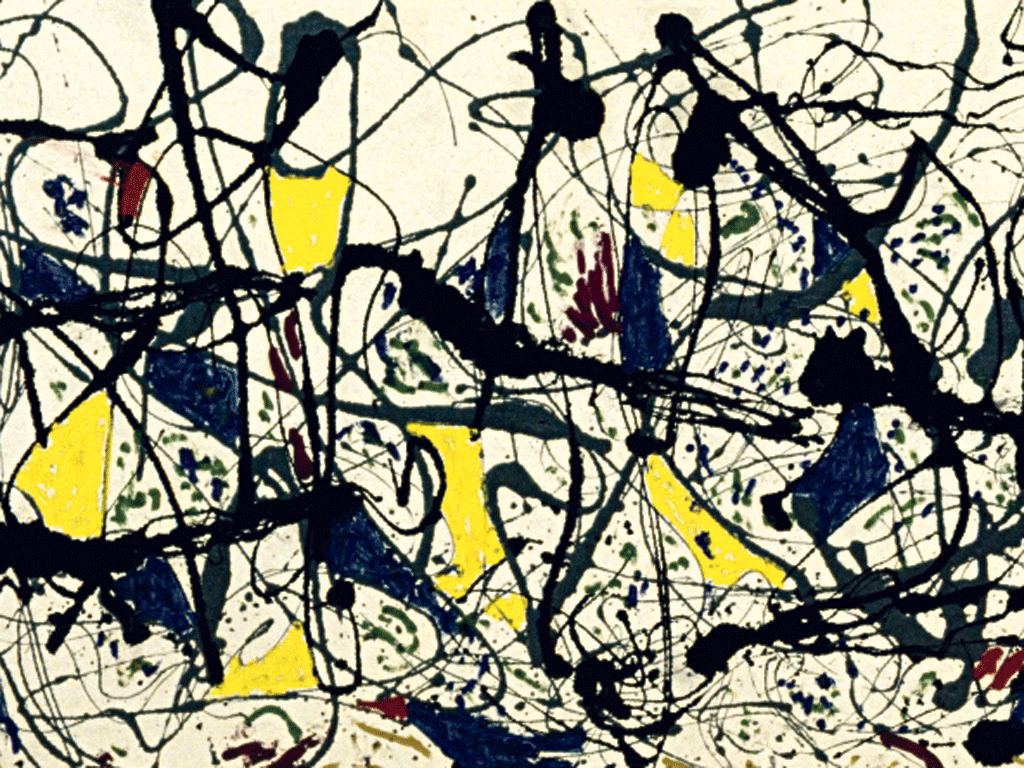
“The decision to include culture and art in the US Cold War arsenal was taken as soon as the CIA was founded in 1947. Dismayed at the appeal communism still had for many intellectuals and artists in the West, the new agency set up a division, the Propaganda Assets Inventory, which at its peak could influence more than 800 newspapers, magazines and public information organisations. They joked that it was like a Wurlitzer jukebox: when the CIA pushed a button it could hear whatever tune it wanted playing across the world. The next key step came in 1950, when the International Organisations Division (IOD) was set up under Tom Braden. It was this office which subsidised the animated version of George Orwell's Animal Farm, which sponsored American jazz artists, opera recitals, the Boston Symphony Orchestra's international touring programme. Its agents were placed in the film industry, in publishing houses, even as travel writers for the celebrated Fodor guides. And, we now know, it promoted America's anarchic avant-garde movement, Abstract Expressionism.” Good to know. https://independent.co.uk/news/world/modern-art-was-cia-weapon-1578808.html

@Culture_Crit - Culture Critic
Explain why this painting is worth $300 million. https://t.co/uNQAcgHqPS

@Crystalita_x - 𝘊𝘳𝘺𝘴𝘵𝘢𝘭
Hey look… real journalism… now that’s true art Hidden hands - Art & the CIA https://youtu.be/k5YSikO6JRM?si=q6cqBhVDYSdiYxEV https://t.co/DVN02xdcAA
@Crystalita_x - 𝘊𝘳𝘺𝘴𝘵𝘢𝘭
@Crystalita_x - 𝘊𝘳𝘺𝘴𝘵𝘢𝘭
@Culture_Crit Lol I can’t even believe they’re mentioning these exact artists. Wild times. https://t.co/Zv97lEE5qV

@Crystalita_x - 𝘊𝘳𝘺𝘴𝘵𝘢𝘭
This basically explains the Entertainment industry & why it’s so fcked up. It’s funny to me how they now try to achieve the very same “Totalitarianism” they claimed to hate in the 70s 🤡 https://t.co/fUkCi7Rf5N
@Crystalita_x - 𝘊𝘳𝘺𝘴𝘵𝘢𝘭
2019 “Ultimately, those who own these cables will be able to control and monitor the information that passes through them. Not bound to any one territory, who has the right to control these cables?” https://mironline.ca/undersea-espionage-ownership-of-underwater-internet-cables/ This article is a banger! Definitely read! 👀‼️


@Crystalita_x - 𝘊𝘳𝘺𝘴𝘵𝘢𝘭
“Digital Gold: Internet cables are protected as though they contain gold, and to some extent, they do. Over 95% of precious data flows through those fibres every day—including government correspondence, user profiles, and banking information. Not only are they routinely inspected for external damage from dropped anchors, earthquakes, or even shark bites, but they are also patrolled by their owners to deter any information tapping from foreign governments.”

@Crystalita_x - 𝘊𝘳𝘺𝘴𝘵𝘢𝘭
“All this is done through the collaboration of private investors, tech companies, and governments. Projects are backed by governments or state-owned companies, and resources are poured into the process of laying down the cables; hundreds of millions of dollars and the most advanced tools and materials all dedicated to building the backbone of the modern world.”

@Crystalita_x - 𝘊𝘳𝘺𝘴𝘵𝘢𝘭
“A key for espionage: Tapping undersea cables for espionage is not a new idea. Back in the 1970s, submarines were sent on missions like Operation Ivy Bells. Troops were sent down to the bottom of the Sea of Okhotsk in Soviet territorial waters to find a five-inch diameter cable that carried communications between military bases. They installed a 20-foot long listening device on the cable to record Soviet messages. The tap was eventually discovered, and that specific mission had been compromised.”

@Crystalita_x - 𝘊𝘳𝘺𝘴𝘵𝘢𝘭
“Such operations could still be ongoing beneath the ocean without us knowing. However, with tech giants quickly gaining control of more and more cables, there could be a new way to spy on other countries. Partnerships or deals with these companies can easily give governments access to the information that flows through the cables, giving Facebook and Google even more leverage than they already have. With state backing and investment, tech giants could control and sell more information, and they could even persuade governments since they own the cables that deliver their secrets. For example, Google could restrict access to information vital for national security interests if governments refuse to give them more tax exemptions.”

@Crystalita_x - 𝘊𝘳𝘺𝘴𝘵𝘢𝘭
“Cable Ownership: These cables run through international territory, muddying the question of ownership. It begs the question: are sections of these cables subject to the local laws of the territories they cross? Private companies will argue that they’re private property and thus subject to solely the company’s control. However, they still must comply with international laws and treaties regarding marine territory.”

@Crystalita_x - 𝘊𝘳𝘺𝘴𝘵𝘢𝘭
“According to Article 87 of the United Nations Convention on the Law of the Sea (UNCLOS), states have the freedom to lay submarine cables and pipelines in international waters, and only areas that cross into sovereign territory (the Exclusive Economic Zone [EEZ] or continental shelf) are subject to restrictions. Article 112 stipulates that the freedom to lay down cables must be subject to the rights of other states to do the same.” - Does this mean international waters are fair game for sabotage too?

@Crystalita_x - 𝘊𝘳𝘺𝘴𝘵𝘢𝘭
“While ownership of the cables themselves vary from company to company (state-owned or private), tech giants like Facebook and Google are quickly taking over the seas. By 2020, both companies will own about 29% of the cables that run throughout the world; they even own a couple of whole cables from end-to-end. For instance, Google currently owns the entirety of the Curie cable, which runs from Chile to Los Angeles.”


@Crystalita_x - 𝘊𝘳𝘺𝘴𝘵𝘢𝘭
“With tech giants taking over, international and local laws need to be updated to ensure that the sovereignty of the different states the cables cross is protected. It’s a unique position they currently occupy: the cables are privately-owned but are allowed to traverse sovereign territory. States are subject to the international treaties they signed, but private companies’ hands are not as bound.”

@Crystalita_x - 𝘊𝘳𝘺𝘴𝘵𝘢𝘭
“While they still need permits to lay down the cables, the information they collect can be considered property of the owner. This gives private companies significant leverage over governments. If current regulations are not updated, tech companies have the potential to gain a monopoly over our data, and governments may find it more and more difficult to control their behaviour.” 👀 @Vltra_MK

@Crystalita_x - 𝘊𝘳𝘺𝘴𝘵𝘢𝘭
“China and the South China Sea: All this considered, China’s presence in the South China Sea is even more intimidating. As they continue to take control over the various islands in the area, they will be able to lay down their own network cables away from the eyes of the international community. Their goals to expand their 5G networks, headed by Huawei, will give the Chinese government even more control over the information that flows into and out of the country. The infamous Great Firewall can be expanded and improved further if the state has complete control over the internet cables that source internet traffic. Tapping the cables will no longer be necessary for espionage if the state owns the whole thing.”


@Crystalita_x - 𝘊𝘳𝘺𝘴𝘵𝘢𝘭
“The Huawei Marine Networks has already begun to lay down 100 submarine cables across the world, and it completed a 4,000-mile cable last year that runs from Brazil to Cameroon. China Unicom, the company that owns the cable, was able to win the bidding because of the subsidies they received from the government. Possession of the South China Sea could mean the control over the data that flows between surrounding countries. A monopoly on the network can give China the intelligence and leverage necessary to control such regions.”

@Crystalita_x - 𝘊𝘳𝘺𝘴𝘵𝘢𝘭
“China, however, is simply taking a page from American books. Former National Security Agency contractor Edward Snowden revealed PRISM to the public: a program wherein the U.S. government collected user data from various internet companies, and they could do so without a warrant. Global superpowers know that intelligence is the key to control, so they have been working with telecommunication companies for years, whether it be through under-the-table deals or direct partnerships.”

@Crystalita_x - 𝘊𝘳𝘺𝘴𝘵𝘢𝘭
“Protecting Our Data: Individual consumers of the internet may not have the power to fight this control themselves. There are only a few companies that own the cables, so there aren’t many choices if one needs to use the internet. “ https://t.co/HXVgDMsK2F

@Crystalita_x - 𝘊𝘳𝘺𝘴𝘵𝘢𝘭
“UNCLOS may protect states’ rights to lay down the cables and their sovereignty once a foreign wire is in their territory, but specific agreements on how private companies should behave are yet to be clarified. Tech giants and government-backed data businesses are gaining more and more control over the internet, so they need pressure from other states to keep them in check. Information is precious to us all, so we ought to take steps to protect it, whether it be from foreign government control or a shark lying in wait.” Internet Bill of Rights @Vltra_MK 👀

