reSee.it - Tweets Saved By @Culture_Crit

@Culture_Crit - Culture Critic
America built the greatest train stations ever seen — and then demolished them. Here's what the American railway was like at its peak. And what destroying it says about us… (thread) 🧵

@Culture_Crit - Culture Critic
Right now, the US has more railway tracks than any other country (155,000+ miles). Most of this, of course, is freight...

@Culture_Crit - Culture Critic
But Americans also once had the greatest passenger system in the world. Note the decline since the mid-20th century. 1962 vs. 2005:


@Culture_Crit - Culture Critic
America was built by the railroad, and Pennsylvania Railroad was once the largest corporation in the world. By 1920, there were 250,000+ miles of tracks and 1.2 billion passengers per year.

@Culture_Crit - Culture Critic
Powerful railways came with a powerful aesthetic. American rail infrastructure expressed the sentiment of a burgeoning nation: grand, Neoclassical and Art Deco concourses...


@Culture_Crit - Culture Critic
New York's Penn Station (1910) was expressly modeled on the Baths of Caracalla in Ancient Rome. America owed its prosperity to the railroad, and the architectural ambition of its stations recognized that.


@Culture_Crit - Culture Critic
Art Deco in the 1930s brought not only great infrastructure, but visionary new streamliners. The "Mercury" was a passenger train operating in the Midwest from 1936 to 1959.

@Culture_Crit - Culture Critic
In fact, the phrase "red carpet treatment" came from a luxury of this era. New York Central used crimson carpets to welcome people aboard the iconic 20th Century Limited.


@Culture_Crit - Culture Critic
How do the passenger railways look now? Amtrak is the only nationwide operator, running ~300 trains per day. France's SNCF runs 14,000 daily for comparison.
@Culture_Crit - Culture Critic
And the scale of abandoned infrastructure is something to behold. This map shows only railroad lines that are abandoned or out of service...


@Culture_Crit - Culture Critic
Why did it fail? Passenger trains were of course a casualty of motorcars and air travel. New interstates connected East and West better than any road before, and mid-century state subsidies favored the new modes of transport.


@Culture_Crit - Culture Critic
As planes and highways stole passengers, overregulation choked the private railroads. Amtrak was created in 1971 to save the lines, but it limped along underfunded ever since.

@Culture_Crit - Culture Critic
Then, the fervor of car-centric "urban renewal" changed cities irrevocably. New interstates cut right through cities and gutted urban cores, as people fled to the suburbs and inner-city populations cratered.


@Culture_Crit - Culture Critic
So much space was surrendered that even if you did catch a train into a city center today, you'd be stranded without a car. The overpass rattling by Richmond's Main St Station tells you everything about the attitude of planners to the railways...

@Culture_Crit - Culture Critic
Most egregious was the toppling of Penn Station. New York's largest indoor space was razed for Madison Square Garden and the station pushed underground: "One entered the city like a god; one scuttles in now like a rat."


@Culture_Crit - Culture Critic
The loss of the great train stations was the failure to realize that monuments are what build nations. Penn Station was a train station, but it was also an ode to the railroad and the civilizational energy that built it.


@Culture_Crit - Culture Critic
All this was shortsighted not just because it changed cities — but because rail travel (in eastern centers) didn't die. New Penn Station does far more traffic than the old one ever did, such that major works were just required to expand it.


@Culture_Crit - Culture Critic
The mid-century myopia of urban planners changed cities, but the railroad dream never died. New Yorkers want their station back, and big plans are now forming to restore it to its old, neoclassical glory...

@Culture_Crit - Culture Critic
We go much deeper on this in our free newsletter! Do NOT miss tomorrow's email. 120,000+ people read it: art, history and culture 👇 https://www.culture-critic.com/welcome

@Culture_Crit - Culture Critic
Every aspect of life is being stripped of color. Many have noticed this trend — but why exactly is it happening? Something deeper is going on… (thread) 🧵

@Culture_Crit - Culture Critic
Look at car colors since 1990. Paint suppliers are seeing huge shifts toward black, gray, silver and white color preferences. 80% of new cars are now grayscale...

@Culture_Crit - Culture Critic
Ridley Scott's "Napoleon" made sets and costumes that are vibrant in reality look utterly lifeless on screen. Muted color grades (that blue/gray wash over everything) are the new normal in cinema.


@Culture_Crit - Culture Critic
Yesterday, we were told HBO is rebranding Max — again. The big change? It will go from using blues to a duller combination of black and white.


@Culture_Crit - Culture Critic
In fact, colors in all objects have been steadily neutralized since 1800, per a study of photos of 7000 objects in the UK Science Museum. What is behind the relentless shift to neutrality?

@Culture_Crit - Culture Critic
It's partly materials. Moving from wood to metals and plastics led to more neutral color schemes...


@Culture_Crit - Culture Critic
But David Batchelor's book "Chromophobia" argues that it goes back to very birth of Western thinking. Plato, Aristotle, and thinkers that followed saw color as opposed to the higher workings of the mind.


@Culture_Crit - Culture Critic
Plato famously saw the world of sight as a deceptive "prison-house". Color is a sensory experience, and humans should look beyond the sensory world to uncover truth (using reason).

@Culture_Crit - Culture Critic
Aristotle thought lines, not color, contain the soul and meaning of an image. The essence of a thing is its form — what makes a chair a chair, not just a pile of wood.

@Culture_Crit - Culture Critic
Later thinkers like Rousseau and Kant agreed, stating that the drawing of forms is what gives life to color. Color can only add charm to art, but has no bearing on aesthetic judgement because it is purely sensory.

@Culture_Crit - Culture Critic
So, color in the Western mind represents chaos and form represents order and rationality. Maybe that's why brands that want to be taken "seriously" choose muted storefronts, unlike a colorful book shop with no such ambitions.


@Culture_Crit - Culture Critic
But minimalism takes this further. When the modernists stripped all detail from architectural design, it was a kind of extreme rationalism that distilled everything to its basic form.


@Culture_Crit - Culture Critic
As Adolf Loos raved: "we have gone beyond ornament, we have achieved plain, undecorated simplicity." Color was primitive and must be purged along with everything else. Only form mattered.


@Culture_Crit - Culture Critic
The result was copy-paste, colorless architecture that comes from nowhere and yet exists everywhere.

@Culture_Crit - Culture Critic
There's no single explanation for the achromatic shift across industries. But commercial incentives is a big one: appeal to the broadest possible tastes and offend no one.


@Culture_Crit - Culture Critic
Appeasing homogenous, mass consumer markets improves profits in all sorts of things. There's a related shift in music, where complexity is being stripped out to appeal to worldwide streaming audiences.

@Culture_Crit - Culture Critic
Going back to Plato, maybe the best art is that which gives sensory and rational concerns equal weight. Baroque art overwhelmed the senses with color — but with enough form to challenge you profoundly...

@Culture_Crit - Culture Critic
If these threads interest you, join my free newsletter! We write about culture, art and history every week. Join 110,000 others to get it in your inbox 👇 https://www.culture-critic.com/welcome
@Culture_Crit - Culture Critic
The Lord of the Rings does not take place on an imaginary planet — it's Earth. Middle-earth is our forgotten past, before recorded history, when Eden (Valinor) was a real place. The truth of Tolkien's world will blow your mind... 🧵

@Culture_Crit - Culture Critic
Middle-earth is our Earth long ago, as Tolkien said: "I have (of course) placed the action in a purely imaginary (though not wholly impossible) period of antiquity, in which the shape of the continental masses was different."

@Culture_Crit - Culture Critic
He even compared latitudes directly: Hobbiton and Rivendell are about the latitude of Oxford, Minas Tirith the latitude of Florence, and Pelargir the latitude of ancient Troy.


@Culture_Crit - Culture Critic
The reason is that Tolkien was writing a mythology for England, which he felt lacking next to Greek or Norse traditions. Middle-earth is Europe, several millennia before written history. But it gets much more interesting than that...

@Culture_Crit - Culture Critic
In Tolkien's legendarium, Earth (Arda) is flat when first created. But then, at a critical juncture in history, it becomes a spherical globe like our own.

@Culture_Crit - Culture Critic
Why? A great flood took place in punishment for the pride of mankind, and it transformed the world. The heart of human civilization, the island city of Numenor, was destroyed...

@Culture_Crit - Culture Critic
In the process, Valinor (where immortal elves live) was separated from Arda so men could never reach it. These are the Undying Lands that Frodo "sails" to — a special exception made for him as a mortal.

@Culture_Crit - Culture Critic
So what does all this mean? Well, Tolkien (a devout Catholic) believed the Garden of Eden was once a real, physical place on Earth — before the Biblical Fall of Man. His Valinor is a representation of Eden...

@Culture_Crit - Culture Critic
Notice the close parallels. Two Trees bring life to Tolkien's Valinor. In Genesis, there are two important trees: the Tree of Life and the Tree of Knowledge of Good and Evil.

@Culture_Crit - Culture Critic
The Fall of Man in Tolkien's lore happens after Sauron convinced the Númenorean king that men should seize access to Valinor (and immortality) like the elves. Just like the snake's poisonous influence in Eden.

@Culture_Crit - Culture Critic
The elves are purer, immortal beings (though not sinless) who reside in Valinor — why? They are what Man was supposed to be before the Fall, "freed from those limitations which [Man] feels most to press upon him."


@Culture_Crit - Culture Critic
It isn't even just Biblical parallels. Tolkien saw Numenor as a version of the Atlantis myth in Greek tradition — a lost city of the western ocean, destroyed by cataclysm, which lingers on in humanity's collective unconscious.


@Culture_Crit - Culture Critic
His lore is therefore a mythology that runs parallel with all great deluge myths throughout history. It leads right up to recorded history and the present day — the events of LOTR take place in his 3rd age, and we are living in the 6th or 7th.

@Culture_Crit - Culture Critic
Tolkien was devoted to the study and creation of myths because he knew that myths are not lies, but the exact opposite: "Myths convey the essential truths, the primary reality of life itself."

@Culture_Crit - Culture Critic
Myths are God's mode of communication, and a lens through which humanity can know its true self. For Tolkien, humanity lived *inside* a myth — the one true myth — the culmination of ancient stories finally fulfilled by a real event...

@Culture_Crit - Culture Critic
Tolkien's lore goes FAR deeper than most realize. I'm going to break it down further soon — join my free newsletter so you don't miss it! 110,000+ people read it: culture, art and history 👇 https://www.culture-critic.com/welcome
@Culture_Crit - Culture Critic
The 12 Apostles risked their lives to spread Christianity across the globe. All but one were murdered for doing so — brutally. Here's what happened to them, starting with Judas... (thread) 🧵

@Culture_Crit - Culture Critic
Preaching the Gospel was a dangerous business in the first century Roman Empire (and beyond). Christians were widely persecuted, and most Apostles faced brutal martyrdoms for their teachings...

@Culture_Crit - Culture Critic
Judas Iscariot, however, died before the Resurrection. Consumed by guilt, he returned the 30 pieces of silver received to betray Christ, and hanged himself near Jerusalem.

@Culture_Crit - Culture Critic
First to be martyred was James the Greater, brother of John. Herod Agrippa was desperate to suppress the growing movement in Judea, and had him beheaded before a crowd in Jerusalem in 44 BC.

@Culture_Crit - Culture Critic
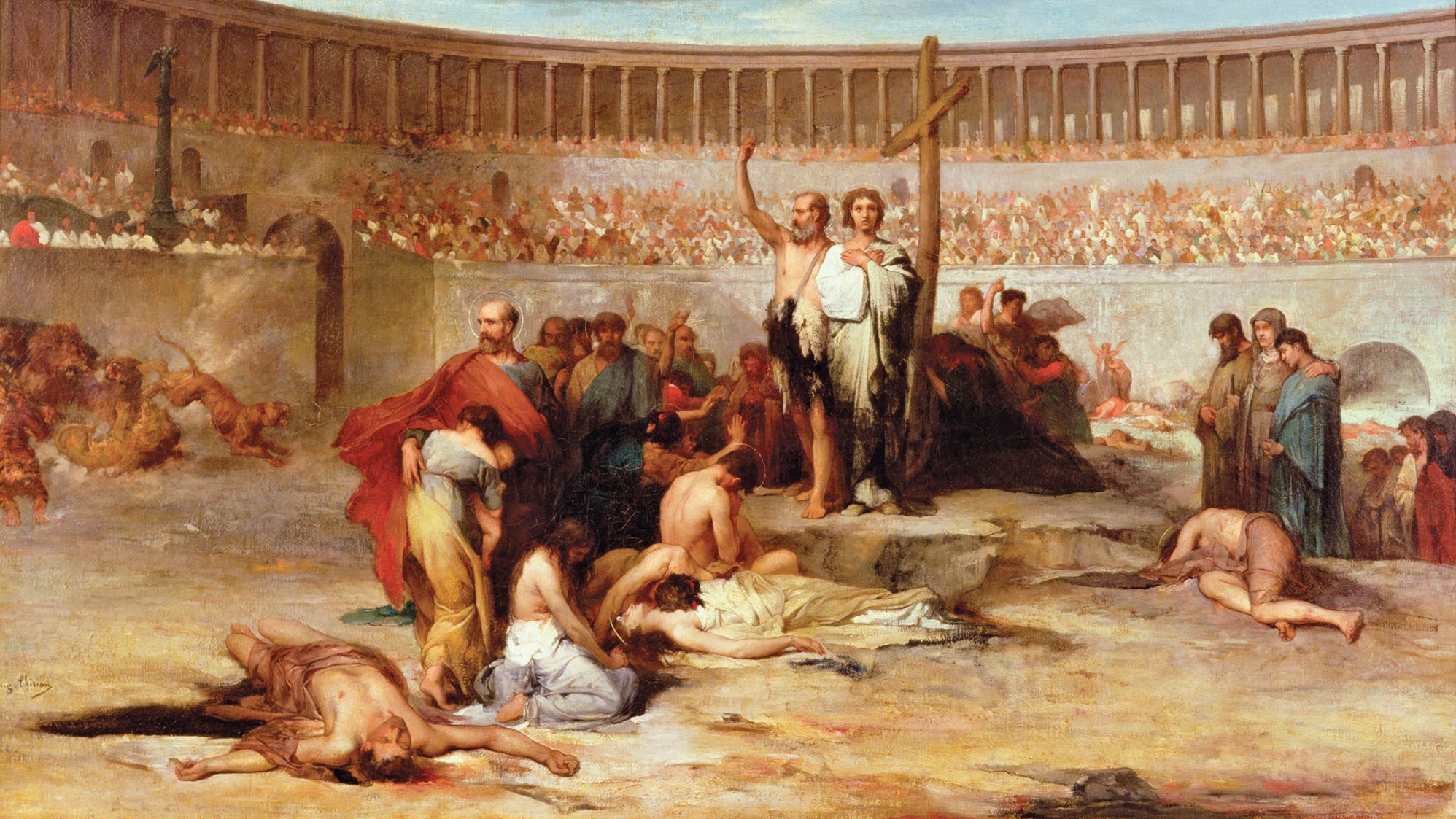
Emperor Nero was especially cruel, scapegoating Christians for the fire of 64 AD and branding them enemies of the state. Mass executions took place at his circus, of which Saint Peter was one...

@Culture_Crit - Culture Critic
Peter bravely took his ministry to center of the globe, Rome — making him a major target for Nero. Insisting he wasn't worthy of dying like Christ, he had the Romans crucify him upside down.


@Culture_Crit - Culture Critic
Peter's legacy lives on as the first Pope, and the majestic altar of St. Peter's Basilica stands just meters from where he was killed. His bones were only discovered in 1968, right beneath the altar floor where they were most expected...


@Culture_Crit - Culture Critic
Peter's brother Andrew also died on the cross, after travelling through Asia Minor and Greece. Roman authorities caught up with him in Patras and strung him on an X-shaped cross — now the national flag of Scotland.


@Culture_Crit - Culture Critic
Philip, executed in Hierapolis for converting the wife of a proconsul, was also crucified upside down. As he hung there he continued to preach, as tradition holds, and he wasn't the only one...

@Culture_Crit - Culture Critic
Bartholomew was skinned alive for converting the king of Armenia, but apparently kept preaching to a rapt audience as they peeled off his skin. But executions got even more brutal than that...


@Culture_Crit - Culture Critic
Simon the Zealot and Jude traveled together to Persia, where Jude was beaten to death with clubs. Simon, however, was quite literally sawn in half by the authorities.

@Culture_Crit - Culture Critic
Some Apostles traveled even further. Doubting Thomas preached in India and later became its patron saint, although locals eventually came for him with spears...


@Culture_Crit - Culture Critic
And Matthias, who replaced Judas as the 12th Apostle, is thought to have journeyed as far Ethiopia — before local pagans beheaded him.


@Culture_Crit - Culture Critic
Matthew, the redeemed tax collector turned Gospel writer, also got to Ethiopia by many traditions. Again, he was martyred for his words, hacked to death with swords and spears.


@Culture_Crit - Culture Critic
Others faced death in Jerusalem. James the Less was called to deny Jesus before a large crowd, from atop the Temple. Instead, he proclaimed Christ as the saviour — before being thrown from the building and killed by a mob.

@Culture_Crit - Culture Critic
Only John died of natural causes. It's thought he lived until 100 AD, exiled on the island of Patmos, where the Book of Revelation came to him in a set of startling visions...

@Culture_Crit - Culture Critic
Is all this history? Although most of it isn't in the scripture, it does come from very ancient church tradition...

@Culture_Crit - Culture Critic
What is clear: the Christian message terrified the powers that be. 12 great men had the courage to spread it anyway, and in so doing shook the Roman Empire to its core...

@Culture_Crit - Culture Critic
If you enjoy these threads, join my FREE newsletter — it goes deeper on topics like this. Do NOT miss this week. 100,000+ people read it: history, art, and culture 👇 https://www.culture-critic.com/welcome
@Culture_Crit - Culture Critic
Here's a beautiful, FREE online course on the history of ancient Christianity... https://online.hillsdale.edu/courses/promo/ancient-christianity?sc=01211D00F8LEHDOPDEC&utm_campaign=ancientchristianity_oc&utm_source=Culture_Critic_X&utm_medium=paid&utm_content=Jan_2025_X
@Culture_Crit - Culture Critic
This painting is over 500 years old, but looks like it could have been made yesterday. It might seem like an acid trip - it's actually the greatest warning about sin ever painted... (thread) 🧵 https://t.co/8YzGqYIH6H

@Culture_Crit - Culture Critic
It was painted by Dutch artist Hieronymus Bosch in around 1510 - a triptych of oak panels that looks like this when closed (Earth on the third day of creation): https://t.co/lHaty2SDWf

@Culture_Crit - Culture Critic
When opened, three panels are exposed: • The Garden of Eden • The Garden of Earthly Delights • Hell It was a wildly imaginative painting the likes of which had never before been seen in art.. https://t.co/6uudYa2bkt

@Culture_Crit - Culture Critic
This isn't a typical Biblical scene of an Earthly paradise. It's a chaotic swirl of bizarre characters and events, yet somehow all bound by harmonious perspective and artistic balance. https://t.co/5aeC938dnO

@Culture_Crit - Culture Critic
Bosch is often compared to the surrealists of the 20th century. In fact, it was they who called Bosch the first modern artist, and the "the singer of the unconscious". You can see direct links in the work of Salvador Dalí... https://t.co/PLZKAIy58p

@Culture_Crit - Culture Critic
But Bosch himself took inspiration from the strange gargoyles and drolleries common in medieval architecture, art and manuscripts. Here are some of Bosch's oddities: https://t.co/p1s4fFXkQP


@Culture_Crit - Culture Critic
This however was not a medieval painting. It was done at the height of the Northern Renaissance, and several years after Leonardo had completed The Last Supper. But rather than paint the Renaissance ideal of heroic man, Bosch depicted a world corrupted by humanity. https://t.co/YGSsf1F9nj

@Culture_Crit - Culture Critic
The first panel shows Eve being presented by God to Adam in the Garden of Eden - a scene that would at first seem peaceful... https://t.co/wh5N9bdbHk

@Culture_Crit - Culture Critic
But there are already warnings for what is to come. Strange reptilians (including one with three heads) are climbing out of the water, and Adam's rosy-cheeks express not just surprise, but lust. https://t.co/xY7qdD7f09

@Culture_Crit - Culture Critic
God is absent in the next panel. The garden is now populated - chaotically - by people and animals. They indulge a lush garden of carnal desires, a scene of unbridled lust and gluttony. https://t.co/vP9AJocsQE

@Culture_Crit - Culture Critic
It's the definition of over-indulgence, and life lived without consequence. But rather than outright obscene, Bosch depicted it through innuendos that were known in his day - like the picking of fruit being a euphemism for sexual acts. https://t.co/2jazlg6zJ6

@Culture_Crit - Culture Critic
The final panel is both the most iconic and most disturbing depiction of hell in art history. Hell is a burning prison city, with strange creatures that torment the lost souls. Less a traditional fiery hellscape, more a kind of bizarre battlefield... https://t.co/e75gTQRea9

@Culture_Crit - Culture Critic
Every time you view it you discover a new horror. Like a man tied to a giant lute, about to be devoured by a snakelike monster; or people being crushed by an enormous pair of ears... https://t.co/tVBGJF9eEn


@Culture_Crit - Culture Critic
All the over-indulgence of the central panel has now backfired. A vain woman must stare at her reflection for eternity, and a glutton throws up his meal... https://t.co/YYGdXGz0kd


@Culture_Crit - Culture Critic
The crucial message: all this horror is man-made. That is evident in a quite literal sense: the organic structures of previous panels are gone, and everything is now decidedly man-made. The creations of man, even the musical instruments, have turned on him. https://t.co/4TBksKlA9P

@Culture_Crit - Culture Critic
Bosch's warning is just that - the pursuit of transient pleasure leads to a permanent hell of our own making. Bosch used his sheer imaginary strength to set that impression on us permanently, in a painting of symbols and mysteries that have been debated for centuries... https://t.co/0glC4SQv3u

@Culture_Crit - Culture Critic
If you like threads like this, you NEED my weekly emails. Art, culture and history (join 21,000 readers FREE) 👇 culturecritic.beehiiv.com/subscribe
@Culture_Crit - Culture Critic
The Garden of Earthly Delights is on permanent display in the Prado, Madrid. It's bigger than most people expect, and easy to get lost in... https://t.co/Tng37DRjUB

@Culture_Crit - Culture Critic
Past societies produced so much beauty because they knew that math and beauty are deeply connected. It all started when Pythagoras discovered something mind-blowing about reality: The universe is not made of matter — but music... (thread) 🧵 https://t.co/F04pbQmGu9

@Culture_Crit - Culture Critic
At the end of the Roman Empire, inflation was out of control. Huge state spending required endless money "printing" — until an entire bag of coins couldn't buy a sack of wheat. Here's how inflation (and taxes) brought the empire to its knees... (thread) 🧵 https://t.co/GYiUFiuSY1

@Culture_Crit - Culture Critic
Rome's monetary system required continual looting of silver and gold from conquered lands to supply its coinage. But when the expansion of the empire stopped, wealth stopped flowing into the treasury... https://t.co/6qGsk3qTJu

@Culture_Crit - Culture Critic
To maintain territories and conquer new ones, a massive army was required. By the mid 2nd century AD, half a million soldiers were on the payroll — 70% of the total budget. https://t.co/DIcnMGMGiA

@Culture_Crit - Culture Critic
The state also haemorrhaged money via social programs for free and subsidized grain: 200,000 people in Rome were on the grain dole. Note, when the silver denarius was introduced in 211 BC, a modius of wheat (8.7 L) cost a fraction of a denarius. https://t.co/uOi1A086br


@Culture_Crit - Culture Critic
Emperors like Nero and Commodus spent lavishly, nearly bankrupting Rome with indulgent displays. For a while, free grain and games kept the lower classes happy — "bread and circuses." https://t.co/9GvluHhI0Q

@Culture_Crit - Culture Critic
When Nero had to rebuild Rome after the fire in 64 AD, money was tight (especially due to war in Armenia). So, he melted down denarii and created more of them from the same silver content — diluting purity from 98% to 93% while retaining the same face value. https://t.co/S2yeSNWFsU

@Culture_Crit - Culture Critic
It seemed like a harmless way to increase the money supply, but the state soon got addicted to solving its problems this way. Emperors continued debasing coins ever so slightly, and things remained stable for a while... https://t.co/LcrbiK3aRG

@Culture_Crit - Culture Critic
Plus, emperors had other ways of obtaining funds. Commodus seized the assets of wealthy citizens by accusing them of treason, and Caracalla granted citizenship to 30 million provincials overnight in order to tax them. https://t.co/cgIdlYcqwX


@Culture_Crit - Culture Critic
By the 3rd century, the denarius was down to 60% purity and a modius of wheat cost multiple denarii. Still, the state kept spending to maintain the illusion of prosperity — until crisis struck... https://t.co/DdQcNsu6LQ

@Culture_Crit - Culture Critic
Frontiers across the empire came under attack in the mid 3rd century. Military expenses soared, provinces were abandoned and their tax yields lost, and vast quantities of silver and gold lost in looting and tributes. https://t.co/ypVqc0kVif

@Culture_Crit - Culture Critic
When soldiers' wages could no longer be paid, debasing the currency even more was the only option. Emperors issued new denarii with less and less silver content — by 268 AD, it was down to 0.5% silver. https://t.co/2xPV3thJtk

@Culture_Crit - Culture Critic
Soon, an entire bag full of coins replicated the silver content of a single coin a century earlier. By 300 AD, soldiers were paid 8x in denarius versus a century ago, and wheat prices were up 200x. https://t.co/2rOUCbjhjW

@Culture_Crit - Culture Critic
The administration even started issuing new coins with hardly any silver but a deceptively silver surface. People lost confidence in the money, paid their taxes with the worthless new coins, and hoarded the old silver ones. https://t.co/cte2I76QsV

@Culture_Crit - Culture Critic
When the state *still* struggled to pay troops, some abandoned the military and went pillaging towns. For half a century, the empire was on the brink of destruction: emperors were assassinated, barbarians sacked towns and enslaved citizens. https://t.co/aFvHXMpRAl

@Culture_Crit - Culture Critic
In 301 AD, Diocletian tried to stabilize things with price caps on 1,000 goods and services, but it ultimately failed. A modius of wheat that had cost 0.5 denari in the 2nd century sold for 10,000 denarii in 338 AD. https://t.co/TS2SPO9Q0U

@Culture_Crit - Culture Critic
Who pays when the money system breaks? The people pay with their freedom. The currency was so worthless that the state demanded forced labor rather than accept coins as tax. Merchants had to provide goods directly to the army, and leaving their trade was outlawed. https://t.co/e25vnVNMJ2

@Culture_Crit - Culture Critic
Constantine tried to restore the currency by introducing the new, gold solidus into mass circulation. But subsequent emperors carried on debasing coins, refusing to believe it caused inflation. https://t.co/eXMhWgdCEg

@Culture_Crit - Culture Critic
Over time, the masses fell into serfdom and unrest while the state grew more authoritarian in response. When the 5th century barbarians came, invaders were seen as liberators. "The empire could no longer afford the problem of its own existence." https://t.co/ha7lKvXG8I

@Culture_Crit - Culture Critic
Remember, I go deeper on this and much more in my FREE newsletter — do NOT miss tomorrow. 96,000+ people read it: history, art and culture 👇 culture-critic.com/welcome
@Culture_Crit - Culture Critic
Also, if any of this sounds familiar... It might be because 80% of all dollars in circulation today were printed since Covid (going by M1 money supply). https://t.co/mZwiT8nJfa

@Culture_Crit - Culture Critic
The Lord of the Rings is a deeply Christian story — once you see it, you can't unsee it. Tolkien's elves aren't just mythical beings; they're Mankind before the Fall. And Middle-earth is no imaginary world — it's our Earth, a long time ago... (thread) 🧵

@Culture_Crit - Culture Critic
Middle-earth is meant to be our world thousands of years ago. With LOTR and his legendarium, Tolkien was trying to create a mythology for England. He said himself: "Middle-earth is our world..." https://t.co/wnJ5quCl7J

@Culture_Crit - Culture Critic
"I have (of course) placed the action in a purely imaginary (though not wholly impossible) period of antiquity, in which the shape of the continental masses was different." https://t.co/ZI6vbgAtZz

@Culture_Crit - Culture Critic
So, if Middle-earth is Earth, then Valinor symbolizes the Garden of Eden. Elves (immortal beings) reside there, in a blissful paradise created by the Valar (essentially angels). https://t.co/3TnuGRdweG

@Culture_Crit - Culture Critic
Elves resemble what Man was meant to be before the Fall in the Garden of Eden: higher, purer beings with a deep connection to nature. According to Tolkien, elves are "freed from those limitations which [Man] feels most to press upon him." https://t.co/b7adgzQ1PD


@Culture_Crit - Culture Critic
Men suffer a "Fall" in Tolkien's lore. Númenor is destroyed by a tsunami after Númenoreans became prideful and sailed to Valinor to seize immortality. The god of Tolkien's universe destroys their city, and makes Valinor inaccessible to the physical world. https://t.co/49e3JwomwK

@Culture_Crit - Culture Critic
This was after Sauron convinced the Númenorean king that men should have access to Valinor (and immortality) like the elves. You can see the poisonous influence of the serpent in the Garden of Eden in this tale. https://t.co/QytX3dagd4


@Culture_Crit - Culture Critic
Old Testament parallels don't stop there — do you ever wonder what is the meaning of the White Tree of Gondor? It was a seedling of a much more significant tree... https://t.co/4GB2twOSSC


@Culture_Crit - Culture Critic
It came from one of the Two Trees that brought light to Valinor (Eden), before they were destroyed by evil. In Genesis, Eden has two important trees: the Tree of Life and the Tree of Knowledge of Good and Evil. https://t.co/ctYgwVvdGi


@Culture_Crit - Culture Critic
When Aragorn (a descendent of Númenor) restores the line of Kings, he replants the dead White Tree with a new sapling — symbolizing the Resurrection. The events of LOTR, then, are like a New Testament narrative... https://t.co/KCll3kJLjp


@Culture_Crit - Culture Critic
In this story, there isn't one Christ figure, but three. Aragorn is one, journeying from ranger to king like Christ's slow revelation as Messiah and King... https://t.co/HFvfPZa5iB


@Culture_Crit - Culture Critic
Gandalf's wisdom echos Christ's role as teacher and prophet. His clash with the Balrog, death and resurrection, reflect Christ's death, descent into Hell, and return... https://t.co/o6jWha12xR


@Culture_Crit - Culture Critic
And Frodo's journey resembles Christ's sacrificial one. He bears the ring's immense burden (symbolizing sin), and eventually departs to Valinor, like Christ's ascension to Heaven. https://t.co/HSi2qMmqSY

@Culture_Crit - Culture Critic
Tolkien's symbolism goes on and on. Lembas bread symbolizes the Eucharist, the quest to destroy the ring beings on December 25th — and ends on March 25th, the traditional date of the Crucifixion. https://t.co/li3wF4Z6K4


@Culture_Crit - Culture Critic
But with all these parallels, there are no one-to-one allegories. Elves are not perfect and still entirely capable of sin. Christ's nature is reflected in multiple characters, not just one. https://t.co/q9QCjltN23

@Culture_Crit - Culture Critic
Tolkien famously disliked allegory, unlike his friend C.S. Lewis, whose stories contain direct allegories (e.g. Aslan). LOTR contains no such direct links, and that's the beauty of it... https://t.co/qpTilIp3BG

@Culture_Crit - Culture Critic
There's a distinct lack of overpowering allegories or moralizing messages in LOTR — to see the parallels, you have to look for them. Tolkien's messages instead lie in the background: in characters of virtue and small acts of courage. https://t.co/zjcw96dpZI

@Culture_Crit - Culture Critic
If threads like this interest you, I go deeper in my FREE newsletter every week! 94,000+ people read it: history, art and culture 👇 culture-critic.com/welcome
@Culture_Crit - Culture Critic
And here's my article going deeper on this. The hidden meaning of The Lord of the Rings... culture-critic.com/p/the-hidden-m…
@Culture_Crit - Culture Critic
Ancient Greek thinkers like Socrates and Plato hated democratic elections. They saw democracy as part of an endless cycle of regimes — destined to slip into mob rule. But Polybius knew how to break the cycle... (thread) 🧵 https://t.co/yeZUKGiSrq

@Culture_Crit - Culture Critic
Socrates likened the state to a ship. The uneducated voting in elections is like a ship taken over by a crew with no knowledge of sailing. When selecting a captain, the crew is easily swayed by whoever is best at persuasion — not navigation. https://t.co/Z1hN1Bn6uz

@Culture_Crit - Culture Critic
Voting, thought Socrates, is a skill to be learned. In Plato's 5 forms of government, democracy ranks only above tyranny, which it will inevitably become. Why? https://t.co/zJHfVhU0nJ

@Culture_Crit - Culture Critic
Systems that maximize freedom and equality lead us to pursue selfish pleasures, not the common good. When votes are cast based not on what is good, but what is desired by the masses, demagogues emerge. https://t.co/4DaDLsYdKF

@Culture_Crit - Culture Critic
Like the ship, he with the best rhetoric wins by playing on selfish interests and emotions, not reason. Once in charge, he creates a system of dependancy: "He is always stirring up some war so that the people may be in need of a leader..." https://t.co/zyPYW5ymJe

@Culture_Crit - Culture Critic
So, Plato thought the ideal system was aristocracy. Voting should be a profession like any other, and only those with expertise should participate. Those with knowledge of "good" (the philosophers) should rule. https://t.co/mMy7LiBUMW

@Culture_Crit - Culture Critic
But Plato admitted this too is doomed to fail. When aristocratic rulers are no longer motivated purely by reason, but prioritize public approval, things fall apart again. 200 years later, a man named Polybius proposed a brilliant solution... https://t.co/BTPu6Fmdjj

@Culture_Crit - Culture Critic
Polybius argued that regimes were in an endless cycle, and the three basic forms of government are destined to degenerate into their lower forms — and lead back to anarchy. But there's a way to fix it... https://t.co/oVZwda9wf3

@Culture_Crit - Culture Critic
To break the cycle, you need to combine elements of each system. Polybius admired this in the Roman Republic: Consuls (monarch-like leaders), Senate (aristocratic body), and Assemblies (democratic element). https://t.co/dbthjY9chj

@Culture_Crit - Culture Critic
This idea of separation of powers was developed by Montesquieu, and led ultimately to the American system devised by the Founding Fathers: The Presidency (monarch-like), the Senate (aristocratic) and the House (democratic) — plus the Judiciary to add balance. https://t.co/GXxV7jr7Kf

@Culture_Crit - Culture Critic
There isn't a true aristocratic element (by birth or wealth), but Senators are in some sense. They have longer terms than representatives, represent states not populations, and were originally chosen by state legislatures, not the public (until 1913). https://t.co/nzxlmRsjQM

@Culture_Crit - Culture Critic
Going back to Socrates, his concern was that democracies are unsafe in the hands of ordinary people. But instead of a privileged voting class, he wanted everyone to think rationally enough to become worthy of participating. https://t.co/r1fTzijEGy

@Culture_Crit - Culture Critic
Democracy, he thought, is only as good as the education system surrounding it — and Jefferson had much the same concern: "If a nation expects to be ignorant & free, in a state of civilisation, it expects what never was & never will be". https://t.co/rwJuAASwh4

@Culture_Crit - Culture Critic
If these threads interest you, I go deeper in my free newsletter every week — do NOT miss tomorrow. 93,000+ people read it: history, art and culture 👇 culture-critic.com/welcome
@Culture_Crit - Culture Critic
Most people don't realize how mysterious the Pyramids truly are. They're so old that Cleopatra lived closer to us than to their construction — yet Khufu's Pyramid is so precise it aligns north within 1/20th of a degree. Some more mind-blowing facts about them… 🧵

@Culture_Crit - Culture Critic
They're not just incredibly old, but impossibly precise. The Great Pyramid (attributed to Khufu, c.2550 BC) is 3.4 arcminutes off perfect alignment with true north. That's precision of ~1 millimeter per meter of the length of its base. https://t.co/tZN3EYIgFN

@Culture_Crit - Culture Critic
Executing such accuracy on something with a 13 acre footprint is astounding — how did they do it? Possibly with the help of the sun on the equinox, which on that day rises exactly in the east (and sets perfectly in the west)... https://t.co/tlrRGVqDjA

@Culture_Crit - Culture Critic
Staying on precision, the inner chamber blocks of the Great Pyramid were cut and fit together so tightly that a razor blade cannot fit between them. And some of the granite blocks of the King's chamber weigh 80 tons each. https://t.co/YYSHAmifnK

@Culture_Crit - Culture Critic
Then there's the sheer scale: 2.3 million blocks make up the Great Pyramid, averaging 2.5 tons each. Quarrying these with mere copper saws and pounding stones, transporting and lifting them into place, is a true enigma. https://t.co/YbByEukYxY

@Culture_Crit - Culture Critic
It's useful to compare it to the great constructions of our day. The Burj Khalifa may dwarf it in height, but a more telling measure is probably weight. At 6 million tons, the Great Pyramid is 12x heavier than our greatest skyscraper. https://t.co/FbDiSDlBwt

@Culture_Crit - Culture Critic
But the Great Pyramid did hold the title of world's tallest building for 3,900 years — only surpassed in the 14th century by Lincoln Cathedral. It was 481 feet tall, but erosion has reduced it slightly over time. https://t.co/qey3KI54n8

@Culture_Crit - Culture Critic
Once covered in limestone casing stones, they would've been majestic in their day. Some also think their capstones were plated with precious metals. Both were likely plundered and repurposed following damages caused by a 14th century earthquake. https://t.co/kzbmvs7Wrr

@Culture_Crit - Culture Critic
What's curious about the Giza Pyramids is that they do not contain a single hieroglyph or painting. Nor were burial treasures or mummies found inside. That's clearly unusual for a tomb — other pyramids, like that of Unas, have protective spells etched into their burial chambers. https://t.co/b9U4Mn234m

@Culture_Crit - Culture Critic
And by contrast, the tombs at the Valley of the Kings are decorated with intricate hieroglyphic texts and art from floor to ceiling. These were meant to accompany the pharaohs on their greatest journey — into the afterlife. https://t.co/c7BwePzRJS

@Culture_Crit - Culture Critic
In fact, only a handful of ancient texts have ever been found that even mention the Pyramids at all. The best we have on their construction are these papyrus fragments, found in 2013, mentioning the delivery of limestone blocks via the Nile river. https://t.co/GopfkhS7eg

@Culture_Crit - Culture Critic
Finally, the internal layout of the Great Pyramid is perplexing at best. These are tunnels of smooth rock without steps, all sloping 26 degrees (half that of the external walls). There's even a giant, unexplored chamber yet to be found, according to recent imaging. https://t.co/QTHZOpOxnY

@Culture_Crit - Culture Critic
The list of questions goes on and on: why were mathematical constants encoded so carefully throughout, why were the internal slopes measured so precisely... Advanced geometers and mathematicians were evidently at work here. https://t.co/TocWeviaRH

@Culture_Crit - Culture Critic
Struck by these vast achievements, it's interesting to ponder the societal organization that must have produced them. Visiting in the 5th century BC, Herodotus supposed that some 100,000 men must have built them. https://t.co/mFbqhpHQXf


@Culture_Crit - Culture Critic
The Great Pyramid is usually attributed as a funerary monument to the Pharaoh Khufu — he was seen not just as an earthly ruler, but a divine one. That the will of one man to live forever in stone could mobilize an entire population is daunting to imagine. https://t.co/nqRUQ0AcRY


@Culture_Crit - Culture Critic
With all the looming questions, we can't say for sure exactly how or why they were built — but one thing is clear. These structures were built to last forever.

@Culture_Crit - Culture Critic
If threads like this interest you, I go deeper in my FREE newsletter every week! Breakdowns of great art, architecture and history — 93,000+ people read it 👇 culture-critic.com/welcome
@Culture_Crit - Culture Critic
These structures don't just fascinate modern observers. When Napoleon came in the 18th century, he correctly calculated that the Great Pyramid contained enough material for a 10-foot wall around the entire perimeter of France. It's believed he calculated this himself. https://t.co/KPrTQVmvb7

@Culture_Crit - Culture Critic
And if you enjoy these threads, please give the original post a retweet! And I'll keep making more of them 🙏 https://t.co/gIC5d8Rol9
@Culture_Crit - Culture Critic
Most people don't realize how mysterious the Pyramids truly are. They're so old that Cleopatra lived closer to us than to their construction — yet Khufu's Pyramid is so precise it aligns north within 1/20th of a degree. Some more mind-blowing facts about them… 🧵 https://t.co/0Xx4d3xrIk

@Culture_Crit - Culture Critic
This 2,700-year-old tablet is the oldest map of the world. It reveals just how differently the ancients understood the world — but one detail is particularly strange. It sheds light on a VERY ancient story… (thread) 🧵

@Culture_Crit - Culture Critic
The "Imago Mundi" is the oldest map of the world — as it was known to the Babylonians around 700 BC. It's carved into a small piece of clay, with annotations explaining it, and the creation myth of the world. https://t.co/SJfYc0ktut

@Culture_Crit - Culture Critic
The central parts of the map are easy to read: The Euphrates river runs north to south, straddled by the city of Babylon (modern-day Iraq), and surrounded by cities and regions marked by small circles. https://t.co/N2sgXsraT1


@Culture_Crit - Culture Critic
A point of interest is the place marked "Urartu" — this is the ancient name for what we now call Armenia. Encircling these points on the map is the "Bitter River" (meaning salt water). https://t.co/OiYP7PEK2I

@Culture_Crit - Culture Critic
Like other ancient maps, the known world is encircled by water across which man wasn't known to have ventured. What lies across the water is where it gets interesting... https://t.co/rqU1Hv3xSc

@Culture_Crit - Culture Critic
On the other side lie 7 triangular regions — and this is where the mythological is introduced. These regions are where legendary beasts are said to roam, and the text on the back of the tablet tells us what we can find at each one... https://t.co/jyUOqTPKci


@Culture_Crit - Culture Critic
One area is marked: "where the sun is not seen." This likely refers to the legendary journey of Gilgamesh to lands of perpetual darkness, as in Sumerian myth.


@Culture_Crit - Culture Critic
Next, a "great wall" occupies one region (likely the home of a demon from Sumerian myth). To reach it, "you must travel seven leagues". The Babylonian worldview was steeped in mystery and myth — with the mythological firmly entangled with the physical world... https://t.co/pLfxcgj7mF

@Culture_Crit - Culture Critic
But most interesting of all are the (fragmented) inscriptions relating to the next triangle: "To the fourth, to which you must travel seven leagues…. Are as thick as a parsiktu-vessel..."

@Culture_Crit - Culture Critic
There's only one other cuneiform tablet known to exist that uses that language: "thick as a parsiktu-vessel". It's the "Ark Tablet" — 1,000 years older than the map, it provides instructions for the building of a great Ark...

@Culture_Crit - Culture Critic
This tablet describes the boat built by Atraḥasis to carry humanity through the Flood at God's instruction. That ancient measuring unit relates to its giant ribs: "I set in place in thirty ribs, that were one parsiktu-vessel thick." https://t.co/Sr5y7BY6tK


@Culture_Crit - Culture Critic
So, the map seems to imply a rough location of where the Ark came to ground according to Babylonian myth. If an intrepid explorer went from Babylon, through Urartu and across the Bitter River, they'd find the Ark's wooden ribs upon the mountainside... https://t.co/bPnSDIjWfq

@Culture_Crit - Culture Critic
Intriguingly, that's in the direction of the Ararat mountains — where Biblical tradition states Noah's Ark landed. Albeit, the map implies you must keep going, and cross the water (unclear which) before you'll find it. https://t.co/JAzGf8QaDt

@Culture_Crit - Culture Critic
To modern archeologists, the location of Noah's Ark lies firmly in the realm of myth. But that wasn't true of first-century historians. Josephus said it lay "in Armenia, at the mountain of the Cordyaeans" — now thought to be Turkey's Mount Ararat. https://t.co/EK2HkfCcbM


@Culture_Crit - Culture Critic
For the Babylonians, the Ark lay at the very edge of their world — unaccessible, but a tangible distance (7 leagues) away. That is, perhaps, until someone would just be bold enough to venture there... https://t.co/n8khy0W8bS


@Culture_Crit - Culture Critic
If topics like this interest you, I go deeper every week in my FREE newsletter! 92,000+ people read it: history, art and culture 👇 culture-critic.com/welcome
@Culture_Crit - Culture Critic
The very last paragraph on the back of the tablet reads quite poetically: "In all eight regions of the four shores of the earth …, their interior no-one knows." https://t.co/7HhFkBHapp

@Culture_Crit - Culture Critic
If you enjoy these breakdowns, please give the original post a retweet! 🙏 And I'll keep doing more like this... https://t.co/4raxWAVNNF
@Culture_Crit - Culture Critic
This 2,700-year-old tablet is the oldest map of the world. It reveals just how differently the ancients understood the world — but one detail is particularly strange. It sheds light on a VERY ancient story… (thread) 🧵 https://t.co/xZuR01RP6H

@Culture_Crit - Culture Critic
We often hear about the 7 Wonders of the World, both ancient and modern. But what about wonders of the Medieval Age? Here are seven — and what happened to them... 🧵 https://t.co/nfT90MI9ol

@Culture_Crit - Culture Critic
There's no "official" list of wonders built in the Middle Ages like for antiquity. The 7 ancient wonders list was proposed by Ancient Greeks, and endured to today. So here are suggestions — sadly, most are long lost to time... https://t.co/zfwHM5ynl3

@Culture_Crit - Culture Critic
1. Old London Bridge By all measures considered a world wonder by medieval Europeans. "Living bridges" were common in the Middle Ages and London's was the greatest — people even flocked to it for religious pilgrimage. https://t.co/hxCfFsUi6L

@Culture_Crit - Culture Critic
Completed in 1209, it was a 900 foot marvel that peaked at some 300 homes and shops, inside structures that were 6 stories high. It stood for 600+ years, and was only demolished in the 19th century when a wider road was needed. https://t.co/VooIOFHXo0


@Culture_Crit - Culture Critic
2. The Round City of Baghdad 1,200 years ago, Baghdad was the world's largest city, with 1.5 million living there. The Round City was an architectural wonder at its core, a meticulously planned, perfect circle with a 1km radius... https://t.co/r4SHBA1n4b

@Culture_Crit - Culture Critic
It boasted the largest medieval library in the Islamic world, housing the rarest Greco-Arabic texts in existence. When the Mongols sacked it in 1258, the Tigris ran black with the ink — and the Round City never recovered. https://t.co/KXKBVNujMs

@Culture_Crit - Culture Critic
3. Tenochtitlan / Templo Mayor To Spanish forces arriving in the 16th century, the floating city built by the Aztecs was utterly majestic. At the middle was the Templo Mayor — the very center of the Aztec worldview. https://t.co/eN1yHDRjRU

@Culture_Crit - Culture Critic
The masonry was of astonishing quality and beauty according to Spanish soldiers. It all floated upon Lake Texcoco: a system of exquisite canals and gardens surrounding the Great Temple. https://t.co/mlG0kQ3cp3

@Culture_Crit - Culture Critic
And yet, horrified by the brutal human sacrifice that took place here, Spanish conquerors reduced Tenochtitlan and its temple to rubble — putting a spiritual end to the barbarism. Only its foundations can be seen today. https://t.co/txC8Y186It

@Culture_Crit - Culture Critic
4. Ely Cathedral It's impossible to pick one great cathedral, but Ely Cathedral in England is traditionally counted in the 7 medieval wonders — for its unique octagonal lantern in the Decorated Gothic style. https://t.co/injnYTwKuY

@Culture_Crit - Culture Critic
5. The Bologna Towers The "Manhattan of the Middle Ages". The city of Bologna may have had 200 towers in the 12th and 13th centuries. They were mostly around 25 meters but some as high as 100 meters... https://t.co/Sy5l49UHiU

@Culture_Crit - Culture Critic
We don't know exactly why they built them, but probably for defensive purposes. Over the centuries, they either collapsed or were demolished, although a few are still standing: https://t.co/Ii5wvJ9oTi

@Culture_Crit - Culture Critic
6. Porcelain Tower of Nanjing To people of the Middle Ages, this was a world wonder. A huge pagoda, built during the Ming Dynasty (15th century) — but unusually from white porcelain, not wood. Taiping revolutionaries destroyed it in the 1850s, to smash its Buddhist images. https://t.co/Jutlr8nnbI

@Culture_Crit - Culture Critic
7. The Hagia Sophia This of course still stands, but as history tells us, it's not nearly as glorious as it once was. Byzantine emperor Justinian set out in the 6th century to build the greatest church the world had ever seen... https://t.co/nTIgFhtNb2


@Culture_Crit - Culture Critic
Medieval travellers to Constantinople couldn't believe their eyes — encased in white marble, and unimaginably opulent inside. Legends say visitors from Kiev came in the 10th century, to consider converting their people to Christianity... https://t.co/GlRtIjv3kv

@Culture_Crit - Culture Critic
On entering, they "knew not whether they were in Heaven or on Earth". They went home with no doubt — and Vladimir the Great converted the Kievan Rus virtually overnight... https://t.co/Lps9VQ6hRP

@Culture_Crit - Culture Critic
If threads like this interest you, I go deeper every week in my FREE newsletter! 92,000+ people read it: history, art and culture 👇 culture-critic.com/welcome
@Culture_Crit - Culture Critic
Please give the original post a retweet if you enjoyed this thread 🙏 And I'll keep making more of them! https://t.co/urCLAcZOKT
@Culture_Crit - Culture Critic
We often hear about the 7 Wonders of the World, both ancient and modern. But what about wonders of the Medieval Age? Here are seven — and what happened to them... 🧵 https://t.co/nfT90MI9ol

@Culture_Crit - Culture Critic
Deep in his notebooks, Leonardo da Vinci had a mind-blowing idea: That the human body is a scale model of Earth. And that's just the beginning — his theory will change the way you see everything… 🧵

@Culture_Crit - Culture Critic
While dissecting the human body, Leonardo noticed its workings reflected the natural world. Branching blood vessels were like tributaries flowing into rivers...


@Culture_Crit - Culture Critic
The expansion and contraction of breathing mirrored the ebb and flow of ocean tides...


@Culture_Crit - Culture Critic
And erosion and deposition of sediment by rivers was like the deterioration of our blood vessels as we age. But then he went way beyond simple comparisons...

@Culture_Crit - Culture Critic
Leonardo began comparing the size of different parts of branching systems — like tree branches and blood vessels — and comparing their various angles.


@Culture_Crit - Culture Critic
This all led him to a belief that pervaded every aspect of his work — that humans are not just part of the cosmos, but a miniature representation of it. The "macrocosm-microcosm" analogy...

@Culture_Crit - Culture Critic
When you look for it in his work, you start to see it everywhere. Notice how, in the Mona Lisa, the river in the background seems to flow into Lisa's scarf. "Man is the model of the world," Leonardo wrote.

@Culture_Crit - Culture Critic
The idea wasn't originally Da Vinci's — it's ancient. Comparison of physiological functions to cosmology can be found as far back as ancient Mesopotamia. Plato even suggested the cosmos itself could be considered alive...

@Culture_Crit - Culture Critic
But with Leonardo's help, the theory became the defining idea behind Renaissance Humanism. If human beings were not just one creature among many, but a miniature instantiation of the cosmos, then human life had potential for greatness.


@Culture_Crit - Culture Critic
Whilst grappling with humanity's place in the universe, Leonardo turned to an ancient, unsolvable math problem: squaring the circle. How do you draw a square with the same area of a circle, using only a compass and straightedge?

@Culture_Crit - Culture Critic
This question was about far more than geometry — circles represented the divine and infinite, while the square was an ancient symbol of the physical world. Solving the riddle was essentially answering: can the physical world ever be fully united to the divine?

@Culture_Crit - Culture Critic
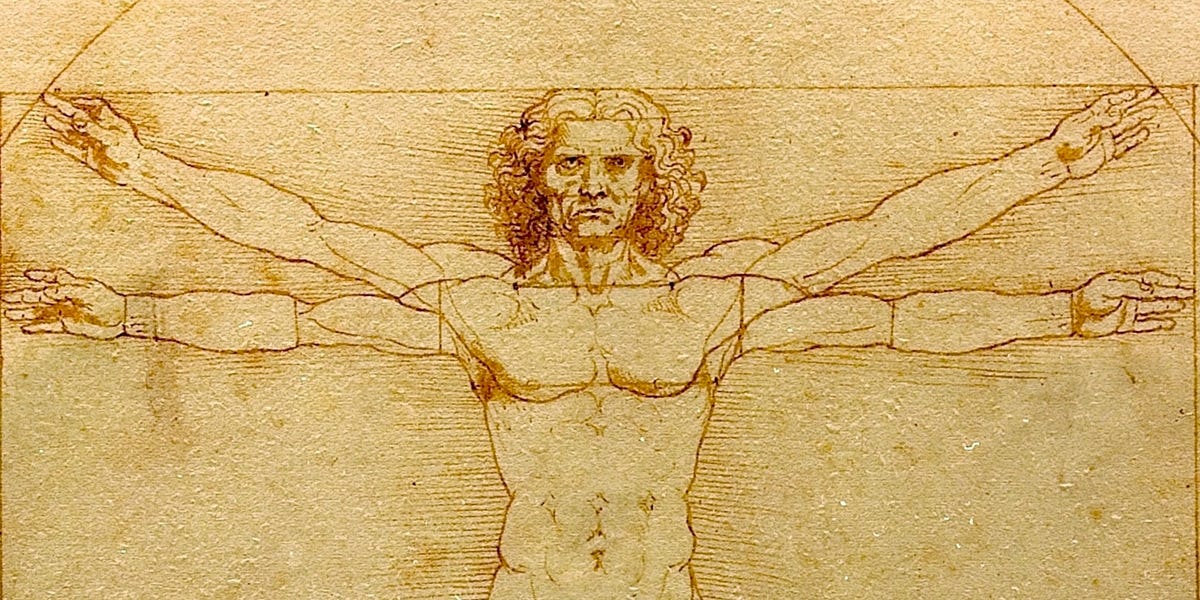
The math is not solvable (due to the nature of pi), but Leonardo solved it symbolically. He asked: perhaps humanity was so important that proportions of the body could solve geometrical puzzles? That's where this famous image comes in...

@Culture_Crit - Culture Critic
By measuring the "ideal" proportions of the male body against a square and circle, the Vitruvian Man solved the unsolvable problem. Notice the man's limbs are at two positions: touching the borders of the circle, and meeting perfectly at the edges of the corresponding square.

@Culture_Crit - Culture Critic
With a simple sketch, Leonardo showed that it is man himself who squares the circle. He can exist in both the earthly and the divine realms (the square or the circle) — it just depends on what he chooses...

@Culture_Crit - Culture Critic
Or, in other words, human beings do have a significant place in the universe. The unique place of uniting the earthly with the divine.


@Culture_Crit - Culture Critic
If threads like this interest you, I go deeper in my FREE newsletter! 91,000+ people read it every week: art, history and culture 👇 culture-critic.com/welcome
@Culture_Crit - Culture Critic
And here's the full article if you want to go deeper: Decoding the Vitruvian Man... https://www.culture-critic.com/p/decoding-the-vitruvian-man
@Culture_Crit - Culture Critic
If you enjoy these threads, please give the original post a retweet! 🙏 And I'll break down more of Leonardo's work... https://t.co/RLx9PesWY6
@Culture_Crit - Culture Critic
Deep in his notebooks, Leonardo da Vinci had a mind-blowing idea: That the human body is a scale model of Earth. And that's just the beginning — his theory will change the way you see everything… 🧵 https://t.co/JwzG6ds3sd

@Culture_Crit - Culture Critic
Is this the image of Jesus of Nazareth? New X-ray analysis just revealed the Shroud of Turin, Christ's alleged burial cloth, to be 2,000 years old. So here's what we know — and why it might just be real... (thread) 🧵

@Culture_Crit - Culture Critic
This 14-foot linen cloth, kept in Turin, is claimed by many to be the actual burial shroud of Christ — imprinted with a miraculous image of him. Can it possibly be real? What do we know about it?

@Culture_Crit - Culture Critic
According to the Gospels, Jesus was wrapped in a linen burial cloth after the Crucifixion by Joseph of Arimathea. The same man who owned the rock-cut tomb Christ was buried in.

@Culture_Crit - Culture Critic
It comes up again when the empty tomb is found (Luke 24:12): "But Peter rose and ran to the tomb; stooping and looking in, he saw the linen cloths by themselves." After these events, the shroud is not mentioned again in the Bible.

@Culture_Crit - Culture Critic
Other than indications it might've gone to Constantinople, we don't see it in the written record until it emerges in 1354 — in the hands of a knight. Geoffroi de Charny was a renowned warrior and crusader, but we don't know how he got it.


@Culture_Crit - Culture Critic
From there, the history is well documented up until it arrives at Turin Cathedral in 1578. It has lived there ever since and has its own purpose-built chapel.


@Culture_Crit - Culture Critic
Finally, in 1988, a piece of the shroud was carbon dated for the first time by three teams of scientists. The world stood and watched as the results came through...

@Culture_Crit - Culture Critic
The date: somewhere between 1260 and 1390 AD. Medieval, not ancient — and around the same time it came into the possession of that knight. So then, case closed? Not quite...

@Culture_Crit - Culture Critic
First, nobody has a clue how the image on the cloth was made — there's no pigment or dye present. The fibers themselves seem to be discolored to form the image, and the concentration of those fibers is what creates darker or lighter sections.

@Culture_Crit - Culture Critic
It also appears to be a photographic negative. In 1898, someone first noticed what happens when you reverse the image.

@Culture_Crit - Culture Critic
Its luminance correlates continuously with the distance from the body to the cloth — like a 3D image. Nothing like it has ever been seen on something this old. If this was a medieval hoax, simply pulling it off was a miracle in itself...

@Culture_Crit - Culture Critic
Then there are all the physical accuracies. The wounds are consistent with Roman crucifixion and the specifics of the Bible account: marks from the crown of thorns, stab wound in the side, lacerations on the back and bruises on the shoulders.

@Culture_Crit - Culture Critic
And even if this wasn't Christ himself, it appears at least to be the victim of a real crucifixion. Analysis of nanoparticles on the shroud revealed high levels of creatinine and ferritin — found in patients who suffer trauma, like torture.

@Culture_Crit - Culture Critic
There are too many other lines of evidence to cover in a summary thread: Pollen analysis suggesting plant pollen native to the Jerusalem; a weave pattern common in the ancient Middle East — not medieval Europe...

@Culture_Crit - Culture Critic
And though any ancient record is hard to establish, it seems the shroud might've had an impact on art way before 1354. Byzantine icons like the Sinai Pantocrator (6th century) appear strikingly similar. Before this icon, there was no standardized way to depict Christ in art.


@Culture_Crit - Culture Critic
Going back to the carbon dating, many argue that the analyzed corner piece was either contaminated or repaired in the Middle Ages. If the shroud was subject to contamination, or the samples not properly cleaned, it might be flawed.

@Culture_Crit - Culture Critic
And then there's the news that just landed. A new X-ray technique was used to study the aging of the linen's flax cellulose. It found that the breakdown of the cellulose matches that of other 2,000 year old samples — not medieval ones.

@Culture_Crit - Culture Critic
If it was just 7 centuries old, as the 1988 test suggests, the cellulose would have to have aged incredibly fast. To do that, it would have to have been kept at a temperature "very close to the maximum values registered on the earth".

@Culture_Crit - Culture Critic
Whatever you might think about the shroud, there's no doubting its mystery — modern science has yet to explain or replicate it. Perhaps it never will...

@Culture_Crit - Culture Critic
If this thread interests you, I go deeper in my FREE newsletter — do NOT miss the next one! 75,000 people read it: art, history and culture 👇 https://www.culture-critic.com/welcome
@Culture_Crit - Culture Critic
And because of the "3D" properties of the image, we've even been able to produce 3D, life-size models from it... https://t.co/T3qgZwW6Cc

@Culture_Crit - Culture Critic
Michelangelo's Sistine Chapel ceiling is history's greatest artwork — but what does it actually mean? Well, these are no ordinary Bible scenes. And there's one key detail that everyone ignored for centuries… (thread) 🧵

@Culture_Crit - Culture Critic
Man's greatest painting was made not by a painter, but a sculptor. Michelangelo was primarily a sculptor in 1508, when the Pope twisted his arm into adorning the chapel ceiling. He had never completed a fresco before...


@Culture_Crit - Culture Critic
That is evident in the 343 figures that look like they were "sculpted" onto the ceiling — muscular, powerful forms that borrowed from classical sculpture. So what did he actually paint up there?


@Culture_Crit - Culture Critic
In short, there are 9 scenes from Genesis across the center: the story of man's creation, and his fall from grace...

@Culture_Crit - Culture Critic
Including, of course, the Creation of Adam — perhaps the most famous image in history. The moment God gives the gift of life to the first man: "Let us make man in our image, after our likeness."

@Culture_Crit - Culture Critic
But there's so much more than meets the eye. For one thing, God reaches through what appears to be the prefrontal cortex of an anatomically correct brain...

@Culture_Crit - Culture Critic
And there's a brain stem concealed in God's neck. Michelangelo, an expert in anatomy, was creating a sort of treatise of the human body — celebrating the wonder of man's origin story.


@Culture_Crit - Culture Critic
And it's not only a celebration of the body, but the soul — imparted to Adam as if by an electric charge through his finger. Why isn't Adam's finger fully outstretched like God's is? Because to find God, we need only reach towards him as vigorously as he reaches towards us.

@Culture_Crit - Culture Critic
Then, surrounding the panels are all these nude figures called the Ignudi. They seem to frame each scene, but nobody really knows why. Perhaps they're simply reflecting Michelangelo's love of classical nude sculpture...

@Culture_Crit - Culture Critic
Around the outside are Old Testament prophets who predicted Christ's coming, like Isaiah and Zechariah. They're painted right into the architecture — except the ceiling is smooth. It was made 3D by architectural elements entirely painted on.


@Culture_Crit - Culture Critic
Then there are figures not from the Bible: the Sibyls. They're oracles from other ancient traditions who also foretold Christ's coming — from Persia to Libya. Anticipation of the saviour came from all across the ancient world...


@Culture_Crit - Culture Critic
But many have pointed out that the ceiling of the most holy space in Christendom doesn't actually contain any Christian (New Testament) theology. Why is that?

@Culture_Crit - Culture Critic
Well, there's one more clue. In Michelangelo's Garden of Eden, Eve isn't reaching for an apple — it's a fig...

@Culture_Crit - Culture Critic
In medieval Christian tradition, the Forbidden Fruit (not specified in the Bible) was always an apple. But Michelangelo's interpretation suggests he was familiar with the old Jewish tradition of a fig tree...

@Culture_Crit - Culture Critic
Why choose this? He was painting a path from the Hebrew Bible and the classical world right up to the Catholic Church. Other cultures weren't at odds with Christianity, but awaiting it — and it was time to unite them all...

@Culture_Crit - Culture Critic
Jesus isn't present on the ceiling, but everything leads up to him. From the millennia of prophecies that predicted him, to his Jewish ancestral family painted around the outside, to the need for salvation in the first place.


@Culture_Crit - Culture Critic
The ceiling is an almighty bridge connecting the Old Testament with the New — and the chosen people of Israel with their successors in the Catholic Church. Decades later, Michelangelo would return to complete the story above the altar: The Last Judgment...

@Culture_Crit - Culture Critic
I go deeper on topics like this in my FREE newsletter — you do NOT want to miss tomorrow's email! 66,000+ people read it: art, history and culture 👇 https://www.culture-critic.com/welcome
@Culture_Crit - Culture Critic
You've seen this before: Mont-Saint-Michel — the Wonder of the Western World. But did you know it has a twin, 200 miles away, also named after St. Michael? That's where things get really strange... (thread) 🧵 https://t.co/4gFMgHojJy

@Culture_Crit - Culture Critic
This is the "twin": St. Michael's Mount in Cornwall, England. It's also a tidal island with a chapel, remarkably similar to its French counterpart, and only accessible at low tide. https://t.co/hh4Mqb7Qew

@Culture_Crit - Culture Critic
Here's a map of the two. You can draw a line between them just over 200 miles long as the crow flies. But what happens if you keep extending that line? https://t.co/8mPUOv1Wog

@Culture_Crit - Culture Critic
You get this: a straight line all the way from Ireland to Israel. Along it are 7 medieval monasteries linked to the Archangel Michael. What are they, and is this just a strange coincidence? https://t.co/7wXGLlZo2l

@Culture_Crit - Culture Critic
St. Michael is one of the biblical archangels. He's best known for defeating Satan in the New Testament, and is usually depicted with a sword or spear during this heroic moment. Each point on the line has a curious link to him... https://t.co/tmqUxu7gAr

@Culture_Crit - Culture Critic
The westernmost point is an island called Skellig Michael. Medieval monks started worshipping here in the 7th century, and built a church honoring Michael around 950 AD. https://t.co/SRXooJw6Ji

@Culture_Crit - Culture Critic
Next is St. Michael's Mount. A monastery was built here in the 8th century, and it was later gifted to the same Benedictine order of Mont Saint-Michel. But local legend says the link is far older, and Michael was sighted here by fishermen in 495 AD. https://t.co/ULgdIBpvHL

@Culture_Crit - Culture Critic
Then, Mont-Saint-Michel in Normandy. People call it the 8th Wonder of the World for obvious reasons — it can be hard to believe it's a real place. This one has the most curious origin story of all... https://t.co/oqoa6hpUHD

@Culture_Crit - Culture Critic
In 708 AD, an oratory was built here by a local bishop. He had been visited by Michael in a series of visions and instructed to build a shrine on the island... https://t.co/TFKLtCwKmv

@Culture_Crit - Culture Critic
Why? Because this was the exact point at which Saint Michael defeated Satan (in the form of a dragon). This is stated in a 9th century Latin text recording the origins of Mont-Saint-Michel. https://t.co/h31M07Fa9i

@Culture_Crit - Culture Critic
Next is Sacra di San Michele, at the peak of Mount Pirchiriano (near Turin). It's also on an impressive pinnacle, and its origin story is a vision of St. Michael. In 980 AD, he appeared to a hermit and instructed him to build an abbey here. https://t.co/gVRC65XRCK

@Culture_Crit - Culture Critic
Next is even older. The Sanctuary of Monte Sant'Angelo is the oldest shrine dedicated to St. Michael in Europe. 8th century writings say he appeared in 490 AD, and again in 663 — when his spectacular apparition helped the Lombards defeat invaders in battle. https://t.co/N6RrpCAZ9y

@Culture_Crit - Culture Critic
Then, a small Greek island called Symi. Most of its religious buildings are dedicated to Michael, including this one in Panormitis. It dates all the way to 450 AD, and was built around a miraculous icon of Michael... https://t.co/VxIFhl8OBI


@Culture_Crit - Culture Critic
Last is the Stella Maris Monastery in Israel, on Mount Carmel — close to Nazareth. It's also a vantage point, but not dedicated to St. Michael. It's where the prophet Elijah lived, built over a small grotto of his... https://t.co/sKPgGzxxYl

@Culture_Crit - Culture Critic
Similar imagery to Michael is associated with Elijah, wielder of a sword. And the monastery is dedicated to the Virgin Mary — Queen of Angels. Perhaps it's fitting that the line ends here, at the entrance to the Holy Land... https://t.co/jndWwxUYSs

@Culture_Crit - Culture Critic
So, what is this all about? Some say the line represents the stroke of St. Michael's sword that sent Lucifer to Hell. But how accurate is the line exactly? https://t.co/5EtGTxIQnL


@Culture_Crit - Culture Critic
In order to capture all of 7 points in an arc connecting the end points, the line has to be about 20km wide. Sacra di San Michele falls exactly in line with the two extremes.

@Culture_Crit - Culture Critic
This is what's known as a "ley line". Of course, you can draw them between all sorts of places and eventually find one. There's even another relating to St. Michael across England: https://t.co/odHcQgKLQA

@Culture_Crit - Culture Critic
They're usually put down to sheer coincidence. But what about this one? Well, there are many more accounts from the Middle Ages of him appearing miraculously across Europe, and plenty of other sites bearing his name. https://t.co/TvnHeTL7Xz

@Culture_Crit - Culture Critic
But these are the most beautiful and significant of all, arranged curiously in one great swing of a sword. Were they named intentionally by medieval Christians to form a line? Or did they simply fall into place... https://t.co/WKZoRpzcEZ

@Culture_Crit - Culture Critic
Looking at Mont-Saint-Michel, it's certainly hard not to conclude it was divinely created… If you find this interesting you NEED my free newsletter! 50,000+ others read it: art, history and culture 👇 culturecritic.beehiiv.com/subscribe
@Culture_Crit - Culture Critic
Pilgrims have come from afar for 1,000 years. To cross to it from the shoreline is known as taking the "paths to paradise" — and it's easy to see why... https://t.co/rZIZPBmIty

@Culture_Crit - Culture Critic
Many of Europe's greatest architectural wonders were lost to history — or willingly demolished. Here are some you haven't heard of... 🧵 1. Neue Elbbrücke Bridge: torn down to add an additional lane https://t.co/hr71cK5ecw

@Culture_Crit - Culture Critic
Hamburg's greatest bridge was destroyed not by aerial bombs, but by urban planning zealots. The original, completed in 1887, had two beautiful neo-Gothic gateways — destroyed in 1959 to widen the bridge. https://t.co/jHoDaDr7c4

@Culture_Crit - Culture Critic
2. Pont Notre-Dame, Paris Medieval Paris had bustling "living bridges", with shops and homes towered 4 or 5 stories high. The Pont Notre-Dame's buildings were razed for sanitary reasons, and to avoid risk of collapse in the 18th century. https://t.co/ox4OGZ9p7s

@Culture_Crit - Culture Critic
3. Louvre Castle, Paris At the very heart of Paris once stood a massive, 12th century castle. It was built by King Philip II to reinforce the city walls, but demolished during the Renaissance to make way for the Louvre Palace (now home of the museum). https://t.co/RytJ9X7KQf

@Culture_Crit - Culture Critic
4. The Imperial Institute, London You could build an entire town out of London's lost gems. This majestic Victorian palace was built to celebrate Queen Victoria's Jubilee. Deemed too "inefficient" to keep, it was replaced in the 1950s by something modern... https://t.co/EcsoaMtJLS

@Culture_Crit - Culture Critic
5. Crystal Palace, London London once had the largest glass building ever seen, built for the 1851 World's Fair. Its 60,000 glass panels and iron beams went up in just 39 weeks — but it was razed in a fire in the 1930s. https://t.co/Ssf35MCJFC


@Culture_Crit - Culture Critic
6. Palace of Coudenberg, Brussels This enormous palace towered over Brussels for 700 years as a royal residence and hub of European diplomacy. It was completely destroyed when a fire broke out in the kitchens in 1731. https://t.co/9HVGKpGgdd

@Culture_Crit - Culture Critic
7. Cathedral of Christ the Saviour, Kharkov Stalin went on an anti-Christian rampage in the 1930s that destroyed thousands of iconic churches. This 19th century, Byzantine-style wonder near Kharkov (modern-day Ukraine) was razed to the ground. https://t.co/rsIv0aoPDP

@Culture_Crit - Culture Critic
It wasn't rebuilt, but thankfully, many were. The demolished Cathedral of Christ the Saviour in Moscow was rebuilt, to the original specifications, after the Soviet Union collapsed. https://t.co/FmMs7aUG9b


@Culture_Crit - Culture Critic
8. The Hippodrome of Constantinople This is how Istanbul would look today if its 100,000-capacity Roman circus had been saved. After the Ottomans sacked the city in 1453, chariot racing fell out of favor and the hippodrome forgotten — and its stone looted over time. https://t.co/f1qdiMGqBk

@Culture_Crit - Culture Critic
9. The Royal Opera House, Valletta One of Europe's most magnificent opera houses was obliterated by Luftwaffe bombs in WW2. It's 19th century, but its ruins (still kept as an open air theater) look like something far older... https://t.co/vF1SztEt64

@Culture_Crit - Culture Critic
10. Old London Bridge The world's greatest inhabited bridge was in London. A 12th century, 900-foot marvel — at the time considered a wonder of the world. It was only demolished in 1832 in a dilapidated state, when a bridge with a wider road was needed. https://t.co/mknh9qM9ud

@Culture_Crit - Culture Critic
If threads like this interest you, you NEED my free newsletter! Short articles on history, art and culture — 50,000+ people read it 👇 culturecritic.beehiiv.com/subscribe
@Culture_Crit - Culture Critic
One more: the Parthenon. You've heard of this, but you might not know why it looks like it does. In 1687, Turkish soldiers used it to store gunpowder, which exploded after a direct hit from a Venetian barrage. The Acropolis burned all through the night and the next day... https://t.co/s8bEnoehP8


@Culture_Crit - Culture Critic
Why do American cities feel less "alive" than their European counterparts? It's because of something called the "missing middle". A century ago, American cities looked completely different... (thread) 🧵 https://t.co/zwNWejfx4L

@Culture_Crit - Culture Critic
Millions make pilgrimages to Europe's centers every year. Architectural beauty is one thing, but they simply feel more vibrant and "alive" than American cities. But why is that?

@Culture_Crit - Culture Critic
In the early 20th century, American cities were much like European ones. They had smaller footprints relative to population, and people lived centrally enough to walk or take elegant streetcars to work. What happened? The "missing middle" was decimated... https://t.co/iD0G9izQDN

@Culture_Crit - Culture Critic
Missing middle housing is simply medium-density housing that bridges the gap between single-family homes and high-rise apartments. In America, there's very little in between. https://t.co/GzzZY7TuNt

@Culture_Crit - Culture Critic
Most American cities follow the same pattern: a cluster of downtown skyscrapers, then flat, urban sprawl for miles. They're segmented between suburban areas where people live, and downtown areas where they work. https://t.co/wnzDqxYGsb

@Culture_Crit - Culture Critic
European cities have more medium-density areas that are mixed-use: people living, shopping, working and worshipping in the same place. Urban communities come alive in these places. https://t.co/kgqDwrDJ9U

@Culture_Crit - Culture Critic
Before the 1940s, US cities did have "middle" housing options that brought this gentle density — like the two-flats of Chicago or triple-deckers in Boston. So what happened to America's missing middle?


@Culture_Crit - Culture Critic
Well, we demolished it — at least part of it. From the 1940s, decades of freeway construction gutted many of these areas. Entire communities were displaced in places like Kansas City and Minneapolis. https://t.co/ngp0sNh31f

@Culture_Crit - Culture Critic
Super highways cut through cities and shifted people out to suburbia. Inner city populations cratered: 521,000 lived in Minneapolis in 1950. This fell to 368k by the '90s, and never recovered (425k today). https://t.co/DxK5oPsmES

@Culture_Crit - Culture Critic
This was the site of the new I-35W which gutted Minneapolis. It was decided that new highways must "go right through cities and not around them." https://t.co/IbZnSM0OHY

@Culture_Crit - Culture Critic
Then, car-friendly laws and strict zoning made it impossible to build anything other than single-family homes or downtown tower blocks. In San José, 94% of residential land only allows single-family builds. https://t.co/FqGGgOP3XV

@Culture_Crit - Culture Critic
So, with everyone shifted to the suburbs, demand for places and amenities that create bustling urban communities evaporated — and everything got built around the motorcar. https://t.co/mfSrpwdYBc

@Culture_Crit - Culture Critic
Drive-thrus just don't do as much for the atmosphere as a cafe does in a local town square... https://t.co/oBTnCLe7rJ


@Culture_Crit - Culture Critic
This wrecked America's urban fabric. Plus, suburban sprawl meant inner cities lost their tax bases and fell into spirals of decline. https://t.co/qbWNUAvZLl

@Culture_Crit - Culture Critic
Still, residential developers have no choice but to build single-family homes or downtown skyscrapers. And towers don't fix anything — they're structures of inhuman scale that are even worse for community cohesion. https://t.co/MSP699yfZx

@Culture_Crit - Culture Critic
Changes are being made in some places. Minneapolis just relaxed its zoning laws to allow more multi-family homes to be built — but there's a lot left to do... https://t.co/Wf9X4p3nNH


@Culture_Crit - Culture Critic
Restoring the missing middle might be the first step to recapturing that old vision of what American cities can be. But can it ever undo the damage that was done? https://t.co/oVnzxD62Ye

@Culture_Crit - Culture Critic
My free newsletter covers topics like this every week: history, art and culture — 50,000+ readers. Do NOT miss the next email 👇 culturecritic.beehiiv.com/subscribe
@Culture_Crit - Culture Critic
One more comparison: how Milwaukee was transformed for the interstate — 1940s vs today... https://t.co/iEqTRW3IGp

@Culture_Crit - Culture Critic
You've seen this image before. It's Leonardo da Vinci's "Vitruvian Man" — but who actually was he? Well, the Renaissance masters were all imitating a man who lived over 1,000 years earlier. When his work was discovered in an old library, it changed everything... (thread) 🧵 https://t.co/L1A5PK8jm0

@Culture_Crit - Culture Critic
Da Vinci was fascinated by how geometries of nature could be applied to art and engineering. He studied the ancient structures around him — to understand how they were built, and the ratios encoded within them... https://t.co/6JWSkNXD6w

@Culture_Crit - Culture Critic
In 1416, an ancient text was rediscovered in a library in Switzerland, and it changed everything. It was called De architectura, by a Roman architect named Vitruvius. It was the book that founded the study of architecture...


@Culture_Crit - Culture Critic
Vitruvius explained the principles of classical architecture and how to build it: appropriate dimensions to use, the required thickness of walls, how to calculate correct slopes... https://t.co/kLUvwkQvCi

@Culture_Crit - Culture Critic
Above all, he explained that buildings should have symmetry and proportion — this makes them harmonious and connects them with nature. They should be constructed using precise ratios, with every part of the building in proportion to the rest. https://t.co/VPgBYFo3bU

@Culture_Crit - Culture Critic
Renaissance architects embraced these principles of symmetry and harmony, using them to build some of the most beautiful structures ever seen — modeled on the architecture of antiquity... https://t.co/qo8dkMoPtC

@Culture_Crit - Culture Critic
But what fascinated da Vinci most was Vitruvius' astounding idea: That the ideal ratios for building could be found in the human body. Vitruvius described how placing a man inside a square and circle yielded the ideal proportions for a church... https://t.co/oLLbq8ZzL6

@Culture_Crit - Culture Critic
It wasn't only Leonardo intrigued by this. One architect attempted to draw Vitruvius' description, and another measured a man against a church floor plan... https://t.co/wC8fzRxOJk


@Culture_Crit - Culture Critic
It was all linked to an ancient, unsolvable math problem called "squaring the circle": How do you draw a square with the same area of a circle, using only a compass and straightedge? https://t.co/VZBStdL7Gr

@Culture_Crit - Culture Critic
This question was of profound, symbolic significance, because the circle represented the divine and infinite, while the square was earthly and finite. The problem is not in fact solvable (due to the nature of pi), but Leonardo solved it symbolically...
@Culture_Crit - Culture Critic
He placed the man with his naval at the center of the circle, and his genitals at the center of the square. His outstretched arms touch the edge of the square — and the edge of the circle when raised. https://t.co/3mdT2jGCsr

@Culture_Crit - Culture Critic
It's one of the most famous images of all time — but why? The drawing is clearly beautiful (and was probably a self-portrait), but it encapsulated something deeper.. https://t.co/ISPqETUEUR


@Culture_Crit - Culture Critic
Underpinning the Renaissance was the idea that man was the center of the universe. Perhaps humanity was so important that proportions of the body could solve ancient geometrical puzzles? Geometry was the language of the universe, and God the divine geometer... https://t.co/BZqBa86zwz

@Culture_Crit - Culture Critic
Using geometry, Leonardo showed that man can exist in both the earthly and divine realms (the square or the circle) — depending on what he chooses. https://t.co/3iI1jSrrS8

@Culture_Crit - Culture Critic
That humanistic idea is why the art of the time was so uplifting. Michelangelo's David was supposed to inspire passers-by with the potential of what man can be at his best...

@Culture_Crit - Culture Critic
And it's why the Greeks built architecture to feel human. Their harmonious designs were no accident, drawing on the geometries of nature. Vitruvius preserved the formula, and it's still used in every corner of the globe today.

@Culture_Crit - Culture Critic
The Vitruvian Man was genius for bringing all this together. A simple notebook sketch that put man at the center of the universe — and became a symbol of Renaissance humanism that will never be forgotten... https://t.co/SS0oyikoTF

@Culture_Crit - Culture Critic
If we're going to create art like this again, we need a worldview centered on the importance of humanity. I go deeper in my free newsletter — 46,000+ read it: art, history and culture 👇 culturecritic.beehiiv.com/subscribe
@Culture_Crit - Culture Critic
How much human knowledge has been lost to history? Well, this ancient wonder was razed by the Mongols in 1258 — it's said the Tigris River ran black with ink. Here's what was inside... (thread) 🧵 https://t.co/fa3z5ga2ck

@Culture_Crit - Culture Critic
1,200 years ago, the world's largest city was Baghdad (modern-day Iraq) — 1.5 million lived there at its peak. The Round City, a masterpiece of urban planning, contained one of history's greatest libraries. https://t.co/WsjpF7zx88

@Culture_Crit - Culture Critic
Baghdad was then an intellectual capital of the world. Scholars came from all across the Islamic empire, and the ruling Caliphs were eager to collect their knowledge under one roof: The House of Wisdom. https://t.co/AdTRID3rOP

@Culture_Crit - Culture Critic
When the city was sacked after 500 years, the Islamic Golden Age came to an end — alongside a devastating loss of knowledge. But what was actually in there? How significant was the loss? https://t.co/2FK6AxEYX3

@Culture_Crit - Culture Critic
The House of Wisdom was foremost a place where knowledge was transferred. Many classical texts by that point were lost in Europe, because after the Roman Empire collapsed, copies of texts weren't often being made.

@Culture_Crit - Culture Critic
Texts were translated into Arabic from Persian, Syriac and Greek, including some of the rarest Greek materials in existence: Plato, Aristotle, Euclid, etc. Some were so precious that Caliphs paid translators their weight in gold to translate them. https://t.co/zmzPNas5PU

@Culture_Crit - Culture Critic
We know works of philosophy, medicine, astronomy, optics and mathematics were copied — but original research also flourished. Foundational work was done in algebra, and in the pioneering of medical techniques. https://t.co/iYwtdxFTVq


@Culture_Crit - Culture Critic
So much knowledge was stored there by the 13th century that the Tigris apparently ran black with ink when the Mongols sacked it. One source says: "So many books were thrown into the river that they formed a bridge that would support a man on horseback." https://t.co/3JsW0YyP84

@Culture_Crit - Culture Critic
We don't know how much was lost, but c.400,000 manuscripts were evacuated before the siege. Given the numbers involved, losses might have been as significant as at the Library of Alexandria — where estimates range in the hundreds of thousands. https://t.co/SeNqdfVU29

@Culture_Crit - Culture Critic
It's obviously impossible to know what was lost in the great libraries — so put it this way: All of our knowledge of the Greco-Roman world comes from some 500 volumes. 700,000 scrolls were potentially lost at Alexandra alone. https://t.co/uwjj4seo8e

@Culture_Crit - Culture Critic
Catastrophes of this kind might seem like they set humans back centuries with a single blow. The truth is, cultures usually die much earlier... https://t.co/fkRgjaNkmU

@Culture_Crit - Culture Critic
When the House of Wisdom burned, it was already in rapid decline under the reign of new Caliphs. A literal interpretation of the Quran was being embraced, scientific rationalism abandoned, and Greek philosophy seen as anti-Islamic.
@Culture_Crit - Culture Critic
Same in Alexandria: by the time the library was burned down (in part) by Caesar's men in 48 BC, it was already in disuse and decay. https://t.co/RDl7hkcGzW

@Culture_Crit - Culture Critic
Texts through history were lost not because of fires, but because they weren't copied in the first place — cultures need a reason to preserve them. Many survived because they were in school curricula for centuries. That's why so many copies of Virgil, Homer and Aristotle exist. https://t.co/RInbJn406z


@Culture_Crit - Culture Critic
When the Round City fell, the spirit that inspired the translation movement was long gone. Perhaps as much knowledge was lost by what wasn't translated in those final years, than during the eventual destruction. https://t.co/WsHjqvUUtP

@Culture_Crit - Culture Critic
Cultures aren't simply lost at the hands of ransacking barbarians. They're lost because they die first from something much worse: indifference... https://t.co/S9SlSw7Yz1

@Culture_Crit - Culture Critic
If threads like this interest you, you NEED my free newsletter! Art, history and culture: 36,000 others read it 👇 culturecritic.beehiiv.com/subscribe
@Culture_Crit - Culture Critic
Conclusion: Preserving knowledge (and culture) requires more than a good set of barbarian defenses. It requires a constant state of tending and diligence... https://t.co/bmzZodsz4Q

@Culture_Crit - Culture Critic
America built some of the world's greatest architecture... and then demolished it. A thread of wonders that were lost (and why)... 🧵 1. Cincinnati Library: replaced by a parking garage https://t.co/ip1awUWEzY

@Culture_Crit - Culture Critic
The most beautiful library ever built in the US, with towering cast-iron book alcoves. An institution since 1874, it was demolished in 1955 and the library moved to a new site with more space. Today, a parking garage stands in its place. https://t.co/c8IGB4OByC


@Culture_Crit - Culture Critic
2. The Chicago Federal Building (1905 - 1965) Demolished to make way for larger premises that more government departments could fit into: the modernist Kluczynski Federal Building. https://t.co/ZEkkl5bPOQ

@Culture_Crit - Culture Critic
Chicago lost what was the largest dome in the US (larger even than the US Capitol), and a wonder of the Beaux-Arts era. https://t.co/4TpLnx5Uqt


@Culture_Crit - Culture Critic
3. Old Waldorf-Astoria Hotel, NYC (1893 - 1929) If you ever wondered what was demolished to make way for the Empire State Building, this is it. A German Renaissance design containing the world's largest hotel — which also set the standard for luxury. https://t.co/ud99mzJ1CR

@Culture_Crit - Culture Critic
4. The Singer Building (1908 - 1968) Maybe the greatest of the early skyscrapers, and once the tallest building on Earth. When its antiquated floor plan was deemed too inefficient for modern use, it was razed — and replaced by something far less dignified... https://t.co/VtjPeNVuLL

@Culture_Crit - Culture Critic
5. Garrick Theater, Chicago (1891 - 1961) A wonderfully ornate theater inside what was a landmark of early modern architecture (by Louis Sullivan). Despite considerable protest, it was demolished for a parking garage. https://t.co/bmXH2ztspI

@Culture_Crit - Culture Critic
6. Old Penn Station, NYC (1910 - 1963) New York's majestic gateway might be the greatest train station ever built. After just 50 years, it was demolished to make way for Madison Square Garden, and the station pushed underground… https://t.co/wvFrNem4xk


@Culture_Crit - Culture Critic
7. The “Mayan Revival” Fisher Theatre, Detroit (1928 - 1961) This theater still stands (inside the Fisher Building in Detroit), but it was gutted in the 1960s so it could be "modernized". https://t.co/NEdrjpEzAU

@Culture_Crit - Culture Critic
8. Old Metropolitan Opera House, NYC (1883 - 1967) When the Metropolitan Opera Association moved to a new venue, rather than risk competition from a new company buying the Old Met, they handed it to developers. It was demolished for bland commercial property to be built. https://t.co/AJrjtk2WcO

@Culture_Crit - Culture Critic
9. Old Detroit Library (1877 - 1931) Like the one in Cincinnati, it had a huge atrium (five-stories) with skylights, ornate iron railings and towering columns. Scaling the tall bookshelves was deemed an inefficient way to run a library in the modern world, so it was demolished. https://t.co/OIr3qr8jrj

@Culture_Crit - Culture Critic
10. Festival Hall, St. Louis, (1904 - 1905) A gem of classicism that became an icon of the World's Fair held in St. Lous. It was built as a temporary structure (plaster and wood) to host large-scale musical pageants. https://t.co/MAFtvxgd5M

@Culture_Crit - Culture Critic
11. Erie County Savings Bank, Buffalo (1893 - 1968) A truly unique, Romanesque design that was the city's most beloved building. It was demolished in an "urban renewal" project of the 1960s that saw a bland, modernist tower built instead. https://t.co/zXuqfzAtwb

@Culture_Crit - Culture Critic
To explore the beauty of the old world (and much more), join my free newsletter. 33,000 others read it too (art, culture and history) 👇 culturecritic.beehiiv.com/subscribe
@Culture_Crit - Culture Critic
Why does everywhere look exactly the same? The death of local architecture, and why it matters... (thread) 🧵 https://t.co/xkymb2MADc

@Culture_Crit - Culture Critic
Take Frankfurt: a modern city of glass and steel - it looks like it could be anywhere in the world. And 50 more towers are currently going up... https://t.co/lX9BbhM8O7

@Culture_Crit - Culture Critic
Frankfurt was of course once very different. A devastating amount of its traditional architecture was lost in the war, like the wonderful Salzhaus: https://t.co/pYwmxEXu8z

@Culture_Crit - Culture Critic
A century ago, a German home was nothing like an American one, which was nothing like an Indonesian one. They all had unique shape, materials and character - they were from somewhere.


@Culture_Crit - Culture Critic
That's because of "vernacular architecture", which: • Used local, natural materials and techniques • Didn’t adhere to academic or technical styles • Expressed its environmental and historical context This architecture told the stories of its origins... https://t.co/L8gHBo3RNK


@Culture_Crit - Culture Critic
Take the iconic stave churches of Norway, for example. They tell a fascinating story: The Christian conquest of the Norse world... https://t.co/Ogz33eZM6o

@Culture_Crit - Culture Critic
When missionaries carried Christianity north, they brought with them memories of the Romanesque basilicas of the Mediterranean. The churches they built were imprinted with Norse traditions: pillared wooden interiors and doors carved with intricate knots and swirls. https://t.co/wQCEW2Rnad

@Culture_Crit - Culture Critic
Another example: when you think of a German home, you picture tall black-and-white townhouses of plaster and wooden beams. You’re thinking of fachwerk, or half-timbered houses.

@Culture_Crit - Culture Critic
Medieval German builders learned to make timber skeletons, then filled them with whatever material they had - mostly clay and sand. Clay was unpopular with nobles, so they added on white plaster to hide the cheap material. https://t.co/zKbXXEX45r

@Culture_Crit - Culture Critic
The timber frames were surprisingly stable: enough to support more storeys than before (so builders stacked up high-rising townhouses) and able to bear the weight of turrets and spires. https://t.co/d1qXbHD0JQ

@Culture_Crit - Culture Critic
Vernacular architecture is therefore a kind of cultural memory. It encapsulates the collective wisdom and worldview of prior generations. Modern architecture has since lost sight of what a building is supposed to be, and reduced it to something to be merely used.

@Culture_Crit - Culture Critic
That philosophy was at the core of modern architecture. Le Corbusier, one of the first modern architects, saw the home as "a machine for living in." If a building is simply for its utility, who cares how it looks or what message it carries? https://t.co/k092JfAa7s


@Culture_Crit - Culture Critic
This is partly why European towns built back as they did after the war. Partly due to efficiency, but also the new idea that "form follows function". Architectural schools merged new materials with the idea that aesthetics are secondary to utility. Berlin, then and now: https://t.co/XUbsQzxU8T

@Culture_Crit - Culture Critic
The dreary sameness that now exists everywhere was born out of an industrialized, globalized world - architecture no longer relied on local materials and craftsmanship. Steel beams, glass and sheet metal were readily available. https://t.co/U3nP3c4hCz

@Culture_Crit - Culture Critic
The "international style" architecture soon emerged - fitting for one which comes from nowhere but exists everywhere. Buildings that originated not from local forms and traditions, but in the mind of a Bauhaus architect - and then dumped in every corner of Europe and beyond. https://t.co/IZOZ8u4pmF

@Culture_Crit - Culture Critic
All of this matters because we have an inherent need to belong somewhere. A built environment that tells no story, and carries no generational wisdom, is incapable of fostering the growth of community - or inspiring pride in one's surroundings.

@Culture_Crit - Culture Critic
The scientific evidence for this is inescapable: ugly, impersonal environments make us feel depressed and isolated. Humans are made for human-scale homes and streets, not to be piled into tower blocks. https://t.co/CAcDfo2W2H

@Culture_Crit - Culture Critic
And the idea that architecture need not feel human did perhaps irrevocable damage to our urban centers in the 20th century. https://t.co/A45oahtEzS

@Culture_Crit - Culture Critic
Fortunately, places around Europe are slowly throwing off the architecture of the postwar era and recovering their old identities. Just look how some old towns are starting to heal... https://t.co/dyoJJaRyHo

@Culture_Crit - Culture Critic
I went into more detail on this topic in my weekly newsletter (free). Art, culture and history - 25,000+ readers 👇 culturecritic.beehiiv.com/subscribe
@Culture_Crit - Culture Critic
Why did we stop? A brief history of marble sculpture in 9 masterpieces... (thread) 🧵 https://t.co/mRPYW0rzzj

@Culture_Crit - Culture Critic
1. Laocoön and His Sons (c.323 BC - 31 AD) The first truly advanced and naturalistic sculptures came from Ancient Greece - marble was the preferred medium from which to extract extreme detail. And they usually depicted idealized human anatomies... https://t.co/aOopbW4vJV

@Culture_Crit - Culture Critic
This one came from the Hellenistic era, when sculptures accelerated from static, graceful figures to far more expressive ones. Because this was rediscovered in Rome during the Renaissance, many thought it wasn't genuine, and that Michelangelo himself must've carved it. https://t.co/JeDyxOhFug

@Culture_Crit - Culture Critic
2. Augustus of Prima Porta (c.20 BC) The Romans inherited the love of marble, often reproducing old Greek bronzes with stone. The Ancient Greeks had depicted their gods as naturalistic, earthly figures - the Romans instead carved their human rulers as glorious and godlike. https://t.co/t1S8YZ8Kwv

@Culture_Crit - Culture Critic
3. Pisa Baptistery pulpit - Giovanni Pisano (1310) Medieval sculpture focused less on realistic, life-sized subjects, and more on symbolic, religious scenes. Stylized reliefs and statues of Biblical events were made for altarpieces, pulpits and church façades across Europe... https://t.co/KhgyQQNacC


@Culture_Crit - Culture Critic
4. La Pietà - Michelangelo (1499) The Italian Renaissance was the first time the mastery of the Greeks was surpassed, and interest in naturalism renewed. A 24-year-old Michelangelo stunned Rome when he unveiled this depiction of Mary and Jesus... https://t.co/cnO7JKzpg7

@Culture_Crit - Culture Critic
Classical beauty and naturalism were now combined in a new way: The human forms are idealized and Mary appears youthful and serene. But she also has an expression of deepest grief, and the anatomical precision took things to an entirely new level. https://t.co/fubl7CgPHx

@Culture_Crit - Culture Critic
5. David - Michelangelo (1504) Still in his twenties, Michelangelo defined Renaissance art yet again. David was a classical expression of what man can be... https://t.co/jk5tCDmvBU

@Culture_Crit - Culture Critic
But he went far further than the Greeks could - incorporating anatomical accuracies he learned from dissecting corpses. A century later, scientists made anatomical discoveries that Michelangelo knew - like the bulging jugular vein fitting for someone in a state of fear... https://t.co/cBQAZCDmSt

@Culture_Crit - Culture Critic
Michelangelo was the ultimate naturalist: he believed his goal was "to liberate the human form trapped inside the block by gradually chipping away at the stone surface". https://t.co/xKEvdGGk63

@Culture_Crit - Culture Critic
6. The Abduction of Proserpina, Gian Lorenzo Bernini (1622) The Baroque era saw new energy and movement injected into marble. Motion is evident if every inch of Bernini's depiction of Pluto dragging Proserpina off to the underworld... https://t.co/XnuQt9WwI5

@Culture_Crit - Culture Critic
To exemplify the shift in focus, just look at the difference between Michelangelo's David and Bernini's version. https://t.co/oijXQ54FvO


@Culture_Crit - Culture Critic
7. Release from Deception - Francesco Queirolo (1759) The medium was stretched to its technical extreme in the Rococo era. One Italian master spent 7 years of his life carving this unthinkably intricate net from a single block of stone... https://t.co/eq0WjR4jdO

@Culture_Crit - Culture Critic
Artists in his era continually one-upped each other with more and more difficult technical feats. A few years earlier, contemporaries of Queirolo unveiled these: Sanmartino's "Veiled Christ" and Corradini's "Modesty". https://t.co/DN83KHqQVt


@Culture_Crit - Culture Critic
8. The Three Graces - Antonio Canova (1817) The neoclassical era took sculpture back to the graceful, classical ideal. Many consider Canova the last great sculptor of marble - he could carve almost anything from it, his biggest leap being impossibly supple skin. https://t.co/oPMYmwQYZc

@Culture_Crit - Culture Critic
9. The Veiled Virgin - Giovanni Strazza (c.1850) The exquisite draperies from antiquity were finally perfected in the 19th century: solid stone could be made translucent. Probably nobody took this further than Strazza did with his depiction of the Virgin Mary... https://t.co/GeEiEFpsz4

@Culture_Crit - Culture Critic
At the turn of the 20th century, modern sculptors like Rodin executed their best works in other mediums (like bronze), but with no lesser craftsmanship. His epic bronze Gates of Hell took 37 years to finish. https://t.co/iUQRmosRbP

@Culture_Crit - Culture Critic
After Rodin, marble was still used fairly regularly, but in an abstract sense. The properties of marble, like its luminosity, were from then on used for reasons other than realism. https://t.co/nvgr9NCKNr


@Culture_Crit - Culture Critic
So why did we stop producing marble sculpture of earlier standards? Perhaps it was the stifling cost of the stone, or maybe all that could be achieved with marble had already been done... https://t.co/aKO9h9Otsg

@Culture_Crit - Culture Critic
Or perhaps we simply lost the necessary conviction - marble is so unforgiving that a single mistake can undo years of work. A better question might be: what inspired them to do it in the first place? https://t.co/qCbBybgu8R

@Culture_Crit - Culture Critic
If threads like this interest you, you NEED my weekly newsletter (free)! Art, culture and history - 25,000 other readers 👇 culturecritic.beehiiv.com/subscribe
@Culture_Crit - Culture Critic
This building is nearly 2,000 years old. How can something so ancient, of such scale, still be standing? The answer might surprise you... (thread) 🧵 https://t.co/SAJKm1yODE

@Culture_Crit - Culture Critic
Rome's Pantheon (built by Emperor Hadrian between 119-128 AD) is 142 feet in diameter. Nobody has ever built a bigger unreinforced concrete dome to this day. How on earth did they do it? https://t.co/lKYd1HEmlE

@Culture_Crit - Culture Critic
The Romans believed in wide open spaces, uninterrupted by columns and interior walls like the Greeks used. They wanted interiors to be as inspiring as the exteriors. So, they innovated mighty hemispherical domes, setting the precedent for millennia to come. https://t.co/ux2n3Ul57L

@Culture_Crit - Culture Critic
What made it possible was their ancient formula for concrete. Incredibly, it wasn't until some research by MIT in 2022 that we truly understood this: the Romans' recipe involved volcanic ash which allows concrete to "self-heal". https://t.co/my7kOFt3Z6

@Culture_Crit - Culture Critic
Roman concrete had calcium carbonate lumps called "lime clasts": previously thought to be the result of poor mixing. We now know that water seeping in through cracks in the concrete dissolves the calcium carbonate, forming a solution which then recrystallizes to plug the gaps. https://t.co/qPt02ECVEJ

@Culture_Crit - Culture Critic
The volcanic ash probably came from Mount Vesuvius, near Naples. The Romans once shipped 20,000 tons of it across the Mediterranean to construct the harbour at Caesarea Maritima in Israel: https://t.co/FwQT0MQY21

@Culture_Crit - Culture Critic
After the Roman Empire fell, the recipe was lost. Only in the 15th century, when a manuscript resurfaced with notes on the recipe, was the race to "re-invent" concrete reignited. https://t.co/uJ2xJ8t6WQ

@Culture_Crit - Culture Critic
Even today, the concrete we use still hasn't really caught up. It might be stronger, especially when reinforced by steel bars, but it's not as evergreen - those bars tend to corrode over time. https://t.co/3NPcrryAfN

@Culture_Crit - Culture Critic
The Pantheon boasts several other architectural innovations, too. The coffered ceiling reduced the weight of the dome, and the mix of concrete was exceptionally light by design - decreasing in density as you move up the dome. https://t.co/ibRWheEdQo

@Culture_Crit - Culture Critic
Its most striking feature is a 27-foot wide oculus (itself contributing significant weight reduction). It is completely open to the elements and functions as the building's only light source. https://t.co/qWGTLV1Jys

@Culture_Crit - Culture Critic
Many believe it was once a giant sundial. Every year at noon on 21 April, traditionally the birthday of Rome, the sun’s rays light up the entrance. Imagine the Emperor entering the building on such occasions being bathed in glorious sunlight... https://t.co/H10am7M2nq

@Culture_Crit - Culture Critic
The Pantheon's longevity is nothing short of an architectural miracle. One which weathered invasions and earthquakes for centuries. And it will likely stand for several more millennia. https://t.co/XTrjlkJEmx

@Culture_Crit - Culture Critic
But why are there so few Roman structures that survived this perfectly? The Romans built to resist centuries of persistent onslaught from mother nature - but not looting. https://t.co/XFwpbje0vL


@Culture_Crit - Culture Critic
Imperial Rome's great buildings were plundered for their materials for centuries. A single quarryman once took 2,522 cartloads of travertine from the Colosseum in 1452. https://t.co/WCbnxV7sTY

@Culture_Crit - Culture Critic
The real reason we get to enjoy the Pantheon in its present condition? In 609 AD it was converted into a church by the Pope, safeguarding it from looters. And it’s still a church to this day, named the Basilica of St. Mary and the Martyrs. https://t.co/Pej8VNYw99

@Culture_Crit - Culture Critic
Unsurprisingly, the Pantheon's wondrous dome inspired countless more over the ages. Most notably perhaps is Brunelleschi's design in Florence. That however was built from brick - the ancient concrete formula being long since forgotten. https://t.co/gRNNwptRiI

@Culture_Crit - Culture Critic
The Pantheon even won the endorsement of Michelangelo, architect of the dome of St. Peter's Basilica. Seeing it for the first time in the early 1500s, he called it "an angelic and not a human design". https://t.co/JQJWSQMx7C

@Culture_Crit - Culture Critic
Lovers of great architecture, art and history NEED my weekly newsletter - do NOT miss tomorrow's. Join 23,000+ other readers (for free) 👇 culturecritic.beehiiv.com/subscribe
@Culture_Crit - Culture Critic
The annual Pentecost tradition is a moment of extraordinary beauty. Thousands of rose petals are dropped through the oculus as a choir sings "Veni Sancte Spiritus", known as the Golden Sequence... https://t.co/SuoHgq2N0a
@Culture_Crit - Culture Critic
Where did this depressing architecture come from? Is it really designed to demoralize us as @TuckerCarlson says? A thread... 🧵 https://t.co/5hqZ5cyNjf

@Culture_Crit - Culture Critic
Yesterday, Tucker went viral on architecture (watch the full clip): "Buildings that are warm and human and that elevate the human spirit are pro-human. Brutalism for example, or the glass boxes that crowd every city in the US, those are not." https://t.co/sDxGFImUb6
@Culture_Crit - Culture Critic
He is right, Brutalist architecture is anti-human. It's inextricably linked to sinister social engineering - an attempt to subdue the spirit of humans as individuals, and reduce them to property of the state. https://t.co/tK2VtrpagE

@Culture_Crit - Culture Critic
Above is Soviet-era housing in Moscow. But why did theaters in England go from this (left) to this (right)? https://t.co/MnQ6ALAjDj


@Culture_Crit - Culture Critic
In 1945, the world had to be rebuilt. An efficient way to do it was with cheap, fast to put up materials: concrete, steel, sheet metal. But were postwar styles like Brutalism about more than cost? https://t.co/lZBPRwzRjh

@Culture_Crit - Culture Critic
Well, Vladimir Lenin once said: "Only by abolishing private property and building cheap and hygienic dwellings can the housing problem be solved." For one thing, he believed that only government can solve a housing crisis. https://t.co/JBN4bNUa0c

@Culture_Crit - Culture Critic
Above all, he thought the proletariat can only be properly led by a "vanguard party": a hyper-class-conscious group that would guide them out of their prejudices and into the "right beliefs." His line of thinking was a fundamental mistrust of ordinary people. https://t.co/DcFlbUD0sL

@Culture_Crit - Culture Critic
The Bolsheviks deemed vernacular architecture (built by ordinary people with local materials) "unhygienic". Lenin was afraid that if people built by themselves, they might default to bourgeois behavior, like beautifying one’s property to stand out from the rest. https://t.co/eNquHlaFHw

@Culture_Crit - Culture Critic
Russian communism therefore found its perfect ally in what became brutalism: cheap, conformist, and centrally planned. And after WW2, socialism was quickly capturing the Western intelligentsia too - and Western architects. https://t.co/ktFWMBOvXl

@Culture_Crit - Culture Critic
The real marriage of communism and concrete was officiated not by Lenin, but by a Swiss-French architect - Le Corbusier... "We must create a mass-production state of mind… a state of mind for living in mass-production housing." https://t.co/ekaI80VdQl

@Culture_Crit - Culture Critic
He thought the world was enslaved to outdated traditions and ideals of beauty. To him, homes were mere "machines for living in", and should be severe, blank and angular - he would tell the masses what was good for them. https://t.co/32yAefTCNr

@Culture_Crit - Culture Critic
In his brave new world, all cities must look the same. Undifferentiated houses would prevent any impulse toward owning private property. "Oslo, Moscow, Berlin, Paris, Algiers, Port Said, Rio or Buenos Aires, the solution is the same", he raved. https://t.co/AlPoJPV63O

@Culture_Crit - Culture Critic
He even planned to demolish vast swathes of Paris for this... https://t.co/Kq8FSuD409

@Culture_Crit - Culture Critic
Those plans were thrown out, but his ideas spread: the Paris plans were showcased around the world, and Le Corbusier became the first modern architect. https://t.co/2m8PmiPY5F

@Culture_Crit - Culture Critic
His style later became Brutalism (from the phrase "béton brut" meaning "raw concrete"), which sprang out of the postwar construction crisis and did irrevocable damage to cities across Europe and elsewhere. Even churches became hunks of concrete: https://t.co/NXjz4G0ELU

@Culture_Crit - Culture Critic
Le Corbusier set in motion a new architecture which rejected the need for outward beauty. Architecture was to focus not on what an ornamental façade can do for the senses, but on space, light and function at the cost of all else. https://t.co/VI1EEORa30

@Culture_Crit - Culture Critic
From then on, architects simply knew what's good for us... https://t.co/FF63KUUTLK

@Culture_Crit - Culture Critic
I discuss topics like this every week in my newsletter. Join 23,000 readers (completely free!) 👇 culturecritic.beehiiv.com/subscribe
@Culture_Crit - Culture Critic
And if your goal was to demoralize, this is exactly what you would do... https://t.co/f3WylJ3Nue

@Culture_Crit - Culture Critic
I asked X: "What is the one book that changed your life the most?" These were the top 15, in order... (thread) 👇 15. Brave New World, Aldous Huxley https://t.co/ZLq2o3vCwq


@Culture_Crit - Culture Critic
9. How to Win Friends and Influence People - Dale Carnegie https://t.co/Bzfn99t6GJ


@Culture_Crit - Culture Critic
And by far the most common suggestion... 1. The Holy Bible https://t.co/GWystiOjvN

@Culture_Crit - Culture Critic
Reminder: I often discuss great literature in my weekly newsletter (free)! Art, architecture, history, and much more 👇 culturecritic.beehiiv.com/subscribe
@Culture_Crit - Culture Critic
These were some other very popular ones: • Orthodoxy - G.K. Chesterton • Man's Search for Meaning - Viktor Frankl • Outwitting the Devil- Napoleon Hill • The Creature from Jekyll Island - G. Edward Griffin https://t.co/dC5MSLsjTu


@Culture_Crit - Culture Critic
This 500-year-old sculpture is one of the most haunting artworks ever made. And it tells an unforgettable story... (thread) 🧵 https://t.co/ST0ZERUDpS

@Culture_Crit - Culture Critic
It's by Renaissance sculptor Marco d'Agrate: a rare example of an écorché (a figure showing the muscles of the body without skin) in sculpture. Many artists at that time studied anatomy in this way, most notably Leonardo da Vinci: https://t.co/AxY6PHE17C

@Culture_Crit - Culture Critic
But this one was executed both in impossible detail and at life-size scale, from solid marble... https://t.co/kYL3ZqlHrH

@Culture_Crit - Culture Critic
Its subject is even more remarkable - a man who suffered the most excruciating demise imaginable. Saint Bartholomew was one of Christ's twelve apostles, known for bringing Christianity to India and Armenia in the 1st century. https://t.co/Ng40qfVZxJ

@Culture_Crit - Culture Critic
Like many Christian martyrs, his demise was brutal. A common account tells that he was skinned alive and then beheaded, in punishment for converting the king of Armenia to the faith. https://t.co/6jCsdRnf4K

@Culture_Crit - Culture Critic
The "cloak" you see draped over his shoulder is not clothing but the apostle's own skin. Bartholomew wears it proudly; clutching the knife that flayed him in one hand, his Bible in the other. https://t.co/134PXfrJ50

@Culture_Crit - Culture Critic
He stands defiant and stern in expression - quite literally wearing his own suffering. According to legend, Bartholomew continued preaching to a rapt audience after his executors had flayed him. https://t.co/DtROFzioTi

@Culture_Crit - Culture Critic
His story has been told many times in art history. Michelangelo included him in the Sistine Chapel, curiously imbedding a self-portrait in the flayed skin he's holding. https://t.co/Q8KuVgJ73A

@Culture_Crit - Culture Critic
The flayed Saint Bartholomew has some interesting parallels with another anatomical masterpiece: Michelangelo's David. A relaxed, contrapposto stance (weight resting on one leg, the other bent at the knee) and determined glare. https://t.co/HvCWBVjaXD

@Culture_Crit - Culture Critic
But d'Agrate one-upped Michelangelo: flexing his anatomical mastery by stripping bare his subject, revealing every detail beneath the skin. Every vein, muscle and tendon is shown in shocking precision. https://t.co/S6gKFwU11O

@Culture_Crit - Culture Critic
The unique sculpture has lived at Milan Cathedral for nearly five centuries, reminding visitors of the power of enduring faith in the face of religious persecution. https://t.co/6J6TgGCqAk

@Culture_Crit - Culture Critic
If you love great art like this, you NEED my weekly newsletter. Art, architecture, history and more (free) 👇 culturecritic.beehiiv.com/subscribe
@Culture_Crit - Culture Critic
Mark Twain famously said of his visit: "I am very sorry I saw it, because I shall always see it now. I shall dream of it sometimes." Here are some more details that will shock you... https://t.co/v1nk6cL5N2


@Culture_Crit - Culture Critic
Why are there thousands of paintings of Mary and Jesus, but none of Muhammad? This week's article explains... culturecritic.beehiiv.com/p/art-gateway-… (free to subscribe) https://t.co/xdzgQ0fHkl

@Culture_Crit - Culture Critic
Blown away by the interest in the newsletter - thanks for the support everyone! Join for free: culturecritic.beehiiv.com/subscribe
@Culture_Crit - Culture Critic
Reminder that Cleopatra lived closer in time to today than to the construction of the pyramids. Of the 7 Wonders of the Ancient World, the Great Pyramid is by far the oldest - yet the only one still standing. So what happened to the others...? 🧵 https://t.co/p6UyykCxsi

@Culture_Crit - Culture Critic
1. Colossus of Rhodes: A war memorial built in 282 BC on the Greek island of Rhodes, marking victory over a great siege on the city. Rhodians melted down the enemy's bronze and iron weaponry and erected a colossus of the sun god Helios - about the size of the Statue of Liberty. https://t.co/CedQCY7jVZ

@Culture_Crit - Culture Critic
After just 50 years it was toppled by an earthquake. It lay in ruin for centuries (we don't know precisely where) until the pieces were sold off. It was so great that people still came to visit the fragments - Pliny the Elder said few could wrap their arms around its thumbs. https://t.co/OisLau7r2W

@Culture_Crit - Culture Critic
2. Lighthouse of Alexandria The youngest of the ancient wonders, built in the 3rd century BC. Alexandria was then a crucial trade port - the gateway to the Mediterranean. It was around 400 feet tall, the world's second tallest structure for centuries behind the Great Pyramid. https://t.co/oLZQePsIqw

@Culture_Crit - Culture Critic
The lighthouse survived for over 1,400 years. It was gradually destroyed by earthquakes during the medieval period and fell into the sea. A major discovery occurred in 1994 - some of its remains were found on the harbour seafloor, as well as several statues (pictured). https://t.co/AErNSnVcxi


@Culture_Crit - Culture Critic
3. Temple of Artemis Initially a Bronze Age shrine at Ephesus (in modern-day Turkey). It was destroyed by flooding, rebuilt, then destroyed again by arson. The third temple was the greatest, and it stood for around 600 years. It was huge - twice the size of the Parthenon. https://t.co/jXoMOeuWkI

@Culture_Crit - Culture Critic
Paganism was threatened as Christianity swept through the Roman Empire, and in 391 AD, the temple was closed by the Emperor Theodosius. It was finally torn down by a mob in 401 AD. Only a single column remains today, but some fragments are kept at the British Museum. https://t.co/eolEmpyr8i

@Culture_Crit - Culture Critic
4. Mausoleum at Halicarnassus An enormous tomb built in 350 BC for Mausolus, a ruler of Caria (then part of the Persian Empire). Crowned by a mighty four-horse marble chariot, it was so great that Mausolus's name stuck as the generic word for funeral monument buildings. https://t.co/NseSfVcVgz

@Culture_Crit - Culture Critic
A series of earthquakes destroyed it in the 13th century and some fragments were used to build Bodrum Castle. You can still visit its foundations in Bodrum (modern-day Turkey) and many of its original statues and reliefs - some of which are now kept in the British Museum. https://t.co/1q6OS8Y4dR


@Culture_Crit - Culture Critic
5. Statue of Zeus A 41-foot statue of Zeus, the greatest of the Greek gods, erected inside the Temple of Zeus at Olympia. It was made in 435 BC from gold and ivory, decorated with precious stones, polished bone and ebony. Zeus's head was crowned with golden olive shoots. https://t.co/UccQSYadM8

@Culture_Crit - Culture Critic
By the end of the 6th century AD it was lost. We don't know for sure what happened, but the temple was closed in the 4th century when Theodosius banned pagan worship. Some say the statue was taken to Constantinople and destroyed in the fire of the Palace of Lausus. https://t.co/YtuznzLGHE

@Culture_Crit - Culture Critic
6. Hanging Gardens of Babylon The gardens are said to date to c.600 BC, built by Neo-Babylonian king Nebuchadnezzar II for his wife. Babylonian priest Berossus described them as a series of terraces supported by stone columns and irrigated by pumps from the Euphrates river. https://t.co/cJIS9Fssbs

@Culture_Crit - Culture Critic
It's the only ancient wonder that we haven't been able to locate. Whether or not the gardens existed at all has been debated for centuries. No archaeological evidence has yet been found, but they were said to lie in the ancient city of Babylon - near present-day Hillah, Iraq. https://t.co/NmXLFHQAkn

@Culture_Crit - Culture Critic
If you enjoy threads like this you will definitely like this (free) weekly newsletter: culturecritic.beehiiv.com/subscribe
@Culture_Crit - Culture Critic
The most astonishingly lifelike sculptures ever produced - a thread 🧵 1. “David”, marble - Michelangelo (1504) https://t.co/2UjdOSNwHE

@Culture_Crit - Culture Critic
2. “Undine Rising From the Waters”, marble - Chauncey Bradley Ives (1884) https://t.co/pKvhdHOvHp

@Culture_Crit - Culture Critic
3. “Perseus with the Head of Medusa”, bronze - Benvenuto Cellini (c.1554) https://t.co/p6DFXRl37l

@Culture_Crit - Culture Critic
4. Copy of the “Barberini Faun”, marble - Edmé Bouchardon (1732) https://t.co/OmKQAT8N0q

@Culture_Crit - Culture Critic
5. “Modesty”, marble - Antonio Corradini (1752) https://t.co/wz95HXWwyR


@Culture_Crit - Culture Critic
7. “Neptune” atop the Fountain of Neptune in Bologna, bronze - Giambologna (c.1567) https://t.co/wvf6imbEVO

@Culture_Crit - Culture Critic
8. “Charles de Sainte-Maure”, marble - Louis-Philippe Mouchy (1781) https://t.co/lipG5XPcQh

@Culture_Crit - Culture Critic
9. “Laocoön and His Sons”, marble - Unknown sculptor (c.323 BC - 31 AD) https://t.co/Bhale7MVaz

@Culture_Crit - Culture Critic
10. “Ugolino and His Sons”, marble - Jean-Baptiste Carpeaux (1867) https://t.co/QgFUHA6S0o

@Culture_Crit - Culture Critic
11. “The Abduction of Proserpina”, marble - Gian Lorenzo Bernini (1622) https://t.co/nSgGHm0gaK

@Culture_Crit - Culture Critic
12. “The Veiled Virgin”, marble - Giovanni Strazza (1850s) https://t.co/91YQowQSbe

@Culture_Crit - Culture Critic
13. “The Age of Bronze”, bronze - Auguste Rodin (1876) https://t.co/YuJC3xMOBJ


@Culture_Crit - Culture Critic
15. “Blessed Ludovica Albertoni”, marble - Gian Lorenzo Bernini (1674) https://t.co/BEVcRh5Da3

@Culture_Crit - Culture Critic
16. The Monteverde Angel, marble - Giulio Monteverde (1882) https://t.co/mvhYRFR1Yg

@Culture_Crit - Culture Critic
17. The Antikythera Ephebe, bronze - Unknown sculptor (c.330 BC) https://t.co/x2eZrTbGJE

@Culture_Crit - Culture Critic
18. “Terpsichore Lyran”, marble - Antonio Canova (c.1816) https://t.co/V2FSZ7I8Rj

@Culture_Crit - Culture Critic
19. “The Veiled Christ”, marble - Giuseppe Sanmartino (1753) https://t.co/EHKq4cC2I1

@Culture_Crit - Culture Critic
20. Lucius Verus sculpture at Chatsworth House, marble (19th century) https://t.co/uHBLOslM5a

@Culture_Crit - Culture Critic
21. “St. Bartholomew Flayed”, marble - Marco d’Agrate (1562) https://t.co/tlu79EcxXL

@Culture_Crit - Culture Critic
22. “The Release from Deception”, marble - Francesco Queirolo (1759) https://t.co/8WOB7kjGsI

@Culture_Crit - Culture Critic
23. “The Diana of Versailles”, marble - Unknown sculptor (c.1st - 2nd century AD) https://t.co/n3IICZKKxG

@Culture_Crit - Culture Critic
24. “The Boxer at Rest”, bronze - Unknown sculptor (c.330 - 50 BC) https://t.co/5T49BtKkbw

@Culture_Crit - Culture Critic
25. “The West Wind”, marble - Thomas Ridgeway Gould (1874) https://t.co/syYpUoq9hX

@Culture_Crit - Culture Critic
Rome never truly fell. 9 architectural wonders of the Eternal City that everyone must see in their lifetime - a thread 🧵 https://t.co/WL3giuP5qT

@Culture_Crit - Culture Critic
1. The Pyramid of Cestius (c.12 BC) An ancient, 118-foot tomb built for Roman senator Gaius Cestius. Egyptian forms were fashionable during the Augustus years - the Circus Maximus was adorned with an Egyptian obelisk, and several other pyramids went up across the Roman Empire. https://t.co/kfDgP9Bpiv

@Culture_Crit - Culture Critic
2. The Tempietto of San Pietro (1502) A small tomb at the site of Saint Peter's crucifixion, designed by Donato Bramante. It's a perfect expression of the order and harmony of Renaissance architecture. Bramante later designed Rome's other major site relating to Saint Peter... https://t.co/dYKHhjJwop

@Culture_Crit - Culture Critic
3. St. Peter's Basilica (1626) The Vatican's Renaissance / Baroque masterwork, built on an incomprehensible scale - it's the world's largest church by interior measure. Michelangelo designed its 448-foot dome. The letters you see around the base are themselves 2 meters tall. https://t.co/qccaOo5qD9

@Culture_Crit - Culture Critic
4. The Church of San Carlo alle Quattro Fontane (1641) A showcase of flowing Baroque architecture. A small but unique church made up of geometric forms masterminded by Francesco Borromini - the elliptical coffered dome is unlike any other structure in Rome. https://t.co/86YnUSRojh


@Culture_Crit - Culture Critic
5. Quartiere Coppedè (1927) A bizarre quarter of Rome built in an eclectic mix of styles: Ancient Greek, Baroque, Mannerist, Medieval, and Art Nouveau. It was all built between 1921 and 1927 according to the plans of Florentine architect Gino Coppedè - touted as Italy’s Gaudí. https://t.co/gdtiSvdo3a

@Culture_Crit - Culture Critic
6. The Palazzo Spada (16th / 17th century) A huge stucco palace built in 1540 and later added to by Giovanni Borromini. Borromini's forced-perspective illusion in the courtyard is a masterpiece. This colonnade is only 8 meters long, but it looks like 30. https://t.co/UN07lgZwbV

@Culture_Crit - Culture Critic
7. The Colosseum (80 AD) When it was completed under Emperor Titus it had a seated capacity of 50,000 - impressive even by today's standards. Even more impressive is that it only took the Romans 8 years to build it. It is still the largest standing amphitheatre in the world. https://t.co/akzs6ll3HJ

@Culture_Crit - Culture Critic
8. The Pantheon (c.126 AD) Hadrian's engineering wonder, made of Roman concrete that has lasted nearly 2 millennia. 500 years after completion, it was consecrated as a church, likely saving it from ransack. Its immense dome is the largest unreinforced concrete dome ever built. https://t.co/Ayx5dVHSC9

@Culture_Crit - Culture Critic
9. The Church of St. Ignatius (1650) Often missed by tourists on their way to the Pantheon. It's a Baroque church which by Rome's standards is unassuming from the outside. Inside is one of Italy's most astonishing ceilings, adorned with Andrea Pozzo's illusionistic frescoes. https://t.co/GfpCdy4eNF

@Culture_Crit - Culture Critic
What is one book you consider essential reading for everyone? According to X, these are the 30 most essential: Philosophy: 1. Meditations - Marcus Aurelius 2. The Abolition of Man - C. S. Lewis 3. Nicomachean Ethics - Aristotle 4. Tao Te Ching - Laozi 5. Letters from a Stoic - Seneca 6. The Republic - Plato 7. Orthodoxy - G. K. Chesterton Fiction: 8. 1984 - George Orwell 9. Atlas Shrugged - Ayn Rand 10. To Kill a Mockingbird - Harper Lee 11. The Lord of the Rings - J. R. R. Tolkien 12. The Brothers Karamazov - Fyodor Dostoevsky 13. Fahrenheit 451 - Ray Bradbury 14. Demons - Fyodor Dostoevsky 15. Lord of the Flies - William Golding 16. Crime and Punishment - Fyodor Dostoevsky 17. A Tale of Two Cities - Charles Dickens 18. Siddhartha - Hermann Hesse Classical & Medieval Poetry: 19. The Iliad - Homer 20. The Odyssey - Homer 21. The Divine Comedy - Dante Alighieri 22. Metamorphoses - Ovid Psychology / Self-Improvement: 23. Man's Search for Meaning - Viktor Frankl 24. The 48 Laws of Power - Robert Greene 25. How to Win Friends and Influence People - Dale Carnegie Economics / Personal Finance: 26. Rich Dad Poor Dad - Robert T. Kiyosaki 27. The Richest Man in Babylon - George S. Clason 28. Basic Economics - Thomas Sowell Science: 29. Cosmos - Carl Sagan Scripture: 30. The Holy Bible --- Note: This list is approximated by counting the responses to an earlier tweet asking this same question. These are the 30 most popular suggestions. Each category is ordered approximately by popularity. For example, "1984" was the most common suggestion within fiction, followed by "Atlas Shrugged". By far the most popular suggestion across all categories was the Holy Bible.

@Culture_Crit - Culture Critic
America was supposed to be Art Deco. Marvels of American Art Deco design - a thread 🧵 1. Union Terminal, Cincinnati, OH (1933) https://t.co/QvinzblD2W

@Culture_Crit - Culture Critic
2. The Duesenberg Coupé Simone “Midnight Ghost” (1939) https://t.co/1jv0dgaCFj

@Culture_Crit - Culture Critic
3. Boston Avenue Methodist Church, Tulsa, OK (1929) https://t.co/WtcW4jQnsl

@Culture_Crit - Culture Critic
4. The peacock doors at the C.D. Peacock jewelry store, Chicago, IL (1925) https://t.co/DgmtZxGngU


@Culture_Crit - Culture Critic
6. The 20th Century Limited, a passenger train which ran between NYC and Chicago from 1902 to 1967 https://t.co/JrNi4bRYtj

@Culture_Crit - Culture Critic
7. The Statue of Prometheus, Rockefeller Center, NYC, NY (1934) https://t.co/DQOtLIiJxw

@Culture_Crit - Culture Critic
8. 30th Street Station, Philadelphia, PA (1933) https://t.co/qHO0tgPhxw

@Culture_Crit - Culture Critic
9. The Spirit of Light sculpture, Niagara Mohawk Building, Syracuse, NY (1932) https://t.co/adz9cJpHHx

@Culture_Crit - Culture Critic
10. The Ohio Bell Building, Dayton, OH (1930) https://t.co/bMYUcj2Yzi

@Culture_Crit - Culture Critic
11. The Winged Figures of the Republic, Hoover Dam, NV (1936) https://t.co/Xq5kEVvxuj

@Culture_Crit - Culture Critic
12. "Wisdom", Rockefeller Center, NYC, NY (1933) https://t.co/ceZA9ZsLCj


@Culture_Crit - Culture Critic
14. The Soldiers' Memorial sculptures, St. Louis, MO (1938) https://t.co/lxYQ0LUr1W

@Culture_Crit - Culture Critic
15. The Cathedral of Learning, Pittsburgh, PA (1926) https://t.co/dRNMVWG1D1

@Culture_Crit - Culture Critic
“I often think that the night is more alive and more richly colored than the day.” ― Vincent van Gogh The most beautiful paintings of the night sky 🧵 1. Starry Night Over the Rhône, Vincent van Gogh (1888) https://t.co/Kd5Br02TXy

@Culture_Crit - Culture Critic
2. Moonrise by the Sea, Caspar David Friedrich (1822) https://t.co/CJ9dmHuxqV

@Culture_Crit - Culture Critic
3. Rocky Coast in the Moonlight, Johann Nepomuk Schödlberger (1830) https://t.co/NeFpbM75GN


@Culture_Crit - Culture Critic
5. Stormy Sea at Night, Ivan Aivazovsky (1849) https://t.co/tFYj9m3oHs


@Culture_Crit - Culture Critic
9. The Battle of Alexander at Issus, Albrecht Altdorfer (1529) https://t.co/q2slEstNrt

@Culture_Crit - Culture Critic
10. Moonlit Night on the Dnieper, Arkhip Kuindzhi (1880) https://t.co/SF7351UEG2

@Culture_Crit - Culture Critic
11. Reflections on the Thames, John Atkinson Grimshaw (1880) https://t.co/bVu5Re2MOC

@Culture_Crit - Culture Critic
12. The Boulevard Montmartre at Night, Camille Pissarro (1897) https://t.co/1OHCxinkEe

@Culture_Crit - Culture Critic
13. The Flight into Egypt, Adam Elsheimer (1609) https://t.co/zOsHqmdRdE

@Culture_Crit - Culture Critic
14. The Great Comet over Rotterdam, Lieve Verschuier (1680) https://t.co/Xseo5IIAPg

@Culture_Crit - Culture Critic
15. Café Terrace at Night, Vincent van Gogh (1888) https://t.co/Y52a0tSSFY

@Culture_Crit - Culture Critic
16. The Fall of Babylon (mezzotint), John Martin (1831) https://t.co/y4wCtKf7l0

@Culture_Crit - Culture Critic
What would you say is the greatest work of art from your country? I'll start: The Hay Wain - John Constable (1821) https://t.co/RaSsyRs94H

@Culture_Crit - Culture Critic
Europe's most picturesque towns and villages - a thread 🧵 1. Freudenberg, North Rhine-Westphalia, Germany 🇩🇪 https://t.co/iE3nxF54DE


@Culture_Crit - Culture Critic
6. Lauterbrunnen, Canton of Bern, Switzerland 🇨🇭 https://t.co/mY4GvRpN1g


@Culture_Crit - Culture Critic
10. Monsanto, District of Castelo Branco, Portugal 🇵🇹 https://t.co/HawHYvsPkq


@Culture_Crit - Culture Critic
17. Rothenburg ob der Tauber, Bavaria, Germany 🇩🇪 https://t.co/iIEpMWYdFF


@Culture_Crit - Culture Critic
This is one of the most haunting sculptures ever produced. It depicts Saint Bartholomew, one of Christ's twelve apostles, who brought Christianity to India and Armenia in the 1st century. Like many Christian martyrs, he suffered an excruciating demise; a common account tells that he was skinned alive and then beheaded, in punishment for converting the king of Armenia to the faith. This terrifying piece is by Renaissance artist Marco d’Agrate. It's a rare example of an écorché (a figure showing the muscles of the body without skin) in sculpture, produced in exquisite detail from a block of marble in 1562. The "cloak" you see draped over the apostle's shoulder is not clothing but his own skin. Bartholomew wears it proudly, clutching the knife that flayed him. Despite his torment he stands defiant and stern in expression, quite literally wearing his own suffering. According to legend, Bartholomew continued preaching to a rapt audience after his executors had flayed him. The contrapposto stance and determined glare make an interesting parallel to Michelangelo's "David". But d’Agrate went one further - the subject here is (literally) stripped bare with remarkable anatomical precision, the result of d’Agrate's careful study of the human body. Every vein, muscle and tendon is represented in minute detail. The unique sculpture has lived at Milan Cathedral for nearly five centuries, reminding visitors of the power of enduring faith in the face of religious persecution.

@art_critic0 - Art Critic
@Culture_Crit 360 degrees video of the sculpture you’ll fall in love with it😍 https://t.co/45C8d33EvM
@Culture_Crit - Culture Critic
Try to wrap your head around the fact that the same person is responsible for all of this. The greatest works of art (and architecture) of the most accomplished artist in history - a thread 🧵 https://t.co/H1dsuDTpAe

@Culture_Crit - Culture Critic
1. The Torment of Saint Anthony (1488) Michelangelo's talent was evident very early in life; he painted this at 12 or 13. It's a copy of an engraving by Schongauer, of demons assailing Saint Anthony. Michelangelo added his own twists, like giving some of the demons fish scales. https://t.co/wv4SUBHSg4

@Culture_Crit - Culture Critic
2. Pietà (1499) Michelangelo was just 24 years old when he completed it, and it was received in Rome with sheer disbelief. The young genius was fairly unknown then, and many questioned if it was his own work - so he carved his name into the sash across Mary's chest. https://t.co/yuegC7I3MC

@Culture_Crit - Culture Critic
3. David (1504) Still in his twenties, he carved his most iconic work - the young shepherd confronting Goliath. Famous for its astonishing realism, it was the result of detailed anatomical studies by the great polymath. It came to be the defining work of Renaissance sculpture. https://t.co/0646qdS6A8

@Culture_Crit - Culture Critic
4. The Sistine Chapel ceiling (1512) Reluctantly painted at the request of the Pope during his thirties. Michelangelo preferred to sculpt and did not consider himself a painter - and yet he produced this, adorning the chapel ceiling with vivid scenes from the Old Testament. https://t.co/S3wCCfUIYK

@Culture_Crit - Culture Critic
5. The Tomb of Pope Julius II (1505 - 1545) A monumental sculptural ensemble created for the tomb of Pope Julius II. It includes "Moses" at the center, which Giorgio Vasari said was "unequaled by any modern or ancient work". https://t.co/SdcdAWFscP

@Culture_Crit - Culture Critic
6. The Medici Chapel tombs (1520 - 1534) In his forties, under the patronage of the Medicis, Michelangelo moved into architectural design. The marble interior of the Sagrestia Nuova is one of his best works, especially his personifications of Night and Day, and Dawn and Dusk. https://t.co/5e5vbesTjV

@Culture_Crit - Culture Critic
7. The Laurentian Library, Florence (1524 - 1527) Michelangelo designed this library inside the Basilica of San Lorenzo, and so became a pioneer of Mannerism as an architectural style - contradicting classical themes such as by using columns recessed into the wall. https://t.co/56mZPZuddK

@Culture_Crit - Culture Critic
8. The dome of St. Peter's Basilica (1546 - 1564) At the age of 71 he (reluctantly) took over as chief architect of Saint Peter's Basilica. His key contribution was redesigning the enormous dome, the tallest in the world, which was completed posthumously according to his vision. https://t.co/6FBXImI5Nr


@Culture_Crit - Culture Critic
1. Turning water to blood "Water is Changed into Blood" - James Tissot (c.1902) https://t.co/mCn2S3lMzY

@Culture_Crit - Culture Critic
2. Frogs "The Plague of Frogs" - Johann Sadeler I (c.1585) https://t.co/UaqYa1yQrd

@Culture_Crit - Culture Critic
3. Lice "The Plague of Lice" - Anonymous (c.1779) https://t.co/EO1mhEPoWU

@Culture_Crit - Culture Critic
4. Wild animals or flies "The Plague of Flies" - James Tissot (c.1902) https://t.co/LT2AYFojJF

@Culture_Crit - Culture Critic
5. Pestilence of livestock "The Fifth Plague of Egypt" - J. M. W. Turner (1800) https://t.co/mk5wUrwK7v

@Culture_Crit - Culture Critic
6. Boils Miniature from the Toggenburg Bible - Anonymous (c. 1411) https://t.co/fes7vowYts

@Culture_Crit - Culture Critic
7. Thunderstorm of hail and fire "The Seventh Plague" - John Martin (1823) https://t.co/62pmvHgXee

@Culture_Crit - Culture Critic
8. Locusts "The Plague of Locusts" - Jan Luyken (1700) https://t.co/YuirrhqSIj

@Culture_Crit - Culture Critic
9. Three days of darkness "The Ninth Plague: Darkness" - Gustave Doré (1866) https://t.co/o3iYY5W3mK

@Culture_Crit - Culture Critic
10. Death of the firstborn son "The Death of the First-Born of Egypt" - Pietro Paolétti (1839) https://t.co/HIkIuT5I1K

@Culture_Crit - Culture Critic
The Ancient Greeks set the benchmark for Western art - a standard that was not caught up to again for centuries, if not millennia. The greatest Ancient Greek masterpieces, a thread 🧵 1. Laocoön and His Sons, marble (c.27 BC - 68 AD) https://t.co/84SakoIwyd

@Culture_Crit - Culture Critic
~2,000 years old but clearly among the most impressive marble sculptures ever made. It was discovered in Rome during the Renaissance, leading many to believe it must've been a fake produced by Michelangelo himself. It's evidently a Hellenistic sculpture, diverting away from the more static and idealized figures of the Classical era - injecting drama and dynamism into the human form. It depicts the Trojan priest Laocoön and his sons wrestling with sea serpents sent in punishment by the gods.

@Culture_Crit - Culture Critic
2. The Antikythera Ephebe, bronze (c.340 - 330 BC) A Classical era bronze sculpture, thought to be the mythological figure Paris presenting the Apple of Discord to Aphrodite. It's standing in a "contrapposto" pose, typical of Classical works. Its piercing eyes are made of glass. https://t.co/TsnbLFkfhR

@Culture_Crit - Culture Critic
3. The Siren Vase, pottery (c.480 – 470 BC) The best surviving paintings from Ancient Greece are generally those that were done on works of pottery. The Siren Vase is a red-figured stamnos with a scene from Homer's Odyssey painted onto it. It shows the ship of Odysseus passing through sirens - sea nymphs that lured sailors to their deaths with a bewitching song.

@Culture_Crit - Culture Critic
4. "Boxer at Rest", bronze (c.330 - 50 BC) Hellenistic art marked a move away from idealized depictions of heroes, towards more emotive and realistic subjects. This boxer resting between fights is life-sized, and one of the most exceptional bronze-works ever discovered. https://t.co/Yec9uWKaVv

@Culture_Crit - Culture Critic
5. “The Dying Warrior” in the Temple of Aphaia, marble (c.490 BC) A pedimental sculpture from the Archaic era. Greek sculptors had a masterful understanding of the musculature of the human body as early as the 5th Century BC. https://t.co/bNy9HBTByU

@Culture_Crit - Culture Critic
6. The Derveni Krater, bronze (c.370 - 320 BC) An enormous Hellenistic vessel, used as a funeral urn, adorned with intricate motifs. It was made with bronze with a high tin content (c.15%), giving it a remarkable golden sheen. https://t.co/uSriMxbHf3

@Culture_Crit - Culture Critic
7. The Head of Seuthes III, bronze (c.310-300 BC) Another masterwork of Hellenistic realism - thought to be the work of a Hellenic sculptor belonging to the artistic circle of the great Silanion. It's the head of Seuthes III, king of the Thracian Odrysia during the late 4th century BC. It was found in 2004 at his tomb near Kazanlak, Bulgaria. The expressive eyes are made of white stone (likely alabaster) and glass paste, and the eyelashes and eyebrows from copper strips.

@Culture_Crit - Culture Critic
8. The Winged Victory of Samothrace, marble (c.200 - 190 BC) Nike, the Greek goddess of victory, depicted in flight with outstretched wings. Her drapery being blown by the wind is executed masterfully in solid marble. Excluding the ship's bow that it stands on, the figure is 9 feet tall. It's one of the most celebrated works of sculpture in history, and set the standard for the "wet drapery" technique that has been the obsession of sculptors for centuries.

@Culture_Crit - Culture Critic
How can something built 2,000 years ago still be standing today? The most enigmatic Roman engineering wonders - a thread 🧵 1. The Pantheon, Rome, Italy (c.128 AD) https://t.co/G5uXwG4vbR

@Culture_Crit - Culture Critic
Rome's best preserved ancient monument - at 42 feet in diameter, its dome is still the largest unreinforced concrete dome ever built. The secret of its longevity is only a recent discovery. Roman concrete includes calcium carbonate lumps called "lime clasts", which provide "self-healing" properties. Water seeping in through cracks in the concrete has been shown to dissolve the calcium carbonate, creating a solution which then recrystallizes to plug the gaps.

@Culture_Crit - Culture Critic
2. The Maison carrée, Nîmes, France (c.2 AD) Possibly the best-preserved Roman temple anywhere. It's also a textbook Roman temple, as described by the architectural writer Vitruvius. Built in the Corinthian order, it has a deep porch (portico) with six frontal columns (hexastyle) leading up to a triangular pediment. Unsurprisingly, it provided the model for many neoclassical buildings around the world, including Thomas Jefferson's Virginia State Capitol building.

@Culture_Crit - Culture Critic
3. The Verona Arena, Verona, Italy (c.30 AD) Verona's amphitheatre was built c.40 years before the Colosseum to host gladiators. Incredibly, it's still in use today as a concert venue, and its elliptical shape and tiered seating layout are remarkably similar to modern stadium designs. At its height it could accommodate 30,000 people. It has been rocked by earthquakes during its history and was restored most notably during the Renaissance by the Venetian Republic.

@Culture_Crit - Culture Critic
4. The Tower of Hercules, A Coruña, Spain (2nd Century AD) The oldest lighthouse in the world, built by Emperor Trajan and modeled on the original plans for the Lighthouse of Alexandria. The tower was restored in the 18th century but the original Roman core remains highly visible. In mythology, the construction site was the place of one of Hercules’ greatest victories - his defeat of the giant tyrant Geryon.

@Culture_Crit - Culture Critic
5. The Aqueduct of Segovia, Segovia, Spain (c.50 AD) The mighty aqueduct in Segovia is among the best preserved Roman engineering feats - it was still being used as late as 1973. The structure has been held together in perfect balance by gravity (no cement or mortar holding the stones together) for two millennia - each stone is perfectly shaped to fit tightly with the next.

@Culture_Crit - Culture Critic
6. Garni Temple, Garni, Armenia (c.77 AD) Built at a mighty elevation of 4,600 feet, it's the "easternmost building of the Graeco-Roman world." Slightly off-theme because the original building collapsed after an earthquake in 1679 and was rebuilt in the 20th century (albeit using the original stones). The extent of Roman involvement in its construction is also debated. It was likely built by king Tiridates I with the support of Emperor Nero who provided him with Roman craftsmen.

@Culture_Crit - Culture Critic
This building is 1,898 years old. What did the Romans know that we have forgotten? https://t.co/1zpuvxYU40

@Culture_Crit - Culture Critic
One masterpiece from each major movement of Western architecture - a thread 🧵 1. Classical Greek: The Erechtheion, the Acropolis of Athens, Greece (c.406 BC) https://t.co/O5fWs5E8jB

@Culture_Crit - Culture Critic
2. Roman: The Pantheon, Rome, Italy (c.125 AD) https://t.co/1H53g9m2LN

@Culture_Crit - Culture Critic
3. Byzantine: The Basilica of San Vitale, Ravenna, Italy (547 AD) https://t.co/yehpHn2Jro

@Culture_Crit - Culture Critic
4. Romanesque: Pisa Cathedral, Pisa, Italy (1092) https://t.co/uOeYUixZPT

@Culture_Crit - Culture Critic
5. Early Gothic: Chartres Cathedral, Chartres, France (1252) https://t.co/z96dQTJnO4

@Culture_Crit - Culture Critic
6. High Gothic: Amiens Cathedral, Amiens, France (c.1270) https://t.co/vEifp89kRY

@Culture_Crit - Culture Critic
7. Italian Gothic: Siena Cathedral, Siena, Italy (1348) https://t.co/wiZOmmTYe4

@Culture_Crit - Culture Critic
8. Late / Brabantine Gothic: Leuven Town Hall, Leuven, Belgium (1469) https://t.co/07fXmVPyVT

@Culture_Crit - Culture Critic
9. Early Renaissance: Florence Cathedral, Florence, Italy (1436) https://t.co/wcIXV7iKxe

@Culture_Crit - Culture Critic
10. High Renaissance: The Tempietto of San Pietro, Rome, Italy (1510) https://t.co/7hTL26M0Ca

@Culture_Crit - Culture Critic
11. Mannerist: The Teatro Olimpico, Vicenza, Italy (1585) https://t.co/Fgc0HVLJ3E

@Culture_Crit - Culture Critic
12. Baroque: San Carlino, Rome, Italy (c.1680) https://t.co/hVjGL1wC9B

@Culture_Crit - Culture Critic
13. Rococo: Sanssouci, Potsdam, Germany (1747) https://t.co/4bT9bgVe0g

@Culture_Crit - Culture Critic
14. Neoclassical: The Panthéon, Paris, France (1790) https://t.co/FQcJzGmmp3

@Culture_Crit - Culture Critic
15. Beaux-Arts: The Palais Garnier, Paris, France (1875) https://t.co/dWKGakynXF

@Culture_Crit - Culture Critic
16. Gothic Revival: Cologne Cathedral, Cologne, Germany (1880) https://t.co/Q7Foyx08kA

@Culture_Crit - Culture Critic
17. Art Nouveau: The Museum of Applied Arts, Budapest, Hungary (1896) https://t.co/IC7tcZPNWK

@Culture_Crit - Culture Critic
18. Art Deco: The American Radiator Building, New York City, USA (1924) https://t.co/QTHMIJe0Yw

@Culture_Crit - Culture Critic
Reminder that Argentina was once one of the richest nations on Earth and a rival of the U.S. - hence the well-known phrase, "as rich as an Argentine". Incredible facts about the Argentinian economy in the early 20th century: ✅ As rich as the U.S. per capita at the turn of the century ✅ GDP grew 6% annually during the 43 years to 1914 (fastest in the world) ✅ Top 10 wealthiest nations globally per capita by 1914 ✅ Argentinian exports peaked at ~4% of world trade during the 1920s ✅ Argentina was still as rich as much of Europe as late as 1950

@Culture_Crit - Culture Critic
UPDATE: Elon Musk is now a FAR-RIGHT conspiracy theorist according to Wikipedia. https://t.co/aITlEE31mL


@Culture_Crit - Culture Critic
The best bridges are not just feats of engineering but works of art. The most beautiful bridges in the world - a thread 🧵 1. The original Neue Elbbrücke Bridge, Hamburg, Germany (1887) - its neo-Gothic gateways were tragically removed in 1959 to widen the bridge. https://t.co/4V9HoCKbKK

@Culture_Crit - Culture Critic
2. Liberty Bridge, Budapest, Hungary (1896, rebuilt 1945) A marvel of Art Nouveau design which connects Buda and Pest across the River Danube. It sustained heavy damage during WW2 but was rapidly rebuilt. https://t.co/rILXFiks28

@Culture_Crit - Culture Critic
3. Charles Bridge, Prague, Czech Republic (1402) Perhaps the most beautiful medieval bridge still standing, decorated with 30 Baroque-style statues of saints. It stretches across the Vltava River, connecting Prague's Old Town and Lesser Town. https://t.co/XYbHsNAMZq

@Culture_Crit - Culture Critic
4. The Bridge of Sighs, Venice, Italy (1603) The enclosed white limestone bridge connects the New Prison to the interrogation rooms of Doge’s Palace. It was named after the despairing sighs of prisoners, gazing at Venice's beauty from its windows. https://t.co/9DI53myeyY

@Culture_Crit - Culture Critic
5. Stari Most, Mostar, Bosnia and Herzegovina (1566, rebuilt 2004) An example of Balkan Islamic architecture, it's named after the bridge keepers (the mostari) who guarded it during the Ottoman era. It was destroyed during the Croat-Bosniak war in 1993 and completely rebuilt. https://t.co/IaoxuiCYqI

@Culture_Crit - Culture Critic
6. Pont Alexandre III, Paris, France (1900) A deck arch bridge across the Seine, built in the Beaux-Arts style. Decorated with Art Nouveau lamps and crowned with four winged horses atop its 17 metre-high pylons - representing the Arts, Sciences, Commerce and Industry. https://t.co/B1nP6QUc2z

@Culture_Crit - Culture Critic
7. The Puente Nuevo, Ronda, Spain (1793) A spectacular bridge crossing a 390 ft chasm of the Guadalevín River in southern Spain, connecting the town of Ronda. The chamber above the central arch was once used as a prison and torture chamber. https://t.co/rTxAnvG1jG

@Culture_Crit - Culture Critic
8. The Rialto Bridge, Venice, Italy (1591) A masterpiece of Renaissance architecture, spanning the famous Grand Canal in Venice. Venetian architect Antonio da Ponte designed it, after beating some of the finest designers of the day to the contract, including Michelangelo. https://t.co/ipRkY4blHd

@Culture_Crit - Culture Critic
9. The Bridge of Sighs, Cambridge, England (1831) A covered bridge crossing the River Cam at St John's College, named after the iconic bridge in Venice. It is said to have been Queen Victoria's favourite spot in all of Cambridge. https://t.co/ZOqqZDRTQZ

@Culture_Crit - Culture Critic
10. The Aqueduct of Segovia, Spain (c.50 AD) A Roman engineering marvel, held together in perfect balance by gravity (no cement or mortar holding the stones together) for two millennia - each stone is perfectly shaped to fit tightly with the next. https://t.co/8iHofDtXNr

@Culture_Crit - Culture Critic
“I saw the angel in the marble and carved until I set him free.” - Michelangelo One masterpiece of sculpture from each major period of Western art - a thread 🧵 https://t.co/aCkgmTE4ua

@Culture_Crit - Culture Critic
1. Archaic Greek: “The Dying Warrior” from the Temple of Aphaia (marble) - Unknown sculptor (c.490 BC) https://t.co/GU0e8tPA4v

@Culture_Crit - Culture Critic
2. Classical Greek: “Antikythera Ephebe” (bronze) - Unknown sculptor (c.340 - 330 BC) https://t.co/6fn6SUzskY

@Culture_Crit - Culture Critic
3. Hellenistic Greek: “Laocoön and His Sons” (marble) - Unknown sculptor (c.323 BC - 31 AD) https://t.co/9kzrjZW4IX

@Culture_Crit - Culture Critic
4. Roman: “Augustus of Prima Porta” (bronze) - Unknown sculptor (c.20 BC) https://t.co/oCPYeCl7f5

@Culture_Crit - Culture Critic
5. Romanesque: The Brunswick Lion (bronze) - Unknown sculptor (c.1164 - 1176) https://t.co/7LOaJ9P1P9

@Culture_Crit - Culture Critic
6. Gothic: “The Well of Moses” (Asnières stone) - Claus Sluter (c.1403) https://t.co/F8ubZJaDVb

@Culture_Crit - Culture Critic
7. Early Renaissance: “David” (bronze) - Donatello (c.1440) https://t.co/34Zh5L56u0

@Culture_Crit - Culture Critic
8. High Renaissance: Pietà (marble) - Michelangelo (1499) https://t.co/x0LRCY3QoA

@Culture_Crit - Culture Critic
9. Mannerist: “Hercules and the Centaur Nessus” (marble) - Giambologna (1599) https://t.co/8LgKlrl2SD

@Culture_Crit - Culture Critic
10. Baroque: “The Abduction of Proserpina” (marble) - Gian Lorenzo Bernini (1622) https://t.co/br0xrst3c3

@Culture_Crit - Culture Critic
11. Rococo: “Modesty” (marble) - Antonio Corradini (1752) https://t.co/SVTJeP3DZM

@Culture_Crit - Culture Critic
12. Neoclassical: “Psyche Revived by Cupid's Kiss” (marble) - Antonio Canova (1793) https://t.co/jiJ5xRVocu

@Culture_Crit - Culture Critic
13. Romantic: “Ugolino and His Sons” (marble) - Jean-Baptiste Carpeaux (1867) https://t.co/Ojh38O6sT2

@Culture_Crit - Culture Critic
14. Modern: “The Gates of Hell” (bronze) - Auguste Rodin (1917) https://t.co/QI4IRHfitz

@Culture_Crit - Culture Critic
My favourite paintings from each major movement of art - a thread 🧵 1. Northern Renaissance: "The Garden of Earthly Delights", Hieronymus Bosch (c.1490-1510) https://t.co/lQmoNquBVm

@Culture_Crit - Culture Critic
2. Early Renaissance: "Saint George and the Dragon", Paolo Uccello (c.1470) https://t.co/jZzLpEKDpZ

@Culture_Crit - Culture Critic
3. High Renaissance: "Madonna Litta", Leonardo da Vinci (c.1490) https://t.co/YzoKfsyDFb

@Culture_Crit - Culture Critic
4. Mannerism: "The Burial of the Count of Orgaz", El Greco (1586) https://t.co/CsbQK4GoVu

@Culture_Crit - Culture Critic
5. Baroque: "The Fall of the Damned", Peter Paul Rubens (c.1620) https://t.co/7TPXL1bN14

@Culture_Crit - Culture Critic
6. Rococo: "The Swing", Jean-Honoré Fragonard (c.1768) https://t.co/0MZFMUrbZk

@Culture_Crit - Culture Critic
7. Romanticism: "Pandemonium", John Martin (1841) https://t.co/34GnTg4Sfa

@Culture_Crit - Culture Critic
8. Neoclassicism: "Dante And Virgil", William-Adolphe Bouguereau (1850) https://t.co/YiwTVQLcx0

@Culture_Crit - Culture Critic
9. Impressionism: "Woman with a Parasol – Madame Monet and Her Son", Claude Monet (1875) https://t.co/zvQxGHpzBR

@Culture_Crit - Culture Critic
10. Post-Impressionism: "Skull of a Skeleton with Burning Cigarette", Vincent van Gogh (c.1886) https://t.co/OqiHsw5EA5

@Culture_Crit - Culture Critic
11. Academicism: "Flaming June", Frederic Leighton (1895) https://t.co/deuEaXY79J

@Culture_Crit - Culture Critic
12. Art Deco: "Young Girl in Green", Tamara Łempicka (1929) https://t.co/Cs1L0De9ZU

@Culture_Crit - Culture Critic
13. Surrealism: "The Face of War", Salvador Dalí (1940) https://t.co/cFS3K0CD8n

@Culture_Crit - Culture Critic
14. Contemporary Realism: "Christina's World", Andrew Wyeth (1948) https://t.co/fEJApX9XTU

@Culture_Crit - Culture Critic
Reminder that modern art was a CIA psy-op. Former CIA officials came clean on this during the '90s, confirming that the agency used abstract art by Jackson Pollock, Willem de Kooning and others to promote American culture during the Cold War. The intent was to portray America as a bastion of intellectual and creative freedom. This was to rebut Soviet assertions that the U.S. was "culturally barren", and to contrast the cultural confinement of the Soviet empire, where artists had been restricted to painting Soviet realism since the 1930s. Abstract Expressionism was seen as the most free and extreme form of artistic expression - the antithesis of Soviet rigidity. Modern art therefore became a weapon in the cultural war against communism. Beginning in the 1950s, the CIA secretly funded a group called the Congress for Cultural Freedom, through which it funnelled money to international art shows, literary magazines and operated dozens of offices around the globe - all with the explicit goal of promoting American Abstract Expressionism. These efforts, coined operation "long leash", were meant to demonstrate to disaffected Soviets and European intellectuals that American painters were free to invent, and offend; unlike under tyranny, where "artists are made the slaves and tools of the state", as Eisenhower once said. Paradoxically, at the time the works of Pollock and de Kooning were not even broadly popular with the American public, and earlier, more open attempts to promote new American art by the State Department had been widely mocked. Even President Truman famously said, 'If that's art, I'm a Hottentot'', when visiting an exhibit purchased by the DOS. Because of this, and because it would have been impossible to attain support for such a project through Congress, the CIA's covert operation was necessary to push Abstract Expressionism in secret. Do you think this had a meaningful impact establishing abstract art as a legitimate movement, or would it have flourished anyway on its own merits?

@Culture_Crit - Culture Critic
Leonardo da Vinci had an infinitely curious mind. He was fascinated by everything from human anatomy to hydraulics. His notebooks are an insight into his extraordinary genius - these are some of his best sketches 🧵 1. Drawings of a fetus, from the Codex Windsor (c.1511) https://t.co/ujsLrdbi2r

@Culture_Crit - Culture Critic
2. Sketch of an elderly man, believed to be a self-portrait at the age of 65 (c.1516) https://t.co/wBSOTo3CRl

@Culture_Crit - Culture Critic
3. A study of the Moon's brightness in relation to the Sun, from the Codex Leicester (c.1508-1510) Leonardo believed that the Moon's surface was covered in water, reflecting sunlight. https://t.co/RMxYnYP0ou

@Culture_Crit - Culture Critic
4. Studies of expressions of fury in horses, a lion and a man, from the Codex Windsor (c.1503-4) These were preparation for the mural of the Battle of Anghiari that Leonardo was asked to paint in the Sala del Maggior Consiglio in Florence, which he unfortunately never finished. https://t.co/8jSAKaAwVS

@Culture_Crit - Culture Critic
5. A design for underwater breathing apparatus / diving suit, from the Codex Arundel (c.1475-80) There are two breathing tubes made of cane and reinforced with steel rings, leading to a pocket of air on the surface of the water trapped by a diving bell. https://t.co/yG6CDc0PGH

@Culture_Crit - Culture Critic
6. A design for an "aerial screw" / "helicopter", from the Paris Manuscript B (c.1489) He drew it while he was employed as a military engineer, but some believe it was just meant as a theatrical spectacle. Leonardo also drew an early parachute, an ornithopter and a hang glider. https://t.co/2sR7LLgMjE

@Culture_Crit - Culture Critic
7. A study of mortars bombarding a fortress, from the Codex Atlanticus (c.1503-04) https://t.co/HXbTwqtSIr

@Culture_Crit - Culture Critic
8. A design for a giant crossbow, from the Codex Atlanticus (early 1490s) It was intended to be a mounted siege weapon. Leonardo's used his skills as a military engineer to secure employment in 15th century Milan. https://t.co/0wVHuZdPiz

@Culture_Crit - Culture Critic
9. A study of a human skull, from the Codex Windsor (c.1489) It was one of his earliest human anatomical studies, made after he acquired a human skull for the first time. It is universally admired for its level of accuracy. https://t.co/CAPyOS2KFQ

@Culture_Crit - Culture Critic
10. The Vitruvian Man - a study of the ideal proportions of the human body, inspired by the work of Roman architect and engineer, Vitruvius (c.1490) https://t.co/BdRFP2mGfB
