reSee.it - Tweets Saved By @LoftusSteve

@LoftusSteve - Steve Loftus
🍃 The Offshore Wind Megathread 🍃 How many times have you seen on TV or read on Twitter that wind power is cheap and that's where the Government should focus its efforts? Let's have a look at why that isn't remotely true. #windenergy #greenenergy #renewables

@LoftusSteve - Steve Loftus
1️⃣ We see tweets like this on a daily basis lamenting the high cost of nuclear (or other traditional energy sources) and bestowing the virtues of wind as quicker, greener and cheaper. It's a big fat lie. This 🧵 will explain why.
@LoftusSteve - Steve Loftus
2️⃣ In 2014, the Lib Dem led Department of Energy started a Government scheme called Contracts for Difference (CfD). This was a mechanism to encourage private investment in low carbon energy. CfD is supposed to give them a fixed MwH price for 15 years. https://vimeo.com/515916173
@LoftusSteve - Steve Loftus
3️⃣ This is done via sealed bids with the Gov having limited funds in each allocation round for developers to bid on. The lower your bid the better your chance of a contract. These rounds were every 2 years, but Round 5 which started in March is the first of annual bids.
@LoftusSteve - Steve Loftus
4️⃣ These CfD bids is where the "Wind is so cheap now!" propaganda comes from. In 2015 the best bid was £114 per MwH. In 2017 the best bid was £57.50. In 2019 it was £39.65 and in 2021 it was £37.35. How fantastic! Price are down 2/3's. Except it's all nonsense.
@LoftusSteve - Steve Loftus
5️⃣ The problem with CfD is the contract does not need to be taken up, and there was little punishment for not doing so. It has been used as a fall back. There's also very little punishment for backing out. If your contract price is £100 but the market is £170 then adios CfD.
@LoftusSteve - Steve Loftus
6️⃣ By far the lowest price currently paid to any offshore wind farm is £107 per MwH to Triton Knoll (Round 2) which went online 2 years ago. Moray East, another round 2 project didn't take up its contract and is reportedly charging around £130 per MwH.

@LoftusSteve - Steve Loftus
7️⃣ The prices being quoted in the media and by MP's are known to be fake. They couldn't possibly be real. In the latest round of bidding in 2021/22 the best price for Onshore Wind was £42.47 per MwH. How could far more expensive Offshore come in £5 cheaper? Scale you say? No.
@LoftusSteve - Steve Loftus
8️⃣ Andrew Montford of Net Zero Watch has analyzed the public accounts for offshore projects and found both Capital and Operating costs have risen, not fallen. And will only rise more as projects require deeper seas.

@LoftusSteve - Steve Loftus
9️⃣ This is backed up by Professor Gordon Hughes of Edinburgh University who's similar study has shown the capital cost per MwH of offshore wind increasing significantly as we install more of it. 15% increase in cost for every doubling of capacity.

@LoftusSteve - Steve Loftus
1️⃣0️⃣ Not only are capital costs increasing, so are operational costs. In Gordon Hughes study of offshore projects the operating costs in year 1 for Offshore wind is £44 per Mw. This will increase to £82 per Mw by year 12 of service. All this runs counter to BEIS forecasts.

@LoftusSteve - Steve Loftus
1️⃣1️⃣ And this is without factoring in inflation and supply chain issues that have seen turbine prices increase 38% over the last 2 years. This cost increase isn't included in the above graphs. https://www.spglobal.com/marketintelligence/en/news-insights/latest-news-headlines/vestas-hikes-wind-turbine-prices-to-highest-in-last-decade-71615845

@LoftusSteve - Steve Loftus
1️⃣2️⃣ Even before these cost increases Prof. Hughes estimates that the real break even strike price for offshore wind built after 2018 is between £114 and £152. Andrew Montford has similar numbers. This is with a very generous 60% efficiency when real world figures are 40%.
@LoftusSteve - Steve Loftus
1️⃣3️⃣ And all of this is without accounting for subsidies these wind farms receive under the Renewables Obligation contracts (for Wind farms built pre 2016) and CfD (for post 2016). This was estimated to be £4.3b in 2020 and rising. That's over £150 on every household bill.

@LoftusSteve - Steve Loftus
1️⃣4️⃣ The subsidies via CfD come when the agreed strike price is greater than the current wholesale price. The current average price per MwH for offshore wind is £179.38. The current day ahead price for gas powered electricity is around £70.

@LoftusSteve - Steve Loftus
1️⃣5️⃣ The most insane element of CfD contracts is that they are index linked to the CPI. Despite wind being a free input the strike price agreed at inception is always getting more expensive as it's linked to inflation. At the times when you need cheap energy its rising.

@LoftusSteve - Steve Loftus
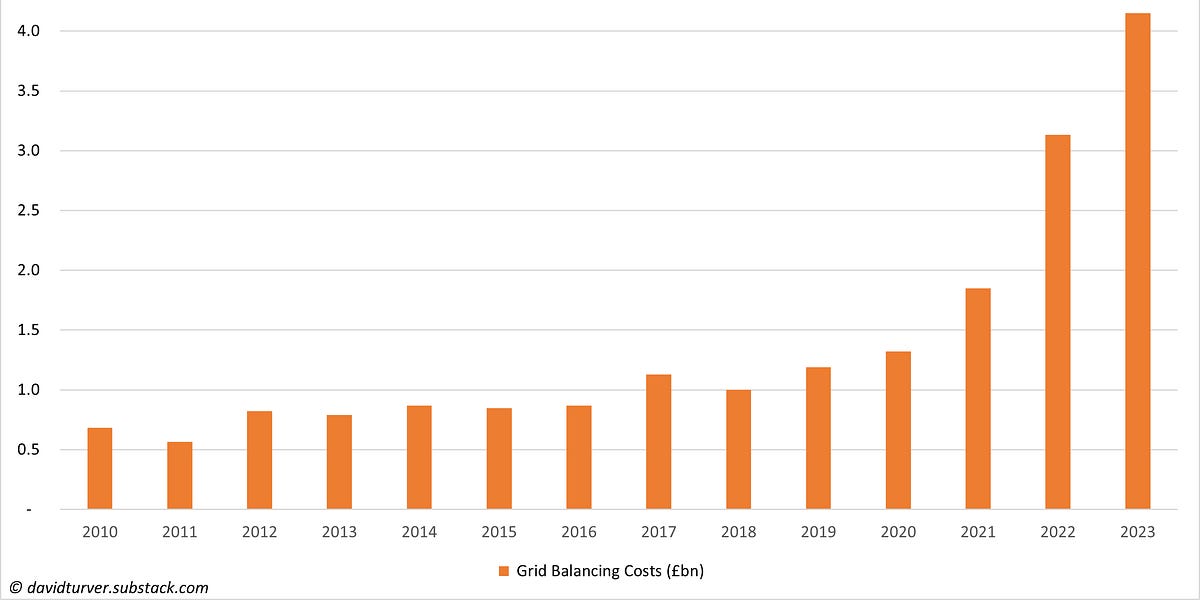
1️⃣6️⃣ The expense doesn't end there. Not only do we pay for wind we use, we pay for the wind we don't. As wind is unreliable there are times when there is too much. Especially at night. When there is too much wind the Grid has to pay providers to turn off.
@LoftusSteve - Steve Loftus
1️⃣7️⃣ These are called balancing costs. For example, Beatrice wind farm has a strike price of £164 per MwH and in the year ending March 2022 nearly 25% of it's output was paid NOT to enter the grid. We are paying to generate electricity we cannot use.
@LoftusSteve - Steve Loftus
1️⃣8️⃣ Balancing costs were £4.2 billion in 2022. £150 per household. Not only do we pay to dump excess energy, but when the wind isn't blowing we have to pay more for Gas Turbines to power up. In 2015 these costs were only £506m. https://www.wsj.com/amp/articles/renewable-energy-balancing-costs-united-kingdom-energy-bills-9795e48d
@LoftusSteve - Steve Loftus
1️⃣9️⃣ The intermittency of wind (and solar) wrecks the economics of Combined Cycle Gas turbines which have to be ready to start or stop at a moments notice. Since 2000 the average load factor of CCGT's has dropped from 68% to 35%. Doubling the cost per MwH.

@LoftusSteve - Steve Loftus
2️⃣0️⃣ CCGT's have two elements. Low efficiency gas turbines which turns on quickly. And high efficiency steam turbines which takes 90 minutes. As the high efficiency steam can rarely turn on it lowers the total efficiency and increases costs.

@LoftusSteve - Steve Loftus
2️⃣1️⃣ The true cost of wind is far greater than we are told. The cost to consumers is never likely to be lower than £150 per MwH. That's 3x traditional gas prices. On top of this we pay £150 each every year in balancing and £150 each every year in subsidies, and rising.
@LoftusSteve - Steve Loftus
2️⃣2️⃣ All this wind is far out at sea, which means the grid must be expanded and upgraded. Would you believe we have 10GW of offshore wind in Scotland connected to a 6GW transmission cable? This will cost us all £54bn by 2030. That's £1600 each. https://www.nationalgrideso.com/news/eso-publishes-pathway-2030-major-step-deliver-50gw-offshore-wind-2030

@LoftusSteve - Steve Loftus
2️⃣3️⃣ The Government, eventually, has got wise to this CfD scam and in the latest round 5 auction has stipulated that developers must take up the CfD contract upon completion. They have also set a target price of £44 per MwH for offshore. Word is, there have been no bids...
@LoftusSteve - Steve Loftus
2️⃣4️⃣ And those wind farms that created the "cheap wind" headlines at £37 per MwH (£55.90 in 2023 money)? Not one of them is being built and all are asking for more subsidies. https://dailybusinessgroup.co.uk/2023/03/offshore-wind-farm-at-risk-without-tax-breaks/

@LoftusSteve - Steve Loftus
2️⃣5️⃣ When you add all these things together...strike price, balancing costs, subsidies, transmission grid upgrades etc and the true cost of wind is likely more than £250 per MwH. And this is without even touching on the fact that it all needs backing up with reliable energy!
@LoftusSteve - Steve Loftus
2️⃣6️⃣ The most concerning part about this is that I'm not sure the Department of BEIS knows. All their planning documents are still based on 10+ year old projections by civil servants. Not audited costs from real world projects. Still today they are projecting falls by 2030.
@LoftusSteve - Steve Loftus
2️⃣7️⃣ I read a lot of great articles by people that know much more than me while researching this. James McSweeney (@WestminsterPup) helped answer some questions and is worth a follow. His article below is well worth a read for more info. https://thecritic.co.uk/gone-with-the-wind/

@LoftusSteve - Steve Loftus
2️⃣8️⃣ Andrew Montford (@aDissentient) has many informative articles on the subject which are worth searching for and also helped with this thread. This is just one example worth reading. Please search for some of his papers and stories on this. https://conservativehome.com/2023/04/18/andrew-montford-bureaucrats-must-be-honest-about-the-costs-of-offshore-wind/

@LoftusSteve - Steve Loftus
2️⃣9️⃣ Professor Gordon Hughes and Capell Aris are highly experienced in the energy field and have several interesting articles worth searching for. Including this one by Mr Aris. Please search for articles by Gordon Hughes. https://www.telegraph.co.uk/news/2023/06/11/green-energy-disaster-uk-awful-warning-america/

@LoftusSteve - Steve Loftus
3️⃣0️⃣ This article by Brian Leyland, a power systems engineer, has some interesting information. https://www.telegraph.co.uk/news/2023/05/10/wind-solar-renewables-pointless-waste/

@LoftusSteve - Steve Loftus
3️⃣1️⃣ David Turner (@Kiwi7) has a great blog on all things energy related. This article in particular is very informative. He's well worth a follow for energy related facts. https://davidturver.substack.com/p/lies-damned-lies-wind-power-lobbyists
@LoftusSteve - Steve Loftus
3️⃣2️⃣ Kathryn Porter (@KathrynPorter26) is an Independent Energy Consultant and owner of Watt Logic.
@KathrynPorter26 - Kathryn Porter
There is a widespread belief that wind farm costs are falling and will continue to fall, but as OEM losses mount it's time to re-assess https://watt-logic.com/2023/06/14/wind-farm-costs/
@LoftusSteve - Steve Loftus
3️⃣3️⃣ All these people know far more about this subject than I do and were invaluable when researching this thread. Water is more my thing than Energy and it's a complicated, messy and opaque system. Consider this a "Dummies guide" that covers the basics but please read more.
@LoftusSteve - Steve Loftus
3️⃣4️⃣ If you enjoyed this thread then please retweet so others can also. Also read my thread on the real state of UK waters. https://t.co/ptBnE6Hu5T
@LoftusSteve - Steve Loftus
🌊 𝗨𝗞 𝗪𝗮𝘁𝗲𝗿𝘀 𝗠𝗲𝗴𝗮𝘁𝗵𝗿𝗲𝗮𝗱 🌊 Twitter and the media is awash with lies, half truths and misconceptions about the state of UK rivers, sewage overflows and water privatisation. It's a complicated topic, it's going to be a long 🧵 https://t.co/avANknYtLO

@LoftusSteve - Steve Loftus
I messed up. David Turver is @7Kiwi
@LoftusSteve - Steve Loftus
If you see anyone say "But the IPCC says offshore wind prices are dropping (because their graphs do) they qualify those graphs with this statement showing prices are rising everywhere but China. https://t.co/cjDBRYWYIv

@LoftusSteve - Steve Loftus
💰The Cost of Renewables Megathread💰 The popular narrative in UK politics, and subsequently social media, is that renewables are cheap and drive bills down while gas is the problem driving prices up. This is propaganda designed to make you buy in.

@LoftusSteve - Steve Loftus
1⃣ You could be forgiven for thinking that the following points are facts as they are repeated often enough. 🔸Renewables are 9x cheaper than gas 🔸Renewables are bringing prices down 🔸Solar is the cheapest form of electricity 🔸Wind is cheap, especially onshore All lies.
@LoftusSteve - Steve Loftus
2⃣ There are three renewables subsidy schemes in operation. Contracts for Difference (CfD) that came into effect in 2017 and Renewable Obligation Contracts (ROC) which ran from 2002 until 2017. These cover all large projects. FiT (Feed in Tariff) is for sub 5MW projects.
@LoftusSteve - Steve Loftus
3⃣ CfD has 6.8GW of operating renewables as of October '23. This is only 9% of the UK's installed RE capacity. It's not cheap. The IMRP is the average weighted wholesale price, generally set by gas. Apart from 2022 RE on CfD have been far more expensive, including this year.

@LoftusSteve - Steve Loftus
4⃣ The vast majority of our renewables (73%) are under ROC. Under ROC generators get the wholesale price of electricity PLUS a subsidy. So by definition, can never be cheap. Consider a ROC to be like a voucher and in 21/22 each was worth £58.24.
@LoftusSteve - Steve Loftus
5⃣ Different generation technologies then get a fixed number of ROCs on top of the wholesale price. Offshore wind gets 1.8 ROCs per MWh. So £104.83 on top of market price. Until 2006 this was 1. Then 1.5 until 2010. Then 2 until 2015. Most are on 2 ROCs.

@LoftusSteve - Steve Loftus
6⃣ And the rest? 🔸Onshore wind is now 0.9 ROCs per. 🔸Biomass is 1 🔸Solar PV on buildings is 1.4 🔸Solar PV on the ground is 1.2 These are the main sources and equate to multiples of £58.24 on top of the average wholesale price of £95 per MWh in 2023 so far.
@LoftusSteve - Steve Loftus
7⃣ The average price across all technologies under ROC was around £80 per MWh of subsidy on top of the wholesale price. Every MWh of renewables under this scheme cost you £175 per MWh this year, and this scheme covers 73% of all renewable capacity.
@LoftusSteve - Steve Loftus
8⃣ Last, but certainly not least is FiT. The Feed in Tariff scheme came into effect in 2010 and was designed to encourage smaller scale renewable projects. In total there are 6.46GW of capacity under FiT of which 99% is Solar PV.

@LoftusSteve - Steve Loftus
9⃣ The total cost of FiT in YE 2022 was £1.57 billion which produced 7.94TWh of electricity. That equates to £198 per MWh.

@LoftusSteve - Steve Loftus
🔟 Now we have the prices for CfD, ROC and FiT for each technology and we know how much each scheme generated we can calculate the delivered price in 2022. This is what you paid.

@LoftusSteve - Steve Loftus
1⃣1⃣ This is important because 2022 is where the "9x cheaper than gas" myth comes from. When gas prices were high. In reality the wholesale price of gas averaged £202 per MWh last year (inc 45% carbon tax). Cheaper than all renewables.
@LoftusSteve - Steve Loftus
1⃣2⃣ If we use similar generation numbers for 2023 and adjust to 2023 prices this is what you are paying this year. As we know, the price of gas per MWh has been £95. Nearly half the price of renewables even after 45% carbon tax.

@LoftusSteve - Steve Loftus
1⃣3⃣ It's true that future costs will be lower, but nowhere close to what some would have you believe. New offshore wind will cost £100 per MWh in 2024 to come online around 2028. Solar will be £84 and Onshore wind £88 to come online around 2026.
@LoftusSteve - Steve Loftus
1⃣4⃣ Small additions to the existing expensive fleet only marginally decrease the average price. FiT and ROC contracts are fixed for 20 years. CfD for 15. Every one of them in existence is expensive and will be for another 10-15 years.
@LoftusSteve - Steve Loftus
1⃣5⃣ We could be enjoying gas generated electricity at around £55 per MWh (on average) right now. Our electricity generation emissions are only 0.2% of global emissions. Around half 1990. Your bill is more than double what it could be to reduce global emissions around 0.2%.
@LoftusSteve - Steve Loftus
1⃣6⃣ These are just the MWh costs of generation and don't factor in the high external costs of renewables. You can read more about that in my Offshore wind thread below.

@LoftusSteve - Steve Loftus
1⃣7⃣ I hope you enjoyed the thread. If you did so and don't already follow me please do so for more facts about energy and water.
@LoftusSteve - Steve Loftus
1⃣8⃣ Don't forget to bookmark this thread so you can use it every time you see the big renewable lies!
@LoftusSteve - Steve Loftus
1⃣9⃣ If you want to verify or replicate these prices. CfD https://dp.lowcarboncontracts.uk/dataset/actual-cfd-generation-and-avoided-ghg-emissions ROC https://www.ofgem.gov.uk/publications/renewables-obligation-ro-annual-report-scheme-year-20-2021-22 FiT https://www.ofgem.gov.uk/publications/feed-tariff-fit-annual-report-2021-22

@LoftusSteve - Steve Loftus
1⃣ There is no bigger lie than Palestinians are an oppressed people and it's all Israel's fault. They may be oppressed, but it's largely their own fault. A Dummies Guide I put together as I was a Dummy until recently. https://t.co/vHa1s9Olwc

@LoftusSteve - Steve Loftus
2⃣Firstly, there is no Palestine. The name did not exist until Roman occupation when after the defeats of the Jews they renamed Judea as Paleastina. When the Ottoman empire ruled it the whole area was Ottoman Syria. It wasn't until the British Mandate that the state was created.
@LoftusSteve - Steve Loftus
3⃣ Most of the people now considered Palestinians are descendents of immigrants from Syria, Egypt and Lebanon that came to work during Ottoman rule or the British Mandate. Yet, it is Jews that are accused of "colonising" the land. Despite it being their ancestral homeland.
@LoftusSteve - Steve Loftus
4⃣ Jews did not "occupy" Palestine. Those that moved to the region bought land legally from Arabs under the Ottoman land laws that were maintained by the British. No different than people that move to the UK today. A weapon was not raised, nor a shot fired. https://t.co/Emn766ag9e

@LoftusSteve - Steve Loftus
5⃣ Jews, Arabs and Christians lived together relatively peacefully for centuries under Ottoman rule. It wasn't until the 1920's that things got ugly as more Jews legally moved to the region and Arabs turned to violence.
@LoftusSteve - Steve Loftus
6⃣ The first major incident in Palestine were the 1920 Nebi Musa Riots where Arab mobs attacked and murdered Jews in Jerusalem. This was followed by the 1921 Jaffa riots and after a few years of calm the 1929 Hebron massacre and 1929 Palestine Riots. All Arab attacks on Jews.
@LoftusSteve - Steve Loftus
7⃣ Let's break from the history here and ask why this is any different from Far Right Brit's attacking Muslims because they think too many are coming here? These Jews were either from the area, or legally moved there, and were attacked because of skin colour and religion.
@LoftusSteve - Steve Loftus
8⃣ The repeated attacks and constant threats of violence led to the rise of Jewish militia groups. Haganah (Defense) was born in 1920 to protect Jewish settlements but after years of violence more extreme splinter groups formed starting with Irgun in 1931.
@LoftusSteve - Steve Loftus
9⃣ Irgun would become known in later years as a terrorist organisation but not until after the 1936 Arab Revolt did it resort to organised violence. In 1940 another splinter group was formed in Lehi and at this point both sides were attacking the Brits and occasionally each other
@LoftusSteve - Steve Loftus
🔟The first major Jewish attack was in 1937 in retaliation for attacks on Jews, but at this point they had suffered 17 years of violence. And from 1936 through to the 1947 Partition plan bombings were common place on all sides, especially against the British.
@LoftusSteve - Steve Loftus
1⃣1⃣ While Zionist Jews had been pushing for their own state for decades it was the long history of violence against them (and between them) that pushed the UN into a 2 state solution. What other solution could there be? Arabs had shown for 25 years a desire to kill Jews.
@LoftusSteve - Steve Loftus
1⃣2⃣ The British and UN had tried to find a single state solution since the 1920's and made various proposals that were rejected by both sides. Both sides had a historical, religious and cultural ties to the region but could not coexist peacefully.
@LoftusSteve - Steve Loftus
1⃣3⃣ This process was an impossible one. How do you divide lands of mixed religions and ownership? The UN mandate would allow Arabs to retain their land in the Jewish state but they did not want to be there. The 10% of Jews on proposed Arab land were fearful.
@LoftusSteve - Steve Loftus
1⃣4⃣ The main difference was that Jews engaged with the process despite reservations about the split. The proposed Israeli land had no access to the River Jordan for water, and no forests for wood. And while the coastal lands were fertile the rest was arid. https://t.co/vMLNCbacKN

@LoftusSteve - Steve Loftus
1⃣5⃣ The Arab Higher Committee and Arab League refused to come to the table and refused to entertain partition at all. While they had the greater population by nearly 2:1 they had no more claim on the land than the Jews. They were fundamentally against a Jewish state.
@LoftusSteve - Steve Loftus
1⃣6⃣ They again resorted to threats of violence with several Arab leaders from neighbouring countries threatening war and the murder of Jews throughout the process. Much is made of the division of land, but no division was good enough for the Arabs who opposed any Jewish state.
@LoftusSteve - Steve Loftus
1⃣7⃣ As the Jews had taken part in the process, including lobbying nations for support, they inevitably won the UN vote which led to the First Arab-Israeli War in 1948. The armies of Egypt, Jordan, Syria, Lebanon and Iraq attacked Israel with the aim of reclaiming the land.
@LoftusSteve - Steve Loftus
1⃣8⃣ As you know Israel eventually won but the damage to Arabs was extensive. They lost significant territory that was to be theirs in the partition including Galilee, West Jerusalem, Lydda, Ramle and a large part of the coast. Egypt retained Gaza and Jordan the West Bank. https://t.co/9AyzZVf7QG

@LoftusSteve - Steve Loftus
1⃣9⃣ Instead of Jews and Arabs coexisting side by side as the UN mandate suggested 700,000 Arabs were displaced. Either through their own choice due to the risk from bombing or because of Israeli Expulsion Orders. Large numbers were expelled from Lydde and Ramle for example.
@LoftusSteve - Steve Loftus
2⃣0⃣ I'm sure some reading this will consider that Jewish colonisation. But the Arabs attacked them, and in the course of the war in which many Jews died they won that territory in battle. I would say the Arabs brought it on themselves.
@LoftusSteve - Steve Loftus
2⃣1⃣ You can pretty much repeat this story for the next 70 years. Arabs nations declare war, Israel wins, Israel gains more territory (then gives some back). Rinse and repeat. Always Arabs are the aggressors. Never have they shown willingness to live side by side with Jews.
@LoftusSteve - Steve Loftus
2⃣2⃣ How are Jews the bad guys in this? For a century they have been attacked and murdered for legally migrating to the region, legally buying land and taking part in the democratic process. While Arabs have murdered, threatened and refused anything but wiping out Israel.
@LoftusSteve - Steve Loftus
2⃣3⃣ There is no race or religious community more persecuted. 🔸They were blamed for the plague 🔸They were expelled from Spain in 1492 🔸Russian, Moldova & Ukraine pogroms 🔸Kristallnacht and the Holocaust 🔸Pogroms across the Arab world
@LoftusSteve - Steve Loftus
2⃣4⃣ That's not to say Israel is perfect. It's done many things wrong, especially in the past 20 years, but I imagine after 100 years of being murdered and attacked they probably don't have a great opinion of their Arab neighbours. They didn't start it. It's not hard to see why.
@LoftusSteve - Steve Loftus
2⃣5⃣ I'm wary to write this thread because I know the loons will pile on but I think the response from a large number of people in this country and across the world to the torture, rape and murder of 1400 innocents has been shameful. Engage with facts or get blocked.
@LoftusSteve - Steve Loftus
All images except the map generated with AI just for giggles.