TruthArchive.ai - Tweets Saved By @Metabolic_Mind

Saved - August 28, 2025 at 6:16 AM
reSee.it AI Summary
Bipolar disorder is a whole-body physiological state, and my journey with bipolar II led me to discover ketogenic therapy, which transformed my life. After my diagnosis, I found that this approach stabilized my mood and redirected my career. As a Baszucki Metabolic Psychiatry Research Fellow, I now focus on how personal experiences can drive scientific discovery in mental health. In my video, I share my journey, practical guidance for safely exploring ketogenic therapy, and the importance of combining diet with sleep and stress management for better mental health.

@Metabolic_Mind - Metabolic Mind

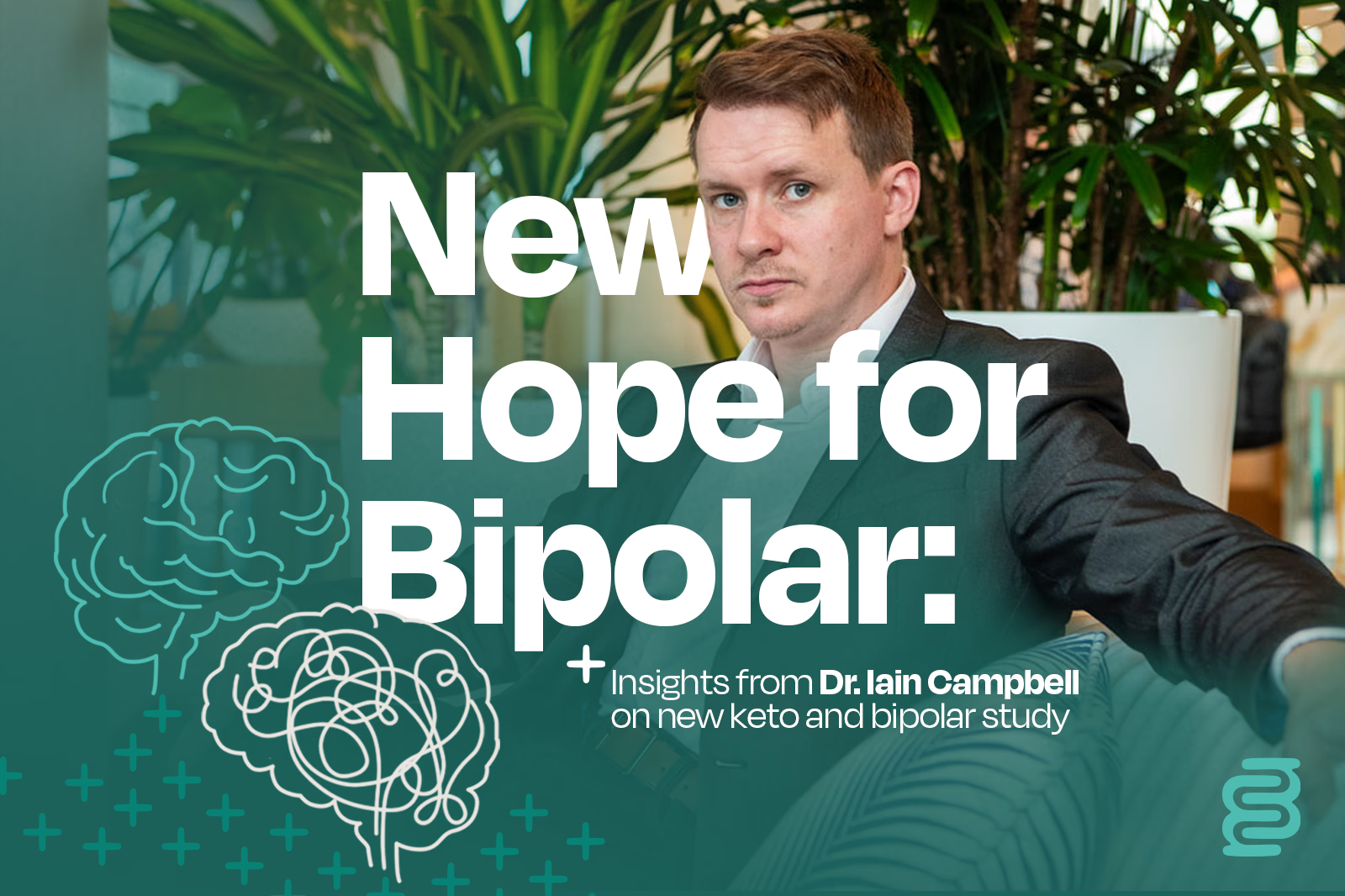
“Bipolar is a whole-body physiological state.” For Dr. Iain Campbell, this isn’t just theory, it’s lived experience. Diagnosed with bipolar II, he discovered ketogenic therapy by accident… and it changed everything. Within months, his mood stabilized, his life regained balance, and his career took a new direction. Today, Dr. Campbell (@IainCampbellPhD) is a Baszucki Metabolic Psychiatry Research Fellow at University of Edinburgh and lead author of one of the first clinical trials on ketogenic therapy for bipolar disorder. His research is fueled by personal transformation, a defining feature of metabolic psychiatry, where lived experience often drives scientific discovery. In this video, Dr. Campbell shares: His journey with bipolar II and ketogenic therapy Practical guidance for exploring this approach safely Why combining diet with sleep, stress management, and clinical support is key 📺 Watch now to learn how one researcher’s personal battle with bipolar disorder became a mission to change mental health care. #MetabolicPsychiatry #KetogenicDiet #BipolarDisorder #MentalHealthHope Expert Featured: Dr. Iain Campbell, PhD @IainCampbellPhD https://www.metabolicpsychiatryhub.com/ Resources Mentioned: Learn more about the THINK+SMART framework: a self-guided, community-based framework that helps you develop a customized metabolic approach to mental health: https://thinksmart.metabolicmind.org/ To learn more about Dr. Campbell’s personal journey, check out his full THINK+SMART profile: - https://www.metabolicmind.org/thinksmart/explore-strategies/iain-campbell/ Learn more about the “Pilot Study of a Ketogenic Diet in Bipolar Disorder: Clinical, Metabolic, and Magnetic Resonance Spectroscopy Findings.” - https://www.metabolicmind.org/resources/news-views/blog/frontiers-in-metabolic-mental-health/ketogenic-diet-study-offers-hope-for-a-new-treatment-for-bipolar-disorder-insights-from-dr-iain-campbell-s-research/ Our channel is for informational purposes only. We are not providing individual or group medical or healthcare advice nor establishing a provider-patient relationship. Many of the interventions we discuss can have dramatic or potentially dangerous effects if done without proper supervision. Consult your healthcare provider before changing your lifestyle or medications. Timestamps: 0:00 - Meet Iain, diagnosed with Bipolar Disorder Type 2 0:28 - Depression's role in bipolar disorder 1:28 - Iain's self-led quest for his own mental health 2:13 - How his metabolic and weight loss goals interacted with his mental health goals 4:01 - Pivoting professionally to gain deeper understandings 4:29 - "Being bipolar is like being on a sinking cruise ship..." 5:20 - Strategies for moments when his control over diet is diminished 6:23 - Non-diet factors that impact metabolism and ketones, like sleep and stress 8:03 - Advice for those seeking to try ketogenic therapies for bipolar treatment and mental health

Video Transcript AI Summary
Dr. Ian Campbell, University of Edinburgh, Bisuke Research Fellow in Metabolic Psychiatry, is bipolar type II and has studied a ketogenic diet for its effects on mental health. He describes bipolar depressions as "a physiological state" with "very profound deprivation of energy and function" and notes "elevated lactate markers of mitochondrial dysfunction." He recounts periods of hypomania and deep depression. While working in the music industry, he tried "the new Atkins diet" and, on ketosis, felt "the weight of depression lift from my mind." Exogenous ketones ("MCTLs") produced similar relief, prompting follow-up research and a PhD, then a pilot trial funded by John Bazooki. He warns ketosis is not a cure; off-diet relapse can occur within 2-3 days, particularly for depression. He advocates a synergistic approach—ketosis, sleep, circadian rhythm management, stress reduction, light exposure, diet, exercise—and notes about 20 clinical trials exist; signing up for research is recommended.
Full Transcript
Speaker 0: Hi there. I'm, doctor Ian Campbell. I work at the University of Edinburgh as a Bisuke Research Fellow in Metabolic Psychiatry. I'm diagnosed with bipolar disorder type two and have been using a ketogenic diet and researching a ketogenic diet in a clinical academic setting at the university to try and understand what are the mechanisms and how this might be useful in mental health conditions. So for me, bipolar disorder, depressions were always the hardest aspect of it. You really get plunged into this state where you have very low energy, you can't function, you can't think, you can't feel, and you're really sort of struggling to stay alive sometimes during these depressions. And the way I try to describe it to people is it's much more like a physiological state. It's not just a mood. It's a whole state in the body where there's very profound deprivation of energy and function. And I I almost describe it a little bit like kind of being deprived of oxygen. You're really struggling to catch your breath. Your your body's physiology is struggling to produce energy and stay alive. And you can see this in the blood markers of bipolar patients with things like elevated lactate markers of mitochondrial dysfunction. It really is a whole body physiological state that you're thrown into, and that's why you can't move or think or feel or function in these, depressions. And then I'd have periods of hypomania where I'd be kinda productive and, able to think more quickly for periods of time, but then I'd go back into the depressions. And at the time, I was long before I was an academic, I worked in the music industry. I was the music producer for a interactive entertainment company called Rockstar Games, and I worked on games like Grand Theft Auto and Red Dead Redemption. And it was around this time that I started experimenting with everything I could possibly try. I made a Google Doc, and I put every possible thing that I thought I could do to improve my health, and it was really kind of I was gonna try and fight for survival. And it was really driven by I wanted to have a family. I wanted to have a kind of life, and I could see that none of these things were gonna be possible for me to to work or to have a family or to to have any kind of quality of life if I didn't really try hard to fix this. So I started working through all these different options. I tried an unbelievable amount of things, and I eventually decided I'm just gonna at least try to lose weight. I was heavily overweight at the time, and I wanted to try and, at least be as physically healthy as I could be and see if this would help in some way. So I I came across the this thing called the new Atkins diet. It's actually a kind of form of ketogenic diet. I didn't understand this at the time. But I I just adhere to this very strictly. And I noticed, one time I was going to work, commuting, and for the first time since I can remember, I really felt this weight, this incredible weight of depression lift from my mind for the first time. And it it was really confusing to me at the time because I wasn't aware that it was the diet causing this. I just knew that for the first time, I was feeling something different, and I was feeling clear headed and objective and normal, and my mind was at peace, and I could feel something was physically very different. But I didn't understand what it was at the time. And over the weeks, I I I kind of put it together that maybe this diet that I was doing was having some effect in causing these periods of wellness. And I told my father, he's a professor of medicine, and we've been through many times of illness, and I was saying, I think there's something about this diet that's changing something. And so I started researching. I learned about ketosis and that the body goes into periods of ketosis on this kind of at the time, was this new Atkins diet, which puts you into periods of ketosis. And I started then taking exogenous ketones like MCTLs, and I noticed that they they were having a similar effect to the diet. They were giving me some of this alleviation of symptoms, which was really remarkable to me because I didn't think anything could affect this. I'd always experienced this my whole life. And so I I really decided it was really a sort of complete turnaround in my life where I said I have to understand this, you know, that if this could help other people or if this is gonna work for other people, I have to really do everything I can to understand this and see if it could be useful. So I, over many years, went into research and completed a PhD, and then, eventually met, John Bazooki, who funded a pilot trial of a ketogenic diet, bipolar disorder because her son had been through the same journey and wanted to understand how this might be helpful for others. So we completed the study of a ketogenic diet. So really, my journey from this was through kind of experiencing these symptoms, and I sometimes compare it to, like, being bipolar. It's like being a bit like on a cruise ship. And, you you know, imagine you're put in the captain's seat, you have all these controls, and you can see that the ship is, you know, kind of going under, and that there's nothing you can really do, and you're pressing all the different buttons, trying all these different health techniques, all these different medications, all these ways of doing something. And then you hit this one button that kinda seems to turn the engines back on, makes the ship work, and you have no idea what this button is. It's like, you know, but but but you know that whatever that is must be really important for whatever's wrong with this ship. And so for me, ketosis was that button. It was like, I don't understand this. I don't know what it does, but I know that when I hit this button, everything gets better. And so I I need to really start researching under the hood and seeing what this is connected to and what it does. And that was my research, was trying to understand what this ketosis does to my symptoms and how it works. So I think it's important with any way of approaching bipolar disorder to know that any treatment, no matter how effective, is not gonna be necessarily a cure for a condition like this. And there are some cases in epilepsy where people have very long term seizure emission, even lifelong seizure emission. And I hope as we understand interventions like this more, things like this might be possible in bipolar. But for me, have to stay quite strictly on the diet to maintain the benefits. Like many people with epilepsy, if I go off the diet, then within two to three days, my symptoms can return, particularly the depression is quite notable. So the ways I've tried to manage this are to use strategies like using exogenous ketones to bridge periods where I have less control over the diet, say, you're traveling and exogenous ketones can be helpful as shown in epilepsy. They're not a solution or a long term solution, but they can be helpful in helping you through periods where if your sleep is disrupted, you can go out of ketosis, for example. And I find when traveling, for example, it is quite important to have exogenous ketones with me. And I I think also what we're seeing in metabolic psychiatry, and this is something we're researching, is that there's a lot of factors that play into metabolism. So this includes your sleep, it includes your diet, it includes your circadian rhythm, your light exposure, And all these factors are synergistic in making your metabolism healthy. So diet is a major pillar of that. But there's also sleep and circadian rhythm management and stress reduction, and all these things play into making your metabolism function well. So it's a com it's really there's a combination of these metabolic therapies that you can use. And when one is, you know, less available, like sleep, for example, if you're traveling or you have, young kids, for example, have young kids and often have sleep disrupted sleep because of that, You can use, like, exogenous ketones or different strategies to bridge those things. And in times when you have less control over your diet, perhaps you can really optimize the sleep and light exposure. And so using these these things synergistically, I think, is very helpful. And I I think this is because there's some aspect of bipolar I have a paper on this called Metabolic Plasticity. Can read that is a dysregulation of kind of very long evolutionary conserved mechanisms of metabolic and circadian type regulation. And if you can give the right inputs to these systems, it helps your health. And if you get the wrong inputs, like artificial light at night, bad nutrition, it can really dysregulate all these systems in the body that control your metabolism. So I think combining healthy sleep cycles, stress reduction, ketosis, diet, exercise, all these things help to keep a person stable. I think if someone's learning about ketosis, the the first thing to be aware of is that it's really important to work with your psychiatrist. There this is we're at the very early stages of research in understanding this, And we we hope, like, in epilepsy, this can be very helpful to a lot of people, but we are at the early stages. And so it's very important to approach your psychiatrist about a change to your diet like this and to work with them and and hopefully also a dietitian, who can advise how to do a ketogenic diet, because it it's not easy to just go into a ketogenic diet in a medical sense. People can do this freaking weight loss, and and many people do it in a casual way, but a a medical ketogenic diet is a very different approach where you're trying to maintain ketone levels and and specific nutrients, and you're you need supplementation, in many cases and things to help manage the diet. So I'd recommend, working with a psychiatrist and hopefully a dietitian, to manage this if you're thinking of this. And and one of the best ways to engage, with ketosis at this stage, if you're, looking to try this, is to engage in research. There's many clinical trials happening all across the world, around 20 clinical trials that are underway to investigate this. So one of the best, most safest, controlled, and effective ways to try this would be to register for a research study, and there's quite a high likelihood there'll be one somewhere near where you are. And certainly in the coming years, I think that'll be increasingly possible. So I'd recommend signing up as a research participant if you can because you'll get the full spectrum of psychiatric care, dietitian support, and this is a very and it helps contribute to our understanding of the of the effects of ketosis as well.
The Hub for Metabolic Psychiatry The Hub for Metabolic Psychiatry is one of six research hubs forming the basis of the UKRI Mental Health Research Platform, established to accelerate progress towards novel and more effective treatments for severe mental illness. metabolicpsychiatryhub.com
THINK + SMART Discover the power of metabolic psychiatry and ketogenic therapy with THINK+SMART—a free, community-inspired framework for improving mental health. thinksmart.metabolicmind.org
Iain Campbell | THINK + SMART metabolicmind.org
Ketogenic Diet Study Offers Hope for a New Treatment for Bipolar Disorder | Metabolic Mind A new paper has reported the clinical, neuroimaging and metabolic findings of an interventional trial that offers fresh insights into a ketogenic diet’s impact on serious mental illnesses... metabolicmind.org
Saved - August 8, 2025 at 3:59 AM
reSee.it AI Summary
In this episode, Dr. Georgia Ede and Dr. Bret Scher discuss the complexities of ketogenic therapy for mental health. They address common concerns, such as what to do if mental health doesn’t improve or worsens on a ketogenic diet. Key topics include entering ketosis, the impact of sweeteners and snacks, and the importance of lifestyle factors. They also explain the difference between a ketogenic diet and therapy, and provide strategies for troubleshooting. Listeners are encouraged to ask questions for further discussion.

@Metabolic_Mind - Metabolic Mind

Ketogenic therapy for mental health is gaining traction, but what happens when it doesn’t seem to work or even makes things worse? In this episode, Dr. Georgia Ede (@GeorgiaEdeMD) and Dr. Bret Scher (@bschermd) answer some of the most common questions about ketogenic diets, including what to do when your mental health doesn’t improve, how to properly enter ketosis, and why sweeteners, snacks, and dairy might be holding you back. They break down the difference between a ketogenic diet and ketogenic therapy, and why things like ketone levels, medication adjustments, and lifestyle factors matter. You’ll also learn why some people experience initial worsening symptoms, how to transition more gradually, and when to seek support from experienced clinicians. From food choices to long-term outcomes, this episode covers key troubleshooting strategies for making ketogenic therapy work for your brain and body. Have questions about ketogenic therapy and mental health? Drop them in the comments, we’d love to hear from you! Expert Featured: Dr. Georgia Ede @GeorgiaEdeMD Follow our channel for more information and education from Bret Scher, MD, FACC, including interviews with leading experts in Metabolic Psychiatry. Learn more about metabolic psychiatry and find helpful resources at https://metabolicmind.org/ Timestamps: 0:00 - Intro 0:24 - What if a ketogenic diet isn’t helping my mental health? 3:06 - What do I do if my mental health gets worse when I start a ketogenic diet? 6:39 - Can I include sweeteners in my keto diet? What are the best sweeteners for keto? 9:07 - Are keto bars and keto snacks ok for a therapeutic ketogenic diet? 11:36 - How do you deal with emotional eating? 13:55 - Ketogenic diet vs vegetarian diet evidence for longevity. 16:06 - Scientific evidence vs real world data. 18:50 - Can you have dairy on keto? 23:13 - Conclusion - Subscribe for more coming soon!
Video Transcript AI Summary
Here's a summary of the transcript: Ketosis helps most people feel better, but if a ketogenic diet worsens mental health, ensure consistent ketosis (1.0 mmol or higher) for at least 12 weeks, measuring ketones. If issues persist, troubleshoot food choices, meal frequency/timing, and consider functional medicine testing. Mental health worsening often relates to the keto-adaptation phase; transition gradually, manage electrolytes, and seek clinical support. There isn't one ketogenic diet; sweeteners and dairy can be included or excluded. Allulose and monk fruit are the best sweetener choices, while sugar alcohols are the worst. Whole foods principles are important, so avoid keto-friendly packaged and processed bars, cereals, shakes, and cookies. There is no long-term data on any dietary pattern. Use your own health markers as your guide rather than untested theories or ideologies about what a healthy diet is supposed to look like. Dairy is a popular ingredient in ketogenic diets, but it's a common cause of inflammation. Everyone should explore how dairy affects them personally by doing a month-long dairy experiment.
Full Transcript
Speaker 0: Should I include sweeteners in my keto diet, or should I avoid them? What about the the baked goods and the keto bars and the keto snacks? What role does dairy play in a ketogenic diet? Hey Georgia, welcome back to our second episode, our second meal bag episode. Good to see you again. Speaker 1: Nice to see you, Brett. Speaker 0: So we already did a first episode where we went through a lot of the common questions people have about ketogenic diets, ketogenic therapy for mental health benefits, but there are so many others. We get so many questions from people, which we want. We want more questions, so let's get into some of the other common questions, starting with, well, what if I'm on a ketogenic diet and it doesn't help my mental health? Or if my mental health even gets worse on a ketogenic diet, what do I do then? Speaker 1: Yeah. So ketosis does help most people feel noticeably better, but it doesn't work for everyone. However, make sure first that that you really are in that in that small group of people where it's not working. So when I consult with patients who tell me that a ketogenic diet didn't work for their mental health problem, the first two questions I always ask are, how long did you try it for? And were you measuring your ketones? Because nine times out of 10, they either didn't try it for long enough. They didn't realize that it, you know, takes time, or that their ketones weren't high enough and and they because they weren't measuring. So were you in good consistent ketosis for at least twelve weeks? Six and the minimum 12 is even better. And by good consistent ketosis, as we were talking about in the last episode, blood ketone levels one point o millimole or higher almost all the time, including when you first wake up in the morning. And if that's the case, if you have been in really good ketosis, then you need to do some troubleshooting. Right? So if you've if you've good consistent ketosis for long enough, if that hasn't helped, Other things matter too. So troubleshooting, you might troubleshoot your food choices, your meal frequency, your meal timing. You might wanna see a functional medicine practitioner for deeper testing to find out if there are some other issues that might be going on. I don't want you to give up on lifestyle strategies for mental health. But nine times out of 10, it's either that the ketones weren't high enough or consistent enough for long enough to allow the brain and body to shift gears and let that healing, process start to take place. Speaker 0: Yeah, that's why we have a number of videos that talk about the difference between ketogenic therapy and a ketogenic diet. And they're not one and the same. Someone can't just think they're going to start eating lower carb and higher fat and it's going to be an adequate enough ketogenic intervention. And what differentiates ketogenic therapy is how long are you doing it? Are you measuring your ketones and how high they are? What are your goals and what are you trying to achieve with your ketogenic therapy? What are you doing with your medications? What are you doing with the rest of your lifestyle? What supplements? You know, there's this sort of umbrella of ketogenic therapy that is far beyond just a ketogenic diet. So if you're going to say the keto diet isn't working, it's so much more detailed than just that which you went into. But but there is a subset of people who when they start a ketogenic diet, they may feel their mental health actually gets worse. How do you address that? Because that seems sort of counterintuitive to what we're talking about. Speaker 1: Right. And so you do see this sometimes. But if this happens, first of all, you'll usually feel better by week three. But even more important, there are things you can do to minimize the risk of this happening. So usually when people feel worse on a ketogenic diet from from if their mental health feels worse, they're more depressed, they're more anxious, If they have a tendency to have a history of manic or hypomanic episodes, they might slip back into the those patterns. They might start to lose sleep, might have trouble concentrating. If your mental health gets worse on a ketogenic diet, it's almost always related to the keto adaptation phase. There are a lot of changes, shifts that are happening, as the as the brain and body are seeking to find their new equilibrium. And and this is a longer topic than we have time for, but just suffice it to say, the ketogenic the keto adaptation phase can be stressful on the brain and body, especially if you're not managing that period of time properly, working with somebody who understands ketogenic diets, keeping an eye on your medications, getting the right electrolyte supplementation. And I can't stress this enough, switching over to a ketogenic diet gradually. So if you because if you switch too quickly, cold turkey from hundreds of grams of carbohydrate per day down to 20 grams of carbohydrate per day is a huge shock to the brain and body and completely unnecessary. So if you transition gradually, get the right electrolyte support, get the right clinical support, and plan ahead. It it usually, these symptoms that some people report getting, when they switch over, those are almost always those are almost entirely preventable. So I would say back up, start again, with the right information, and give it another try, but more slowly and with the right support. Speaker 0: Yeah. I think that's such such a great perspective. And, you know, I think a lot of people talk about it as if it's, you know, a light switch. One day, you're eating 300 grams of carbs. You just flip the switch. The next, you're eating 20 grams of carbs. But like you're saying, there's absolutely no reason that it has to be that way. And in fact, that can set you up for some complications and for feeling worse. So why would you do it that way? So, yeah, such an important perspective there. Speaker 1: Yeah. So the, so Beth Du Picanha, who's an expert dietitian, registered dietitian in ketogenic diets for all kinds of health conditions, more than thirty years of experience. You've interviewed her on your channel before. She has this lovely way of transitioning people to ketogenic diets, which is just first you switch over your breakfast and you get used to that, then you switch over your lunch and you get used to that, and then you switch over your dinner, and then you then all now all three of your meals are ketogenic. The way that I recommend in my book is, just, to do two weeks of, whole foods kind of paleo style 90 grams of carb per day, which is about two thirds less than most people eat. And that's that's gonna lower your glucose and insulin levels and give your body some time to adjust before you before you drop down into the ketogenic range. Speaker 0: There are also lots of questions about the specifics of ketogenic diet. There isn't one ketogenic diet, and as we've talked about, you can do vegan, vegetarian, carnivore, omnivore, everything in between. You can also do it with or without sweeteners, with or without dairy, with or without baked goods. So, let's sort of take, you know, a lot of those, individually. So when it comes to sweeteners, should I include sweeteners in my keto diet, or should I avoid them? How do you respond? Speaker 1: Yeah. So it depends on who you are. And I know I keep saying this, but it really does depend on who you are. So some people do fine with certain sweeteners in their ketogenic diet and others do not. And so if you're having trouble with cravings, for sweets, if you're having in particular or if your glucose levels are running too high or if you're not getting into ketosis, you really wanna look at your sweeteners because there are some sweeteners that raise glucose and insulin levels, and many sweeteners, can keep those cravings for sweet taste alive and make it harder for you to you're just gonna need an awful lot more willpower. And the beautiful thing about a ketogenic diet is when it's properly formulated for your needs, those cravings you need so much less willpower on on a on a on a ketogenic diet that's well formulated for your needs. So sweeteners, the the best choices of sweeteners for a ketogenic diet are allulose and monk fruit, and that's because they're both natural molecules that are extracted from plants. And according to the best available studies so far, they don't seem to raise glucose or insulin levels. Whereas the worst sweeteners are sugar alcohols, these sweeteners that end in o l, especially maltitol and xylitol. They can raise glucose and insulin levels quite substantially. So, so different sweeteners have different effects. If you have a beverage that's sweetened with your favorite sweetener and you see your ketones drop or your glucose goes up, that's something that you wanna really be really careful with. Speaker 0: Yeah. But I like how you answered that, that it's about the glucose and the insulin, but it's also about the cravings. Because even if you're eating a ketogenic diet, but you're getting the sweet cravings, you're eating more and more and more of sweetened products, it can sort of sabotage your progress with ketosis and with mental health benefits. So you really have to pay attention to both the glucose insulin response and the cravings response. So and that leads to another part, you know, like, well, what about the baked goods and the keto bars and the keto snacks versus this concept of of a whole foods keto diet? How do you talk to your patients about that? Speaker 1: Well, you know, whole foods principles are important for all human beings, not just not just not just people on a ketogenic diet. All of us are better off and healthier if we're following whole foods principles, and ketogenic diets are no exception. So all of these keto friendly packaged and processed bars and cereals and shakes and cookies and, all of those treats, none of that is good for you. And most of those products are, first of all, they're most of them are highly processed. And second of all, many of them are made with whey protein, and dairy protein, which can spike insulin levels and work against your ability to get into ketosis. So whey protein spikes insulin almost as much as pure glucose does. It doesn't raise glucose, doesn't raise blood sugar levels, but it raises insulin levels substantially. So even though the bar may say or the cereal may say or the shake may say that, you know, it's very low in carbohydrate and that's keto friendly. It's neither ketogenic nor friendly to to your health or to or to your metabolic goals. So, I am not a fan of keto treats. However, certain types of treats can be really important for helping people sustain the diet. So if you know which ones are safe for your glucose and insulin levels and aren't gonna trigger you to overeat for days on end afterward, the judicious use of a of a particular type of treat can really help if you're feeling if you're feeling tempted rather than going all the way to something, you know, like ice cream or cake or cookies. You know what I mean? Before you go down that road, I think there is some there is a place for harm reduction strategies in terms of certain keto treats. Speaker 0: Yeah. You know, I think there's no question that for the majority of people, cravings for treats and sweets and things go down substantially on a ketogenic diet, but they don't go away for everybody. And cravings can still exist. And so people still need to sort of scratch that need sometimes. And we're emotional creatures, right? We get emotional, sometimes we want to eat, you know, emotionally. So if someone is, you know, kind of sad or upset or something big happens and they want to turn to these keto treats, it can be helpful, but it can also be a double edged sword. So how do you discuss with them about sort of their responses to those emotions? Speaker 1: Yeah. I mean, this emotional eating is a real thing. So as you were saying, you know, cravings don't just come from your metabolic inner workings. They can come from your environment. Right? So they can come from a stressful event. They can come you see a commercial. You know, you walk past a convenience store. You know, they they can be triggered from the outside. So and as some you smell something sweet. You walk by a bakery. I mean, all of this is gonna waken the beast. Right? So so that's where, you know, having a plan in advance is really helpful, like thinking it through, talking it through, and then, okay. What can I do instead? What can I do instead of reaching for those things when I'm under stress? And that's where, understanding the kinds of things you really enjoy doing it. You really wanna ask yourself, is is there anything you enjoy doing more than eating that particular thing? Is it playing music or being in nature or, you know, being with your friends? Whatever it is, do more of that. But the other thing is we were talking about these, you know, these kind of, harm reduction strategies. If you can find a treat that doesn't trigger you, some people, for example, find the sweetener allulose to be relatively straightforward when it comes to they're able to have a treat that has allulose in it without feeling triggered. But you have to really test this for yourself and have some of those available for the times when you're worried that you're you're gonna be vulnerable. Speaker 0: And this is a little bit of a glib response, but, one of the good things about allulose is it is sort of a self protective for overeating because if you have too much of it, your GI tract's gonna let you know. So you're gonna it's almost self protective that you're not gonna overeat allulose because you'll pay the consequences. So I guess that's a good thing. Right? Speaker 1: That is true. A lot of people do have that, that reaction to allulose, but not as much as they do to sugar alcohols. Speaker 0: Yeah. Good point. Good point. Right. Not unique to allulose. Okay. Well, one very common question is, which can come from clinicians and dietitians and, you know, if someone is on a ketogenic diet, they may get the advice, well, look, there's no studies or no evidence that that people are surviving to 100 years old on a ketogenic diet and thriving, but we have all this evidence on vegetarian diets. So, you know, the ketogenic diet may help you a little bit, but in the beginning for a short time, but it's not a long term solution. How do you respond to that? This this sort of just flat comparison that we have evidence of vegetarian diets but not keto diets for long lived populations. Speaker 1: We don't have long term data on any population for any diet, full stop. So it may appear as though we have long term data on diets like vegetarian diets and blue zones diets and Mediterranean diets, but we don't. What we have are we have questionnaire based guesswork about about how these diets are influencing our health. And it's a it this could be an entire episode in itself, but the type of study that is used to generate those claims is is not scientific. The methodology is not scientific. There is no data. There are just people reporting what they remember eating and only reporting certain aspects of their diet, from time to time, and then researchers jumping to conclusions about what those wild guesses about people's diets actually means about their health. And so there's a whole chapter in my book about this, so I will not I will not go into it, you know, unless you wanna do a whole episode on it. But suffice it to say, please, you know, there is no long term data on any dietary pattern of any kind. It would be impossible to conduct a study over many decades where you know exactly what everyone's eating and you follow their health. It would be it would be exorbitantly expensive, and it would be impossible to control. So this is not something that we may never know the answer to this question. Speaker 0: Yeah. But I can see unfortunately, I can see how clinicians, dietitians, physicians, etcetera, can react that way because we've been taught for so long that we know the one healthy way to eat. And we've been taught for so long that this epidemiology data or guesswork, as you put it, is sort of like the standard of evidence in nutritional research. So I can see where they're coming from, but it's really that foundation that we sort of have to get get across or or change that we all have to realize exactly what you said, that that data that we think exists really doesn't exist and is not strong at all. And instead, why can't we just follow our response to a diet? If my metabolic health is improving, if my mental health is improving, if all my markers are improving, where's the harm? Like, I want someone to tell me where the harm would be, where the concern is if all those markers are improving. So, I mean, do you have you had discussions with other physicians or other clinicians about this type of of way of seeing it? Speaker 1: I think it would be good for us all, no matter what kind of diet we follow, to keep an open mind about what the ideal diet might be and that there we may not know the answer to that question. And, therefore, it's just good, as you were saying, use your own health markers as your guide rather than any kind of these untested theories or ideologies about what a healthy diet is supposed to look like. And these really are untested theories by and large when it comes to a lot of these dietary patterns follow not just the biology, but also your own response to the diet. So if you switch your diet and all of your health markers improve, that's a that's a pretty good piece of evidence right there that you're doing something right. And and and there there are good things to be said about whole foods, plant based diets. There are there are some pluses to that pattern compared to the standard western diet. And there are you know? So every diet compared to the standard western diet, I mean, almost any change you make to the standard western diet is bound to be an improvement. Question is, are you getting to where you're trying to go, or are you only getting part of the way there, and do you need to make additional changes? Speaker 0: Yeah. And and, I mean, for someone to put their bipolar disorder or their schizophrenia into remission with a keto diet, but then for their doctor to say, Yeah, but this isn't healthy for you long term. I mean, that's just risk benefit analysis and not seeing the whole picture and really, I think we need to reeducate from that standpoint. But like you said, we could do like a whole episode on this one, but let's get to our last question for this mailbag episode. Something that can seem very simple and yet very controversial at the same time, dairy. What role does dairy play in a ketogenic diet? And I mean, some people do great with dairy, some people don't do well with dairy. So how do you advise people? Speaker 1: Yeah. So there's a whole chapter in my book about this because it is really controversial and I think really fascinating topic. So dairy is really popular ingredient in ketogenic diets because especially the low carbohydrate, high fat dairy products like butter and cream and aged cheeses, they're delicious. They're versatile. They're convenient. They're really popular to include in ketogenic diet. Many of them have this naturally high fat to protein ratio, which supports ketosis, but dairy is risky. It's nutritious. It's delicious, but it's risky. And and dairy is different from other animal foods that we eat. It's different from meat and seafood and poultry because milk, all dairy products come from milk, is a species specific growth formula intended exclusively for very young mammals of a particular species. So, I mean, we clearly weren't designed or we didn't involve to require these foods. No mammal is really supposed to consume dairy beyond, weaning age. We're supposed to graduate to solid food at a certain point. But, you know, so dairy for a lot of people, it's a really common cause of inflammation. And remember that inflammation is a root cause of mental health problems, not just high glucose and insulin levels, but inflammation. And so but your brain doesn't have nerve endings, so you can't really tell if it's inflamed. You can't feel if it's inflamed. So how do you know if you have inflammation? Skin problems and pain problems are the easiest way to tell. So if you have acne or eczema or any kind of skin issue that often is a sign that your system is inflamed. Or if you have pain migraine headaches, back pain, muscle aches, any kind of chronic pain syndrome, that's a sign that inflammation is occurring in your body. But dairy can also cause digestive problems, it can even cause metabolic problems, appetite control issues, weight plateaus, weight gain. So I you know, like you said, some people do much better with dairy than others. But the bottom line is I recommend that everyone explore how dairy affects them personally by doing a month long dairy experiment, and then you can decide whether you put it back in and which types of products you put back in. Speaker 0: Yeah. Some things just become so common, so commonplace and so universal that we don't even think that it could be an issue, which you don't know unless you try it. You can say the same thing for ketosis. Right? You don't know how you're gonna feel in ketosis unless you try it. You don't know how you're gonna feel by adding meat to your diet unless you try it. You don't know how you're going to feel by adding or excluding dairy unless you try it. So just like anything, sort of an end of one experiment, which people might become overwhelmed with if there are too many, but I think dairy is something that's so ubiquitous and for some people can be harmful, but gosh, cheese tastes so good, doesn't it? It can make it hard. Speaker 1: So does cake. Right, Speaker 0: and so there's some evidence actually that dairy can trigger opioid receptors as well, you know, maybe not as strongly as others. But that so some people who have that, like, sort of addictive personality or the addictive trends can overeat dairy as well. Right? That's something that can be a source of too many calories and and and too much overeating as well. Speaker 1: I have to tell you that it's the it's the most the most useful intervention that I have and my most useful troubleshooting. One one of the one of just a few really useful troubleshooting steps that I take with my patients if they're if they're not getting good appetite control, if they're not feeling well, if they're not if they've hit a weight plateau or if they're even gaining weight on their ketogenic diet. I mean, this is or if their mental health still isn't improving, this is a simple and brief thing that you can try to see whether or not this is an issue for you. Because I guess that's the only way to really know. Speaker 0: Fellow mental health clinicians and health care providers, you now have access to a suite of free CME lectures on metabolic psychiatry and metabolic health. Each of these CME sessions provide insight on incorporating metabolic therapies for mental illnesses into your practice. These CME sessions are approved for AMA Category I credits, CNE nursing credit hours, and continuing education credit for psychologists. And they're completely free of charge on mycme.com. Now, back to the video. All right. Well, again, another wonderful episode of our mailbag episode. So mailbag episode number two in the bag. So thank you so much for joining me, and thank you for taking the time to respond to everyone's questions, which we just want more of, like you said. Right? Speaker 1: Yes. Please send in your questions. We love questions, and we'd really love to help you. Great. Speaker 0: Thank you, Georgia. Speaker 1: Thanks, Brett.
Home | Metabolic Mind Pioneering a new era in mental health with the groundbreaking science of metabolic psychiatry. metabolicmind.org
Saved - August 1, 2025 at 4:10 PM
reSee.it AI Summary
I explored the potential of a ketogenic diet for managing ADHD, sharing my journey from diagnosis and medication to discovering Dr. Chris Palmer's work. Initially curious, I found that the ketogenic diet significantly improved my mental health and focus, offering benefits similar to stimulant medications without the side effects. Now, as a registered psychiatric nurse, I guide others in using metabolic strategies for mental health, emphasizing how ketones can enhance brain function and stabilize mood. My story underscores the importance of considering ketogenic therapy as a primary treatment option.

@Metabolic_Mind - Metabolic Mind

Can keto help with ADHD? Ketogenic therapy for Attention Deficit Hyperactivity Disorder (ADHD) is showing promising results, and Natasha Smikles (@NatashaSmikles) is living proof. In this video, Natasha shares her powerful story: from adult ADHD diagnosis and medication use, to discovering Dr. Chris Palmer's work and trying a ketogenic diet for the first time. What started as a curiosity turned into a life-changing shift in her mental health and focus. After struggling with restlessness, overstimulation, focus, and task switching, she found that a ketogenic diet offered the same benefits as stimulant medication, without the unwanted side effects. This highlights an important takeaway. Ketogenic therapy isn’t just for people with treatment resistant mental illness and it shouldn’t only be considered as an adjunctive therapy. There are situations where ketogenic therapy can either provide more robust benefits or reduce unwanted side effects (oftentimes both!) compared to medications, making a strong case for it to be considered a front-line treatment for some patients. As a registered psychiatric nurse, Natasha now helps others explore metabolic strategies for mental health: explaining how ketones can fuel the brain, reduce neuroinflammation, and support more stable mood, energy, and cognition. Expert Featured: Natasha Smikles Website: https://www.natashasmikles.com/ @NatashaSmikles IG: natasha.smikles Get better acquainted with Natasha’s mental health strategies at her THINK+SMART profile: https://www.metabolicmind.org/thinksmart/explore-strategies/natasha-smikles/ Learn more about the THINK+SMART framework: a self-guided, community-based framework that helps you develop a customized metabolic approach to mental health: https://thinksmart.metabolicmind.org/ Follow our channel for more information and education from Bret Scher, MD, FACC, including interviews with leading experts in Metabolic Psychiatry. Learn more about metabolic psychiatry and find helpful resources at https://metabolicmind.org/ Timestamps: 0:11 - Natasha’s Diagnosis of Attention Deficit Hyperactivity Disorder (ADHD) 0:45 - Negative side effects of medication 1:30 - Discovering ketogenic therapy for ADHD 2:11 - Trying ketogenic diet for ADHD 3:26 - How ketogenic therapies impacted task-switching and mental focus 5:14 - How Natasha is using her own story to help others 7:51 - Unexpected diagnosis. Unexpected transformation.


Video Transcript AI Summary
Natasha Smikles, a registered psychiatric nurse, was diagnosed with ADHD as an adult and initially treated it with Concerta. While the medication helped, she experienced drawbacks like crashes, appetite suppression, and muted creativity. Introduced to ketogenic diets for mental health via Chris Palmer's podcast in January 2024, she found it substantially better than medication. The ketogenic diet provided controlled focus, a relaxed state, and maintained creativity. It also resolved issues with task switching, which were previously difficult due to either lack of focus or hyper-focus. Smikles now utilizes ketogenic diets with her clients, teaching them about the impact of metabolism on mental health. She explains that the diet shifts the body's fuel source from glucose to ketones, potentially reducing neuroinflammation and improving gut health. Ketones can also bypass issues with glucose consumption in the brain. Smikles emphasizes the profound impact of the diet on her perception of the world.
Full Transcript
Speaker 0: I'm Natasha Smikles, and I've been utilizing ketogenic therapy for the past year for my ADHD symptoms. So I was diagnosed with ADHD as an adult. Actually, I was diagnosed twice because the first time I had a hard time accepting the diagnosis, and then I went for a second opinion. And they were like, nope. You have ADHD. So this was back in 2022, so not too long ago. And at that time, I did decide to try, stimulant medication, which is really popular for ADHD diagnoses, which I took Concerta. And I took Concerta consistently for about a year, and it did help me quite a bit. But there were drawbacks to the medication. So the things I didn't like about the medication were I would get a crash at the end of the day, so I get really overwhelmed with a lot of anxiety, overstimulation, just racing thoughts at the end of every day after the medication wore off. The medication also really suppressed my appetite, so going out and eating food in restaurants was no longer enjoyable. And I really felt like it muted my creativity. Prior to taking the medication, I was a very creative person, always thinking, always daydreaming, always having all kinds of, you know, interesting stories running through my mind, very visual thinker, and all of that was gone. So I got introduced to specifically a ketogenic diet for ADHD about a year ago. So this would have been January 2024 when I came across one of Chris Palmer's podcasts, and he was talking about how ketogenic diets can be very helpful for people who struggle with all sorts of mental health problems, including bipolar disorder, schizophrenia. And when I was listening to his brain energy theory, in the back of my mind, I was like, this is it. I have to try this because I was actually curious to see if a diet intervention would help me with my symptoms. So I tried a ketogenic diet, and it was substantially better than the medication. So I no longer take the Concerta. The ketogenic diet really gave me a lot of what the Concerta offered, but substantially better. So I have a much more controlled focus, attention span. I also don't have this pent up energy. So prior to being diagnosed with ADHD, I always felt like I was in a hamster wheel. I always had to get moving or doing things, and I just felt, like, so incredibly restless all of the time, and it was so uncomfortable. So the ketogenic diet gives me this opportunity where I can just feel relaxed. I can feel at ease, and I feel like I can fully embrace experiences and really, really, really enjoy them and feel very connected to my surroundings and the people that I'm with. Where before, my mind was always bouncing and racing, and again, just had this pent up energy that I could not control at all. The other really big benefit to the ketogenic diet is it hasn't suppressed my creativity. So I feel like I can still be quite creative. I can still think of a lot of interesting ideas, but I also feel like I am more focused on how I want to utilize the ideas that I have. So I'm kinda getting the best of both worlds in that sense. The other thing that I really struggled with before would have been this idea of tasks switching. So people who have ADHD will often really struggle with either having almost like a lack of focus or having an absolute hyper focus. And there would be times where just shifting, you know, through one task to another was so incredibly difficult. So there could be, as an example, when I was in grad school, I would be trying to write a paper, and there were times where I just couldn't do it because I was lacking the focus. I would try literally locking myself in my office on a timer being like, I can't leave my office for the next hour and would sit in front of a screen. And sometimes in that entire hour, I would have only typed out two sentences because I just couldn't get into it. Where other times when I had, like, the motivation or that hyper focus and I was super into it, I could just do something uninterrupted for hours. So I could be in the same scenario. It could still be that I'm writing a paper, but then I got some kind of a flicker of an idea of how I was gonna write that paper, and then I could completely hyper focus and then be stuck in it for hours, forgetting to eat, forgetting to take breaks. And if something interrupted me, it would be beyond frustrating because then I feel like if my attention's pulled, then it's almost like I have to do some kind of like mental gymnastics to get back to doing that task again. And with the ketogenic diet, I haven't had any of those issues with switching between tasks. So it's really helped with that. So those are the big ones that stand out in terms of implementing the ketogenic diet is I'm much more relaxed. I have a much much more controlled focus and attention span, and then the task switching is is substantially better. In addition to utilizing a ketogenic diet for my own mental health and ADHD, I am also a registered psychiatric nurse in the province of Manitoba in Canada. And because I've had such great results myself personally with this diet and the metabolic interventions that I have been helping my clients with these interventions as well. So I'm often trying to teach my clients a little bit more about how impactful diet can be, how important this idea of metabolism can be, and how it can impact mental health. Typically, when people come to me asking me about ketogenic diets for mental health struggles or ADHD, you know, I'll often talk to them about why this type of treatment might work. I fully understand that sometimes medications can be a helpful tool, but ketogenic diet is a completely different type of intervention where, you know, the main goal we're trying to get to here is getting to your body to a state where you're shifting your metabolism. So we typically are running off of glucose, and glucose is what is derived from things like sugars, carbohydrates, and that ends up being our fuel source a lot of the time. And with a ketogenic diet, we wanna try to have this metabolic shift where we're almost starving out some of this glucose. We're lowering the carbs. We're eliminating the sugars, and we're starting to run off our fat stores. And what happens when we run off our fat stores is we start to release what's called ketones, which can be utilized as an alternative fuel source for your brain. So I always think of it as we're kind of like, you know, going from maybe, like, mediocre fuel to going super premium fuel for your brain. And there's a lot of advantages to a ketogenic diet. So some of them are that your neuroinflammation can go down. Right? So if you have inflammation in your brain, that can start to subside over time. There's also questions about, you know, could this actually be helping with your gut health? And there's another piece here too where sometimes our brains can just get so, you know, overburdened with just too much glucose stuck in there where insulin can't come in to basically kind of, like, dissolve it or eat it back up, and your ketones can bypass that. So if your brain is struggling to consume energy, ketones can be an awesome solution for that. So that's really what we're talking about when we're looking at utilizing a ketogenic diet for your brain health. I never knew or even had the thought I had ADHD up until I got diagnosed because I could function really well in a lot of ways. And so I never even would have had the thought that crossed my mind being like, have some kind of a deficit in some way. Because the environment around me, I have a lot of supportive people, so people could just, like, you know, excuse, like, if I forgot something or I never did anything that was really detrimental where it was like, woah. Woah. Woah. Why do you keep doing this? Like, I could still function well. And this past year I'm almost gonna get, like, tearful here. This past year, Hannah, like, just being on this diet has transformed my entire perception of the world. Like, it is wild. And that's why it's like I wanna pivot, and I wanna do so much more because the way I experience things, I don't even think I ever would have thought that that was possible. Like, it's it's profound. It really is.
Natasha Smikles | Metabolic Mental Health I ADHD Natasha Smikles – "Providing innovative mental health interventions for adults with ADHD and various mental health conditions, integrating metabolic psychiatry and functional medicine strategies for personalized care." natashasmikles.com
Natasha Smikles | THINK + SMART Natasha Smikles. Managing ADHD & Anxiety. metabolicmind.org
THINK + SMART Discover the power of metabolic psychiatry and ketogenic therapy with THINK+SMART—a free, community-inspired framework for improving mental health. thinksmart.metabolicmind.org
Home | Metabolic Mind Pioneering a new era in mental health with the groundbreaking science of metabolic psychiatry. metabolicmind.org
Saved - August 1, 2025 at 12:47 AM
reSee.it AI Summary
In this premiere Mailbag episode, Dr. Bret Scher and Dr. Georgia Ede discuss the distinctions between low-carb and ketogenic diets, particularly in relation to mental health. They clarify the importance of being in ketosis, the optimal ketone levels for mood enhancement, and factors influencing ketosis, such as stress and sleep. The episode also addresses the duration of ketogenic therapy for mental health benefits and the appropriateness of supplements like MCT oil. This conversation sets the groundwork for future discussions on individualized ketogenic therapy.

@Metabolic_Mind - Metabolic Mind

What’s the difference between a low-carb diet and a ketogenic diet, especially when it comes to mental health? In this premiere Mailbag episode, Dr. Bret Scher (Medical Director at Metabolic Mind) (@bschermd) and Harvard trained psychiatrist Dr. Georgia Ede (@GeorgiaEdeMD) answer some of the most common questions they receive about ketogenic diets specifically for mental illness. Whether you're new to ketogenic therapy or have been experimenting for years, this discussion offers valuable clarity on concepts that often cause confusion, even among clinicians. 💡 Topics covered include: - The difference between low-carb and ketogenic diets for mental health - Why being “in ketosis” matters more than just eating low carb - How high ketones may need to be for mood and psychiatric benefit - When (and how often) to test ketone levels - Factors that may affect your ability to stay in ketosis, including stress, sleep, exercise, and protein intake - Whether a ketogenic diet needs to be lifelong for mental health benefits - When (or if) supplements like MCT oil or exogenous ketones are appropriate This episode is not a deep dive into every topic, but it sets the stage for future discussions—and highlights just how individualized ketogenic therapy can be. 📬 Have a question for Dr. Ede and Dr. Scher? Leave a comment below or DM us. Your question may be featured in a future Mailbag episode! 🔗 Learn more about ketogenic therapy for mental health: https://www.metabolicmind.org #KetogenicDiet #MentalHealth #LowCarbVsKeto #DrGeorgiaEde #DrBretScher #MetabolicPsychiatry #NutritionForMentalHealth #BrainEnergy #Ketosis #Depression #BipolarDisorder #Schizophrenia #MailbagEpisode #MetabolicMind Expert Featured: Dr. Bret Sher @bschermd Dr. Georgia Ede @GeorgiaEdeMD Follow our channel for more information and education from Bret Scher, MD, FACC, including interviews with leading experts in Metabolic Psychiatry. Learn more about metabolic psychiatry and find helpful resources at https://metabolicmind.org/ Timestamps: 0:00 - Introduction to the mailbag format. Send us your questions! 2:37 - What is the difference between a low-carb diet and a ketogenic diet? 4:21 - Low carb vs keto for mental health improvement. 7:40 - How high do ketones need to be for mental health benefits? 10:54 - When should you monitor your ketone levels? 14:34 - How do you raise your ketone levels? 18:52 - Should you take exogenous ketones or MCT oil to raise ketone levels? How does exercise affect ketones? 20:40 - How much protein should you eat on a ketogenic diet? 24:49 - How long do you have to stay keto to improve mental health? 27:45 - Are there risks to doing keto long term? 29:07 - Conclusion & what to expect from future mailbag episodes. Submit your questions!

Video Transcript AI Summary
Drs. Schir and Eid address common questions about ketogenic diets for mental health, emphasizing that these diets differ from low-carb diets by lowering insulin, not just glucose. Ketone levels are key, but the ideal range varies; 1.0-3.0 mmol/L is a good starting point. Consistent ketosis, ideally starting in the morning, is crucial. To raise ketones, lower insulin by limiting carbs and protein, and consider intermittent fasting. Stress and poor sleep raise glucose, hindering ketosis. Exercise helps burn liver glycogen and soak up glucose. Protein needs are similar for everyone (0.5-1g per pound of ideal body weight), but should be adjusted based on activity level and metabolic health. The duration of a ketogenic diet for mental health varies; some may eventually loosen the diet, but most need to stay consistent to avoid symptom relapse. A well-formulated ketogenic diet is likely safe long-term. Future episodes will cover what to do if keto doesn't help, sweeteners, dairy, vegetarian diets vs. keto, and more.
Full Transcript
Speaker 0: What is the difference between a low carb diet and a ketogenic diet? How high do ketones need to be for mental health benefits? How much protein does someone need on a ketogenic diet? How long do I have to stay on this ketogenic diet? With all the new evidence and new discussion about ketogenic diets for treating mental illness, there are bound to be a number of questions that come up over and over again. Well, welcome to our mailbag episode. In our mailbag episodes, Doctor. Georgia Eid and I are going to address some of the common questions that come up. So by introduction, I'm Doctor. Brett Schir. I'm a cardiologist with a focus on ketogenic diets as medical interventions, and I'm the medical director at Metabolic Mind. And Doctor. Georgia Eid is a board certified Harvard trained psychiatrist who for over a decade has been treating mental illness with ketogenic diets. And we are going to start doing these mailbag episodes where we're going to take your questions and answer them on air, know, on our videos and on our podcast. So please send us your questions wherever you're getting this. If it's on YouTube, leave us a comment. If it's on Instagram or ex Twitter, DM us with your questions so that we can help address the most common concerns that come up so we can help people be better educated to either discuss with their clinician the best ways to potentially approach ketogenic therapy. So once again, enjoy Mailbag episode number one with myself and Doctor. Georgia Eid. Georgia, welcome to our first Mailbag episode. How are doing today? Speaker 1: Good. How are you doing, Bret? Speaker 0: I'm great. I'm excited to get into these questions because look, we get so many questions about ketogenic therapy for mental health and you've been doing this for over a decade. And, know, how do you see it? Like a lot of these questions that we're going to talk about today and and what you've experienced over the past decade or so, what what stands out for you about the importance of these questions? Speaker 1: Well, you know, even so ketogenic diets in general for weight loss or for type two diabetes, blood sugar control, there are some basics that apply to everybody, but then ketogenic diets for mental health is a little bit different. There are some special things people need to know about ketogenic diets specifically for mental health. But the other reason I think it's good to go over these questions is because even for people who have been doing ketogenic diets for a while or think they have been, there can be some points of confusion or sticking points or places where people may not realize why they're not getting the benefits that they were hoping for. And and there have been there are some really common questions that even veterans of ketogenic diets for mental health may want, may it may help to get some clarity on those. So these questions are not just for beginners, they're for everybody who is interested in ketogenic diets for mental health. Speaker 0: Yeah, think that's a great lead in. And the first question, a question that comes up all the time, is what is the difference between a low carb diet and a ketogenic diet? Because often it seems like people can use the two terms interchangeably, but when it comes to mental health, they're probably not the same. So give us some of your thoughts on that. Speaker 1: So the difference between a low carb diet and a ketogenic diet, a low carbohydrate diet lowers glucose levels. A ketogenic diet lowers insulin levels, not just glucose levels. So on a simple low carbohydrate diet, all you're doing is keeping your carbs very low. That won't necessarily get you into ketosis. It depends on who you are. So how low is a low carb diet? Most people would say, well, it's below 50 grams per day of carbohydrate. But some would even say that below a 100 grams per day counts as a low carb diet, and there are even some people who would say that the cutoff should be below a 130 grams per day. But to be ketogenic, most people need to go below 50 grams, and many people need to go down to 20 grams, to have the chance of getting into ketosis or being in ketosis on a regular basis. So so some people say that if you lower carbohydrate to 20 grams or less, then that is automatically ketogenic. But it's only ketogenic if you are producing ketones. Yeah. And there are plenty of people who limit their carbohydrate to 20 grams a day, and that's all they're doing. They're not paying attention to anything else about their diet or lifestyle. And there are many people out there who are counting their their carbs religiously getting down to 20 grams, and they are not in ketosis most of the time. Speaker 0: That's a great point, though, that is a great point because two people can be eating the same foods and that's quote a ketogenic diet, but if you're not in ketosis, it's not a ketogenic diet for you. So it's one of probably the only diet that you can really test compliance or compliance is the wrong word. You can test efficacy of the diet in getting the state that you want by testing your ketones. So I think that's such an important point, that you just brought up. Now the other thing though that's really interesting is a lot of people can go on a low carb diet. Like if you're eating the standard American diet, 350 grams of carbohydrates per day with ultra processed food and refined carbs and sugars, and you go to a 100 gram per day low carb diet, chances are you're going to lose weight, chances are you're going to improve your metabolic health somewhat, chances are you're going to feel better. But when it comes to mental health, do you think that's really enough to treat bipolar depression, to treat schizophrenia, to you know, put OCD into remission. Not that we have, you know, randomized controlled trials showing all that, but we have lots of clinical experience with it. Is that where you see the difference between low carb and keto? Speaker 1: Yeah. So as we were saying before, low carb lowers glucose levels and ketogenic diets lower insulin levels, and you can't get into ketosis. You can't make ketones unless well, there are three there are three steps to getting into ketosis. And so the first is you have to lower your blood sugar levels, And a low carb diet will do that. The second step though is you have to lower your insulin levels to the fat burning point. And that we can talk about in a little while may require doing more than just counting your carbohydrate. And the third thing you have to do is you have to burn off a certain amount of stored starch in the liver called glycogen. You have to burn down enough of that so that the body gets the signal, we're running out of carbohydrate energy. We better start burning fat. Speaker 0: Yeah. Speaker 1: And when when when you're burning fat vigorously enough, the liver will turn some of that fat into ketones. It'll chop fat molecules. It'll break them down into these small fragments, these ready to burn fragments called ketones that cross the blood brain barrier and can bridge any energy gaps that might be there, supplement brain energy. And if you have a mental health condition that is rooted in brain energy production problems, then ketones are going to be essential for you to improve those symptoms of the mental health. That that's very different than trying to get your blood sugar levels under control if you have type two diabetes. If you have type two diabetes and you want to get your blood sugar levels under control, you don't need to get into ketosis. You just need to lower your glucose levels. Speaker 0: Yeah. Such a critical point that it's getting the ketones in your brain that can really, I know, you could say supercharge the effect of your diet is like a sort of simplistic way of saying it. So, yeah, I think that I think that's really important to note. Well, Speaker 1: not just a low carbohydrate diet, it's a low insulin diet. So it's low enough that fat burning switches on and produces ketones. You don't see ketones on your meter, 0.5 millimole or higher on your blood ketone meter. It's not a ketogenic diet. It's just a low carb diet. Speaker 0: And and that leads us to our next question, kind of perfectly. This is a question we get often, often, often. How high do ketones need to be for mental health benefits? And, of course, we can't give, you know, an individual recommendation to say this is for you where your ketone level needs to be, but in general, that question comes up a lot. So, do you respond to that? Speaker 1: Yeah. So, how high do your ketones need to be for mental health? That's the most common question I get from clinicians in my training program and the most common question I get from patients. And so the answer is we don't know. Mhmm. And it probably depends on who you are. Right? Speaker 0: So Which is the answer that nobody likes. Right? Nobody likes that answer. Speaker 1: Likes to see it. But it is the truth. Truth. The truth shall set you free. So emerging data from their pilot clinical trials, in particular, doctor Ian Campbell's pilot trial for bipolar disorder, suggests that ketone levels do matter for symptom management. So at least in the early phase of treatment and in his study, for example, he found and people were measuring their ketones every day in his study that, that the higher the ketone levels were, the better people's mood and anxiety and impulsivity symptoms were, for example. Right? But this is very early days when it comes to the research. The the newer trials that are going to be coming out soon will have even more information about the relationship between depth of ketosis and degree of mental health improvement that will be really interesting. But if I had to guess based on my clinical experience and and that of my colleagues is I think it's gonna vary quite a bit, depending on who you are, how metabolically healthy you are, what medications you're taking, what kind of condition you're up against, and, you know, what really, what's what's the root cause of your mental health problem. There are some mental health problems which I think are going to need very high ketone levels, things like neurodegenerative diseases, like Alzheimer's disease, perhaps bipolar disorder, and other conditions where we may not need deep ketosis at all. We may not even need to be in ketosis at all. I have got patients with anxiety disorders, for example, mild depression, certain types of ADHD, other types of milder conditions where they don't even need to be in ketosis most or even most of the time or even at all. Some people just benefit from getting those glucose low and insulin levels down. But most people, this is clinical experience talking and of myself and my colleagues, aiming for somewhere between one point o millimole and three point o millimole is a great place to start. It doesn't mean that everyone is going to benefit in that range. Some people need to go even higher, and it doesn't mean that everybody needs to be in that range, but that's where most people are going to start to notice benefit is above one point o millimole. And and really we're talking about consistent ketosis, being in ketosis as much of the time as you as you possibly can. Speaker 0: Yeah. It's such an important point that consistent ketosis and and you know, that leads to another question. When should somebody monitor their ketones? Now, we know ketone levels vary greatly during the day, and if you're checking once per day, you're getting a snapshot. We don't yet have complete wide, you know, availability of the continuous ketone monitors, although that's coming and they're available in some places, which I think can really sort of revolutionize our understanding of ketosis and ketone levels. But when you're talking about a goal ketone level between, you know, one and three millimolar for treating someone's brain based disorder, when should they measure it to to get that best best understanding of where their ketones are? Speaker 1: Yeah. That's a that's a really important question, Brett, because, for example, if you're using a blood ketone meter, you you of course, it's it's uncomfortable. The strips cost money. You you don't necessarily wanna be testing many, many times per day to see what's going on with your ketone levels. So most people who are using a blood ketone meter as opposed to urine strips or breath meter, which are far less accurate and reliable, then, you know, many people may not be able to afford to or be able to measure more than once a day. So if you're measuring just once a day with a blood meter, there's no consensus about the answer to this question, but my favorite, time to recommend is first thing in the morning when you're fasting, when you wake up. It it it gives you a really clean baseline. So you can compare from day to day what that looks like before all kinds of variables start to interrupt your day, like exercise and stress and meal timing and food choices. So it gives you a clean baseline day to day. And the other thing, and I think this is another common misconception about ketogenic diets. I really find that my patients do best when they wake up in ketosis, not when they have to wait until later in the day to get there. And if you're testing later in the day, ketones have a rhythm, and they they do tend to rise in many people's, you know, towards the later part of the day. A lot of people are not waking up in ketosis, and so they're chasing ketones for the rest of the day, and they're only in ketosis towards the end of the day. And that's not gonna give you, in most cases, as good results as if you're in ketosis from first thing in the morning. Speaker 0: Yeah. And I think I think another helpful tip is is maybe in the beginning when you're first sort of learning about ketosis is is to test multiple times then and to learn how your ketones vary during the day, how your meals affect them, how your exercise affects them. And then once you're more in sort of like a steady state, more of a, you know, routine, that's when you can, you know, because of the cost and the discomfort, go to once a day. Although there's some debate, you check when your ketones are highest or do you check when your ketones are lowest? And if you're gonna check twice a day, you wanna check when they're the lowest and the highest possibly. But if you're only checking once a day and you see that your pattern, do you wanna check when you're the lowest or the highest? Speaker 1: I would like the lowest because I want that low to be higher. Yeah. And so I I I I really think it's important for people to make sure that their lowest ketone levels are, you know I would I would definitely not wanna go below point eight, but one point o is a nice floor, I think, for a lot of people. And as I said, some people will need that bottom to be even higher. But if you're testing at your lowest point, you'll know if you're actually falling out of ketosis, which is a one of the most common reasons for poor clinical results. So if you're not getting the results you're looking for, it might be that your ketones are not high enough consistently enough. Speaker 0: So another very common question is, I think I'm doing everything right and I'm trying to get my ketones in that one to three millimole range that I hear is most impactful for mental health but I can't get it above 0.5, I can't get it above 0.8 and it's just inconsistent. What can I do to raise it? Now, with the caveat that this could be an hour long discussion in itself, but what are some of the what are some of the highlights of what you think people can do to help with their ketone levels? Speaker 1: Yeah. I mean, I've had so many people say, my metabolites must be broken different or, you know, I'm too old or whatever it is. I just I probably just this is the best that my metabolism will do, and that's not true. So if your ketones are too low, your insulin is too high. It really is that simple. So to raise your ketones, you have to lower your insulin. And to lower insulin, you have to know what raises insulin. And everybody knows that carbohydrates raise insulin, and most people are doing a great job limiting their carbohydrate already. So carbohydrate raises insulin the most, especially processed carbs like sugar, flour, cereals, fruit juices. But protein also raises insulin, especially processed proteins like whey protein powder raise insulin substantially, whereas pure fat has virtually no effect on insulin levels. So from a metabolic perspective, fat is the safest macronutrient you can eat. So carbs are the worst for insulin followed by protein, and then fat really doesn't touch insulin at all. So, really, step one is getting your macros right. So because carbohydrates followed by proteins are the macronutrients that raise insulin, you can think of carbohydrate plus protein. The way I describe it in the book is that's your ketone control knob because carbohydrate plus protein is your insulin control knob. The more carbohydrate and protein you eat, the higher your insulin levels will be, the lower your ketones will be. Ketones and insulin mirror each other like this when ketones are high, insulin is low, and vice versa. So you wanna lower your carbohydrate as much as you can. Yeah. And since we have no biological requirement for it, you really can't go too low. And and a lot of people already know to do that, but it's the overeating protein that is the most common problem that I see in clinical practice. And, so I think that this is a really important thing. But there are other simple things people can do too, like eating less frequently because everything we eat except pure fat raises insulin to some extent. Speaker 0: Mhmm. Speaker 1: So nothing is more effective at lowering insulin than not eating at all. It drops insulin like a stone, and that's the power of intermittent fasting. Speaker 0: I mean, are those are some great food related and eating related answers, but there's so much more that can still impact your ketones. Someone can say, you know, I'm I'm I'm following all the recommendations and my ketones still aren't up, but, you know, you get asked, how are you sleeping? How are you exercising? What's your stress level like? Where's your cortisol levels at based on that stress, etcetera? So do you find in your in your practice that those impact the level of ketosis as well? Speaker 1: Yes. So so although those affect glucose levels. Right? So so stress, for example, affects glucose levels. So there are two places that glucose can come from. Everybody knows you can get it from food, but even if you're not eating any carbohydrate at all, even if you're eating no visible carbohydrate at all, let's say you're eating a carnivore diet that has no carbohydrate in it, no visible carbohydrate, That doesn't mean that your blood sugar can't go up. Your blood sugar can go up because there's another place that glucose can come from, and that's from your liver. So under stress, for example, if you've got stress hormones like adrenaline and cortisol surging through your bloodstream, that sends signals to your liver to break down the starch that it's stored stored away and break it down into glucose and release it into the bloodstream. So, this is how medicines like prednisone, steroid medications can raise blood sugar really quite substantially is because they trigger that cortisol liver mechanism. So there are definitely other things that can cause problems with with glucose levels that are that have nothing to do with food. So, yes, cortisol is a major player. Speaker 0: Yeah. And and so there's also you know, if someone is you know, their insulin levels are low, they're kinda doing everything quote unquote right, it does seem like some people just have trouble getting their ketone levels up. So at some point, do you recommend exogenous ketones or MCT oil, coconut oil, things like that to help boost ketones if they find they feel better from a mental health standpoint at those higher levels? Speaker 1: So there's something else I would recommend first before we go to adding supplements and things like that, and that is exercise. So, because, again, these three things have to happen before your body is going to fire up your fat burning machinery. So your blood sugar levels have to come down, your blood insulin levels have to come down, and you have to burn off some of that stored starch in the liver. And working muscles will help you in this regard. So working muscles soak up glucose like a sponge from your bloodstream. No insulin required. So you can lower your glucose without an insulin spike, and exercise triggers the liver to break down stored glycogen to make glucose for the muscles to use for energy. So it starts burning down some of that stored starch in the liver. So that can help you get into ketosis faster and stay in ketosis more consistently. So it really the the the kind of the bottom line with getting into better ketosis before you start looking at supplements is that this is gonna sound, you know, this is gonna sound strange, but it really is eat less and exercise more. Speaker 0: The famous advice. The famous advice. Speaker 1: It really is. Speaker 0: Within the context of a ketogenic diet, though. Speaker 1: Exactly. Speaker 0: That's great. That's great. Alright. So so you've talked about protein raising insulin levels. So there's always this question that comes up about how much protein should I eat on a ketogenic diet. And again, it's going to vary from person to person. But first, there's an assumption that ketogenic diets are by definition high protein diets, which they are not. And second, there's a concept that, you know, the RDA for protein is 0.8 grams per kilo, which we know is maybe adequate for survival but not optimal for metabolic health and lean mass development. So with all that as a long lead in, how much protein did someone need on a ketogenic diet if they're using that ketogenic diet for a mental health benefit? Speaker 1: The same amount of protein that everybody needs regardless of what diet you're eating. Everybody needs this. The the protein rules are the same for all diets, and so the but the main message is that the amount of protein that you need just it depends. It varies, but it varies within a very a widely agreed range. So like you said, there's no there's controversy. There's no consensus around how much protein do we all need. Many of us would look at these standard recommendations and think that they're too low. And but there are also many of us who think that they should be much higher than others of us might. So there's there's not a lot of agreement, But there are some some things about which I think we can all agree is that protein requirements vary depending on how old you are, how tall you are, how active you are, and your health situation. So for example, whether you're recovering from an injury or you're pregnant or you're breastfeeding, that that will affect your protein requirements. And if you're very physically active and athletic, that may also affect your protein requirements to a small extent. So but it's a broad range depending on who you ask, but it to keep it simple, especially for people who think in pounds as opposed to kilograms, which is just harder for a lot of us to think, and in The United States anyway, it's somewhere between half a gram and a whole gram, 0.5 to one gram per pound of ideal body weight. I would say do not go below point five grams per pound of ideal body weight and that nobody should need to go above one gram per pound of ideal body weight. And so somewhere in the middle there is probably the sweet spot for a lot of us. But if you're if you're very physically active, metabolically healthy, or growing, you might need to be on the higher end. If you're sedentary, have a lot of weight to lose, you may or older, you might need to go a little bit lower Yeah. To get into ketosis. Right? So that that range and it's the math is easy because let's say that your ideal body ideal body weight is say you're a woman, hundred and twenty pounds. You're five four of your ideal weight is a hundred and twenty pounds. That's easy to do the math. You don't wanna go below sixty grams per day, and you don't wanna go above a 120 grams per day. And somewhere in the middle is probably gonna be where most people are gonna fall. Speaker 0: Yeah. And part of the the great part about ketogenic diet, so, is you can measure its impact. Right? You can measure your ketone level. So it really is possible for someone to titrate their protein level if they're doing sort of a controlled experiment, that's the only thing they're changing. You could really titrate your protein and see how it changes your your ketone levels. But but it's funny, this discussion about, you know, pounds and kilos. If we talk pounds, we lose all the Europeans. If we talk kilos, we lose all the Americans. It's like, why can't we agree? Why can't we just pick one metric? Ugh. That's awful. Speaker 1: So don't go below one one so one gram per kilogram would be the absolute lowest, but more like 1.2 to 1.7 grams per kilo ideal body weight for those of you who think in kilograms. Speaker 0: Right. And and it's also really important to define your goal. If your goal goal is a ketone level to treat a mental health condition, that's very different than if your goal is building lean lean mass and trying to build muscle. You know, one might be on the lower side and one might be on the higher side. So, you got to define your goal as well, which I think is so important. Yeah. Speaker 1: Exactly. Exactly. Speaker 0: Yeah. Another very common question is, alright. Well, I'm gonna try ketogenic diet for my mental health condition because I've heard so much about how it can improve and seen the research, etcetera. But how long do I have to stay on this ketogenic diet? Is it forever? Is it just a few months? What do you think? Speaker 1: Well, you know, again, we really don't know. We don't have enough data to be sure about this, but we do have information from, for example, the field of epilepsy to tell us that there's some intriguing information from the history of, many decades of using ketogenic diets to treat epilepsy. And that intriguing information is that some children who were following ketogenic diets for seizure control were, after a few years, able to stop the ketogenic diet, go back to eating normally, and their seizures never returned. So that suggests that at least in those cases that some very deep and permanent healing had taken place. And, so we don't know if this is possible yet in the field of psychiatry, or for adults. So for mental health conditions other than epilepsy, or for adults, I can tell you that from my clinical experience, some of my patients, a small number of my patients, have been able to, after a while, kinda loosen up their diet around the edges, not go back to the way they were eating before, clearly, but just loosen their diet up around the edges, not be in deep ketosis all the time or or, you know, add a few foods back in that they enjoyed, and they were able to maintain their mental health benefits. But most of my patients, that has not been the case. Yeah. So most of my patients have seen their symptoms return within twenty four to forty eight hours of, of of of out of ketosis. And and but that's a really important learning opportunity. Right? It's a great in a certain way, it's a great experience to have because it tests you're kinda testing the waters, right, to see, k, is the boundary for me? And what is the safe outer limit for me? And and because we're human beings, pretty much everybody does this. Eventually, they test the waters. Yeah. That's how I know because pretty much all of my patients try this, and most of them do not get away with it. Speaker 0: Yeah, mean, it's really amazing that, you know, we've heard people share their experience that, you know, on the weekends they eat with their kids, they kind of eat whatever they want, and then during the week they go back into ketosis and they don't really notice a return of their symptoms. But interestingly, one individual says, alright, if I do it on the weekend, I'm okay, but if I stretch that to Monday or Tuesday, now all of a sudden my symptoms come back. But yet on the other hand, if someone drops below three mmolL, that's when they experience their symptoms come back. So, it really is interesting how much variability there is, and this is where we all have to sort of become our own scientists in a way learn. But the safest thing, if you don't want to experiment, if you don't want to risk it, stay in ketosis. I mean, you know, there's really no harm other than giving up the foods that you may be missing. But that seems like a fair trade off for preventing a relapse of a serious serious psychiatric condition. I mean, would you agree with that? Speaker 1: Absolutely. Absolutely. I mean, and there's and as you were saying, there's no evidence to suggest that a well formulated ketogenic diet should be risky to any aspect of health long term. And so there's no reason to believe that that would be unsafe. Yeah. So and and and and this is one of the things that a lot of people worry about with the ketogenic diet. They think, well, you know, this is a diet just for extreme circumstances, dire circumstances, special situations. There's some risk involved, so I I I don't wanna stay on it too long. There's no risk that I'm aware of that's been shown in any in any there's no theoretical risk or or demonstrated risk for a well formulated ketogenic diet that contains all the nutrients you need, enough protein, enough calories, nutritious foods for your needs, there's no reason to believe that being in ketosis for the rest of your life would be dangerous. Speaker 0: Alright. Well, Georgia, I think this has been a really good exploration of some of the common questions we get. But of course, there are many more. So I want to thank you for joining me today, but also sort of, you know, plant the teaser. We're going to do this again, and we're going to talk about, you know, what happens if keto doesn't help your mental health, what if it makes it worse, or, you know, some of the more specific things about the ketogenic diet, like sweeteners and dairy and, like, the processed foods and baked goods and things like that. And also, this big comparison about, you know, vegetarian diets versus keto diets, who lives longer, what do we know about that? So, thank you for joining me for this, and I look forward for episode two where we can get deeper into these other questions. Speaker 1: Me too. And I hope people will send in their questions, you know, because we really we really wanna we really want to hear from you about what you think is most important, what kinds of things you're struggling with, or what kinds of, curious what kinds of curiosity questions you have about ketogenic diets for mental health. So I hope we hear from you. Speaker 0: Yeah. And like I said in the intro, you know, wherever you're watching this, if it's on YouTube, comment on YouTube. If it's on Instagram or Twitter or X, send us a DM. So want to hear from you. So, point. Thank you. Speaker 1: Yep. Our favorite thing is questions, so bring them on. Speaker 0: Fellow mental health clinicians and healthcare providers, you now have access to a suite of free CME lectures on metabolic psychiatry and metabolic health. Each of these CME sessions provide insight on incorporating metabolic therapies for mental illnesses into your practice. These CME sessions are approved for AMA Category I credits, CNE nursing credit hours, and continuing education credit for psychologists. And they're completely free of charge on mycme.com.
Home | Metabolic Mind Pioneering a new era in mental health with the groundbreaking science of metabolic psychiatry. metabolicmind.org
Saved - July 26, 2025 at 7:32 AM
reSee.it AI Summary
I share my extraordinary journey of recovery from schizophrenia, anorexia, OCD, anxiety, and depression after 40 years of struggling with relentless symptoms. Traditional treatments failed me, but discovering metabolic therapies by Dr. Georgia Ede and Dr. Chris Palmer changed everything. By gradually adopting a ketogenic diet, I saw significant improvements at 3, 6, and 9 months, and after a year, my symptoms disappeared. Now, eight years later, I reflect on how this approach restored my brain, relationships, and sense of self.

@Metabolic_Mind - Metabolic Mind

Can ketogenic therapy put serious mental illnesses into remission? Valerie Anne Smith shares her extraordinary journey of full recovery from schizophrenia, anorexia, OCD, trichotillomania, anxiety, and depression after 40 years of relentless symptoms and failed treatments. From a young age, Valerie lived with constant auditory hallucinations and self-destructive behaviors. Traditional psychiatric care—including 15+ medications, multiple hospitalizations, and decades of talk therapy—failed to bring her lasting relief. But after discovering the work of Dr. Georgia Ede and Dr. Chris Palmer, she committed to a gradual, more nutrient-dense metabolic approach. She began noticing real, measurable changes at 3, 6, and 9 months—and after a full year, the symptoms that once ruled her life were gone. Now, eight years into sustained remission, Valerie reflects on how ketogenic therapy helped restore her brain, her relationships, and her sense of self. *(Tapering medications can be extremely dangerous and should always be done gradually with the support of a care team. Visit Inner Compass Initiative for more information on safe tapering.) - https://www.theinnercompass.org/ Resources Mentioned - Get better acquainted with Valerie’s mental health strategies at her THINK+SMART profile: https://www.metabolicmind.org/thinksmart/explore-strategies/valerie-anne-smith/ - Learn more about the THINK+SMART framework: a self-guided, community-based framework that helps you develop a customized metabolic approach to mental health: https://thinksmart.metabolicmind.org/ Follow our channel for more information and education from Bret Scher, MD, FACC, including interviews with leading experts in Metabolic Psychiatry. Learn more about metabolic psychiatry and find helpful resources at https://metabolicmind.org/ Timestamps: 0:00 - Meet Valerie 0:23 - Valerie’s childhood: “I don’t have any memories being well.” 0:44 - Valeria’s schizophrenia, anxiety, and depression diagnoses 1:05 - Anorexia, obsessive-compulsive disorder (OCD), and the start of self-harm 2:12 - Valerie’s history with traditional mental health care and medications 3:25 - Her 30s and 40s, and the discovery of osteoporosis 3:58 - “I could not function.” 5:34 - Valerie begins to search for something else 6:03 - Discovering metabolic mental therapies 7:55 - Implementing ketogenic nutrition 8:55 - “Things started changing…” 10:20 - One year later 11:45 - Overcoming early setbacks in her transition 15:32 - Why should you try a therapeutic ketogenic diet? Valerie answers.


Inner Compass Initiative Inner Compass Initiative provides information and resources that help people make more informed choices regarding all things “mental health”. theinnercompass.org
Valerie Anne Smith | THINK + SMART Valerie Anne Smith. In remission from Schizophrenia, OCD & Anorexia. metabolicmind.org
THINK + SMART Discover the power of metabolic psychiatry and ketogenic therapy with THINK+SMART—a free, community-inspired framework for improving mental health. thinksmart.metabolicmind.org
Home | Metabolic Mind Pioneering a new era in mental health with the groundbreaking science of metabolic psychiatry. metabolicmind.org
Saved - June 11, 2025 at 12:50 AM
reSee.it AI Summary
I explored the potential of ketogenic therapy for OCD through two case series. Both studies showed remarkable improvements in individuals with severe, treatment-resistant OCD, achieving clinical remission. OCD is often misunderstood as purely a behavioral issue, but evidence suggests it has biological roots linked to neuroinflammation and metabolic dysfunction. Ketogenic therapy, which shifts the brain's energy source, has shown promise in stabilizing mood and reducing anxiety. These cases highlight the need for a holistic approach in treating OCD, integrating brain and body health.

@Metabolic_Mind - Metabolic Mind

🧵 Can ketogenic therapy help with OCD? This thread dives into two case series on ketogenic therapy for OCD—one from @chrispalmermd and another from @loricalabresemd. Across both publications, people with severe, long-standing OCD hit clinical remission (virtually no symptoms, no significant daily impairment)—a level of recovery that’s rare in psychiatry. Let’s unpack how it happened.

@Metabolic_Mind - Metabolic Mind

Obsessive-Compulsive Disorder (OCD) is a misunderstood, often devastating neuropsychiatric condition. It involves intrusive, unwanted thoughts (obsessions) and repetitive behaviors (compulsions) that feel impossible to resist. OCD affects ~1–4% of people, but standard treatments like therapy and medication don’t work for everyone. What if OCD reflects a deeper connection between brain and body, not just the brain alone?

@Metabolic_Mind - Metabolic Mind

🧠 OCD isn’t just behavioral, it’s biological. Brain scans show overactivity in the CSTC loop (cortico-striato-thalamo-cortical), which governs habit formation, error detection, and decision-making. When overstimulated, the brain gets stuck and repeatedly fuels anxiety and compulsions. Emerging research links OCD to 👇 🔗 Neuroinflammation: overactive immune activity in regions tied to judgment and emotion 🔗 Mitochondrial dysfunction & glucose hypometabolism: energy shortages that impair brain function 🔗 Neurotransmitter imbalances: disrupted communication between brain regions that affects behavior #OCD may not just be a brain disorder but rather a whole-body metabolic condition in disguise.

@Metabolic_Mind - Metabolic Mind

Ketogenic therapy is gaining serious interest in psychiatry. Ketones, an alternative fuel source to glucose, are produced when carbs are drastically reduced. Recent studies in depression, bipolar disorder, and schizophrenia suggest ketones are anti-inflammatory, brain-energizing, and may help stabilize mood and reduce anxiety. But until recently, no one had published a case connecting ketogenic therapy to OCD treatment. Originally developed for epilepsy, the ketogenic diet is a high-fat, low-carb, moderate-protein diet that shifts the brain’s energy source from glucose to ketones which are more energetically efficient and neuroprotective. A therapeutic ketogenic diet can take many different forms, but usually involves: 🥦 0 to 10% carbohydrates 🍳15 to 30% protein 🥩 60 to 75% fat People often will also recommend limiting seed oils which are potentially proinflammatory.

@Metabolic_Mind - Metabolic Mind

The first clinical case by @loricalabresemd describes a 37-year-old woman with treatment-resistant OCD and ulcerative colitis who began supervised ketogenic metabolic therapy at a specialized metabolic psychiatry clinic. Full paper: https://doi.org/10.3389/fpsyt.2025.1541414 She had 25 years of severe OCD, including distressing harm-related thoughts after childbirth, plus chronic inflammation from ulcerative colitis, depression, fatigue, and food addiction. After years of failed treatments, initiating ketogenic therapy led to widespread improvements in her mental health, gut health, and overall well-being.

Frontiers | Remission of OCD and ulcerative colitis with a ketogenic diet: Case Report BackgroundThere is little research describing the clinical use of a ketogenic diet in obsessive-compulsive disorder (OCD) or inflammatory bowel disease. We d... frontiersin.org

@Metabolic_Mind - Metabolic Mind

After following ketogenic therapy for 3 months, her physical and mental changes were tracked through daily blood tests (glucose & ketones), weekly and monthly psychiatric assessments, food journaling, and regular follow-ups with her clinical care team. In 15 days: ✅ Increased energy and mental clarity ✅ 9.4 lbs weight loss ✅ Sugar cravings stopped In 3 weeks: ✅ Cramping and bloody diarrhea ceased ✅ Normal bowel movements By 9–12 weeks: ✅ Full remission of OCD, depression, and food addiction ✅ Significant improvements in daily functioning and quality of life

@Metabolic_Mind - Metabolic Mind

In a case series by @ChrisPalmerMD, three adults with OCD achieved remission with ketogenic therapy. Full paper: https://doi.org/10.3389/fnut.2025.1568076 📉 All three experienced OCD symptom relapse when stopping ketogenic therapy 📈 All three improved again upon restarting ketogenic therapy with notable positive changes in weight, mood, and sleep No major life changes explained these results as the only variable was dietary changes from ketogenic therapy. Two individuals had never tried medication which suggested the ketogenic therapy may be a potential frontline option. The average Y-BOCS score (the gold-standard scale measuring OCD severity) dropped 90.5%. Such a large drop is rare, especially in treatment-resistant cases. This suggests ketogenic therapy may target underlying metabolic and neuroinflammatory dysfunctions, not just symptoms.

Frontiers | Ketogenic diet as a therapeutic intervention for obsessive-compulsive disorder: a case series of three patients IntroductionThe ketogenic diet is being explored as a therapeutic intervention for the treatment of neuropsychiatric disorders. Emerging research suggests th... frontiersin.org

@Metabolic_Mind - Metabolic Mind

What do these cases tell us? 🤔 They don’t prove causation, but open new doors. For some, OCD may be driven by metabolic and immune dysfunction, not just “bad thoughts” or chemical imbalances. Ketogenic therapy might target root causes that standard treatments miss. These are case reports, not clinical trials, with limitations: ⚠️ Small sample sizes ⚠️ No placebo control ⚠️ Some self-reported or retrospective data Still, these individuals transformed their lives and this offers newfound hope. As psychiatry seeks better answers, metabolic therapies like ketogenic therapy deserve serious attention. It’s time to integrate brain, body, and metabolism in #mentalhealth.

Saved - May 25, 2025 at 12:38 AM
reSee.it AI Summary
In honor of World Schizophrenia Day, I’m sharing inspiring stories from individuals with schizophrenia who found significant relief through ketogenic therapy. Many struggle to find lasting solutions, but for those featured, this approach provided the breakthrough they needed. The video highlights their experiences before and after therapy, showcasing how nutrition played a crucial role when other treatments failed. These accounts offer hope to anyone feeling lost in their mental health journey. For more information on metabolic strategies, visit the Schizophrenia Resource Hub.

@Metabolic_Mind - Metabolic Mind

Can ketogenic therapy help reduce schizophrenia symptoms? In honor of #WorldSchizophreniaDay, we’re sharing powerful firsthand stories from people living with schizophrenia who experienced remarkable improvements through metabolic and ketogenic interventions. For many living with schizophrenia, lasting relief can feel out of reach. For the individuals in this video, and countless others around the world, ketogenic therapy became the breakthrough they had been waiting for. In this video, you’ll hear: ✅ Raw accounts of life before and after ketogenic therapy ✅ How nutrition helped when other treatments fell short ✅ Signs of remission, motivation, and regained independence These voices offer hope to anyone feeling stuck or unseen in their mental health journey. If you or someone you love is struggling to find support and progress in their journey with schizophrenia, we’ve created the Schizophrenia Resource Hub. There you can learn all about metabolic and ketogenic strategies, how to implement them, and more: metabolicmind.org/schizophrenia @LWSchizophrenia @bright_har6612 @valerieanne1970 @ChrisPalmerMD @GeorgiaEdeMD

Video Transcript AI Summary
Psychiatric medication didn't address the root issues for some patients. One patient was an isolated individual with zero energy. Another was hospitalized and diagnosed with schizophrenia, experiencing repeated hospitalizations, psychosis, delusions, and homelessness. Relationships with family suffered due to constant caretaking needs. A practitioner has seen patients and heard from thousands globally with severe mental disorders, including bipolar disorder, schizophrenia, and depression, who found that ketogenic therapies put their symptoms into remission after years of unsuccessful treatments. Patients report that they no longer experience incapacitating symptoms. They are now more driven, motivated, and participate in life. Some have reduced anxiety, are no longer depressed or suicidal, and have increased motivation. One individual was blown away by the power of nutrition in achieving remission of mental illness, emphasizing the empowering nature of these interventions.
Full Transcript
Speaker 0: The main focus of my treatment for so many years was psychiatric medication, but it did seem like I was never really getting at the root issues. Basically, I was Speaker 1: an isolated mental health patient that did not want to leave the house and had absolutely zero energy. Speaker 2: I was hospitalized and they gave me the diagnosis of schizophrenia. For the next few years, I would be hospitalized more times without any break from the psychosis, no break from the delusions, and I was wandering the streets. I would spend some time homeless. Speaker 3: Life was dark. Life was gray. There was no color. There was no functioning. My relationships with my family suffered because they were always on the caretaking hand. I always needed someone to fill me up with some sort of energy and mood because I could not function. Speaker 4: I've seen many patients in my own private practice, but have literally heard from thousands of people around the world who had horrible, crippling, disabling, chronic mental disorders. Bipolar disorder, schizophrenia, chronic unrelenting depression, OCD, and others who tried years of medications, psychotherapies, hospitalizations, and nothing really helped them. And when they found ketogenic therapies, their symptoms went into remission. Speaker 0: I no longer experience symptoms that used to really incapacity me for much of my life. Speaker 1: Now I'm more driven, I'm doing better, I'm more motivated to do things. I participate in life. I don't just let life pass me by. Speaker 2: So I'm finally reduced anxiety, no longer depressed, suicidal, increased motivation, becoming more of a go getter. Speaker 3: I was absolutely blown away by how powerful the intervention of nutrition is to follow and make the remission of mental illness. It was just absolutely unbelievable to me. These interventions are they're not just powerful, they're empowering.
Saved - May 24, 2025 at 11:44 PM
reSee.it AI Summary
It’s Mental Health Awareness Month, a time that began as a week in 1949, aimed at improving care and support for those with serious mental illnesses. I’m sharing impactful resources from Metabolic Mind, including our FREE THINK+SMART framework, which utilizes metabolic therapies for various mental health diagnoses. For those interested in the science, our research hubs provide valuable insights. Families and clinicians can find tailored support tools, and I recommend foundational books on ketogenic therapy. Let’s go beyond awareness this month and share these resources to bring hope to others.

@Metabolic_Mind - Metabolic Mind

🧵🧠 It’s Mental Health Awareness Month! Did you know that Mental Health Awareness Month originally started as Mental Health Week? 📅What started as a one-week campaign in 1949 has grown into a month-long movement, reflective of the rising prevalence and urgency of addressing mental illness. But “awareness” was never the only goal. This month was originally created not just to spark conversation but to improve care and support for people living with serious mental illnesses. In that spirit, we’re sharing some of Metabolic Mind’s most impactful resources, evidence-based tools, and stories rooted in hope and action. 👇

@Metabolic_Mind - Metabolic Mind

🧠 THINK+SMART THINK+SMART is our FREE community-inspired framework that helps individuals employ metabolic therapies to improve mental health. 👉 https://thinksmart.metabolicmind.org/ THINK+SMART supports a range of diagnoses, including bipolar spectrum disorders, schizophrenia spectrum disorders, major depressive disorder, anxiety disorders, anorexia nervosa and other eating disorders, and more. Check out the Community Strategies page to hear from individuals who are improving their mental health and achieving long-term wellness using ketogenic and metabolic strategies 👇 https://thinksmart.metabolicmind.org/communitystrategies

THINK + SMART Discover the power of metabolic psychiatry and ketogenic therapy with THINK+SMART—a free, community-inspired framework for improving mental health. thinksmart.metabolicmind.org
THINK + SMART Inspiration THINK+SMART is a community-inspired framework that helps individuals employ metabolic therapies to improve mental health. Hear from individuals who are improving their mental health and achieving wellness using ketogenic and metabolic strategies. thinksmart.metabolicmind.org

@Metabolic_Mind - Metabolic Mind

🔬 For the Research Buffs Curious about the science behind metabolic psychiatry? Explore the research that's shaping the field—both what’s been done and what’s underway: 👉 https://www.metabolicmind.org/research Interested in bipolar disorder? Our Bipolar Research Hub offers a comprehensive look at the evidence supporting ketogenic therapy, plus top blogs, videos, and expert resources and insights: 👉 https://www.metabolicmind.org/bipolar-disorder
Research: Metabolic Mind Decades of rigorous scientific studies demonstrate that mental illness can arise from metabolic impairments affecting the brain. metabolicmind.org
Bipolar Hub: Metabolic Mind This hub brings together the history, latest research, active clinical trials, leading clinicians, best resources, and real stories of individuals finding hope with ketogenic therapy. metabolicmind.org

@Metabolic_Mind - Metabolic Mind

❤️ For Families & Peers Supporting a loved one on this journey? Visit our Families & Peers page for tools designed just for that: 🥼How to Talk with Your Doctor 🩸Sample Labs to Request Before Starting Keto 🗃️Keto Mental Health Clinician Directory 👉 https://www.metabolicmind.org/families-and-peers

Families and Peers: Metabolic Mind Individuals and families are finding hope and inspiration in the promise of improving metabolism to create mental health. metabolicmind.org

@Metabolic_Mind - Metabolic Mind

👩‍⚕️ For Clinicians Are you a healthcare professional exploring metabolic psychiatry? Our Clinician Support page features trusted resources, including free CME opportunities. 👉 https://www.metabolicmind.org/clinician-support

Clinical Support: Metabolic Mind Resources for clinicians who want to learn more about how modifying metabolism can improve mental health. metabolicmind.org

@Metabolic_Mind - Metabolic Mind

📚 For the Readers Prefer diving into books? Here are two foundational texts on ketogenic therapy for brain health: Brain Energy by @ChrisPalmerMD 👇 https://brainenergy.com/ Change Your Diet, Change Your Mind by @GeorgiaEdeMD 👇 https://www.diagnosisdiet.com/full-article/all-about-my-new-book-change-your-diet-change-your-mind

Brain Energy: A Revolutionary Breakthrough in Understanding Mental Health--and Improving Treatment for Anxiety, Depression, OCD, PTSD, and More The book that will forever change the way we understand and treat mental health. brainenergy.com
All About My New Book: Change Your Diet, Change Your Mind - Diagnosis Diet This comprehensive guide explains how to combine the surprising truth about brain food with the cutting-edge science of brain metabolism to optimize your mental (and physical) health. diagnosisdiet.com

@Metabolic_Mind - Metabolic Mind

🔥 Getting Started with Keto Thinking about trying ketogenic therapy for mental health? Our curated YouTube playlist walks you through the essentials from nutrition basics to sustainable lifestyle tips 👇 https://youtube.com/playlist?list=PLzWI83-NWCL6GuYuIM4mHtGqEqD1wwcAu&feature=shared

@Metabolic_Mind - Metabolic Mind

This Mental Health Awareness Month, we invite you to go beyond raising awareness. Seek real answers. Explore emerging strategies. And help expand access by sharing these evidence-based resources with others who may benefit. 🙏If you found this thread helpful, please share it with your community! Together, we can bring hope to those who need it most. 🧠💙 #MentalHealthAwarenessMonth #MHAM25 #MentalHealthMatters

View Full Interactive Feed