TruthArchive.ai - Tweets Saved By @PutrinoLab

@PutrinoLab - Putrino Lab
A tumultuous 24-ish hours since our preprint was released yesterday. I mentioned that this was a fraught issue and I genuinely do understand that people have mixed feelings about the work. I wanted to take some time to respond to some of the concerns and comments that have 1/
@PutrinoLab - Putrino Lab
arisen. First, and most importantly: #LongCOVID (LC) and post-vaccine syndrome (PVS) both exist. Anyone claiming that all LC or even *most* LC is actually PVS is unserious and is making up nonsense that is not supported by the consensus science. I cannot stress this strongly 2/
@PutrinoLab - Putrino Lab
enough. While we're talking about Long COVID and its clear distinction from PVS, I'd like to remind people that my team was talking about persistent effects of acute COVID in April and May of 2020. By November of 2020, we pre-printed our first LC paper: https://www.medrxiv.org/content/10.1101/2020.11.04.20226126v1.full.pdf 3/
@PutrinoLab - Putrino Lab
Of note, at the time - we couldn't get it published! We were told by the academic community that the science was weak, and quote from one reviewer: "all you have is the patient's word that they have Long COVID and they're probably just anxious or depressed". Fast forward a few 4/
@PutrinoLab - Putrino Lab
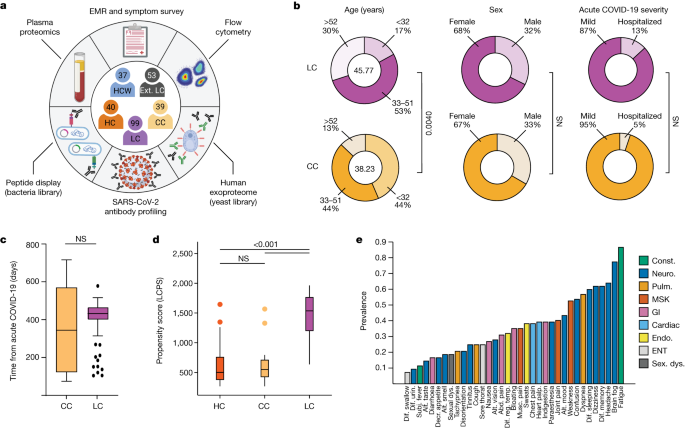
years and in collaboration with @VirusesImmunity and her incredible team we published our paper where we showed that we could identify people from healthy controls using blood biomarkers alone. Pre-printed in '22, and published in late '23: https://www.nature.com/articles/s41586-023-06651-y EVERY SINGLE 5/
@PutrinoLab - Putrino Lab
Long COVID participant in this study got sick BEFORE vaccines were available. So the argument that these physiological changes were triggered by the vaccine, as many asserted, is an unserious one. Please can we all stay focused on the problem: people are sick, people are 6/
@PutrinoLab - Putrino Lab
hurting and they need good science to guide pathobiological understanding and interventional strategies. The sick folks that we serve do not need our science to be hijacked to support extreme positions and dangerous agendas. After vaccines started to be distributed to the 7/
@PutrinoLab - Putrino Lab
general public, we started to note that a small percentage of folks were reporting significant and prolonged adverse events. I really want to point out that when members of our team spoke up in defense of our patients who were reporting what we now call PVS, we received some 8/
@PutrinoLab - Putrino Lab
pretty aggressive pushback - ranging from harsh words to death threats - I've got a pretty thick skin and a pretty great therapist. I don't need any sympathy, but I'm not going to pretend that this behavior didn't occur. I find it discouraging that I need to state this, but 9/
@PutrinoLab - Putrino Lab
here we go: you have no right to attempt to erase an illness simply because you find its existence to be politically inconvenient. I am eternally grateful that as my incredible team struggled to find allies in this landscape, there was also @hmkyale and @VirusesImmunity who 10/
@PutrinoLab - Putrino Lab
were conducting the LISTEN trial. Listening to the community about their experiences with Long COVID, vaccine injury and other complex chronic illnesses. Thanks to their dedicated work and amazing team, we produced two papers based on LISTEN data: one about Long COVID and one 11/
@PutrinoLab - Putrino Lab
about PVS. Both had comparable sample sizes, used identical methodologies and were released as preprints at the same time (late 2023). By early 2024, the Long COVID paper was published in the American Journal of Medicine, while the PVS paper remains https://www.sciencedirect.com/science/article/pii/S0002934324002389 12/

@PutrinoLab - Putrino Lab
unpublished in pre-print, generating, amongst other things, many of the same critiques we heard about Long COVID in '20: "you can't just take these people at their word that they have PVS", etc, etc. So now onto our most recent paper: we have a responsibility to people living 13/
@PutrinoLab - Putrino Lab
with PVS to investigate this condition. Yes, the current work has some limitations: like Long COVID, our working definition of PVS relies heavily on self-report, but this is because we're characterizing a new syndrome - until we can characterize it from a biomarker, we must 14/
@PutrinoLab - Putrino Lab
use a clinical diagnosis (sound familiar?). Yes, the sample size is small - well if you thought it was hard talking about PVS, you should publishing about it. And if you think publishing about it is bad, just try getting funding to study it. The deep immune profiling work is 15/
@PutrinoLab - Putrino Lab
extremely expensive and all the people working on this are doing it strictly as "night and weekend" work on a shoestring budget in service of a community that is being minimized and gaslit (sound familiar?). This means that releasing preliminary data with a small sample size 16/
@PutrinoLab - Putrino Lab
was necessary for us to establish the syndrome and talk about next steps. Of course we would prefer to have been able to publish on several hundred or thousand patients, but that would take millions of dollars of unrestricted funds and we don't have that. Lest we forget: many 17/
@PutrinoLab - Putrino Lab
seminal papers that establish new illnesses or syndromes are case studies that don't utilize control cohorts. Ppl living with PVS deserve the release of data that validates their lived experience in a timely fashion, and so this is what we have committed to doing. Yes, more 18/
@PutrinoLab - Putrino Lab
research is necessary on this phenomenon so that we can understand how to treat and manage PVS. So that we can develop biomarkers for diagnosis of PVS. So that we can develop BETTER VACCINES with fewer side effects. Vaccines save lives. We have been explicit in this message 19/
@PutrinoLab - Putrino Lab
from the very beginning and stand by the vital importance of vaccines in the maintenance of public health. The study that was pre-printed yesterday is the start of a conversation, not the end of the conversation - we have so much more to discover and learn from this work. 20/
@PutrinoLab - Putrino Lab
As we continue to learn, I would remind you that our singular purpose is to serve people who are suffering with PVS. They have a right to answers, they have a right to be believed and they have a right to competent care. If you don't like our science, do better science: make 21/
@PutrinoLab - Putrino Lab
our science obsolete with your own. Finally, I genuinely hope that no one thinks that we released this work lightly - we understand its gravity, but also feel the urgency for folks who are sick to be believed. Ultimately we will always center the needs of our patients first. /end
@PutrinoLab - Putrino Lab
Soon, we will be formally announcing the launch of our new clinic: a center dedicated to recovery from complex chronic illnesses. In this clinic we will treat folks with conditions like #EDS, #LongCOVID, #MECFS and #LongLyme. We were incredibly intentional about the decision 1/
@PutrinoLab - Putrino Lab
to treat many complex chronic illnesses because we truly believe that a commitment to understanding the similarities and the differences between these conditions will serve to develop better and more specific therapeutics for all of them. This categorically does NOT mean 2/
@PutrinoLab - Putrino Lab
that these conditions are all the same, and we need to proceed carefully as a community in this regard. These are COMPLEX, chronic conditions. IMO the greatest source of harm (inadvertent or intentional) that people with these conditions have experienced is from clinicians 3/
@PutrinoLab - Putrino Lab
and researchers trying to simplify what is complex. This is a very powerful urge that we need to suppress. Oversimplifying these conditions has not worked out for anyone. We need to acknowledge and embrace the complexity, and this will help all conditions. For instance, 4/
@PutrinoLab - Putrino Lab
#LongCOVID and #MECFS share many overlapping symptoms and diagnostic criteria. However, a fundamental and irrefutable difference between the two is that we *know* that acute SARS-CoV-2 infection was the precipitating event in LongCOVID. This matters greatly because we also 5/
@PutrinoLab - Putrino Lab
have significant evidence showing that spike proteins specific to SARS-CoV-2 may contribute to symptom burden and pathobiology in folks with #LongCOVID (and vaccine injury). To this end, we mustn't stop aggressively investigating therapies that will target circulating spike 6/
@PutrinoLab - Putrino Lab
proteins for folks with #LongCOVID and vaccine injury, even though this may not benefit those with pre-COVID #MECFS, EDS and #Lyme. Similarly there are folks with complex chronic illness who have #MECFS diagnoses from mold exposure or other triggering exposure events that will 7/
@PutrinoLab - Putrino Lab
not respond to therapies like Paxlovid, but DESERVE specific research tracks. Then of course we see the similarities. So many folks with #LongLyme, #LongCOVID, #EDS and #MECFS experience recurrent and debilitating latent viral reactivation, parasitic infection, bacterial 8/
@PutrinoLab - Putrino Lab
reinfections, etc. We see microclots, endotheliitis, biofilm formation, POTS and dysautonomia in these folks with similar underlying causes that can be addressed with similar therapies. All of this is to say, folks with complex chronic illness deserve clinical and research 9/
@PutrinoLab - Putrino Lab
strategies that acknowledge the similarities AND the differences between these conditions. Oversimplifying a complex problem is, IMO, a mistake especially when we still have SO MUCH to learn from the different communities. However, we need unity and collaboration in order to 10/
@PutrinoLab - Putrino Lab
rapidly disseminate the wisdom that can help everyone living with complex chronic illness in the moment. I *know* this is a fraught issue, but I wanted to explain the thinking behind our clinic and why we will be doing things in the way that we do. I hope this thread helps 11/
@PutrinoLab - Putrino Lab
to do so in a respectful way that keeps everyone feeling seen and heard, because everybody in this community matters and we truly need every single one of you in this fight. Every. Single. One.🙏 end/
@PutrinoLab - Putrino Lab
In the light of the damning report yesterday from @betsyladyzhets about lack of @NIH progress on #LongCOVID, I wanted to share a story of my own. In 2014, I was a newly minted young faculty member at Cornell Med. My research institute did this thing where they paid some large 1/
@PutrinoLab - Putrino Lab
amount (six figures over however many years) to an organization that would mentor young faculty on how to write NIH grants. That was all they did - day in and day out: taught you to write things that the NIH might say ‘yes’ to. Now there were lots of tips and tricks about 2/
@PutrinoLab - Putrino Lab
how to write specific sections of the grant, and course was taught by this guy, John R, who was a lovely and charismatic man and in his time in academia (before he realized that TEACHING people to write grants paid better than writing them himself) he was one of the most 3/
@PutrinoLab - Putrino Lab
funded NIH researchers on the planet. His advice came down to two key points that were more important than any of the other tricks: 1) Never EVER say you are going to solve a problem: This one was key. He used the example of diabetes: “Let’s say you have a complete cure for 4/
@PutrinoLab - Putrino Lab
Diabetes and all the pilot data in the world to show that your miraculous, silver bullet molecule cures diabetes and reverses all the negative effects. Don’t write that grant. Why? Because it will be reviewed by a room full of people that are funded to STUDY diabetes. If you 5/
@PutrinoLab - Putrino Lab
cure it, they have nothing to study so at least some of the people in that room will give you a bad score. It’s survival. Instead, write a grant that reassures your reviewers that there is always more work to be done. Kick the can down the road, and answer small ‘questions’: 6/
@PutrinoLab - Putrino Lab
don’t solve problems.” 2) “Get friendly with program officers and anyone who will be on your study section. Take them out to drinks, go to the same conferences with them and become their friends. People are far more likely to give you a favorable review if they know and like 7/
@PutrinoLab - Putrino Lab
you than if they don’t. Basic psychology.” Now, far be it from me to say that this is the truth of how to get NIH funding, but I can say, with confidence, that a company that gets paid lots of money to teach young academics to succeed in the NIH system identified these things 8/
@PutrinoLab - Putrino Lab
as important pillars of success. IF true, the obvious problem here is that these two pillars of success ensure: 1) NIH money is spent on small ideas 2) NIH money is distributed amongst a small “in-group” This was the moment in my career where I decided to largely dump the NIH 9/
@PutrinoLab - Putrino Lab
as a funding source and instead forge collaborations with industry partners and foundations that we’re mission-aligned with and who understand the need for urgency and disruptive innovation. Let me be clear: the NIH funds some of my favorite researchers who do science that we 10/
@PutrinoLab - Putrino Lab
NEED. We will never NOT need incremental research, it gives us insights that can only be gained through patience and time. BUT, it is NOT the right mechanism creating solutions for problems that need solving inside of 5 years. RECOVER was dead on arrival because it was never 11/
@PutrinoLab - Putrino Lab
designed to achieve the things it said it would achieve on the timeline so desperately needed by people with #LongCovid and everyone else who looked on with hope. I mourn RECOVER, but mainly I mourn the waste of resources. Knowing some of the fantastic research being funded 12/
@PutrinoLab - Putrino Lab
independently, however, I still have hope. Every day we learn more from scientists, patients and caregivers doing the real work: testing things, taking risks, engaging in citizen science and solving problems: not just “kicking the can down the road”, but building the road 🙏🏻 /end