reSee.it - Tweets Saved By @culturaltutor

@culturaltutor - The Cultural Tutor
A brief history of your favourite fonts... https://t.co/hj3yVOAJs2

@culturaltutor - The Cultural Tutor
1. Aptos First Times New Roman, then Calibri... and now Aptos has become the standard font on Microsoft Office. Created in 2021, it was — like so many other fonts ever since — inspired by the legendary Helvetica. But how long will it last as the world's default font? https://t.co/f8wW2Q8EB6

@culturaltutor - The Cultural Tutor
2. Times New Roman Commissioned by The Times newspaper in Britain in 1931 as an update to the "spindly" 19th century typeface they used at the time. This more solid design actually harks back to Italian typefaces of the 16th century. The ultimate serif font. https://t.co/5BfVd6Xsod

@culturaltutor - The Cultural Tutor
3. Calibri A baby in the world of fonts, Calibri was only developed in the early 2000s. But, after being made the default font for all Microsoft programmes in 2007, it fast became a force to be reckoned with. Modern, simplified, "warm"... but rather sterile. Will it be missed? https://t.co/zZ74gCdCBl

@culturaltutor - The Cultural Tutor
4. Papyrus An infamous font with humble origins. Graphic designer Chris Costello created Papyrus over six months in 1982 — he wanted to imagine what English letters would have looked like on 2,000 year old Egyptian papyrus. Unusual, distinctive, legendary, controversial. https://t.co/6SFH5Or8xR


@culturaltutor - The Cultural Tutor
5. Gill Sans The ultimate British font. Designed by Eric Gill in 1926 and based on the "underground alphabet" created by Edward Johnston for signs on the London Underground. Penguin Books and LNER both famously use Gill Sans. Stylish, easy to read, simple but sophisticated. https://t.co/yAxPnnQHA1


@culturaltutor - The Cultural Tutor
6. Helvetica The ultimate modern font, created by Swiss designers in 1957 who wanted to produce a neutral, "meaningless" typeface devoid of historical connotations. Sleek, stylish, clean, ubiquitous, and astonishingly influential — Arial is but one of many imitators. https://t.co/JX8mfGKDd1

@culturaltutor - The Cultural Tutor
7. Futura A 20th century typeface heavyweight: futuristic, imposing, & stylish. Designed by Paul Renner in 1927 under the influence of ideas from the Bauhaus, and a hugely influential typeface in its own right. Futura Bold was Stanely Kubrick's favourite font. https://t.co/NMDkqfcszl


@culturaltutor - The Cultural Tutor
8. Comic Sans Perhaps the most controversial typeface of all time. Comic Sans was designed in 1994 by Vincent Connare, based on comic book speech bubbles, intended either for casual use or children's materials. It's been around since Windows 95 and it's never going away. https://t.co/Wmf8yPuce0


@culturaltutor - The Cultural Tutor
9. Broadway Typically used to evoke the atmosphere and art of the 1920s... and its Art Deco vibe is authentic. The highly-stylised and ever-popular Broadway typeface was designed in 1927 by none other than Morris Fuller Benton. Perhaps a little overused, though? https://t.co/b3umedtbxD

@culturaltutor - The Cultural Tutor
10. Jokerman Yet another member of that exclusive group of peculiar, playful 1990s fonts which have somehow dominated the world ever since their creation. Jokerman was designed in 1995 by Andrew Smith and named after a Bob Dylan song. https://t.co/1JFJZ6pi3w


@culturaltutor - The Cultural Tutor
11. Rockwell The most famous of the once-popular "slab serif" fonts, where the serifs are big and heavy... like slabs. And Rockwell is older than you might think; it was created in 1934. Somehow feels exciting and optimistic. https://t.co/jYIY2VFEwf

@culturaltutor - The Cultural Tutor
12. Arnold Böcklin Designed by Otto Weisert in 1904 and named after the painter (most famous for "Isle of the Dead"), this might be the most evocative typeface ever created. It oozes Art Nouveau, though it is *not* the same font used by Hector Guimard for his Paris Metro signs. https://t.co/J63y48QsRJ


@culturaltutor - The Cultural Tutor
13. Impact Designed by Geoffrey Lee in 1968 for publicity and advertising in Britain as an alternative to similar European typefaces. Impact was included in Windows 98... and experienced a rather unexpected revival in the 21st century as the definitive font of choice for memes. https://t.co/UW6i012Emo

@culturaltutor - The Cultural Tutor
14. Microgramma Designed by Aldo Novarese and Alessandro Butti (who also made the iconic Eurostile typeface) in 1952, Microgramma was all over graphic design in the second half of the 20th century. Also popular in science fiction, particularly the Alien films and Star Trek. https://t.co/YtroRE8PJK


@culturaltutor - The Cultural Tutor
15. OCR-A One of the first Computer Age typefaces, designed in 1966 to be readable both by humans and machines. Although the real need for OCR-A has passed it lingers on in documentation and has even entered the world of graphic design because of its distinctiveness. https://t.co/KqXe84CWBv


@culturaltutor - The Cultural Tutor
16. Garamond One of the oldest fonts still in regular use. It was designed in the 1920s as a revived version of a typeface used by the 16th century French publisher Claude Garamond, though the original designer (or "punchcutter") was called Robert Granjon. Renaissance revival. https://t.co/4DtPp9pR59

@culturaltutor - The Cultural Tutor
17. Courier New Added to Windows 3.1 in 1992 as a digitised version of Courier, designed by Howard Kettler for IBM in 1956. Though it is the classic "typewriter" font, associated with old documents, it has enjoyed a surprising renaissance thanks to its use in coding. https://t.co/msb23D07U2


@culturaltutor - The Cultural Tutor
18. Old English Despite its name, the so-called Old English typeface is really a modern reinterpration of the Blackletter style used when the printing press was first invented in the 1440s, itself based on the style of the hand-written manuscripts of Medieval monks. https://t.co/REfPwWaggZ


@culturaltutor - The Cultural Tutor
19. Bauhaus Not actually created by the radical and incredibly influential Bauhaus design school, which flourished in Germany in the 1920s. But it was based on an experimental "universal font" created for them by Herbert Bayer; the current digital interpretation is from 1993. https://t.co/OCOjaQMkf2


@culturaltutor - The Cultural Tutor
20. Bodoni Designed by Giambattista Bodoni in the late 1700s, this font — with its extreme contrast between thick and thin strokes — takes us back to a different era of typefaces. Though rather sophisticated, you can tell it wasn't designed for digital display. https://t.co/fiRtxr2oU0

@culturaltutor - The Cultural Tutor
21. Bank Gothic Created in the 1930s by Morris Fuller Benton, perhaps America's greatest ever typeface designer, Bank Gothic is more common than you think. It's been used in everything from the facade of Arsenal's Emirates Stadium to the Grand Theft Auto games. https://t.co/6R1dojPt1P

@culturaltutor - The Cultural Tutor
22. Centaur An underrated font? Perfect for body text or heading, it was designed in 1914 by Bruce Rogers, based on a font used by the Venetian-based French printer Nicolas Jenson in the 1470s. The italic version is called Arrighi. Always a classy choice. https://t.co/0l23oT5Pc6


@culturaltutor - The Cultural Tutor
23. Chiller Created by the same person as Jokerman, a British designer called Andrew Smith, in 1995. It is the ultimate "scary" font and has been used in everything from film posters to video games. Another member of that exclusive 1990s club, still going strong. https://t.co/GJdvLsICnF

@culturaltutor - The Cultural Tutor
24. Stencil Two typefaces, both called Stencil, were designed within a month of one another in 1937 by R. Hunter Middleton and Gerry Powell. Usually associated with the American military, but also briefly used by Real Madrid... https://t.co/3PGtYofChF


@culturaltutor - The Cultural Tutor
The Kiss, painted by Francesco Hayez in 1859, is surely one of the most perfect portrayals of romance in history. But it also has a hidden political message. This is the story of The Kiss — and how art can mean more than one thing at once... https://t.co/LiEFawyJKE

@culturaltutor - The Cultural Tutor
Francesco Hayez, the son of a Venetian fisherman, was born in 1791. Despite his humble origins the young and talented Francesco won a scholarship — in 1809 he went to study in Rome. And in 1823 he moved to Milan, where he became one of the leading artists of his generation. https://t.co/HmrJFY4iaw

@culturaltutor - The Cultural Tutor
In Milan Francesco found constant patronage among the nobility and political classes, especially Italian nationalists. There were three main genres he worked in. First were historical and religious paintings, such as the Destruction of the Temple at Jerusalem: https://t.co/qSwfTAXN3Y

@culturaltutor - The Cultural Tutor
Many were Classical or Biblical history, and even Classical mythology, along with Crucifixions and paintings of Christ. But Hayez also emphasised episodes from Italian history, bringing his eye for smooth Neoclassical finishes and Romantic drama to these historical panoramas: https://t.co/jQUG6fPfy9

@culturaltutor - The Cultural Tutor
Then there were the portraits. Here we see Hayez the technical master, who was able to conjure paintings with an almost photorealistic level of detail. Little wonder he was so popular among the nobility, politicians, and artists of Milan: https://t.co/OjnzkgRK5y


@culturaltutor - The Cultural Tutor
Then there was a third type, best seen in his Revenge Triptych, which tells the story of a woman enacting vengeance on her lover. But it is more than that: it is allegorical and mysterious, mixing history with an allusive, symbolic quality. We ask, "what does this really mean?" https://t.co/JXz9HTVOGb

@culturaltutor - The Cultural Tutor
The Kiss, painted in 1859 for Count Alfonso of Saliceto, is one of this type. It is perfect in its ambiguity — we do not see specific historical figures but a generic Medieval couple whose stories we can imagine, onto whom we can freely project our own feelings and thoughts. https://t.co/wNcpTNweeB

@culturaltutor - The Cultural Tutor
And the first thing we think is... what a perfect portrayal of romance! The pale colour of the background acts as a canvas for the colourful clothes of the lovers, and its very simplicity focusses our attention on their embrace. Simple, subtle, powerful composition. https://t.co/cVuEgCXe2z

@culturaltutor - The Cultural Tutor
And so, regardless of context or hidden meaning, we can place it alongside something like The Kiss by Klimt as a romantic masterpiece. Hayez brings his technical mastery and photorealistic detail without losing any sense of a dramatic, almost fantastical, heightened reality. https://t.co/8BSlMRRFd0

@culturaltutor - The Cultural Tutor
But there *was* a context to Hayez's Kiss. See, in 1859 Italy was divided into separate states and kingdoms — there was no single country called "Italy". But, ever since the end of the Napoleonic Wars in 1815, there had been a growing movement in favour of Italian unification. https://t.co/FhsBUuokO6

@culturaltutor - The Cultural Tutor
This movement was part of a broader geopolitical struggle between the Great Powers of Europe, especially France and the Austrian Empire. The Austrians did not want Italian unification; they wanted to dominate the peninsula. France, meanwhile, would benefit from Italian unity.
@culturaltutor - The Cultural Tutor
Underground nationalist groups emerged and there were riots and revolts until, in 1849, the First Italian War of Independence broke out — alas, it ended in Austrian victory. But ten years later came the Second Italian War of Independence... https://t.co/sgGOddCqSI


@culturaltutor - The Cultural Tutor
So one potential meaning of The Kiss is that we see a soldier bidding farewell to his love before setting out for battle. Suddenly the context changes and it becomes charged with ideas of patriotism and sacrifice. And we wonder... what is that shadow lurking in the corner? https://t.co/HcPnBfM8nX

@culturaltutor - The Cultural Tutor
But there's more — in 1859 Napoleon III of France had signed an agreement with Count Cavour, Prime Minister of the Kingdom of Sardinia. This would be the turning point, they hoped, to bring about victory in the war with the Austrians. France might be Italy's saviour! https://t.co/1sa8uLzLrZ


@culturaltutor - The Cultural Tutor
Count Alfonso specifically asked Hayez to paint something that embodied these fresh hopes for the future of Italy. Notice the colours of the clothes in The Kiss: red, white, and blue... the French flag! This is an allegorical kiss representing union between France and Italy. https://t.co/feTeaYS4Tc

@culturaltutor - The Cultural Tutor
And, going further, the kiss might represent unity in a more general way — the union of the Italian kingdoms into a single state. Suddenly what seemed like a purely romantic painting becomes a potent political symbol, rich with ideas of nationhood, brotherhood, and freedom. https://t.co/a0Mh7Pzs8J

@culturaltutor - The Cultural Tutor
In the second version of The Kiss, painted after the official unification of Italy in 1861, Hayez includes a white cloth on the steps by the couple and gives the man a green cloak. Now we have green, white, and red... the Italian flag! (& blue for France also remains in thanks) https://t.co/IHSVeKdV32

@culturaltutor - The Cultural Tutor
Little wonder, then, that The Kiss quickly became a symbol of the Risorgimento — meaning "Resurgence", the unification movement as a whole, politics and culture together. It has featured in other paintings, films, advertising, and graffiti, and is still as iconic as ever. https://t.co/aXvpce99YC

@culturaltutor - The Cultural Tutor
The Kiss is a wonderful example of how the meaning of a work of art can change depending on how much you know about it. And it reminds us that no interpretation is "correct" —The Kiss can be nothing more than a pure evocation of how the world disappears in the ecstacy of love. https://t.co/m6GDRonVOw

@culturaltutor - The Cultural Tutor
Or it can be a symbol of the Italian unification movement, the Risorgimento, or even of the country of Italy itself — or it can represent patriotism, sacrifice, unity, and peace in any place or time. ...and is this not the wonder of art, the thing that inevitably compels us?
@culturaltutor - The Cultural Tutor
A painting can, even regardless of what the artist intended or the context it was made in, mean a thousand different things to a thousand different people. John Ruskin explained this perfectly when comparing science and art: https://t.co/2dcRDkVBv0


@culturaltutor - The Cultural Tutor
2023 is about to end... or is it? That depends on what calendar you're using: https://t.co/xcvyLXnbxZ

@culturaltutor - The Cultural Tutor
Gregorian Calendar: 2023 The world's most commonly used dating system. Introduced in 1582 by Pope Gregory XIII as a slight modification of the old Julian Calendar. It dates history from the birth of Jesus Christ. And there's no "year zero" — 1 BC is followed by 1 AD.
@culturaltutor - The Cultural Tutor
Chinese Calendar: 4721 Used as the basis for traditional holidays such as Chinese New Year. There are several Chinese calendars, however, and 4721 is the year according to the one that dates history from the birth of the mythical Yellow Emperor, Huangdi.
@culturaltutor - The Cultural Tutor
Coptic Calendar: 1740 Used for liturgical purposes by the Coptic Christian Church in Egypt. It dates history from the Year of the Martyrs, when the Roman Emperor Diocletian unleashed a wave of violent persecution on the Christians of Alexandria.
@culturaltutor - The Cultural Tutor
Hebrew Calendar: 5784 Used for Jewish religious observance and ceremonial purposes. It dates history from the moment of the creation of the Earth according to the Book of Genesis.
@culturaltutor - The Cultural Tutor
Hinduism has several calendars. One of them structures history by Yuga Cycles, which last 4,320,000 years and each comprise four Yugas, like world ages. The current cycle has entered Kali Yuga, which began with the death of Krishna 5,124 years ago and has 426,876 years left.
@culturaltutor - The Cultural Tutor
Japanese Regnal Calendar: Reiwa 5 This is a "regnal calendar", which means that it is dated according to the years of an emperor's reign. Each new reign is given a name; Reiwa, meaning "Beautiful Harmony", is the current era, which began when Naruhito ascended the throne.
@culturaltutor - The Cultural Tutor
Britain also has a regnal calendar which is still used for some legal purposes such as parliamentary legislation. It counts the year of a monarch's reign, followed by the monarch's name and number. So 2023 was split between "1 Cha. 3" and "2 Cha. 3".
@culturaltutor - The Cultural Tutor
Islamic Calendar: 1445 Used to determine Islamic holidays and for other religious purposes. It dates history from the Hijra, when Muhammad went from Mecca to Medina and established the first ummah, or Muslim community.
@culturaltutor - The Cultural Tutor
Nanakshahi Calendar: 555 Used for religious purposes in Sikhism. Dates history from the birth of Guru Nanak Dev, the founder of Sikhism and the first of the Ten Gurus.
@culturaltutor - The Cultural Tutor
Buddhist Calendar: 2566 Used for religious, ceremonial, and also official and civil purposes. Dates history from the year the Buddha attained parinibbāna, although there is disagreement about when that actually occurred.
@culturaltutor - The Cultural Tutor
Juche Calendar: 112 Used exclusively in North Korea. Dates history from the birth of the state's founder, Kim Il-Sung.
@culturaltutor - The Cultural Tutor
Byzantine Calendar: 7532 Formerly used by the Byzantine Empire and afterwards by the Eastern Orthodox Church for several centuries. Its starting point is the creation of the universe, dated to 5509 years before the time of Jesus.
@culturaltutor - The Cultural Tutor
Julian Calendar: 2023... minus ten days. The calendar introduced by Julius Caesar in 45 BC as an updated version of the old Roman system. Used all over Europe for over 1,500 years until it fell slightly out of alignment with the solar year. Thus Pope Gregory modified it in 1582.
@culturaltutor - The Cultural Tutor
Roman: 2776 The Ancient Roman dating system was based on the consuls who had served in a given year rather than being numbered. But one system, created in the Renaissance and used by classical scholars, dates Roman history from the founding of the city of Rome: Ab Urbe Condita.
@culturaltutor - The Cultural Tutor
Assyrian Calendar: 6773 Technically the oldest calendar still in use, since it is based on the dating system of the Ancient Assyrians and measures history from the date of the Flood in Mesopotamian mythology. Revived in the 20th century by modern Assyrians.
@culturaltutor - The Cultural Tutor
Baháʼí calendar: 180 The religious calendar of the Baháʼí Faith, known as the Badíʻ calendar, meaning "Wonderful." It dates history from when the Báb first started preaching.
@culturaltutor - The Cultural Tutor
Holocene Calendar: 12,023 Dates history from the Neolithic Revolution, when humanity moved away from a hunter-gatherer lifestyle to an agricultural society and civilisation as we know it was born, which for ease is regarded as 10,000 BC.
@culturaltutor - The Cultural Tutor
Unix Time is a dating system used in computing which records how many seconds have elapsed since 00:00:00 UTC on 1st January 1970. When 2024 begins it will have been 1,704,067,200 seconds since that moment. In some sense this might be the world's most important calendar.
@culturaltutor - The Cultural Tutor
Most of these calendars structure years, months, weeks, and days differently, whether based on astronomical phenomena, historical events, or pure mathematics, and do not neatly overlap with the Gregorian Calendar. Because there is no single way to calculate or organise time.
@culturaltutor - The Cultural Tutor
And these are only a few of the many calendars still used or which have been used throughout history. Though the Gregorian Calendar might seem fixed, as if 2023 is somehow the objective date, it is but one of many possibilites. Even time and history are a matter of perspective.
@culturaltutor - The Cultural Tutor
And so even if the Gregorian is the world's dominant calendar at the moment (for civil purposes at least) that won't always be the case. All things must pass, as they say. Which begs the question... what calendar will be used in the future?
@culturaltutor - The Cultural Tutor
Some helpful art words... 1. Impasto A technique where paint is thickly laid on a canvas and therefore has its own physical texture. Vincent van Gogh loved to use impasto. https://t.co/dchpjRyVT6

@culturaltutor - The Cultural Tutor
2. Trompe-l'œil When a flat surface is painted to seem three-dimensional. Much art appears to have depth, but trompe-l'œil is where the artist does so in an incredibly realistic way and perhaps even deceives us. It is almost a form of optical illusion. https://t.co/7J9U0wYjfy

@culturaltutor - The Cultural Tutor
3. Di sotto in sù A specific form of trompe l'œil where it used to paint walls and ceilings with vast murals of gods, skyscapes, warriors, and angels. Or to paint architectural features (e.g. domes) which aren't actually there. Common in Baroque art and architecture. https://t.co/5qHM624Wf8

@culturaltutor - The Cultural Tutor
3. Relief Where a sculpture remains part of the material from which it was sculpted, and thus projects outward from a flat surface. "High Relief" is when the sculpture has more depth, and "Low Relief" less. https://t.co/74zDzt21aL


@culturaltutor - The Cultural Tutor
4. Stiacciato A type of incredibly shallow and technically difficult relief. It was mastered by Donatello in the Early Renaissance. Despite carving no more than a few millimetres into the marble, he creates the illusion of depth and perspective. https://t.co/IAqn6jxRiB

@culturaltutor - The Cultural Tutor
5. Sfumato From the Italian for "smoky". When colours and outlines are blurred into another. This makes art more realistic because it reflects how we actually see the world. Leonardo used it, for example, on the Mona Lisa. Notice that there are no hard outlines on her face. https://t.co/N4nnP262Nm

@culturaltutor - The Cultural Tutor
6. Chiaroscuro The contrast and balance between light and darkness. It usally refers to the particularly bold and noticeable use of light and shadow to enhance the drama and atmosphere of a painting. https://t.co/iLs1VyyH22


@culturaltutor - The Cultural Tutor
7. Fresco Where paint is applied to wet plaster; as it dries it binds the paint. A mural is any painting on a wall (rather than a canvas or panel) and so a fresco is a type of mural. In the Sistine Chapel Michelangelo painted on a section of freshly laid plaster each day. https://t.co/QVbQwgzInH

@culturaltutor - The Cultural Tutor
8. Diptych, Triptych, Polyptych A Diptych is when a painting has two panels; a Triptych has three; a Polyptych has more than three. Hieronymus Bosch's Garden of Earthly Delights is probably the most famous example of a triptych. https://t.co/FTlxsKVBtG

@culturaltutor - The Cultural Tutor
9. Grisaille When paintings are done exclusively in greyscale colours. As a result they imitate the appearance of stone sculpture. https://t.co/DQXDITGCvY

@culturaltutor - The Cultural Tutor
10. Engraving A method of making prints where a copper plate is engraved to create an image. These engraved furrows then hold the ink and, when pressed against a sheet of paper, reproduce the original picture. https://t.co/oWFWKghOto

@culturaltutor - The Cultural Tutor
11. Woodblock Similar to engraving in that it produces multiple prints, but uses the opposite method. A block of wood is engraved, but it is the raised parts — lines or larger areas — that are inked and used to make the image. Japanese ukiyo-e are woodblock prints. https://t.co/qfdC1MZJwC

@culturaltutor - The Cultural Tutor
12. Lost-Wax Technique An ancient method for creating large or complex metal sculptures. It is a multi-staged process whereby an original sculpture, usually made from wax, is used to create moulds by which more copies of the same sculpture can be cast, often in bronze. https://t.co/7KQRgWsHwM

@culturaltutor - The Cultural Tutor
13. Contrapposto When the human in a sculpture has their weight on one foot. This naturally alters their entire pose and makes them seem much more realistic. Contrapposoto, though subtle, brings a statue to life. Michelangelo's David is most famous, but there are many examples. https://t.co/evPdeWKZGw

@culturaltutor - The Cultural Tutor
14. Pointillism A method of painting developed in the late 19th century by Georges Seurat, inspired by new science regarding human sight and optics. There are no mixed colours; thousands of indivial points of paint are placed next to one another and our eyes do the mixing. https://t.co/hEXocqXkI2


@culturaltutor - The Cultural Tutor
15. Anamorphosis An optical illusion where what we see is distorted unless viewed from the correct angle — think of road markings. Michelangelo gave David an oversized head because he would be seen from below; Holbein's mysterious skull is another famous example. https://t.co/jGUGZOZuKd


@culturaltutor - The Cultural Tutor
16. Rückenfigur From the German for "Back Figure". There is a person, usually in the foreground, with their back turned to us, observing the scene before them. Sometimes this motif evokes mystery; sometimes it serves as a conduit for the viewer to enter the painting. https://t.co/D1OQkRhg73

@culturaltutor - The Cultural Tutor
17. Repoussoir A motif whereby something is placed at the right or left foreground of a painting. This helps to frame the scence, balances its composition, and guides the viewer's eyes. You'll realise thousands of paintings have repoussoir when you start to look for it. https://t.co/kNMMWpeIue

@culturaltutor - The Cultural Tutor
18. Donor Portrait During the Middle Ages and Renaissance people commissioned artists to make religious paintings — and had themselves added in. Thus, in these "Donor Portraits", we see the person who commissioned the painting as part of the scene. https://t.co/UBA2gxESFm

@culturaltutor - The Cultural Tutor
19. Tenebrism A particularly dramatic, unrealistic, and intense form of chiaroscuro where scenes are shrouded in thick shadow and only certain details are illuminated. Most famously used by Caravaggio. https://t.co/2PIckwAEYS

@culturaltutor - The Cultural Tutor
20. Craquelure The cracking that appears on the surfaces of paintings over time. Different types of paint produce different shapes and forms of craquelure; thus it is helpful for dating and authenticating works of art. https://t.co/tJDFISgnmL

@culturaltutor - The Cultural Tutor
A helpful guide to what all those "bits" of buildings are actually called: https://t.co/fRYEKWmD6W


@culturaltutor - The Cultural Tutor
Soffit: the flat underside of any overhanging structure, most often the edge of a roof. Corbels: structures to help support the weight of any overhanging element, structurally important but often decorated. https://t.co/mQk5yX6OrD

@culturaltutor - The Cultural Tutor
Cornice: that "horizontal bit", projecting out and usually decorated, at the top of a building. Dentils: those tiny, teeth-like details beneath the cornice. https://t.co/8RZTnlunJM


@culturaltutor - The Cultural Tutor
Finial: a sort of finishing decorative element at the very top of any other structure, such as a dome, tower, or spire. https://t.co/5aH4prVX7y


@culturaltutor - The Cultural Tutor
Cupola: a small structure which usually lets in light, often dome-shaped but not always, on top of a larger roof or dome. https://t.co/arT0Tuwu0c


@culturaltutor - The Cultural Tutor
Arcade: any row of arches. Blind Arcade: a purely decorative arcade which is up against a wall. https://t.co/9jwsMKZtCL

@culturaltutor - The Cultural Tutor
Pediment: the triangular or semi-circular part above a door or window, originating in classical architecture. https://t.co/IvdwWG8trU

@culturaltutor - The Cultural Tutor
And, speaking of classical architecture, here are the different parts of a column. (Though these terms do apply to all columns, classical or otherwise). https://t.co/4IfgMKdOaG

@culturaltutor - The Cultural Tutor
And here are the five "Classical Orders". An Order include both the column and everything it supports. Each have different proportions, rules, and decorative features. https://t.co/incmvoiYqf

@culturaltutor - The Cultural Tutor
The entablature rests on top of the column. It's made up of the architrave, frieze, and cornice. https://t.co/5mWAHIsCWh

@culturaltutor - The Cultural Tutor
A colonnade is any row of columns, whether as part of another building or standalone. And a balustrade is a row of balusters, usually as part of a railing or parapet, as here. https://t.co/ungpbOGEcZ

@culturaltutor - The Cultural Tutor
Portico: a porch leading to the entrace of a building supported by a colonnade, often with a pediment too. https://t.co/ESVZqFfYJi

@culturaltutor - The Cultural Tutor
These are some elements of Gothic architecture. Clerestory: the upper level of windows in a church. Pinnacles: miniature spires on top of buttresses. Flying buttress: a buttress separated from the wall it supports by an arch. https://t.co/gLSQjl90ZN

@culturaltutor - The Cultural Tutor
Mullions are the vertical dividing elements in windows. Tracery is the decorative, carved stonework in the upper parts of the window. The individual windows separated by the mullions and tracery are called lights. https://t.co/0nbV2oDpzx

@culturaltutor - The Cultural Tutor
In Islamic architecture there is a wonderful feature called muqarnas. A complex array of geometrically carved vaulting, almost like honeycomb, on the underside of arches, domes, and semi-domes. https://t.co/vTmDRmTOlp

@culturaltutor - The Cultural Tutor
The iwan is a vaulted hall walled in on three sides; the unwalled side forms a large entranceway which opens onto a central courtyard. https://t.co/7ANJFhW5Zu

@culturaltutor - The Cultural Tutor
Some elements of Byzantine Architecture. Pendentives: the convex triangles between perpendicular round arches; they create a circle on which a dome or drum can be constructed. Drum: the cylindrical structure that supports a dome. Semidomes... it's in the name. https://t.co/opOIpRzXw2


@culturaltutor - The Cultural Tutor
Some types of windows. Mashrabiya: an upper-storey window which juts out and is enclosed with ornate lattices. Venetian: one large central window flanked by two smaller ones. Rose Window: the large, circular windows of High Gothic architecture. https://t.co/6B1iU8mOAi


@culturaltutor - The Cultural Tutor
And back to where we started: a gable is the triangular wall at the end of a pitched roof. https://t.co/cGsKV3fTgx

@culturaltutor - The Cultural Tutor
Simply knowing what something is called helps to describe, understand, and even *see* it more clearly. And, indeed, architecture is a language all of its own: the language of our streets, history, and civilisation. When you speak that language the world comes to life.
@culturaltutor - The Cultural Tutor
The Problem with Galleries: (and why they're bad for art) https://t.co/aAyVYzZcPf

@culturaltutor - The Cultural Tutor
Galleries and Museums of Art are wonderful places. Room after room of art. Hundred or even thousands of varied, interesting, and beautiful paintings and statues from across the centuries and the world. And all of this in some neoclassical palace or modernist masterpiece. https://t.co/9uYhoj2RdW


@culturaltutor - The Cultural Tutor
But walking through these galleries and looking at all this "art" can be deceptive. It makes us think that we have found the answer to the question, "what is art?" Paintings and sculptures in a gallery to be perused and consumed — pure art to be viewed as nothing but art. https://t.co/MMRU0Fja5a

@culturaltutor - The Cultural Tutor
Yet nothing could be further from the truth. Art has never been "pure art", either for those making it or those seeing it. Think of it this way. Where is Leonardo da Vinci's Last Supper? Not in a gallery — it is painted on the refectory wall of a convent in Milan. https://t.co/GveOIs0zLY

@culturaltutor - The Cultural Tutor
Leonardo's second most famous painting, one of the world's most iconic images, was painted onto the wall of a dining room where monks ate their breakfast, lunch, and dinner. Thus they could imagine themselves dining with Christ and the Apostles. https://t.co/JbABwWFwL8

@culturaltutor - The Cultural Tutor
Where is the Creation of Adam? It is part of Michelangelo's frescos on the ceiling of the Sistine Chapel — the private chapel of the Pope in the Vatican City. The Last Supper, like the Creation of Adam, was religious art; it had a context, a place, and a purpose. https://t.co/PWU2fvyLQB

@culturaltutor - The Cultural Tutor
And so galleries remove art from its context — they lead us to believe it never had any. Altarpieces were once in churches; people held services, worshipped, and prayed with them. Removed from that context, such art is almost impossible to fully understand and appreciate. https://t.co/J0q4MLI794


@culturaltutor - The Cultural Tutor
And this is true all over the world. From the Parthenon Friezes to the Buddhist murals at the Ajanta Caves; from the mosaics in the Great Mosque of Damascus to the mosaics of St Mark's Basilica in Venice. This was not "simply art" — it was the art of a living religion. https://t.co/fyQFOdkgFr


@culturaltutor - The Cultural Tutor
There was also, say, funerary art. The mask of King Tutankhamun, the sarcophagus of King Pacal of Palenque, the tomb of Pope Alexander VII, the terracotta army of Qin Shi Huang. This was art to glorify and commemorate a dead ruler— it was, again, art with a purpose and a place. https://t.co/2uvtufElTz

@culturaltutor - The Cultural Tutor
But religion or the glorification of kings was not the only purpose or context of art. Michelangelo's statue of David, upon completion in 1504, was placed outside the Palazzo Vecchio in Florence. This was a piece of public art intended to embody the city of Florence itself. https://t.co/0jh4mxAUYZ


@culturaltutor - The Cultural Tutor
And not all art was such grand and singular works of marble sculpture, altarpieces, or fresco. Only recently a terracotta relief of the Madonna that had adorned the corner of a street in Florence for six centuries was identified as a work of the Renaissance master Donatello! https://t.co/dEq1Kt4Kft

@culturaltutor - The Cultural Tutor
And so art wasn't a contextless creation for a gallery, separated from society and boxed off as this thing called "Art". It was simply the expression of religious reverence, of civic pride, of humour, of delight, of beauty, of memory — and every street was filled with such art. https://t.co/FFUr2sF4U5

@culturaltutor - The Cultural Tutor
And it goes beyond the streets and into the houses. Brueghel the Elder produced drawings for Hieronymus Cock's printing house to be sold to the public in Antwerp, much like the prints of the great Japanese ukiyo-e artists Hiroshige and Hokusai. This was art for the home. https://t.co/9X1l0B26jY


@culturaltutor - The Cultural Tutor
So it wasn't only the aristocracy who could afford art. No doubt they did commission much of it and thus their houses were filled with art. Like the family villa of Cardinal Sciopione Borghese, who paid Gianlorenzo Bernini to make his marble masterpieces in the 17th century. https://t.co/gXzLMxTwCg

@culturaltutor - The Cultural Tutor
But the middle classes also bought art and decorated their homes with it. Not only Brueghel and Hiroshige, but what else were Monet and van Gogh doing when they made their paintings? They hoped to find a buyer who liked their pictures and would hang them in their houses. https://t.co/7dKhfcif1N

@culturaltutor - The Cultural Tutor
Albrecht Dürer and Gustave Doré, both of them master engravers in the 16th and 19th centuries respectively, created illustrations for books. Those illustrations are now in galleries and museums — once they were in books that people absent-mindedly flicked through in the evening! https://t.co/OckJJNGta9

@culturaltutor - The Cultural Tutor
And beyond paintings or sculptures, almost *everything* before the Industrial Revolution was art. Whenever humans make anything by hand we are inclined to decorate it in some way. Thus museums are now filled with "art" that is, in fact, nothing more than everyday objects. https://t.co/mDeZ1x2sLW


@culturaltutor - The Cultural Tutor
Incense burners, candlesticks, chairs, cutlery, crockery, wine jugs, tables, cupboards, fences, gates, carpets, lampshades, even ships! All of these were what we now call "art" — at the time there was no need to call them that because it was obvious that that is what they were. https://t.co/MCvZpvCOgT

@culturaltutor - The Cultural Tutor
The great William Morris explained all this best in the late 19th century, as he tried to fight against the rising tide of industrial mass manufacture and the slow retreat of the arts into their galleried confines. https://t.co/XaYOZxq99w

@culturaltutor - The Cultural Tutor
We can go back even further, beyond even the dawn of human civilisation. The oldest art we have ever found is cave paintings — of bison, pigs, deer, abstract patterns, and handprints. We have been decorating our homes with art pretty much since "we" first started to exist. https://t.co/dE0UKCXtbc

@culturaltutor - The Cultural Tutor
Galleries are wonderful — but they risk making us believe that "art" is a thing separate from the rest of society. It is not and never has been. Art was a universal feature of life, from the castles of kings to the churches and temples to the street corner and the lowliest home. https://t.co/XnDpjNCksm

@culturaltutor - The Cultural Tutor
What's the alternative? Well, all these paintings and sculptures need to be somewhere, and it's better that they are in places where the public can see them. That being said, perhaps some of these artworks could be — like David — placed in the streets, as they once were? https://t.co/ssEDEdc30U

@culturaltutor - The Cultural Tutor
Alas, the point here isn't that galleries should be empty or closed down; many of these older artworks would deteriorate and it is surely our duty to preserve them for future generations. Simply — we must remember that galleries conceal the real nature of art. https://t.co/iPZhB41QDq

@culturaltutor - The Cultural Tutor
Once upon a time people didn't need to go to galleries to "see art", because art was everywhere around them. Perhaps the rise of industrial mass production has made such a world impossible... perhaps! But, lest we forget, art is not what galleries seem to say it is. https://t.co/ID63r02QpH

@culturaltutor - The Cultural Tutor
None of this is to say that we no longer make art — it's just that we may have been looking in the wrong place! What is cinema if not the definitive modern art form? In which case, recent decades have seen some of the greatest art ever produced. But that's another story...
@culturaltutor - The Cultural Tutor
A Brief Guide to Byzantine Architecture: https://t.co/d885w3Fvif

@culturaltutor - The Cultural Tutor
The place to begin is with the architecture of the Ancient Greeks. Their architecture was "trabeated" — it was based on the post and lintel. A column holding up a horizontal beam was the basic unit of almost everything they built. https://t.co/gaM4QMvZYG

@culturaltutor - The Cultural Tutor
Then came the Romans, whose architecture was inherited from the Greeks. They started building with the round arch. But notice that wherever the Romans used an arch they would always surround it with pilasters and entablatures — an imitation of the Greek post and lintel. https://t.co/07asYGssWS


@culturaltutor - The Cultural Tutor
Then came the Byzantines. The so-called "Byzantine Empire" was really just the Roman Empire in the east. Whereas it faded away in the west in the 5th century, the Eastern Roman Empire survived for another one thousand years. https://t.co/ehDnC6w7g1

@culturaltutor - The Cultural Tutor
Their capital was Constantinople, an ancient Greek city once called Byzantium but renamed by Emperor Constantine when he made it capital of the Roman Empire. Hence modern scholars called them the "Byzantines", even though they thought of themselves as Romans. https://t.co/aD8HPuHIrC

@culturaltutor - The Cultural Tutor
William Morris put it best when he said that the Byzantines "liberated the arch". Remember that the Romans had inevitably surrounded their arches with pilasters, entablatures, and pediments. https://t.co/0kfd4KBIgd

@culturaltutor - The Cultural Tutor
The Byzantines did away with this and let the arch speak for itself. They still decorated their arches, but they weren't hemmed in by those pilasters and pediments — leftovers from the age of trabeated architecture. The Byzantine arch stood alone and stood supreme. https://t.co/GCk2q2l5iO

@culturaltutor - The Cultural Tutor
Still, early Byzantine churches took their layout from Roman basilicas (a type of large civic building in all Roman cities). They had long, rectangular naves flanked by columns with rounded arches and an apse at the end, like the 4th century Saint Sofia in Bulgaria: https://t.co/aoqn026r3Y

@culturaltutor - The Cultural Tutor
But this elongated shape soon transformed into something more centralised. Freeing the arch had allowed Byzantine architects to build in new ways. They started raising up large domes, as at the Hagia Irene in Istanbul (formerly Constantinople), on cylindrical "drums". https://t.co/9YlBGOFNxa

@culturaltutor - The Cultural Tutor
And Byzantine Architecture is unusual in that its essence is stated by a single great and revolutionary building, one of the most famous in the world: the Hagia Sophia. It was built in 537 under Emperor Justinian I and was the world's largest church for over 1,000 years: https://t.co/YEx3awNRPz

@culturaltutor - The Cultural Tutor
One of its key design features is a symmetrical plan centred around a large central space. That is, rather than the rectangular plan of older Roman-based churches or the later cruciform plan of Western European churches. A new model that would last for centuries. https://t.co/8X15GUK6MW

@culturaltutor - The Cultural Tutor
However, perhaps *the* most important feature of the Hagia Sophia was its use of "pendentives". These are convex triangles, curving inwards, placed between perpendicular rounded arches. They thus create a circlular base on which a large dome can be constructed. https://t.co/UJheaPsW3Y

@culturaltutor - The Cultural Tutor
The architects then surrounded the central dome with smaller "semi-domes", which cascade outwards to create a vast roof unsupported by columns. It was both a masterpiece of engineering and an aesthetic wonder — a waterfall of masonry. https://t.co/Ja8c7ySG17

@culturaltutor - The Cultural Tutor
Hagia Sophia is simply colossal — a vast, awe-inspiring, almost inexplicable place. This was the apotheosis of Byzantine Architecture: it singlehandedly defined a new architectural style, and has done ever since. Unmatched. https://t.co/z34blUMcIG

@culturaltutor - The Cultural Tutor
This use of cascading domes and semi-domes quickly became a key feature of Byzantine churches, on whatever scale they were built. Rather than the spires of Gothic Architecture is was to clustered domes that the architects of the Byzantine Empire turned their expertise. https://t.co/4aDAoC8JMp

@culturaltutor - The Cultural Tutor
One of the most important elements of Byzantine Architecture was its decoration. Whereas the Italians painted frescos and Northern Europe created stained glass, the artisans and craftsmen of the Byzantine Empire decorated their domes and semidomes with mosaics. https://t.co/1zAntvCoIZ


@culturaltutor - The Cultural Tutor
Venice, because it was a maritime city, had close links with the Byzantines — and was therefore influenced by them in many ways. Thus St Mark's Basilica in Venice is essentially a masterpiece of Byzantine Architecture, perhaps second only to the Hagia Sophia itself. https://t.co/Xi2r8rwME8

@culturaltutor - The Cultural Tutor
The mosaics of St Mark's, like the mosaics of so many Byzantine churches, are works of supreme technical skill — and of profound artistic expression. Gold, purple, scarlet, blue, green... technicolour kaleidoscopes, always stylised and yet somehow more real than reality itself. https://t.co/R7oXf6VvbR

@culturaltutor - The Cultural Tutor
Some would argue that the mosaics at San Vitale in Ravenna — another Italian city where Byzantine Architecture held sway — are even finer. It is fitting that domes and pendentives, by virtue of creating large surfaces, were the perfect canvas for this form of Byzantine art: https://t.co/eVgQBqr6iA

@culturaltutor - The Cultural Tutor
Constantinople and the Byzantine Empire fell in 1453 at the hands of the Ottoman Empire. But Byzantine culture and Byzantine architecture lived on. The Hagia Sophia, unsurprisingly, was a major influence on Ottoman Architecture. Consider the famous 17th century Blue Mosque: https://t.co/PfPedLMXlO

@culturaltutor - The Cultural Tutor
Byzantine architecture was also preserved in the Orthodox kingdoms of the Balkans, Eastern Europe, and Russia. Regional styles developed, but Byzantine design principles dominate throughout: multiple domes, symmetrical plans, rounded arches, pendentives... https://t.co/avH4tFZ0Qm


@culturaltutor - The Cultural Tutor
And it was fully resurrected in the 19th century as Neo-Byzantine Architecture swept right across Europe. From Bulgaria's Alexander Nevsky (s.1882) to Latvia's St. Michael the Archangel (s.1895) to the Sacré-Cœur in Paris (s.1875) a Catholic church inspired by Byzantine design. https://t.co/UVvtozuHPI


@culturaltutor - The Cultural Tutor
And Byzantine Architecture lives on. Saint Sava Cathedral in Belgrade is still under construction; a traditional Byzantine church built with modern materials — the dome is concrete! https://t.co/b7v8Sts4kq


@culturaltutor - The Cultural Tutor
And that's Byzantine Architecture. It emerged from the ancient traditions of the Greeks and the Romans before blossoming with the Hagia Sophia into something unique. Vast, candelit chambers filled with golden mosaics; cascades of domes like a waterfall of stone... majestic. https://t.co/w84Jk6sI6X

@culturaltutor - The Cultural Tutor
A Brief Introduction to Gianlorenzo Bernini: https://t.co/vLAmyOpWHm

@culturaltutor - The Cultural Tutor
Gianlorenzo Bernini was born in Naples in 1598. His father Pietro was a successful sculptor and he taught his son everything he knew. They moved to Rome in 1606 when Pietro was commissioned to decorate a church there, and Gianlorenzo's education continued...
@culturaltutor - The Cultural Tutor
In Rome, under the careful tutelage of his father and later working alongside him, Bernini blossomed into a prodigiously talented artist. He made this statue when he was only 17; no wonder Pope Paul V said "this child will be the Michelangelo of his age." https://t.co/IKWBzR1hzk

@culturaltutor - The Cultural Tutor
Thus started Bernini's long career in Rome — he received patronage from a succession of Popes and Cardinals, most of all Maffeo Barberini (later Pope Urban VIII) and Scipione Borghese. Aeneas, Anchises, and Ascanius was one of the statues Bernini made for Borghese... he was 22. https://t.co/h6G7TBe3VB

@culturaltutor - The Cultural Tutor
Bernini worked almost relentlessly for six decades, producing an immense volume of work and slowly reshaping the city of Rome itself. Borghese gave Bernini the chance to prove himself and soon enough everybody wanted Bernini to make them one of his famously lifelike busts. https://t.co/0hVsScMuxc


@culturaltutor - The Cultural Tutor
Bernini was praised for his technical ability; his skill in carving marble was literally unmatched. This young sculptor could make stone look like anything. Consider the sling from his statue of David. This is marble, but it looks as taught as real rope: https://t.co/8vSxjay3X6

@culturaltutor - The Cultural Tutor
Or consider Daphne's hands from Daphne and Apollo, or the hand of Pluto on Proserpina's thigh, or Proserpina's tears. There was seemingly nothing Bernini couldn't do with marble. Both of these were made in Bernini's early career when he was working for Scipione Borghese. https://t.co/N9B9n8v9OJ


@culturaltutor - The Cultural Tutor
Bernini didn't make all his sculptures alone. As the years went by he increasingly relied on a small group of trusted assistants. Bernini designed statues for his commissions; they executed his designs. Thus Noli Me Tangere was designed by Bernini but carved by Antonio Raggi. https://t.co/qygZoHuXzx

@culturaltutor - The Cultural Tutor
Bernini was an artistic force of nature who did things that literally nobody else could; thus he inspired a generation of imitators. And his style — all full of life and detail and drama and dynamism — almost singlehandely defined a new art movement: the Baroque. https://t.co/gmuvvBjQyO


@culturaltutor - The Cultural Tutor
Baroque Art, in both painting and sculpture, was defined by high drama, intense emotion, exuberant decoration, manifold details, and movement. Just compare Bernini's David with Michelangelo's David, from 1504, to get a sense of the difference between Renaissance and Baroque Art. https://t.co/C9UtP9U5ne

@culturaltutor - The Cultural Tutor
The commissions came thick and fast from all across Europe, but it was the interior of St Peter's Basilica to which Bernini dedicated most of his time and work. He made the Baldachin, the Chair of St Peter, and countless more tombs, sculptures, and decorations throughout. https://t.co/fGg2g6yzDO

@culturaltutor - The Cultural Tutor
And he was not only a sculptor — Bernini was also a painter, a set designer, an urban planner, and an architect. He created a number fountains that still grace the streets of Rome, perhaps most eye-catchingly of all the elaborate Fontana dei Quattro Fiumi. https://t.co/xKuM7M6BGT


@culturaltutor - The Cultural Tutor
His architectural masterpiece was the colonnade outside St Peter's Basilica. Nothing like this had been built before. All the rules of Classical and Renaissance architecture were reinvented by Bernini. Little wonder he was the Vatican's favourite artist. https://t.co/lwmGi8vm7X


@culturaltutor - The Cultural Tutor
Rarely has an artist dominated their age like Bernini. The city of Rome was shaped, its atmosphere created, its culture guided, by Bernini's sculptures and architecture. Kings, Queens, Popes, and Cardinals chased him; he was *the* artistic superstar of 17th century Europe. https://t.co/KUQZyFanpQ

@culturaltutor - The Cultural Tutor
It's not hard to see why Bernini was so highly praised. What the Renaissance had started, with its dreams of matching the sculptors of Ancient Greece and Rome, Bernini had taken to its technical zenith. He could make marble look as light as air — literally. https://t.co/EEiCCmnSHI

@culturaltutor - The Cultural Tutor
But this is exactly why Bernini has been criticised. In the 18th century, with Neoclassicism on the rise, philosophers like Joachim Winckelman argued Bernini's art was too dynamic and emotional. It lacked the intellectual might and solemn grandeur of Ancient Greek sculpture: https://t.co/nUnIqLIYfr

@culturaltutor - The Cultural Tutor
Others have argued that Bernini's use of marble was ridiculous. As in the Ecstacy of Saint Teresa, Bernini delighted in elaborate designs of almost incomprehensible intricacy. Some have called this idolatry; people venerated the art and artist rather than the saint it depicts. https://t.co/8Qa4fufDfg

@culturaltutor - The Cultural Tutor
These critics said that Bernini prized technical mastery over real meaning or depth; we admire his ability, but do we actually admire the art itself? Is it genuinely moving? Or are we merely impressed in a superficial way by something that we could not have done ourselves? https://t.co/0FGEXvDl9r

@culturaltutor - The Cultural Tutor
What is the point of making marble flutter like cloth, after all? Is art improved by a perfect imitation of reality, or is there something more than mere technical perfection to beauty and meaning? https://t.co/tkBzgwD6Yh


@culturaltutor - The Cultural Tutor
When making a bust of King Louis XIV of France somebody said that whereas a painter could drape a lock of hair across the forehead of a portrait, marble made this impossible for sculptors. Bernini proved him wrong — but only by cutting back Louis' forehead and ruining the bust. https://t.co/PQ5FIiuTE6


@culturaltutor - The Cultural Tutor
He has also been criticised for the luxury and extravagance of his art. A Scottish architect called Colen Campbell said his statues were "capricious ornaments... affected and licentious", and that he had "endeavoured to debauch Mankind with his odd and chimerical Beauties." https://t.co/cPf99gkBsz

@culturaltutor - The Cultural Tutor
Such criticisms have been made against Baroque Art more generally, including Bernini's contemporaries Pietro da Cortona and Borromini. They say Baroque Art is decadent, that it lacks seriousness, piety, or deeper beauty; that it is all show and no meaning, all hand and no heart. https://t.co/lPWGXTWVcp

@culturaltutor - The Cultural Tutor
Love him or hate him, the influence of Bernini cannot be denied — he dominated 17th century Rome and almost singlehandedly created Baroque Art. Whether or not that influence was good depends on your tastes and beliefs. So... what do you think of Bernini? https://t.co/O4nzZ5QxdN

@culturaltutor - The Cultural Tutor
A Brief Introduction to Gianlorenzo Bernini: https://t.co/vLAmyOpWHm


@culturaltutor - The Cultural Tutor
In 1849 an artist and writer called John Ruskin wrote something called "The Seven Lamps of Architecture". It was an immediate best-seller and, in some ways, changed the course of 19th century art and design. Ruskin became one of the leading public thinkers of the Victorian Era. https://t.co/ipcPO8Qvgw

@culturaltutor - The Cultural Tutor
Why did he write about seven "lamps" instead of rules? Because lamps *guide*, whereas rules *dictate*. Ruskin preferred principles that could be understood and lived by, rather than strict laws to be blindly followed. And this is what they were...
@culturaltutor - The Cultural Tutor
1. The Lamp of Sacrifice Ruskin's point was simple: you cannot have good architecture unless you are willing to work for it and pay for it. If our aim is to build as much as possible, as cheaply as possible, then although it may "function" it will not be great architecture. https://t.co/71CXx8u6kG

@culturaltutor - The Cultural Tutor
Nothing good in this world comes easy; that is also true of architecture. Thus, even if it is expensive to build beautiful buildings — though, often, not as expensive as we might think — how else could it be? Good things come at a cost, whether of materials or labour. https://t.co/3fi7BTX65x


@culturaltutor - The Cultural Tutor
2. The Lamp of Truth Ruskin argued against three kinds of architectural deceit: ~When a material is made to look like something it is not. ~When a building has fake structural elements. ~When something machine-made is made to look handmade. https://t.co/wcsWe2CbqH

@culturaltutor - The Cultural Tutor
Ruskin detested, for example, fake wood or marble. He believed that wherever we use a material, inside or outside, we should not hide its true nature. To do so insults us, wastes workers' time, wastes resources, and degrades a building — it feels fake. https://t.co/AnSBx6IaUS


@culturaltutor - The Cultural Tutor
There are exceptions: sometimes we need to whitewash walls, for example. But this is not one material pretending to be another; we *know* we are looking at a whitewashed brick wall, thus there is no deception. Fake wood flooring, meanwhile, deceives us. https://t.co/W1RZsT8QzJ

@culturaltutor - The Cultural Tutor
3. The Lamp of Power By "power" Ruskin was referring to the way in which a sense of scale, particular proportions, and certain arrangements of form and material, instinctively compel our attention. Much of the greatest architecture is, inevitably, of this sort. https://t.co/5tPUlIB8Vc

@culturaltutor - The Cultural Tutor
But, Ruskin argues, this is not magic — there are technical reasons for why a building can leave such an impression on us. A building which lacks consistent terminating lines, for example, will often lose any sense of "power" it might have had. https://t.co/ClmJM0ApsW

@culturaltutor - The Cultural Tutor
In the late 19th century skyscrapers were something new; nobody was sure how to make them look "right". Enter Louis Sullivan. Compare his Wainwright Building and its unbroken vertical lines with the rather confused arcades of the former New York Times Building. That is "power". https://t.co/eb15nQ8XfA

@culturaltutor - The Cultural Tutor
Or, more dramatically, compare St Peter's Basilica in Rome with St Paul's Cathedral in London. Regardless of St Peter's other qualities, the fact that its dome is hidden away behind the facade ends up detracting from its "power". Not so with St Paul's. https://t.co/JZVC8d8y5k

@culturaltutor - The Cultural Tutor
4. The Lamp of Beauty In defining beauty Ruskin focussed on the fundamentals from which we all draw our sense of it: colour, abstract form, decoration, ornamentation, and proportion. He gave Giotto's Campanile in Florence as an example of the elements of beauty united: https://t.co/gDlpgTBhfO

@culturaltutor - The Cultural Tutor
This Lamp is, of course, the most subjective — everybody has a different idea of beauty. But Ruskin's fundamental point was that we must actually *want* to create something beautiful; we must believe beautiful architecture, whatever that means precisely, is worth pursuing. https://t.co/gEFa6JSYuQ

@culturaltutor - The Cultural Tutor
And the specific principles of beauty outlined by Ruskin apply equally to Giotto's Campanile and to, say, the mosques of Isfahan, the palaces of Rajasthan, or the temples of Kyoto. The beautiful buildings of the world all have certain core tenets in common. https://t.co/c3f321Bt2k


@culturaltutor - The Cultural Tutor
5. The Lamp of Life By "Life" Ruskin was mainly referring to decoration and ornamentation, though the deeper principle goes further. He argued against slavishly following tradition and treating workers like machines whose job was to create exactly what they have been told to. https://t.co/dht53Ctlr6

@culturaltutor - The Cultural Tutor
Ruskin believed that wherever we employ somebody to "decorate" a building, be that with sculptures or anything else, they should be free to follow their own creative inclinations and enjoy their work. Thus resulting in a varied, deeply human, living form of architecture. https://t.co/2rkIh1cTOo


@culturaltutor - The Cultural Tutor
6. The Lamp of Memory Ruskin believed that we must build for all ages — that we must have future generations in mind, not only our own, whenever we design new buildings. By thinking about architecture on this scale we immediately raise our standards across the board. https://t.co/TANYTzDCNW

@culturaltutor - The Cultural Tutor
Just think of how we admire the architecture of the past, from all around the world — indeed, just follow the tourists! But Ruskin didn't mean we should simply imitate the past; his point was that, if we want good architecture, we must *always* think about the future. https://t.co/YmVaxlmb4h

@culturaltutor - The Cultural Tutor
7. The Lamp of Obedience Ruskin was deeply critical of the 19th century architects who pursued "originality" for the sake of it. The past has handed down to us countless models for how to build well and how to build beautifully; ignoring them is not "originality", but hubris. https://t.co/4Jq6315PRq

@culturaltutor - The Cultural Tutor
But by "obedience" Ruskin didn't mean blind subservience to tradition — he despised slavish adherence to "rules". Rather, he meant respect for the principles honoured, cherished, preserved, and passed down by the ages. We needn't copy the past — but we must learn from it. https://t.co/xaeYJVCg8u


@culturaltutor - The Cultural Tutor
And they are Ruskin's Seven Lamps of Architecture, albeit heavily simplified — his work demands to be read in full. The wonderful thing about these "Lamps" is that they are universal: they apply to no particular style, era, or country. https://t.co/W2ZWvqeb5e

@culturaltutor - The Cultural Tutor
He defined architecture as "the art which so disposes and adorns the edifices raised by man for whatsoever uses, that the sight of them contributes to his mental health, power and pleasure." Who does not want buildings which make us happier and healthier?
@culturaltutor - The Cultural Tutor
Are Ruskin's Seven Lamps still truthful, if ever they were? Could we learn something by applying them to the architecture of the 21st century? Are there any "lamps" you would add to (or take away from!) this list?
@culturaltutor - The Cultural Tutor
"Decem" means 10 in Latin, so why is December the 12th month of the year? Well, the story begins nearly three thousand years ago with Romulus, the mythical founder of Rome... https://t.co/ldf1XyRGsO

@culturaltutor - The Cultural Tutor
Romulus was the mythical founder of Rome, supposedly descended from Aeneas, who had fled from Troy centuries before. He and his twin brother Remus were raised by a wolf and, eventually, they fought over the founding of their new city. Romulus killed Remus; Rome was born. https://t.co/wgCv09z041

@culturaltutor - The Cultural Tutor
Legend says that, among other things, Romulus gave the Romans their first ever calendar. It had ten months, each of 30 or 31 days, and began in March. These were the names of those months: https://t.co/E32YfiW6Km

@culturaltutor - The Cultural Tutor
What about the period between December and Martius? In its early days Rome was fundamentally agricultural. With no work to be done in Winter it was a long, dark, and undated stretch of time. As Roman society grew, however, this situation became obviously problematic... https://t.co/FzXClyr2UD

@culturaltutor - The Cultural Tutor
The story goes that Numa Pompilius — the second of Rome's legendary seven kings, who ruled until Brutus revolted and made Rome a Republic in 509 BC — fixed this problem. He introduced two new months, Ianuarius and Februarius, to cover the time between December and Martius. https://t.co/6HyQK3EkTY

@culturaltutor - The Cultural Tutor
Thus the Romans had a twelve month calendar, and they kept the original names — including December as the "10th month" even though it did not, strictly, make sense. Hence September, October, and November, meaning 7th, 8th, and 9th month respectively, also remained.
@culturaltutor - The Cultural Tutor
In reality the Roman calendar was probably adapted from one used by the Greeks, which itself was descended from systems created by the Ancient Mesopotamians as early as 3,000 BC. Astronomy might just be humanity's oldest science. https://t.co/WccVx6ugMV

@culturaltutor - The Cultural Tutor
In any case, this Roman twelve month calendar was far from perfect. The trouble with lunar months is that they do not synchronise with the solar year of 365 days. There is "drift" from year to year and the dates fall out of alignment with the seasons if they are not corrected.
@culturaltutor - The Cultural Tutor
Roman priests were in charge of maintaining the calendar — including adding an extra "intercalary month" when necessary to put the calendar back in alignment with the solar year. This was called "Intercalaris". It came after February and varied in length every time. https://t.co/WAqnSoCDwu

@culturaltutor - The Cultural Tutor
By the time of Julius Caesar in the 1st century BC the Roman calendar was in a mess — decades of civil war had caused chaos. Thus, after his victory over Pompey, Caesar reformed the Roman calendar. He consulted the astronomers of Alexandria and created a nearly-perfect system. https://t.co/9q3h7PN5ya

@culturaltutor - The Cultural Tutor
This "Julian Calendar" had 365 days per year, with one day added at the end of February every four years — our "leap years". Astronomers had realised that the real length of a solar year was 365.25 days; adding one day every four meant there was no drift.
@culturaltutor - The Cultural Tutor
To reset the calendar extra days were added to the current year (46 BC) so that everything would be aligned at the start of 45 BC. Thus it was literally the "longest year in history" — 46 BC it had 445 days! No wonder it was called "annus confusionis" — the year of confusion.
@culturaltutor - The Cultural Tutor
In 44 BC the month Quintilis was renamed in honour of Julius Caesar, becoming our modern July. And in 8 BC Sextilis was renamed in honour of the Emperor Augustus, thus becoming our August. Later emperors tried to do the same thing, but their changes never stuck. https://t.co/7yjoHnJNCU

@culturaltutor - The Cultural Tutor
This Julian Calendar was used across the Roman Empire and, even after its fall, continued to be the calendar used all over Europe for more than 1,500 years. Alas, there was an imperfection in the Julian Calendar...
@culturaltutor - The Cultural Tutor
The real length of the solar year is 365.2422, slightly less than the 365.25 used by the Julian Calendar — hence it drifted by one day every 128 years! Thus, by the 16th century, the date of Easter was 10 days out of alignment with what it was originally supposed to be.
@culturaltutor - The Cultural Tutor
And so in 1582 Pope Gregory XIII commissioned another reform to correct the errors of the Julian Calendar, adding one extra leap year every four centuries. The calendar was also reset: in 1582 Thursday 4th October was followed by... Friday 15th October! https://t.co/YwlomLKQer

@culturaltutor - The Cultural Tutor
And this "Gregorian Calendar" is the one we still use today. It is a palimpsest whose origins and systems are, deep within their coding, thousands of years old, going right back to the very dawn of human civilisation in Ancient Mesopotamia.
@culturaltutor - The Cultural Tutor
Its quirks have also survived, whether December being the 12th month rather than the 10th or March being named after Mars, the Roman God of War. The past always influences the present, even invisibly — how we measure time is itself something that has been shaped over millennia.
@culturaltutor - The Cultural Tutor
A brief introduction to Albert Bierstadt, one of the greatest landscape painters who ever lived... https://t.co/KLlnRcrjmx

@culturaltutor - The Cultural Tutor
Albert Bierstadt (1830-1902) was born in Germany but moved to Massachusetts with his family before his second birthday. As a young boy Bierstadt started to paint. He returned to Europe — Düsseldorf — to train, and there turned his hand to landscapes. https://t.co/Fci753yo5g

@culturaltutor - The Cultural Tutor
When Bierstadt returned to America, already a mature landscape artist, he joined the Hudson River School. This was a group of American landscape painters under the tutelage of Thomas Cole, an Englishman who had moved to New York and fallen in love with its natural beauty. https://t.co/RCAkkAIIUE

@culturaltutor - The Cultural Tutor
Cole and his disciples painted the vast, open, and untamed American wilderness; for them it was a place of seemingly endless sublimity. His foremost student was Frederic Edwin Church, who became perhaps the greatest of the Hudson River School. https://t.co/jQCs6D3Zs7

@culturaltutor - The Cultural Tutor
But if Cole and Church were the painters of New England (and in Church's case also of the Andes!), Bierstadt was the painter of California and the Rockies. He travelled west and found a world grander in scale than he had ever seen — and he dedicated his life to painting it. https://t.co/km4AGUTSg6

@culturaltutor - The Cultural Tutor
Bierstadt and the Hudson River School were essentially American Romantics. European Romanticism, represented in art by the likes of Caspar David Friedrich and JMW Turner, depicted nature as mighty but unknowable, beautiful but wrathful, and inevitably triumphant over mankind. https://t.co/Lee6BlfLOX

@culturaltutor - The Cultural Tutor
Love of Nature was central to Romanticism, defending it against Rationality and Science, which threatened to destroy its beauty and mystery. But the Americans painted Nature with a greater sense of optimism; of communion, rather than struggle, between humanity and nature. https://t.co/e0DNrzmt2v

@culturaltutor - The Cultural Tutor
And that lies at the heart of Bierstadt's glorious landscapes. He, like the rest of the Hudson River School, mastered the art of creating vast, highly detailed, perfectly finished, majestic, almost photorealistic scenes in which every detail is iridescent. https://t.co/UmtjccIG7h

@culturaltutor - The Cultural Tutor
But Bierstadt, in his lifetime and since, had been criticised by some for being too realistic. They ask, "what did he do that a camera couldn't?" This is simply untrue. Bierstadt, like all the great artists, did not merely paint what he saw — he painted what he felt. https://t.co/J1cd5B1hAl

@culturaltutor - The Cultural Tutor
Canaletto in 18th century Venice also painted "photorealistic" scenes of the city. But that isn't quite right — Canaletto often rearranged scenes, moving buildings, changing their architecture or shape, in order to create a more perfectly composed, more captivating picture. https://t.co/TPKgnIRL5O

@culturaltutor - The Cultural Tutor
And Bierstadt did the same thing with his landscapes. Were the clouds *really* like that when Bierstadt saw them at Lake Tahoe? And did the mountains *really* rise to such sharp peaks? No. And yet this is not entirely unrealistic. It is somewhere between realism and idealism. https://t.co/6aGSLqDAqb

@culturaltutor - The Cultural Tutor
So Bierstadt was treading a fine line between truth and fantasy, between realism and idealism. But what else have artists ever done? And thus some critics even made the opposite accusation: that his landscapes were purely imaginary! https://t.co/l3PCFBVjWp

@culturaltutor - The Cultural Tutor
Bierstadt, like Canaletto and Turner before him, "rearranged" his scenes. But that is because what he aimed at was not a perfect recreation of a landscape; it was a recreation of how it felt to look upon that landscape. A subtle but profoundly important difference. https://t.co/kkc3WUXGpx

@culturaltutor - The Cultural Tutor
Hence the feeling we get from Bierstadt's art is the same feeling he had when looking upon, say, the Yosemite Valley. It may not actually look *exactly* like that; but, for him and for many others, this is how it feels to look upon the valley. Art more truthful than fact. https://t.co/wgMYtew5bB

@culturaltutor - The Cultural Tutor
For Bierstadt, the mountains were not only big: they were majestic. Stormclouds were not only grey: they were terror-inducing and awe-inspiring. Lakes were not only reflective: they were peaceful. The sky was not only blue: it was heavenly. https://t.co/p5qKo6t91d

@culturaltutor - The Cultural Tutor
Thus he gives us the impression of mountains on an almost incomprehensible scale, lofty and snowbound, towering into the clouds above great green valleys, forests, waterfalls, and lakes. All perfectly framed by the waterfront, close to the viewer, to ground us in this world. https://t.co/wpiAHJXPZq

@culturaltutor - The Cultural Tutor
Bierstadt and the Hudson River School paid close attention to light. It was their primary means of emotional expression; the magic with which they conjured such striking and theatrical natural landscapes. Worlds split between darkness and light; details shimmering with gold. https://t.co/DSemqGeH2L

@culturaltutor - The Cultural Tutor
Bierstadt's method was to make preparatory sketches and drawings on his expeditions and then return home, where he used those sketches to create his colossal, minutely detailed, glittering landscapes. He painted Among the Sierra Nevada while he was in Rome! https://t.co/3qaTpWlrHJ

@culturaltutor - The Cultural Tutor
And, at times, Bierstadt indulged in a certain European Romanticism, crossing over from the optimistic grandeur and glowing beauty of the American Romantics. Notice, here, how Bierstadt has dramatically reduced his usually vivid colours. No gold; only grey. Solemn & brooding. https://t.co/eLmstfgFPW

@culturaltutor - The Cultural Tutor
Bierstadt was also a talented maritime painter — waves and water gave him the chance to experiment with light and colour and create that shimmering, irridescent quality so typical of the Hudson River School. https://t.co/PI5FsfcJGx

@culturaltutor - The Cultural Tutor
But it was in the vast and open wilderness that Bierstadt felt most at home. And rather than the dark and stormy colours of European Romanticism it was the vivid green and — above all — the gold of his American homeland that Bierstadt loved most. https://t.co/EH7WgeA7mh

@culturaltutor - The Cultural Tutor
Bierstadt returned to Europe often, whether Berlin or London (where Queen Victoria viewed his paintings in a private reception!), and especially Switzerland. He was, at his zenith, a hugely successful and popular artist who sold paintings for vast sums. https://t.co/hpvwPOFxmx

@culturaltutor - The Cultural Tutor
But, toward the end of his life, Bierstadt's Romantic landscapes fell from favour. The artistic establishment, influenced by Europe, was turning toward Impressionism and Post-Impressionism, represented in the US by the so-called Ashcan School. https://t.co/ZhVFIcqRfT

@culturaltutor - The Cultural Tutor
Some have said that Bierstadt was a tool of American propaganda, whether to entice migration from Europe or push for westward expansion in the States. And yet Bierstadt's contemporaries criticised him for "ruining" landscapes by painting the Native Americans who lived there! https://t.co/MCEynCL1XX


@culturaltutor - The Cultural Tutor
Thus it is difficult, if not useless, to say what "side" Bierstadt belonged to, or to accuse him of having any agenda other than a lifelong passion for the majesty of the natural world. And that, above all, is his artistic legacy — to remind us that Nature is sublime. https://t.co/9i5CU8FvHH

@culturaltutor - The Cultural Tutor
December In Art: 1. The Magpie by Claude Monet (1869) https://t.co/dXxoAxjuxz

@culturaltutor - The Cultural Tutor
2. Massacre of the Innocents by Pieter Breughel the Elder (1565) A familiar scene from the Bible that took place in Bethlehem recast in a snowy Flemish village. Brueghel brings the New Testament to life for the people of his homeland. Anachronistic but captivating. https://t.co/RkdnGmiEg3

@culturaltutor - The Cultural Tutor
3. Deep Snow by Hans Baluschek (1918) Winter in the modern world. Far from the pastoral scenes of Brueghel's time, Baluschek painted in the age of factories and machines. An ethereal industrial city, almost dreamlike, bathed in a dark and mysterious atmosphere. https://t.co/bjonnUkw1B

@culturaltutor - The Cultural Tutor
4. Kinkaku-ji in the Snow by Hasui Kawase (1922) A masterpiece from the last master of ukiyo-e. Nobody painted the snow like Hasui Kawase; the sensation of snowfall conjured perfectly, all white and blue, obscuring the thrusting eaves and shadows of Kinkaku-ji. https://t.co/Thi9a9ZWy1

@culturaltutor - The Cultural Tutor
5. Aurora Borealis by Frederic Edwin Church (1865) Church, leading light of the Hudson River School, had never seen the Northern Lights. A friend described them to him — hence his unusual depiction. A stirring, imaginative painting from the master of American Romanticism. https://t.co/DiqStj1TCa

@culturaltutor - The Cultural Tutor
6. Winter Townscape by Abel Grimmer (16th century) At once realistic and fantastical; a delightful vision of December in Late Medieval Europe, as though something from a book or film. This was landscape painting before the age of realism had banished such fancifulness. https://t.co/1GXIwGIeQ5

@culturaltutor - The Cultural Tutor
7. Travellers in the Snow by Hiroshige (1837) Hiroshige, along with Hokusai, was the master of ukiyo-e in the 19th century. No wonder his prints were so commercially successful — Hiroshige's stylised art can somehow feel more realistic than any photograph. https://t.co/jBrdvYZSeY

@culturaltutor - The Cultural Tutor
8. In the Wild North by Ivan Shishkin (1892) Solemn, cold, solitary. Shishkin was one of the great Russian Realist landscape painters of the 19th century. He painted winter so well that you can feel the frostbite. But, here, he indulges his more Romantic, emotional side. https://t.co/iX5K3HLqln

@culturaltutor - The Cultural Tutor
9. December from the Very Rich Hours of the Duke of Berry by the Limbourg Brothers and Jean Colombe (1412) December has always meant different things in different eras. During the Middle Ages it was, for some, the time to go boar hunting! https://t.co/yfk9K968mJ

@culturaltutor - The Cultural Tutor
10. Winter Landscape by Caspar David Friedrich (1811) The lonely master of German Romanticism, ignored in his lifetime. A church tower looming through the shadows of late winter dusk; a solitary figure praying before a solitary cross; Humanity subdued before mighty Nature. https://t.co/qq8uLxSPjK

@culturaltutor - The Cultural Tutor
11. Morning After Snowfall by Katsushika Hokusai (1831) The delights of a winter morning captured with precision by Hokusai, of Great Wave Off Kanagawa fame. Crisp air, bright skies, and a shimmering white landscape to be admired from the warmth of the house. https://t.co/usBcyxvXjc

@culturaltutor - The Cultural Tutor
12. Boulevard des Capucines by Claude Monet (1873) December in the city — in Paris, specifically. The carriages roll by and the crowds in their warmest clothes bustle, all beneath a milky-white winter sky. Monet painted a thousand moments with every stroke of his brush. https://t.co/LGLYyOLjQw

@culturaltutor - The Cultural Tutor
13. Snow Storm — Steam-Boat off a Harbour's Mouth by JMW Turner (1842) But long before the Impressionists there was J.M.W. Turner, who in his later years seemingly cast off any artistic traditions whatsoever and reinvented the idea of a landscape for himself. https://t.co/vrVmdaX1ZF

@culturaltutor - The Cultural Tutor
14. Full Moon Landscape at Winter by Louis Douzette (1869) Perfect stillness. Deep mystery. A masterpiece of lighting in art: the reflection of the moon on the frozen river; the warm tones of the orange windowlight contrasted with the cold tones of all else. https://t.co/RTLpeEtdxc

@culturaltutor - The Cultural Tutor
15. From the Flowers of a Hundred Generations by Kamisaka Sekka (1909) Sometimes you don't need an entire landscape or scene to convey the sense of winter. Sekka uses one detail — a traveller bracing themselves against the blizzard, shin-deep in snow — and gives us everything. https://t.co/OlQRhZEsEO

@culturaltutor - The Cultural Tutor
16. The Explorer by Georg von Rosen (1886) The story of humanity's struggle with Winter. A time of cold, hunger, darkness, and the fight to survive until Spring. And yet we have taken it upon ourselves to explore the polar wastes at the ends of the earth! https://t.co/ZjfOIaZvSq

@culturaltutor - The Cultural Tutor
17. Fishing Village in the Winter Time by Walter Moras (1886) The whiteness of winter snow only makes the flaming red light of sunrise and sunset all the more majestic. A glorious diffusion of colour, of light and shadow, with flecks of fading gold on the ice and water. https://t.co/SEbo5mUwUb

@culturaltutor - The Cultural Tutor
18. Snow-Covered Field by Vincent van Gogh (1890) We associate van Gogh with kaleidoscopes of vivid colour: purple, orange, yellow, red. But even in the stillness of this white and icy blue scene, highlighted with greens and blacks, he does not fail to mesmerise. https://t.co/FURk8yXweY

@culturaltutor - The Cultural Tutor
14 of the world's greatest religious buildings: https://t.co/RgKGSyd8dQ

@culturaltutor - The Cultural Tutor
1. Kinkaku-ji, Kyoto, Japan Once the private residence of a villainous shogun, Kinkaku-ji — "the Temple of the Golden Pavilion" — was converted into a Zen Buddhist temple by his son. That was 600 years ago. It was burned down by a monk in the 1950s and rebuilt beam for beam. https://t.co/niPmqgXRjF

@culturaltutor - The Cultural Tutor
2. Durham Cathedral, United Kingdom Britain's finest Norman Cathedral, which still dominates the city of Durham with its massive 11th century drum pillars and sturdy towers. As monolithic now as it was one thousand years ago, and still home to the tombs of Cuthbert and Bede. https://t.co/76FFKFAPDN


@culturaltutor - The Cultural Tutor
3. Hallgrímskirkja, Reykjavík, Iceland One of the world's great modernist churches, subsuming the principles of Gothic unto the modern materials of concrete and steel. An expressive, captivating, almost magical symbol of tradition and modernity united. https://t.co/yxs24sh1mz

@culturaltutor - The Cultural Tutor
4. Gurdwara Sri Hemkund Sahib, Uttarakhand, India Sometimes it isn't just the architecture, but the location that can make a building so extraordinary. Thus it is with the Gurdwara Sri Hemkund Sahib, nearly 5,000 metres high in the Garhwal Himalayas. https://t.co/IKZmji4AuP


@culturaltutor - The Cultural Tutor
5. Szeged Synagogue, Hungary An electic masterpiece, designed in 1902 by Lipót Baumhorn, filled with stained glass and wrought iron. Art Nouveau, Neo-Gothic, Neo-Romanesque, and Neo-Moorish architecture are combined into a sort of architectural wonderland. https://t.co/Fj2XP1QeKs


@culturaltutor - The Cultural Tutor
6. Dilwara Jain Temples, Rajasthan, India Built over the course of five hundred years, between the 11th and 16th centuries, this set of temples is perhaps the finest example of Solaṅkī style architecture. A cornucopia of elaborately carved snow-white marble. https://t.co/0k8cGShdUC


@culturaltutor - The Cultural Tutor
7. Alexander Nevsky Cathedral, Sofia, Bulgaria A monument of Neo-Byzantine architecture thirty years in the making, and perhaps the culmination of Bulgarian independence from the Ottomans. A cascade of gold and green domes outside; a shadowy cavern of candles and icons inside. https://t.co/Th9FPIK61B

@culturaltutor - The Cultural Tutor
8. Great Mosque of Damascus, Syria One of the world's great buildings. A site of worship for 4,000 years, with Phoenician, Roman, and Early Christian remnants still visible among the golden mosaics of this masterpiece, remodelled time and again from the Umayyads to the Ottomans. https://t.co/aym7blEcfK


@culturaltutor - The Cultural Tutor
9. Temple of Apollo at Delphi, Greece Once among the most sacred places in the ancient world, home to the Delphic Oracle and holy to all Greeks. Though it lies in ruins the peculiar mystery of the temple endures, nearly 3,000 years old and high in the climes of Mount Parnassus. https://t.co/Pc9ns8GhTx

@culturaltutor - The Cultural Tutor
10. Abu Simbel, Egypt An Ancient Egyptian temple built by and to the glory of Pharaoh Ramesses II, to be a godlike and eternal sentinel over the Nile. Lost beneath the sands for two thousand years, excavated, and then moved — stone by stone — when the Aswan Dam was built. https://t.co/IkPc8Hm36L


@culturaltutor - The Cultural Tutor
11. Basilica of Our Lady of Peace, Yamoussoukro, Côte d'Ivoire A cathedral, built during the 1980s, which beggars belief. It was inspired by, though does not directly imitate, St Peter's Basilica in Rome. According to some it is the largest church in the world. https://t.co/cif6RHBfLy

@culturaltutor - The Cultural Tutor
12. Cappella Palatina, Palermo, Sicily Many buildings are called unique — this one genuinely is. An unprecedented matrix of Byzantine, Norman, and Fatimid architecture; three religions and three styles combined. Muqarnas, semidomes, icons, round and pointed arches... unique. https://t.co/VBGHhCwxa6


@culturaltutor - The Cultural Tutor
13. Fanjingshan Temples, Guizhou, China Perching on a spur of rock deep in the Wuling Mountains, these two Buddhist temples — whose origins stretch back centuries — seem almost impossible. But they are real — and their tiles are made from iron because of the extreme wind! https://t.co/neltlUcSwa

@culturaltutor - The Cultural Tutor
14. Meenakshi Temple, Tamil Nadu, India This vast complex has a storied history going back well over 1,000 years. It is a stunning example of Dravidian architecture, with 14 gopura — ceremonial entrance towers — some of them monumental, clad in elaborate technicolour sculpture. https://t.co/2JilIg8ruG


@culturaltutor - The Cultural Tutor
Art has lots of "isms". Here's what they mean: https://t.co/DX7lyvGlBl

@culturaltutor - The Cultural Tutor
International Gothic (1350-1450) The late flowering of Medieval art. Little concern for "realism" — hundreds of figures crammed into impossible spaces, abundant details, strange castles, and lots of flowers. The final days of chivalry in art. https://t.co/9b37OSX7sA

@culturaltutor - The Cultural Tutor
Early Renaissance (1425-1490) Italian painters, inspired by the classical art of Ancient Greece and Rome, were getting to grips with realistic perspective, human form, and natural lighting. But things were still fairly stylised — a leftover of the Gothic. https://t.co/3hhXjdpPK1


@culturaltutor - The Cultural Tutor
High Renaissance (1490-1530) The brief consummation of the Italian Renaissance. Leonardo, Raphael, and Michelangelo — this famous triumvirate dominates an era of naturalistic, idealised, and harmonious art. Mellow colours, smooth brushwork, and emphasis on the human form. https://t.co/jK49ihokh7

@culturaltutor - The Cultural Tutor
Netherlandish Renaissance (1420-1570) Concurrent with the Italian Renaissance was a similar revolution in Northern European art, particularly in the Netherlands. They were masters of highly detailed, almost photorealistic oil paintings and of the fantastically bizarre. https://t.co/Md3AG22xuu


@culturaltutor - The Cultural Tutor
Mannerism (1530-1600) A peculiar time for European art which has generated much controversy. It was, perhaps, all about finding a new direction for art after the great heights of the Renaissance. Experimental, artificial, peculiar — as in Giuseppe Arcimbolo's portraits. https://t.co/DPzkFeSYsr


@culturaltutor - The Cultural Tutor
Baroque (1600-1750) An era so broad it can hardly be described properly. Though, from the gruesome and shadowy art of Caravaggio to the bombastic and colourful classical paintings of Rubens, the Baroque was, generally, an age of intense drama in art. https://t.co/pBLHiJaXM3


@culturaltutor - The Cultural Tutor
Then again, just as Caravaggio and Rubens are called Baroque despite their immense differences, so too is somebody like the French landscapist Claude Lorrain. Landscapes like these, idealised and highly classicising, were finally becoming a serious genre. https://t.co/QgZYdH457t

@culturaltutor - The Cultural Tutor
Rococo (1730-1780) A frivolous evolution of the Baroque which was intimately tied up with European high society before the revolutions of the 19th century. Theatrical and fanciful, best captured by Giovanni Battista Tiepolo in Italy and Fragonard or Watteau in France. https://t.co/NY3aUVsiWQ


@culturaltutor - The Cultural Tutor
Neoclassicism (1780-1815) An artistic reaction against the frivolities of Rococo; painters and thinkers turned to Ancient Greece and Rome for inspiration. Austere, bold, statuesque — this was the style of the French Revolutionaries, most of all Jacques-Louis David. https://t.co/cJxo4THgvR

@culturaltutor - The Cultural Tutor
Romanticism (1790-1850s) A reaction against the Enlightenment and the Age of Science. Romanticism was about the power, beauty, and mystery of nature, and the depths of the human soul and of our emotions. The art of the sublime — whatever, precisely, that was. https://t.co/ntPsvmM94M


@culturaltutor - The Cultural Tutor
Pre-Raphaelitism (1848-1900) A peculiar British movement which aimed to recapture the truthfulness, love of nature, bright colours, and vigour of Medieval art. The original Pre-Raphaelite Brotherhood disbanded quickly, but they influenced Victorian Art for decades. https://t.co/GDPJ5RIiD8


@culturaltutor - The Cultural Tutor
Academicism (1815-1900) This was the style of the cultural establishment in 19th century Europe, as taught in the Academies and promoted in exhibitions. Inspired by the Renaissance, usually idealised, and all about scenes from mythology or history. https://t.co/IheMP8crxJ


@culturaltutor - The Cultural Tutor
Realism (1840s-1900) A rebellion against the art of the Academies. Painters like Jean-Francois Millet and Gustave Courbet went into the world and painted ordinary scenes. They wanted to depict the unidealised world as it really was: sweat, blood, mud, and tears. https://t.co/WYAl4hKJof

@culturaltutor - The Cultural Tutor
Impressionism (1871-1926) The movement that changed the world, led by Monet and Manet. They wanted to find a more realistic way of painting reality than Academicism, which it rebelled against. Fundamentally, Impressionism is about the effects of light on the world around us. https://t.co/vViteWWTUP

@culturaltutor - The Cultural Tutor
Pointillism (1884-1925) A movement founded by one man, Georges Seurat, and continued by his pupil, Paul Signac. Inspired by new science regarding human eyesight and optics, they made paintings out of thousands of tiny, individual dots of colour. https://t.co/SidPmaEwaS

@culturaltutor - The Cultural Tutor
Symbolism (1857-1914) A strange late 19th century European art movement which saw artists retreat inwards. This is still "realistic" art, but it is filled with obscure imagery and mysterious scenes, often dark and fantastical. Think of Moreau, Malczewski, Böcklin, and Klimt. https://t.co/vJE2ksWYcD


@culturaltutor - The Cultural Tutor
Cubism (1907-1920s) As the name suggests, this movement — founded by Picasso — was all about transforming the world as we perceive it into a different reality: one of geometry. It was partly inspired by the way cameras could capture an object from many different angles. https://t.co/6ZICL21OJw

@culturaltutor - The Cultural Tutor
Art Deco (1920-1935) Art Deco is most often associated with architecture and interior design: sharp geometry, dramatic lighting, shiny surfaces, and an atmosphere which still feels futuristic over a century later. Tamara de Lempicka was probably the ultimate Art Deco painter. https://t.co/GURY8cE8wL

@culturaltutor - The Cultural Tutor
Expressionism (1900-1930s) Edvard Munch was a precursor in the late 19th century with his famous Scream. Expressionism was the art of emotion: unnatural and vivid colours, distorted forms and faces, and an almost nightmarish intensity. https://t.co/iYpN0YxiAR


@culturaltutor - The Cultural Tutor
Abstract (1900-1960s) Within the broad school of Abstract Art there is everything from the sharp geometry of Kasimir Malevich's Suprematism to the abstract shapes of Piet Mondrian or Hilma af Klint and the wilderness of Jackson Pollock. Art had changed decisively. https://t.co/sVCRoIBUkT


@culturaltutor - The Cultural Tutor
Pop Art (1950s-1970s) Roy Lichtenstein, who alongside Andy Warhol was the definitive Pop Art artist, said that he realised galleries would accept anything as art — even urinals — apart from advertisements and the popular art of, say, comic books. Thus Pop Art was born. https://t.co/3cY6ONgGK2


@culturaltutor - The Cultural Tutor
This is an oversimplified and non-comprehensive list. Each of these movements have many subdivisions of their own, and most of them are only from western art anyway. There is a world of art out there, almost too voluminous and varied to be quantified.
@culturaltutor - The Cultural Tutor
But, then again, all these "isms" aren't even that important. No movement ever painted a picture — only a person can do that. Understanding art — if that's even possible! — isn't about being able to tell the difference between Mannerism and Baroque.
@culturaltutor - The Cultural Tutor
And so, even if thinking about movements can be helpful, it can also be distracting. We mustn't confuse recognising when and who painted something for understanding it or appreciating it fully. In fact, you're probably best off knowing nothing about "movements" at all...
@culturaltutor - The Cultural Tutor
One of the coolest concepts in urban design is "Architecture of the Night". It's about how we illuminate our cities and buildings and streets. And though it originated in 1920s New York, in 2023 the Architecture of the Night is more important than ever... https://t.co/eMBDTIIRWw

@culturaltutor - The Cultural Tutor
The concept of "Architecture of the Night", or "Nocturnal Architecture", first appeared in the 1920s. Although we've been lighting our cities for centuries, it was with the invention of powerful electric lights that a new sort of nocturnal urban landscape became possible. https://t.co/tLSYza6oar

@culturaltutor - The Cultural Tutor
The first experiments came in the late 19th century with the World's Fairs, particularly in Paris in 1889 and Chicago in 1893. Consider the Eiffel Tower, built for the 1889 Exposition Universelle — then the world's tallest building by far — rigged up with spotlights: https://t.co/w8YSqn3EWz

@culturaltutor - The Cultural Tutor
Nobody had ever seen anything like that before — the days of candles and gas lamps were over; the Age of Electricity was about to begin. In Chicago, four years later, the experiments with electrical lighting were turned up a notch: https://t.co/BUSr0zC81u

@culturaltutor - The Cultural Tutor
By the 1920s the importance of light had become obvious — not only for lighting buildings and streets but also in advertising. For people who had lived through the change it's hard to imagine just how much *brighter* cities had become. Consider New York's Times Square: https://t.co/hEbJ1shSsP

@culturaltutor - The Cultural Tutor
But not everybody thought electric illumination was being used properly. As one critic said of London's Piccadilly Circus: "This is hideous and discordant... no architectural scheme runs through the electric signs." https://t.co/L9qcnTo81I

@culturaltutor - The Cultural Tutor
Thus architects, designers, and urban planners started thinking more carefully about how to use lighting. In 1929 Gordon Selfridge even said "light is as necessary to architectural production today as was colour to the painter."
@culturaltutor - The Cultural Tutor
And it was the American Art Deco architect Raymond Hood, who designed the Rockefeller Center and the American Radiator Building, who seems to have first coined the term "Architecture of the Night". Hood considered it a new art form which had barely got going. https://t.co/IoMqMX1wZT

@culturaltutor - The Cultural Tutor
And if we look at Raymond Hood's Rockefeller Center we can see just how seriously he had approached its illumination. This is far from the "discordant" Piccadilly Circus; here we have lighting carefully curated to enhance the sheer scale, the lofty drama, the soaring lines. https://t.co/2wNWZZFFOu

@culturaltutor - The Cultural Tutor
Architects like Hood realised that lighting wasn't arbitrary — used properly it could enhance the design of a building and improve the appearance of a city overall. Or, used carelessly, electric lighting could turn cities into aesthetic and psychological hellscapes of confusion. https://t.co/rYtvVQTsrQ

@culturaltutor - The Cultural Tutor
The Chrysler Building represents the pinnacle of the first age of Noctural Architecture, with a lighting scheme designed by William Di Giacomo and Steve Negrin. Nearly a century later it still fires the imagination with the interplay of light & shadow so typical of Art Deco. https://t.co/mVd3ct2fnU

@culturaltutor - The Cultural Tutor
Urban growth slowed during the 1940s, before exploding into life again after the Second World War and continuing breathlessly through to today. Lighting has also developed dramatically, and so the Architecture of the Night has entered another Age. Just look at Kuala Lumpur: https://t.co/HO7JODOdXL

@culturaltutor - The Cultural Tutor
Or consider the Sky Beam installed atop the Luxor Las Vegas Hotel in 1993; this is the world's single most powerful light. It can be seen from nearly 300 miles away. Raymond Hood's prediction that Architecture of the Night was barely getting started has proven true. https://t.co/3OQQaF9Pgk


@culturaltutor - The Cultural Tutor
The whole concept of Nocturnal Architecture rests on the simple fact that lighting causes both buildings and entire cities to look completely different at night. Consider Singapore's Gardens by the Bay. During the day a strange metal structure; by night a technicolour fantasy. https://t.co/FW3SOOtLRX


@culturaltutor - The Cultural Tutor
There's a peculiar way in which our modern Architecture of the Night — which is all about colour — harks back to the stained glass windows of Medieval Cathedrals. A purity of form: colour and light are elemental forces, and thus more direct than any other form of art. https://t.co/PUzwYpYOez

@culturaltutor - The Cultural Tutor
And there's important science to this: lighting has a colossal impact on our psychology, health, and behaviour. After all, we evolved according to the sun and the day-night cycle. Thus Noctural Architecture isn't only about aesthetics; it is also about public health.
@culturaltutor - The Cultural Tutor
And the Architecture of the Night isn't only about new buildings; it has also allowed us to illuminate older buildings in ways never before possible. Cathedrals, already awe-inspiring, have only been enhanced by the great swathes of light now cast upon them. https://t.co/JcZyrzyiiP


@culturaltutor - The Cultural Tutor
And nor is it only about skyscrapers. The Architecture of the Night is about *everything* we build, from roads to football stadiums. Like the Allianz Arena in Munich, home of FC Bayern, which lights up in different colours: https://t.co/iRS5epp4G8


@culturaltutor - The Cultural Tutor
And the Architecture of the Night is more important than ever. Our urban environments are expanding rapidly and, wherever you have a town or city, you *need* lighting. Why shouldn't we think about our lighting more carefully, then? https://t.co/263A8FWvsy

@culturaltutor - The Cultural Tutor
As Raymond Hood realised a century ago, lighting is an art form of its own, with immense aesthetic and artistic potential to enhance our urban environments. Not to mention the psychology of light, which can make us happy or depressed, energised or tired, comfortable or confused. https://t.co/oMBHv4ieQU

@culturaltutor - The Cultural Tutor
And that is the Architecture of the Night. Technology has realised Hood's dream; the possibilities for turning our cities into carefully curated kaleidoscopes of light and colour, of illumination and shadow, are nearly endless. Time for the Architects of the Night to rise. https://t.co/vEvdW7VJLi

@culturaltutor - The Cultural Tutor
A History of Napoleon in Four Paintings: https://t.co/81CIe87W7V

@culturaltutor - The Cultural Tutor
The French Revolution of 1789 was unlike anything that had happened before. It was, in many ways, the first truly modern revolution. Because this wasn't about getting rid of foreign rulers — it was a civil war which replaced an old political order with a completely new one.
@culturaltutor - The Cultural Tutor
In 1790 the Anglo-Irish philosopher and politician Edmund Burke wrote a long letter in response to fellow Britons who wanted to see a similar revolution in the United Kingdom. He predicted that the chaos would result in a popular general becoming sole ruler of the new republic: https://t.co/1azuiHSRNo

@culturaltutor - The Cultural Tutor
And Burke was right. An impossibly talented, incredibly charismatic, deeply driven young soldier called Napoleon Bonaparte rose through the ranks. Here we see General Bonaparte in 1796, aged 26, leading the French Revolutionary Army against Austria at the Battle of Arcole. https://t.co/b2LvJB21o6

@culturaltutor - The Cultural Tutor
And within three years General Napoleon had launched a coup and made himself Consul of the French Republic. "Consul" was the name for the head of state in the Ancient Roman Republic, the political ideas of which had partly inspired the French Revolution in the first place.
@culturaltutor - The Cultural Tutor
As First Consul Napoleon was not, officially, sole ruler. But as he reorganised and reformed the French state into an efficient military superpower he drew political authority ever closer to himself. Governments and monarchies around Europe started to fear his ambitions...
@culturaltutor - The Cultural Tutor
And so First Consul Napoleon became the most famous, feared, and admired man in all of Europe. When Jacques-Louis David painted Napoleon Crossing the Alps, as Hannibal of Carthage had done two thousand years earlier, this was the sign of a new continental order approaching. https://t.co/fWwQY0Wcie

@culturaltutor - The Cultural Tutor
People across Europe welcomed his rise — Lord Byron had a bust of Napoleon and Beethoven called his 3rd Symphony "Bonaparte". They saw him as a symbol of liberty, justice, and democracy, of a new and better system which would sweep away the rotten & oppressive monarchies of old.
@culturaltutor - The Cultural Tutor
Alas, Napoleon's dream was to imitate the Roman Empire rather than the Republic. He launched a war unlike anything Europe had seen for centuries and established the largest single state on the continent since the fall of the Western Roman Empire in 476 AD. https://t.co/XoKfcmx59J

@culturaltutor - The Cultural Tutor
And, to the horror of those who had so admired and worshipped him, Napoleon had himself crowned Emperor in 1804. Gone was the spirit of the Revolution of 1789 and gone was the French Republic; the French Empire had been created with Napoleon as its sole, authoritarian ruler. https://t.co/veX0Ety2PS

@culturaltutor - The Cultural Tutor
When Ludwig van Beethoven heard that Napoleon had been crowned emperor he tore off the dedication in his 3rd Symphony and even tried to destroy it completely. The music survived and is now simply known as the "Eroica". https://t.co/v4BlJvZ3No

@culturaltutor - The Cultural Tutor
It's hard to understand just how highly people all across Europe thought of Napoleon, and how he had seemed to represent the start of something truly newer and better — and therefore how bitter was his betrayal. This is what Beethoven's secretary later said about the incident: https://t.co/RqonpWQpmg

@culturaltutor - The Cultural Tutor
Napoleon even had his soldiers carry golden standards of eagles, just like the Ancient Romans had done. The Republican dream was dead — Napoleon was to be another Augustus, Julius Caesar, Genghis Khan, or Tamurlaine, just another of history's manifold megalomaniacal warlords. https://t.co/zVwLcaJiJI

@culturaltutor - The Cultural Tutor
Europe united to defeat him, and had not Napoleon's invasion of Russia been such a disaster then he might have become sole ruler of the continent. He was defeated and exiled in 1814, before returning in 1815 for 100 days and suffering a final defeat at the Battle of Waterloo. https://t.co/wpt9SLPc0B

@culturaltutor - The Cultural Tutor
Napoleon was sent by the British Government to the island of Saint Helena in the South Atlantic, where he would die in 1821. That is what JMW Turner would later paint, in 1842 — the great conqueror alone, in exile, under guard, pondering a limpet in a metaphorical sea of blood. https://t.co/5wmFfjt6lc

@culturaltutor - The Cultural Tutor
And Byron, the hero of Romanticism, the unflagging champion of human liberty who would later die fighting for Greek independence, wrote a bitter "Ode to Napoleon" in which he condemned his old hero. "Since he, miscalled the Morning Star / Nor man nor fiend hath fallen so far." https://t.co/9OchVkQYJb

@culturaltutor - The Cultural Tutor
Perhaps the most important words in Byron's Ode are "thy long deceit". Byron, like Beethoven, and like the thousands around Europe who had hoped for the dawn of a brighter age, was thrown into dispair. The dream of human liberty had been shattered. https://t.co/IBVjw7E6RH

@culturaltutor - The Cultural Tutor
It's hard to quantify the sociopolitical, cultural, and economic consequences of Napoleon and his wars. The fall of the Spanish and Portuguese Empires, the redrawing of the map of Europe, the rise of Britain, and so many more knock-on effects... the world was never the same.
@culturaltutor - The Cultural Tutor
And Napoleon left behind a great many physical monuments which have come to define our modern idea of France, not least the Arc de Triomphe — another reference to Ancient Rome. It even has a colossal sculpture of Napoleon being crowned by the goddess of victory. https://t.co/6rMvC5whn3


@culturaltutor - The Cultural Tutor
Napoleon's bones were repatriated in 1840 and a grand tomb — of which he would surely have approved — was built for him. And the fascination with Napoleon endures to this day; perhaps it always will. Was he a villain, a hero, or something else? https://t.co/pBibf72Mtm


@culturaltutor - The Cultural Tutor
Napoleon once said, "death is nothing, but to live defeated and inglorious is to die daily." Well, that is what happened to him. Bonaparte was defeated and lived ingloriously, alone with his books and regrets and failed dreams of conquest on the Island of Saint Helena... https://t.co/ACMwRvpLIs

@culturaltutor - The Cultural Tutor
There is no single version of The Thinker by Auguste Rodin. There are at least 28 copies of it around the world, all of them slightly different, and all "original". How? Well, here's a brief introduction to Rodin, the man who changed art forever... https://t.co/dpYeQu5fj9

@culturaltutor - The Cultural Tutor
Auguste Rodin (1840-1917) was by far the most important and influential sculptor of the late 19th and early 20th centuries. And, even more than that, he was regarded during his lifetime as the world's greatest living artist. Why? https://t.co/KepuQu0tA2

@culturaltutor - The Cultural Tutor
Well, Rodin was an unusual man. And his unusual style — of vigorously worked surfaces and seemingly unfinished sculptures — was initially met with skepticism, rejection, and even ridicule by the artistic establishment. This was the sort of thing people were used to: https://t.co/ZkPXKMsUYw


@culturaltutor - The Cultural Tutor
Just as shocking was that Rodin's statues rarely depicted a specific person or some figure from mythology, and nor were they allegorical. His statues were, instead, about pure elements of the human condition. It doesn't sound radical now; it was a revolution back then. https://t.co/2TEuRiHOcA

@culturaltutor - The Cultural Tutor
And even when they depicted a specific person Rodin's sculptures were far removed from the sort of photographic realism and precise idealism of typical statues. Nobody had ever dared to create something like this and call it a finished statue. https://t.co/1oR517jaxz

@culturaltutor - The Cultural Tutor
But that was Rodin. He criticised the artistic establishment, accusing them of merely imitating the statues of Ancient Greece and Rome and of the Renaissance. Rodin believed an artist should look to nature, not other artists, for their inspiration and — above all — truth: https://t.co/T36GKjHwWL

@culturaltutor - The Cultural Tutor
Rodin made small clay statues, working the material with his thumbs rapidly, while having the model move around naturally rather than staying still. As the writer George Bernard Shaw later recalled about Rodin's methods: https://t.co/JvY9xTx5Lp


@culturaltutor - The Cultural Tutor
Plaster casts were made from these models by assistants in Rodin's workshop, and from those casts larger versions would be made in marble by those assistants or in bronze at specially contracted foundries. Thus multiple different versions would be made of Rodin's works. https://t.co/WMieYqLn7L

@culturaltutor - The Cultural Tutor
David, sculpted by Michelangelo, exists in one place at one time — there is only one David. The same is true of something like the Mona Lisa — there is only one. Not so with Rodin's statues, which exist in several places at once, all slightly different, all equally "original".
@culturaltutor - The Cultural Tutor
So, what about The Thinker? Rodin first created him in 1880 after being commissioned to create a set of bronze doors for the Museum of Decorative Arts in Paris. The museum never opened and Rodin kept working on the doors, called The Gates of Hell, until the end of his life. https://t.co/7OiI5Pqt9q

@culturaltutor - The Cultural Tutor
The Gates of Hell were inspired by Dante's Divine Comedy, and The Thinker — originally called The Poet — may have been inspired by him. But this was not a statue of Dante; Rodin aimed at universality. Hence his statues were always unclothed; he wanted to capture eternal truths. https://t.co/krOllsfgUN


@culturaltutor - The Cultural Tutor
And this was, perhaps, Rodin's greatest achievement. He liberated sculpture from cleaving blindly to "tradition" and "realism" and revitalised it with an urgent natural truthfulness and the soaring, gripping, unforgettable might of unshackled human emotion. https://t.co/zHp4B07iAK

@culturaltutor - The Cultural Tutor
In this way Rodin evoked the forceful, almost barbarous, but somehow truthful and moving appearance of early Medieval sculpture. It was imperfect and "unrealistic", but possessed greater emotional power than later works of overly precise, technically "accurate" sculpture. https://t.co/SXQnll7EDZ

@culturaltutor - The Cultural Tutor
What Rodin sought was the "inner truth" of humanity, not the mere photographic facts of outward appearance. The Thinker was perhaps his masterpiece in this regard; it has rightly became a universal symbol for human intellect and emotional introspection. https://t.co/KxSbi9tm4T


@culturaltutor - The Cultural Tutor
It was in 1904 that bronze casts based on the Poet from The Gates of Hell were first made — and The Thinker was born. Now there are dozens of versions, all of different sizes and materials and made at different times, each of them thus unique in some way, whether major or minor. https://t.co/r2iAnwDijC

@culturaltutor - The Cultural Tutor
Rodin viewed sculpting as fundamentally sacred work. He once told the poet Rainer Maria Rilke that whenever he read prayers he would mentally replace the word "God" with "sculpture". With an approach like that, no wonder his art seems to be bursting with life. https://t.co/H118OqRRj2

@culturaltutor - The Cultural Tutor
So this was a monumental personality and a revolutionary artist; so much of 20th century art was a direct consequence of Rodin's work. For though he was met with resistance at first, by the end of his life Rodin was the undisputed Artist of the Age. https://t.co/WMAHTesw1k


@culturaltutor - The Cultural Tutor
Oh, and today is his birthday — Bon Anniversaire Auguste! https://t.co/92X9MnsxK8


@culturaltutor - The Cultural Tutor
Once upon a time it seemed like every building had white walls with some arrangement of swirls, bumps, or lines. There are dozens of potential wall patterns, each with varying degrees of depth and complexity, that can be created after a wall has been built. https://t.co/WApbkFw2ar

@culturaltutor - The Cultural Tutor
But, in the last decade or two, the world seems to have entered a firmly minimalist design phase. Gone are the days of colour and detail, whether in graphic design or cars — this is the age of smooth, clean, flat finishes. Even Serif fonts seem to have disappeared. https://t.co/deqtWG4p0v

@culturaltutor - The Cultural Tutor
Which is fine — much of this minimalist design is aesthetically pleasing. And, besides, there have always been, and always will be, trends. Fashions come and go, and the minimalist age will inevitably end at some point; perhaps we should simply enjoy it while it's here. https://t.co/DwYwwKY10Y

@culturaltutor - The Cultural Tutor
But there is one particular aspect of this broad design fashion which might, in fact, be quite harmful — the rise of plain, utterly featureless, smoothly finished white walls. They are everywhere. https://t.co/a7UPKmJRX7

@culturaltutor - The Cultural Tutor
And the trouble with them is that they lack any texture whatsoever. You could call it detail, but detail suggests a certain amount of decorative purpose. This is different — because texture is more fundamental than decoration.
@culturaltutor - The Cultural Tutor
Why? And how? Because texture is a law of nature. There are no (or, at least, very few!) smooth and featureless finishes in forests, meadows, beaches, mountains, rivers, cliffs, and so on. Whether a whole jungle or a single pebble, there is always some level of texture. https://t.co/XoAdvJ1K15

@culturaltutor - The Cultural Tutor
Even the clouds have texture, and are changing shape and colour all the time. Our world is itself an endlessly varying work of art better than any human could ever paint. https://t.co/G5QRFnWfhA

@culturaltutor - The Cultural Tutor
You need only look at a pile of autumn leaves on the side of a street! They are ostensibly all the same, but within this image there are thousands of minute and subtle variations. https://t.co/yLwaJJyiMI

@culturaltutor - The Cultural Tutor
Hence people tend to like brick walls, all of which are slightly or sometimes majorly different, and in every case a sea of tiny fluctuations in colour, texture, shape, light, and shadow. https://t.co/VAmpThY4Vq

@culturaltutor - The Cultural Tutor
And so, as humans, we are naturally drawn to texture. You can see how it is different from detail in the decorative sense. This isn't about ornamentation and fancy flourishes; this is about a minimum level of texture in keeping with the appearance of the natural world.
@culturaltutor - The Cultural Tutor
Crucially, natural texture is *not* simply repetitive. Think of those autumn leaves: they are all similar, but none are identical. Hence new brick walls are less visually appealing than older ones: they lack the varied textures and colours brought on by age and weathering. https://t.co/xYWcdosyu1

@culturaltutor - The Cultural Tutor
For most of the 20th century (which was, on the whole, a fairly maximalist time!) people gave their walls texture by default. It simply made sense to have swirls, spirals, and bumps — even though it wasn't necessary, it just felt right. https://t.co/vMujYqMTOi

@culturaltutor - The Cultural Tutor
Now those days are gone — and many people won't miss them. But there is a danger to this change of design philosophy. Studies have shown what we instinctively know; that featureless white walls can be psychologically and physiologically harmful. https://t.co/v9b6cH13Qv

@culturaltutor - The Cultural Tutor
A totally sterile environment with plain white walls, especially when lit with white lights, negatively impacts the mood and mindset of everyone from school students to office workers. And this isn't only about health — productivity is also reduced in sterile environments. https://t.co/RcPLCKgKGS


@culturaltutor - The Cultural Tutor
And this is partly (but not only!) because texture is not a visual distraction. Rather, it is a basic quality of the natural world, and so its absence ends up being more distracting than its presence. Visual silence can be very loud indeed. https://t.co/XwZwrv1nal

@culturaltutor - The Cultural Tutor
None of which is to say that people shouldn't have plain white walls in their houses — many prefer a clean, minimalist aesthetic. But the problem is that featureless white walls have become the default design choice in offices, public buildings, hotels, schools, and elsewhere. https://t.co/8tlfJfpJ4u

@culturaltutor - The Cultural Tutor
Sometimes plain white walls are necessary and helpful, as in hospitals and certain clinical settings, not to forget that any potential harmful effects can always be offset by texture, detail, and colour elsewhere. The problem is when we are surrounded by nothing else. https://t.co/TQT43s60Qt

@culturaltutor - The Cultural Tutor
Which brings us back to those old wall patterns. They may not have the same level of depth, warmth, and character as brick, stone, bamboo, thatching, wood, terracotta, or ceramic tiling... ...but at least they have *something*. And that something is accordance with nature. https://t.co/YuUilooADn

@culturaltutor - The Cultural Tutor
So... should textured walls make a comeback? https://t.co/CwYl4htNTa

@culturaltutor - The Cultural Tutor
This 228 year old painting shows St Paul's Cathedral in London... on a canal in Venice. It's a "capriccio" — an art genre where painters simply made up impossible architectural fantasies. And they're some of the most interesting paintings you'll ever see... https://t.co/qppL5PEA7n

@culturaltutor - The Cultural Tutor
Capriccio is a term in painting and music which means something like "fantasy" or "whimsy". The purpose is to explore a new idea without being overly serious, and to rely on one's imagination above all else. This church, painted by Canaletto, doesn't actually exist. https://t.co/vm5oZw3Qu9

@culturaltutor - The Cultural Tutor
Capricci first appeared in the 17th century. Of course, artists have always been "making things up" in some sense. In this 15th century miniature painting — a wonderful example of Late Gothic Art — we see a castle which clearly didn't look quite like that in real life. https://t.co/ZpjGGcOPuH

@culturaltutor - The Cultural Tutor
The difference with the capriccio is that it was purely about inventing a new, sometimes fantastical location, and at all times with a focus on architecture and proper architectural draughtsmanship. In other words: the capricco is about imaginary but realistic architecture. https://t.co/52hGEUUP5C

@culturaltutor - The Cultural Tutor
Something like The Adoration of the Magi, painted in 1512 by the Flemish artist Jan Gossaert, includes architecture which doesn't technically "exist". But this is the setting for a Biblical scene — the architecture is not the point of the painting. https://t.co/li9JZ0Dmlv

@culturaltutor - The Cultural Tutor
Whereas when Francesco Battaglioli painted this capriccio in the 18th century he made architecture the star of the show; there is no "scene" here as such. And, crucially, he pays close attention to the rules, proportions, and motifs of Neoclassical Architecture. https://t.co/MPvYv4yDSN

@culturaltutor - The Cultural Tutor
It's no coincidence that the capricco first emerged in the 17th century. Landscape painting was becoming more popular, especially with the likes of Claude Lorrain and Nicolas Poussin, two French painters who worked in Rome and painted scenes from classical mythology and history. https://t.co/alKizkoYEV

@culturaltutor - The Cultural Tutor
The earliest traces of modern archaeology had also just appeared. Renaissance and Baroque scholars like Leon Battista Alberti and Giovanni Battista Piranesi started paying more attention to ancient ruins, cataloguing and studying them in a serious and methodological way. https://t.co/ZaStFHipGD

@culturaltutor - The Cultural Tutor
This, along with a growing number of European tourists coming to Rome and Venice, created the perfect storm for a new genre. Landscape paintings plus renewed and serious architectural interest plus a market eager for reminders of their trips to Italy equalled... the capriccio. https://t.co/Bz4Hjt3rMa

@culturaltutor - The Cultural Tutor
There was another genre of art know as "veduti", which were highly accurate paintings of cities. These were also popular with tourists; a veduta was the closest thing they could get to taking a photo. But veduti artists like Bellotto also indulged in capricci: https://t.co/xktlG2Bykq

@culturaltutor - The Cultural Tutor
Salucci, Codazzi, Guardi, van Dalen, Piranesi... these are the names of just some of the 17th and 18th century capricci artists who have left behind their fabulous architectural dreams. https://t.co/IZEGQlPMzp


@culturaltutor - The Cultural Tutor
But not all capricci were about perfect architecture; many of them were fantasies of ruined buildings, of crumbling ancient temples and weatherbeaten monuments. Panini, Ghisolfi, and Spera all excelled at these moody and atmospheric (but always realistic) ruined capricci. https://t.co/tL74z9JfPE


@culturaltutor - The Cultural Tutor
And there was another form of the capriccio in which artists painted real buildings, but not where they actually were. Thus Hubert Robert painted The Monuments of Paris in 1789, putting together several buildings into a single scene which are, in reality, far apart. https://t.co/O7ePQicThi

@culturaltutor - The Cultural Tutor
Perhaps the most unusual of all capricci were those of the archaeologist, architect, and artist Giovanni Battista Piranesi. He created a series of imaginary prisons which were, and remain, rather terrifying visions of some dark and impossible dungeon. https://t.co/U9hlLDnoNM


@culturaltutor - The Cultural Tutor
The capriccio faded in the late 18th century, partly because of changing artistic tastes and partly because of political developments in Italy and France, which had been the home of the genre. But architectural fantasies lived on with 19th century painters like Thomas Cole: https://t.co/nsRCvbblaQ

@culturaltutor - The Cultural Tutor
And then were was CR Cockerell, a prolific architect who also created this for his students in 1848 — The Professor's Dream. It shows many of the world's greatest buildings, from across the ages, united as part of the same grand story of architecture. https://t.co/ZoVI0NPWyB

@culturaltutor - The Cultural Tutor
Alas, even if the capriccio faded as a pure genre, its spirit of artistic imagination and of exclusive focus on location and mood rather than narrative lived on in the work of artists like the proto-Surrealist Giorgio de Chirico: https://t.co/BSaxRLkm3r

@culturaltutor - The Cultural Tutor
And also in the drawings of Hugh Ferriss, the foremost architectural draughtsman of 1920s America, who partly shaped the skyline of New York and the whole feel of Art Deco architecture. Ferriss helped design real buildings, but he also imagined cities of the future: https://t.co/MkdHJ3qLre

@culturaltutor - The Cultural Tutor
And in the mind-bending drawings of M.C. Escher. This is capriccio in the age of nuclear war and quantum physics; no doubt Piranesi and co would have approved of these impossible architectural fantasies. https://t.co/3XI9drH2cN

@culturaltutor - The Cultural Tutor
The capriccio as a genre is a reminder of how art is inevitably a product of its times — and, equally, how art is influenced by our surroundings. Had Italy not been filled with striking ancient ruins then the capriccio would never have emerged. https://t.co/dR2WyscIvn

@culturaltutor - The Cultural Tutor
It also speaks to how closely art and architecture were united; they considered two sides of the same coin rather than different disciplines. Hence during the Renaissance and Baroque eras painters were also scholars, archaeologists, and architects. ...and that's the capriccio. https://t.co/xkm8tf0IxM

@culturaltutor - The Cultural Tutor
How did they tell apart the thousands of different saints in Medieval and Renaissance art? Each saint had their own stories and symbols. Like St Ulrich, who's always holding a fish, or St Peter of Verona, with a knife in his head. And these aren't even the strangest... https://t.co/bSf0gbVEIt


@culturaltutor - The Cultural Tutor
Why replacing orange street lights is an aesthetic downgrade — and bad for our health: https://t.co/tewHoDINpy

@culturaltutor - The Cultural Tutor
Street lighting has been around for a long time — thousands of years. And, for most of history, it was provided by flames, whether oil lamps or people simply carrying burning torches. After that came gas lamps in the 19th century: https://t.co/u6FrUp40bD

@culturaltutor - The Cultural Tutor
The first electric street lighting came in the form of "arc lights" in the late 19th century. Then, in the 1920s, sodium-vapour lamps were invented, which were more efficient and had a longer lifetime. Soon enough they were everywhere, with their famous orange glow. https://t.co/7ZdCVMbdrC

@culturaltutor - The Cultural Tutor
There was something skeuomorphic about these sodium lamps. A "skeumorph" is a new invention which is designed to imitate what it has replaced, even when it doesn't need to. Think of digital cameras making a shutter sound, or the Gmail logo being an envelope. https://t.co/hudHeZfdNx

@culturaltutor - The Cultural Tutor
Given that for all of human history we had been lighting our homes and cities with fire of some sort, people expected street lighting at night to be orange, red, and yellow. Sodium lamps, by a strange coincidence, just felt "right" to people. https://t.co/yePvzY0G8F

@culturaltutor - The Cultural Tutor
But with the invention of LEDs this has changed. They are far more energy efficient, powerful, and long-lasting than sodium lamps. Thus, in recent years, the old sodium street lighting has been slowly but surely replaced with LEDs, most of which are white rather than orange. https://t.co/D350KmzPI4

@culturaltutor - The Cultural Tutor
The most important thing is that street lights work, making towns and cities safer places: function must come first. But the shift away from sodium lamps does feel like an aesthetic loss. There was something romantic and atmospheric about them — they suited the night. https://t.co/BoIJjj935C

@culturaltutor - The Cultural Tutor
The world has bigger problems than the aesthetics of street lighting. But this isn't only about aesthetics. See, the intensity of a light's colour is known as "colour temperature", measured in kelvins. More intense colours are known as "cold", and less intense as "warm". https://t.co/AVpeIZPnS5

@culturaltutor - The Cultural Tutor
Orange has a much lower "colour temperature" than white — it is warmer. And the intensity of light colour has a profound impact on our psychology and physiology. We evolved to be awake during the day — when light is most intense, or "cold" — and sleep at night. https://t.co/AP1g7OK6lS

@culturaltutor - The Cultural Tutor
And so the notion that orange sodium lamps simply "feel" different isn't an illusion — they literally produce a different psychological, physiological, and emotional reaction in us. Their "aesthetic" is attuned to the lighting of the natural world, and to our biology.
@culturaltutor - The Cultural Tutor
But, more to the point, intense colour temperatures keep us awake — because they are similar to daylight, and so our body tells us to stay awake. Hence doctors have warned that white LEDs will disrupt our circadian rhythms and our ability to sleep — and even damage our eyesight. https://t.co/72D97h07nR

@culturaltutor - The Cultural Tutor
Wildlife also suffers from more intense light at night — it is fundamentally confusing for all creatures to be exposed to daylight after sunset. Not to forget light pollution in general. Sodium lamps were already bad in this regard, but LED lighting has only made things worse. https://t.co/ArxSuuUvvi

@culturaltutor - The Cultural Tutor
A Brief Introduction to Gothic Architecture: https://t.co/BY0N2UQAh5

@culturaltutor - The Cultural Tutor
When talking about Gothic Architecture — the architecture of Medieval Europe between the 12th and 16th centuries — people tend to focus on the outward form of buildings. We say that Gothic Architecture is about pointed arches, flying buttresses, vaults, and pinnacles. https://t.co/bwiLczXhIX

@culturaltutor - The Cultural Tutor
But there is much more to Gothic architecture than that. Because people didn't just decide to create "Gothic" cathedrals; these buildings, and every part of them, were the logical conclusion of a worldview and a mindset. Such was the argument made by John Ruskin in 1853. https://t.co/sG5xb98yN8

@culturaltutor - The Cultural Tutor
His essay On the Nature of Gothic was wildly popular and influential; it's probably the best explanation of Gothic Architecture ever written. He argued it had six key elements which, though not individually unique, are all only fully united in true Gothic Architecture. https://t.co/yjGo11ooIB

@culturaltutor - The Cultural Tutor
1. Savageness By Savageness Ruskin meant that, in the Middle Ages, craftsmen and sculptors were not expected to make "perfect" work. When building and decorating a cathedral they were free to create what they liked, to the best of their ability. Truthful rather than perfect. https://t.co/x38EPCsITQ


@culturaltutor - The Cultural Tutor
And as a result lots of Gothic sculpture is "imperfect", especially when compared to Classical or Renaissance sculpture. But, Ruskin argued, that was part of its beauty. Imperfection is itself a law of nature, and a law of humanity. Gothic sculpture, therefore, is more human. https://t.co/JFvgJ75bVx

@culturaltutor - The Cultural Tutor
And, even more importantly, Ruskin argued that the very imperfection of Gothic Architecture represented the creative freedom of the people who had made it — a freedom which workers in the 19th century did not have. Gothic imperfection is a symbol of liberty. https://t.co/ns4VnI0XaO

@culturaltutor - The Cultural Tutor
2. Changefulness Because Medieval masons were given the freedom to create their own work, Gothic architecture is inevitably filled with variety. Go into any Gothic cathedral and look at the details — they are always different, either minutely or massively. https://t.co/ffTl24YzjF


@culturaltutor - The Cultural Tutor
And this Changefulness did not only apply to sculptures and decorations — it also applied to the overall form of a building. Most Gothic cathedrals are assymetrical and, more incredibly, every single Gothic cathedral is totally unique in shape, design, and decoration. https://t.co/OeDDVOMzya


@culturaltutor - The Cultural Tutor
3. Naturalism This one is simple enough. Medieval people found great delight in nature — in flowers, foliage, trees, and all manner of vegetation. Hence, because the masons were free to pursue their own inclinations, Gothic architecture is always filled with floral decoration. https://t.co/fAo9MYtwuf

@culturaltutor - The Cultural Tutor
4. Grotesqueness The most obvious quality of Gothic architecture. People in the Middle Ages were peculiarly fascinated by the fantastical and macabre, somehow uniting things that were both hilarious and terrifying at once. Think of Hieronymus Bosch's Garden of Earthly Delights: https://t.co/u7sDj6Nm96

@culturaltutor - The Cultural Tutor
The equivalent of Bosch's wild art is the gargoyles and grotesques and misericords of Gothic Architecture — the inexplicable beasts crowding round the towers and the strange faces peering up at you. Nightmarish, darkly funny, delightful, vulgar, and captivating all at once. https://t.co/4MfnmtjJbg


@culturaltutor - The Cultural Tutor
5. Rigidity Whereas Egyptian, Greek, or Roman architecture was fundamentally horizontal, Gothic architecture was fundamentally vertical. https://t.co/xvprTZP0xJ

@culturaltutor - The Cultural Tutor
And so Gothic Architecture, almost like a tree, inevitably soars *upwards*. Ruskin argued that the pointed arches and vaults, which lead to this peculiarly *living* quality of the Gothic, was a result of both religion and temperament, of a certain hurriedness and joy united. https://t.co/tOpDhzDkLd


@culturaltutor - The Cultural Tutor
6. Redundance Ruskin also called this "generosity". What he meant by it was the overwhelming profusion of sculpture and detail and decoration in Gothic Architecture. Nothing was left untouched. Every surface was an opportunity for some delightful design or hidden message. https://t.co/scebN7b0AB

@culturaltutor - The Cultural Tutor
To take joy in creating abundant designs, and to know that others will delight in them, and not to think of oneself as better than giving the people what they love, can only result from real humility. Gothic sculptors were generous in design because they were humble. https://t.co/m3DCOWboOV

@culturaltutor - The Cultural Tutor
And so the sheer variety of Gothic architecture, and the richness of its decoration, from the mightiest of its towers to the lowliest of its benches, is another result of the creative freedom of Medieval craftsmen. Gothic architecture is, fundamentally, a worldview. https://t.co/YSm9ytTxwk


@culturaltutor - The Cultural Tutor
And they are Ruskin's six elements of Gothic — his essay demands to be read in full. But the broader point here is that all architecture, Gothic or modern, is not about outward form so much as mindset; the former is, always and everywhere, the inevitable result of the latter. https://t.co/fLkTM3Fas5

@culturaltutor - The Cultural Tutor
Why does every superhero have a secret identity? It isn't because of Superman or Batman — it's because of the Scarlet Pimpernel, who was created 120 years ago. As Stan Lee said, "he was the first superhero I had read about, the first character who could be called a superhero." https://t.co/9H42xynegG

@culturaltutor - The Cultural Tutor
Baroness Emma Orczy was born to an aristocratic family in Hungary in 1865. When she was fourteen the family moved to London, and there Orczy started writing. Her early work — historical novels and detective stories — weren't successful, but everything changed in 1903. https://t.co/RaR8KSheb7

@culturaltutor - The Cultural Tutor
With her husband, an illustrator, she wrote a play based on one of her short stories. It was set during the French Revolution and involved a wealthy Englishman called Sir Percy Blakeney who seemed to care about nothing other than fashion, women, and money. https://t.co/dznW0LqOHj

@culturaltutor - The Cultural Tutor
But this was merely a cover for his true identity — the Scarlet Pimpernel. With a small group of friends, known as the League of the Scarlet Pimpernel, he went on daring rescue missions to save French aristocrats who had been condemned to death by guillotine. https://t.co/4G1IyMEyLG

@culturaltutor - The Cultural Tutor
He had a signature weapon, was a master of disguise, and knew how to plan complex escape operations. And, whenever he had successfully rescued an aristocrat, he would leave behind a card with the image of a small flower — a scarlet pimpernel, hence his name. https://t.co/2Z5ZcDsiP6

@culturaltutor - The Cultural Tutor
This mysterious hero becomes internationally famous and the French revolutionary government sends agents all around the continent to track him down. But nobody could have suspected that the rather ridiculous Sir Percy was actually the brave and quick-witted Scarlet Pimpernel. https://t.co/kyJrhoJhkw

@culturaltutor - The Cultural Tutor
The play was a major success and in 1905 Baroness Orczy published her first novel about The Scarlet Pimpernel. They were wildly popular in Britain, Europe, and the US, and she wrote sixteen more over the next thirty five years. https://t.co/hZ6yRQwk1m

@culturaltutor - The Cultural Tutor
Characters inspired by the Scarlet Pimpernel soon followed, especially in the United States, such as Zorro, the Shadow, and the Phantom. And, in the 1930s, a young Stan Lee — who would go on to shape Marvel Comics — read the novels of Baroness Orczy... https://t.co/eryPFjd0lC

@culturaltutor - The Cultural Tutor
As Lee later said: "The Scarlet Pimpernel was the first superhero I had read about, the first character who could be called a superhero. Anybody who is interested in superheroes... this was the first legitimate superhero." https://t.co/3tQ0UASHBc

@culturaltutor - The Cultural Tutor
Lee had seen and loved the 1934 film with Leslie Howard in the lead role. It was one of many film adaptations; as with modern superheroes, the Scarlet Pimpernel appeared time and again in cinemas, played by different actors and with different interpretations of the story. https://t.co/nRHWNEwWW2

@culturaltutor - The Cultural Tutor
But it wasn't only Lee who learned from Orczy. Superman (who first appeared in 1939) has a famous "love triangle" in which Lois Lane loves both Clark Kent and Superman; this echoed Marguerite, the wife of Sir Percy, who is drawn to the mysterious and dashing Scarlet Pimpernel. https://t.co/PizaPzjkHm

@culturaltutor - The Cultural Tutor
Orczy popularised the secret identity trope, which has become a universal feature of superhero stories. But nowhere was it more closely imitated than with Bruce Wayne, who curates his public image as a billionaire playboy so that nobody could suspect him of being Batman. https://t.co/YSjnXCuAVu

@culturaltutor - The Cultural Tutor
And then there's the calling card, whereby the Scarlet Pimpernel left behind a drawing of the flower from which he took his name, thus increasing his notoriety. Spiderman, too, is known for leaving notes behind at the scenes of his heroic deeds... https://t.co/VCn7bPnJSV

@culturaltutor - The Cultural Tutor
Not to forget the "League of the Scarlet Pimpernel", a group of friends and associates who knew Sir Percy's secret identity and aided his work. This trope has also become ubiquitous, whether Bruce Wayne with Alfred as his assistant or the many sidekicks and superhero teams.
@culturaltutor - The Cultural Tutor
The idea of the "hero" is ancient, of course — the word itself comes from Ancient Greek, and refers to mythical warriors like Achilles and Hector from Homer's Iliad. People have always been drawn to heroic characters, and we have always been telling their stories. https://t.co/S2XLHA6Cf1

@culturaltutor - The Cultural Tutor
And before the Greek heroes there was the Ancient Mesopotamian Epic of Gilgamesh, composed well over four thousand years ago, about a hero-warrior who defeats strange beasts, battles with or is favoured by the gods, and even has a sort of sidekick called Enkidu. https://t.co/YzAecLhvds

@culturaltutor - The Cultural Tutor
Then, in the Middle Ages, there were poems and tales of chivalrous knights, whether Roland or King Arthur and his Round Table. Modern superheroes have much in common with these ancient and Medieval predecessors, especially in how their stories were told, retold, and reworked. https://t.co/FjaeE7FfWp

@culturaltutor - The Cultural Tutor
But the Scarlet Pimpernel was the first true superhero in the modern sense. Unlike the heroes of Greece, who sought glory above all, or Gilgamesh, who sought immortality, or the knights who fought in war, the Scarlet Pimpernel sought to save lives and serve the common good. https://t.co/8sQYk9cd7T

@culturaltutor - The Cultural Tutor
Orczy could never have known in 1903 that her Scarlet Pimpernel would create a set of tropes and an all-new character type which has, more than a century later, become the world's most popular entertainment genre. All that remains to say, then, is thank you Baroness Orczy! https://t.co/DbZN6WcwJc

@culturaltutor - The Cultural Tutor
511 years ago today the ceiling of the Sistine Chapel was shown to the public for the first time. Is it the greatest achievement in the history of art, or is it overrated? To help you decide, here are some things you probably didn't know about the world's most famous ceiling... https://t.co/PQcMIkKy3Y

@culturaltutor - The Cultural Tutor
Where did the Sistine Chapel get its name? It was commissioned in 1473 by Pope Sixtus IV and completed nine years later. His name in Italian was Sisto, hence... Sistine Chapel. https://t.co/daOncCpKlk

@culturaltutor - The Cultural Tutor
Also, where is the Sistine Chapel? It's within the Apostolic Palace, which is the Pope's official residence, in the Vatican City. But for such a famous building it isn't particularly noteworthy from the outside. https://t.co/lLNQm6Obks

@culturaltutor - The Cultural Tutor
After Sixtus' chapel was completed he had it decorated by the leading artists of the day, including Botticelli, Ghirlandaio, and Perugino. Everybody looks up, but along the walls of the Sistine Chapel are some of the other great works of the Italian Renaissance. https://t.co/RNszoFQ77n

@culturaltutor - The Cultural Tutor
Alas, their fame has been eclipsed by a certain Michelangelo. By his early thirties Michelangelo had become the foremost sculptor in Italy, having already made the Pieta and David. But he wasn't much of a painter; it was marble that Michelangelo loved most. https://t.co/uGFLgjHvrP

@culturaltutor - The Cultural Tutor
Enter Pope Julius II, nephew of Sixtus IV, known as the "warrior pope" — his papal name was inspired by Julius Caesar. This portrait by Raphael seems to show a pious old man. But, in reality, it depicts Julius in mourning over the loss of Bologna in war. https://t.co/sx3qastg5S

@culturaltutor - The Cultural Tutor
Julius may have cared more about war than helping the poor, but he was also a patron of the arts — although it seems to have been because he wanted his name to be remembered forever. And in 1508 he commissioned Michelangelo, then 33, to paint the ceiling of the Sistine Chapel.
@culturaltutor - The Cultural Tutor
Michelangelo didn't want the job; he was a sculptor, not a painter, and the scale of the commission was colossal — it seemed like a ruse. Alas, Julius (as usual) got his way, and in 1508 he convinced the greatest sculptor of the age to decorate the Sistine Chapel...
@culturaltutor - The Cultural Tutor
So Michelangelo got to work in 1508 — it would take him four years to finish. The ceiling had originally been painted like the night sky, with stars over a blue background. This was removed for Michelangelo, who painted on freshly laid plaster each day. https://t.co/dWawJU9hru

@culturaltutor - The Cultural Tutor
Popular belief says Michelangelo painted the ceiling of the Sistine Chapel while laying on his back, but the truth is that he painted it while standing, bent over backwards on a special scaffold. He had back problems for the rest of his life, and he even wrote a poem about it: https://t.co/lJ3p2M4r8E

@culturaltutor - The Cultural Tutor
And this is the overall plan of the ceiling — an incredibly complex array of stories from the Old Testament, especially from Genesis, and of prophets and other biblical scenes, along with a motley crew of angels, cherubs, and more. https://t.co/bqIWwZZhXM

@culturaltutor - The Cultural Tutor
So there's a lot going on here — there are more than three hundred figures in total. And it is a supreme example of illusionistic art; the surface of the ceiling is smooth, but Michelangelo organised his figures among architectural details to create a depth, texture, and order. https://t.co/nJRexFqlc9

@culturaltutor - The Cultural Tutor
The most famous parts are those he painted last. He started with the minor scenes because he wanted to perfect his technique before attempting to paint God — it's easy to forget that Michelangelo was literally learning on the job. Here God divides the waters from the heavens. https://t.co/GUeLO8dL5w

@culturaltutor - The Cultural Tutor
And here you can see the effect of Michelangelo's illusionistic architecture more clearly. Some speculate that this is a self-portrait in which Michelangelo shows himself painting the ceiling as God dividing the light from the darkness. This was the very last part he painted. https://t.co/Bj59eqQ7fF

@culturaltutor - The Cultural Tutor
The ceiling of the Sistine Chapel is, rather curiously, filled with acorns. Why? Julius II was born Giuliano della Rovere, and Rovere means oak in Italian. Hence his personal symbol was the acorn, and Michelangelo's inclusion of them was a not-so-subtle symbol of his patronage. https://t.co/aWXk8r011B

@culturaltutor - The Cultural Tutor
Four years passed, Michelangelo completed his project, and the ceiling was shown to the public on the 1st November 1512. It was immediately hailed as a masterpiece and Michelangelo as the greatest artist of all time. As the biographer Giorgio Vasari said only a few years later: https://t.co/tD2CtUBbBU

@culturaltutor - The Cultural Tutor
But Michelangelo was a controversial artist and his works inevitably divided people. Most startling of all was his decision to include five "sibyls" — oracles from the ancient world of Greece, Rome, and Persia. Mixing pagan and Christian figures was, at the time, shocking. https://t.co/ZNkygRSi6E

@culturaltutor - The Cultural Tutor
Others were appalled by the amount of nudity. Michelangelo, true to the Renaissance, had been inspired by the heroic nude statues of Ancient Greece and Rome. Hence the array of thick, muscular torsos and twisting bodies which defined both his painting and his sculpture. https://t.co/UM6HKIWGlQ

@culturaltutor - The Cultural Tutor
Parts of the ceiling were directly inspired by Michelangelo's favourite ancient statues: Laocoön and His Sons and the Belvedere Torso. This 19th century painting by Jean-Léon Gérôme shows a young Michelangelo seeing the Belvedere Torso for the first time. Familiar... https://t.co/wNHneF83lW

@culturaltutor - The Cultural Tutor
But a great many people thought this sort of art was simply inappropriate for such a sacred place. There had been essentially no nudity in Medieval or Gothic art, and one of the defining features of the Italian Renaissance, led by Michelangelo, was reintroducing it. https://t.co/FiJhTVXuRZ

@culturaltutor - The Cultural Tutor
The Sistine Chapel has been used continuously for five centuries, whether for religious services or for the conclave that gathers to elect the new pope. And so by the 20th century its ceiling had deteriorated, with the paintings covered in candle smoke and muck. https://t.co/2OGZGEhwMG

@culturaltutor - The Cultural Tutor
In the 1980s there was a major restoration. All filth and the remains of previous restorations were removed in an attempt to restore Michelangelo's original work. From beneath the soot emerged a far brighter ceiling; but some argued that Michelangelo's subtleties had been lost. https://t.co/8r1DmnqmFh

@culturaltutor - The Cultural Tutor
You don't have to agree with the mindlessly restated opinion that this is "the greatest achievement in the history of art". It's entirely reasonable to say, as the 19th century critic John Ruskin did, that "no work of Michelangelo has ever been worshipped except by accident."
@culturaltutor - The Cultural Tutor
Still, what cannot be denied is that the ceiling of the Sistine Chapel represents a turning point in art history; nothing was ever the same again after 1st November 1512. But is it good, is it great, is it unequalled? Or is it misunderstood? Or overrated? Only you can decide... https://t.co/R3vTk3k3CN


@culturaltutor - The Cultural Tutor
Proper urban parks aren't quite as old as you might think. There were public gardens in Ancient Rome, though they were mostly private, and some early public parks in Europe include the Alameda de Hércules in Seville (16th century) and the City Park in Budapest (18th century). https://t.co/t0qI6Xrj71

@culturaltutor - The Cultural Tutor
But, for the most part, any large expanse of urban parkland or gardens were inevitably the private property of royalty or aristocracy. Such as the Generalife of the Nasrids in Granada or the gardens of Villa Borghese in Rome. https://t.co/b4AeEmov9F


@culturaltutor - The Cultural Tutor
In London there were the Royal Parks, which belonged to the monarchy. St James's Park was created by Henry VIII in the 1530s as a place for hunting deer, though by the 17th century King Charles II had opened it to the public as a place for recreation and entertainment. https://t.co/uC0fLNiGaZ

@culturaltutor - The Cultural Tutor
But city parks as we know and think about them today were really an invention of the 19th century. Why? This graph should explain — it is specific to England but represents broader global trends. https://t.co/12EYBsEW8y

@culturaltutor - The Cultural Tutor
The point is this: for most of history cities weren't big enough to justify large public parks and there wasn't a serious need for them. But then, in the 19th century, the Industrial Revolution arrived and urban populations soared. https://t.co/xczMSEG72R

@culturaltutor - The Cultural Tutor
Cities became overcrowded and unhealthy; urban parks were no longer only a matter of leisure, amusement, and aesthetics. Their presence became an urgent necessity for public health, especially that of working people, and how to create them was a new challenge of urban design. https://t.co/uPtA37x4CF

@culturaltutor - The Cultural Tutor
One of the earliest urban parks in this new industrial era, built purposively rather than adapted from royal or aristocratic gardens, was Prince's Park in Liverpool, created in 1843. It started as a private development but was given to the city in 1849. https://t.co/5VA7T28soT

@culturaltutor - The Cultural Tutor
There was also an artistic element to all this, largely in the form of Romanticism, which had been partly inspired by the destruction of nature during the Industrial Revolution. People were becoming more aware of the importance of nature right as they were losing it. https://t.co/e1UuijpOnB


@culturaltutor - The Cultural Tutor
And so city parks started appearing throughout the world, whether adapted from old gardens or created afresh. It was the "English Garden" style which became popular in Europe — an artificial environment carefully sculpted to look natural, scattered with temples and bridges. https://t.co/hdwJhGohej

@culturaltutor - The Cultural Tutor
The Englischer Garten in Munich, created by English gardeners for the Elector of Bavaria in the late 18th century, is still one of the largest urban parks in the world. https://t.co/WkAOK2O0jY

@culturaltutor - The Cultural Tutor
Central Park in New York, undoubtedly the most famous of all urban parks, was started in 1857 — the city's population had more than tripled in just two decades — though a settlement called Seneca Village was demolished to make space for it. https://t.co/LIT5H3NXVg

@culturaltutor - The Cultural Tutor
Interest in city parks continued through to the 20th century, and urban planners even came up with the idea of "Garden Cities". This was partly inspired by thinkers like William Morris who had argued for the blending of countryside and city, bringing together the best of both. https://t.co/UG1R24yu2G

@culturaltutor - The Cultural Tutor
And this was, originally, a central tenet of modernist architecture and city planning. When the immensely influential Swiss architect Le Corbusier theorised a perfect city in the 1920s, he proposed a set of colossal, identical skyscrapers surrounded by forests and parklands. https://t.co/c1lrzPDN79

@culturaltutor - The Cultural Tutor
So this was something else entirely: not merely the creation of urban parks, but a form of city in which, as Morris said, it was gardens with houses rather than houses with gardens. The city of Zlín in Czechia was one of many attempts around the world to achieve such a utopia. https://t.co/wiAcoMDNuG

@culturaltutor - The Cultural Tutor
But city parks aren't, nor ever have been, only about large swathes of land with rivers, forests, and hills. The urban environment presents many opportunities for green spaces, however small or oddly-placed, especially along former railways and around industrial sites. https://t.co/IujsngDEIi

@culturaltutor - The Cultural Tutor
These "greenways" are a recent concept, their rise having coincided with industrial decline and subsequent freeing up of urban space. New York's High Line is a famous example, but there are many more in existence and new opportunities for novel green spaces appear all the time. https://t.co/8l8qmLnHbe

@culturaltutor - The Cultural Tutor
And city parks are no less important now than they were two hundred years ago. Projections suggest that the urban population will continue to rise; the need for green spaces in cities, then, will only become more important. https://t.co/22BWQ6z4PN

@culturaltutor - The Cultural Tutor
Studies have proven what we instinctively know: that people are happier in natural surroundings, that trees, flowers, rivers, & meadows are more soothing than tarmac and glass. And this is an age when people, spending all their time online, are more stressed than ever.
@culturaltutor - The Cultural Tutor
Perhaps we should, as John Ruskin once argued in the 1870s, lamenting how England had ruined its countryside and transformed its cities into miserable hellscapes, put public wellbeing above profit: https://t.co/A0ZpIvAiH6

@culturaltutor - The Cultural Tutor
For is there any city in the world which has not been, or would not be, improved by the creation of more green spaces? Not merely tree-lined streets, but areas devoid of buildings and dedicated entirely to grass, trees, flowers, meadows, fields, rivers, and... nature. https://t.co/EhRPcZ4xXj

@culturaltutor - The Cultural Tutor
Hugh Ferriss is one of the most important architects in history, even though he never designed a single building. He shaped the skyline of New York, helped to create Art Deco architecture, and even inspired Gotham City. How? With his drawings of imaginary skyscrapers... https://t.co/OzxluzOCUs

@culturaltutor - The Cultural Tutor
Hugh Ferriss (1889-1962) studied architecture but chose to be a draftsman. So, instead of designing buildings himself, his job was to draw out the designs of other architects. His career coincided with a boom in skyscraper construction, and it was skyscrapers Ferriss loved most. https://t.co/yKXyxyNjBh

@culturaltutor - The Cultural Tutor
But Ferriss was an unusual draftsman. He did not merely draw the "facts" of a building — its size, materials, proportions, and location. Rather, he used intense chiaroscuro (contrast of light and shadow) to create moody, atmospheric, highly artistic visions. https://t.co/bqwEg9Aq6T

@culturaltutor - The Cultural Tutor
In other words, Ferriss didn't draw these buildings as they would look; he drew them as they would feel. You can sense his love for architecture, for skyscrapers, and for the concept of "the city". https://t.co/Oxgx1QtbWI

@culturaltutor - The Cultural Tutor
And so, unsurprisingly, Ferriss wasn't only a draftsman. He was also a poet, a painter, a theorist of urban design, and a sort of aesthetic philosopher. Most remarkable about Ferriss was the scale and precision of his imagination. This was how he described his beloved New York: https://t.co/27bxJpza7I

@culturaltutor - The Cultural Tutor
His most influential idea came after New York's 1916 Zoning Resolution, which required tall buildings to have setbacks so light and air could reach the streets. It was introduced after the construction of the Equitable Building, which rose 500 feet straight up from the ground. https://t.co/EaZN0hxpQW

@culturaltutor - The Cultural Tutor
Ferriss was the first to understand how these setbacks should be designed and, more importantly, he realised their huge aesthetic potential. The archetypal Art Deco skyscraper is a direct consequence of Hugh Ferriss' work. https://t.co/UzwFFvNOD7

@culturaltutor - The Cultural Tutor
Little wonder he was so popular during the 1920s. Skyscrapers were going up all around the US and Ferriss was *the* draftsman. He worked with Raymond Hood (Rockefeller Center, American Radiator Building) and Cass Gilbert (Woolworth Building), among many more architects. https://t.co/DPLFjun599

@culturaltutor - The Cultural Tutor
And so the New York of the 1920s and 30s, along with Art Deco architecture in general, was shaped by Hugh Ferriss. Sometimes because he was involved in imagining specific buildings but more often, and importantly, because of his aesthetic ideas and spectacular artistic vision. https://t.co/yPAL9zenMH

@culturaltutor - The Cultural Tutor
The culmination of Ferriss' career was a 1929 book called The Metropolis of Tomorrow. He had become a famous artist, his drawings were known all over the country, and people wanted more. So Ferriss gave them his assessment of the present — and his vision for the future. https://t.co/TQKZeUlXy3

@culturaltutor - The Cultural Tutor
The Metropolis of Tomorrow is filled with extraordinary drawings of future cities and future skyscrapers, all rendered with brooding monumentality, colossal scale, dark grandeur, and — somehow — a deeply emotional character. Ferriss had mastered the art of architecture. https://t.co/A6gYJ57MQe

@culturaltutor - The Cultural Tutor
It makes perfect sense that his drawings inspired the Gotham City of Batman. https://t.co/MKiuxOkK62

@culturaltutor - The Cultural Tutor
Not all of Ferriss' ideas were practical and not all of his predictions came true, but his sense for the nature of a city, for the problems of urban design, and for the expressive power of architecture were all second to none. https://t.co/Wq0IB2e7F1

@culturaltutor - The Cultural Tutor
Each of his drawings seems to tell a thousand stories: https://t.co/dm41XVlOk4


@culturaltutor - The Cultural Tutor
And they remain futuristic even now, nearly a century after The Metropolis of Tomorrow was first published. https://t.co/7M5NJXNTm1


@culturaltutor - The Cultural Tutor
Ferriss was fascinated by the problems of urban design in the age of skyscrapers — fascinated because, for Ferriss, every problem was really just an opportunity for better, more interesting architecture. He suggested highways under buildings (and on top of them): https://t.co/XZeaepq1Bf

@culturaltutor - The Cultural Tutor
Or, because of limited urban space, cathedrals atop offices: https://t.co/sXSjvFvXPT

@culturaltutor - The Cultural Tutor
Ferriss also made a number of predictions which have turned out to be highly accurate, whether the use of glass curtain walls or, here, the general trends of modern architecture. (Where he also argues that even if form follows function, we can't forget that effect follows form.) https://t.co/zZzKymZsU8

@culturaltutor - The Cultural Tutor
Ferriss' central belief was that architecture had a major role in the improvement of society. He knew the emotional power of architecture and argued that buildings must be designed with this fact in mind — so that our cities would uplift and inspire rather than oppress us. https://t.co/Uf51jsBccq

@culturaltutor - The Cultural Tutor
Hugh Ferriss couldn't have known that the Great Depression would strike after his book was published and that the first age of skyscrapers would end, along with Art Deco. But his legacy remains: a unique architectural vision which seems no less important now than a century ago. https://t.co/bgKgMfxkfP

@culturaltutor - The Cultural Tutor
Pablo Picasso's art changed a lot. Here's why: https://t.co/tfwBHyHtHL

@culturaltutor - The Cultural Tutor
It wasn't just Pablo Picasso (born on this day 142 years ago!) who radically changed his style. Between about 1870 and 1920 European art underwent a total transformation — from the idealised, naturalistic art of the Academies to movements like Cubism and Suprematism. https://t.co/g38ZNf5qmL

@culturaltutor - The Cultural Tutor
Well... why? There is no single reason, because there are never sole causes for anything, but here are three of the main ones, beginning with... photography. The impact of photography on art is often misunderstood — we tend to assume that cameras simply replaced artists.
@culturaltutor - The Cultural Tutor
That is true in some sense. Portraitists, for example, and those who painted souvenir landscapes or city-views, were certainly challenged by the invention of photography. But art had never really been about making "realistic" images of things. https://t.co/Y8CuIKrYuI

@culturaltutor - The Cultural Tutor
The real impact of photography on art was rather surprising. Many artists found it fascinating; cameras created new ways of looking at the world and so they embraced it wholeheartedly. Like Marcel Duchamp, who created this five-part self-portait photograph: https://t.co/W3E0bl6hp7

@culturaltutor - The Cultural Tutor
Cubism was itself partly inspired by the way photography could capture the movement of an object or person at so many different points in time and from different angles. Cubism incorporated this idea; hence Duchamp's paintings feel like thousands of photos layered together. https://t.co/rE6FxhRP5R


@culturaltutor - The Cultural Tutor
The impact of new technology on art is hard to underestimate. Something like Italian Futurism was a movement expressly inspired by this new Age of Machines. The point is that artists weren't replaced by technology — they were inspired by it. https://t.co/X87sXPebLQ

@culturaltutor - The Cultural Tutor
The same thing happened with architecture. Although there are plenty of socio-economic and political reasons for the rise of modern architecture, influential theorists like Adolf Loos and Le Corbusier were inspired by cars, ships, factories, and grain silos. https://t.co/dUWxTxV8bE


@culturaltutor - The Cultural Tutor
A second reason for the transformation of European art was the influence of non-Western art. The Impressionists were inspired by the Japanese ukiyo-e prints that came flooding into Europe in the second half of the 19th century. They had never seen anything like this before: https://t.co/JO286vcIEH

@culturaltutor - The Cultural Tutor
Vincent van Gogh was an avid collector of Japanese ukiyo-e; he, like the Impressionists and Post-Impressionists, admired their vivid colour, unusual perspectives, and ordinary subject matters. Van Gogh even made his own versions of prints by his favourite artist, Hokusai. https://t.co/ngIfWsYyHX

@culturaltutor - The Cultural Tutor
Toward the end of the 19th century European colonial powers also brought huge amounts of African art back to their museums. Picasso's famous Demoiselles d'Avignon was based on traditional masks from West and Central Africa he had seen in the Musée du Trocadéro. https://t.co/YBAGxgmYGX

@culturaltutor - The Cultural Tutor
Gauguin, Rousseau, Picasso... these and other artists of their generation felt that European culture itself had become stale and artificial. But, in the art of non-Western nations, they found the urgency, vibrancy, life, and symbolic power that was totally lacking in their own. https://t.co/FVe2Klt1n0

@culturaltutor - The Cultural Tutor
A third reason is the cultural, intellectual, philosophical, and even spiritual state of Europe. Art always reflects how we see the world — and people were beginning to see the world in a fundamentally different way. When society changes... so does art.
@culturaltutor - The Cultural Tutor
And the 19th century was one of perpetual change and growth on a scale never known in Europe. Art tracked this socio-cultural evolution closely: Romanticism, Realism, Impressionism, Post-Impressionism, Symbolism... all culminating in Picasso's Cubism and Malevich's Suprematism. https://t.co/dKgsJZEvC3

@culturaltutor - The Cultural Tutor
Europe had become a maelstrom of new ideas, and the first decade of the 20th century was one of increasing experimentation in all the arts. And then came the First World War, a catastrophe of almost incomprehensible magnitude — nothing was ever the same again. https://t.co/1wYIINIfCi

@culturaltutor - The Cultural Tutor
It's no coincidence that Surrealism, for example, only fully emerged in the years after WWI. The likes of Magritte and Dalí were part of a generation which had been betrayed by the society they were born into. Surrealism, turning inwards, was partly the art of disillusionment. https://t.co/SU0VUFCZOm

@culturaltutor - The Cultural Tutor
And it's strangely appropriate that Duchamp's infamous Fountain appeared at a New York exhibition in 1917, while war was raging in Europe. It was the logical conclusion to four decades of artistic evolution; for good or bad, society had totally transformed — and art with it. https://t.co/q2dYoVMW6z

@culturaltutor - The Cultural Tutor
These three reasons are not the only ones, of course, and far more has been excluded than included here. But, hopefully, it should help explain Pablo Picasso's total artistic transformation — and of European art more generally. In any case... Feliz Cumpleaños Pablo! https://t.co/X4qJBIT34h

@culturaltutor - The Cultural Tutor
7% of the humans who have ever lived are alive right now. And we are all directly linked to the 109 billion people who have come before us. You know somebody who knew somebody else who knew another person who knew another, and so on, going back further and further in time, who once knew William Shakespeare (for example). In other words: we are all connected to every human who has ever lived by a chain of conversations, relationships, friendships, and every other form of social connection, going back to the beginning of human civilisation and beyond. And the decisions those people made continue to influence the present in ways both major and minor. A good example is language. There are certain words (including mother, fire, and what) which linguists believe to be at least 15,000 years old. They were part of a language spoken during the Ice Age which is the common ancestor of many modern languages. But these words didn't just appear — people, perhaps a single individual, came up with them. And, passed on from one person to another, we are still using them today. What words we create will be spoken 15,000 years from now? The point here is that history has few hard lines. We usually think about the past in terms of dates and movements. The Battle of Hastings was in 1066, the Western Roman Empire fell in 475 AD, the Renaissance began in the 15th century etc. Thus we end up with a neat procession of ages: Classical Antiquity, the Middle Ages, the Renaissance, the Enlightenment, the Industrial Revolution, and so on. But the truth is that generations, movements, cultures, ideas, events, and civilisations all melt imperceptibly into one another. We are currently living in the Information Age (or the Digital Age), but when did it begin? Was it with the invention of the transistor in 1947, or of the World Wide Web in 1989? Maybe, but in the 1980s our capacity for storing data was less than 1% digital, and it didn't go beyond 50% until 2002. You've got to draw lines somewhere, if only for simplicity and ease. But we've got to remember that the past, like the present, was ever-changing, complex, and imprecise. In the same way that our Digital Age didn't simply "begin", in the year 1475 people didn't suddenly wake up and decide they were in the Renaissance rather than the Middle Ages. Over the years Leonardo painted his pictures, Machiavelli wrote his books, and Bracciolini uncovered ancient manuscripts — the Renaissance emerged and people realised they were living through it. History isn't movements and dates; history is people saying and doing things. As Thomas Carlyle once wrote, the entirety of the past and the entirety of the future are contained in the present. This isn't just a memorable line — it is literally true. Every future human being will be the descendant of people alive today, just as we are all the descendants of people who came before. Everything that has ever happened has brought us here, and everything that could ever happen will be a product of today.

@culturaltutor - The Cultural Tutor
In Scotland there's an 18th century house with a giant pineapple on top. It might seem strange now, but 250 years ago this sort of thing was normal — people once used pineapples to decorate everything from sports trophies to cathedrals... https://t.co/b2wI86dW9v

@culturaltutor - The Cultural Tutor
This peculiar house was built by John Murray, 4th Earl of Dunmore, on his estate in Stirlingshire in 1776. It is a "folly" — an architectural whimsy — which once included a special room for growing, among other things, actual pineapples. But his choice of design wasn't strange. https://t.co/dmJ9WFKe8y

@culturaltutor - The Cultural Tutor
Perhaps the most famous (and least noticed) example is the trophy given to the winner of the Gentlemen's Singles Championship at Wimbledon. It has been awarded since 1887 and includes a small golden pineapple on top. https://t.co/gpvLKGQpJm

@culturaltutor - The Cultural Tutor
Then there's something like this 18th century monument built in memory of Jemima Grey, Duchess of Kent. https://t.co/YUp3g4vdIs

@culturaltutor - The Cultural Tutor
And, possibly the strangest of all, is St. Paul's Cathedral in London. Sir Christopher Wren, the architect, originally wanted the entire dome of the cathedral to be one colossal pineapple. That didn't happen, but the two western towers are each surmounted by gilded pineapples. https://t.co/Ds133BUOrB

@culturaltutor - The Cultural Tutor
These ornamental pineapples are not exclusive to cathedrals, grand monuments, and architectural follies. Fences, gateways, arches, and windows all over Europe are decorated with iron and plaster pineapples. https://t.co/8h1whLZYZJ

@culturaltutor - The Cultural Tutor
There are quite literally thousands of them, but why? Well, until the 15th century nobody in Europe had ever seen a pineapple, because they originate in South America. And so it was only after Columbus' voyage that they finally arrived in Europe. https://t.co/6U23EM8LhS


@culturaltutor - The Cultural Tutor
The pineapple caused a sensation in Europe; people had never seen or tasted anything like it before. And they were, because of the immense cost of importing them, prohibitively expensive. Hence they quickly became a symbol of wealth and luxury, not for food so much as display. https://t.co/mmogHw9o8l

@culturaltutor - The Cultural Tutor
Pineapples sold for the equivalent of thousands of dollars, and so it was once normal to rent rather than buy them. Such matters even concerned royalty; this portrait depicts King Charles II being presented with the first pineapple ever grown in England. https://t.co/ZYlBYkFkRQ

@culturaltutor - The Cultural Tutor
It makes sense, then, that the pineapple worked its way into art and architecture. Beyond wealth and luxury and novelty it also came to represent hospitality. And so they were used, more often than not, to decorate entrances. https://t.co/qq9llO3BXx

@culturaltutor - The Cultural Tutor
But even when the pineapple itself ceased to be an item of quite such luxury it endured as a symbol and became a standard decorative feature. Hence something like the Duke of Westminster's house in France, from 1911. How to decorate your gateway? With pineapples, of course. https://t.co/yiSuvcF11s

@culturaltutor - The Cultural Tutor
Thus the pineapple entered the design language of Baroque and Neoclassical architecture; it had become one potential decorative motif among many. The entrance to the Examination Schools in Oxford, built in the 1870s, is another example of its use in gateways. https://t.co/P0SNMcpglz

@culturaltutor - The Cultural Tutor
King Charles being solemnly presented with a pineapple or Christopher Wren placing them on St Paul's Cathedral seem rather funny now, but that is only because pineapples have become ubiquitous and cheap. https://t.co/yW0xQtKYXq

@culturaltutor - The Cultural Tutor
Much like salt, which was once so valuable that people fought wars over it. Its importance in the past is perhaps best explained by the fact that our word "salary" comes from the Latin for salt. And yet to us salt has become utterly normal. https://t.co/eFFVbEeE2i

@culturaltutor - The Cultural Tutor
The list goes on. We are surrounded by things — pineapples, salt, planes, phones — which have become normal or even boring but which, to people in the past, were miraculous and delightful. Perhaps the Roman poet Lucretius, writing in the 1st century BC, said it best: https://t.co/FnZ3GttmaT

@culturaltutor - The Cultural Tutor
And so this peculiar pineapple house is ultimately a reminder not to take for granted the extraordinary things all around us — blessings which, as William Morris once wrote, our ancestors could have not have even conceived and which we think of no more than the air we breathe. https://t.co/wRvxBDHuWW

@culturaltutor - The Cultural Tutor
Lucretius pointed out that the sky itself is a marvel, but one which we inevitably ignore because we are so accustomed to it. What are some other everyday wonders we take for granted? https://t.co/u7pfOosGzt

@culturaltutor - The Cultural Tutor
A brief introduction to Victorian architecture: https://t.co/Lijb4oZzmR

@culturaltutor - The Cultural Tutor
During the 19th century the Victorians built everything: churches, train stations, theatres, public baths, banks, bridges, courts, town halls, museums, castles... But there was no single Victorian style — they mixed together old styles and transformed them into something new.
@culturaltutor - The Cultural Tutor
The best place to begin is with their most famous: Victorian Neo-Gothic. After centuries of slumber Medieval architecture was revived by the Victorians, who filled their buildings, whether houses or town halls, with pointed arches, clustered columns, vaults, and stained glass. https://t.co/JNO9ZO2dm8

@culturaltutor - The Cultural Tutor
And, in keeping with the Pre-Raphaelite Movement in art (which look to art from *before* the Italian Renaissance for inspiration) the Victorians filled their churches with Neo-Medievial paintings and mosaics. https://t.co/ABRhSrs25X


@culturaltutor - The Cultural Tutor
There was no single style of Gothic architecture, of course, and the Victorians looked to all its versions for inspiration. The French-style Royal Courts of Justice, more like a fantasy castle than anything else, has a flèche typical of Medieval French cathedrals. https://t.co/rPPA2yhVeU

@culturaltutor - The Cultural Tutor
The Palace of Westminster, designed by Augustus Pugin (who was a major force in the Gothic Revival) is a prime example of Neo-Perpendicular. Perpendicular Gothic originated in 14th century England as a more austere form of Gothic architecture with an emphasis on vertical lines. https://t.co/GLipBvwNhD

@culturaltutor - The Cultural Tutor
Tower Bridge, finished in 1894, is perhaps the most emblematic work of Victorian architecture. Its combination of Gothic design with modern materials and form creates something which, though Medieval in appearance, is unlike anything built in the Middle Ages. https://t.co/gNlfZe4pJH

@culturaltutor - The Cultural Tutor
And then there's something like the Templeton Carpet Factory in Glasgow, directly inspired by the Ducal Palace in Venice — which, thanks to the hugely influential critic John Ruskin, was regarded by many Victorian architects as the world's most beautiful building. https://t.co/vIxup9rqIr

@culturaltutor - The Cultural Tutor
Then again, the Victorians also built plenty of Neoclassical architecture. But rather than the purer form popular in the 18th century, closer to actual Greek and Roman architecture, the Victorians preferred the more palatial neoclassical interpretation of the Renaissance. https://t.co/CkEw3EpblM


@culturaltutor - The Cultural Tutor
There was also the Romanesque Revival, which looked to the rounded arches and robust simplicity of 11th century Norman architecture. The Natural History Museum in London is probably the best example but, as ever, it was also used for smaller buildings of all types. https://t.co/lcrIdHrCRw

@culturaltutor - The Cultural Tutor
The Victorians also took inspiration from the Elizabethan and Jacobean architecture of the 16th and 17th centuries, especially the country houses of that time. There was no style they didn't adopt at one point or another. https://t.co/tVulRrUqki

@culturaltutor - The Cultural Tutor
Tudor vernacular architecture was also very popular, with its slender brick chimneys and infilled timber framing. Except that here the timber framing was aesthetic rather than structural, as it once had been. Did that make it inauthentic? The Victorians didn't care. https://t.co/arW8L33txl

@culturaltutor - The Cultural Tutor
There was even an Egyptian Revival! These offices at the Temple Works Flax Mill in Leeds were given all the trappings of the Ancient Egyptian Temple of Edfu, complete with papyriform capitals, hieroglyphic inscriptions, and winged solar disk reliefs. https://t.co/PzdAflXfe7

@culturaltutor - The Cultural Tutor
The Scots Baronial style, meanwhile, harked back to Medieval castles. Balmoral is the most famous example, with its conical spires, barrel-shaped towers, jutting turrets, loopholes, and battlements. Only, it's a royal holiday home rather than a "real" castle. https://t.co/w5t7tIQ3a6

@culturaltutor - The Cultural Tutor
But, perhaps even more so than architects, the Victorians were engineers, always pushing modern technology to its limits. The vast train shed at St. Pancras Train Station, built in 1868, once had the biggest unsupported span of any building in the world. A marvel. https://t.co/M3DStRqZME

@culturaltutor - The Cultural Tutor
One of the defining features of Victorian architecture was its use of modern materials and construction methods: this was an age of iron, steam, plate glass, girders, and industry. The Victorians were both backwards and forwards looking. https://t.co/bNLwKSaUUv

@culturaltutor - The Cultural Tutor
They also filled their buildings with lavish decoration: explosions of colour and pattern, of wallpaper, ceramics, murals, and wrought iron — there was no surface they left untouched. This sort of wild interior design, like so much else, still divides opinion. https://t.co/z7qKefxOr2

@culturaltutor - The Cultural Tutor
Victorian buildings rarely matched the historical styles they drew on. Rather, they mixed different styles from different eras, throwing together design elements never supposed to be united. That is what makes it unique — and controversial.
@culturaltutor - The Cultural Tutor
Critics at the time (and ever since) have derided this Victorian eclecticism, whereby different architectural styles were thrown together with little regard for their true purpose and form. For some, the result was messy and inauthentic, a mockery rather than a triumph. https://t.co/I7qFQ9R77t

@culturaltutor - The Cultural Tutor
Consider what had come before: the simpler and more harmonious forms of Georgian architecture. Compared with that, the often chaotic extravagance of Victorian design, dripping with detail and ornamentation, can feel somewhat overwhelming. https://t.co/6ash6rrgBl

@culturaltutor - The Cultural Tutor
But even if Victorian architecture ransacked the past for inspiration, it was also deeply modern. Elsewhere in the world neo-Gothic architecture was generally more faithful to its Medieval models; Victorian buildings, meanwhile, were totally unique to the 19th century. https://t.co/g7cOzMxUas

@culturaltutor - The Cultural Tutor
Perhaps the most peculiar feature of Victorian architecture is that they totally ignored the idea that different types of buildings should look different. Hence their banks look like castles, town halls like cathedrals, factories like palaces, and sewage plants like temples. https://t.co/NGJI89P2Te

@culturaltutor - The Cultural Tutor
It wasn't only because of aesthetics that people like William Morris, writing in the 1880s, described it as an "anti-architectural age." Such critiques were also social: while these extraordinary buildings were being constructed, millions of people were living in squalor. https://t.co/DF4qa5IhgB

@culturaltutor - The Cultural Tutor
Victorian architecture is a total contradiction, looking both forwards and backwards, beholden to the past but unafraid to meddle with age-old forms, mixing historical styles at will and totally ready to embrace modern technology and methods. The question is: does it work?
@culturaltutor - The Cultural Tutor
199 years ago today one of the most influential artists you've never heard of was born: Adolphe Monticelli. He was an outcast, an Impressionist before Impressionism... and Vincent van Gogh's favourite painter. As van Gogh once said about him: "I am continuing that man’s work." https://t.co/uGXZQViEd9

@culturaltutor - The Cultural Tutor
Adolphe Monticelli (1824-1886) had an unusual career. His favourite artists were the Rococo painter Jean-Antoine Watteau and the Romantic painter Eugène Delacroix, both of whom had, seemingly, very different artistic styles. But Monticelli found something in common. https://t.co/YnMN68c9xI


@culturaltutor - The Cultural Tutor
He trained at a school in Marseille, where he had been born into a relatively poor family, and then studied at the École des Beaux-Arts in Paris under Paul Delaroche. Delaroche mainly painted historical scenes in a highly Academic style, albeit with some Romantic flourishes. https://t.co/GoWNXsYJUP

@culturaltutor - The Cultural Tutor
But Monticelli was not interested in painting like Delaroche. After leaving the École des Beaux-Arts he became friends with Narcisse Diaz, a member of the Barbizon School, who favoured Realism in art. For years they painted together in the Forest of Fontainebleau near Paris. https://t.co/VUCNZQ8aJv

@culturaltutor - The Cultural Tutor
So you've seen Monticelli's main influences, from Rococo to Romanticism to Realism, and yet this was how he painted. Whatever he had learned from those other artists, Monticelli put it all toward doing something new. https://t.co/B3hmBM7NDe

@culturaltutor - The Cultural Tutor
What interested Monticelli was not the outward, "realistic" form of things so much as their essence and their colour. He could paint in a more "normal" way, as some of his works show, but he chose not to. https://t.co/kbbApwM2EI

@culturaltutor - The Cultural Tutor
And so he was ahead of his time. Before the Impressionists and Post-Impressionists, before Monet and Cézanne and Gauguin, Monticelli had thrown off any concerns about what was traditionally considered "realistic". https://t.co/evlsaOeK6m

@culturaltutor - The Cultural Tutor
No wonder his blurry, often unintelligible scenes, filled with broad patches of colour and thick clods of paint, didn't bring much success. France (and Europe generally) was still dominated by the sort of Academic Art his former teacher Delaroche had painted. This was the norm: https://t.co/RSGSD6yjB3

@culturaltutor - The Cultural Tutor
As the years went by Monticelli started using impasto ever more. Impasto is a technique in which the artist lays paint on the canvas very thickly, so that when it dries the brushstrokes are highly visible and the painting has a physical texture of its own. https://t.co/QZWs8sIGhx

@culturaltutor - The Cultural Tutor
That was directly opposed to the smooth, perfectly finished paintings of the Academy, but Monticelli seemingly loved this heavy impasto. He didn't invent the technique — it went back centuries — but few European painters had ever used it so violently, so vividly: https://t.co/RiYN3061JG

@culturaltutor - The Cultural Tutor
Perhaps unsurprisingly, this artistic outsider was well-regarded by the Impressionists. And of the many painters who followed in their wake, flocking to Paris at the close of the 19th century, there was one in particular who fell in love with his art... Vincent van Gogh.
@culturaltutor - The Cultural Tutor
When Vincent and his art-dealer brother Theo lived in Paris they collected Monticelli's paintings — and even helped published the first ever book about him. Vincent often wrote in his letters about how much he cherished these paintings, especially Monticelli's flowers. https://t.co/qXIHY1EgOv


@culturaltutor - The Cultural Tutor
It was Monticelli's love of and experimentation with colour that inspired van Gogh. Before he went to Paris in 1886 (the same year Monticelli died; they never met!) van Gogh's paintings looked like this, devoid of those vivid, swirling colours for which he is now so famous: https://t.co/YydjsNhDaG

@culturaltutor - The Cultural Tutor
After 1886 van Gogh's art changed rapidly, and that was in large part (though not entirely, of course) thanks to Monticelli. When the critic Albert Aurier praised van Gogh for his use of colour... this was how he responded, attributing his breakthrough to Monticelli: https://t.co/78DlZyVqIQ

@culturaltutor - The Cultural Tutor
Van Gogh wanted Monticelli to receive "public, though too late, appreciation", as he wrote to the Australian artist John Russell. Why? He had unlocked for van Gogh the secrets of colour and form. Van Gogh took it much further, of course, but Monticelli was the starting point: https://t.co/abQkrt2ext

@culturaltutor - The Cultural Tutor
This might be most revealing thing he said about Monticelli: "Monticelli gives us not, neither pretends to give us, local colour or even local truth. But gives us something passionate and eternal – the rich colour and rich sun of the glorious south in a true colourist's way." https://t.co/YLgDR4d2Dx

@culturaltutor - The Cultural Tutor
It's not hard to see the similarities between Monticelli's art (especially his later work) and that of van Gogh. This was artistic freedom; van Gogh felt liberated by Monticelli's total embrace of colour, however vivid, and shape, however warped and dynamic. https://t.co/oFJy5fLpQi


@culturaltutor - The Cultural Tutor
But it wasn't just Monticelli the painter who van Gogh so admired; it was also Monticelli the man. A lonely, heavy-drinking, prolific, half-mad artist who received little public recognition... van Gogh evidently saw Monticelli as a kindred spirit and an inspiration. https://t.co/RtdlJVfTaG

@culturaltutor - The Cultural Tutor
Van Gogh described him as "a melancholy man, an unhappy, rather resigned man, seeing high society’s party pass by, the lovers of his day, painting them... the outcast." That was in reference to Monticelli's party scenes, but van Gogh seemed to identify with the man himself. https://t.co/eP7x7CpvzD

@culturaltutor - The Cultural Tutor
The point is this: Vincent van Gogh believed that both as a man and an artist Adolphe Monticelli was his direct predecessor. What Monticelli started, van Gogh finished — colour and form unleashed. As he wrote to his brother Theo: https://t.co/rQWVZFTI2M

@culturaltutor - The Cultural Tutor
Had van Gogh never come across Monticelli's flowers... perhaps the van Gogh now beloved around the world would not have painted as he did, and the world would have been deprived of one of its great artistic legacies. All that remains to say, then, is... bon anniversaire Adolphe! https://t.co/cdFfdMeJyT

@culturaltutor - The Cultural Tutor
1,255 years ago today Charlemagne was crowned King of the Franks. You've heard of him before, but why is he so famous? Well, it wasn't because of his military conquests. Even though he couldn't read or write, the mighty Charlemagne is important because... he really loved books. To cut a long (and very interesting) story short, Charlemagne was crowned King of the Franks alongside his brother Carloman on the 9th October 768 AD. Carloman died three years later and Charlemagne became sole ruler. He defeated the Lombards (to defend the Pope), invaded Spain (recently conquered by the Umayyad Caliphate), Christianised the Saxons, and extended his territory all across Western Europe. This culminated on Christmas Day in 800 AD, when Charlemagne was crowned Holy Roman Emperor by the Pope. He had come to rule the largest state in Europe since the fall of the Western Roman Empire — and the largest that would exist until Napoleon's brief conquests one thousand years later. Charlemagne's kingdom included modern-day France, Belgium, the Netherlands, Germany, Austria, Switzerland, Czechia, Hungary, and Croatia, alongside parts of Spain, Italy, Poland, and more. Very impressive. But this is *not* what makes Charlemagne so important — after all, this kingdom splintered soon after his death, and history has seen countless conquerors before. Rather, Charlemagne's devotion to books is his greatest legacy. The strangest thing of all is that Charlemagne could not read or write himself — he learned from scholars through conversation and had books read aloud to him. But Charlemagne recognised the immense importance of education and so he funded monastic libraries and scriptoriums (where monks copied or wrote out manuscripts) all across his kingdom. There was a political motive — the only way to run a such a vast state was with highly educated administrators. But Charlemagne also believed a proper liberal arts education had intrinsic value, and ensured that he and his family received lessons in arithmetic, rhetoric, logic, and grammar. He also invested in architecture, and his Palace at Aachen (in modern-day Germany, of which only the chapel survives) was the first major structure built in stone in Northern Europe since the fall of the Western Roman Empire — Charlemagne was trying to drag Europe out of the Dark Ages. No wonder this period has been called the "Carolingian Renaissance". Art, literature, education, and architecture all flourished under Charlemagne's rule. His scribes even developed a type of Latin script known as "Carolingian Miniscule", which became the continental standard for writing and is the direct precursor to our modern and much-loved Times New Roman font. But, most importantly of all, he gave monks the time and resources to copy manuscripts of Ancient Greek and Roman books. The originals have long since deteriorated, but the copies made by Charlemagne's scribes have survived. In almost every case they are the oldest versions of Greco-Roman literature, philosophy, and history. A major part of the Renaissance was the "rediscovery" of Ancient Greek and Roman culture. But it wasn't original Greco-Roman texts they read — it was those copies made by Charlemagne's scribes, scrupulously written out by hand and scattered across the monastic libraries of Europe. Without Charlemagne's devotion to literature, literacy, history, and education, the Renaissance would almost certainly have never happened. Who knows how long the Dark Ages would have continued without him? And without the Renaissance there would have been no Scientific Revolution, Enlightenment, and Industrial Revolution — or at least not where and when it happened. And this legacy lives on; anybody who ever reads anything Greek or Roman today would likely not be able to do so without those nameless, tireless monks who worked under Charlemagne — not to forget the many Islamic scholars who also contributed to the preservation of Classical texts. Legend says that Charlemagne tried to become literate in his old age, practicing writing on a wax tablet each night before bed, but to no avail. Alas, the King who could not read or write turned out to be the most important champion of education in European history.

@culturaltutor - The Cultural Tutor
A brief introduction to Soviet Architecture: https://t.co/x8np5dRbnk

@culturaltutor - The Cultural Tutor
The old saying that "we shape our buildings and then they shape us" was exactly what the architects of the Soviet Union (1922-1991) believed. Soviet architecture was a central part of the attempt to create a fundamentally new and different society.
@culturaltutor - The Cultural Tutor
The first stage of Soviet architecture, known as Constructivism, dominated in the 1920s and early 1930s. Constructivism rejected everything historical. Nothing Neoclassical or Neo-Gothic here — it was abstract, industrial, and futuristic. (Svoboda Factory Club, 1928) https://t.co/0K1zUIoe9U

@culturaltutor - The Cultural Tutor
There is something Utopian about this style of architecture. The Soviets wanted to reshape both society and human nature, and their early architecture speaks to this conviction. It was unlike anything that had come before — by intention. (Zuyev Workers' Club, 1929) https://t.co/ljKP882g5M

@culturaltutor - The Cultural Tutor
Then came Postconstructivism in the mid-1930s. The Opera and Ballet Theatre in Minsk captures this transition from industrial futurism to a more Neoclassical style. Columns and entablatures are beginning to emerge from the sharp geometry of Constructivism. https://t.co/uErYrOHlBp

@culturaltutor - The Cultural Tutor
And so the second major phase of Soviet architecture was Stalinism, which turned to the past for inspiration — but with a unique Soviet spin. The entrance to the Exhibition of Achievements of National Economy, opened in 1935, imitates the triumphal arches of Ancient Rome. https://t.co/BHC1DuchQq

@culturaltutor - The Cultural Tutor
But it only *sort of* looks like a Roman triumphal arch, or other imitators like the Arc de Triomphe in Paris. Stalinist architecture sits in the uncanny valley, manipulating classical motifs in unfamiliar ways. Here's the Arch of Constantine, from 315 AD, for comparison: https://t.co/uDHJjQbxxm

@culturaltutor - The Cultural Tutor
Hence Stalinist architecture has also been called Socialist Classicism — classical, but *not quite*. Constructivism was gone, but you can sense its lingering influence on the unusual shape and sharp lines of the mostly neoclassical Red Army Theatre. https://t.co/qZtvTFVe3n

@culturaltutor - The Cultural Tutor
A good way to understand Stalinist architecture is the demolition of the Cathedral of Christ the Saviour in 1931. Architecture has immense symbolic power — to destroy this Cathedral is to destroy what it represents... and replace it with something else. https://t.co/hN0CdicHBn


@culturaltutor - The Cultural Tutor
And this is what was supposed to have been built in its place: the Palace of the Soviets. It was never even started, but that this colossal temple of Communism would have replaced a cathedral illustrates what Soviet architecture was all about. https://t.co/sEkFeuICrE

@culturaltutor - The Cultural Tutor
Perhaps the crowning achievement of Stalinist architecture was the Moscow Metro, built in an electic mix of styles. Solniki, one the first stations (1935), has a simple, geometric, futuristic design in keeping with the transition away from Constructivism. https://t.co/0r6YpglZFa

@culturaltutor - The Cultural Tutor
Elektrozavodskaya Station, opened in 1944, represents the move towards Socialist Classicism, albeit here with a sort of Art Deco flourish. Notice the sculptures on the walls. Soviet Art, like its architecture, was didactic: it had a strict moral, social, and political purpose. https://t.co/Bdw5TVYX0w

@culturaltutor - The Cultural Tutor
Then there's something like Komsomolskaya Station, opened in 1952. It is shamelessly Baroque, harking back to the florid ornamentation of the 18th century. Soviet Architecture was never more decadent or luxurious than this. https://t.co/136BCRb3h5

@culturaltutor - The Cultural Tutor
The other major legacy of Stalinist architecture was the "Seven Sisters", a series of monumental skyscraper-palaces built in Moscow between 1947 and 1953. These combined the Baroque, the Classical, and even the Gothic into what can only be described as colossal Soviet castles: https://t.co/Gra9mXgXey

@culturaltutor - The Cultural Tutor
But, as time went on, Stalinist architecture and Socialist Classicism faded away. Nikita Khrushchev openly condemned Stalinist "excess", and Soviet architecture underwent a third major stylistic change in the 1960s. It swung back to a more austere, modernist style: https://t.co/wKqu6WbWGi

@culturaltutor - The Cultural Tutor
The richness and decadence of Stalinist architecture had become ideologically problematic because, apparently, it was no longer truly Socialist. Consider VDNKh station, completed in 1958. The ornamentation of Komsomolskaya has been completely stripped away. https://t.co/Nciqs25AUC

@culturaltutor - The Cultural Tutor
But this was also an economic change; Stalinist architecture was expensive. The typical copy-and-paste Soviet apartment blocks, needed to house a rapidly growing population, were cheap and easy to build. First came the five-storey "Khrushchyovkas" in the 1960s: https://t.co/mIoOonQVpH

@culturaltutor - The Cultural Tutor
To be succeeded by "Brezhnevkas" in the 1970s and 1980s, much taller and larger. This trend of cheap, standardised concrete high-rises has come to define late Soviet architecture. https://t.co/bwUBRcHzOj

@culturaltutor - The Cultural Tutor
But this stylistic shift also led the USSR to embrace Brutalism, even as it was declining in the rest of the world. Here is the Buzluzhda Monument in Bulgaria (1981), and the Transport Ministry in Georgia (1974): Another attempt to create a fundamentally different society? https://t.co/RGuTieFGBQ


@culturaltutor - The Cultural Tutor
The House of the Soviets in Moscow and the National Palace of Culture in Bulgaria, both completed in 1981, represent the height of post-Stalinist Soviet architecture. And yet they are both vaguely Constructivist. The architectural journey had come full circle... https://t.co/qwsVyn4dWN


@culturaltutor - The Cultural Tutor
The story of Soviet architecture is really about architecture in general — the symbolic, cultural, and political power it has to guide and even reshape a society. Along with the way architecture necessarily responds to hard facts like economic decline or population growth.
@culturaltutor - The Cultural Tutor
Why we should give the world's most-hated architectural style a second chance... https://t.co/BS2E36PGlj

@culturaltutor - The Cultural Tutor
When you hear the word "Brutalism", what do you think of? Perhaps something like this: a rather uninspiring array of highrises, the sort of which people tend to call miserable, soulless, and oppressive. But that *isn't* Brutalism, and never has been... https://t.co/jyQhilxXZQ

@culturaltutor - The Cultural Tutor
Brutalism has become a byword for any modern architecture whose primary construction material is concrete. But that would be like saying Gothic Architecture is anything built from stone, or that Islamic Architecture is anything which uses ceramic tiling for decoration. Not so.
@culturaltutor - The Cultural Tutor
That being said, Brutalism is intimately linked to concrete. Its name partly comes from the French term "béton brut", meaning "raw concrete", as used by the Swiss architect Le Corbusier. But the use of concrete is only one part of the story of Brutalism. https://t.co/vq24o7gGYQ

@culturaltutor - The Cultural Tutor
Although its origins can be traced back to the first decades of the 20th century with modernist architects in Austria and Germany — Loos, the Bauhaus, Le Corbusier — it only properly appeared after the Second World War. And there's a very good reason for that. https://t.co/2TkxZGLetR

@culturaltutor - The Cultural Tutor
Within one lifetime the world had torn itself to pieces twice. You can see why people felt things needed to change, so as never to repeat those mistakes — architecture was part of this process. Not to forget that population was booming and thousands of cities needed rebuilding. https://t.co/CdMxDoYoKI


@culturaltutor - The Cultural Tutor
And so Brutalism was a fundamentally *optimistic* style. Its stark difference with the architecture of the recent past was about creating a new world; one that was fairer, more proserous, and more peaceful. After the horrors of WWII, Brutalism had faith that we could rebuild. https://t.co/Ue49ovHrkJ

@culturaltutor - The Cultural Tutor
The use of concrete in post-war construction was inevitable, because economic and social pressure meant that people had to build as cheaply and effectively as possible. And Brutalism was about doing so in the most imaginative way possible; making the most of the situation. https://t.co/LZRFU7clRw

@culturaltutor - The Cultural Tutor
And rather than hiding the real nature of its primary construction material, Brutalist buildings proudly display their concrete. In the same way that Gothic cathedrals were built from blocks of stone and did not hide this fact behind façades of marble. Architectural honesty. https://t.co/MLxWgz5qdm

@culturaltutor - The Cultural Tutor
And, stylistically, Brutalism was about exploiting the strengths of concrete. With its monumental forms and bold, exciting shapes, Brutalism aspired to make the world *more interesting*. https://t.co/ACzXYg7kXW

@culturaltutor - The Cultural Tutor
And, strangely, Brutalism harks back to the oldest of all human architecture. Its massiveness and monolithic geometry have more in common with the Pyramids of Ancient Egypt or England's prehistoric Stonehenge than with modernist skyscrapers. https://t.co/yG7qr126Kf

@culturaltutor - The Cultural Tutor
Hate it or love it, this is architecture with an opinion. And though people have said many things about proper Brutalism, nobody has ever called it boring: https://t.co/URLhwHCkG6

@culturaltutor - The Cultural Tutor
Something like Trellick Tower in London, built in 1972 and designed by Ernő Goldfinger, is often held up as an example of Brutalism. That is true in some sense, but as you can tell from the other buildings shared here, Trellick Tower represents its most watered-down form. https://t.co/Xs123S5obE

@culturaltutor - The Cultural Tutor
And so Trellick Tower is not True Brutalism. It may have been cheap and effective, but it was shorn of the aesthetic boldness, the stylistic optimism, and the great sense of elemental excitement. Trellick Tower, like many other postwar highrises, *is* boring architecture. https://t.co/u9KptRppOU

@culturaltutor - The Cultural Tutor
Such plain modernism is the direct precursor to much of the world's current architecture: it doesn't have an opinion, simply does its job, and tries not to be noticed. Maybe we can credit it for that, but such plastic-clad buildings have made the world a less interesting place. https://t.co/tA4dSzRFNH

@culturaltutor - The Cultural Tutor
Another important part of Brutalism, which has been largely forgotten, is the importance of its interior design. Large spaces filled with light and air, not the gloomy corridors of so much other postwar architecture. https://t.co/hsVS42jNLK


@culturaltutor - The Cultural Tutor
Brutalist architects were also perfectly aware of the monotonous colour and texture of concrete. Hence they chose to offset all that greyness with rich interior colour and texture: carpets, parquet floors, wooden furniture, metal fixtures, or stained glass. https://t.co/KPAhe9zhms


@culturaltutor - The Cultural Tutor
Brutalism is also peculiarly suited to greenery, perhaps more so than any other architectural style. A plain concrete structure is one thing, but when clad in trees, bushes, vines, and flowers, it suddenly looks more akin to the wild rocks of a mountainscape. https://t.co/InGJobeKz9

@culturaltutor - The Cultural Tutor
There were many phases of Brutalism and it flourished at different times in different countries. In the USSR, for example, it caught on later than the rest of the world. And in Brazil, led by Oscar Niemeyer, it developed into a unique form sometimes called "Tropical Brutalism". https://t.co/y81w3cXIBa

@culturaltutor - The Cultural Tutor
Nobody is obliged to enjoy an architectural style, and to dislike Brutalism is perfectly justifiable. But Brutalism has been unfairly maligned because of guilt-by-assocation with other forms of modernist architecture. At least let us criticise it for what it actually is. https://t.co/AVmibyngCc

@culturaltutor - The Cultural Tutor
And the tragedy is that whereas so many unobtrusive but boring buildings have survived, Brutalist architecture is being demolished — an era of socio-economic and cultural history destroyed. Even if we don't like it, Brutalism is surely worth preserving because of its uniqueness. https://t.co/dLI2QG7Gsb

@culturaltutor - The Cultural Tutor
In an age of insipid architecture and bland urban design, Brutalism offers a modernist alternative which is bold, exciting, optimistic, has a view of the world, and at least tries to be interesting. So, should we give it a second chance? https://t.co/Xfu2i2awXZ

@culturaltutor - The Cultural Tutor
A small number of famous architects tend to get all the attention, so here are 12 brilliant architects you probably haven't heard of, from Medieval Azerbaijan to 19th century Finland: https://t.co/snQzhQ7fXr

@culturaltutor - The Cultural Tutor
1. Alexander Pomerantsev He is responsible for a number of revivalist-style buildings across Russia and Bulgaria, but his masterpiece is the Alexander Nevsky Cathedral in Sofia. Designed in 1898 but not built for 30 years, this might be the zenith of Neo-Byzantine architecture. https://t.co/tl2VvSrw4m

@culturaltutor - The Cultural Tutor
2. Orcagna Once more famous than he is now, Orcagna was among the greatest of Medieval Italian architects. His mid-14th century work on the facade of Orvieto Cathedral perfectly captures how different Gothic architecture was in Italy compared to the rest of Europe. https://t.co/wCzmdwx4CU

@culturaltutor - The Cultural Tutor
3. Rafael da Silva The Royal Portuguese Cabinet of Reading, a Brazilian group dedicated to Portuguese literature, asked Rafael da Silva to design their headquarters in 1880. So he turned to the unique Portuguese style of Manueline Gothic and created a library unlike any other.
@culturaltutor - The Cultural Tutor
4. Bahāddīn ʿĀmilī Isfahan was the jewel in the crown of Safavid Iran, and under Shah Abbas it blossomed into one of the world's greatest cities. Partly thanks to the polymath-architect Bahāddīn ʿĀmilī, who designed the city's huge public square and the mosques around it. https://t.co/UAooFXZIQc

@culturaltutor - The Cultural Tutor
5. Gustave Strauven Of the many Art Nouveau architects few were so distinctive as Gustave Strauven; he had a talent for designing tall and thin houses, epitomised by the Maison Saint-Cyr in Brussels, from 1903. Had he not died in WWI, who knows what else he might have achieved. https://t.co/W9CI374npl

@culturaltutor - The Cultural Tutor
6. Isidore of Miletus & Anthemius of Tralles Their names aren't as famous as their joint masterpiece: the Hagia Sophia in Istanbul, built in the 530s AD. These mathematical geniuses were way ahead of their time; Hagia Sophia was the world's largest cathedral for 1,000 years. https://t.co/GBokxJ6Ri5

@culturaltutor - The Cultural Tutor
7. Ricardo Bofill A rebellious modern architect who fought back against what he saw as the bland and oppressive tendencies of modernist architecture. With Les Espaces d'Abraxas, built in the 1970s, he wanted to bring beautiful architecture to the lives of ordinary people. https://t.co/S2TelVLfS3


@culturaltutor - The Cultural Tutor
8. Ahmad Nakhchivani In the grand and storied tradition of mausolea in Islamic architecture, perhaps the most distinctive style emerged in Medieval Azerbaijan. Ahmad Nakhchivani's technicolour Garabaghlar Mausoleum, built in the 14th century, is its defining achievement. https://t.co/HuQ3sVKA0X

@culturaltutor - The Cultural Tutor
9. Salvador Valeri i Pupurull Gaudí is the most famous architect of Catalan Modernism — a unique subgenre of Art Nouveau — but he was not the only one. Another was Salvador Valeri, whose Casa Comalat, a private house built from 1906-1911, is bafflingly and delightfully unique. https://t.co/WplmSOD7qn

@culturaltutor - The Cultural Tutor
10. Odo of Metz One of history's most important architects. After the fall of the Western Roman Empire architecture in northern Europe essentially faded away. Until Odo designed the Palatine Chapel, now part of Aachen Cathedral in Germany, for Charlemagne in the 9th century. https://t.co/fVWtUI6xMF

@culturaltutor - The Cultural Tutor
11. Signe Hornborg The first ever "official" female architect in history, Hornborg received special permission to graduate from Helsinki Polytechnic in 1890. She was not allowed to design entire buildings, but Hornborg did design the exterior of Newander House in Pori. https://t.co/QENjAxV3OS

@culturaltutor - The Cultural Tutor
12. Auguste Perret The tutor of Le Corbusier. Perret's style may divide opinion, but he was one of the first to embrace the possibilities of concrete in architecture, and his influence was therefore immense. Perret's rather striking Notre-Dame du Raincy was built in the 1920s. https://t.co/j37yzoIdrr


@culturaltutor - The Cultural Tutor
It's important to remember that while architects get all the credit, architecture is impossible without the thousands of unnamed labourers, artisans, and engineers who actually built these places. Though, with that being said, who are some other underrated architects?
@culturaltutor - The Cultural Tutor
A brief introduction to Neoclassical Architecture... https://t.co/XE8453cvRU

@culturaltutor - The Cultural Tutor
The story begins over two thousand years ago with the architecture of Greece and, later, Rome. Proportion, rounded arches, porticos, tympanums, the five orders (Doric, Ionic, Corinthian, Etruscan, Composite) — this was the original Classical Architecture. https://t.co/ErDgF9CagB


@culturaltutor - The Cultural Tutor
But the Roman Empire fell, the Middle Ages arrived, and Classical Architecture faded away. In its place Gothic Architecture slowly but surely emerged, a style fundamentally at odds with that of Greece and Rome. Pointed arches, gargoyles, tracery, & flying buttresses. https://t.co/QfsnLEIIVJ


@culturaltutor - The Cultural Tutor
Until, in 15th century Italy, scholars started paying more attention to Roman ruins. They studied the buildings carefully, read a treatise written by the Roman architect Vitruvius, and learned the rules and motifs of classical architecture. The Renaissance had begun. https://t.co/GDCkrn8Gv1

@culturaltutor - The Cultural Tutor
Scholars like Leon Battista Alberti wrote their own books about classical architecture, codifying the different orders, proportions, and design features. And these Renaissance architects, after learning the rules of classical architecture, applied them in new ways. https://t.co/Vmap6oN4dR

@culturaltutor - The Cultural Tutor
The Palazzo della Cancelleria (the first Renaissance palazzo in Rome) isn't necessarily something the Romans or Greeks would actually have built themselves, even though it uses their rules about proportion and the same decorative elements. This is general, small N neoclassicism. https://t.co/gRLjc5ctu4


@culturaltutor - The Cultural Tutor
During the 16th century a new form of neoclassical architecture appeared — Baroque — partly in response to the Protestant Reformation. Baroque still operated on classical ideas, but it played with the rules and was far more exuberant and ornamented than the Renaissance style. https://t.co/i1CxHCK8c4


@culturaltutor - The Cultural Tutor
Eventually this morphed into the Late Baroque, or Rococo Style. This was an even more refined and extravagant form of neoclassicism, moving ever further away from the actual architecture of Greece and Rome. Luxurious, flamboyant, theatrical. https://t.co/66xSlHl8Xy


@culturaltutor - The Cultural Tutor
Things changed in the second half of the 18th century. People started paying more attention to Greek architecture in particular, which was simpler and more restrained than Roman architecture. Think of the Baroque and the Rococo — now look at a Greek temple. Worlds apart. https://t.co/TzfprFqYhv

@culturaltutor - The Cultural Tutor
After the extravagance of the Baroque and Rococo it was time for something more serious — capital N Neoclassical Architecture was born. Suddenly architects were designing buildings which the Greeks or the Romans might have actually built themselves. Like La Madeleine in Paris. https://t.co/ObBNRbgBkP

@culturaltutor - The Cultural Tutor
This sort of Neoclassical Architecture was much less decorative and far more austere, imposing, and even rather geometric. It wasn't always an *exact* copy of classical architecture, but you can see how something like the British Museum is much closer to original Greek design. https://t.co/r4AK3o1DPR

@culturaltutor - The Cultural Tutor
And so this was called the Greek Revival; the purest form of Neoclassical Architecture. All across the world, though mainly in Europe, buildings started appearing which had not really been seen for almost 2,000 years. Neoclassicism at its peak. https://t.co/iQc73qhtZW


@culturaltutor - The Cultural Tutor
But Neoclassicism was a global movement, of course, and it took on slightly different forms around the world. In the USA the Founding Fathers adopted a rather pure Neoclassicism to match their political admiration for the Romans and Greeks. https://t.co/3gABjBNKI6


@culturaltutor - The Cultural Tutor
But then there's something like the US Capitol. With that colossal dome it is certainly an interpretation of Classical Architecture rather than pure imitation. But compare it to Baroque or Rococo or even Renaissance — this is still much closer to the original thing. https://t.co/cuOXNjQ2Ct

@culturaltutor - The Cultural Tutor
In Britain there was a movement known as "Palladianism", named after the Renaissance architect Andrea Palladio and his unusually simple and harmonious interpretation of classical architecture. Chiswick House, built in 1729, is the ultimate Neo-Palladian building. https://t.co/HtIe3XkwVE

@culturaltutor - The Cultural Tutor
Georgian architecture is also part of this broader Neoclassical movement — not so much because it directly imitated Greco-Roman Architecture, but because it cleaved to their principles of symmetry, simplicity, and proportion. The Royal Crescent in Bath is a perfect example. https://t.co/65iHMduRkS


@culturaltutor - The Cultural Tutor
Neoclassicism in France reached its zenith during the reign of Napoleon — who cast himself as the successor to the Roman Emperors. This was the monumental, intimidating "Empire Style", epitomised by the Arc de Triomphe, a callback to the triumphal arches of ancient Rome. https://t.co/XPW6Qw0D3w

@culturaltutor - The Cultural Tutor
Then there's the Beaux-Arts Style, which saw the return of certain Baroque tendencies; pure, rigorous Neoclassicism was beginning to fade in some parts of the world. By the second half of the 19th century in France it had gone altogether; just look at the Palais Garnier. https://t.co/R8aVm6KkUX

@culturaltutor - The Cultural Tutor
There were many more variations of Neoclassicism with varying levels of adherence to original Greco-Roman Architecture, but all united by a general tendency toward simplicity and monumentality, far from the excesses of Baroque. https://t.co/BI6VArn8xb

@culturaltutor - The Cultural Tutor
Renaissance, Baroque, and Rococo are all neoclassical because they are inspired by and use the rules of Ancient Greek and Roman architecture. But true Neoclassical Architecture directly imitated the temples actually built by the Greeks and the Romans.
@culturaltutor - The Cultural Tutor
It's important not to get too caught up with "styles" — the lines are inevitably blurred and architecture is always about more than rules and external appearances. But, hopefully, this has helped to explain the difference between neoclassical and Neoclassical architecture...
@culturaltutor - The Cultural Tutor
Who was the greatest artist of the 20th century? People talk about Picasso and Dalí, but here's a name you probably haven't heard: Hasui Kawase, the last master of Japanese ukiyo-e. It sounds oddly specific, but no other artist in history was so good at depicting the weather... https://t.co/YWwlkXHvWK

@culturaltutor - The Cultural Tutor
There's a world in which Hasui Kawase never existed. He was born as Bunjiro Kawase in 1883 and though art was his passion, Bunjiro was supposed to take over his father's business. Until his sister and her husband eventually took over instead... https://t.co/ljsDGRZsM0

@culturaltutor - The Cultural Tutor
So Bunjiro was free to study painting, first under the Western-style artist Okada Saburosuke and then the traditional Japanese-style artist Kaburagi Kiyokata. And it was Kiyokata who, according to custom, gave the young man his own artist's name — Hasui. A legend was born.
@culturaltutor - The Cultural Tutor
Hasui became involved in the "shin-hanga" (new prints) movement, working with the publisher Watanabe Shozaburo. Whereas some Japanese artists pursued western methods alone, Hasui sought rather to preserve Japanese methods and combine them with elements from western art.
@culturaltutor - The Cultural Tutor
Ukiyo-e is the broad name for the traditional Japanese art of woodblock printing. It was a multi-staged, collaborative process involving designer, engraver, printer, and publisher. Hokusai and Hiroshige, both active in the 19th century, are the most famous ukiyo-e artists. https://t.co/VLDPCvDhBd

@culturaltutor - The Cultural Tutor
Hasui started designing ukiyo-e, focussing almost exclusively on landscapes. He travelled around Japan, preferring to see things for himself rather than base his designs on photographs or the work of other artists. And it shows — he captured the essence of every place he went. https://t.co/RJD3abAsB6


@culturaltutor - The Cultural Tutor
Many Japanese artists of his generation had been influenced by the Impressionists in Europe — who had themselves originally been influenced by the likes of Hiroshige and Hokusai! Hasui had Impressionist traits, especially in his near-perfect sensitivity to the effects of light. https://t.co/iQzjCIYnAY


@culturaltutor - The Cultural Tutor
But he took this further. Notice how you can immediately tell the time of day and identify the weather in any of his prints. This sounds simple, but it really isn't. To do so requires both scrupulous observation of the real world and absolute command of light, colour, & shape. https://t.co/SOTxSPIoK9

@culturaltutor - The Cultural Tutor
Rain is notoriously difficult to depict in art, but for Hasui it offered no trouble whatsoever. With a few pale lines and careful control of lighting he gives the impression either of a gentle shower or violent downpour. It sounds silly, but Hasui's rain always *looks wet*. https://t.co/hrdory4LqF


@culturaltutor - The Cultural Tutor
Hasui could also conjure the heat of midday or the warm glow of an autumn afternoon. By paying such careful attention to the real scene before him and then simplifying its elements, Hasui was able to create highly evocative landscapes which feel, somehow, both real and timeless. https://t.co/tUt0rA0eFW


@culturaltutor - The Cultural Tutor
Hasui, though a man who evidently loved bright colours, was equally at home in the darkness of night. A sole lighted window, silhouetted mountains, glinting reflections — he knew which details contained the essence of any given scene. You can almost *hear* Hasui's landscapes. https://t.co/g3Sxp1Ax3i


@culturaltutor - The Cultural Tutor
Look at the subtlety of his sunrises & sunsets — the gentle gradation of colour and shadow is enough to make them feel more like dawn or dusk than any photograph ever could. He even worked with printers to create different versions of the same scene at different times of day. https://t.co/pV0me37JJB


@culturaltutor - The Cultural Tutor
It was for his snow prints that Hasui became, perhaps understandably, most famous. Though rooted in the tradition of Hiroshige and Hokusai, Hasui blended just enough Western influence — especially in lighting and modelling — to create a style and atmosphere never before seen. https://t.co/iMMIwkOrZl


@culturaltutor - The Cultural Tutor
The result of Hasui's mastery over light and weather is that his prints are intensely atmospheric; the viewer gets a visceral sense of the landscape before them. But it isn't merely "realistic" — Hasui imbues these scenes with mood, mystery, beauty, and delight. https://t.co/QsJlKzgZIs


@culturaltutor - The Cultural Tutor
This is partly because Hasui was also a master of composition; he knew how to make an image "feel right". Whether castles, valleys, dockyards, bridges, or mountains, Hasui always found the right angle to give us a perfectly evocative snapshot of the place he was visiting. https://t.co/UaBj4tmALV


@culturaltutor - The Cultural Tutor
And it also has something to do with Hasui's tendency to add, at most, one or two solitary figures to his prints. Whether working, travelling, bathing, or strolling, these people transform Hasui's landscapes into something *more* — quiet stories unfolding before our eyes. https://t.co/GrlLp2PebI

@culturaltutor - The Cultural Tutor
This is how Hasui described his creative process: "I do not paint subjective impressions. My work is based on reality. I can not falsify but I can simplify." Unlike many other 20th century artists, Hasui was interested in outward reality, and he wanted to convey its beauty. https://t.co/0lPWuqRO5m


@culturaltutor - The Cultural Tutor
There is a serenity and purity to his art which few other artists in the 20th century ever matched; we become lost in his worlds... and we *want* to become lost in them. You can see why Hasui was proclaimed a National Living Treasure in Japan toward the end of his life. https://t.co/aQwfqtjyY2

@culturaltutor - The Cultural Tutor
And so, with his love for nature, his sensitivity to light and colour, his impeccable sense of composition, his command of atmosphere, and his poetic sensibilities, Hasui Kawase surely deserves to be mentioned in any conversation about the greatest artists of the 20th century. https://t.co/omFcxj3BKj

@culturaltutor - The Cultural Tutor
14 of the most beautiful windows in the world, from around the globe and across the centuries: https://t.co/Qi6lSiZyny

@culturaltutor - The Cultural Tutor
1. Maison Saint-Cyr, Brussels, Belgium Art Nouveau was invented in Belgium — and the Maison Saint-Cyr, designed by Gustave Strauven in 1901, might just have the world's single finest Art Nouveau window. An elegant shape with flowing lines, floral metalwork, and sumptuous wood. https://t.co/MVLJRqjwHW

@culturaltutor - The Cultural Tutor
2. Nasir ol-Molk Mosque, Shiraz, Iran Also known as the Pink Mosque and built in the 1880s, this is perhaps the crowning architectural achievement of the Qajar Dynasty. It is a kaleidoscope of pattern and light — partly thanks to its technicolour array of stained glass windows. https://t.co/CglYswGtUg


@culturaltutor - The Cultural Tutor
3. Notre-Dame de Paris, France Of the many great rose windows of Medieval cathedrals, that of the north transept at Notre-Dame, built in the 13th century, might just be the best. A colossal, ever-changing circle of light, illuminating the stories of the Bible and the saints. https://t.co/Kp1z3nvjJn


@culturaltutor - The Cultural Tutor
4. Hawa Mahal, Jaipur, India Built in 1799, this royal palace perfectly exemplifies the sophistication of Rajput architecture. Its façade has over 900 projecting windows, known as jharokhas, each with a carved stone lattice. Hence it is known as the Palace of the Winds. https://t.co/SEozQroQuJ

@culturaltutor - The Cultural Tutor
5. Pena Palace, Sintra, Portugal King Ferdinand II had Pena Palace built in the 19th century as a summer residence; it drew freely on all sorts of architectural styles. And he designed this window himself in the Manueline style, a version of Gothic unique to Portugal. https://t.co/ribfu5mglv

@culturaltutor - The Cultural Tutor
6. Erawan Museum, Samut Prakan, Thailand Commissioned by the businessman Lek Viriyaphan, who wanted Erawan Museum to revive an interest in Thai culture and history. A colossal elephant statue was part of this project, along with a huge stained glass skylight rich in symbolism. https://t.co/NczNiAkNVc


@culturaltutor - The Cultural Tutor
7. St Sebaldus, Nuremberg, Germany At the unassuming parsonage of the Church of St Sebaldus in Nuremberg there is this astonishing 15th century oriel window, or chörlein in German. Nuremberg is filled with these projecting Medieval windows, richly sculpted and rather romantic. https://t.co/uAEiTyzDpF

@culturaltutor - The Cultural Tutor
8. Sidi Saiyyed Mosque, Ahmedabad, India The "jali" is an intricately carved screen. They aren't only decorative — those small perforations cool the air as it passes through — but they were often designed in beautiful, symbolic shapes, as at the 16th century Sidi Saiyyed Mosque. https://t.co/Lk2QcnezlR

@culturaltutor - The Cultural Tutor
9. Gran Hotel Ciudad de México, Mexico Built at the beginning of the 20th century, this was one of Mexico's first department stores. Its outside is neoclassical, but it has a lavish Art Nouveau interior dominated by Jacques Grüber's huge skylight-ceiling, installed in 1918. https://t.co/Fvv1CMmtOx

@culturaltutor - The Cultural Tutor
10. St. Joseph's Church, Le Havre, France Whether it is beautiful depends on your taste, but this is certainly one of the world's most unusual windows. A mid-20th century tower which appears to be concrete is actually filled with glass blocks hand-made by Marguerite Huré. https://t.co/66XiELSHal


@culturaltutor - The Cultural Tutor
11. Casa Batlló, Barcelona Antoni Gaudí is most famous for the Sagrada Familia, but he designed several other masterpieces, always with an eye for the smallest details, even windows. Here, as elsewhere, Gaudí revelled in bringing stone to life with curving organic forms. https://t.co/wjRCjEwDTA

@culturaltutor - The Cultural Tutor
12. Beinecke Rare Book & Manuscript Library, New Haven, USA A clever architectural triumph from 1963. These "windows" are not made from glass in order to protect the rare books from sunlight; they are translucent slabs of onyx which glow with a gentle, fiery gold during the day. https://t.co/goGqDGYoXm


@culturaltutor - The Cultural Tutor
13. Ajitanatha Jain Temple, Gujarat, India Another masterpiece of Medieval Indian architecture which dates back to the 12th century. Here the windows are essentially hidden within the overall design — but, look closely and you'll see the shadows of an elaborate stone window. https://t.co/isVXnOXbEw


@culturaltutor - The Cultural Tutor
14. Sainte-Chapelle, Paris, France This building somehow survived the ravages of centuries of revolution and war — these walls of stained glass, created in the 1200s, are still almost entirely original. Perhaps the crowning achievement of all Medieval European stained glass. https://t.co/2hFQBNhRvp

@culturaltutor - The Cultural Tutor
Why are the Ancient Greeks so important? Why do people talk about them so much? Well, it has something to do with Socrates, who was put on trial by his fellow citizens and sentenced to death. The crime? Asking too many questions...

@culturaltutor - The Cultural Tutor
It's important to ask why the Ancient Greeks are regarded so highly. Is there actually a good reason for it? We can talk about their maths or their architecture, their poetry or their politics, but in the end what matters most is their philosophy.
@culturaltutor - The Cultural Tutor
Although there were philosophers before him, Socrates marked a turning point - he embodies what Ancient Greek philosophy was all about. He was born in 470 BC in Athens and lived during the city's Golden Age, when it flourished politically, culturally, and economically.

@culturaltutor - The Cultural Tutor
Socrates, who had fought in the Peloponnesian War, was uninterested in wealth or material comfort; he walked around barefoot and didn't care for his appearance. What interested him was the pursuit of wisdom and virtue. His method of reaching them was to question everything.
@culturaltutor - The Cultural Tutor
And he never wrote anything down. What we know about Socrates' ideas comes entirely from other people, especially his students. Foremost among them was Plato, who subsequently influenced almost all of western philosophy.

@culturaltutor - The Cultural Tutor
But in 399 BC Socrates, aged seventy, was put on trial by his fellow Athenians. What were the charges? Failing to acknowledge the gods of the city, introducing new gods, and corrupting the youth of Athens. A jury of 501 attended the trial, including Plato, who wrote it down.
@culturaltutor - The Cultural Tutor
This was a turbulent time for Athens. They had lost the Peloponnesian War and their democracy had recently been overthrown in an oligarchic coup. Democracy was back - but it felt fragile. And, to many, Socrates must have seemed like a threat to the city's stability.
@culturaltutor - The Cultural Tutor
When quizzed about his influence over the youth of Athens - several of whom had taken part in those anti-democratic coups - Socrates flatly denied having ever taught anybody anything. Socrates only ever asked questions - he never claimed to be a teacher.

@culturaltutor - The Cultural Tutor
Indeed, Socrates explained during his trial that this was why so many people hated him and wanted him punished. Because by his questioning he had exposed their own ignorance and aroused their hatred - the charges, he said, were a pretext.

@culturaltutor - The Cultural Tutor
He freely admitted that those who listened to him, especially the youth, had gone on to question their parents and the city's elders - a rift was appearing between the generations. And yet, Socrates explains, there were no specific teachings of which he could be accused.

@culturaltutor - The Cultural Tutor
But the jury voted (by a margin of just thirty) that he was guilty on both charges. After that he was sentenced to death; Socrates would have to drink a cup of poison hemlock. But he refused to beg for mercy - that would have been demeaning, both for him and for Athens.

@culturaltutor - The Cultural Tutor
And Socrates, apparently, wanted this. Another of his pupils, the warrior-historian Xenophon, believed that Socrates preferred death to exile in old age. He wrote of how Socrates refused to ask for a lesser punishment and did not let his friends help him escape.

@culturaltutor - The Cultural Tutor
Xenophon's point was that Socrates saw in his potential death sentence the chance to die as he had lived, virtuous until the end. "The difficulty, my friends, is not to avoid death, but to avoid unrighteousness."

@culturaltutor - The Cultural Tutor
And this is what Jacques-Louis David depicted in his 1787 painting. While Socrates' friends and followers despair, he remains calm, taking his chance to offer one last moment of wisdom. That life was not about avoiding death, but about living the right way.

@culturaltutor - The Cultural Tutor
Xenophon recounts how he remained cheerful and rational throughout the trial and right up until his death, comforting and even chiding his friends. And how, in the end, he drank the cup of poison like it was wine.

@culturaltutor - The Cultural Tutor
This was probably the most important thing Socrates said during his trial, as recounted by Plato: "The unexamined life is not worth living." He believed the mind is humanity's greatest gift, and that to use it in the pursuit of wisdom and truth is the greatest good.

@culturaltutor - The Cultural Tutor
Plato's account of the trial is not all one-sided. Socrates evidently conceptualised the gods very differently to most Athenians - he even claimed to have been divinely inspired and given a special quest to provoke, question, and rouse his fellow citizens.
@culturaltutor - The Cultural Tutor
So we can understand why the Athenians punished Socrates. His unorthodox ideas were destabilising in a city whose democracy was fragile. But they made him a martyr; Socrates has become the symbol of rationality and intellectual enquiry, and of the modern, scientific world-view.

@culturaltutor - The Cultural Tutor
"The unexamined life is not worth living." That, in a single line, summarises the essence of the legacy of Ancient Greece - not a specific set of beliefs or ideas, but a *way* of thinking. A way of thinking that has shaped the world as we know it today.
@culturaltutor - The Cultural Tutor
I've written about this before in my free, weekly newsletter. Every Friday, along with historical figures like Socrates, I also write about art, architecture, literature, and music. To join 70k+ other readers, consider subscribing here: https://culturaltutor.com/areopagus
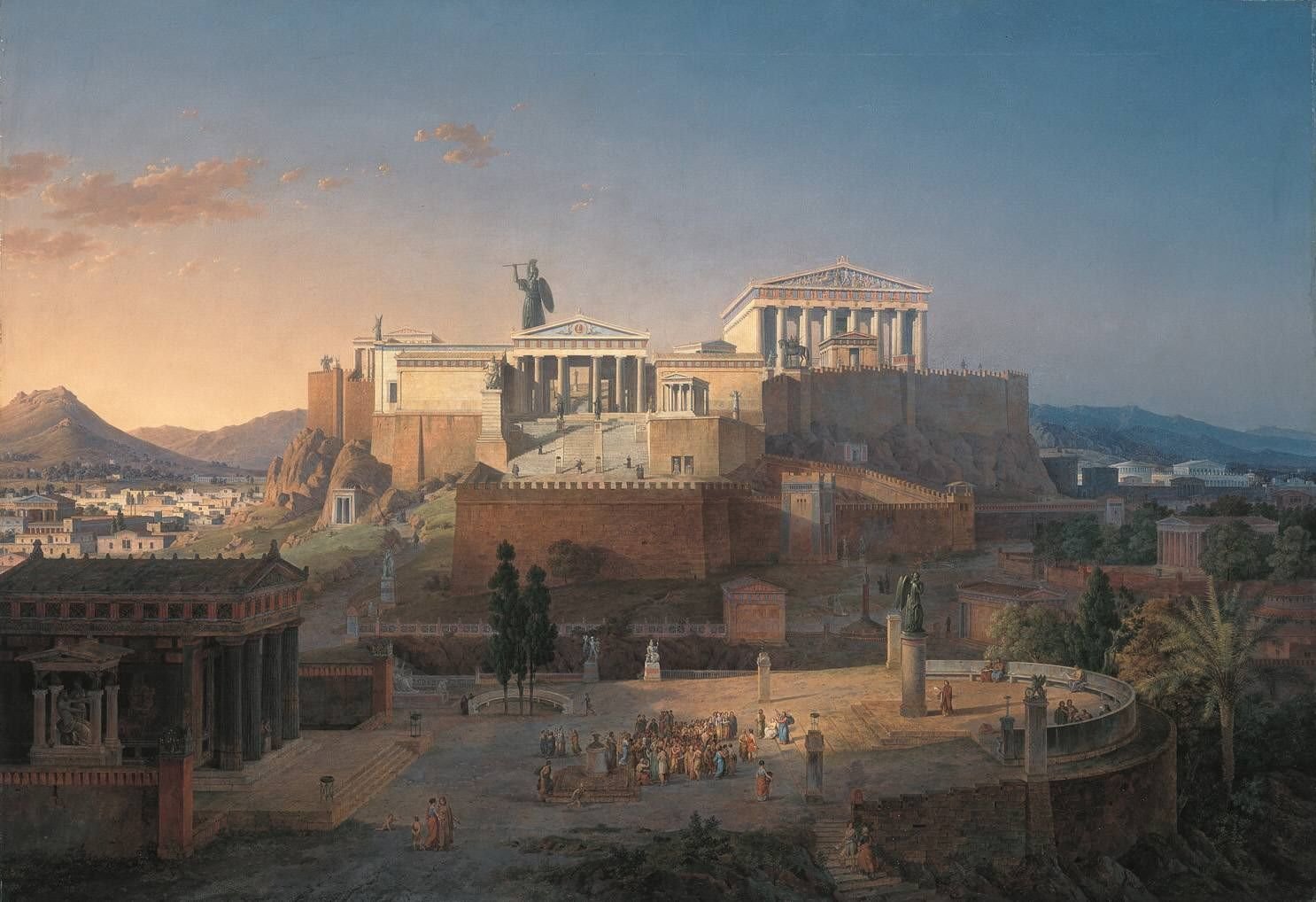
@culturaltutor - The Cultural Tutor
This is a sewage pumping station from 1865. Why did the Victorians build things like that? Were they just confused? Or did they have the right idea?

@culturaltutor - The Cultural Tutor
The Victorians built everything: churches and train stations, theatres and public baths, banks and bridges, courts and town halls, museums and castles. But there was no single Victorian style - they mixed together what had come before and transformed it into something new.
@culturaltutor - The Cultural Tutor
The best place to begin is with their most famous style: Victorian Neo-Gothic. After centuries of slumber the architecture of the Middle Ages was revived by the Victorians, who filled their town halls with pointed arches, clustered columns, ribbed vaults, and stained glass.

@culturaltutor - The Cultural Tutor
There was no single style of Gothic architecture, of course, and the Victorians looked to all its incarnations for inspiration. The French-style Royal Courts of Justice, more like a fantasy castle than anything else, has a flèche typical of Medieval French cathedrals.

@culturaltutor - The Cultural Tutor
The Palace of Westminster, designed by Augustus Pugin in 1840, is a prime example of Neo-Perpendicular. Perpendicular Gothic originated in 14th century England as a more austere form of Gothic architecture, with an emphasis on vertical lines and reduced ornamentation.

@culturaltutor - The Cultural Tutor
Tower Bridge, finished in 1894, might just be the most emblematic work of Victorian architecture. Its combination of Gothic design with modern materials and form creates something which, though Medieval in appearance, is unlike anything built in the Middle Ages.

@culturaltutor - The Cultural Tutor
And then there's something like the Templeton Carpet Factory in Glasgow, a remarkable reimagining of the Moorish and Byzantine influenced Gothic architecture unique to Venice in the Middle Ages. Only here it is built from those famous red bricks rather than Istrian limestone.

@culturaltutor - The Cultural Tutor
The Victorians also created plenty of neoclassical architecture. But rather than the purer form popular in the 18th century, which was more in line with actual Greek and Roman architecture, the Victorians revived the neoclassical style of the Renaissance.


@culturaltutor - The Cultural Tutor
Then there was the Romanesque Revival, which referenced the rounded arches, robustness, and relative simplicity of 11th century Norman architecture. Originally used in churches, the Romanesque Revival soon spread to other public buildings like this, the Natural History Museum.

@culturaltutor - The Cultural Tutor
The Victorians also took inspiration from the Elizabethan and Jacobean architecture of the 16th and 17th centuries, especially the country houses of that time.


@culturaltutor - The Cultural Tutor
And, of course, Tudor architecture was also very popular, with its slender brick chimneys and infilled timber framing. Except that here the timber framing was aesthetic rather than structural, as it once had been.

@culturaltutor - The Cultural Tutor
There was even an Egyptian Revival. These offices at the Temple Works flax mill in Leeds were given all the trappings of Ancient Egyptian architecture, complete with an overhanging cornice, hieroglyphic inscriptions, and winged solar disk reliefs.

@culturaltutor - The Cultural Tutor
The Scots Baronial style, largely exclusive to Scotland, harked back to Medieval castles. Balmoral is the most famous example, with its conical spires, barrel-shaped towers, jutting turrets, loopholes, and battlements. Only, it's a house rather than a real castle.

@culturaltutor - The Cultural Tutor
The Victorians also pioneered new forms of building, especially in what might be called industrial architecture. A good example is St. Pancras Train Station, where a vast train shed of girders and glass - once the biggest unsupported span in the world - was constructed in 1868.

@culturaltutor - The Cultural Tutor
Indeed, one of the defining features of Victorian architecture was its incorporation of modern materials and construction methods. Whether in their historical revivalism or engineering marvels, the Victorians embraced structural metal frames, plate glass, and girders

@culturaltutor - The Cultural Tutor
The Victorians also filled their buildings with lavish decoration: explosions of colour and pattern, of wallpaper, ceramics, murals, and wrought iron. There was no surface they left untouched by detail and ornamentation. And this, like so much else, divides opinion.


@culturaltutor - The Cultural Tutor
Most Victorian buildings do not neatly match the historical styles they draw on. Rather, Victorian architecture mixed different styles from different eras, throwing together design elements never supposed to be united. That is what makes it unique - and controversial.
@culturaltutor - The Cultural Tutor
Critics at the time (and ever since) have derided this Victorian eclecticism, whereby different architectural styles were thrown together with little regard for their true purpose and form. For some, the result was messy and inauthentic, a mockery rather than a triumph.
@culturaltutor - The Cultural Tutor
Consider what had come before: the simpler and more harmonious forms of Georgian and Neo-Palladian architecture. Compared with that, the chaotic extravagance of Victorian design, dripping with detail and ornamentation, can look like it was designed by AI.


@culturaltutor - The Cultural Tutor
But even if Victorian architecture ransacked the past for inspiration, it was also deeply modern. Elsewhere in the world neo-Gothic architecture was generally more faithful to its Medieval models; Victorian buildings, meanwhile, were totally unique to the 19th century.


@culturaltutor - The Cultural Tutor
And the idea that different types of buildings should look different is thousands of years old - but, like so many other rules, the Victorians broke it. Hence their banks like castles, town halls like cathedrals, factories like palaces, and sewage plants like temples.

@culturaltutor - The Cultural Tutor
It was in opposition to this mixing up of forms - whereby a building's purpose had little to do with its appearance - that some of the ideas of modern architecture first arose. When Louis Sullivan said "form ever follows function", this is what he was referring to.
@culturaltutor - The Cultural Tutor
Victorian architecture is a total contradiction, looking both forwards and backwards, beholden to the past but unafraid to meddle with age-old forms, mixing historical styles at will and totally ready to embrace modern technology and methods. The question is: does it work?
@culturaltutor - The Cultural Tutor
Today's edition of my free, weekly newsletter will include Shostakovich's jazz suites, the letters of Pliny the Younger, Rajput architecture, and more. If you'd like to join 70k others in reading it, consider subscribing here: https://culturaltutor.com/areopagus