TruthArchive.ai - Tweets Saved By @ggreenwald

Saved - January 24, 2026 at 3:21 PM

@ggreenwald - Glenn Greenwald

Having armed, masked federal agents roam the streets and threaten American citizens that they're being put into a "database" and are being deemed a "domestic terrorist" for the crime of videotaping them should disgust everyone.

@nathanTbernard - Nathan Bernard

ICE agent in Portland, Maine tells legal observer she is a domestic terrorist for peacefully recording him, adds her to "nice little database" https://t.co/6miHpXUdT7

Video Transcript AI Summary
They assert that recording is not illegal and proceed with filming. They question why their information is being taken down, and are told, “Because we have a nice little database.” A statement follows, “He is considered a domestic terrorist.” The exchange ends with, “So We're videotaping you? Are you crazy?”
Full Transcript
Speaker 0: It's not illegal to record. Yeah. Exactly. Yeah. That's what we're doing. Yeah. Why are you taking my information down? Because we have a nice little database. Oh, good. And now you're Yeah. He is considered a domestic terrorist. So We're videotaping you? Are you crazy?
Saved - January 4, 2026 at 8:31 AM

@ggreenwald - Glenn Greenwald

Yet another mega-viral video from Trump supporters that is falsely described. This is not a video from today. This is an old video long before that. There also aren't close to "millions" here. But again, who cares? These claims make people feel good. That's what counts.

@RealAlexJones - Alex Jones

Video: millions of Venezuelans flooded the streets of Caracas and other major cities in celebration of the ouster of Communist dictator Nicholas Maduro. Now we need to see the same type of energy here on the HomeFront! The domestic political equivalent of this incredibly decisive move in Venezuela is getting rid of the filibuster. We are in the end game and it’s time to start acting like it!

@RealAlexJones - Alex Jones

Maduro asked for a fight, and history gave him a knockout. Elon fights with satellites and code; Maduro fought with rhetoric and electronic voting machines stealing US elections. Trump just chopped the head off of one of the deep state’s biggest funding mechanisms.

Saved - January 4, 2026 at 8:16 AM

@ggreenwald - Glenn Greenwald

This is Miami, not Venezuela. But who cares? Just keep re-tweeting it! It feels good, and that matters most.

@nickshirleyy - Nick shirley

Wait a minute the MSM media lied to us again? The people of Venezuela actually didn’t like being ruled by a narco-terrorist? World Cup style celebrations are ERUPTING all across Venezuela atm, congratulations to the people of Venezuela! Que Dios te bendiga! 🙏🏼 https://t.co/E2UQ9lh08M

Saved - October 19, 2025 at 8:03 PM

@ggreenwald - Glenn Greenwald

The former Mossad agent Avner Avraham described how Israel would "erase Gaza" regardless of any agreements imposed by Trump or Arab states. Israel will easily engineer attacks in Gaza and blame Hamas to re-start the war, he said. Gaza has "no future": https://t.co/gNchL0V2Ez

Video Transcript AI Summary
The speaker asserts an intent to erase Gaza, proposing to take the people there and send them to Libya. They ask what the future for Gaza looks like, answering: no future, a parking lot, a dumping ground. They claim to have a creative idea and say they have agreement. The speaker notes that missiles were suddenly fired, with missiles from inside their side, and then they say there is a missile from Gaza, using that to justify a response. They question whether that proves anything is possible, concluding: everything is possible and that they are going to erase Gaza.
Full Transcript
Speaker 0: We are going to erase Gaza. We have to take the people there and send them to Libya. What do you see as the future for Gaza? No future. A parking lot? A dumping ground. But what's a creative idea? I do. Okay. We have agreement. Suddenly, they send some missiles. Our people send missiles from inside. And then we said, oh, there is a missile from Gaza. So now we can answer them. So you think that's also something that's that's possible? Everything is possible. We are going to erase Gaza.
Saved - October 2, 2025 at 9:44 PM

@ggreenwald - Glenn Greenwald

🇮🇱 ....... 🇺🇸 The most important media story by far is how Larry Ellison -- the largest-ever private donor to IDF -- is buying up the largest media properties (not just CBS and Paramount but also TikTok), at exactly the same time support for Israel in the US is unravelling.👇

@DropSiteNews - Drop Site

⚡️NEW from Drop Site: Larry Ellison Vetted Marco Rubio for Fealty to Israel, Hacked Emails Reveal The billionaire Oracle founder is on track to take control of the American media. By @RyanGrim and @MazMHussain https://www.dropsitenews.com/p/larry-ellison-vetted-marco-rubio-israel-hacked-emails-ron-prosor
Larry Ellison Vetted Marco Rubio for Fealty to Israel, Hacked Emails Reveal The billionaire Oracle founder is on track to take control of the American media. dropsitenews.com
Saved - October 2, 2025 at 12:46 PM

@ggreenwald - Glenn Greenwald

The ADL has bullied and coerced huge numbers of institutions to take orders from it about whose views should be deemed "extremist" and thus prohibited, and whose shouldn't. As but one example, Paypal uses the ADL to decide who should be expelled from using its services: https://t.co/M1En4hIaOI

@FBIDirectorKash - FBI Director Kash Patel

James Comey wrote “love letters” to the ADL and embedded FBI agents with them - a group that ran disgraceful ops spying on Americans. That era is OVER. This FBI won’t partner with political fronts masquerading as watchdogs. https://t.co/R6IKpSTfuP

Saved - October 1, 2025 at 7:56 PM

@ggreenwald - Glenn Greenwald

There were 2 venues in the US where Israel criticisms thrived: US campuses and TikTok. The campus problem was solved by the Trump's new hate speech codes, firing professors, DEI for Jewish students etc. The TikTok problem was solved by giving it to IDF financier Larry Ellison.

@ME_Observer_ - Middle East Observer

RIP Tiktok Israel assassinated it https://t.co/jmQi38fi3n

Saved - August 20, 2025 at 9:23 AM

@ggreenwald - Glenn Greenwald

This conversation between @megynkelly and @RepMTG -- on the inordinate power exercised by the Israel Lobby and the multiple prongs of influence they wield -- would have been completely unthinkable even a year ago, and shows how aggressive they became as their polling collapses:

@MegynKellyShow - The Megyn Kelly Show

“Israel is the only country I know of that has some sort of incredible influence and control over nearly every single one of my colleagues…”   @mtgreenee on AIPAC and the Israel lobby's power in Washington, D.C. Watch below, and subscribe: https://youtube.com/c/MegynKelly/?sub_confirmation=1

Video Transcript AI Summary
This conversation centers on Israel, lobbying, and US policy. Speaker 0 says he’s been very pro Israel and defender of its right to defend itself, but has 'no skin whatsoever in defending any lobbyist group,' and has declined repeated invitations to go to Israel. He notes mounting pressure to stay aligned and that he’s not on Hamas’ side, though his views have shifted since 10/08/23. Speaker 1 explains APAC is 'not registered under FARA' and describes freshman trips to Israel, meetings with government members. He notes that '3.8, billion dollars in funding for Israel' is an annual decision, that Israel is 'less than 400,000,000,000 in debt,' and that Israelis have 'government funded health care' and 'government funded college.' He questions why the US funds this given its own economic strain, citing that 'we buy money from your defense contractors' and that Israel can buy from Israeli defense contractors.
Full Transcript
Speaker 0: This audience knows, and I know where you stand too on Israel and all that, but I've been very pro Israel Mhmm. And I've been very defensive of of their right to defend themselves in this Sure. Nightmare. Of course. And I've been very defensive of American Jews on campuses who are just being harassed, and it's ridiculous. Speaker 1: Of course. Speaker 0: But I have absolutely no skin whatsoever in defending any lobbyist group, including AIPAC. Right. So I would love to know what they do to get the loyalty of politicians, because I will say I have had multiple, multiple reach outs to me, both from friends and from connected people in DC, begging me to go to Israel with them. And I have said no every time. Usually am just too busy. I have three kids. I have a full time job. Sure. I'm not I'm not doing it. But lately, it seems like it's coming to be even more because I feel like there's a there's a contingent of people who are worried that they're losing me. Speaker 1: Uh-huh. Speaker 0: And I've said that you're not losing I'm I'm not on Hamas' side. Speaker 1: No. God, no. Nobody's on Hamas' Speaker 0: But I it's been a while now that this has been going on. Speaker 1: Right. Speaker 0: And we're getting more involved with the Iranian bombing and so on. Speaker 1: Sure. Speaker 0: And my own feelings are just, you know, I'm just I'm looking at Israel in a different way right now than I was on 10/08, that's for sure, of '23. Speaker 1: Right. Speaker 0: And I can feel the pressure being slightly ratcheted up, like you're not allowed to. You're not allowed to. Mhmm. And I can see people like you, like Tucker, who I know. I know Tucker. I've known him for years, and I've seen you in in your early career. I know you have nothing against Israel. Speaker 1: Oh gosh. No. They Speaker 0: Never mind Jews. That's all in a lie. Speaker 1: But Right. Speaker 0: And I see the beatdowns coming. Uh-huh. Like, you're not allowed like, you're you have to stay right on this lily pad. Yes. And you cannot jump to another neighboring lily pad because it could take you all the way down the river away. So I'm I'm very interested in this dynamic. Speaker 1: Yeah. Well, I find it fascinating that you're getting asked more and more and more. I've been asked more and more and more. Well, you're a person of very big influence. You've got a big voice. You've got a large audience. They also take a lot of influencers. They invite tons of influencers. Speaker 0: Many of whom have invited me. Like, we're all going together, and will you come? Like, they seem to be coming at me from a number a number of ways, which only really kind of raises my hackles. Like, I'm not going. I'm going to stay right here. I can cover this conflict from here, and I don't wish to be wooed by any side. I actually don't wish to be Speaker 1: Well, do are you persuaded. Have you been invited by any other foreign country? No. No. Okay. That's that's the part. Right? So we have tons of lobbyists and the foreign countries lobbyists that come to, Washington DC. Pretty much every country has some sort of representative. They have an ambassador they send to Washington. It's naturally in their interest. We can understand that. They also are required to register under FARA. It's a law. They have to register as a foreign agent, a foreign lobbyist. That is required. It's extremely important. Here's the here's the difference with APEC. APEC is not registered under FARA, under this law that requires anyone coming to lobby a member of congress or a senator or department of the government and the federal government on behalf of another country. So APAC argues, oh, but we're Americans. Yes. They are Americans, but they are coming to Congress and to the federal government asking on behalf of the country of Israel. And I fully agree with you, Megan. We are not against Israel. We are all for their right to defend themselves just as we are for any Jewish person on campus, just as I think in it, like, gosh, we could talk about, young white males in high school that are constantly getting beat up. Yeah. Guess what? They should have a right to defend themselves too, and people should stand up for them as well. We think anybody that is a victim should should be able to defend themselves. However, Israel is the only country I know of that has some sort of incredible influence and control over nearly every single one of my colleagues. And it is I don't know how to explain it. Speaker 0: I mean, I believe it just given the amount of reach out I've had in this position. And I don't vote on anything. Know? If I had taken money, I could see them really thinking that they had a right to control my speech or my positions, which is why I never have, of course. I mean, what context would I? I don't take advertising from random people. Like I always say, have Jennie Sell, whose cosmetics are really nice. Speaker 1: But who loves good cosmetics? Speaker 0: Like it can't be bought by a special interest group, but I can see it because look, no one wants to feel like their position has been bought and paid for, but these politicians, it's they have. And so I can see why APAC would get mad if these politicians then turned on them and didn't support. You know, it's like, what what did my Mhmm. 3,800 times three get me if you're not gonna vote for my issues? Speaker 1: Exactly. Because APAC are Americans, therefore, they can legally donate to members of Congress and senators. So let's talk about how that works. APAC takes every single that they can, freshman, member of congress, their first year in congress, they take them on a very special trip to Israel in August. That's our August is our recess. It's our it's our, month long district work period. Dems and Republicans or just Republicans? They take both of them. Yes. And they they invite pretty much everyone to my knowledge. So they take them on this trip to Israel. They they I I guess they go on tours all around. I didn't go. So I I don't know what they do there. But they take them on tours. You like the pictures we've seen recently of the speaker and and, other members of congress at the Wailing Wall. Speaker 0: They've all gone. Speaker 1: They've all gone. Speaker 0: I see them all. Speaker 1: And they and they wear the kippah. They and even though they're Christians. They're they're not Jewish, but yet they're adorning, Jewish attire, and they're at these Jewish, religious sites. Then they also meet with different members of the Israeli government. Now we gotta recognize the Israeli government is secular. This is not the biblical Israel. It is the secular government of Israel. And so they meet with their members of of, you know, all throughout their government and the prime minister. Benjamin Netanyahu meets with them, and so they've done that trip already this month. The the new freshmen and members of our leadership all went, and they they did that trip. Here's what else they do. APAC takes influencers, they take really big people like you, they want you to come over there, they they want to pull you in because they want to pull you on their their side. And and why is that? Okay. For members of congress, every single year annually, Israel receives, and we have to vote on it. It's a yes or no vote, 3.8, billion dollars in funding for Israel. Now, what what does that money mean? Well, they'll say, oh, well, this is for Israel. It's it's it's them to be able to defend themselves. They're the only democracy in The Middle East. Yep. They're constantly under attack. They're surrounded by their enemies who wants to annihilate Speaker 0: That's all true. Speaker 1: Sure. We're not arguing those points. However, let's flip over and look at well, okay. Well, what does this mean? Number one, Israel is doing so well with their economy, and I'm excited for them. This is a big deal. I wish we were doing this good. We're $37,000,000,000,000 in debt. Israel is less than 400,000,000,000 in debt. Less than. If you're an if you're an Israeli citizen, you have government funded health care, and you have government funded college. So why is America having to give Israel $3,800,000,000? If they're doing so great and they're funding health care and college and their government is is their economy is doing so well and their tax revenue is so good that they're less than $400,000,000,000 in debt. Why is dead broke America Speaker 0: Yeah. Speaker 1: Having to send $3,800,000,000? Well, then they argue back and they go, oh, but this helps America's economy. Well, how how is that? Tell me how it helps. Okay. Well, because we buy money from your defense contractors. Although, guess what? This is really interesting. We give a ton of money to all these foreign countries. And and and with with its military aid, they're required to buy purchase weapons from our defense contractors. Except Israel is the only one with an exception. They don't have to buy from our American defense contractors. They can use that money to buy from Israeli defense contractors. Speaker 0: Oh, Speaker 1: wow. So there's a funny little a little exception. Just like the same exception that Israel has that this just came from judge McFadden. He just had a ruling that you can burn any flag in The United States Of America and including our own American flag, except you can't burn the Israeli flag in Who said that? Judge McFadden. In Speaker 0: what context? Speaker 1: In his court. It just happened. Speaker 0: Well, that's not gonna be upheld. Speaker 1: It shouldn't be. Speaker 0: That's a violation of the First Amendment, blatant, and it will be struck down as soon as it goes up on appeal. What a ridiculous notion. Speaker 1: Should be. He said in what he wrote is that the Israeli flag, it's an identity erase, and it would be a hacking Yeah. Yes. Speaker 0: Wrong. That's getting struck down. But I I see why you're raising it. Because I I'm picturing, you know, look, I have a lot of very close friends who are Jewish, are very big supporters of Israel, and some faction of them will say like, well, why would you platform an MTG? She's definitely gone anti Israel. And I don't care whether you're anti Israel or not. Any anti Israel people are welcome here. I I Of course. You're allowed to have that view. It's a country that's involved in a war, and it's you don't have to be pro any country in order to come here. But I know you're not. Speaker 1: I'm not anti. Speaker 0: I know you're not. Yeah. But I am also sensing discussed this with Charlie Kirk recently, how we're just getting to a place now, the more you tell me I can't talk to somebody or some about something, the more I'm guaranteed going to do it. No one owns me, and I will talk about it, and I will hear you out, and I wanna hear why you're having this kind of experience times 10,000. You know, like, my little lily pad, you're way down there and there. I can see you getting rained down on. And I don't like it, Marjorie. I have to tell you, I don't like it because this is America, you're allowed to have your view. Israel's not America. They're a friend to America, but they're not America. And we do have areas in which we have divergent interests, and it is our obligation, and yours especially as a representative Mhmm. To say when you see a divergence, you cannot Speaker 1: reconcile Right. Speaker 0: Where you gotta choose one. Yes. Right? Like, that's what I see happening to you. So what happened? Did you well, like, did you find yourself in this place? Because you stopped voting for funding for the Israel war? Speaker 1: Yeah. It was easy for me. I'm a business owner. So right now, I feel like I'm I'm part of a board of 435 members, 435 members of congress where we should act like an executive board of a company. And I feel like our company, the United States of America's federal government, is a company that is has sirens blaring, and we are on the verge of literally imploding and going out of business. Speaker 0: Bankruptcy. Speaker 1: Yeah. Massively. I also pay a lot of attention to our economy. Being a business owner in the construction industry, my success of my business for as long as I've run it rises and fall falls with the economy. And I'm very concerned. The cost of doing business is extremely high. The cost of living is extremely high. Insurance is completely out of control. Car, health, life insurance, business insurance, you name it. Speaker 0: Forget homeowners insurance. That's almost impossible to even Gosh. Find as an offering anywhere. Speaker 1: And if you're 40, forget being able to buy a home. Speaker 0: Right. Speaker 1: They don't even have the hope I of a Speaker 0: heard you and Tucker talking about how he was saying some 14 friends of his daughter, they all graduated, three out of 14 had jobs. I can see this in my our kids are a little younger than college age now, but our friends, some of them got started earlier, and a lot of their kids are now graduating from college. Great colleges. Smart kids cannot find jobs. Speaker 1: It's this is so heartbreaking. So for me, it's not I'm not anti Israel. I'm not anti any country. I've turned radically and unapologetically for America, just flat out for America. I'm like, I'm sorry. We don't have time to fund what you're doing. No. We don't. You guys are doing great. Speaker 0: We had the extra. Totally. Speaker 1: Yeah. But we don't. We don't have the money. Speaker 0: So what do we think the effect of the sparring between president Donald Trump and the Fed is going to be? Can the Fed take the right action at the right time? Do we trust in that? Or are we gonna be looking at a potential economic slowdown as they slow roll roll any of their moves as they worry about his tariffs? And what exactly does all of this mean for your savings? You might wanna consider diversifying right about now with gold through Birch Gold Group. For decades, gold has been viewed as a safe haven in times of economic stagnation, global uncertainty, and high inflation. And Birch Gold makes it incredibly easy for you to diversify some of your savings into gold. If you have an IRA or old four zero one k, you can convert that into a tax sheltered IRA in physical gold, or just buy some gold to keep it in your safe. First, get educated. Birch Gold will send you a free info kit on gold. Just text m k to the number 989898. Again, text m k to 989898, and you'll start the process of just getting the four one one on what it means to own gold. Consider diversifying a portion of your savings into gold. So if the Fed cannot stay ahead of the curve for the country, at least you can stay ahead of the curve for yourself. Thanks so much for watching. If you like what you just saw, hit the subscribe button for more clips and full episodes.
Megyn Kelly The Megyn Kelly Show is your home for open, honest and provocative conversations with the most interesting and important political, legal and cultural figure... youtube.com
Saved - August 7, 2025 at 12:52 PM

@ggreenwald - Glenn Greenwald

Members of Congress spend their recess in their home district.

@IsraeliPM - Prime Minister of Israel

Prime Minister Benjamin Netanyahu met yesterday evening with an @AIPAC-organized delegation of Republican members of the US Congress. https://www.gov.il/en/pages/event-aipac060825 https://t.co/pDaw9dHskv

Saved - August 6, 2025 at 3:41 PM
reSee.it AI Summary
I plan to discuss the influence of Qatar when the U.S. government continues its financial support, punishes dissenting students, and maintains close ties with Doha. It’s interesting to note the contrast in how Qatar is treated compared to Israel, especially regarding lobbying and congressional receptions. If the Qatari leader receives the same warm welcome in Congress, then we can have a more balanced conversation about influence.

@ggreenwald - Glenn Greenwald

I'll speak more about the "influence of Qatar" when the US Govt: - sends billions every year to finance Qatar; - punishes students for criticizing Qatar; - makes regular pilgrimages to Doha and tweets #IStandWithQatar; - announces new policies every week to serve Qatar, etc.

@CElder556 - CatoTheElder556

@ggreenwald When are you going to criticize Qatar for spending more than AIPAC and doing more stuff like this with American lawmakers? What's so different between Israel and Qatar that you whine about Israel but not Qatar, hmm?

@ggreenwald - Glenn Greenwald

Or let me know when the Qatari leader is invited to speak repeatedly to the US Congress, only for him to be interrupted by sustained, reverent standing ovations every sentence by most members of both parties. Then we can talk about "Qatari influence": https://www.youtube.com/shorts/i90yOSAM-7I

Saved - August 2, 2025 at 6:46 PM

@ggreenwald - Glenn Greenwald

The corporate media constantly whines about how a free internet allows conspiracy theories to spread. Absolutely nobody spreads deranged conspiracies like them. While Trump flooded Ukraine with offensive arms and demanded a stop to Nord Stream 2, here's what they were saying.👇 https://t.co/IYoklohqQg

Saved - July 31, 2025 at 3:33 PM

@ggreenwald - Glenn Greenwald

Bernie Sanders today yet again refused to apply "genocide" to Gaza, even as Israeli genocide scholars, human rights groups, and courts use that term. Meanwhile, listen to John Mearsheimer with Tucker today, explaining why it's classic genocide and the US should stop funding it:

@TuckerCarlson - Tucker Carlson

John Mearsheimer: What’s happening in Gaza is genocide. The United States should have nothing to do with it. (0:00) An Update on the Ukraine/Russia War (5:13) The West’s Ridiculous Russophobia (15:47) Why Do We Still Have NATO? (25:29) The Growing Threat of China and How the US Empowered Them (39:30) The US Puppet Called Zelensky (41:48) Donald Trump’s Biggest Challenges With Ending the War (48:14) Why the US Foreign Policy Establishment Is So Hawkish on Middle Eastern Wars (51:10) Why the US Puts Israel’s Interests First (56:13) The Palestinian Genocide (1:05:32) The Zionist Mission for Greater Israel (1:11:24) The Power of the Israel Lobby (1:20:53) The Attempts to Shut Down Criticism of Israel (1:32:58) Why Are Christians in the West Supporting Israel’s Killing of Christians in the Middle East? (1:38:10) The Growing Opposition Towards Israel Among Young People (1:42:45) Why Don’t We Know the Death Toll of Any of These Wars? (1:53:27) The Authoritarianism That Has Infected Israel (1:55:25) Will Israel Rebuild the Third Temple? (1:58:22) What Is Being Hidden in the 9/11, Epstein, and JFK Files? (2:01:07) The Future of the Global Stage (2:08:26) Will There Be a US/China War Over Taiwan? Includes paid partnerships.

Video Transcript AI Summary
The speaker argues that Russia is winning the war in Ukraine due to superior weaponry and manpower, and Ukraine's dependence on Western support. He claims that Trump won't refill the "Biden pipeline" of weaponry. He says Ukraine's defenses are collapsing and a diplomatic settlement is impossible because Russia's demands are unacceptable to Ukraine and the West. These demands include Ukraine becoming a neutral state, demilitarizing, and accepting Russia's annexation of Crimea and four oblasts. He believes Ukraine should cut a deal now to minimize losses, but nationalism prevents it. He dismisses the idea of Russia dominating Europe as ridiculous, stating Russia struggles to conquer eastern Ukraine. He says Putin pines for the Soviet era but understands recreating the Soviet empire is impossible. He views NATO expansion into Ukraine as the taproot of the war, analogous to America's Monroe Doctrine. He says the decision in 2008 to bring Ukraine into NATO was made despite recognizing Ukraine as a special case and a potential source of trouble. He attributes this decision to the belief that the US could "shove it down their throat," underestimating Russia's security concerns. He says the US has driven Russia into China's arms, which is against American interests. He says the Israel lobby has awesome power and influences US foreign policy in the Middle East, even when it conflicts with American interests. He says Israel is executing a genocide in Gaza to ethnically cleanse Palestinians from Greater Israel. He says the US has a special relationship with Israel that has no parallel in recorded history.
Full Transcript
Speaker 0: Professor, thank you for doing this. The arc of and it's not the topic of today's conversation, but the arc of your career as someone who's just watched it pretty carefully all of these years. You've wound up where I think all of us wanna be, which is universally respected regardless an oracle. It must be sort of nice to look back and be vindicated. So anyway, so I'm honored to have you. Where are we in Ukraine right now? Well, we're in deep trouble Speaker 1: if you mean The United States Yes. Speaker 0: That's right. Speaker 1: You talk about we. The fact is that the Russians are winning the war, and there's no way that Ukraine can rescue the situation. If you look at the balance of power, in terms of weaponry and in terms of manpower, the number of soldiers that each side has, the Ukrainians are in a hopeless situation. And furthermore, they're heavily dependent on the West for support, and president Trump has made it clear that he's not going to refill the Biden pipeline, once all the weaponry in that pipeline runs out. So the Ukrainians are doomed, and if you look at what's happening on the battlefield, it's quite clear that the Ukrainians understand that. Their defenses are slowly but steadily collapsing. Now one might say, well, can't we get a negotiated settlement? Can't we bring this war to an end? And the fact is that neither the Ukrainians nor the West, and here we're talking mainly about the Europeans, is willing to cut a deal that's acceptable to the Russians. So there's no way you're gonna have a diplomatic settlement to this war. It's gonna be settled on the battlefield, and the Russians are gonna win an ugly victory, and you're gonna have a frozen conflict. Speaker 0: Why can't you have a negotiated settlement? Speaker 1: Because Russia has a set of demands. There are three main demands and I'll spell them out in a second, but they are unacceptable to the Ukrainians. They're unacceptable to the West. Donald Trump may find them acceptable, but he's surrounded by people in his administration and certainly true in the American foreign policy establishment who wouldn't accept those demands. And the big three demands are number one, that Ukraine has to be a neutral state. It cannot be a NATO, and it cannot have a security guarantee from The United States or from the West more generally. So it has to be neutral. Second is that Ukraine cannot have a significant offensive military capability. Ukraine has to be demilitarized to the point where it doesn't present the threat to Russia. And then third, and maybe most important of all, the Ukrainians and the West have to accept the fact that Russia has annexed Crimea and those four oblasts in Eastern one fifth of Ukraine that they now almost occupy. So in other words, you're asking Ukraine to give up about 20% of its territory, and the Ukrainians won't do that. And they won't agree not to be in NATO, and they will not agree to disarm in some meaningful way. So there's no way you get a settlement. Speaker 0: So but there will be a settlement by your description because there will be a victory. So there will just be it's not an official settlement, but there will be a new status quo in which Russia controls a fifth of what was Ukraine, and that's just gonna happen. So why wouldn't you wanna get out of that with Speaker 1: as little destruction as possible? Well, you're gonna get an armistice in all likelihood, and this is why we say you'll have a a frozen conflict that will present all sorts of problems moving down the road. I have long argued that the Ukrainians should cut a deal now because what's gonna happen is the Russians are gonna end up taking more territory, and the Russians have made it clear that any territory they take, they'll keep. And furthermore, more Ukrainians are gonna die the longer the war goes on. So if you believe like I do and many people do that Ukraine is losing, the smart thing to do is cut a deal now and minimize your losses both in terms of territory and people killed on the battlefield. But you just can't sell that argument. And Why why can't you sell that argument? I think it's probably nationalism in the case of the Ukrainians. The Ukrainians view the Russians as existential threat, and they're willing to fight and die in huge numbers. They're willing to make incredible sacrifices to do everything they can to win this war, and they just won't quit. And in terms of the West, it's easy for the So Speaker 0: I I just wanna say I understand that and respect that. First, I think they're wrong, but I I think it's self defeating. But I certainly think it's honorable, those impulses, but I don't understand the West's stake Speaker 1: in this exactly. Well, I don't believe the West has a strategic stake in this for one second, but the Russophobia in the West is so powerful at this point in time that especially among the elites in Europe and in The United States that getting them to concede that the Russians have won this war or going to win this war is just unacceptable. Speaker 0: And have legitimate con security concerns on their border. I mean, that Speaker 1: They're not allowed. The Russians are not allowed to have legitimate security concerns in the minds of most western elites. Why? I don't know. It it befuddles me. If you look at the Russian reaction to NATO expansion into Ukraine, which I believe is the taproot of this war, it's analogous to America's Monroe Doctrine. The United States under those circumstances would allow the Soviet Union to put missiles in Cuba or to locate a naval base at Cienfuegos in Cuba. That was just unacceptable. This is what the Monroe Doctrine is all about. Yes. We'd never allow China to station military forces in Mexico or in Canada, but yet we think we have the right to move NATO far enough eastward to include Ukraine and then put NATO assets, including American military assets in Ukraine, and this is not of concern to the Russians. They shouldn't care. They should recognize that Ukraine has the right to do whatever it wants. NATO has the right to expand wherever it wants, and Russia has no say in the matter. The Russians, of course, don't accept this because they have a Monroe doctrine of their own, But we can't get it through our thick skulls that this is foolish thinking on our part and is destined to lead to trouble as it has. Speaker 0: It's it's interesting that the standard that US foreign policymakers apply to Russia is different from a standard they'd apply to any other country, including China and even North Korea. They just they don't have the same level of emotion about any other place. It's Russia, Ukraine. And I I find it baffling because on on some level, this is as you said at the outset, this is not about America's strategic interests. We don't really have many there. This is about an almost overwhelming emotional response from our leadership class to this conflict, to this region. I think it's weird. Speaker 1: Yeah. Yeah. Well, I think also at this point in time, we have convinced ourselves, both the Europeans and the Americans, that Russia is a mortal threat to dominate all of Europe. This is a ridiculous argument. Course. Think it is ridiculous? It's a ridiculous argument. As you have seen, the war started in 2022. We're well over five years into this war, and the Russians have had a very difficult time conquering the Eastern 1 Fifth of Ukraine. Just think about that. Over three plus years, they have been unable to conquer all of the territory in those four oblast that they've annexed. Please tell me how this army is gonna overrun all of Ukraine, then overrun Eastern Europe, and then overrun Western Europe. This is a laughable argument. Furthermore, if the Russians are foolish enough to try to occupy Western Ukraine, they're gonna find themselves in a quagmire. They're gonna find themselves dealing with a huge amount of resistance from all of those ethnic Ukrainians in the Western part of Ukraine who hate Russians. This is why I don't think Putin is gonna even try to conquer the western half. Much less Poland and Romania and the rest. Exactly. Their view on that, by the way, in terms of occupying Eastern Europe is we've been there, done that, and it did not work out very well. Remember, they occupied Eastern Europe roughly from 1945 to the early nineteen nineties when they pulled out after the cold war ended. They had to invade Hungary in '56. They had to invade Czechoslovakia in '68. They had to put down a major insurrection in in East Germany in 1953. They almost went into Poland three times. They had their hands full dealing with the Romanians and the Albanians Oh, yeah. And the Yugoslavs. I mean, the idea that a country like Russia is gonna, you know, invade and occupy and run the politics of countries in Eastern Europe is a remarkably foolish idea. And again, they don't even have the military capability to do that. Speaker 0: But that is the idea. And when you talk to Europeans about it, as I often do, they say that Putin's aim is to restore the Soviet empire. And he said that, and, you know, just listen to what he says. He wants Speaker 1: he pines for the Soviet era, and he wants to restore it. He's never said that. In fact, he said that, you know, he can understand why someone in his or her heart pines for the Soviet Union, but in his or her head, it makes absolutely no sense. He said that. The idea that you can recreate the Soviet Union, number one, and then two, recreate the Soviet Empire is a pipe dream. And you might not like Vladimir Putin, but he is a very smart man. He is a first class strategist and he surely understands that, you know, the idea of recreating the Soviet Union or the Soviet empire makes no sense at all. Speaker 0: If it ain't broke, don't fix it. A cliche for a reason because it's pretty good advice, but sometimes it's not true. Cell phones are a glaring exception. You've got your cell phone, you've had it for years, You don't change. Sometimes your cell phone battery life fades or maybe your processor can't keep up, but your phone is bound to run into trouble eventually no matter what the problem is. And replacing it early is much better and often far cheaper than replacing it too late. Enter PureTalk. This month, if you switch to a qualifying $35 plan, $35, PureTalk will give you a Samsung Galaxy a 36 completely free, literally free. Just $35 a month for talk, text, and data, and you get to restart your phone life cycle without paying for a brand new device. So it's a scam free deal. All on America's most dependable five g network. It's like a cell phone that works as well as any other. It's just way cheaper, and they're not scamming you. So switching is a win for everybody. You save money on your cell phone bill. PureTalk grows to hire more Americans to support more veterans, which it does. So go to puretalk.com/talker to get your free phone today. That's puretalk.com/talker to switch to our wireless company. It's America's wireless company. It's PureTalk. You spent ten years in the US military, graduated West Point during the Cold War. Yes. So your life for ten years was focused on the Soviets, of course. No question. No question. So that's ten years. That's a long time in your young life. How were you able to transition mentally from viewing Russia as an enemy to viewing them as another country? It's an interesting question. Why weren't others able to do that? Speaker 1: Well, a lot were, but a lot weren't. I think that what happened was that during the Cold War, when I started to think about The US Soviet Competition, the subject that I got interested in was the conventional balance of forces in Europe. It was the NATO Warsaw Pact balance. And I wrote my dissertation on the subject of conventional deterrence, and it focused on the NATO Warsaw Pact balance. And my argument was, which was very controversial at the time, was that the Soviets were not ten feet tall and actually if a war did break out in Central Europe, the west or NATO would do very well, that we would hold off the Soviets, that they would not win a quick and decisive victory, which is the conventional was the conventional wisdom at the time. So in a very important way, I was engaged in threat deflation. I always thought when you looked at the Soviet Union, this is during the latter part of the cold war when I was coming of age, that we greatly overestimated the threat and that the Soviet Union was not ten feet tall. So once the cold war ends and then we segue into the unipolar moment, I'm already moving in that direction. And then during the nineteen nineties, the Soviet Union, which has become Russia, is a total basket case. I mean, it's the only threat that it represents is to itself. Yes. Does it represent a threat to the West? And in fact, Tucker, NATO expansion, which really gets going in 1994, that's when Bill Clinton decides to expand NATO, It's not designed to contain Russia because there is no Russian threat. So then Putin comes to power, and what happens from about 2000 up until the present is that the West, and here we're talking about The United States as well, of course, becomes increasingly Russophobic and hostile to Putin. And I think it's in large part because Putin stands up to us. I think that we get used to the idea, certainly in the nineteen nineties, that we call the shots. It's the unipolar moment. And when we tell countries to jump, their only question is how high. And we get away with that to some extent with Putin to begin with, but then he begins to play hardball with us. And he gives a very famous speech in Munich in 2007 where he throws down the gauntlet. And from 2007 forward, relations really deteriorate. And as they deteriorate, the Russophobia comes racing to the fore and remains firmly in place today. What what is the point of NATO now? Like, why do Speaker 0: we still have NATO? What's its objective? Speaker 1: Well, I think if you asked most Europeans and even many Americans in the American foreign policy establishment, the argument would be that NATO serves as a pacifier. In other words, it keeps the peace in Europe. The United States is the most powerful state in NATO, and The United States sits on top of all the European countries. It provides security for them. It provides a nuclear umbrella for them, and that prevents the European countries from engaging in security competition with each other. So we are a pacifying force, and this is the reason that the Europeans today Speaker 0: To prevent intra European conflict? Speaker 1: European conflict. Interesting. Well, if you think about it, up until 1945 when World War two ends, he would had two world wars in the first half of the twentieth century. And then if you go back in time, European countries had been fighting against each other almost since the beginning of time. Speaker 0: Well, that's why there are so many European countries and so many languages and different distinct cultures. I mean, you might also make the argument that's why Europe was Speaker 1: so successful because they were You can certainly make that argument, and you can make the argument that that's why they were able to conquer huge chunks of the planet and create these empires because they were very good at projecting military Speaker 0: societies before they became Speaker 1: tourist destinations. Yes. But but anyway, what happens during the Cold War is the Soviets dominate one side of Europe, and we dominate the other side of Europe. And as long as those two great powers are dominating those two halves of Europe, the countries located below them cannot fight among themselves. Okay? So what happens when the Cold War ends in 1989 and then into the nineteen nineties is that we decide that we're gonna expand NATO eastward. And as I said to you, it's very important to understand that when we expand NATO eastward in the nineties and then the early two thousands, we're not aiming at containing Russia. What we're interested in do is doing is taking the pacifier, the American pacifier that sits over Western Europe and putting it over Eastern Europe and making Europe one giant zone of peace. And the Europeans liked that idea. You wanna remember after 1989, lots of Europeans were very worried about Germany, which reunified when the cold war ended. Yes. And you can understand why Europeans were very nervous. Yes. But as long as the Americans stay in Europe, as long as NATO remains intact, the pacifier is there. You know, most people don't realize this, but the Soviets and then the Russians were perfectly content to see The United States remain in Europe and for NATO to remain intact after the cold war because the Soviets slash Russians understood that we served as a pacifier. What they didn't want, and they made this very clear, was NATO expansion. And, of course, what we did starting in 1994 was to expand NATO eastward, again, to move the pacifier from over just Western Europe to over all of Europe. And that is what that is what has produced the catastrophe in Ukraine. Speaker 0: By the time NATO gets to the Baltics and then we start talking openly as the Biden administration did just openly, like at press conferences about moving NATO into Ukraine, it's very obvious that that's gonna trigger a conflict with Russia at some point. You know, how could it not? Why didn't anyone pause and say, okay. NATO's great. Obviously, there's a massive budget. We're all getting richer from NATO also. But is it well, let's balance that against, like, a a war with Russia. We don't want that. Did anyone raise that point? Couple points. Just to get Speaker 1: the dates right, the second big tranche of NATO expansion, which brings the Baltic States in, is 02/2004. Yep. The first big tranche is 1999. That's Poland, Hungary, and the Czech Republic, '99. Then 2004 is when the Baltic states come in. 2008 is when the critical decision is made, April 2008, to bring Ukraine into NATO. Okay? To get to the heart of your question, what's very interesting is if you go back and look at many of the planning documents from the nineties about NATO expansion, people recognize at the time that Ukraine is a special case, and it will be a huge source of trouble if we move NATO into Ukraine. So you can get away with Poland. You can even get away with the Baltic States, but Ukraine is a different matter. And it's very important to understand that we understood that from the get go. So the question then becomes what you're asking is why did we do it? Right? What's going on here? Why didn't we just back off? And I think the answer is we thought we could shove it down their throat. You wanna understand, they opposed the 99 expansion, the first tranche. We just shoved it down their throat. Speaker 0: Yeah. What's Boris Yeltsin gonna do about it? Speaker 1: That's right. That's exactly right. What's he gonna do about it? And then 02/2004, Putin's in control now. We shove it down their face, down their throat again. So in 02/2008, immediately after NATO says at the Bucharest April 2008, NATO Bucharest summit. Immediately after he says that NATO says that, Ukraine will be brought into NATO, Putin makes it manifestly clear that this is unacceptable, that this is an existential threat, and that Russia will not let it happen. And by the way, at that April 2008 NATO summit, they said they were not only gonna bring Ukraine into NATO, they're gonna bring Georgia into NATO. That's April 2008. A war breaks out in Georgia in August 2008 over this very issue. So you would expect us to back off at that point, but we don't back off. In fact, we double down. And then when the crisis first starts, this is in 02/2014, 02/22/2014, that's when the crisis starts. That's when the Russians take Crimea. This is what you understand or should understand. The Russians mean business. Do we back off? Do we try to accommodate the Russians in any way? Absolutely not. We plow forward. And then, of course, we get the war in 2022. And you ask yourself, why did we do this? And by the way, if you look at the process, the decision making process after Joe Biden moves into the White House in January 2021 January 2021, and then thirteen months later, the war breaks out. Biden makes no effort whatsoever to accommodate the Russians. So, again, the question is why? What's going on here? Yes. We're just gonna shove it down their throat. We think we're Godzilla. We think it's still the unipolar moment. Speaker 0: We're sorry to say it, but this is not a very safe country. Walk through Oakland or Philadelphia. Yeah. Good luck. So most people, when they think about this, wanna carry a firearm, and a lot of us do. The problem is there can be massive consequences for that. Ask Kyle Rittenhouse. Kyle Rittenhouse got off in the end, but he was innocent from the first moment. It was obvious once on video, and he was facing life in prison anyway. That's what the anti gun movement will do. They'll throw you in prison for defending yourself with a firearm, and that's why a lot of Americans are turning to Berna. It's a proudly American company. Berna makes self defense launchers that hundreds of law enforcement departments trust. They've sold over 600,000 pistols, mostly to private citizens who refuse to be empty handed. These pistols, and I have one, fire rock hard kinetic rounds or tear gas rounds and pepper projectiles, and they stop a threat from up to 60 feet away. There are no background checks. There are no waiting periods. Berna can ship it directly to your door. You can't be arrested for defending yourself with a Berna pistol. Visit Berna, byrna,.com or your local sportsman's warehouse to get your stay. Berna.com. But why would you want to even if you have absolute power, which, of course, doesn't exist, but let's Speaker 1: say you believed you had it. Why would you wanna do that? I believe that once the decision is made in 2008 that you're gonna bring NATO to Ukraine. You're gonna bring Ukraine into the alliance that the idea of backing off is unacceptable to The United States and to the West. You just don't do that. That would be a sign of weakness, and we cannot show weakness. And I think a lot of this thinking has to do with why we won't quit now. One should say to him or herself at this point, it's time to put an end to this war and accept the fact that the Russians have won an ugly victory, but we can't bring ourselves to do that. That would be showing weakness. So instead, we continue to plow on. Speaker 0: But in, you know, attempting to show strength, we reveal weakness. I mean, that's my concern is, you know, once you project force and it doesn't work, then you're revealed to the world as weak. The limits of your power are obvious to everybody. It's better to threaten than have your true power concealed. People can guess at what you can do. But now there's no guessing. We couldn't be Russia. Speaker 1: That's correct. Right. So we Speaker 0: lost a war to Russia. It's proxy war, but it was a war. And so what does that mean? Speaker 1: Well, it is a devastating defeat for NATO Yeah. Because we have invested so much in this war. Right? The other problem that we face is that The United States, and this is true of both the Biden and Trump administration, consider China to be the principal threat to The United States. China is a pure competitor. Russia is not a pure competitor. Russia is not a threat to dominate Europe. Russia is not the Soviet Union. China is a pure competitor. It's a threat to dominate Asia. And what we've been trying to do since 2011 when Hillary Clinton announced it when she was secretary of state is we've been trying to pivot to Asia. What's happened here is we've got bogged down in Ukraine, and now we're bogged down in The Middle East, and this makes it difficult to fully pivot to Asia. And this is not in the American national interest. But to make matters even worse, what we have done is we have driven the Russians into the arms of the Chinese. Yes. If you think about it, we live in a world where there are three great powers, United States, China, and Russia. If The United States views China as its principal competitor and The United States is interested in containing China in East Asia, it would make eminently good sense to have Russia on its side of the equation. Instead, what we've done with the Ukraine war is we've driven the Russians and the army, the Russians and the Chinese closer together. Speaker 0: So that's so obvious even to me, a nonspecialist, just like it's obvious. Look at a map. That it had to have been obvious to the previous administration, but they did it anyway. So you have to kind of wonder, did they want that? Speaker 1: I think you're underestimating how much strategic sense the American foreign policy establishment has. Speaker 0: So they're just so incompetent they didn't see that coming? Speaker 1: Yes. I mean, I'll take it a step further. I mean, Speaker 0: come on. Speaker 1: Let's talk about China. This is an even bigger issue. The Cold War ends, and as you well remember, at the end of the Cold War, China and The United States were basically allied together against the Soviet Union. Of course, that was the whole point. Yeah. Right. So the Soviet Union cold war ends, Soviet Union disappears, and there's no longer any need for us to have a close relationship with China. We don't need them to help contain the Soviet Union. So the question is, what do we do with the Chinese moving forward? And economically, China is a backwards country in the early nineteen nineties. What we do is we adopt a policy of engagement with China. Engagement is explicitly designed to turn China into a very wealthy country. This is a country that has over four times the population of The United States, and you're talking about making it very rich. For a realist like me, this is lunacy. You are in effect creating a peer competitor. In fact, you may be creating a country that is more powerful than The United States. But the foreign policy establishment in The United States almost to a person, including hawks like big new Brzezinski and Henry Kissinger, said that China can grow economically. We can integrate it into institutions like the World Trade Organization and so forth and so on, and it will become a democracy, and we will all live happily ever after. Right? So what we did is that we helped fuel China's phenomenal growth between 1990 and 2017 when it became a great power. You wanna remember that when the Cold War ends and then the Soviet Union collapses in December 1991, we enter the unipolar moment, which by definition means there's one great power on the planet. Yeah. That's The United States Of America. By 02/2017, there are three great powers on the planet, and one of those three great powers is a peer competitor. And we helped create that peer competitor on the foolish belief that if we turn China into a rich country, it would become a liberal democracy, and it would become a friend of The United States, and it would allow us to run international politics the way we did during unipolarity. This is a remarkably catastrophic decision. It must be strange for Speaker 0: you having spent your life in this one field, both in the military effectively and then in academia, and you've had tenure at Chicago since '82. Is that right? Speaker 1: I went to Chicago in '82. I got tenure in 1987. Speaker 0: So you've been there over forty years working on this suite of topics, this group of topics. When you look around and everybody, even the most famous people in your field, are buying into something that stupid, how does that make you feel? Brzezinski and Kissinger are saying things that are just, like, obviously dumb. That must be weird. Speaker 1: It's very weird. I remember I debated Zbig in the early two thousands at Carnegie in Washington DC on whether China could rise peacefully. And there's actually a big story in foreign policy, the magazine, that has an abbreviated transcript of our debate. And I remember Zbig was arguing that China can rise peacefully, and I was arguing that China could not rise peacefully and that our policy of engagement was foolish. And as he was speaking and I was sitting on the dais, I was saying to myself, I don't get what's going on here. Svigniew Brzezinski, who's about 10 notches to the right of me on almost all foreign policy issues, shouldn't be making this argument, but he's making this argument. Speaker 0: Yes. Speaker 1: And I'm the one who looks like a super hawk. When at the end of the cold war, I was more on the dovish side arguing the Soviets were not 10. And, of course, Big was always arguing the Soviets were ten feet tall. So it was really perplexing. And throughout the nineties and throughout the early two thousands when I argued China could not rise peacefully, I could not get a hearing in The United States. People just didn't take me seriously. They'd say John's a very smart guy. He's very entertaining. He's amusing, but he's basically crazy when it comes to China. That was the view. Now, of course, I think everybody understands that I was basically right and they were wrong. Speaker 0: Your identity is constantly under attack. In just the last year, Americans lost over $16,000,000,000 to scammers online. Anyone can fall victim to this. Your Social Security number, your bank account, your credit profile can be exposed, and you won't even know it. And the second they are exposed, thieves can take out loans in your name, open credit cards, wreck your life financially. Identity Guard can save you. Identity Guard monitors everything from your credit card to your bank accounts, your Social Security number, looking for early signs of fraud before damage is done. If something weird happens, you get an instant alert. Someone does steal your identity. Identity Guard's expert team works directly with banks, credit card companies, and lenders to shut it down quickly. End the scam. Having your identity stolen is a nightmare. Someone in this country becomes a victim of identity theft every six seconds. Identity Guard protects you. Thirty day free trial and exclusive discount at identityguard.com/tucker. Protect yourself before it's too late. Identityguard.com/tucker. It's just but there hasn't I mean, if you had a field, just pick some other field, structural engineering. And if you had America's corpus of structural engineers, and they also know each other, the eminent ones are friends, and all the bridges they built started to fall down, there would be an immediate reorganization of the field. You would say, this just put you know, you don't know what you're doing. Look. Look at the results. I don't understand how you could have this many decades of back to back foreign policy disasters and not have a wholesale reorganization of, like, the brain trust. Speaker 1: I agree. Let me just let me I I mean, I let me just tell you one other story. Let's go back to the nineteen nineties, talk about NATO expansion. As I said to you, the Clinton administration made the decision in '94. One might think that there was overwhelming support for NATO expansion in the foreign policy establishment. There actually was not. Bill Perry, who was Clinton's secretary of defense, was adamantly opposed to any NATO expansion and thought about resigning as secretary of defense over the issue. The chairman of the joint chiefs was opposed. Jean Kirkpatrick, Paul Nitza, George Kennan. There's a laundry list of prominent people who were opposed to NATO expansion. Anyway, the decision is made in '94, the first tranche is in 1999, and then the opposition disappears. There's no more opposition. Disappears. Disappears. And as this situation regarding NATO expansion deteriorates over time, especially once the decision is made to bring Ukraine into NATO, you would think that we would begin to do an about face that more and more people would begin to appear who make the argument that NATO expansion into Ukraine is a bad idea. Again, in the nineteen nineties, people were making that argument, but that doesn't happen at all. And I become in many ways the principal person who argues that we're responsible for the February. I wrote a piece in foreign affairs after the crisis broke out in February 2014, but there are remarkably few people who are questioning whether further, pushing down the road to bring Ukraine into NATO makes sense. Right? Speaker 0: No. They're doubling down. Speaker 1: They're doubling Speaker 0: you're getting people at the Atlantic Council say, you know what? Well, I guess we have to use nukes now. I mean, you see people get not just refused to reflect or repent, but become, like, actively crazy. Just crazy. Like, no. Tactical nukes. I mean, you know, we're not gonna win without them. People are saying Speaker 1: that, as you know. What is that? Well, it will be a devastating blow for us to lose the war in Ukraine. And when foreign policy elites get desperate, they do reckless things or they talk in reckless ways. Right. Right. This is why, by the way, the Ukraine war, even once it's settled and becomes a frozen conflict, will be so dangerous. Right? Because it the fact that it is a defeat for the West and that we have been humiliated and that we lost this major war that we were so deeply committed to will give people incentives to try to reverse the tide, to rescue the situation. And when people are desperate, they sometimes pursue very risky strategies. So once this war becomes a frozen conflict, we're gonna have to worry about it reescalating. Speaker 0: It seems very easy for, you know, a reckless government in Kyiv to provoke Moscow, basically. I mean, you've seen it, you know, sending drone swarms onto air bases or in you know, setting the Kremlin on fire, which they did and got no publicity, but they have done that. It's just it's it's this weird asymmetrical arrangement where they Ukraine actually has quite a bit of power to stoke a global conflict and incentive to do it, don't they? Speaker 1: Mhmm. That's exactly right. What they wanna do is they wanna see the war escalate because they wanna bring us in. If if the Ukrainians have any hope of rescuing the situation, it's to bring NATO into the fight. Exactly. Actually doing the fighting. And We've Speaker 0: seen this in other regions. It's it's a bad idea to get allow other countries an incentive to suck in The United States because they will. Speaker 1: Yeah. Well, I mean, you see this with the Israelis and Iran. Right? In 2024, the Israelis tried to bait us into the war, into a war against Iran on two separate occasions. And the Biden administration, much to its credit, did not take debate, but Donald Trump did take debate. Right? The Israelis have long had a deep seated interest in getting us involved against Iran because they understand they can't defeat Iran by themselves and they can do it, they think, with us. So this is analogous to the situation with regard to Ukraine. The Ukrainians, as you said, have a deep seated interest in getting us into the fight. Speaker 0: So as long as we're tied to Ukraine, if there's an implicit security guarantee, so kind of is at this point, I mean, there has been, why don't we have an interest in, like, controlling the government of Ukraine? You can't well, in other words, why do we have Zelenskyy running Ukraine, this unelected lunatic running Ukraine, when we have skin in the game? Like, why why do we allow that? Speaker 1: Well, we've been content with Zelenskyy up to now, and the Europeans love Zelenskyy. Why? He's committed to continuing the war, and he is very good at public relations in the West. He has excellent advisers. He's a former actor. He knows how to play the game. So he's good at dealing with the West, and and he does what we want. I mean, it's not like he's doing things that we don't want him to do. No. That's right. He he he is our man. And once he ceases to be our man, we'll go to great lengths to put somebody else in his place. Speaker 0: But both Europe and The United States have become poorer and weaker during the course of the Ukraine war, probably as a result of the Ukraine war. So I don't really see how we're winning. How is The US benefiting from this? How is how is Western Europe benefiting from this? Speaker 1: Well, I think that it's Europe, Western Europe in particular, that's been hurt economically Yes. By this war, not so much us. And one could argue that we've we've benefited on the margins at the expense of the European. Speaker 0: Well, the US dollar kind of is I mean, it's no it's obviously not a safe haven anymore. So, I mean, it's just a matter of time, I would say. Speaker 1: Well, the question is how much of that is due to the Ukraine war versus other American policies? Speaker 0: I'm sure that there are a million factors, but kicking Russia at a swift, just stealing the personal property of the so called oligarchs behavior, lawless crazy behavior like that sends a message to the world that, like, don't keep your wealth in dollars because it can become an instrument of war. I mean, that's my view on it anyway. Speaker 1: Yeah. There's no question about that. Yeah. There's no question about that that but we the problem is that we're now so deeply committed Yeah. That we we just can't turn the ship around. Speaker 0: Do we have any leverage at all left? Notice administration is threatening today that in twelve days we're going to do something with sanctions, then secondary sanctions against China and India if they buy Russian oil. I mean, that any of that meaningful? Speaker 1: I don't think secondary the threat of secondary sanctions is meaningful. I mean, the economic consequences for the world and for The United States would be disastrous if they actually were put into effect and worked. I think the Chinese and Indians would just blow them off at this point. Yeah. So I don't think that they'll work. We have no cards to play. If we had cards to play, Biden would have played those cards. I mean, one fundamental difference between Biden and Trump is that Biden was fully committed to the war and wanted to do everything he could to make sure The United States stayed in the game and continued to support Ukraine no matter what. Trump definitely wanted to end the war. He's been unsuccessful. He really doesn't know what he's doing. He doesn't know how to end the war, but he does wanna end it. And the question you really have to ask yourself is what is he gonna put into the pipeline, the Biden pipeline once the weaponry dries up? And I don't think that Trump is gonna end up giving the Ukrainians a lot more weaponry. So I think he's gonna basically allow the Ukrainians to be defeated on the battlefield. This is gonna be a huge problem for Trump because he's gonna be blamed for losing Ukraine. The problem that Trump runs into is the same problem that Biden ran into with Afghanistan. Remember, Trump was the one who wisely decided we're getting out of Afghanistan. Yes. He was smart to do that, but it was Biden who actually took us out of Afghanistan, and that was a disaster. And he got all sorts of mud spilled on him, for taking us out of Afghanistan. Well, what's gonna happen in Ukraine at some point is the Russians are gonna win, and Trump is gonna get blamed for that. Yeah. And I think one of the reasons that Trump is so hesitant on Ukraine is not simply because he's surrounded by advisers who are super hawks Ukraine and wanna hang on to the bitter end. It's also because Trump understands that when Ukraine loses, it will be seen as having happened on his watch. No question. Yeah. No question. He he doesn't want that to happen. This is why Trump was deeply committed to negotiating a settlement. Why couldn't why didn't that work? It didn't work because Trump would have to accept Russia's three key demands that I spelled out to you at the start of the show. And those three key demands are unacceptable to almost every person in the American foreign policy establishment and almost every, foreign policy elite in Europe. Trump is an outlier on the whole issue of Ukraine. He, JD Vance, and a handful of other people, and they're not in a position to bite the bullet and say, we will accept the main Russian demands and go from there. And by the way, even if they do accept the main Russian demands, the fact is that there will be huge resistance from the foreign policy establishments on both sides of the Atlantic. Speaker 0: So sometimes when people sell products on TV, I love this product. I use this product. There's the question in the mind of the viewer, does this guy really use the product? Does he really love the product? Would he keep the product at home? Ask my dogs. Yes. Now, we are in a garage. I'm not gonna tell you where it is because again, this is prepping, but this is my garage. There's a gun safe, and this is a part of my stock pile of Ready Hour. Completely real. The second I put it here, the second Ready Hour sent it to me, I felt peace of mind. Because no matter what happens, we're not going hungry in my house. I moved a lot of fishing gear out of the way to keep it in my garage, and ever since it's been here, I have felt the peace of mind that comes from knowing my family's not going hungry no matter what. Lastcountrysupply.com. Lastcountrysupply.com, it can be in your garage along with the peace of mind that comes with having it. Well, I can't think of a group I'm less interested in listening to than the foreign policy establishment. I mean, again, that just seems so totally discredited. It's like dating tips from Jeffrey Epstein. It's like, who cares what they say? Speaker 1: But I guess Well, they still wield enormous power. Speaker 0: Yeah. Apparently. This is Speaker 1: the problem that Trump faces. Right? I mean, Trump had this problem in spades the first time he was elected. Trump comes into the White House, and he has to pick advisers. But it's not like he has a large number or even a small number of foreign policy experts who share his foreign policy views. Right? Because he has to draw from the establishment. Right. So you wanna remember that Trump was very interested in improving relations with Russia and with Putin in particular the first time around, and he failed completely. Where Trump succeeded was on China. Trump abandoned engagement. We talked about engagement being a disastrous policy. Trump abandoned engagement and moved to containment in 02/2017. He ran as a candidate in 2016 explicitly against engagement, got rid of it immediately. I believe that was a smart thing to do and to pursue containment. He also, Trump, wanted to improve relations with Putin, which I think made eminently good sense. He couldn't do that in part because of Russiagate, but also because the foreign policy establishment was so committed to NATO expansion. So he failed on that count. But the problem is he was surrounded by advisers in that first administration who were all very hawkish on Ukraine and very hawkish about American foreign policy in general, very hawkish about the forever wars. Right? So So what's I Speaker 0: don't understand, since you raised it, what is the connection? The same people who are telling me we need to fight a regime change war against Iran are the same ones who are hysterical about supporting Ukraine in its and continuing our war against Russia, the Mark Levin's and and and then the smarter people, but same orientation. What do they have in common? I don't really understand. Speaker 1: Well, you have a foreign policy establishment, whether you're talking about the Republican side or you're talking about the Democratic side Mhmm. That is deeply committed to pursuing hawkish foreign policy. Speaker 0: Just for its own sake? Speaker 1: No. No. They believe that that's what's good for The United States. They believe we should spend exceedingly large amounts of money on defense, that we should be willing to use military force in a rather liberal fashion. They believe that military force can solve all sorts of problems. They believe that The United States, and this was certainly true during the unipolar moment, can use that military force to spread liberal democracy around the world. We can spread democracy at the end of a rifle barrel. This is what the Bush doctrine was all about in the Middle East. Iraq was just the first stop on the train line. Right? We were gonna do Iran, Syria, and eventually, everybody would just throw up their hands. We're gonna democratize the entire Middle East, and we were gonna use military force to do that. So we are, in a very important way, addicted to war. Now it's important to emphasize that a lot of this has to do with Israel. Right? Because Israel's supporters have a deep seated interest in making sure that The United States has a remarkably powerful military and is willing to use that military in a rather liberal fashion because they believe that if Israel ever gets into trouble and it needs help from The United States, the ideal situation is to have a US military that's like a cocked gun. And if you think about the recent war between Israel and Iran, it really wasn't just between Israel and Iran. No. It was Israel and The United States against Iran. Right? Clear clearly. Clearly. Right? And The United States had a huge number of military assets in the Middle East, right, that were there in large part to help the Israelis in their war against Iran. Well, if you think about it, it makes perfectly sense if you're a supporter of Israel to wanna make sure that The United States has a large military and that it is willing to use that military, and that if need be, it can help Israel if it gets into trouble. Speaker 0: I didn't hear any reference to American interests in that Speaker 1: description. Well, when it comes to Israel, right, and what Israel needs, right, that has little to do with American interests. Right? The truth is any two countries in the world are gonna have similar interests plus different interests. Yes. Right? So there's no question that Israel and The United States have sometimes have similar interests Yes. And sometimes have different interests. Let me give you an example of this. The United States has a vested interest in making sure Iran does not have nuclear weapons. Yes. We're against proliferation. It's in the American national interest. It's obviously in Israel's national interest for Iran not to have nuclear weapons. Right? So two states can have similar interests. In the case of Israel and The United States, they also happen to have different interests. And what we have in The United States is a situation where we have this thing called the Israel lobby, which I, of course, have written about with Steve Wald, which goes to great lengths to push The United States to support Israel unconditionally. In other words, no matter what Israel does, we are supposed to support Israel. And the lobby is so effective. It is so powerful. It is so effective that we basically end up supporting Israel unconditionally. What that means, Tucker, is in those cases where Israel's interests are not the same as America's interests, we support Israel. We support Israel's interests, not America's interests because Speaker 0: Over and against America's interests. Of course. Speaker 1: Because the interests clash in those specific instances. Speaker 0: Right. Which is, as you noted at the outset, just the nature of sovereign countries doing business with each other. You're going agree on some things and disagree on others. Absolutely. But can you think of any moment in the last, say, forty years where there was that clash between non converging interests where The United States chose its own interests over Israel's interests? Speaker 1: No. No. I can't think of anything that fits that description. I mean, one could argue that Israel wanted us to fight against Iran in 2024, that they tried to to bait us into attacking Iran in April and then in July. And as I said before, the Biden administration did not take the bait. Speaker 0: Can you think conversely of instances where the US government chose the interests of a foreign power over and against its own interests and its people's interests? Speaker 1: Besides the Israeli case? No. No. Speaker 0: In the case of Israel. You know, we're allied with Israel informally, and, you know, they want us to do something that is hurtful to us, does not help our interest at all, but we do it anyway. Can you think of examples of that? Speaker 1: Two state solution is the best example. Every American president since at least Jimmy Carter has pushed forcefully for creating a Palestinian state. We have long believed that the best solution to the Palestinian problem, which is the taproot of so many other problems that we face in The Middle East, is to create two states. So every president has pushed hard except for maybe Donald Trump for a two state solution in The Middle East. The Israelis have rebuffed us at every turn, and the the end result is we now have a greater Israel, and there's no possibility of a two state solution. Speaker 0: How does it hurt The United States not having a Palestinian state? Why is it in our our interest? Why is every president push for that? Speaker 1: Because The United States has a vested interest in having peace in The Middle East. It's not in our interest to have wars in that region. First of all, it forces us to commit military forces. It forces us to fight wars, and that's not in our interest. And we have long felt from a strategic point of view that what you wanna do is make sure you have peace in that region. You wanna remember right before October 7, Jake Sullivan, was then the national security adviser, was crowing about the fact that we had not seen the Middle East so peaceful in a long period of time. Yeah. He understood full well that this is in our interest. Well, if you compare the world, you know, on 10/06/2023 with the world, that exists in The Middle East today, we are much worse off today. This is not in our interest, and this is in large part because of Israel. And this is just a strategic dimension. We're not even talking about the moral dimension. I mean, the Israelis are executing a genocide in Gaza, and we are complicitous in that genocide. Speaker 0: When you say it's a genocide, what what do you mean? Speaker 1: Well, if you look at what the definition of a genocide is, right, it's where one country tries to destroy either all or a substantial portion of another group, another ethnic or religious or national group for the purposes of basically destroying that group identity. That's what you're talking about here. I think that that's the definition of of genocide. It's laid out in the 1948 convention. I think that what the Israelis are doing fits that description, and lots of people and organizations agree with me on that point. It's very important to understand here that just killing large numbers of Palestinians is not necessarily genocide. I mean, The United States, it firebombed Japan in World War two, killed many more Japanese than the Israelis have killed Palestinians in Gaza. There's no question about that. But no one would ever accuse The United States of executing a genocide against Japan. The United States was killing large numbers of Japanese civilians, and by the way, we killed large numbers of German civilians as well. Millions. Yeah. For purposes of ending the war. We wanted to end the war. And if you look at how we treated the Japanese and how we treated the Germans once the war ended, it was very clear that we were not bent on genocide. This is not to excuse what we did against Japan and Germany, and I do believe we murdered. I would use the word murdered large numbers or millions of Japanese and Germans together. But in the case of what's going on in Gaza, right, what's happening here is that the Israelis are systematically trying to destroy the Palestinians as a national group. Right? They're they're targeting them as Palestinians and they're trying to destroy Palestinian national identity in addition to murdering huge numbers of Palestinians. Speaker 0: And I mean, it's not just a rage reflex. This is a strategy, of course, two and a half years later, almost three years later. What is the strategy? What's what's the the goal of this? Speaker 1: My view on this is that the Israelis have long been interested in expelling the Palestinian population from Greater Israel. If you look at Greater Israel, this include includes the Israel that was created in 1948 and the occupied plus the occupied territories. This is the West Bank. Speaker 0: Post sixty seven. Speaker 1: Post sixty seven. West Bank and Gaza. So West Bank West Bank, Gaza, and what we call Green Line Israel. That's Greater Israel. Inside Greater Israel, there are about 7,300,000 Jews and about 7,300,000 Palestinians. And from the get go, going back to the early days of Zionism and the views of people like David Ben Gurion, they believed that you needed a Jewish state that was about 80% Jewish and 20% Palestinian. In an ideal world, you would get rid of all the Palestinians, but the least bad alternative is eighty twenty. But you actually have a situation in Greater Israel where you have fifty fifty. So October 7 happens, and what the Israelis see is an excellent opportunity for ethnic cleansing, and they make this clear. In other words, it's an excellent opportunity to go to war in Gaza and drive the Palestinians out of Gaza and solve that demographic problem that they face. Speaker 0: That's such a a dark thing, and therefore, that's a very strong allegation. On what basis are you making it? Speaker 1: Oh, there's just a huge amount of data that supports this in the Israeli press. They have they have been perfectly willing to make this argument loudly and clearly. The issue of genocide, which I'll get to in a second, is a different issue. I'm separating ethnic cleansing from genocide. So what happens after October 7 is that the Israelis see an opportunity to drive Palestinians out of Gaza. And you wanna remember that you had massive ethnic cleansing in 1948 when the state is created. Virtually all of those people in Gaza are descendants of the ethnic cleansing of nineteen forty eight. Speaker 0: Kicked out of another place. Speaker 1: And sent to Gaza. Yeah. And by the way, there was another massive ethnic cleansing after the sixty seven war in the West Bank. So this is the third attempt at a massive ethnic cleansing in Gaza. So this is hardly surprising at all. And in fact, if you go back and read the literature, on the creation of Israel, this is all thoroughly documented. Ethnic cleansing was a subject that the Zionists talked about from the get go, and they talked about extensively because there was no way they could create a greater Israel without doing massive ethnic cleansing. You wanna remember that when the Zionists come to Israel starting late eighteen hundreds, early nineteen hundreds, there are remarkably few Jews in Palestine, and those Jews are not Zionists. The Zionists are the Jews who come from Europe. Right. And they understand that they're moving into a territory that's filled with Palestinian villages and Palestinian people. And the question you have to ask yourself is, how can you create a Jewish state on a piece of territory that's filled with Palestinians without doing ethnic cleansing, massive ethnic cleansing? And the answer is you can't. So they're talking about and thinking about ethnic cleansing from the get go. So the idea that they wouldn't think of what the situation looks like after October 7 is an opportunity to do ethnic cleansing. You know, it belies Speaker 0: So it wasn't really a land without people for a people without land. Speaker 1: Absolutely not. Absolutely not. And and David Ben Gurion, Vladimir Jabotinsky, all these key Zionist leaders understood that full well, and they understood that they were going to have to do horrible things to the Palestinians. They understood that, and they were explicit in saying that they did not blame the Palestinians one second for resisting what the Jews from Europe were going to do to them. They fully understood that they were stealing their land, and they fully understood that it made perfect sense for the Palestinians to resist, which of course they did. But anyway, just to fast forward to October 7. What happens after October 7 is that the Israelis see an excellent opportunity to ethically cleanse the Palestinians in Gaza. You have about 2,300,000 Palestinians in Gaza. Just to be clear, you have about 2,300,000 Palestinians in Gaza, about 3,200,000 in West Bank. West Bank, and about 1.8 in grade in Green Line Israel. Okay? So this is an opportunity to get rid of those Palestinians. And the way to do it is to turn the IDF, the Israeli military loose, and let them tear the place apart. And the idea is that that will just drive the Palestinians out. But the problem that the Israelis face is the Palestinians don't leave. Both the Egyptians and the Jordanians, which are the two countries that the Israelis would like to drive the Palestinians into, make it, you know, unequivocally clear that that's not gonna happen. Jordan is just a giant refugee camp already It already is. Speaker 0: From all these other wars that have been inspired for the same reason. So I mean, I think Jordan is what percentage Jordanian is Jordan? I mean, tiny percentage Jordanian. Speaker 1: It's definitely less than 50%. Speaker 0: Way less. Way less. Yeah. Speaker 1: Yeah. And Egypt has a 100,000,000 people already. So But here's what happens, Tucker. And I think it makes sense if you listen to the logic. They start with the goal of ethnic cleansing. They I don't believe they wanna murder all of the Palestinians in Gaza. They just simply want to drive them out. But the problem is they don't leave. And then the question is, what do you do? And what they do is they continue to up the attacks, increase the attacks, kill more and more people in the hope that they will drive them out. And I'm sorry. Speaker 0: I should have asked this. Why do they want Gaza in the first place? It seems a lot of trouble killing all these people committing, you know, atrocities on camera. I mean, the press are barred, but we're still getting a lot of video out of the area. That's a big hit. Why do you why would you be willing to go through all of that to get Gaza? Why do they want it? Speaker 1: Well, the Zionists from the beginning have wanted a greater Israel. And David Ben Gurion wrote a piece in 1918, and David Ben Gurion, of course, is the founding father of Israel. Yes. Wrote a piece in 1918. I don't think it's ever been published in English. It's just in Yiddish where he describes what his goals are for a greater Israel. Right? And it obviously includes Green Line Israel, Gaza, the West Bank, it includes parts of the East Bank, it includes parts of Southern Syria, It includes parts of Southern Lebanon, and it includes the Sinai Peninsula. Just think about that. That was Ben Gurion's vision. And this was a vision that was shared by almost all the early Zionist leaders, and there are still many people in Israel who are in favor of a greater Israel. They don't want a tiny Israel. The Israel that was created in 1948 is a tiny state. Yes. Even with Gaza and the West Bank, it's quite small. It's a postage stamp like state. Right? They want more territory, and they believe they have a historical right to that territory. Israel has never said these are our final borders. What are Israel's final borders? They've never been articulated. And the reason is the Israelis don't wanna say out loud. The early Zionists did not say out loud what their intentions were. David Ben Gurion didn't get up on a soapbox and say, we are going to create a greater Israel and it's going to include Southern Lebanon, Southern Syria, the occupied territories, Green Line Israel, the Sinai, and so forth and so on. Speaker 0: It's just a little I mean, irony doesn't isn't powerful enough a word. I can't think of one. It's odd that the very same people who are saying we need to consider tactical nukes in order to preserve the territorial integrity of the sovereign nation Ukraine because national borders are sacrosanct, you know, that's our our sacred norms are violated when those borders are violated, are saying it's totally okay for this one country to, like, take over other countries. Speaker 1: But this gets back to my point to you. Right? We yes. We I agree completely. We support Israel unconditionally. Right? In other words, whatever Israel does, especially vis a vis the Palestinians, The United States backs them to the hilt. And the fact that they're changing borders I mean, I look at what they're doing in Lebanon and Syria, and you would think that The United States would have a vested interest in trying to put pressure on the Israelis to stop causing murder and mayhem in Lebanon and in Syria, but we do hardly anything at Speaker 0: all. And those are real countries. Those are ancient countries and beautiful beautiful countries with sophisticated, intelligent people and, like, that the roots of Christianity are there. And, like, it's not in other words, I mean, there's a sense if you're fighting over Sinai or something, it's one thing. But, like, Lebanon? I mean, that's like one of the great countries in the world. Syria, same thing. And they're being destroyed. I don't understand why people allow that to happen. Speaker 1: Well, let me explain to you what Israel's goal is here. First of all, Israel's goal is to create Laban's realm. That's what I was describing to you when I said what Ben Gurion's vision was regarding borders. Speaker 0: So Could you define the word? Speaker 1: Lebensraum means living room. You you want you want a big country. You want lots of space Yes. For your people. Yes. Strategic depth. Strategic depth. Yeah. And so that's one goal. The second goal that the Israelis have is they wanna make sure that their neighbors are weak, and that means breaking them apart if you can, right, and keeping them broken. So the Israelis were thrilled that mainly The United States and the Turks broke apart Syria. One could argue that Syria was even broken before Assad fell, but the Israelis want Syria to be a fractured state. They want Lebanon to be a fractured state. What they want in Iran, you know, we talk about the nuclear program, the nuclear enrichment program, and the argument is sometimes made that the principal goal, the only goal is to go in and and eliminate their nuclear capability. That's a lie. Well, it's just part of the story. You could call it a lie. What what the Israelis wanna do is they wanna break Iran apart. They wanna make it look like Syria. Right? You want neighbors that are not powerful. You want them to be fractured. Jordan and Egypt, they have a different solution there. And what's happened is because those countries are economically backwards, The United States gives them huge amounts of economic aid. I've noticed. Yep. And and that's done for a purpose. And anytime the Egyptians And what's the purpose? Because anytime the Egyptians or the Jordanians get uppity about Israel, The United States reminds them, you better behave yourself because we have huge economic leverage over you. You have to be friendly to Israel. So Jordan and Egypt never caused the Israelis any problem. Speaker 0: It sounds like our entire foreign policy, at least in Speaker 1: the Western Hemisphere, is based on this one country. Well, I would say in The Middle East Well, yeah. In The Middle East, there is no question People now call it West Asia, I believe. I call it The Middle East. In The Middle East, our policy is profoundly influenced by Israel. We give as I said to you before, we have a special relationship with Israel that has no parallel in recorded history. It's very important to understand it. There is no single case in recorded history that comes even close to looking like the relationship that we have with Israel. Because, again, as I said, states sometimes have similar interests, and this includes The United States and Israel Speaker 0: For sure. Speaker 1: But they also have conflicting interests. And when a great power like The United States has conflicting interests with another country, it almost always, except in the case of Israel, acts in terms of its own interests. America first. But when it comes to Israel, it's Israel first. And if you go to the Middle East and look at our policy there, there's just abundant evidence to support that. So then the question Speaker 0: I mean, there's so many questions, but the question is why? Like, what is that? And it's I think it's really causing serious problems in the current ruling coalition because it's the contradiction is too obvious. It's not America first, and people can see that because it's so so evident. But what are the causes of it? Like, why would, for the first time, as you said in recorded history, a nation spend, you know, whatever it is, a trillion dollars a year in effect to serve the interest of another country. Speaker 1: Like, why? Well, I believe there's one simple answer, the Israel Lobby. Think the lobby is an incredibly powerful interest group, and I'm choosing my words carefully. It has awesome power and it basically is in a position where it can profoundly influence US foreign policy in The Middle East, and indeed it affects foreign policy outside of the Middle East. But when it comes to the Middle East, and again, the Palestinian issue in particular, it it has awesome power, and there's no president who is willing to buck the lobby. Speaker 0: What sort of power is it? Because it's not it's not rhetorical. It's not, You know, the most powerful movements in history are fueled by an idea that's usually The most powerful are fueled by an idea that it's like true. Right? But I never hear anybody make a detailed case for why The United States benefits from the current arrangement. Never. No one. Ever. Nikki Haley came as close as anyone by saying The United States gets a lot more out of the relationship than Israel does, but they never explained how exactly that works. So it's not a matter of, like, convincing people clearly. So what is it a matter of? Where does that power come from? Speaker 1: Well, let me put this in a broader context. I think that in the past, when I was younger, the lobby operated on two levels. One was the policy level, and two was the popular discourse. Yes. And I think in terms of the popular discourse for a long long time. Right? And and this would be well into the two thousands. The Israel lobby the Israel lobby basically influenced the discourse in ways that made the Israelis look like the good guys, and it make it look like every time The United States supported Israel, it was because it was in our national interest. Right? So the discourse was not at odds with what was happening at the policy level. Right. Now the situation you described, which I think is perfect description of the situation that we face today, is that the lobby has lost control of the discourse, and people now understand that The United States is doing things for Israel that are not in the American national interest. Furthermore, they see the lobby out in the open engaging in smash mouth politics. People are now fully aware that there is a lobby out there, that it's trying to control the discourse, and in fact, it basically does control maybe that's a bit too strong a word, but it's close. It basically does control the policymakers. So now you have this real disconnect. Speaker 0: Controls the policymakers. I mean, we just that's demonstrable. You know? Yeah. Speaker 1: I think. It's measurable. Yeah. So Yes. But you so you have what you were describing is the disconnect between the discourse and the policy world that now exists. But what I'm saying to you is you wanna remember that the lobby was immensely successful for a long period of time because the disc the discourse and the policy process looked like they were in sync. Speaker 0: So successful that just basic historical facts about the creation of this nation state in 1948 are, like unknown to people, and it's shocking to hear them. And you think, well, that can't be right. That's like so far from what I heard as a child that that's obvious. What? All the Christians were kicked out? All these Christians were kicked out of their historic homelands there, and of course, many more Muslims. And did that really happen? I mean, people just have no idea what the facts are. It's kind of interesting. Speaker 1: Yes. Well, the lobby went to great lengths to make sure that you didn't know the facts. Speaker 0: And anyone who said the facts out loud was a lunatic or a jihadist or or a, you know, hater of some kind. Speaker 1: An anti Semite. Yeah. Self hating Jews. You know, it's very interesting. I often think about my own evolution in this regard. When I grew up as a kid, I was heavily influenced by Leon Urus's book, Exodus and the subsequent movie with I think Paul Newman and Eva Marie Saint. And that, of course, that exodus story portrayed the Israelis in the most favorable light and the Arabs or Palestinians in the most negative light. So for much of my life, you know, up until the late eighties, early nineties, I thought the Israelis were without a doubt the good guys up against the bad guys, and it was really David versus Goliath as well. And the Israelis were David up against an Arab Goliath. That was the picture I had in my head. But then in the late eighties, early nineties, a group of historians in Israel called the New Historians came on the scene. Speaker 0: Benny Morris. Speaker 1: Benny Morris, Avi Schleim Yeah. Ilan Povet. Speaker 0: Some of Speaker 1: them were amazing. Amazing. Speaker 0: Yeah. I agree. Speaker 1: And and what they did was they had access to the archives. Yes. And they told the real story. Speaker 0: And that was a moment where I think the country felt Israel felt confident enough to allow that conversation internally and that honesty. Speaker 1: I think that's exactly right. The lobby had been so successful. Israel had been so successful. Speaker 0: Yes. I went there. I was amazed. What a beautiful place. Great people. It was great. Speaker 1: Yeah. Yeah. They thought they controlled they had things under control. They did? That's right. And that they could allow these historians to tell the truth. Now I believe they could have gotten away with it if they had stopped expanding or if they had agreed to a two state solution. The problem is that after the early nineteen nineties when this literature came out, the Israelis continued to act in barbaric ways towards the Palestinians. And Well, Speaker 0: they had a prime minister who tried to reverse the trend and then because he was shot to death. Speaker 1: He was moving in that direction. I think there were a number of Israeli leaders who understood that the course that Israel was on was unsustainable. Speaker 0: Oh, you often heard them say that. Yeah. When a robust debate within the country about this. Speaker 1: Well, whether they would have agreed to a Palestinian state ultimately is an open question, but the fact is Rabin was killed. Ehud Barak who made moves towards a two state solution ultimately couldn't pull it off, and we are where we are today. And the problem is that something else occurred in the late nineties, early two thousands, which fundamentally affected Israel's position and that's the Internet. Because once you get the Internet and once you get social media and the mainstream media is not the sole source of information on these issues, The story about the real creation of Israel and what Israel is doing today is available to the vast majority. It's shocking Speaker 0: to people. So you have to shut down the Internet. You can't allow that. Speaker 1: Yeah. You can try to shut down the Internet, but, you know, there are limits to what you can do. Speaker 0: But it does seem like so you you were describing the two separate tiers, the policy and the discourse about the policy, and that one remains basically the same, but the other has changed just so radically, so radically and so fast that it's going off in some dark directions that I just want to say on the record I totally disapprove of. I don't think you should hate anybody, period, especially groups of people. It's immoral, and I mean it. But that's happened because there's been just like an avalanche of new information, a lot of which is totally real. People haven't seen it before, and their minds are exploding. And so public opinion is moving so radically in the other direction. I feel it all around me. Do you feel this? Of course. Yeah. And your life, I mean, I should say, for people who aren't familiar with your background, you wrote a book with Stephen Walt of Harvard. You're at the University of Chicago, so both of you are have tenure or famous in your world. You're not crazy. And you write this book in 02/2007, and both of you are immediately attacked in, like, pretty shocking ways. Also defended by some of your colleagues, but but really maligned for it. And now eighteen years later, people are saying, that Mearsheimer guy, actually, he was kind of right about everything. So that's a reflection, I think, of the change in public opinion. But that's not sustainable. You can't have, in a democracy, policy that's a 180 degrees from public opinion over time. That just doesn't work. So you have to either change the policy or change public opinion. And no one's even making any attempt at all to change public opinion through good faith argument, through like, hey, I know you think this, but you're wrong, and here's why. There's zero. None. It's shut up, Nazi. Okay? And that's not working. So I really think the only option is to stop the conversation. Or maybe I'm missing something. Like censorship is the only option if you wanna maintain status quo. Speaker 1: Well, there's no question that they're trying to stop the conversation. Speaker 0: Yes. Speaker 1: No question. I mean, they went to great lengths to shut down TikTok, and the evidence is that the lobby played a key role. Speaker 0: Just banning one of the world's biggest social media apps because it says things you don't like? Speaker 1: Yeah. Yeah. Yeah. Well, this is the way they've always behaved. The lobby's always behaved this way. And, I mean, this is what happened to me and Steve. You know, we originally wrote an article, and we at one point thought the article would never be published. After we wrote the article and we went through all sorts of interactions with the Atlantic Monthly that had commissioned the article, we put the article in the back closet and just Speaker 0: So you were to write a piece about the influence of a foreign lobby, the Israeli lobby Israel lobby. In Washington, which is one of many foreign lobbies in Washington, but is by far the most effective and the biggest. And you write the piece, and they didn't run it? Speaker 1: Yeah. Why? Because they got cold feet. I mean, what invariably happens in these cases is that down at the lower levels of a journal or or a newspaper, people will be interested in somebody writing something on Israel lobby or writing a piece that's critical of Israel, but then as it filters up the chain of command and people at the top see it, they kill it. Right? And And that happened Speaker 0: to you? Speaker 1: Oh, that's definitely what happened at the lobby at the Atlantic Monthly. They killed it. And then Steve and I went to Princeton University Press and a handful of other journals and asked if they would be interested in either the article or turning the article into a book. And in all those cases, everybody at first exudes enthusiasm. They think it's a it's a great topic. Something needs to be written on it, which, of course, is true. But then they think about it for a month and you get a callback, and they've lost interest. So Steve and I actually put the the articles I said in that closet and just said What's wild Speaker 0: is you're both at this point very well known your can you explain who Steve is to your coauthor? Speaker 1: Yeah. Steve is a chaired professor at Harvard University. And at the time that we wrote the lobby article, he was the academic dean at the Kennedy School. Okay. Speaker 0: So I just I'm sure a lot people already know that, but I just wanna make it totally clear. You're not two random guys on the Internet who are like antisemites or something at all. You're like the some of the most famous people in your field, and you're totally moderate. I don't even know what your politics are, but you're not a political activist at all. Speaker 1: No. As I and I as I used to like to say, if Adolf Hitler were alive, he would have thrown Steve's wife and his two children in a gas chamber. Speaker 0: Exactly. Speaker 1: Mean, the idea that we're antisemites, I mean, is a laughable argument. We're both first order filo Semites. I mean, I can't prove that, but it's true in my humble opinion. But, anyway, we we were certainly, you know, at the top of our academic disciplines and highly respected, which is not to say people didn't disagree with what we wrote. Speaker 0: But you weren't crackpots at all. Speaker 1: And and the other thing is I wanna make it clear that we worked very carefully with the Atlantic to get our final draft draft up to their standards. Right? We did what they wanted. And, and you also wanna remember that Steve and I are both excellent writers. Many academics cannot write clearly. Whatever you think of the substance of our views, there's no doubt there were two of the best writers in the business. And it's the two of us working with the editors, at the lower rungs of the Atlantic Monthly that produced what I thought was an excellent article. But, anyway, it was killed there, and we couldn't get it published. Kinda proven your point. Yes. Exactly. Exactly. And, by the way, I probably shouldn't tell this story, but I'll tell you. We told the editor at the Atlantic as we were going through the process that we thought he was getting cold feet, and he was quite offended by that. And he said to us, just to prove that that wasn't true, he would give us a $10,000 kill fee. That means if they didn't take the article, they'd give us $10,000. So I said to Steve, I remember it very well, that's the fastest $10,000 we ever made. He said, oh, John, you're being too cynical. Anyway, we collected the 10,000 paid you? Yes. Yes. I mean but what what he did How ashamed was he when he because I'm not gonna name him. Speaker 0: I know the editor. This is a pretty well known editor who's just been in magazine journalism for decades and, you know, has a high regard for himself and good reputation and all this stuff. And he's told from somebody else who's more powerful than he is, you can't do this. How embarrassed was he in that conversation? Speaker 1: I had no evidence that he was embarrassed. Speaker 0: Oh, so he has no soul. Speaker 1: Okay. No. I I mean, who knows, you know, what kind of face he had to put on things. I I don't know what happened inside the Atlantic. I've never been told. But but, again, he said he'd give us a $10,000 kill fee because he thought the peace was gonna go forward. And somebody sat on him and told him that that was not gonna happen. I I don't know what happened, but I don't wanna be too harsh on him because this is the norm. Yeah. That this was the norm. Speaker 0: And he didn't own the magazine. Speaker 1: And so what we did was we put it in the back closet. And and I remember Steve and I had a a conversation, and I think Steve said to me, this is why we have tenure so that you can spend two years of your life Exactly. Writing something that never gets published, and you're not punished in terms of promotion to tenure. Right? But anyway, what then happened is that somebody inside the Atlantic who was actually involved in the original commissioning of the article gave a copy to a very prominent academic who had who had contacts close contacts at the London Review of Books. And that academic who I knew very well sent me a note and said that Mary Kay Wilmers he said, I got a hold of your manuscript, and I sent it to Mary Kay Wilmers at the London Review of Books, and she'd be very interested in publishing it. And so I then I remember I was in Heidelberg, Germany. I called it Mary Kay, and she published it thankfully. It was like a bomb went off. I'll I'll remember that. I remember that so rapidly. Speaker 0: So the piece the Atlantic killed comes out in the London Review of Books. What's the thesis of the piece if you could just sum it up for people who didn't read it? Speaker 1: Well, the argument basically has four parts to it. The first says that The United States has this special relationship with Israel. It's unparalleled in history. We give Israel unconditional support, huge amounts of military and economic aid. That's the first part. Then the second part says it's not for strategic reasons that we do this. Then the third part is Speaker 0: Not It's can you explain what Speaker 1: that means? Speaker 0: Not for Speaker 1: It's not in the American national interest. In in other words, from a geopolitical point of view. Right? Because Israel and The United States sometime have different interests, it makes no sense for us to support Israel unconditionally. We should support Israel when its interests reflect our interests, but otherwise not. But that's not the case. So that's another way of saying what we're doing is not in our strategic interest. Okay? Third part is it's not in our moral interest because when you look at what the Israelis are doing to Palestinians, this violates basic American precepts, liberal precepts. Right? So from a moral point of view, what's happening in Israel doesn't make sense. So then the fourth part deals with the question of why we do this. Right. Fair. Fair question. Right. If we don't do it for strategic reasons, we don't do it for moral reasons, why do we do it? And the answer is the lobby. So that's the story, the lobby. Speaker 0: Does and the the lobby is a is a very large complex informal organization of which APAC is a part, but not the total. Absolutely. And then you describe how that works. Speaker 1: Yeah. It's very important to emphasize. It's a loose coalition of individuals and organizations like APAC, the Anti Defamation League, and so forth and so on that, work overtime to support Israel. Loosely coordinated. I think your description was right on the money. Very important to understand, it is not a Jewish lobby, and it is not a Jewish lobby because many Jews don't care much about Israel, and many Jews are opposed to what Israel or the Israel lobby is doing. Speaker 0: Including many religious Jews, Torah Jews, sincere sincerely Jewish Jews disagree. I know some, so I know. Speaker 1: Absolutely. There there are a large number of Jews who are anti Zionists. I'm aware. Right? So so you're exactly right. So it's not a Jewish lobby for that reason, but also there are the Christian Zionists Speaker 0: Yes. Speaker 1: Who are a core element of that lobby. I've noticed. You know, Christians United for Israel, for example. So that's why we call it the Israel lobby. Speaker 0: And what explains the enthusiasm of Christian groups for policies that kill Christians in the Middle East? Speaker 1: Well, they have this belief that until Israel controls, all of greater Israel. Right? It gets back all the territory, that is rightfully theirs, you won't have the second coming. So they are deeply committed, these Christian Zionists, to supporting Israel's conquest and supporting Israeli expansion for religious reasons. Speaker 0: And are there defined borders that when reached will trigger the second coming? Speaker 1: No. No. Do when we Speaker 0: say Greater Israel, do we have a clear map in mind of what that will mean? No. Could mean? No. Speaker 1: No. Whenever you talk about Greater Israel, there's hardly ever a real map in mind. I talk about it in terms of the occupied territories plus green line Israel. But obviously, the Israelis themselves, most Israelis, I think, have a bigger map in mind. Do we Speaker 0: know where that ends? I mean, doesn't go to Cairo, I assume. Speaker 1: No. No. I think the Sinai what they take of Egypt, I think, will if they can, will be the Sinai. And I don't think they would take all of Syria or all of Lebanon, but they would take big chunks of the South of those two countries. But but but the idea behind the Christian Zion is is that to facilitate the second coming, you know, for religious reasons, we should support Israel. But this does, as you say, cut against the fact that the Israelis oftentimes treat Christians as badly as they do Muslims. There was recently a case where they bombed Catholic church in Northern Gaza, and Trump was infuriated when he heard this and he called up Netanyahu and told him this is recently, like within the past two weeks, told Netanyahu that he had to apologize. And the pope even spoke out on this. But even there, the criticism is quite muted because, again, hardly anybody in the West really criticizes Israel in a meaningful way. Speaker 0: It is just a little bit odd that you could on Christian ground support the bombing of a Christian church. I mean, there are lots of theological differences between sex and Christianity, but if you're getting to the point like where Mike Johnson, the speaker of the house is, where you think Jesus is commanding you to support the murder of Christians, you don't need to be like a theologian to think maybe I've gone off course. Speaker 1: No? Yeah. You're not gonna get any argument from me on that. Yeah. Speaker 0: So where does it go from here now that things that you know, everyone was afraid to talk about any of this to the extent that people understood it because they don't want be called names, and because those names are It's horrible to be called that, and it's almost Sometimes it's true, but for most people it's not true at all. They're not hateful. That's not why they have these views. So once those slurs lose their power, as I think they quickly are, in the same way the word racist lost its power from overuse, like, where are we? What where do we what happens next? Speaker 1: It's hard to tell a happy story, but here's how I think about it. The first question you wanna ask yourself is what are the Israelis likely to do moving forward? In other words, if the Israelis all of a sudden got reasonable, a lot of these problems would go away. But there is no sign the Israelis are gonna get more reasonable. If anything, the political center of gravity is moving further and further to the right in Israel as the years go by. So Israeli behavior in The Middle East, if anything, is likely to be even more aggressive and more offensive to people around the world. So what does that mean here in The United States? It means that the lobby is gonna have to work even harder than it's now working. And again, you wanna remember the lobby is now out in the open and it's engaging in smash mouth politics, but it's gonna have to work harder. Now you say to Speaker 0: yourself Most vicious people I've ever dealt with ever. Speaker 1: Yeah. Yeah. Anybody who's dealt with them, and I've dealt with them for longer than you have, understands full well what you're talking about. But see, here's the problem, Tucker. The problem is that support among younger people for Israel is much weaker than it is among older people. People including Jews. Including Jews. Yes. Yes. Very important to emphasize that. Very important. So the problem is that inside of American society, you're moving towards a situation where increasing numbers of people in the body politic are critical of Israel, extremely critical of Israel because older people are dying off, and those younger people are turning into older people. So the body populace in The United States is going to be more critical of Israel over time, not less critical. At the same time, Israel continues to behave that way. And the question is, how long can we go on with the lobby operating out in the open and engaging in smash mouth politics? I Speaker 0: Attacking Americans in the most vicious way who have no animus toward anyone, but just wanna help their own country, they're somehow criminals? Like that can't go on long. That's too stupid to work over time. No? Speaker 1: I agree. Look at what's happening on campuses. Right? Here you have these students out there protesting, protesting a genocide. Right? Many of the students who are out there protesting are Jewish. This cannot be emphasized enough. Many of them are Jewish. And all of a sudden, they're turned into raving antisemites. This is all about antisemitism. It has nothing to do with the genocide that's taking place in Palestine. This is crazy. Right? And and I talked to people on campuses. Everybody understands this. Everybody understands that this has nothing to do with antisemitism. I've been in academia for decades. I've been at the University of Chicago for forty four years. Before October 7, nobody at Chicago or Harvard talked about an antisemitism problem. It was just unheard of. Huge numbers of administrators, including provosts and presidents, were Jewish. Huge numbers of deans and faculty members were Jewish. Huge numbers of students, graduate and undergraduate, were Jewish. This is a wonderful thing. Nobody was ever critical of it. Was there an antisemitism problem? I never heard about it, and I don't know anybody who was talking about it. But all of a sudden, after October 7, what we discover is that these college campuses are hotbeds of antisemitism. This makes no sense at all because, of course, they were not hotbeds of antisemitism. What they were were hotbeds of criticism of Israel and what it was doing to the Palestinians, But you can't say that Why? Because you are in effect bringing attention to the genocide that's taking place in Gaza, and that is unacceptable. I mean, newspapers like the New York Times, the Wall Street Journal, they never even use the word genocide or anything approximating that. It's just verboten. And the idea is to make Israel look like if anything, it's the victim. That's the Wall Street Journal's principal mission. Right? To make Israel look like it's the victim. Wall Street Speaker 0: Journal is so discredited as a newspaper. It's like, I'd I'd I'd rather read The Guardian. I mean, I'd rather read anything other than The Wall Street Journal. Speaker 1: Well, I like to argue that The Wall Street Journal is two newspapers in one. The news and then the opinions It's Speaker 0: all been corrupted. It changed leadership, and it's just the whole thing is total. I I know some great people who work there still, and they're honest people. But the paper is the most dishonest, I would say, of all papers. That's just my view, and I used to write for them. Speaker 1: Well, you'll get no argument from me. As bad as the New York Times and Washington Post are, they pale in comparison to the Wall Street Journal. Speaker 0: I totally agree. And at least the New York Times and especially the Washington Post are just like liberal papers. Okay? There's Democratic Party papers. I know exactly what you are. I'm not like The Guardian, just a left wing paper, socialist paper. I'm not shocked by anything. They're pretty upfront about it. The Wall Street Journal is uniquely offensive to me because of the deception involved. They pretend to be one thing, but they're very much not that thing. They're something entirely different, and they're stealthy and incredibly dishonest. And I look forward to their demise with with unchristian enthusiasm. Excuse me. But anyway, can I just ask you, like, a question I should have asked before? You have this population of over 2,000,000 people. How many remain in Gaza now? Do we know? Or no there's no news coverage allowed, so we don't I guess maybe we don't know. Speaker 1: But Well, there are 2,300,000 to start. Yes. To start. That's that's the approximate number who are there. It appears that some have gotten out. It's hard to gauge how many. There was one person who told me he thought that about a 100,000 had gotten out. Another person told me 50,000. I'm not sure. Speaker 0: But not a million? Speaker 1: Oh, no. No. No. No. The question is how many have been killed. Right. Do we have any idea? Not really. They're you know, the estimates are around sixty million. I'd be sixty million. Excuse me. Sixty thousand. Speaker 0: Do you think it's weird that in 2025, we can measure everything from your heart rate to sunspots that we don't know how many people were killed in Russia, Ukraine, or Palestine. We can't even I've never met anyone who can give me a hard number on Russian casualties, Ukrainian casualties are dead, Palestinians in Gaza. Speaker 1: That's weird. It's weird. They're they're two different cases. I mean, the Ukrainians have a deep seated interest, for example, in not revealing how many people have been killed. Speaker 0: Of course. And so do the Russians, by the way. Yeah. Speaker 1: And with regard to the case of Israel Palestine, the real problem here is that so many people are buried. They're missing. There's a study that somebody did recently as a legitimate study that said that they believe or the study concludes that there are about 400,000 missing people in 400,400. Yeah. Now I'm not saying that's true. I'm just saying that there are obviously lots of missing people. Right? Well, if you look at what the Israelis have done in Israel, excuse me, what the Israelis have done in Gaza, I wouldn't be surprised if the number is, you know, 400,000 dead. But who knows? But I I think, you know, 60,000 roughly 60,000 is the number that lots of people use on debt. Speaker 0: So of the remaining, you know, probably less than 2,000,000, but close to 2,000,000 people, it's a lot of people, where do they go? Speaker 1: I mean, this is a great question. Can there Speaker 0: actually be in 2025 a transfer of people like that? I mean, the Second World War wasn't that long ago. Like, people have memories or impressions of what it looks like to move that many people. It's just not that's not good. Speaker 1: Well, the news reports say that the Israelis and the Americans are talking to the Libyans and the Ethiopians and the Indonesians about accepting the Palestinians or at least a substantial portion of that. Let's say 2,000,000 that are left. Speaker 0: But if they actually tried that, I mean, that's so grotesque that you'd think I mean, wouldn't the world just blow up if they tried to do that? Move hundreds of thousands of people against their will from one from their land, which they've been on for thousands of years into some foreign country and just like, that's cool. We're doing this. It's for their safety. Could you actually do that? Speaker 1: Well, I didn't actually think that the Israelis could execute a genocide in Gaza. I didn't think they'd be able to do what they have done since October 7 of Palestinian. Rules. Speaker 0: You just do what you can do. Speaker 1: And Yeah. We're we're at a point where you wanna say that that is a possibility. I'm like you. I find it hard to imagine. I'm sickened by this the whole process, the whole thing. I just I Speaker 0: They all get on boats or something and, like, people have iPhones. They can I mean Speaker 1: Well, also, I think there'll be resistance? Right? I mean, Hamas is still there. The Israelis have not defeated Hamas. Right? Yeah. Mean So but your question is a great one. The question is where do we end up here? What the hell? Where do we end up? You know, just to to go back a bit, when the war starts on October 7 and then the fighting goes on into 2024, the Israeli military is asking Netanyahu to tell them what the, final political plan is. In other words, once the war ends, what's the plan for dealing with the Palestinians? And Netanyahu refuses to give the military a plan. And the military says we can't His own military. His own military, the idea. He the the military says that we can't wage the campaign without knowing what the end game is. Right? Okay. But Netanyahu won't tell them what the end game is because the end game is to drive all the Palestinians out. The reason that Netanyahu has no plan, right, for dealing with the Palestinians at the end of the fighting is because he expect them to he expects them to all be gone. Okay? Now what we're saying here is that hasn't happened. It's hard to imagine that happening. Right? And although the Israelis have been murdering huge numbers of Palestinian, at some point, a substantial number are gonna be left. So the question is, what does that look like? Speaker 0: They probably won't be more moderate by that point. Speaker 1: No. But what they're gonna end up in is a giant ghetto, right, or concentration camp. That's what they're building now. And, again, this gets back to our earlier discussion of what this means Israel's reputation in The United States and in the West more generally. You're gonna build a ghetto. You're gonna put, you know, 2,000,000 people in a ghetto and continue to starve them. Is this sustainable? Speaker 0: What It does tend to affect your moral authority when you do that. Speaker 1: I also think it has a terribly corrupting influence on your society at large. Yeah. I I think once this war comes to a conclusion, hopefully that will be sooner rather than later, and the Israelis take stock of what they have done, this is gonna have a deeply corrosive effect. Speaker 0: Well, yeah. Because I mean I mean, the things that are going on to Jewish Israelis at the hands of their own government right now are I'm not an expert on Israel, but I've been multiple times, and I've always really loved it. I mean, it's such an amazing place. But it was liberal in a fundamental way. That's why I always liked it. I mean, not liberal like Democratic Party liberal, but just like civil liberties liberal. If you were Jewish. Of course. That's a totally fair point that kind of went over my head on my trips there, but you're absolutely right. Speaker 1: And it was designed to go over your head. Speaker 0: Yeah. And it did. You're absolutely right. But my point is the things that are happening now to Israeli citizens are so shocking to me that total elimination of free speech. You say certain things, you go right to jail. Question like, what the hell happened on October 7? Which is a completely fair question. In any free society, that should be allowed. Not allowed. Banning people from leaving the country? Your right to travel, especially to leave, is a foundational right. They're telling Israeli citizens you're not allowed to leave? I don't know. Why is that not a big story? I don't really get it. And then the treatment of Christians, which is disgusting. Those are all signs that the society is becoming illiberal, really, becoming authoritarian. I mean, that's authoritarian. You're not allowed to leave the country? You can't say what you think? That's not a free country. And those are all downstream of the military response post October 7. So I think it makes your point. This is corrupting to their society as the stuff always is. Nine eleven is totally corrupting to our society. Speaker 1: I agree. Just to add a couple points to that, the Israeli military has a huge PTSD problem. Oh, I bet. Really? Yeah. And the Jerusalem Post had a piece I think it was the Jerusalem Post had a piece the other day that said there have been five suicides after the during the past two weeks. So they're having a significant problem with suicide, significant problem with PTSD, and they're having huge problems getting reservists to report for duty. I bet. Because the Israeli military is heavily dependent on reservists. Yes. And the reservists have basically had it. And so this war is having a corrosive effect. And the thing you wanna understand is there's no end in sight. There really isn't. Yeah. And now they're in Southern Lebanon. Now they're in Southern Syria. Speaker 0: Wouldn't The United States shut this down tomorrow? Speaker 1: Like, not 1 more dollar for Speaker 0: this stuff. You blew up a church? No. No more money for you. Speaker 1: The the fact that the Israelis are so dependent on us as we were talking about before, and we were just, you know, hitting on the tip of the iceberg. They are so dependent on us. Means we have tremendous coercive leverage over them. This is why the this is why the lobby has to work so hard. Right? We have tremendous coercive leverage on them so we could shut this down. We could fundamentally also afternoon. I don't wanna go that far, but we'd need a couple days. But Yeah. No more money for Speaker 0: you if you do one more. Well, we Speaker 1: could also punish them in significant ways. We could easily bring Israel to its knees. And by the way, I have long argued that that would be in Israel's interest. It is not in Israel's interest. Speaker 0: Of course, it would. Speaker 1: It is not interest in in the interest of Jews around the world for this craziness to continue. This craziness should end right away for the good of Israel, for the good of Jews, for the good of The United States. It makes no sense at all. Speaker 0: To what extent is this Netanyahu? Like you often see him singled out as the guy who's pushing this, whose vision this is. If Netanyahu retired tomorrow, would this continue? Speaker 1: Yes. The fact is that he is not unrepresentative of the largest society. There are surely people on, let's use the word left for lack of a better term. There are certainly people on the left who oppose what he's doing and would be more amenable to a political solution, but their numbers are small and dwindling. And I think the overwhelming majority of Israeli support Netanyahu. That's why he's still in office despite the fact he was responsible for what happened on October 7. Of course. He was in charge. The buck is supposed to stop at his desk, but he's not been held accountable because the Israelis want him in charge. So it's not like, you know, he's the odd man out here. Furthermore, if you look at the political spectrum in Israel, there are many people who are to the right of him Yes. Who are growing in political importance. When you and I were young, people like Smotrich, right, and Ben Gavir, right, who are far to the right of Netanyahu, you know. Speaker 0: Well, there weren't that many of or at least that I was I mean, again, I'm not an expert. Don't speak Hebrew. But, I mean, I've, you know, been around it a lot, and I felt like, again, it was a pretty liberal European type society. That was my impression of it. Those days are gone. Yes. No. I know. Speaker 1: Those days are gone. And my point to you is it's only gonna get worse. So the argument that Netanyahu is the problem, it's an argument that many liberal Jews here in The United States like to make the wet like to make. If only we can get rid of Netanyahu, our troubles will go away, and we'll get some sort of moderate leadership and work out a modus vivendi with The United States, but I don't think that's gonna happen. Speaker 0: What happens on the Temple Mount, do you think? So there's the second temple was obviously built on the mountain Jerusalem. It was knocked down by the Romans in AD seventy, and a few hundred years later, the Muslims built the third holiest site in Islam, the Al Aqsa Mosque there, and beneath it is the foundation of the temple. That's the Western Wall. So that's the geography. But there is this push to rebuild the third temple, but there's a mosque on the site. My sense is that's coming to a head. Do you have any feeling about that? Speaker 1: I think you're right. I think the further right Israel moves or the more hawkish it becomes, the more likely it is that will come to a head. There's no question that certainly the religious right in Israel is deeply committed to building a third temple. But you'd have to blow up Speaker 0: the mosque to do it. Yes. And what would happen if someone blew up the third holiest site in Islam in the middle of Jerusalem? Speaker 1: Well, the Israelis are very powerful vis a vis the Palestinian population, and they would, I guess, go to great lengths to suppress any insurrection. If they had to kill lots of people, they'd kill lots of people. Look at what they're doing in Gaza. Yeah. The Israelis are incredibly ruthless. There's just no question about that. And they believe that Palestinians are subhumans, two legged animals, grasshoppers. They use those kind of words. And take what they've been doing in Gaza. It's easy to imagine them doing horrible things to the Palestinians if they were to rise up over what's happening with regard to the Temple Mount. And in terms of the Jordanians or the Egyptians or the Saudis, are they gonna do anything? I doubt it. I mean, they'll make a lot of noise verbally, but in terms of actually doing anything to Israel. The Israelis basically calculate in all these instances that what they can do is horrible things, and then with the passage of time, people will forget. And not only will they forget, but we'll go to great lengths to help them forget. You know, we'll rewrite the history. That's the idea. So I think that your assessment of what we should expect with the Temple Mount is probably correct. Speaker 0: Feels like that's a I mean, that's a you know, there are billion Muslims. So Speaker 1: But they have a huge collective action problem. What are those billion Muslims gonna do? I mean, they they can't organize themselves into armored divisions and strike into Israel. Speaker 0: No. But they could I mean, I think we learned from nine eleven, a small group of determined people can have a big effect on events. Speaker 1: Oh, yeah. Well, that's all coming too. Right? I mean, this is one of the problems that many Western Jews worry about You know, payback is gonna come not in the form of attacks on Israel, but on in the form of attacks on Western Jews in places like The United States or Europe. And I think that is a real possibility. Let's hope it doesn't happen. But the number of people who are in the in in the Arab and Islamic world who are absolutely enraged by what is going on in Gaza is not to be underestimated. And they have a second strike capability as you point out. You know, I was talking about building armored divisions. That's foolish. They're not gonna build armored divisions, but there are other ways to deal with this. Again, you wanna go back to nine eleven. This gets back to the whole question whether Israel is a strategic liability or a strategic asset. Khalid Sheikh Mohammed, who is the principal planner of nine eleven, now in Guantanamo, and Osama Bin Laden both explicitly said that their principal reason for attacking The United States on nine eleven was The United States' support of Israel's policies against the Palestinians. You just wanna think about that. The conventional wisdom in The United States is that Israel had nothing to do with nine eleven, and these Muslims attacked us because they hate who we are. Nothing could be further from the truth. Obama Obama Osama Bin Laden and KSM, again, have both explicitly said that it was US policy toward Israel that caused nine eleven. Speaker 0: Why do you suppose that so many nine eleven documents are still classified almost twenty five years after the fact? Speaker 1: I don't know. I mean, why are so many Jeffrey Epstein documents effectively classified? Why are so many Kennedy assassination documents still not released? Still not released. That's correct. You know, you really do wonder. They obviously have something to hide. In most cases, it's very hard to divine what it is that they're trying to hide, and that's certainly true with regard to nine eleven. But but we just don't know. We don't know. And it Speaker 0: and it does make everybody into a into a wacko thinking about it. I mean, if you want to end so called conspiracy theories, tell the truth, and then, you know, no one has to theorize would be my view. So you just you have a piece out. It's my last question to you. Thank you for spending all this time. You have a piece out that describes what you believe the world will look like in fifty years, and I should say, just to toot your horn since you're not gonna do it, that you've been right on some of the big big big questions, and you've stood essentially alone in your field in your predictions that have been vindicated on them, not just about the power of foreign lobbies, but about China, about NATO. And so I do think your opinion on this matters. Can you just give us a sense of ten years hence, what's America's place in the world? Speaker 1: Well, I think if you look out ten years, even if you were to look out twenty or thirty years, I think in all likelihood, the system, the international system will continue to be dominated by three countries, The United States, China, and Russia. And I think The United States and China will remain the two most powerful countries on the planet, And The US China competition over the next ten years and even beyond that will influence international politics more than any other relationship. I think that once you begin to project out past ten, twenty years, The United States' position vis a vis China, I think will improve for demographic reasons. I think the Chinese population is gonna drop off at a much more rapid rate than the American population. And moreover, the Americans can rely on immigration to rectify the problem. So if you look at population, which is one of the two building blocks population size, one of the two building blocks of military power. The other is wealth. The United States looking out twenty, thirty, forty years looks like it's in quite good shape. Right? Now what's happened since 2017 and really even before that is that with the rise of China, The United States lost its position as the UNIPOL, as the clearly dominant power in the international system, and we now have a peer competitor. So when people talk about American decline, they're correct that we have had decline, let's say, since 2017 when China became a great power, although it Speaker 0: started before That's the second time you made reference to 2017 as the threshold for China. What is the definition? How does a country go from being a big power to a great power? Speaker 1: It develops enough military capability to put up a serious fight against the most powerful state in the system. Thank you. Right. So you wanna remember the two main building blocks of military power are wealth and population size. You take that wealth, you take that population size, and that's what allows you to build the powerful military. That affects your position in the balance of power. And remember when I talked about engagement, we made China rich. We made China wealthy. So China always had that huge population. And as a result of engagement during the unipolar moment from roughly, let's say, nineteen ninety two to two thousand seventeen, we helped China get rich. And that rich, that wealth, coupled with that population side, China becomes a great power. Okay? So we are losing relative power over that entire time period, and that's when China then becomes a great power. And we now have a competition where The United States is still more powerful than China overall, but the Chinese are closing the gap. So we're still losing relative power to the Chinese, and I would bet over the next ten years, we will lose relative power. Not a substantial amount, but some. But still, The United States will probably remain, ten years from now, the most powerful state in the system, and the Chinese will be right behind us. The Russians will remain the weakest of those three great powers. But if you project out, you know, thirty, forty years, that's when I think The United States will widen the gap with China because population wise, the Chinese population, as a result of the one child policy, will decline significantly. And our population size without immigration will not decline as significantly as the Chinese population will, but we also have immigration as our ace in the hole. So we can bring in immigrants as we have done in the past, and we will remain in quite good shape. So I think the long term future for The United States in terms of raw power looks quite good. That's not to say our policies will be wise because as you and I know, The United States has used that massive power that it's had in the past in oftentimes foolish ways. Speaker 0: Yeah. And is is that power worth having? I mean, I don't know. It's more complicated than it sounds. I mean, do people's lives improve, which seems like an important measure? Not the only measure, but certainly one. Well, this Speaker 1: is the realist in me, Tucker. In the international system, in international politics, because there's no higher authority that can protect you if you get into trouble, it's very important to be powerful. Right? The the you can't dial 911 in the international system and have someone come and rescue you. And in a world where another state might be powerful and might attack you, it's very important to be the most powerful state in the system, and the last thing you wanna do is be weak. You wanna remember the Chinese refer to the period from the late eighteen forties to the late nineteen forties as the century of national humiliation. Yes. It was too. Yes. And why did they suffer a century of national humiliation? Because they were weak. Speaker 0: Because they were divided. Speaker 1: Right. And remember we talked earlier in the show about NATO expansion. We talked about why we continued to push and push and push even though the Russians said it was unacceptable. And I said to you, we were gonna shove it down their throat. And why we were gonna shove it down their throat? Because we thought they were weak. You'd never wanna be weak. You wanna be powerful. The problem with making that argument today, for me to make that argument to you and to many people I know, is that we all understand that The United States has been incredibly powerful and it's used that power in foolish ways, in ways that don't make us happy. And therefore, the idea of having all this power leads us to think or leads many people to think that we'll use that power foolishly, and I fully understand that. But my argument is you still wanna be powerful just because it's the best way to survive in the international system. It's the way to maximize your security. But, hopefully, you'll use that power smartly. Although given America's performance in recent decades, there's not a lot of cause for hope. Do we wind up Speaker 0: in a war with China over Taiwan? Speaker 1: I think it's possible. I don't think it's likely in the foreseeable future. The problem is it's an incredibly difficult military operation for the Chinese because it involves an amphibious assault. They have to go across the Taiwan Strait, which is a large body of water, and amphibious assaults are very difficult. And in all likelihood, the Americans will come to the aid of the Taiwanese. The other thing is the Taiwan I mean, the Chinese, unlike the Americans, don't fight wars all the time. The last time China fought a war was in 1979. Just think about that. 1979. In Vietnam. Yeah. Where they they were foolish enough to follow in our footsteps. Yep. And we were fool enough enough to follow in the French footsteps and go in there. So they went in in '79 and got whacked, but they've not fought a war since then. So they don't have a highly trained military that has lots of combat experience that would be capable of launching one of the most difficult military operations imaginable, which is an amphibious assault across the Taiwan Strait into the face of resistance from not only the Taiwanese, but the Americans. So I think that, will keep a lid on things for the foreseeable future. I don't think the Chinese will attack. I think that what they'll wait for is the right moment to hope that the world changes in ways that makes it feasible for them to do it. They're good at waiting. They're good at waiting. That is I I think that's true. So I I don't think and I wanna underline I'm using the word think. The other point, very quickly, we do live in a nuclear world, and we have nuclear weapons and they have nuclear weapons. And the incentive for them to avoid a war with The United States and for us to avoid a war with them because of nuclear weapons is very great. So that may really put a damper on things if we ever get into a serious crisis. Professor, thank you Speaker 0: for spending all this time. That was wonderful. Speaker 1: It's my pleasure, Tucker. Thanks very much for having me on the Thank Speaker 0: And thank you for doing this, and congratulations on being vindicated after all these years. That must be nice. Whether you admit it or not, you have been. So thank you. Speaker 1: I'm gonna plead the Fifth Amendment. Thank you again.
Saved - July 30, 2025 at 8:44 AM

@ggreenwald - Glenn Greenwald

Trump again publicly contradicts Netanyahu and many of Israel's most devoted US supporters by saying many kids in Gaza are "starving" and that only those who are "pretty coldhearted or, worse than that, nuts" would deny this and be indifferent: https://t.co/WQXqVnhByf

Video Transcript AI Summary
The speaker was asked about the First Lady's role and whether they've discussed the crisis in Gaza. The speaker confirmed they have discussed it, saying she thinks it's terrible and sees the same pictures everyone sees. According to the speaker, anyone who doesn't think it's terrible is cold-hearted or nuts. The speaker emphasized the images of starving children and mothers who can't help them. They stated that "they gotta get them food, and we're gonna get them food."
Full Transcript
Speaker 0: Can I ask about the first lady? You mentioned a couple of weeks ago her role in talking to you about the war in Ukraine and perhaps a big part of your evolution in thinking. Have you discussed the crisis in Gaza and the terrifying I have. Speaker 1: But she she thinks it's terrible, She and sees the same pictures that you see and that we all see. And I think everybody, unless they're pretty cold hearted or worse than that, nuts. There's nothing you can say other than it's terrible when you see the kids. And those are kids, you know, whether they talk starvation or not. Those are kids that are starving. That's that's I mean, they are starving. And you see the mothers, they love them so much, and there's just nothing they seem to be able to do. They gotta get them food, and we're gonna get them food.
Saved - July 21, 2025 at 4:08 PM

@ggreenwald - Glenn Greenwald

Yes, Claire Danes tried to explain on Colbert's show -- after he asked her about all the CIA/intel people she talks to for her role in "Homeland" - that CIA became aligned and "allied" with the corporate media in 2016 against Trump -- and Colbert talked over her and cut her off:

@TheMilkBarTV - Nathan Livingstone (MilkBarTV)

Sad @colbertlateshow is cancelled. I'll miss moments like this, where Claire Danes is talking about "the intelligence community allying itself with journalists" & Colbert abruptly changes the subject! https://t.co/yVWoHMFFyu

Saved - June 27, 2025 at 6:40 AM

@ggreenwald - Glenn Greenwald

2024: Thomas Massie describes how every member of Congress has their own AIPAC minder, and becomes more vocal in questioning why it is that the US finances Israel's military, wars and society. 2025, ensuring everyone understands the punishment scheme:

@DailyCaller - Daily Caller

🚨SCOOP: AIPAC is looking to oust Republican Kentucky Rep. Thomas Massie in the upcoming 2026 midterm election. AIPAC has been actively recruiting candidates to run in a primary against Massie, a source familiar told the Daily Caller. https://t.co/SOUMgWfOtS

Saved - June 14, 2025 at 8:35 AM

@ggreenwald - Glenn Greenwald

Israel, in 2021, built its new IDF supreme command post in the heart of Tel Aviv, buried beneath blocks of civilian buildings. Called the "Fortress of Zion," it was deliberately placed so it couldn't be attacked without seeming to target civilian sites. https://www.nytimes.com/2021/05/22/world/middleeast/israel-fortress-of-zion.html?unlocked_article_code=1.Ok8.5-NS.5RH0VelM1aPG&smid=url-share

A Look Inside Israel’s ‘Fortress of Zion’ Military Command Beneath Tel Aviv (Gift Article) The country’s military and intelligence commanded the recent assault on Hamas in Gaza from an underground bunker made for high-tech air wars. nytimes.com
Saved - June 13, 2025 at 3:40 PM

@ggreenwald - Glenn Greenwald

The @zei_squirrel is a prophet. When virtually everyone believed there was some acrimonious Trump/Netanyahu split and Trump was determined to prevent Israel from bombing Iran, only to now learn that the whole thing was a ruse as the US and Israel jointly planned the attack. https://t.co/O1b68RtXj6

@KassyAkiva - Kassy Akiva

Axios is reporting that Trump was publicly pretending to oppose an Israeli attack on Iran. https://t.co/R7s9C1dgC5

Saved - May 30, 2025 at 7:55 PM

@ggreenwald - Glenn Greenwald

About the videos: https://t.co/TfkSyWowMJ

Saved - April 1, 2025 at 2:07 PM
reSee.it AI Summary
I observe a troubling trend where political establishments resort to banning their opponents when they can't win elections. Romania invalidated Calin Georgescu's victory, Brazil banned Bolsonaro despite his lead, and France convicted Le Pen on embezzlement charges while she was ahead in the polls. This tactic reveals a manipulation of the justice system to undermine populist movements across Europe. It seems that those who claim to be the guardians of democracy are more focused on securing their power than on fair electoral competition.

@ggreenwald - Glenn Greenwald

Romania banned Calin Georgescu after they invalided his win. Brazil banned Bolsonaro as he leads Lula in polls. France now banning Le Pen. Dems tried to ban Trump. The neoliberal establishment's solution to being hated is to ban their opponents: in the name of democracy.

@BGatesIsaPyscho - Concerned Citizen

🚨🇫🇷 “A French Court has found Marine Le Pen Guilty of Embezzlement charges” The EU Communists know they can’t stop the Populist uprising democratically so they have weaponised the justice system across Europe to go after their Political adversaries. Le Pen was leading the French Election Polls.

Video Transcript AI Summary
Marine Le Pen, the far-right leader, has been found guilty in her embezzlement case by the French court. The ruling potentially jeopardizes her political future and presidential aspirations. The case centered around payments made between 2004 and 2016.
Full Transcript
Speaker 0: The French court has found the far right leader, Marine Le Pen, guilty in her embezzlement case. Her political future and aspirations to be president of France now look to be in doubt. Well, the three judges were ruling on a case that centered between payments between 2,004 and $20.16. They were

@ggreenwald - Glenn Greenwald

If you proclaim yourself the True and Sole Guardian of Democracy, but you can't win elections, everyone knows what democracy requires: You just ban your most popular opponents from running, strike them from the ballot, and guarantee the establishment's "electoral" victory: https://t.co/LXGkhPb3vW

Saved - March 19, 2025 at 9:35 AM

@ggreenwald - Glenn Greenwald

This absolute sociopath -- who wants the US to fight a war with Russia for Ukraine, because that's where he was born and maintains loyalty -- denounces the Trump/Putin cease-fire deal (which Ukraine is likely to accept) and claims the US has been "played" by Russia for 35 years:

@AVindman - Alexander S. Vindman 🇺🇸

Terrible deal. I don’t understand how Trump, who has four years under his belt with Putin, constantly gets played. Trump moves to normalize relations with Russia for trinkets. This ceasefire, if it starts and Russia doesn’t violate it, disproportionately helps Russia, whose energy infrastructure is getting pounded by Ukraine. For 35 years, six Republican and Democrat administrations, has succumbed to manipulation. Russia has been extremely successfully dangling small wins and threatening terrible consequences to get the U.S. to compromise and capitulate. But no one has been played as hard as Trump. He consistently claims grand successes, for at best, token achievements. A phone call isn’t an achievement. A watered down ceasefire in exchange for dividing our alliance is a significant cost. I strongly recommend you read my latest New York Times bestselling book, The Folly of Realism: How The West Deceived Itself About Russia and Betrayed Ukraine. You will see the pattern of mistakes being amplified by Trump and get a cheat sheet on how to actually put America First.

@RapidResponse47 - Rapid Response 47

Saved - March 2, 2025 at 1:19 AM
reSee.it AI Summary
During a recent exchange, Victoria Nuland confirmed the existence of dangerous biological research facilities in Ukraine, contradicting expectations. This revelation has led to accusations of conspiracy against those questioning the situation. I noted Lindsey Graham's swift disavowal of Zelensky after a press conference, suggesting a deeper awareness of serious crimes committed by the Ukrainian government, including arms trafficking and political assassinations. The implications of these actions, particularly regarding biolabs, remain uncertain but troubling.

@ggreenwald - Glenn Greenwald

Victoria Nuland was asked by Marco Rubio if there were biolabs in Ukraine. She said Ukraine has very dangerous "biological research facilities." When some of asked: "wait, what does Ukraine have?," we were called Kremlin conspiracy theorists. This was put on my Wikipedia page: https://t.co/FR2TSV2OA0

@TuckerCarlson - Tucker Carlson

One of the most striking things about yesterday’s Zelensky press conference was Lindsey Graham’s reaction to it. The two are old friends, but Graham disavowed him within the hour. This was more than just transactional disloyalty. It was scapegoating. Lindsey Graham knows what’s coming. Over the past three years, with the tacit support of its western patrons, the Ukrainian government has committed a remarkable number of serious crimes. The Ukrainians sold huge quantities of American weapons on the international black market at twenty cents on the dollar. These weapons are now in the hands of armed groups around the world, including Hamas, the Mexican drug cartels and the forces now controlling Syria. God knows what the Ukrainians have done with the pathogens in American biolabs in their country. Even US intel agencies aren’t sure. The Ukrainians have also murdered a number of people in various countries in political assassinations, and tried to murder others, including American journalists and a European head of state. This is all true, and it’s all going to come out at some point. Better to start blaming it on Zelensky now.

@ggreenwald - Glenn Greenwald

It was one of the strangest events of my journalism career. Rubio asked Nuland this expecting her to say no. Instead, she said Ukraine's biol research labs were so dangerous the US feared them "falling into Russia's hands." Anyone who then asked about it was called crazy.🤷‍♂️ https://t.co/1H3bX4zDa5

Video Transcript AI Summary
Ukraine has biological research facilities that concern us. We are worried that Russian forces may try to control them. Therefore, we are collaborating with Ukraine on how to prevent Russian forces from gaining control of any of the research materials if they get close.
Full Transcript
Speaker 0: Does Ukraine have chemical or biological weapons? Ukraine has biological research facilities, which in fact we are now quite concerned Russian troops, Russian forces may be seeking to gain control of. So we are working with the Ukrainians on how they can prevent any of those research materials from falling into the hands of Russian forces should they approach.
Saved - January 23, 2025 at 6:12 PM

@ggreenwald - Glenn Greenwald

For years, Dems and media shrieked that Trump would destroy the rule of law with preemptive pardons for his family and allies. He didn't: despite constant CIA threat of arrest of him and his sons. It was Biden who did this, despite no basis for fear. https://t.co/51zg008eq6

Video Transcript AI Summary
This Friday is significant as it marks the day grand jury indictments may be announced. It’s preferable to avoid the Ides of March next week for such announcements. There are expectations for more indictments, particularly concerning criminal conspiracy involving U.S. persons and Russians. The investigation was ongoing during my tenure, focusing on potential collaboration between U.S. individuals and Russian entities. I anticipated that some individuals would face issues with the Department of Justice, and several have already been indicted or pled guilty. If any Trump family members are to be indicted, it would likely occur at the conclusion of Mueller's investigation, as such actions could jeopardize the special counsel's office's future.
Full Transcript
Speaker 0: For example, this week on Friday, not knowing anything about it, but Friday is the day that the grand jury indictments come down. And also this Friday is better than next Friday because next Friday is 15th March, which is the Ides of March. And I don't think Robert Mueller will want to have that dramatic, flare of the Ides of March when he is gonna be delivering what I think are gonna be his indictments, the final indictments, as well as the report that he gives to the attorney general. Speaker 1: What makes you believe that he has more indictments? Speaker 0: Because he hasn't addressed the issues related to criminal conspiracy as well as any individuals Speaker 1: Criminal conspiracy involving the Russian Russians. Speaker 0: Yes. Yeah. I think it was very Speaker 1: And and that's a scenario Speaker 0: person. Yeah. US person. Speaker 1: That scenario you know something about. That that investigation was developing while you were still on the job. Speaker 0: Well, it was in terms of looking at what was going on with the Russians and whether or not US persons were actively collaborating, colluding, cooperating, involved in a conspiracy with them or not. But also if there's going to be any member of Speaker 1: Did you see a message at that stage to believe that there would now that that would result in indictments once investigated? Speaker 0: I I thought at the time that there was going to be individuals who were going to have, issues with the Department of Justice. Yes. And I think we've already seen a number of individuals who have been indicted. Either have plead guilty or have been convicted now. So again, I don't have any inside knowledge. I'm not talking with anybody in special counsel. Yes, you do. You have the inside knowledge. The status of the investigation right now. But I do think also if anybody from the Trump family, an extended family, is going to be indicted, it would be in the final act of Mueller's investigation because Bob Mueller and think his team knows that if he were to do something, indicting a Trump family member, or if he were to go forward with indictment on criminal conspiracy involving US persons, that would basically be the death knell of the special counsel's office because I don't believe that Donald Trump would allow, Bob Mueller to continue in the aftermath of those types of actions. Speaker 1: John Brennan, thank you very much. You have to listen to every word in the John Brennan answer. Thank you very much for joining us. I really appreciate it.
Saved - January 15, 2025 at 11:42 AM

@ggreenwald - Glenn Greenwald

Google requiring re-education classes for people who spout Wrongthink -- as a condition to being able to use YouTube after a "violation" -- is one of the creepiest things I've ever heard:

@drdrew - Dr. Drew

How do I get these warnings removed? It's simple: I must attend YouTube's reeducation training and be a good boy for 90 days, or else they will delete my channel and its 1000+ videos. https://t.co/MNfw4ZXfXG

Saved - September 17, 2024 at 7:39 PM

@ggreenwald - Glenn Greenwald

If Hillary's insanely repressive measure were implemented -- people spreading disinformation could be imprisoned -- the first two to share a prison cell should be her and Maddow, who drowned the country in the Steele Dossier, Afla Bank servers and other demented debunked lies.

@aaronjmate - Aaron Maté

Hillary Clinton calls for criminal charges and civil penalties against Americans "engaged" in spreading "propaganda." To make her argument against free speechj, she invokes the Russiagate scam that itself was the product of her campaign's own propaganda. Speaking of which, the case that she invokes here -- Mueller charging some Russians for social media activity -- led to Mueller dropping the case after the Russian company showed up to fight the case in court.

Video Transcript AI Summary
Mueller indicted Russians for direct election interference and boosting Trump in 2016. Some Americans are also engaged in this kind of propaganda. Whether they should be civilly or criminally charged could be a better deterrence.
Full Transcript
Speaker 0: Just as Mueller indicted a lot of Russians, who were engaged in, direct election interference and boosting Trump back in 2016. But I also think there are Americans who are, engaged in, this kind of propaganda. And whether they should be civilly or even in some cases criminally charged, is something that would be a better deterrence because
Saved - September 16, 2024 at 12:24 PM

@ggreenwald - Glenn Greenwald

In case you think it's an exaggeration to say that the paramount priority of Western elites is to control the flow of speech and information on the internet, listen to the supremely German authoritarian EU President, Ursula @vonderleyen, say it explicitly and at length:

@Resist_CBDC - Resist CBDC

Ursula von der Leyen declares the biggest threats are mis-information and dis-information. Enter the Digital Services Act 👉 to allow censorship on behalf of The Regime's gated intuitional narrative. She’s trying to end Free Speech. https://t.co/gsXEF1wzUt

Video Transcript AI Summary
Disinformation and misinformation are the primary concerns of the Global Risk Report. The Digital Services Act defines the responsibilities of large internet platforms regarding the content they promote, especially concerning children, vulnerable groups, and hate speech. The boundary between online and offline is blurring, necessitating the protection of offline values online. Generative AI is a significant opportunity if used responsibly, but the World Economic Forum Global Risk Report identifies artificial intelligence as one of the top potential risks for the next decade.
Full Transcript
Speaker 0: Ladies and gentlemen, dear Claus, let me go back to the number one concern of the global risk report, disinformation and misinformation. Tackling this has been our focus since the very beginning of my mandate. With our digital services act, we defined the responsibilities of large Internet platforms on the content they promote and propagate, a responsible to children and vulnerable groups targeted by hate speech, but also a responsibility to our societies as a whole. Because the boundary between online and offline is getting thinner and thinner. And the values we cherish offline should also be protected online. And this is even more important in this new era of generative AI. Now, the World Economic Forum Global Risk Report puts artificial intelligence as one of the top potential risks for the next decade. First of all, let's not forget that AI is also a very significant opportunity if used in a responsible way.
Saved - August 26, 2024 at 3:03 AM
reSee.it AI Summary
I see a troubling trend in the democratic world where the free flow of information and privacy are increasingly threatened. Those who promote these freedoms face severe repercussions. The recent arrest of Telegram's founder, Pavel Durov, highlights this issue, as he has faced intense scrutiny and pressure from authorities. In Brazil, the situation is similarly alarming, with dissenting voices being silenced and punished, reflecting a broader pattern that seems to be emerging in the US and EU as well.

@ggreenwald - Glenn Greenwald

This is 100% the accelerating trend around the entire "democratic world." They most fear the free and open flow of information online, as well as the ability of people to live with privacy. Anyone who tries to facilitate those freedoms will be harshly targeted and punished.

@CollinRugg - Collin Rugg

NEW: Telegram founder Pavel Durov arrested in France for “allowing criminal activity” on his app. Local news sources say the investigation is focused on “a lack of moderators.” Durov previously told Tucker Carlson that the FBI was constantly breathing down his neck. “Whenever I would go to the US I would have FBI agents greeting me at the airport asking questions.” “One time I was having my breakfast at 9:00 AM and the FBI showed up at my house that I was renting… and I thought, you know, we're getting too much attention here.” Telegram first. X next.

Video Transcript AI Summary
The speaker claims that Telegram receives excessive attention from US security agencies. During a US visit, an engineer working for Telegram was allegedly approached by cybersecurity agents attempting a secret hire. The agents were interested in Telegram's open-source libraries and tried persuading the engineer to integrate specific open-source tools that the speaker believes would function as backdoors, potentially enabling government surveillance of Telegram users. The speaker also recounts personal experiences of being met by FBI agents at US airports and visited at their residence. They believe the FBI's interest was in gathering details about Telegram and establishing a relationship to better control the platform. While acknowledging the agents were doing their job, the speaker suggests this level of scrutiny made the US a less-than-ideal environment for running a privacy-focused social media platform.
Full Transcript
Speaker 0: We get too much attention from the FBI, the security agencies wherever we came to the US. So to give you an example, last time I was in the US, I brought an engineer that is working for Telegram and there was an attempt to secretly hire my engineer behind my back by cyber security officers or agents wherever they are called. The US government should hire your engineer? That's my understanding. That's what he told me. To write code for them or to break into Telegram? They were curious to learn which open source libraries are integrated to the Pilgrim's app, you know, on the client side. And they were trying to persuade him to use certain open source tools that he would then integrate into the Pilgrim's code that, in my understanding, would serve as backdoors. Would allow the US government to spy on people who use Telegram. The US government or maybe any other government because the backdoor is a backdoor regardless of who is using it. That's right. And and and you're that's a little surprising to hear. Maybe it's not surprising. It's it's offensive. You're confident that happened? Yes. There is no reason for my engineer to make up the stories. Also because I personally experienced similar pressure in the US. Whenever I would go to the US, I would have, 2 FBI agents greeting me at the airport asking questions. One time I was, having my breakfast at 9 AM and, the FBI showed up at my house that I was renting. And, that was quite surprising. And I thought, you know, we're getting too much attention here. It's probably not the best environment to run away. Why would the had you committed a crime? No. They were interested to learn more about Telegram. They knew I, you know, left Russia. They they knew what we're doing, but they wanted details. And my understanding is that they wanted to establish a relationship to to, in a way, control Telegram better. I'm I I understand that they were doing their job. It's just that for us running a privacy focused social media platform, that probably wasn't the best environment to be. We want to be focused on what we do, not on government relations of that sort.

@ggreenwald - Glenn Greenwald

This is why I talk so much about how extreme and repressive things have become in Brazil. It's a democratic country. But it's now fully normalized for people to silenced and punished for their views. Brazil is a bit further down the road, but it's the same road as the US & EU.

Saved - August 2, 2024 at 10:45 PM

@ggreenwald - Glenn Greenwald

This is such a bullshit story by one of the worst DNC hacks. Rumble is a free speech platform. It allows everyone to upload content: from Communists to people on the far right and everything in between. But since liberals don't believe in free speech, they can't process this:

@joshtpm - Josh Marshall

JD Vance Is An Investor In A Far Right Video Platform Filled With Neo-Nazi Content https://talkingpointsmemo.com/where-things-stand/jd-vance-is-an-investor-in-a-far-right-video-platform-filled-with-neo-nazi-content via @TPM
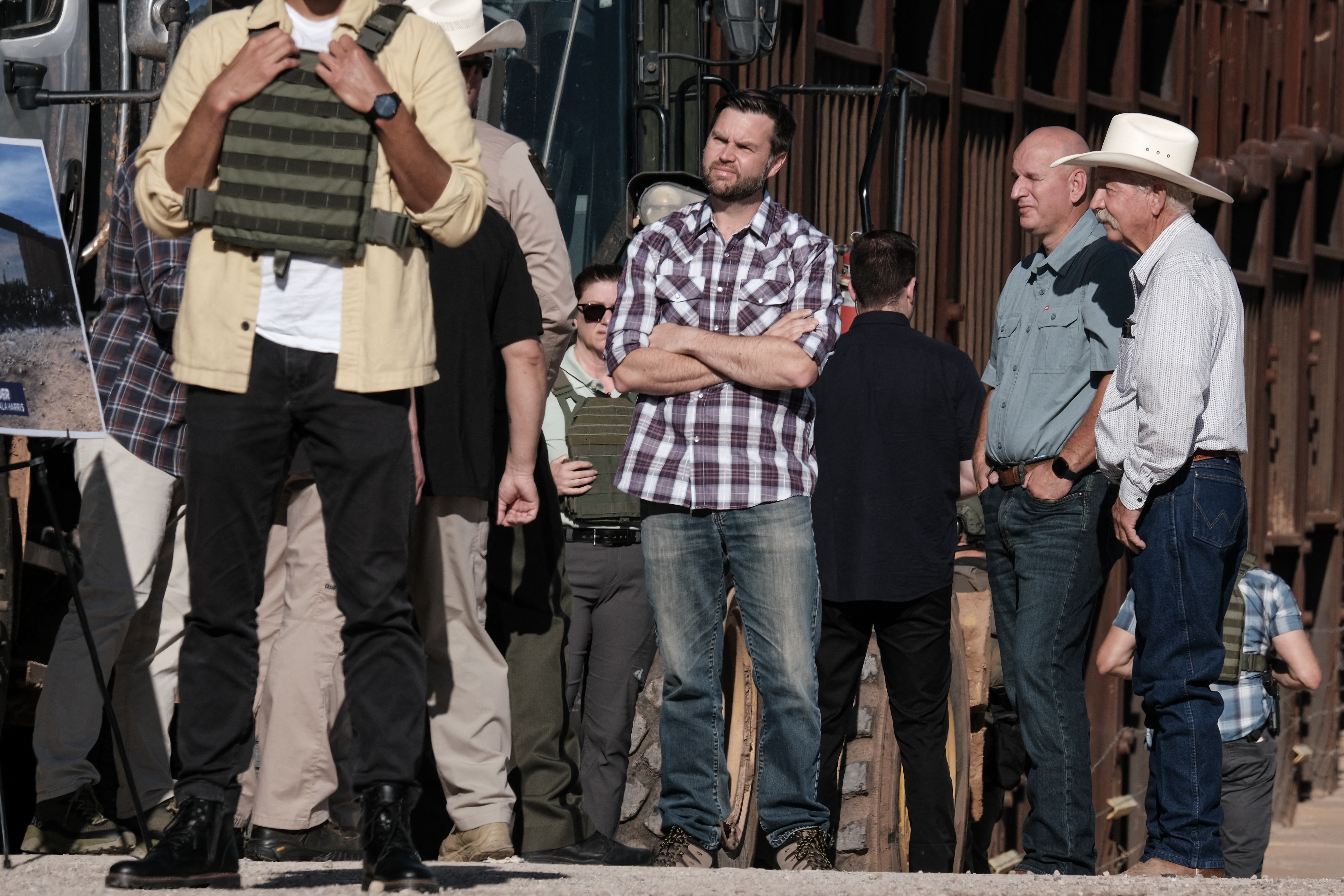
JD Vance Is An Investor In A Far Right Video Platform Filled With Neo-Nazi Content Sen. J.D. Vance (R-OH) has been making headlines for his “rocky rollout” since being named former President Donald Trump’s running mate last month. talkingpointsmemo.com
Saved - July 29, 2024 at 7:08 PM

@ggreenwald - Glenn Greenwald

Israeli troops, with the support of commanders, deliberately exploded the main water reservoir serving Rafah in southern Gaza, then posted it online. There is no possible military justification. It's a classic crime against humanity. Even IDF is investigating it as such. https://t.co/FP4HqmJEb3

Saved - July 22, 2024 at 6:45 PM

@ggreenwald - Glenn Greenwald

A senior state court judge refused to dismiss a defamation lawsuit brought by Trump against the Pulitzer Board. The Board gave Pulitzers to NYT and WPost for their repeated echoing of the Russiagate fraud. Here's what even NYT admitted when reporting on the court ruling:👇 https://t.co/FbwVMWmEjt

Saved - July 15, 2024 at 2:34 PM

@ggreenwald - Glenn Greenwald

Exactly. This is vital to understand. "Disinformation expert" is a fabricated credential, invented after Brexit and Trump's win in 2016 to disguise online censorship as scientific and neutral, and to try to resuscitate the status of media figures as reliable arbiters of Truth.

@AaronKheriatyMD - Aaron Kheriaty

There is no such thing as a disinformation expert.

Saved - June 28, 2024 at 7:36 AM
reSee.it AI Summary
State Department Spokesman Matt Miller alleges that WikiLeaks and Assange harmed numerous people in 2010, but fails to provide any examples when questioned. He also protests Russia's imprisonment of a WSJ reporter, highlighting the potential impact on the US and the West's ability to protest such actions. Another reporter points out that Assange's judge stated that the US admitted "no victims."

@ggreenwald - Glenn Greenwald

State Department Spokesman Matt Miller today alleged that the 2010 publications of WikiLeaks and Assange harmed numerous people. Several WH reporters badgered him to give a single example, and -- like everyone making this false claim -- he couldn't. Watch: https://t.co/SRvUmz53pM

Video Transcript AI Summary
The speaker emphasized the dangers of Julian Assange's actions, highlighting how WikiLeaks' publication of unredacted State Department documents put lives at risk and hindered diplomatic relationships. They mentioned the State Department's efforts to protect individuals named in the documents but couldn't confirm specific harm. The discussion also touched on Assange's potential entry into the US and the judge's ruling on victims. The State Department's challenges in maintaining trust due to leaked information were noted, with concerns raised by foreign counterparts. The conversation concluded with a reference to private conversations and concerns raised by foreign leaders like Berlusconi.
Full Transcript
Speaker 0: Were happy to work with our Australian colleagues on it, and that remains the case. I do think it is important when we talk about Julian Assange to remind the world that the actions, for which he was indicted and for which he has now plead guilty are actions that put the lives of our partners, our allies and our diplomats at risk, especially those who work in dangerous places like Afghanistan and Iraq. This was some years ago now, almost 15 years ago, so I think the world has forgotten much of it. But if you recall when WikiLeaks first disseminated, and published state department documents, state department cables, they did so without redacting names. They just threw them out there for the world to see. And so, the documents they published gave identifying information of individuals who were in contact with the State Department. That included, opposition leaders, human rights activists around the world, whose positions were put in some danger because of their public disclosure. It also chilled the ability of American personnel to build relationships and have frank conversations with them. And at the time, those of you who covered the State Department, at the time will probably remember that in the days leading up to that release, the State Department really had to scramble to get people out of danger, to move them out of harm's way. It was an extraordinary, effort performed by dozens of government officials around the world, but that doesn't change the danger that those actions put innocent people all around the world in, through no fault of their own. And that's, of course, not even to mention the the further actions by WikiLeaks down the road to essentially serve as a conduit for Russian intelligence, interfering in the US presidential election. Speaker 1: I'm sorry. Speaker 0: I'm not So Speaker 1: I actually did cover the State Department back then. And I don't remember there being any public, that there was a public concern that was raised about the potential security risk posed to, sources who might have been quoted. Was there actually any, Did you ever discover anyone who was injured, killed, had to go into hiding because of them. Speaker 0: So a few things about that. 1, I can't give you a definitive answer only because I wasn't here at the time and so much time. And so I hold on. Speaker 2: Oh, no. But but no. Speaker 0: Let me Matt, let me finish. I have a full answer on it. 1, I can't speak to that because it was some years ago, and I don't have a full, you know, accounting of what happened. But number 2, the state department did an extraordinary amount of work when we found out that these cables were going to be published to get people out of harm's way, to to go around and look at what might become public and take action so people that would be put in danger, would be put out of harm's way. But 3rd, you know, if you drive drunk down the street and get pulled over for drunk driving, the fact that you didn't crash into another car and kill someone doesn't get you out of the, of your the reckless actions and the endangerment that you put your fellow citizens in. And it's the same thing same principle applies here. Speaker 1: Right. Well, I I and I I don't think that it does. But the fact of the matter is is that the State Department has been, at least as far as I know, and maybe I'm wrong, but has been has never been able to point to anyone who, was compromised or killed or, you know, put put at risk because because because of the Speaker 0: Their identities were compromised. The state department went to great work to get people out of harm's way to prevent that very action from happening. Speaker 1: Do you know how many people about Speaker 0: as I said, this was some time ago. I was in the government at the time, not at the state department. I'd have to go back and look at it. But I do know that there was work around the world, especially in places, like Afghanistan, Iraq, and other, you know, other places around the world where we they did have to do AAA great amount of work to kind of move people. Speaker 1: Well, 1 of 1 of your predecessors, PJ Crowley, went to, who was standing at the podium at the time, went to great pains to talk about the potential damage that Quivra would be caused by these revelations. And I, you know, unless I missed it, I I didn't hear that there was any. Speaker 0: As as I said, number 1, the department went to a great amount of effort to avoid people being put in harm's way. But it doesn't absolve anyone of their response to I I know, but it's an but but I I know you're not, but it's an important point. Just because people were able to mitigate the harm done by your actions, that doesn't absolve you of your actions in the Speaker 1: first place. Okay. Speaker 0: Shannon, go. Speaker 1: Oh, I'm sorry. Speaker 2: Oh, yeah. 1 other thing. Speaker 1: You said there was some some, small coordination between the US and Australia over the last couple of days. Was that involving Speaker 2: the flight? Speaker 0: With with relation to his landing and transfer in Australia. Yeah. Last before, he said in the agreement that, Speaker 2: mister Assange will not be able to enter the United States without permission. Who will he be seeking permission from? Who would grant that permission? And how would that happen if that were to occur? Speaker 0: It would, so I'm not gonna speak to provisions in what was the Justice Department plea agreement, but that would be handled, as is the case for anyone seeking, permission to enter the United States. Speaker 2: And in the judgment, the sentencing part of the judgment, the the judge noted that there were no victims of mister Assange's, behavior, which is part of the reason that the sentence was what it was. Do you disagree with that? Do you think there were victims of his actions? Speaker 0: I'm not gonna do, speak to a comment made by a judge in a ruling that would be never be appropriate for me to do so, but I stand by the comments I made just a moment Speaker 1: ago. What? Speaker 0: You're not Speaker 1: gonna speak to a comment made by a judge. I mean, if he if he did, I didn't I don't know that he did, but that's exactly the point of my question. Speaker 0: Yeah. I'm but I'm not I'm I'm Speaker 1: Which is that that the state department has never come up even though it was 1 of the prime, quote, unquote, victims of of of these leaks, was never able to identify anyone who came under who was killed or came under came under Speaker 0: I think the point I made a moment ago is an appropriate response to that, which is just because the state department was able to take actions to keep people out of harm's way. People put it in harm's way and does what's all responsible. Speaker 1: What actions did the state department Speaker 0: They were able the state department at the time was able to reach out to individuals whose names were going to be I can't tell you that. It's almost 15 years ago, Matt. It wasn't here. Well, I know. I mean, I know. But but Speaker 1: I The case has just come to a close. Speaker 0: But I you know? Speaker 1: Someone would Speaker 0: I cannot give you a full account of something that happened almost 15 years ago, but people that were here will tell you that the State Department went to great lengths to reach out to people whose identities were exposed, and get them out of harm's way. And the other point I made is that it does when something like that hap happens, it does chill the ability of American personnel to build relationships with people and count on No doubt. Count on the fact that the information they provide us will be held No doubt. Confidential. So it is not just a harm to or potential harm to the safety and security of those individuals. It's a harm to, American diplomacy. Speaker 1: No doubt. But but the fact of the matter is that you have not been ever been able to identify anything tangible about any tangible negative effect? Speaker 0: That is a different so I think I just did point to a tangible negative effect when it had when people are less willing to trust the United States government Speaker 1: to make the information's, secret. Who who who was willing to Speaker 0: It was a so I was in government I was in government at the time, and I can tell you traveling the world, with a different Okay. A different a different agency, we often heard from foreign counterparts that they were I'm obviously not Speaker 2: gonna speak to I'm Speaker 0: not gonna speak to the exact conversations, but we often heard from foreign counterparts that they were worried about providing information to the United States government because of our ability to keep it. Speaker 1: Well, III remember 1, having been here at the time. And I remember that Berlusconi told former Secretary Clinton that he was concerned mainly because of what the WikiLeaks, what the cables suggested about his, activities and, Speaker 0: there were, there were more Speaker 1: Yes. Speaker 0: There were more, substantive and serious concerns. Yeah. Speaker 1: Were there? Speaker 2: Yeah. Okay. Yeah. Speaker 1: Can you name can you name Speaker 0: a I'm I'm I'm person So country. I think you could see why. If the point of the conversation is someone raising concern about private conversations being made public, it wouldn't be helpful for me to then make those private conversations Speaker 1: spoken here. Ago. I'll drop it. Speaker 0: Go ahead, Alex.

@ggreenwald - Glenn Greenwald

Also, Miller began by protesting Russia's imprisonment of WSJ reporter Evan Gershkovich on espionage charges. One argument Australia made when demanding Assange's release is that it guts the ability of the US and West to protest things like that. Look what Miller has to say: https://t.co/gmGvVuTrQW

Video Transcript AI Summary
Evan Gorskovich appeared in a Russian courtroom today. Journalism is not a crime, and Evan should not have been detained. The Russian authorities staged today's events to justify their suppression of journalists and independent voices.
Full Transcript
Speaker 0: With a couple things. Earlier today, Evan Gorskovich appeared in a courtroom in Yekaterberg, Russia. We have been clear from the start that journalism is not crime and that Evans should never have been detained in the first place. What happened today was a performance put on by Russian authorities to justify their repression of journalists and independent voices.

@ggreenwald - Glenn Greenwald

(In the first tweet, I meant State Dept. reporters, and "WH reporters," and -- as usual -- the journalist being most dogged and insistent is @APDiploWriter, who should be cloned and put at every network. Another reporter noted Assange's judge said the US admitted "no victims."

Saved - June 20, 2024 at 5:37 PM

@ggreenwald - Glenn Greenwald

Wikipedia is a complete bullshit site. It glorifies establishment dogma and those who advocate it, while smearing anyone who questions western institutions. That's why its co-founder, @lsanger, has urged people not to use it due to ideological bias: https://rumble.com/v33nemd-system-update-121.html
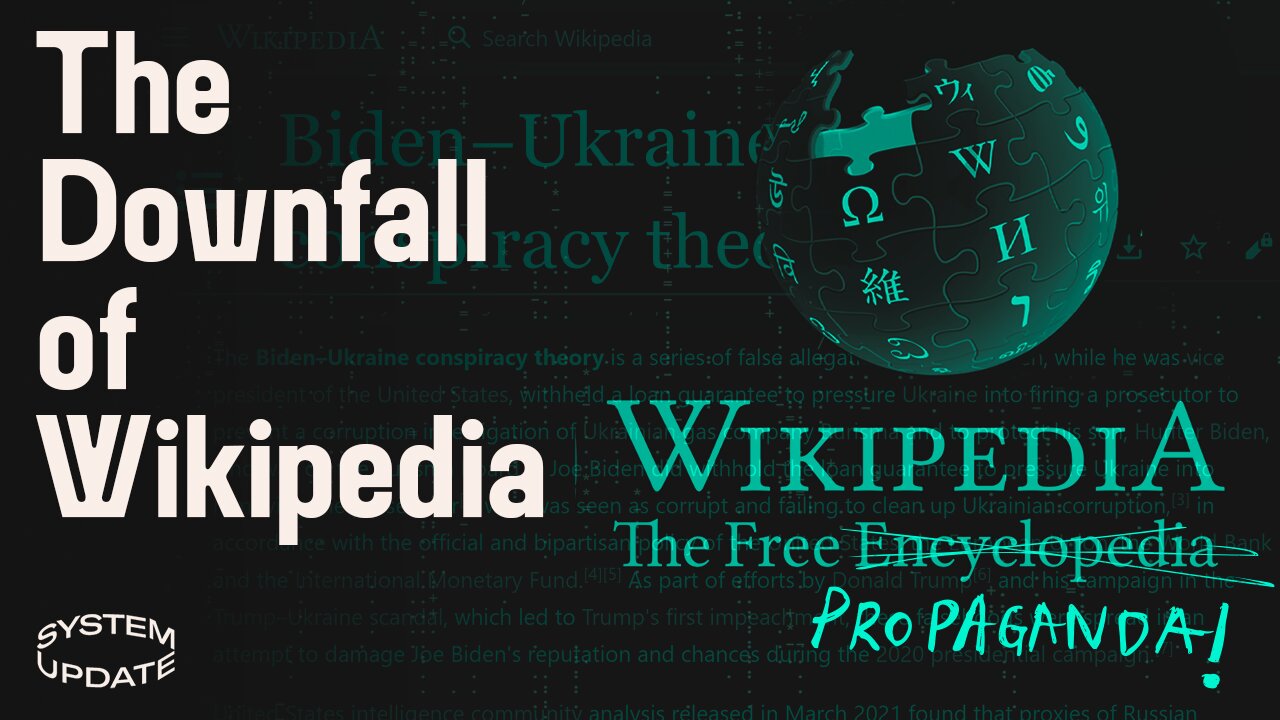
Wikipedia: From Democratized Knowledge to Left-Establishment Propaganda, w/ co-Founder Larry Sanger. Plus: Joe Rogan on FBI in Jan 6 | SYSTEM UPDATE #121 Become part of our Locals community: https://greenwald.locals.com/ You can read more about Larry's encyclosphere here: https://larrysanger.org/2023/07/the-encyclosphere-is-greater-than-wikipedia/ Foll rumble.com

@mindsex69420 - Doctor MindSex M.D. A.D.H.D.

@ggreenwald @RandPaul Just checked the Wikipedia page on the lab leak theory and it vehemently rejects the lab leak hypothesis with citations. I think this is BS, but it’s concerning as I use Wikipedia as my general knowledge base. What can the average person do to find the truth?

Saved - May 21, 2024 at 9:23 PM

@ggreenwald - Glenn Greenwald

This original Newsweek headline predictably went viral, claiming Tucker Carlson has "launched" a new program on Russia state TV. The "edited" article now makes clear the whole story is bullshit -- false -- but it was an irresistible McCarthyite smear: https://www.newsweek.com/tucker-carlson-launches-show-russian-state-tv-russia-24-1903045#:~:text=A%20show%20from%20former%20Fox,is%20broadcast%20on%20Russia%2024.

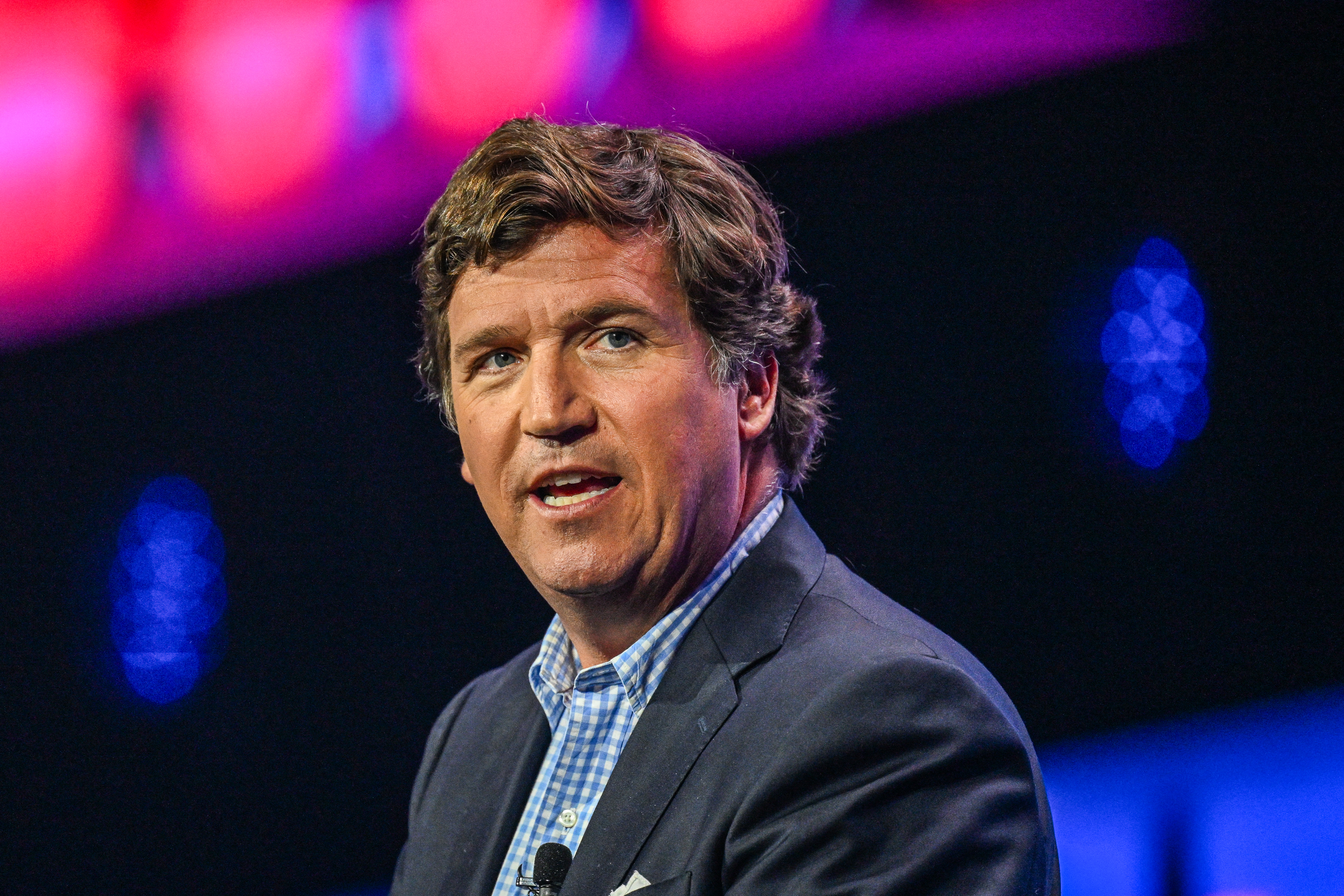
Tucker Carlson show aired by Russian state TV There is no evidence that the former Fox News anchor has done a deal to show the old episodes. newsweek.com
Saved - May 11, 2024 at 7:50 AM

@ggreenwald - Glenn Greenwald

American's Queen of Free Speech and Free Discourse -- stalwart opponent of cancel culture -- endorses the idea that only those who love Israel should be hired as interns in America, while those who criticize Israel's war should not be. https://t.co/nZnxdgSfo5

Saved - April 11, 2024 at 7:09 PM
reSee.it AI Summary
Post 1: Speaker Johnson's change of view on warrantless spying powers is attributed to a classified briefing, highlighting the influence of such briefings in DC politics. Post 2: The US Security State's influence on DC is evident as politicians, like Obama, often alter their stance on issues once in power, possibly due to the allure of secret access and recognition.

@ggreenwald - Glenn Greenwald

Just absolutely amazing that Speaker Johnson admits that he completely changed his view on the need for the FBI/NSA's warrantless spying powers -- after vocally opposing it -- because he went to get a classified briefing and they convinced him. That's how DC works.

@haleytalbotcnn - Haley Talbot

Speaker Mike Johnson elaborates on his FISA flip flop from when he was a rank and file member of the House, explaining that after receiving classified briefings he has a “different perspective.” https://t.co/mrLj9ouEji

Video Transcript AI Summary
As a former member of the judiciary, I witnessed numerous FBI abuses. However, after becoming speaker, I received a confidential briefing on the importance of section 702 of FISA for national security, which changed my perspective. I urge all members to attend classified briefings to make informed decisions. Opinions have shifted after these briefings, highlighting the importance of being fully informed. Translation: The speaker discussed their experience with FBI abuses and how a confidential briefing on FISA section 702 changed their perspective on national security. They emphasized the importance of attending classified briefings to make well-informed decisions.
Full Transcript
Speaker 0: When I was a member of judiciary, I saw all the abuses of the FBI, the terrible abuses over and over and over, the hundreds of thousands of abuses. And then when I became speaker, I went to the SCIF and got the confidential briefing from sort of the other perspective on that to understand the necessity of the section 702 of FISA and how important it is for national security, and it gave me a different perspective. So I encourage all the members to go to the classified briefing and hear all that and see it so they can evaluate the situation for themselves. And I and I think some opinions have changed both ways, but that's part of the process. You gotta be fully informed. Have you been a Excuse me. Excuse me.

@ggreenwald - Glenn Greenwald

So many DC people switch their views when they get into power -- as Obama did when he strengthened the very War on Terror programs he vowed to uproot -- because the US Security State is a permanent DC power center and people get flattered by secret access and medals on chests.

Saved - April 10, 2024 at 12:03 AM

@ggreenwald - Glenn Greenwald

Earlier today, Brazilian Supreme Court judge Alexandre de Moraes explicitly threatened all X employees in Brazil with criminal prosecution. Musk claimed that X's employees feared arrest and Brazilian media strongly implied he was lying. This proves the fear was well-grounded:

@SamPancher - Samuel Pancher

Ao negar pedido do X Brasil para que medidas judiciais sejam enviadas ao escritório internacional da empresa, Alexandre de Moraes destaca que funcionários da rede social no Brasil estão sujeitos a “eventual responsabilidade penal” (ou seja, criminal) https://t.co/JodhICJjKd

Saved - April 9, 2024 at 10:36 PM
reSee.it AI Summary
The author, a former NPR employee, describes the transformation of NPR from a news organization to an activist one after Trump's election. They highlight how coverage shifted towards damaging Trump's presidency and how the focus on diversity and identity overshadowed other important stories. The author also criticizes the prevailing mindset in newsrooms, the language guidance, and the biased framing of stories. They conclude by pointing out the lack of political diversity within NPR's editorial positions.

@ggreenwald - Glenn Greenwald

This article -- by a liberal long employed at NPR -- describes what happened in most media outlets since Trump's election: they explicitly renounced any journalistic function in favor of becoming political activists in defense of what they see as a greater cause than journalism:

@eyeslasho - i/o

Read this. NPR veteran describes the transformation of NPR from a news to an activist organization after Trump's election: "During most of my tenure [at NPR], an open-minded, curious culture prevailed. We were nerdy, but not knee-jerk, activist, or scolding. In recent years, however, that has changed. Today, those who listen to NPR or read its coverage online find something different: the distilled worldview of a very small segment of the U.S. population... Like many unfortunate things, the rise of advocacy took off with Donald Trump. As in many newsrooms, his election in 2016 was greeted at NPR with a mixture of disbelief, anger, and despair... But what began as tough, straightforward coverage of a belligerent, truth-impaired president veered toward efforts to damage or topple Trump’s presidency [italics mine]. Persistent rumors that the Trump campaign colluded with Russia over the election became the catnip that drove reporting. At NPR, we hitched our wagon to Trump’s most visible antagonist, Representative Adam Schiff... The Schiff talking points became the drumbeat of NPR news reports. But when the Mueller report found no credible evidence of collusion, NPR’s coverage was notably sparse. Russiagate quietly faded from our programming... It’s bad to blow a big story. What’s worse is to pretend it never happened, to move on with no mea culpas, no self-reflection... [Hunter Biden's] laptop was newsworthy. But the timeless journalistic instinct of following a hot story lead was being squelched. During a meeting with colleagues, I listened as one of NPR’s best and most fair-minded journalists said it was good we weren’t following the laptop story because it could help Trump [italics mine]... Over the course of the pandemic, a number of investigative journalists made compelling, if not conclusive, cases for the lab leak. But at NPR, we weren’t about to swivel or even tiptoe away from the insistence with which we backed the natural origin story... [Our new director] declared that diversity—on our staff and in our audience—was the overriding mission... Race and identity became paramount in nearly every aspect of the workplace. Journalists were required to ask everyone we interviewed their race, gender, and ethnicity (among other questions), and had to enter it in a centralized tracking system [italics mine]. We were given unconscious bias training sessions. A growing DEI staff offered regular meetings imploring us to 'start talking about race.' There’s an unspoken consensus about the stories we should pursue and how they should be framed. It’s frictionless—one story after another about instances of supposed racism, transphobia, signs of the climate apocalypse, Israel doing something bad, and the dire threat of Republican policies. It’s almost like an assembly line. The mindset prevails in choices about language. In a document called NPR Transgender Coverage Guidance—disseminated by news management—we’re asked to avoid the term biological sex... The mindset animates bizarre stories—on how The Beatles and bird names are racially problematic, and others that are alarmingly divisive; justifying looting, with claims that fears about crime are racist; and suggesting that Asian Americans who oppose affirmative action have been manipulated by white conservatives. More recently, we have approached the Israel-Hamas war and its spillover onto streets and campuses through the intersectional lens that has jumped from the faculty lounge to newsrooms. Oppressor versus oppressed... I looked at voter registration for our newsroom. In D.C., where NPR is headquartered and many of us live, I found 87 registered Democrats working in editorial positions and zero Republicans. None." https://www.thefp.com/p/npr-editor-how-npr-lost-americas-trust


I’ve Been at NPR for 25 Years. Here’s How We Lost America’s Trust. Uri Berliner, a veteran at the public radio institution, says the network lost its way when it started telling listeners how to think. thefp.com

@ggreenwald - Glenn Greenwald

I really recommend reading that entire scathing indictment of why NPR and media similar to it are failing by every metric, but these paragraphs in particular are such pure truth about the US corporate media and how they now think and behave: https://t.co/qzMbElYnL6

Saved - April 8, 2024 at 8:57 PM

@ggreenwald - Glenn Greenwald

The Brazilian left (and increasingly US liberals) believe -- and often state -- that "free speech" is a fascist value. They say this even though not a single fascist regime has ever defended or offered free speech. And every fascist regime in history has used censorship:

@AnomiePhoenix - Anomie Phoenix #NewDawn

@ggreenwald Brazil is in even more of a democratic crisis than its northern neighbours. And that’s saying something.

Saved - March 25, 2024 at 1:32 AM
reSee.it AI Summary
The Daily Wire's delayed decision to cut ties with Candace Owens is concerning, given her extreme views. Bari Weiss' essay in Commentary emphasizes the importance of debating opponents instead of de-platforming them.

@ggreenwald - Glenn Greenwald

And this piece doesn't even touch on her truly batshit views about Brigitte Macron... That it took the Daily Wire this long to sever ties with Candace Owens is alarming: https://commentary.org/articles/christine-rosen/hateful-candace-owens/

@bariweiss - Bari Weiss

And this piece doesn't even touch on her truly batshit views about Brigitte Macron... That it took the Daily Wire this long to sever ties with Candace Owens is alarming: https://www.commentary.org/articles/christine-rosen/hateful-candace-owens/
The Hateful Candace Owens If you had never heard of Candace Owens until recently, you aren’t alone. Less than a decade ago, she was an unknown college dropout working as a marketing professional in commentary.org

@ggreenwald - Glenn Greenwald

The essay in Commentary by Bari Weiss from which that excerpt is taken, "Say No to the Woke Revolution," is below. It warns of the evils of firing people by accusing them of bigotry, and of the moral urgency of debating not de-platforming opponents: https://www.commentary.org/articles/bari-weiss/resist-woke-revolution/

We Got Here Because of Cowardice. We Get Out With Courage A lot of people want to convince you that you need a Ph.D. or a law degree or dozens of hours of free time to read dense texts about critical theory commentary.org
Saved - March 24, 2024 at 9:56 AM
reSee.it AI Summary
The ACLU is facing criticism for their handling of a case involving an Asian employee who accused her black supervisors of harassment. The employee was later fired and the ACLU is now arguing for an expanded definition of "hate speech." There are concerns about the organization's credibility and its alleged pay-to-play culture. A link to an article highlighting these issues is shared, urging readers to read it for insight into the current state of left-liberal activism and media organizations.

@ggreenwald - Glenn Greenwald

Gift article about the ACLU -- about how an Asian employee often accused her bosses of harassment, only to then get fired for racism since her bosses she complained about were black, and now ACLU is arguing for an expanded definition of "hate speech": https://www.nytimes.com/2024/03/22/us/politics/aclu-employee-fired-race-bias.html

The A.C.L.U. Said a Worker Used Racist Tropes and Fired Her. But Did She? The civil liberties group is defending itself in an unusual case that weighs what kind of language may be evidence of bias against Black people. nytimes.com

@ggreenwald - Glenn Greenwald

It shows what an absolute farce and parody and joke of an organization the ACLU has become -- having as much to do with civil liberties as the phone company. Here's the ACLU's argument for why their Asian employee was guilty of racism for criticizing her black supervisors:

@ggreenwald - Glenn Greenwald

Speaking of ACLU, here's an article on how they worked to ensure that a Democratic Senate AIPAC-donor candidate won his Maryland primary even though he's far worse on their issues than his primary opponent, because he gave the ACLU $15 million:

@matthewstoller - Matt Stoller

This story is just a stunning indictment of the pay-to-play culture of the ACLU, which at this point is just the American Corporate Liberties Union. https://prospect.org/politics/2024-03-22-david-trone-self-funding-victim-criminal-justice/
The Self-Funding ‘Victim’ of the Criminal Justice System David Trone, founder of the Total Wine chain, is trying to draw a contrast with his primary opponent, a former prosecutor, by saying he’s been caught up in the system. It was for business violations. prospect.org

@ggreenwald - Glenn Greenwald

I think I posted the wrong link to the NYT article. Here's the gift link - really encourage everyone to read this. This is the abject idiocy destroying not only the ACLU but almost every left-liberal activist and media organization. Read it for fun: https://www.nytimes.com/2024/03/22/us/politics/aclu-employee-fired-race-bias.html?unlocked_article_code=1.ek0.pCiR.zTNIjKZ7NibS&smid=url-share

The A.C.L.U. Said a Worker Used Racist Tropes and Fired Her. But Did She? (Gift Article) The civil liberties group is defending itself in an unusual case that weighs what kind of language may be evidence of bias against Black people. nytimes.com
Saved - March 17, 2024 at 9:14 PM
reSee.it AI Summary
In 2023, a federal court judge upheld the finding that the Biden administration and FBI coerced Big Tech to censor dissent online, a grave attack on the 1st Amendment. The Twitter Files provided significant evidence of this, but corporate outlets dismissed it as a "nothing burger."

@ggreenwald - Glenn Greenwald

The most under-reported and under-discussed story of 2023: a federal district court judge, upheld by a unanimous appellate panel, found the Biden WH and FBI committed one of the gravest attacks on the 1st Am in decades by coercing Big Tech to censor dissent online. https://t.co/00MamRBUdw

@ggreenwald - Glenn Greenwald

Even worse: the Twitter Files was not the first reporting to prove that the Biden Amin was doing this, but it was the most significant given how much evidence it presented. And corporate outlets united like herd animals to implore the public to ignore it: "nothing burger."

Saved - February 20, 2024 at 2:03 PM
reSee.it AI Summary
There is a heated exchange between Stuart and Glenn regarding their views on press freedom and their opinions on Assange's imprisonment. Stuart accuses Glenn of being a fraud and a GOP hack, while Glenn criticizes Stuart for selectively condemning foreign regimes. Glenn also criticizes Tucker Carlson and expresses concern about the normalization of Putin. The posts highlight the importance of consistent principles and condemn hypocrisy in addressing human rights abuses.

@ggreenwald - Glenn Greenwald

Stuart: you are a gigantic fraud, the least credible person to posture as a champion of dissent and press freedom. Your life is as a GOP hack justifying War on Terror abuses, and cheering Assange's imprisonment. Condemning Russia is easy and worthless. You are Putin's twin.

@stuartpstevens - Stuart Stevens

Glenn, you can’t possibly be neutral on the evil of normalizing Putin’s evil? The “reach” is exactly the danger. It has to trouble you that a man who is responsible for countless murders and torture of journalists is now the darling of the right. I first met Carlson when he was writing for Tina Brown & desperate to be accepted as a serious writer. He failed. Then failed at MSNBC. Then failed at CNN. Then failed at Fox. Fox. How bad do you have to be to fail at Fox? Next stop: Moscow. It’s a classic pattern of resentment and anger at those he so wanted to accept him.

@ggreenwald - Glenn Greenwald

Every press freedom and civil liberties group in the West has united -- and they virtually never do -- to warn that Assange's prosecution by the Biden DOJ is the gravest threat to press freedoms. Those who condemn foreign regimes, but never their own, are cowardly jingoists. https://t.co/Ys9yAmNQdJ

@ggreenwald - Glenn Greenwald

The contempt I have for people who pretend to believe in principles but who selectively weaponize them to serve establishment dogma is infinite. Screaming about the evils of US enemies is as cheap as it is inconsequential, especially when you sanction your own side's abuses. https://t.co/l9KD5O4kj1

@ggreenwald - Glenn Greenwald

If you publicly weep and cry fake tears and express rage when enemy governments far away from you engage in abuses, only to remain quiet -- or, worse, supportive -- when your own government does the same, there are so many things to say about you, none of them good. https://t.co/iYIkLwCPZW

Saved - February 19, 2024 at 3:20 PM
reSee.it AI Summary
Corporate journalism, including the @Atlantic, is facing deserved decline, while independent journalism is thriving. This article by @PeterMVanBuren explains how corporate journalists are responsible for their own demise.

@ggreenwald - Glenn Greenwald

No, "American journalism" is not headed for an "extinction-level event." Corporate journalism is, and deservedly so: including the @Atlantic is: not even Steve Jobs' inherited fortune can save them. Independent journalism is thriving. This is the reality they can't accept.

@ggreenwald - Glenn Greenwald

Good @PeterMVanBuren article on how corporate journalists are the ones who authored their own death: https://www.theamericanconservative.com/the-mainstream-media-are-dying-of-self-inflicted-wounds/

The Mainstream Media Are Dying of Self-Inflicted Wounds Years of professional irresponsibility has consequences. theamericanconservative.com
Saved - December 5, 2023 at 7:36 PM
reSee.it AI Summary
The Department of Homeland Security's Disinformation Board was paused due to public outrage. The Washington Post and Taylor Lorenz criticized the investigation of a Homeland Security official, labeling it as harassment. The rules seem to protect high-level officials while targeting anonymous citizens. The free press focuses on punishing private citizens rather than scrutinizing government officials. The article questions the need for a Disinformation Board to dictate truth in a democracy. It also highlights the oddity of Lorenz defending Jankowicz without disclosing their mutual support. The article concludes by pointing out the contradiction of portraying Jankowicz as a victim of right-wing disinformation while being exposed in an investigative piece by The Nation.

@ggreenwald - Glenn Greenwald

It's a cause of momentary celebration that the Department of Homeland Security was forced by popular anger to "pause" its Disinformation Board and the absurd #Resistance cartoon they hired to run it, but read this to see how angry WPost and @TaylorLorenz are that this happened:

@washingtonpost - The Washington Post

Homeland Security ‘paused’ newly created Disinformation Governance Board after its leader came under online attack https://www.washingtonpost.com/technology/2022/05/18/disinformation-board-dhs-nina-jankowicz/

How the Biden administration let right-wing attacks derail its disinformation efforts Nina Jankowicz was the subject of online attacks from the moment she was named head of the newly created Disinformation Governance Board. Three weeks later, the Department of Homeland Security said the board's work would be "paused." washingtonpost.com

@ggreenwald - Glenn Greenwald

Investigating and criticizing a Homeland Security official is now "harassment" and bullying, according to the WashPost and @TaylorLorenz. Only ordinary citizens can be investigated -- not high-level US Security State operatives. Them's the rules:

@ChristinaPushaw - Christina Pushaw 🐊 🇺🇸

@ggreenwald @TaylorLorenz “Its leader came under online attack”! So we are supposed to feel sorry for a Department of Homeland Security official who was tasked by the federal government to censor dissent? It’s our fault that we object to it?

@ggreenwald - Glenn Greenwald

Summary of the rules from the WPost and @TaylorLorenz in case you're confused: -- High-level officials of the Department of Homeland Security: off-limits from investigation and criticism! -- Anonymous citizens who tweet bad ideologies: Dox, Unmask, Bang on relatives' doors!

@ggreenwald - Glenn Greenwald

In sum, a free press exists to unmask and punish private citizens with the wrong politics ("shoe-lace reporting"), not to investigate and scrutinize the beliefs, conduct and claims of powerful government officials ("harassment" and bullying).

@ggreenwald - Glenn Greenwald

Without having the US Government's Department of Homeland Security have a Disinformation Board run by Nina Jankowicz to decree truth and falsity, how will we know what we should believe and not believe? How can a democracy function without DHS telling us what is true and false?

@ggreenwald - Glenn Greenwald

Also seems odd that WPost allowed @TaylorLorenz (who, credit where due, broke the story of the DHS "pause") to write an entire article arguing Nina Jankowicz should be off-limits from criticism, without mentioning Jankowicz argued the same about Lorenz:

@wiczipedia - Nina Jankowicz

Disgusting; Glenn Greenwald's attack on @TaylorLorenz fueled a Tucker Carlson monologue last night. Online harassment against women is real, it is insidious, and it has offline effects. We have the receipts - and your back. 💪🏻https://www.wilsoncenter.org/publication/malign-creativity-how-gender-sex-and-lies-are-weaponized-against-women-online
Malign Creativity: How Gender, Sex, and Lies are Weaponized Against Women Online wilsoncenter.org

@ggreenwald - Glenn Greenwald

Indeed, Jankowicz has a very long history of defending Lorenz and expressing solidarity for the trauma Lorenz suffers when her work is criticized. That's almost certainly where Lorenz got her version of events and seems like it should be disclosed when Lorenz defends Jankowicz.

@ggreenwald - Glenn Greenwald

The other bizarre aspect of the Nina-Jankowicz/@TaylorLorenz saga: Taylor depicts this poor, marginalized DHS official as the victim of "right-wing" disinformation, when the most devastating investigative piece on her was this one last week in @TheNation: https://www.thenation.com/article/politics/meet-the-head-of-bidens-new-disinformation-governing-board/
Meet the Head of Biden’s New “Disinformation Governing Board” The Nation Magazine thenation.com
Saved - November 20, 2023 at 6:16 PM

@ggreenwald - Glenn Greenwald

I think sometimes people forget that Media Matters was created, shaped and governed for a long time by David Brock, arguably the single most craven, deceitful and amoral scumbag DC politics has ever seen. There was no way for anything decent to be spawned from that rotted root:

@JackPosobiec - Jack Poso 🇺🇸

BREAKING: Media Matters created accounts and gamed the X server to create false impressions for their article This isn’t journalism, this is a hoax https://t.co/vO1HVDBuEo

Saved - October 2, 2023 at 12:48 PM
reSee.it AI Summary
The recent national elections in Slovakia dealt a blow to the EU and NATO. The populist former PM, known for opposing war support and NATO membership for Ukraine, emerged victorious. Western elites are quick to blame the Kremlin for any Western leader's misfortune. The likely new PM, Robert Fico, has shifted towards populism while still holding some left-liberal views. He opposes key EU policies, dislikes NATO support for the war, and may align with Orban in the EU.

@ggreenwald - Glenn Greenwald

The EU and NATO just suffered a huge defeat in the national elections in Slovakia where, as predicted, the populist former PM who opposes war support for Ukraine and NATO membership for Ukraine likely won. 3 guesses as to who and what Western elites are blaming this defeat on:

@ggreenwald - Glenn Greenwald

Oh, wow - who could have guessed? If a Western leader stubs their toe, it's the Kremlin's fault. https://t.co/tONDRdGtyu

@ggreenwald - Glenn Greenwald

The former and likely new PM of Slovakia, Robert Fico, and his party, have always been viewed as left, but increasingly has become populist. He still has many basic left-liberal views but opposes key EU policy, hates NATO support for the war, and may align with Orbán in the EU.

Saved - October 2, 2023 at 12:34 PM

@ggreenwald - Glenn Greenwald

The Canadian government, armed with one of the world's most repressive online censorship schemes, announces that all "online streaming services that offer podcasts" must formally register with the government to permit regulatory controls: https://canada.ca/en/radio-television-telecommunications/news/2023/09/crtc-takes-major-step-forward-to-modernize-canadas-broadcasting-framework.html


CRTC takes major step forward to modernize Canada’s broadcasting framework - Canada.ca Today, the CRTC is advancing its regulatory plan to modernize Canada’s broadcasting framework and ensure online streaming services make meaningful contributions to Canadian and Indigenous content. canada.ca
Saved - September 23, 2023 at 8:41 PM
reSee.it AI Summary
Corporate journalists advocate censorship, as seen in an article targeting Portnoy. They pressure individuals to disassociate from those they dislike. Repressive left-liberal groups like Media Matters and Sleeping Giants exert similar pressure on tech platforms and advertisers. These outlets engage in liberal activism disguised as journalism.

@ggreenwald - Glenn Greenwald

This absolute joke of an article about Portnoy shows how corporate journalists are the leading censorship advocates. This is how they do it: "Hi, I'm from the WPost/NYT. We notice you haven't banned or disassociated from Bad Speaker X, and we'll write about it if you don't."

@ggreenwald - Glenn Greenwald

There are repressive left-liberal activist groups like Media Matters and Sleeping Giants who do the same: pressure tech platforms and advertisers to ban those who liberals dislike. These media outlets do the same: it's obvious liberal activism masquerading as journalism.

Saved - September 10, 2023 at 3:43 PM

@ggreenwald - Glenn Greenwald

Speaking of fascism: an appellate court just largely upheld a lower court ruling that key parts of the US Govt -- FBI and WH -- unconstitutionally threatened and forced tech platforms to censor speech they disliked. What weight does the "Vote Blue!" crowd assign this, if any?

@ggreenwald - Glenn Greenwald

In one of the most significant 1st Amendment victories in years, a 5th Circuit panel (only one of whom is a Trump appointee) rules that the Biden WH, the FBI, CDC, and Surgeon General violated Americans' core free speech rights by coercing Big Tech to censor on their command.

Saved - September 7, 2023 at 9:32 PM
reSee.it AI Summary
WashPost promotes fraudulent study linking X's refusal and FB/YouTube's failure to censor with pro-Russia propaganda. Panic in Western power centers over eroding war support drives the motive. Weaponizing billionaire-funded disinformation experts aims to ban free discourse. EU study omits Omidyar-funded disinformation group. Break down this censorship weapon.

@ggreenwald - Glenn Greenwald

WashPost just promoted one of the most fraudulent "disinformation studies" yet. They claim X's refusal (and FB and YouTube's "failure") to censor more facilitates "pro-Russia propaganda". Analyzing this "study" reveals the fraud on which the "disinformation industry" rests:👇

@ggreenwald - Glenn Greenwald

Part of the motive here is panic in Western power centers over eroding public war support. Slovakia's front-runner opposes more money for Ukraine. But the main goal is to weaponize fake billionaire-funded "disinformation experts" to ban free discourse:

@SystemUpdate_ - System Update

.@ggreenwald “I know we're all trying to think of the EU as these nice, soft Democrats with a small D, but in the name of prosecuting this war, in the name of their powers on COVID and just in general, they are really aggressively seeking to prevent dissent on the internet in…

Video Transcript AI Summary
The EU government determines what disinformation is and requires social media platforms to ban those who post views that deviate from EU policy. This approach is seen as dangerous, as it suppresses dissent on the internet in an authoritarian and totalitarian manner. Despite the perception of the EU as democratic, their actions in prosecuting the war on COVID and in general show an aggressive stance in preventing dissent online, which goes against the values we associate with our enemies.
Full Transcript
Speaker 0: Obviously, who determines what disinformation is is the EU government. So social media companies, under this law that The Washington Post obviously admires, requires these social media platforms to ban people who are posting views that undermine or deviate from formal EU policy or EU perspective. There's really nothing more dangerous than that. I know we're all trying to think of the EU as these nice, soft Democrats with a small d. But in the name of prosecuting this war, in the name of their powers on COVID, and just in general, they are really aggressively seeking to prevent dissents on the Internet in exactly the kind of authoritarian and totalitarian way, we were we are always trained to believe is done by our enemies.

@ggreenwald - Glenn Greenwald

When trumpeting this EU-study, the WPost omitted that the "disinformation group" used by the EU is Omidyar-funded. All these groups have the same small set of neoliberal-billionaire and CIA/MI6 funding. It's vital to break down this censorship weapon: https://rumble.com/v3ffei8-system-update-show-143.html

EU and The Washington Post Escalate Their Censorship Campaign with a New Fraudulent “Disinformation Study” About Twitter and Russia. Plus: The John McCain Institute Used to Promote Neocon Dogma on War | SYSTEM UPDATE #143 Become part of our Locals community: https://greenwald.locals.com/ Follow Glenn: Twitter: https://twitter.com/ggreenwald Instagram: https://www.instagram.com/glenn.11.greenwald/ Facebook: https://www. rumble.com
View Full Interactive Feed