reSee.it - Related Post Feed

Saved - March 9, 2023 at 5:12 PM
reSee.it AI Summary
The Censorship-Industrial Complex is a partnership between Twitter and government agencies, NGOs, and commercial news media. Twitter receives thousands of content reports from various government agencies and NGOs, including the FBI, DHS, and HHS. The company also holds regular industry meetings with these agencies. NGOs like the National Endowment for Democracy and the Atlantic Council's DFRLab are key players in this complex. The Censorship-Industrial Complex is taxpayer-funded and often a major source of disinformation.

@mtaibbi - Matt Taibbi

1. TWITTER FILES: Statement to Congress THE CENSORSHIP-INDUSTRIAL COMPLEX

@mtaibbi - Matt Taibbi

2. “MONITOR ALL TWEETS COMING FROM TRUMP’S PERSONAL ACCOUNT/BIDEN’S PERSONAL ACCOUNT” When #TwitterFiles reporters were given access to Twitter internal documents last year, we first focused on the company, which at times acted like a power above government.

@mtaibbi - Matt Taibbi

3. But Twitter was more like a partner to government. With other tech firms it held a regular “industry meeting” with FBI and DHS, and developed a formal system for receiving thousands of content reports from every corner of government: HHS, Treasury, NSA, even local police:

@mtaibbi - Matt Taibbi

4. Emails from the FBI, DHS and other agencies often came with spreadsheets of hundreds or thousands of account names for review. Often, these would be deleted soon after.

@mtaibbi - Matt Taibbi

5. Many were obvious “misinformation,” like accounts urging people to vote the day after an election. But other official "disinfo" reports had shakier reasoning. The highlighted Twitter analysis here disagrees with the FBI about accounts deemed a “proxy of Russian actors":

@mtaibbi - Matt Taibbi

6. Then we saw "disinfo" lists where evidence was even less clear. This list of 378 “Iranian State Linked Accounts” includes an Iraq vet once arrested for blogging about the war, a former Chicago Sun-Times reporter and Truthout, a site that publishes Noam Chomsky.

@mtaibbi - Matt Taibbi

7. In some cases, state reports didn’t even assert misinformation. Here, a list of YouTube videos is flagged for “anti-Ukraine narratives”:

@mtaibbi - Matt Taibbi

8. But the bulk of censorship requests didn’t come from government directly.

@mtaibbi - Matt Taibbi

9. Asked if Twitter’s marketing department could say the company detects “misinfo” with help of “outside experts,” a Twitter executive replied:

@mtaibbi - Matt Taibbi

10. We came to think of this grouping – state agencies like DHS, FBI, or the Global Engagement Center (GEC), along with “NGOs that aren’t academic” and an unexpectedly aggressive partner, commercial news media – as the Censorship-Industrial Complex.

@mtaibbi - Matt Taibbi

11. Who’s in the Censorship-Industrial Complex? Twitter in 2020 helpfully compiled a list for a working group set up in 2020. The National Endowment for Democracy, the Atlantic Council’s DFRLab, and Hamilton 68’s creator, the Alliance for Securing Democracy, are key:

@mtaibbi - Matt Taibbi

12. Twitter execs weren’t sure about Clemson’s Media Forensics Lab (“too chummy with HPSCI”), and weren’t keen on the Rand Corporation (“too close to USDOD”), but others were deemed just right.

@mtaibbi - Matt Taibbi

13. NGOs ideally serve as a check on corporations and the government. Not long ago, most of these institutions viewed themselves that way. Now, intel officials, “researchers,” and executives at firms like Twitter are effectively one team - or Signal group, as it were:

@mtaibbi - Matt Taibbi

14. The Woodstock of the Censorship-Industrial Complex came when the Aspen Institute - which receives millions a year from both the State Department and USAID - held a star-studded confab in Aspen in August 2021 to release its final report on “Information Disorder.”

@mtaibbi - Matt Taibbi

15. The report was co-authored by Katie Couric and Chris Krebs, the founder of the DHS’s Cybersecurity and Infrastructure Security Agency (CISA). Yoel Roth of Twitter and Nathaniel Gleicher of Facebook were technical advisors. Prince Harry joined Couric as a Commissioner.

@mtaibbi - Matt Taibbi

16. Their taxpayer-backed conclusions: the state should have total access to data to make searching speech easier, speech offenders should be put in a “holding area," and government should probably restrict disinformation, “even if it means losing some freedom.”

@mtaibbi - Matt Taibbi

17. Note Aspen recommended the power to mandate data disclosure be given to the FTC, which this committee just caught in a clear abuse of office, demanding information from Twitter about communications with (and identities of) #TwitterFiles reporters. https://judiciary.house.gov/sites/evo-subsites/republicans-judiciary.house.gov/files/evo-media-document/Weaponization_Select_Subcommittee_Report_on_FTC_Harrassment_of_Twitter_3.7.2023.pdf

@mtaibbi - Matt Taibbi

18. Naturally Twitter’s main concern regarding the Aspen report was making sure Facebook got hit harder by any resulting regulatory changes:

@mtaibbi - Matt Taibbi

19. The same agencies (FBI, DHS/CISA, GEC) invite the same “experts” (Thomas Rid, Alex Stamos), funded by the same foundations (Newmark, Omidyar, Knight) trailed by the same reporters (Margaret Sullivan, Molly McKew, Brandy Zadrozny) seemingly to every conference, every panel.

@mtaibbi - Matt Taibbi

20. The #TwitterFiles show the principals of this incestuous self-appointed truth squad moving from law enforcement/intelligence to the private sector and back, claiming a special right to do what they say is bad practice for everyone else: be fact-checked only by themselves.

@mtaibbi - Matt Taibbi

21.While Twitter sometimes pushed back on technical analyses from NGOs about who is and isn't a “bot,” on subject matter questions like vaccines or elections they instantly defer to sites like Politifact, funded by the same names that fund the NGOs: Koch, Newmark, Knight.

@mtaibbi - Matt Taibbi

22. #TwitterFiles repeatedly show media acting as proxy for NGOs, with Twitter bracing for bad headlines if they don't nix accounts. Here, the Financial Times gives Twitter until end of day to provide a “steer” on whether RFK, Jr. and other vax offenders will be zapped.

@mtaibbi - Matt Taibbi

23. Well, you say, so what? Why shouldn’t civil society organizations and reporters work together to boycott “misinformation”? Isn’t that not just an exercise of free speech, but a particularly enlightened form of it?

@mtaibbi - Matt Taibbi

24. The difference is, these campaigns are taxpayer-funded. Though the state is supposed to stay out domestic propaganda, the Aspen Institute, Graphika, the Atlantic Council’s DFRLab, New America, and other “anti-disinformation” labs are receiving huge public awards.

@mtaibbi - Matt Taibbi

25. Some NGOs, like the GEC-funded Global Disinformation Index or the DOD-funded Newsguard, not only seek content moderation but apply subjective “risk” or “reliability” scores to media outlets, which can result in reduction in revenue. Do we want government in this role?

@mtaibbi - Matt Taibbi

26. Perhaps the ultimate example of the absolute fusion of state, corporate, and civil society organizations is the Stanford Internet Observatory (SIO), whose “Election Integrity Partnership” is among the most voluminous “flaggers” in the #TwitterFiles:

@mtaibbi - Matt Taibbi

27. After public uproar “paused” the Orwellian “Disinformation Governance Board” of the DHS in early 2020, Stanford created the EIP to “fill the gaps” legally, as director Alex Stamos explains here (h/t Foundation for Freedom Online). https://www.youtube.com/watch?v=QbF2UXKV1q8

@mtaibbi - Matt Taibbi

28. EIP research manager Renee DiResta boasted that while filling “gaps," the EIP succeeded in getting “tech partners” Google, TikTok, Facebook and Twitter to take action on “35% of the URLS flagged” under “remove, reduce, or inform” policies. https://www.youtube.com/watch?v=RtcK59lfjrU

@mtaibbi - Matt Taibbi

29. According to the EIP’s own data, it succeeded in getting nearly 22 million tweets labeled in the runup to the 2020 vote.

@mtaibbi - Matt Taibbi

30. It’s crucial to reiterate: EIP was partnered with state entities like CISA and GEC while seeking elimination of millions of tweets. In the #TwitterFiles, Twitter execs did not distinguish between organizations, using phrases like “According to CIS[A], escalated via EIP.”

@mtaibbi - Matt Taibbi

31. After the 2020 election, when EIP was renamed the Virality Project, the Stanford lab was on-boarded to Twitter’s JIRA ticketing system, absorbing this government proxy into Twitter infrastructure – with a capability of taking in an incredible 50 million tweets a day.

@mtaibbi - Matt Taibbi

32. In one remarkable email, the Virality Project recommends that multiple platforms take action even against “stories of true vaccine side effects” and “true posts which could fuel hesitancy.” None of the leaders of this effort to police Covid speech had health expertise.

@mtaibbi - Matt Taibbi

33. This is the Censorship-Industrial Complex at its essence: a bureaucracy willing to sacrifice factual truth in service of broader narrative objectives. It’s the opposite of what a free press does.

@mtaibbi - Matt Taibbi

34. Profiles portray DiResta as a warrior against Russian bots and misinformation, but reporters never inquire about work with DARPA, GEC, and other agencies. In the video below from @MikeBenzCyber, Stamos introduces her as having "worked for the CIA": https://www.youtube.com/watch?v=GsooGvgLh7U

@mtaibbi - Matt Taibbi

35. DiResta has become the public face of the Censorship-Industrial Complex, a name promoted everywhere as an unquestioned authority on truth, fact, and Internet hygiene, even though her former firm, New Knowledge, has been embroiled in two major disinformation scandals.

@mtaibbi - Matt Taibbi

36. This, ultimately, is the most serious problem with the Censorship-Industrial Complex. Packaged as a bulwark against lies and falsehood, it is itself often a major source of disinformation, with American taxpayers funding their own estrangement from reality.

@mtaibbi - Matt Taibbi

37. DiResta’s New Knowledge helped design the Hamilton 68 project exposed in the #TwitterFiles. Although it claimed to track “Russian influence,” Hamilton really followed Americans like “Ultra Maga Dog Mom,” “Right2Liberty,” even a British rugby player named Rod Bishop:

@mtaibbi - Matt Taibbi

38. Told he was put on the Hamilton list of suspected “Russian influence” accounts, Bishop was puzzled. “Nonsense. I’m supporting Ukraine,” he said.

@mtaibbi - Matt Taibbi

39. As a result of Hamilton’s efforts, all sorts of people were falsely tied in press stories to “Russian bots”: former House Intel chief Devin Nunes, #WalkAway founder @BrandonStraka, supporters of the #FireMcMaster hashtag, even people who used the term “deep state”:

@mtaibbi - Matt Taibbi

40. Hamilton 68 was funded by the Alliance for Securing Democracy, which in turn was funded by the German Marshall Fund, which in turn is funded in part by – the Department of State.

@mtaibbi - Matt Taibbi

41. The far worse scandal was “Project Birmingham,” in which thousands of fake Russian Twitter accounts were created to follow Alabama Republican Roy Moore in his 2017 race for US Senate. Newspapers reported Russia seemed to take an interest in the race, favoring Moore.

@mtaibbi - Matt Taibbi

42. Though at least one reporter for a major American paper was at a meeting in September, 2018 when New Knowledge planned the bizarre bot-and-smear campaign, the story didn’t break until December, two days after DiResta gave a report on Russian interference to the Senate.

@mtaibbi - Matt Taibbi

43. Internally, Twitter correctly assessed the Moore story as far back as fall of 2017, saying it had no way if knowing if the Moore campaign purchased the bots, or if “an adversary purchased them… in an attempt to discredit them.”

@mtaibbi - Matt Taibbi

44. Twitter told this to reporters who asked about the story contemporaneously. Moreover, after the story broke, Twitter's Roth wrote: “There have been other instances in which domestic actors created fake accounts… some are fairly prominent in progressive circles.”

@mtaibbi - Matt Taibbi

45. Roth added, “We shouldn’t comment.” Repeatedly in the #TwitterFiles, when Twitter learned the truth about scandals like Project Birmingham, they said nothing, like banks that were silent about mortgage fraud. Reporters also kept quiet, protecting fellow “stakeholders.”

@mtaibbi - Matt Taibbi

46. Twitter stayed silent out of political caution. DiResta, who ludicrously claimed she thought Project Birmingham was just an experiment to “investigate to what extent they could grow audiences… using sensational news,” hinted at a broader reason.

@mtaibbi - Matt Taibbi

47. “I know there were people who believed the Democrats needed to fight fire with fire,” she told the New York Times. “It was absolutely chatter going around the party.”

@mtaibbi - Matt Taibbi

48. The incident underscored the extreme danger of the Censorship-Industrial Complex. Without real oversight mechanisms, there is nothing to prevent these super-empowered information vanguards from bending the truth for their own ends.

@mtaibbi - Matt Taibbi

49. By way of proof, no major press organization has re-examined the bold claims DiResta/New Knowledge made to the Senate – e.g. that Russian ads “reached 126 million people” in 2016 – while covering up the Hamilton and Alabama frauds. If the CIC deems it, lies stay hidden.

@mtaibbi - Matt Taibbi

50. In the digital age, this sprawling new information-control bureaucracy is an eerie sequel to the dangers Dwight Eisenhower warned about in his farewell address, when he said: “The potential for the disastrous rise of misplaced power exists.” https://www.youtube.com/watch?v=cyZoUfNsUl8

@mtaibbi - Matt Taibbi

51. Thanks to @ShellenbergerMD and reporters/researchers @Techno_Fog, @neffects, @bergerbell, @SchmidtSue1, @tw6384, and others for help in preparing this testimony. The Twitter Files searches are performed by a third party, so material may have been left out.

Saved - June 20, 2023 at 3:21 AM
reSee.it AI Summary
Foreign dark money is a major threat to election integrity. The Clinton Foundation and Arabella Advisors are at the center of this issue. Arabella Advisors, founded by Eric Kessler, manages several dark money funds, including The Sixteen Thirty Fund, The New Venture Fund, The Hopewell Fund, The Windward Fund, and The North Fund. These funds are used to move dark money around and influence elections. Swiss billionaire Hansjorg Wyss has funneled millions through Arabella Advisors to support liberal candidates nationwide. It's time to use the Constitution to fight back.

@intheMatrixxx - intheMatrixxx

THREAD: Arabella Advisors: The Third Pillar of Election Integrity As may know, 17 has said, “All assets [F] + [D] being deployed” (Foreign + Domestic) and “They all have foundations & institutes for a reason. Stupid!” Let’s dig in! @shadygrooove @M_C0MS @elonmusk

@intheMatrixxx - intheMatrixxx

All of us anons have been digging on the individual foundations and institutes; however, we missed the target because there is something much bigger, and it is hiding in plain sight.

@intheMatrixxx - intheMatrixxx

The Clinton Foundation is at the center of it with a dark money group called Arabella Advisors.

@intheMatrixxx - intheMatrixxx

What do I mean when I say that this is the Third Pillar of Election Integrity? Let’s go over what I call the First and Second Pillars of Election Integrity to understand the Third. The First Pillar of Election Integrity: Read graphic/Watch for context https://rumble.com/vxoul3-fraction-magic-detailed-vote-rigging-demonstration.html

Fraction Magic - Detailed Vote Rigging Demonstration A real-time demo of the most devastating election theft mechanism yet found, with context and explanation. (See also: Jordan Robertson of Bloomberg Business analyzes Fraction Magic in its Cyber Securi rumble.com

@intheMatrixxx - intheMatrixxx

What about voting machines? Who owns the voting machines? What about voter ID laws? Photo ID? When is it necessary and must be presented? Make a list. Laugh. Reconcile.

@intheMatrixxx - intheMatrixxx

The Second Pillar of Election Integrity.

@intheMatrixxx - intheMatrixxx

The deep state would not lose again in 2020, so they utilized mail-in voting and censorship and pressed the pedal to the metal.

@intheMatrixxx - intheMatrixxx

Is this about the virus or hiding what they have done to the American people? Or BOTH?

@intheMatrixxx - intheMatrixxx

I can keep going on & on regarding the first two Pillars of election integrity, but I want to show you the Third Pillar of election integrity. Now enter Arabella Advisors. To achieve the third pillar of election integrity, we must purge foreign dark money out of our elections.

@intheMatrixxx - intheMatrixxx

To answer some of these questions, we must go back in time. The Clinton Foundation is a great place to start. In 1997 the foundation was born.

@intheMatrixxx - intheMatrixxx

Throughout our research, Eric Kessler’s name kept coming up. So, who is Eric Kessler. Eric Kessler is founder, principal, and senior managing director of Arabella Advisors. https://www.influencewatch.org/person/eric-kessler/

Eric Kessler - InfluenceWatch Eric Kessler is founder, principal, and senior managing director of Arabella Advisors, a Washington, D.C.-based philanthropic consultancy that caters to left-leaning clients. Arabella Advisors also manages a number of center-left funding and fiscal sponsorship organizations, including 501(c)(4) Sixteen Thirty Fund, 501(c)(3) New Venture Fund, 501(c)(3) Hopewell… influencewatch.org

@intheMatrixxx - intheMatrixxx

In 2005, Eric Kessler founded a little for-profit consultancy group called Arabella Advisors, which has turned into a $1.7 billion “dark money”.

@intheMatrixxx - intheMatrixxx

Link to the blog: Arabella Advisors: The Third Pillar of Election Integrity. (Part 1 of 5) https://www.mg.show/arabella-advisors-the-third-pillar-of-election-integrity/

Arabella Advisors: The Third Pillar of Election Integrity As you know, Q has said, “All assets [F] + [D] being deployed” (Foreign + Domestic) and “They all have foundations & institutes for a reason. Stupid!” mg.show

@intheMatrixxx - intheMatrixxx

Arabella Advisors: The Third Pillar of Election Integrity [Part 2] In case you missed the first installment of Arabella Advisors: The Third Pillar of Election Integrity. You can catch up by reading here: https://www.mg.show/arabella-advisors-the-third-pillar-of-election-integrity/

Arabella Advisors: The Third Pillar of Election Integrity As you know, Q has said, “All assets [F] + [D] being deployed” (Foreign + Domestic) and “They all have foundations & institutes for a reason. Stupid!” mg.show

@intheMatrixxx - intheMatrixxx

What is needed to launch the perfect foreign dark money network? Bring in a foreign billionaire mega-donor with a seedy past. Hansjörg Wyss.

@intheMatrixxx - intheMatrixxx

For context, let’s take a closer look at foreign billionaire Hansjörg Wyss and his past dealings. He was the CEO and Chairman of a billion-dollar medical company called Synthes. It was alleged that the company was accused of ignoring FDA regulations.

@intheMatrixxx - intheMatrixxx

How Hansjörg Wyss Funds Fake Advocacy on the American Left. https://rumble.com/vy2kt3-how-hansjrg-wyss-funds-fake-advocacy-on-the-american-left.html

How Hansjörg Wyss Funds Fake Advocacy on the American Left Swiss billionaire financier Hansjörg Wyss prefers to stay under the radar. His “dark money” donations obscure his relationship to several controversial public policy campaigns. Many don’t even realize rumble.com

@intheMatrixxx - intheMatrixxx

How it works: On March 22, 1983, The Supreme Court ruled a 501(c)(3) organization may establish a separate 501(c)(4) to expand its capacity to lobby beyond the limited expenditures allowed for a 501(c)(3).

@intheMatrixxx - intheMatrixxx

How it Works con’t

@intheMatrixxx - intheMatrixxx

The Donors, The Umbrella, The Alumni, and the Funds Next, we examine how dark money is moved around. We will start with the four sister funds, now five funds Arabella Advisors manages.

@intheMatrixxx - intheMatrixxx

The Sixteen Thirty Fund

@intheMatrixxx - intheMatrixxx

The New Venture Fund

@intheMatrixxx - intheMatrixxx

The Hopewell Fund

@intheMatrixxx - intheMatrixxx

The Windward Fund

@intheMatrixxx - intheMatrixxx

The North Fund: This Fund is a lawfare fund set up with Perkins Coie and Marc Elias Law Group and Democracy Docket.

@intheMatrixxx - intheMatrixxx

Marc Elias’ Democracy Docket Action Fund is part of the lawfare initiative.  Mark Elias. Perkins Coie [shell2], the Democratic National Committee’s private law firm, formed Elias Law Group 8/22/21.

@intheMatrixxx - intheMatrixxx

Dark Money Lawyer: Marc Elias.

@intheMatrixxx - intheMatrixxx

To read Part 2 in full click here https://www.mg.show/arabella-advisors-the-third-pillar-of-election-integrity-part-2/

Arabella Advisors: The Third Pillar of Election Integrity [Part 2] What is needed to launch the perfect foreign dark money network? mg.show

@intheMatrixxx - intheMatrixxx

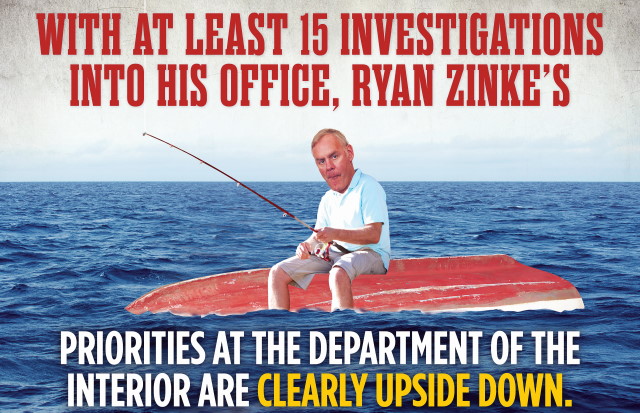
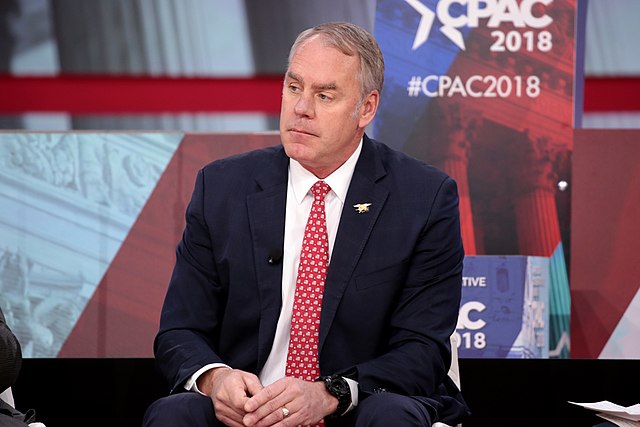
Rep Zinke on Arabella and Dark Money. Congressman Zinke Delivers Speech On The House Floor On The Weaponization Of The Federal Government. Rep. Ryan Zinke entered Hayden Ludwig's 5-part Arabella report "Arabella's Long War".

Video Transcript AI Summary
I rise in support of a select committee to investigate the weaponization of the federal government. The deep state, which coordinates with liberal activists, politicians, and media, is a covert weapon against the American people. Dark money groups funded by liberal billionaires and foreign investors aim to destroy the American West and control our land and lifestyle. I submit a series of investigative articles entitled "Arabella's Long War, Keep It in the Ground" for the congressional record. It's time to uncover corruption and shed light on the deep state. I urge my colleagues to support this critical oversight investigation. Thank you.
Full Transcript
Speaker 0: I yield 2 minutes to my very good friend, distinguished veteran, served in the United States in a variety of capacities in and out of uniform, mister Zinke of Montana. Speaker 1: Gentleman from Montana is recognized for 2 minutes. Mister speaker, I rise today in support of a select committee to investigate the weaponization of the federal government, mister something I have a lot of experience firsthand. I proudly served as the 52nd secretary of interior. And despite the deep stakes repeatedly Attempts to stop me, I stand before you as a duly elected member of the United States Congress and tell you that a deep state exists And it is perhaps the strongest covert weapon the left has against the American people. There is no doubt The federal government deep state coordinates with liberal activists and uses politicians and willing media to carry their water. The deep state runs secret messaging campaigns with one goal in mind, to increase its power to censor and persuade the American people. Dark money groups funded by liberal billionaires and foreign investors funnel money to shell organizations and repeatedly attempt To destroy the American West. In many cases, they wanna wipe out the American cowboy completely, remove public access to our lands, And turn Montana into a national park. They wanna control our land and our lifestyle. Mister speaker, I'd like to submit a 5 pay mister Five part series of investigative articles by the Capitol Research Center entitled, Arabella's Long War, Keep It in the Ground in the congressional record. We all knew politics was ugly, but we need to investigate and uncover corruption no matter where it lies. It's time to bring light to the shadows of the deep state and do our duty. Mister speaker, I hope my colleagues and I will join me in supporting this critical piece of oversight investigations. Thank you mister speaker. I yield back.

@intheMatrixxx - intheMatrixxx

Arabella’s Long War: “Keep It in the Ground” How leftist “dark money” activists brought down Trump’s secretary of the interior and paved the way for Biden’s radical environmentalists. https://capitalresearch.org/article/arabellas-long-war-part-1/
Arabella’s Long War: “Keep It in the Ground” America's Investigative Think Tank capitalresearch.org

@intheMatrixxx - intheMatrixxx

Arabella’s Long War: Web of “Pop-Up” Groups. How leftist “dark money” activists brought down Trump’s secretary of the interior and paved the way for Biden’s radical environmentalists. https://capitalresearch.org/article/arabellas-long-war-part-2/
Arabella’s Long War: Web of “Pop-Up” Groups America's Investigative Think Tank capitalresearch.org

@intheMatrixxx - intheMatrixxx

Arabella’s Long War: Anatomy of an Arabella Campaign How leftist “dark money” activists brought down Trump’s secretary of the interior and paved the way for Biden’s radical environmentalists. https://capitalresearch.org/article/arabellas-long-war-part-3/
Arabella’s Long War: Anatomy of an Arabella Campaign America's Investigative Think Tank capitalresearch.org

@intheMatrixxx - intheMatrixxx

Arabella’s Long War: Harried Until the End. How leftist “dark money” activists brought down Trump’s secretary of the interior and paved the way for Biden’s radical environmentalists. https://capitalresearch.org/article/arabellas-long-war-part-4/
Arabella’s Long War: Harried Until the End America's Investigative Think Tank capitalresearch.org

@intheMatrixxx - intheMatrixxx

"No Private Money Pouring into Local Elections." Here is how they do it: https://mgshow.link/arabella

Video Transcript AI Summary
To maintain our country's integrity, we must address certain issues. These include implementing universal voter ID and confirming citizenship. Additionally, we need to eliminate fake drop boxes and prevent private funding from influencing local elections. These measures are crucial to protect our nation from potential harm.
Full Transcript
Speaker 0: Don't have a country between borders and elections. We're not gonna have a country any longer. We're poisoning our country. And that means universal voter ID, citizenship confirmation, No more fake drop boxes and no private money pouring into local elections.
Arabella Advisors: The Third Pillar of Election Integrity Multi-Part Series – MG Show Arabella Advisors: The Third Pillar of Election Integrity Multi-Part Series mgshow.link

@intheMatrixxx - intheMatrixxx

The AP finally reports on Hansjorg Wyss. Swiss billionaire Hansjorg Wyss has funneled millions in foreign money through Eric Kessler's Arabella Advisor- dark money network to prop up Biden’s agenda and liberal candidates nationwide: https://apnews.com/article/dark-money-democrats-wyss-politics-elections-601d40cd01569190559d545418afe396
Group steers Swiss billionaire's money to liberal causes The Berger Action Fund is a nondescript name for a group with a rather specific purpose: steering the wealth of a Swiss billionaire, Hansjörg Wyss, into the world of American politics and policy. apnews.com

@intheMatrixxx - intheMatrixxx

Want to know about the 3rd pillar of election integrity? How deep is the rabbit hole? How do you like foreign billionaires changing your communities election laws? The Constitution is your weapon. Use it! @intheMatrixxx @ShadyGrooove @M_C0MS

Saved - June 20, 2023 at 10:32 PM
reSee.it AI Summary
Hunter Biden's ties to Burisma, a Ukrainian gas company, have raised questions about potential CIA involvement in Ukraine. Burisma had CIA conduits from both the DNC and GOP on its board, including Cofer Black, a former CIA director. Black advised Burisma on security and development goals that aligned with CIA strategic goals in the region. The Atlantic Council, which has former CIA chiefs on its board and is NED-funded, partnered with Burisma. The State Department also pushed for privatizing Ukrainian gas companies to weaken Russia and win the Donbas war.

@MikeBenzCyber - Mike Benz

Reminder: it’s quite conceivable Hunter Biden was a witting or unwitting intermediary for CIA activities in Ukraine to pry Ukraine’s gas market off of Russia. Conceivable CIA leaned on Justice Dept to avoid trial. Saying this bc of huge CIA-Burisma ties to censorship industry. https://t.co/jsUQ5XyqLG

@MikeBenzCyber - Mike Benz

Btw Hunter’s role on NDI chairman’s cmte, CIA backing of Donbas reconquest, NED cash flood, Biden’s CEE focus on Senate Foreign Relations Cmte, + MI6 figures all over LNG side, at what point do we just call the Burisma energy play a CIA-backed plan, & that’s why it’s untouchable. https://t.co/2JtLcEbxkA

@TruthNinja316 - Truth Ninja

So @StephenM has procured evidence that both Marie Yovanovitch and Eric Ciaramella were on emails chains regarding Burisma with Joe's office, and MAYBE what's underneath may have been why Ciaramella created the impeachment scam when Trump asked for an investigation.

@MikeBenzCyber - Mike Benz

Reminder: Hunter Biden joined the Burisma board in May 2014, just 1 month after the CIA-backed war in the Donbas broke out. Hunter Biden was on the Chairman’s Advisory Committee of NDI, a famous, WaPo-acknowledged multi-decade CIA-out.

@MikeBenzCyber - Mike Benz

On Burisma’s board w/ Hunter was Bush-era CIA director Cofer Black. Cofer Black won the CIA’s highest award for achievement. 30 years CIA + State Dept. Black advised Burisma on “security & development” corporate goals that happen to overlap w/ CIA strategic goals in the region.

@MikeBenzCyber - Mike Benz

Cofer Black has long been known as Mitt Romney’s “trusted envoy” to the world of CIA secrets & intrigue. Romney is a board member of IRI, the GOP side of the CIA cut-out NED, where NDI is the NED’s DNC wing. So Burisma’s board had CIA conduits from both DNC + GOP. Consensus.

@MikeBenzCyber - Mike Benz

Cofer Black joined Burisma in Feb 2017, 1 month after Burisma signed a partnership w/ the Atlantic Council to pump it up. Atlantic Council has 7 former CIA chiefs on its board. NED-funded. So a CIA-NATO consensus backed Burisma, then a CIA trusted envoy joined Hunter onboard.

@MikeBenzCyber - Mike Benz

In that 2014-2022 period in Ukraine, State Dept cut-outs were all pushing in clockwork unison for a plan that involved propping up (Burisma) & privatizing (Naftogaz) Ukrainian gas companies to US-UK stakeholders, thus weakening Gazprom, crippling Russia & winning the Donbas war.

Saved - February 10, 2024 at 9:12 PM
reSee.it AI Summary
In-Q-Tel, a not-for-profit 501c3, serves as the CIA's venture capital tool for technology development. It receives oversight from the CIA and other client agencies, who keep Congress informed. Many government agencies use similar "non-profit foundations" to receive donations from private individuals and industries. The CDC Foundation, for example, received $274.85 million in grants and donations in addition to its $10.65 billion budget. The Bill & Melinda Gates Foundation and other organizations made significant donations to the CDC Foundation, raising concerns about potential influence. Bloomberg Philanthropies, the James F. and Sarah T. Fries Foundation, Meta (formerly Facebook), and various state health departments also made substantial donations. These cozy relationships raise questions about the independence of regulatory agencies.

@JoshWalkos - Champagne Joshi

IN-Q-TEL serves as the CIA’s venture capital tool to promote technology development for the CIA, functioning in a way that a government agency might not be able to do. However did you know that In-Q-Tel is a not for profit 501c3? In its Form 990, In-Q-Tel makes it clear that it does not disclose its financials to the public, so where does the oversight of In-Q-Tel come from? The 990 states that: “IQT receives regular oversight from the CIA and other client agencies, who keep Congress informed of the company’s activities.” They oversee themselves, how convenient. They were early investors in Google, Facebook, Palantir, FireEye and Ginkgo Bioworks to name just a few. Many government agencies practice this, they are endowed by Congress to set up “non-profit foundations”so that they can receive “donations” from private individuals and industries. This is another way for these agencies who explicitly say they do not receive funds from the industries they regulate to do so while technically staying true to their mandates which make it illegal to do so. In other words Congress has allowed our regulatory agencies to be thoroughly compromised through “not for profit” vehicles. Let’s look at another foundation. The CDC Foundation https://iqt.org/how-we-work/ https://projects.propublica.org/nonprofits/organizations/522149962

How We Work - In-Q-Tel Who We Are Innovation on a Mission IQT has served one mission for more than 20 years: to deliver the […] iqt.org
In Q Tel Inc - Nonprofit Explorer - ProPublica Since 2013, the IRS has released data culled from millions of nonprofit tax filings. Use this database to find organizations and see details like their executive compensation, revenue and expenses, as well as download tax filings going back as far as 2001. projects.propublica.org

@JoshWalkos - Champagne Joshi

The CDC Foundation is another example of this sneaky “public private partnerships”. Overall for 2023 they received $274.85 Million in “grants and donations”. This is in addition to the $10.65 Billion budget they received for 2023. Why does an agency that is already extremely well funded need a foundation so it can get another $274.85 Million from the private sector? It reeks of impropriety. Case in point. According to the CDC Foundations 2023 Form 990 the Bill & Melinda Gates Foundation “donated” the following: -$2,791,302.00 for Pathogenic Paramyxovirus Replication in BSL-4 -$1,852,002.00 for Containment Biomarker Discovery through Serum Epitope Repertoire Analysis (SERA) -$1,277,615.00 Support for Inactivated Rotavirus Vaccine -$1,100,000.00 for Evaluation of Pneumococcal Conjugate Vaccine -$552,233.00 for Schedule Change Evaluating the Impact of the Pneumococcal Conjugate Vaccine Intro in Indonesia - $512,815.00 for Evaluating HPV Vaccine Induced Antibodies in Botswana -$363,000.00 for Tobacco Control Surveillance in Africa: close-out -$202,881.00 for Impact of CDC-Tuberculosis Preventative This adds up to a Grand Total of $8,651,838 in 2023 alone. CDC Foundation Financials: https://www.cdcfoundation.org/financials CDC 2023 Budget: https://www.cdc.gov/budget/documents/fy2023/FY-2023-CDC-congressional-justification.pdf


Financials | CDC Foundation Read our annual reports, 990 tax forms and financial statements to learn more about our work in the United States and around the world. cdcfoundation.org
Page Not Found | CDC Page Not Found | CDC cdc.gov

@JoshWalkos - Champagne Joshi

That’s not all though Bill Gates contributed though, his GAVI Alliance also donated the following in 2023: -Gavi Alliance $1,987,848.80 for Strategic Focus Area -Gavi Alliance $1,406,315.68 - TCA -Gavi Alliance $1,034,000.00 Foundational Support A Total of $4,428,164.48 This brings the Gates Affiliates overall donations for 2023 to $13,080,002.48 Gee I wonder if that buys any influence within the CDC?

@JoshWalkos - Champagne Joshi

The biggest overall “Donor” to the CDC Foundation in 2023 was Bloomberg Philanthropies: -Bloomberg Philanthropies $17,100,000.00 for Monitoring the Global & Domestic Tobacco Epidemic -Bloomberg Philanthropies $16,700,000.00 forData for Health, Phase 5 A total of $33,800,000! https://t.co/NYqTGhQgSz

@JoshWalkos - Champagne Joshi

The James F. and Sarah T. Fries Foundation a non-profit established in 1991 right after the CDC Foundation was green lit by Congress was another major “donor” with two donations coming in at $2,232,676.86 and $4,090,987.59. Meta formerly Facebook got in on the action with $5,031,500.00 for the “Emergency Response Fund”. The Moderna Charitable Foundation, Inc. (Moderna, Inc. (Moderna Therapeutics) came in with a $600,000.00 donation for “How Right Now (teachers) - Dissemination”. The Robert Wood Johnson Foundation $4,000,000.00 for “STRETCH 2.0” and $1,399,700.00 for “PLACES: Local Data for Better Health”. Then we have “donations” by various State Health Departments, all for “Workforce Service Supporting Jurisdictions” -Arizona Department of Health Services (State of Arizona) $411,371.70 -State of Connecticut Department of Public Health (State of Connecticut) $2,781,040.00 -Delaware Department of Health and Social Services (State of Delaware) $2,233,798.00 -Idaho Department of Health and Welfare (State of Idaho) $280,131.26 -Illinois Department of Public Health (State of Illinois) $12,095,201.15 -Indiana Department of Health (State of Indiana) $338,699.90 -Kansas Department of Health and Environment (The State of Kansas) $298,578.10 -Kentucky Department of Public Health (State of Kentucky) $4,339,594.00 -Michigan Department of Health and Human Services (State of Michigan) $982,527.36 -Minnesota Department of Health (State of Minnesota) $2,477,446.00 -Nebraska Department of Health and Human Services (State of Nebraska) $1,563,282.06 -Nevada Department of Health and Human Services, Division of Public and Behavioral Health (State of Nevada) $4,092,936.00 -Nevada Department of Health and Human Services, $2,339,200.00 -Division of Public and Behavioral Health (State of Nevada) Nevada Department of Health and Human Services, $506,123.00 -Division of Public and Behavioral Health (State of Nevada) Nevada Department of Health and Human Services, $462,163.00 -Division of Public and Behavioral Health (State of Nevada) Nevada Department of Health and Human Services, $435,693.00 -Division of Public and Behavioral Health (State of Nevada) Nevada Department of Health and Human Services, $328,331.83 -Division of Public and Behavioral Health (State of Nevada) Nevada Department of Health and Human Services, $242,882.00 -Division of Public and Behavioral Health (State of Nevada) Nevada Department of Health and Human Services, $232,938.00 -Nevada Department of Health and Human Services,Division of Public and Rehavioral Health (State of Nevada) $232,938.00 -New Jersey Department of Health (State of New Jersey) $10,658,181.43 -New Mexico Department of Health (State of New Mexico) New Mexico Department of Health (State of New Mexico) $3,982,436.00 -North Carolina Department of Health and Human Services (State of North Carolina) $3,000,000.00 -North Carolina Department of Health and Human Services (State of North Carolina) $8,500,000.00 -North Carolina Department of Health and Human Services (State of North Carolina) $5,814,687.00 These are some very cozy relationships wouldn’t you say? Further proof that our regulatory agencies have been captured and aren’t independent like they are supposed to be.

Saved - February 2, 2025 at 11:41 PM

@elonmusk - Elon Musk

USAID has been paying media organizations to publish their propaganda

@MikeBenzCyber - Mike Benz

Why was USAID actively instructing media organizations around the world to "AGREE POLICIES ON STRATEGIC SILENCE" to all collectively censor social media narratives? https://t.co/oYz0BKjG29

Saved - February 2, 2025 at 11:43 PM

@elonmusk - Elon Musk

USAID has been paying media organizations to publish their propaganda

@MikeBenzCyber - Mike Benz

Why was USAID actively instructing media organizations around the world to "AGREE POLICIES ON STRATEGIC SILENCE" to all collectively censor social media narratives? https://t.co/oYz0BKjG29

@merissahansen17 - Merissa Hansen

@elonmusk https://t.co/kXZhZmAWme

@merissahansen17 - Merissa Hansen

In 2022 USAID forecasted allocating $2.6 Billion to Gender Funding Plans. https://t.co/HDWZ3N0cpr

Saved - February 2, 2025 at 11:43 PM

@elonmusk - Elon Musk

USAID has been paying media organizations to publish their propaganda

@MikeBenzCyber - Mike Benz

Why was USAID actively instructing media organizations around the world to "AGREE POLICIES ON STRATEGIC SILENCE" to all collectively censor social media narratives? https://t.co/oYz0BKjG29

@merissahansen17 - Merissa Hansen

@elonmusk https://t.co/qXoeRWp5ah

@merissahansen17 - Merissa Hansen

Who remembers the Military Coup in Myanmar back in 2021? The regime change that occurred in 2015, which led to the coup seemed to be led by CIA cutouts and USAID. It would only be natural for USAID to redirect $42 million of funds to try and take back control of Myanmar. https://t.co/LfbM8aAB7s

Saved - February 3, 2025 at 4:35 PM
reSee.it AI Summary
I highlighted how AOC's political rise is linked to a USAID program she participated in during college. This program seems to have connections to influential figures in American politics and finance, many of whom are tied to USAID. I also noted that AOC's involvement in a USAID initiative coincided with significant political events in Niger, including a US-backed coup. Furthermore, a participant from her program later became a key figure at USAID, emphasizing the program's role in shaping careers in Washington.

@MikeBenzCyber - Mike Benz

Case in point: AOC, promoting USAID all over X today, actually came from a USAID program in college to jumpstart her miracle political career. https://t.co/EnzReCYHM8

@MikeBenzCyber - Mike Benz

What you will quickly find as you enter The Amazing USAID Vortex Of Despair is that virtually every powerful political & financial motor of American society that promotes & lobbies for USAID is either directly on USAID’s payroll, works at a place that is, or his/her donors do.

@MikeBenzCyber - Mike Benz

See more in this thread here:

@MikeBenzCyber - Mike Benz

AOC was spawned out of USAID too? In college in late 2009 she airdropped into Niger in the middle of a giant civil war just months before what appears to be a US-backed military coup in early 2010 launched against the sitting gov't the West had condemned & was cutting aid to 🧵 https://t.co/AqbNKZOA32

@MikeBenzCyber - Mike Benz

Her exact USAID program was credited with making people’s political careers in Washington after:

@MikeBenzCyber - Mike Benz

Someone from AOC's program became USAID's Niger Mission Director (Country Representative, USAID's version of Ambassador), noting it was "instrumental in shaping our careers." Now he's at USAID's Democracy Rights & Governance (DRG) office, which today is USAID's censorship center https://t.co/HI59rnuzGQ

Saved - February 8, 2025 at 8:19 PM

@MikeBenzCyber - Mike Benz

Now I want you to listen to me very closely: when the CEO of USAID’s Internews pressured advertisers to create exclusion lists to only fund approved news sources, she was carrying out USAID’s formal policy goal to have USAID partners do “advertiser outreach” to “redirect funding” https://t.co/vyWReP0epx

@MarioNawfal - Mario Nawfal

🚨EXPOSED: USAID FUNDED MEDIA CEO CAUGHT PUSHING CENSORSHIP A California filing links Jeanne Bourgault, CEO of government-funded Internews, to a 7th Street Arcata address—raising questions about her ties and influence. At the World Economic Forum 2024, Bourgault called for "exclusion lists" to pressure advertisers into funding only approved news sources—a move designed to silence dissent and control narratives. Internews received almost half a billion dollars from USAID, raising concerns about state-backed censorship disguised as "fighting disinformation." Who decides what news is “good”? The answer is clear now. Source: WikiLeaks

Saved - February 11, 2025 at 1:09 AM
reSee.it AI Summary
I recently listened to an eye-opening interview with Nigerian politician Adamu Garba II, who discussed the implications of USAID funding in Nigeria, which received $824 million in 2023. Initially seen as a vital support for healthcare and education, Garba revealed that documents from the U.S. Army suggest USAID functions as a tool for unconventional warfare, contributing to instability in recipient countries. He questions the true purpose of this funding, suggesting it may align Nigeria with U.S. interests rather than genuinely aid its development, as evidenced by the unrest in many top recipient nations.

@ImMeme0 - I Meme Therefore I Am 🇺🇸

🚨It’s a lengthy interview, but it might be one of the most EYE-OPENING and RED-PILLED interview you’ll ever hear. This is Adamu Garba II, a Nigerian politician, discussing the impact of USAID on his country and other top recipients of the agency’s funding. Nigeria is a significant recipient of U.S. foreign aid, receiving $1.02 billion in 2023, much of it through agencies like USAID. People like us and so many, um, ordinary Africans, especially Nigerians, would be thinking that USAID is actually one of the most important organizations that assist in supporting healthcare, education endowment, and several civil society organization activities in Nigeria. In just FY 2023, Nigeria received almost $824 million in USAID funding. But then again, when the exposé came out and so many documents came to light, especially one critical document from the United States Army, called “Special Army Operation Forces,” it was revealed that USAID is used as a weapon of unconventional warfare, conventional warfare, and irregular warfare. This means that even though USAID is supposed to serve humanitarian, educational, and civil society causes, it is actually an operation of the United States Army. What they use it for is to carry out psychological and informational operations, creating situations that lead to irregularity, destabilization, confusion, and various states of unrest in most of the places where they operate. If you look at the list of the top 10 countries where USAID operates the most—from Ukraine at the top down to South Sudan—you will see that almost all these countries are in disarray despite the large amounts of money committed to them. Then you begin to question the $824 million invested in Nigeria in 2023. Where does it go? Are we sure that this money is not being used for unconventional and irregular warfare, designed to align us with the diplomatic, intelligence, financial, law enforcement, and economic programs of the United States of America? Is this funding ensuring that we remain under their control? Does this confirm the suspicion that USAID is one of the organizations responsible for fostering insurgency around the world? Is this why many of the countries where it operates are plagued with crises? That’s why I refer you to a document from the U.S. Army Special Operation Forces, called ARSOF. The document is available online, and it details various operations conducted under the guise of helping citizens with education endowments and primary healthcare challenges. In reality, these operations serve as a means to extract data and push forward further destabilization agendas. This is not my claim—it is information expressed by the United States government itself. That’s why I told you—just look at the top 10 countries that receive the most grants from USAID. None of these countries is at peace. None of them. Somalia, Ethiopia, South Sudan, Syria, Afghanistan—these are the countries receiving funding, including Nigeria. Nigeria is listed as No. 7 among these countries.”

Video Transcript AI Summary
President Trump's withdrawal of US government personnel and funding impacts global aid, particularly affecting Nigeria's receipt of intervention funds and grants. Concerns exist regarding the true nature of USAID funding, with allegations it's used for unconventional warfare, destabilizing nations, and funding insurgency. Critics cite examples like Ukraine, highlighting the ongoing conflict despite substantial US aid. Conversely, others argue that USAID's interventions in areas like health and governance predate existing conflicts. The debate centers on whether USAID is a genuine aid provider or a tool for furthering US geopolitical interests. The crucial takeaway for Nigeria is the need for self-reliance, focusing on internal capacity building, localizing operations, and reducing dependence on foreign aid. This includes leveraging traditional practices and customizing education to better suit national needs.
Full Transcript
Speaker 0: The impacts of you said, defunding, if you will, and literally withdrawal of personnel by the United States government led by president Donald Trump, where he has made very sweeping statements and policies. As a matter of fact, a lot of the things they are doing what you said, some people are saying you said is dead, quote and unquote. How does that affect Africa, the rest of the world, and especially Nigeria? Because some of those intervention funds and grants, get to us one way or the other. I've been joined in the program, by the founder, global and global president, women environment program, doctor Priscilla Achakba. Joining us from Benue State, also mister, global affairs analyst and former presidential aspirant, mister Adamu Garuba, joins us from Abuja Cities. Mister Garuba, thank you for coming on the program. Speaker 1: Thank you for having me. Speaker 0: So, Trump is barely he was sworn in on January, in literal in just weeks. The whole world is vibrating, from trade war to the statesmen in Gaza. But what that concerns us is some of the interventions through you said, that he's now said, look, all of the spendings that are happening that are not necessary, they're not gonna continue. So as an overview, how does this affect us, for the people who who don't understand the implication of the the policy of an executive order of mister Trump? Speaker 1: Thank you once again for having me. You see, prior to the Dutch announcement, you know, when when Donald Trump was sworn in in office, he promised even during the campaign that there is something called department of government efficiency that is going to be run by Elon Mox. So that department open to be happen to be like an information exposeee department and then driving the great reset of The United States policy framework both internally and externally. Part of which is this you said, that, was, technically put out of out of out of use. And that, although, prior to this expose, people like us and so many, ordinary Africans, especially Nigerians, will be thinking that you said it's actually one of the the most important organization that assisted in supporting health care, education, endowment, and several civil society organization activities in Nigeria. Because in just, FY, February and and '23, Nigeria got almost $824,000,000 of you said funding. But then again, when the expose came out and so many documents came and, to to limelight, especially one of the critical document was the document released by the department of, army of the United States, which is called Special Army Operation Forces. I think the document is online. You can you can check it. I think f, three zero five, dot one thirty document that discussed how you said it's used as a weapon of unconventional warfare, conventional warfare, and also irregular warfare. So it means that even though this, you said, is supposed to serve some humanitarian, educational, and also held, civil society cases, it was actually an operation of the United State army. And what they use is to carry out so many sign ups and info ops operations to create a situation that will bring about irregularity, destabilization, confusion, and so many other state of trouble that we have today in in most of the places where they operate most. Because if you look at the list of the top 10 countries where you said operate most, from Ukraine, the top most, down to South Sudan, you will see that almost all these countries are in this array. Despite there's so much money that is committed to them. Ukraine alone in that twenty twenty twenty three has about $16,000,000,000, but all of us know the situation of Ukraine today. To that, population of Ukraine have left this country. What does 600,000 deaths? And that's it keep continuing. And when you take the history of Ukraine, you know, from the, coup d'etat that took place in 02/2014 that removed Victoria and a Kovich down to Zelensky era and all the current moment that is happening, the crisis between them and Russia and the death that is being recorded there, which is funded single handedly by the USD, by the by the USAID, then you will now begin to question the $824,000,000 that is invested in Nigeria in 2023, where does it go to? I will show that these monies that are invested are not going through this unconventional irregular warfare that they used to drive their agenda by making sure that they keep us in check, in alignment with the principles, diplomatic, intelligence, financial, law enforcement, and economic programs of United States Of America so that we are always in line with their own programs? Does that inform the reason why since you say it's also one of the organs that fund insurgency in the world, Does that inform the reason why most of the places where you Speaker 2: Mister Gamba, I'm I'm trying to understand you. Speaker 1: Crisis and the conflicts hardly sees like Voco Haram that is located in Miss miss remote part of Lake Chad. Speaker 2: Mister Gamba. Speaker 1: This kind of massive weapons. Speaker 2: Mister Garba, I'm I'm trying to understand you. I'm I'm really trying to understand you here. Are you saying that the you you said is a small screen for something entirely different for which what you're saying we cannot particularly provide proof. What we know you said to be is you know an interventionist ah agency providing ah intervention in the health sector and some of its programs are known. PEPFA, you know for instance, the the the programs are known. So, I don't know if you have proof to provide you know, to back up some of the things that you were saying but what we know you say to be, is entirely different. And that's why I want to refer to some of the data that we have that is, you know, showing what we stand to lose as a result of this withdrawal of funding. If we can just show that data on the screen, there, there's a huge threat to job losses, you know, more than 100 employees, for those who responded to the survey, they said ehm, employee losses would be between twenty and fifty people each, overall, there is a sense of insecurity going forward, and, and at this point, perhaps it's important to also mention that, you know, some of those benefiting would rather not speak because of their grant that is still hanging. And this is what I I want you to speak to actually. If there's a, a a huge threat of job losses, you know, and grants as a result of the, USAID funds freeze, when are the lessons really that Nigeria, you know, should be taking away from this? Speaker 1: You You see, just like you and like myself and so many other people, we used to think that you said it's actually in this country to provide this intervention that it mentioned. And that's why I referred to you a document that is relayed by the Department of United, of the army of the US, and, army special operation forces, they call it ARSOF. The document is online. You can check it. You will see the operations. You will see so many activities that is being carried out in the name from the front are trying to intervene to help the citizen get by, to help and in our educational endowment, health care challenges, especially on primary health care operations. But in essence, these operations are actually conducted to extract data so that further destabilization agenda can be pushed. This is not being spoken by me. This is expressed by the United State government themselves. Elon Mox, in fact, even mentioned that you said it's actually a criminal organization. And you have several of this mention from Marco Rubio who is The United States Secretary Of Defense, you know, to the spokesperson, of of the of of the United State government. All of them are mentioning this, including the vice president JD Vance. So when you look at these things, even president Trump himself. So why I'm not saying that it is an information that is online that they are criminalizing the operations of Usaid. So if the funders, the supporters, the encouragers, you know, the the the operational, country of Usaid is telling you that this is a criminal organization, then why should I actually accept it as something that is good? This is the thing. And the lesson is, of course, so many people are going to lose their job. You have so many grants that is going to go off. It is true. But what is the consequence? What is the impact, the damages that this kind of operation is causing to countries? That's why I told you, just look at the top 10. I put it even on my page. Just look at the top 10 that is released by Statista. The top 10 countries that get the most grant from you. He said, none of these countries is in peace. None of them. Somalia, you know, Ethiopia, South Sudan, Syria, Afghanistan. These are the countries that are getting money including Nigeria. Nigeria is listed as number seven in these countries. So if The US themselves are saying that this is criminal and what they do is perpetrate evil in countries by carrying out illegal or unconventional warfare as a program of war on terror. Alright. Then we should take you say Speaker 3: Alright, mister Garba. You know, Speaker 1: with a pinch of salt. Speaker 3: Mister Garba. Speaker 1: Be very careful. I think Nigeria Speaker 0: Alright. Speaker 1: Have a structure of vetting NGOs before they even start operating. Speaker 0: So let's establish some Speaker 3: things, mister Garba, and, be factual as much as possible. Yes. We understand that there's been a change of government in The US. So naturally, lots of and we understand how the politics, the electioneering process, how they went, how a lot of things were very divisive. So this is primarily US politics issue, right? And you'd understand that once a new government comes in, lots of things are said and you can't take some of those things to the bank because they are local politics for America. Secondly, a lot of these countries I will show you some of our countries, most effective to show you that map that you see. And this is done by accountability lab, so you get a sense. Nigeria is there. Ukraine, as you said, is there. But, you know, the color is not as deep as some other countries in North America or South America as you can see. What you will know mister Garaban, I'm sure you are aware. This is a lot of this conflict started before the intervention of USAID. And we'll go to the thematic areas that USAID has been involved in. Let's just move to that briefly. So you see some of the areas, that USAID has been provided intervention. So these conflicts happened and then USAID came in. Some would say you're trying to blame the USAID for a conflict that happened prior to their intervention. But look at the areas, that they've been involved in areas of governance, health, and I'm sure you are you are aware of that. Issues of anti corruption, climate, gender as well. So this is backed by data. Are you not really blaming the wrong person? Because some will say this country should look inwards and look for the cause of the challenges and not blame USAID. Nigeria being one of them. Speaker 1: You see, Kayode, this is because we are engineered, you know, with the colonial mindset. So, and that is why, we always keep thinking that this organization are actually coming, we intervene, and you have a case that, like you mentioned, is it a chicken or the egg? Which one come first? But then I can give you a reference of what happened in Ukraine. Ukraine prior to the color revolution was a very peaceful country in 2010 before started orange revolution. And from there, you have victory and a colleague come in. The country was very stable before Victoria Newland was appointed as under secretary of state of The United State which her principal jobs, these records are online is to see how they can undermine Ukraine because of the government support for the, for the neighboring country of Russia and Belarus. And that is how it was engineered. Zelensky came on board, and this was started. So why did USAID stop? Now look at the spent profile of USAID prior to that conflict, and look at the peace that is in Ukraine, then look at the amount of money that they injected, and then look at the conflict the way it is growing. So, people will always want to say that this has been helping us, maybe giving you health and challenges and supporting these things but then even when you open the books, you will see that these activities that they carry out, the supply chain of the material that they get all comes from The United States. Again, the information they get, the weapons that gets to the terrorist, everyone has question about it. And there are so many blames that have gone to the NGOs, most especially you said. And as I'm as I told you earlier, it is the same United States government. I'm not talking about any other body. You said is an agency of The United States. And it is the same United States government that is telling us that this is a criminal organization. So if we take it, you know mister Garab. Political issue, Mister Garaba. To ourselves because we are also suffering from the consequences of Speaker 0: Mister Garaba, just, just for one of time. Mister Garaba, just a moment. Just a moment for one of time so that we wrap up the conversation. I know there are so many things that have been said about you said, in terms of undermining sovereignities and all the things we've always spoken about and accusation back and forth between the democrat and the republican. But there's a question you're not answering. What we need to do differently at the end of the day, it's not just United States as giving aid. Aid comes to Africa from all over the place. But more aid then we get more impoverished and indebted at the end of the day. What should we do go forward? This is a checker. What signal should we get and do if you are to advise three things in one minute? Speaker 1: Yes. Number one, I like the stand of the government. Vice president works in Davos and then clearly stated the position of Nigerian government that we would rather live with our poverty and with our dignity in our hands than to go with our ball in our hands begging for air. So it is important for Nigeria to begin to discuss equal terms with nations than to just going for air. So it is very important for us to unlock our productivity, to come inward, to see what we can do to enable our growth, to develop local capacity, to look inward deeply so that we can create programs and policies and framework that is in tune with our local realities in Nigeria, not always to be dependent on what is coming from the outside. Even the medicine like the immunization that is going and also some support that is given to maternal health care that that that we we take from you said. None of these drugs came from Nigeria. So why don't we leverage on our local traditional operations to be able to support ourselves? Why don't we look at how we can customize our education system to be in tune with our reality as opposed to the colonially driven education system that gives us good English, but at the end of the day, highly gives us the job we need. You know, other than the service opportunity, we can hardly manufacture. Most countries that grow successfully like China, like India, you find out that they localize the operations. Alright. Mister Garba. That is what I think we need to do than to depend on aid. Speaker 0: I must thank you so much. It's an ongoing conversation. This is our time for Africa to look inward, time for Nigeria to look inward and begin to take care of our self by ourselves. Maybe we'll we'll pick that mantra as well. Making Nigeria great again if you will because America has decided to Yes. To look at themselves and sort out their internal issues even if it has to do removing monies across the across the world. Thank you, mister Garaba, Damu, global affairs analyst and former presidential aspirant. Thank you. Speaker 1: Thank you for having me. Speaker 0: We'll take a quick break. When we come back, how should women protect themselves before help comes? Our security expert will give us what we need. He'll tell us what to do. Join us.
Saved - February 9, 2025 at 2:01 AM
reSee.it AI Summary
I noticed several names receiving USAID funding through the Internews Agency, including Joseph T Flynn and Lara Logan. It struck me as odd. In response, someone pointed out that the funding process is more complex than it appears. They emphasized that USAID money doesn’t flow directly to these organizations but passes through multiple layers, making it difficult to trace accountability. They urged others to look into the details rather than jump to conclusions, highlighting the broader patterns of funding distribution and influence.

@DecentBackup - BackupDecentFiJC

Oh boy. Just LOOK at all these names getting USAID money through their Internews Agency. Joseph T Flynn Lara Logan Mary F O’Neill Michael T Flynn Paul S Hoffecker Tracy Diaz (Beanz) Weird.

@Spiltea - SpiltyTea

Internews Network leads to Flynn’s America Future. What is an army of digital soldiers?

@DecentBackup - BackupDecentFiJC

“…through their Internews Agency.” Try reading, dipshit.

@s3n10el - The Sen10eL

Wow! This sure is misleading AF…. you do realize people can just go to the website where all of this is listed and see exactly how money flows from the USAID to organizations, right? We can also see that the specific org both Lara and Flynn, and all these people actually, is the last one in a flow of money that leads through no less than 15 other orgs/agencies and even investment banks. At the top of each funding flow, it literally says: “Funding is fungible, meaning USAID dollars DO NOT DIRECTLY FLOW INTO these NGOs in a literal sense. Instead, the money moves through multiple layers, with various entities handling and redistributing it. Rather than focusing solely on individual grants or making definitive statements for how NGOs benefit from USAID, it’s more important recognize the broader pattern of funding distribution and influence, and getting rid of the layers of inaccountability.” By the time it got to Americas First, which is where your compensation numbers come from, it had flown through so many other groups/agencies/investment funds, the funding effectively has no connection to USAID, which is the exact point the website posting this info is making: far reaching Influence without any accountability. It says absolutely nothing about Americas First or any of the officers named in your little screen shot. Period. It took me less than 3 min to figure this out. Stop being lazy and Do better!! https://datarepublican.com/officers/?officer_kw=Lara+Logan

Government NGO Tracking Tracking where the money goes datarepublican.com
Saved - February 8, 2025 at 11:02 PM
reSee.it AI Summary
I pointed out the misleading aspects of a chart, particularly regarding Michael Flynn's connections to OSY and Q Cyber. I suggested we inquire with members of the Trilateral Commission for insights. I also highlighted Lenny Mendonca's ties to McKinsey & Co. and his role as an advisor to Gavin Newsom, questioning his connections to various companies. I speculated about the potential links between the Global Mangrove Alliance and several organizations, suggesting a web of connections that might be significant.

@DecentBackup - BackupDecentFiJC

What’s misleading about it? That it leaves off Michael Flynn being on the Board of OSY in fucking Luxembourg? Or being an owner of Q Cyber, a parent company of NSO Group? On that, we agree. https://t.co/gHfiTkzIGr

@PlatformCK - CK

@DecentBackup This is misleading, show the entire chart 👇 https://t.co/lxNSmNTPFl

@DecentBackup - BackupDecentFiJC

Speaking of Luxembourg, perhaps we should ask these gents from TRILATERAL COMMISSION. I bet they’d know something about it. ✅ELI LEENAARS ✅JOHN NEGROPONTE https://t.co/yVZuoan5PE

@DecentBackup - BackupDecentFiJC

Or THIS fa***t, one of the very top executives from MCKINSEY & CO., and the CHAIRMAN of NEW AMERICA. ✅LENNY MENDONCA AKA… Gavin Newsom’s $$$ guy. I wonder if he knows THESE Wix Directors: ✅ALLEN BLOCH GREYLOCK PARTNERS ISRAEL DOLPHIN SOFTWARE LTD K HEALTH INC ✅FRANCESCO DE MOJANA BUONO VENTURES HOLDING PERMIRA TELEFONICA GROUP

@DecentBackup - BackupDecentFiJC

MCKINSEY & CO: I’m not finished with you yet. 💥💥💥💥💥💥💥💥💥💥💥💥💥💥💥💥 👺LENNY T. MENDONCA MCKINSEY & CO., Senior Partner Emeritus MCKINSEY & CO., Founder, U.S. State & Local Public Sector Consulting Practice MCKINSEY GLOBAL INSTITUTE, Chairman MCKINSEY SHAREHOLDER COUNCIL, Member *NEW AMERICA, Chairman *CALIFORNIA GOVERNOR GAVIN NEWSOM, Chief Economic & Business Advisor *CALIFORNIA HIGH SPEED RAIL AUTHORITY, Chair *COMMON CAUSE, Vice Chairman *STANFORD GSB ADVISORY COUNCIL, Vice Chairman *THE GUARDIAN, Trustee *HAAS CENTER AT STANFORD, Trustee *COUNCIL ON FOREIGN RELATIONS *NOTE: Not only is/was LARRY MENDONCA GAVIN NEWSOM’S TOP BUSINESS/ECON ADVISOR, he was also VICE CHAIRMAN of COMMON CAUSE, the organization behind the 1ST TRUMP INDICTMENT. 👺MARTIN LAU MCKINSEY & CO., Management Consultant *TENCENT, President *TENCENT, Chief Strategy & Investment Officer *GOLDMAN SACHS ASIA, Executive Director of iBanking & Chief Operating Officer of Telecoms, Media and Technology Group *NOTE: TENCENT is one of the Top 10-15 LARGEST COMPANIES IN THE WORLD, and is one of the MOST KEY CHINESE COMPANIES responsible for ELECTION FRAUD and TELECOMMUNICATIONS COMPROMISE in the UNITED STATES (alongside Alibaba and Huawei). Like ALIBABA, it was originally FUNDED with capital from SOFTBANK, GOLDMAN SACHS and INVESTOR AB (Wallenbergs). 👺CYRUS TARAPOREVALA MCKINSEY & CO., Partner *STATE STREET GLOBAL ADVISORS, President & CEO *PFIZER, Board *SHELL PLC, Board *BRIDGEPOINT GROUP PLC, Board *FIDELITY *BNY MELLON *LEGG MASON *CITIGROUP *NOTE: Oh. It’s just the PRESIDENT & CEO of STATE STREET. Nbd. He’s a BOARD MEMBER at fucking PFIZER and SHELL too lmao. Idk, guys. I’m starting to think there might be something to this whole “MCKINSEY & CO.” GLOBAL JEWRY operatives thing. Or maybe I’m just Noticing™️ things that aren’t really there. (🤣🤣🤣🤣🤣)

@DecentBackup - BackupDecentFiJC

Or maybe we’ll ask MARK TLUSZCZ, the CHAIRMAN of WIX, which is FOUNDED by AVISHAI ABRAHAMI of IDF UNIT 8200. TLUSZCZ is also the CEO of MANGROVE CAPITAL PARTNERS… “Mangrove” sounds A LOT like the Mangrove consortium involved with WEATHER MOD TERRORISM, and partnered with THE NATURE CONSERVANCY, FATHOM and WORLD BANK.

@DecentBackup - BackupDecentFiJC

GLOBAL MANGROVE ALLIANCE *Boy, it’d be a shame if these were all connected.

@DecentBackup - BackupDecentFiJC

GLOBAL MANGROVE ALLIANCE “A CONSERVATION NETWORK comprised of 36 ‘LEFT-OF-CENTER’ organizations…” ✅THE NATURE CONSERVANCY AND… ✅CONSERVATION INTERNATIONAL ✅INTERNATIONAL UNION FOR THE CONSERVATION OF NATURE (IUCN) ✅OCEAN FOUNDATION ✅PEW CHARITABLE TRUSTS (Mossad/JDCA) ✅WORLD WILDLIFE FUND (WWF) ✅WORLD RESOURCES INSTITUTE *Hey, look! There’s WORLD BANK! *And FATHOM, which is a predictive “FLOOD DISASTER” analytics platform enabling its users to know the social, economic, human and agricultural impact on an area/community in the wake of FLOOD DISASTERS… even BEFORE THEY HAPPEN! Gee, I bet THAT tool’s pretty fucking convenient! *There’s the AUSTRALIAN MINISTRY OF FOREIGN AFFAIRS AND TRADE too, which is part of NEW AMERICA (IQT/CIA, McKinsey & Co., Mossad, etc.)! Imagine that, sports fans! And all of them partnered with THE NATURE CONSERVANCY too, no less. What are the chances?!?!🤦🏻‍♂️😒

Saved - February 10, 2025 at 6:19 PM
reSee.it AI Summary
I’ve been pondering the funding of NGOs and whether I misunderstood their relationship with government support. It seems NGOs are considered non-governmental because they operate independently, despite receiving government funds. However, I question the wisdom of allowing these organizations to function without oversight, especially since non-profits often struggle with governance. This lack of control raises concerns about potential fraud and waste, particularly in light of recent USAID grant issues. I believe it’s time to reevaluate how we invest taxpayer money in these entities.

@BillAckman - Bill Ackman

Did everyone else understand that Non Governmental Organizations, ie, NGOs, receive most if not all of their funding from the government, or was I just being ignorant? If NGOs receive most if not all of their funding from the government, what is the basis for calling them non-governmental? The answer according to Google is that an NGO is non-governmental because it operates without governmental control and oversight even though it receives government funding. Why is it beneficial for there to be non-profit organizations, that is NGOs, that receive all or substantially all of their funding from our government, but don’t have any government oversight or control? Non-profits are not known for having good governance. The combination of funding without oversight and control creates the opportunity for fraud, waste and abuse that we have seen in some of the USAID grants that have been made public in the last week or so. In the private markets, that is the real world, a majority shareholder would have control and oversight. Why do we allow our government to make majority investments without control and oversight? It makes no sense. It is time we scrutinize all NGOs and reconsider investing taxpayer money in private organizations without proper oversight and control consistent with what a majority investor would expect in a private corporation.

Saved - February 10, 2025 at 4:07 PM

@elonmusk - Elon Musk

It is obviously an oxymoron to be a government-funded, non-governmental organization. They are simply an extension of government, but with less accountability and a false veneer of independence.

@BillAckman - Bill Ackman

Did everyone else understand that Non Governmental Organizations, ie, NGOs, receive most if not all of their funding from the government, or was I just being ignorant? If NGOs receive most if not all of their funding from the government, what is the basis for calling them non-governmental? The answer according to Google is that an NGO is non-governmental because it operates without governmental control and oversight even though it receives government funding. Why is it beneficial for there to be non-profit organizations, that is NGOs, that receive all or substantially all of their funding from our government, but don’t have any government oversight or control? Non-profits are not known for having good governance. The combination of funding without oversight and control creates the opportunity for fraud, waste and abuse that we have seen in some of the USAID grants that have been made public in the last week or so. In the private markets, that is the real world, a majority shareholder would have control and oversight. Why do we allow our government to make majority investments without control and oversight? It makes no sense. It is time we scrutinize all NGOs and reconsider investing taxpayer money in private organizations without proper oversight and control consistent with what a majority investor would expect in a private corporation.

Saved - January 10, 2026 at 2:24 PM
reSee.it AI Summary
I review a thread arguing that powerful networks—Gannett, Knight Foundation, Aspen, SC Johnson—shape information, trust, and democracy from Racine to national policy. The posts trace ties among media, philanthropy, and government, claim planned, multi-generational influence, and warn that control of information equates to control of people.

@SuaSponte_1776 - 🇺🇸Quinn🇺🇸

If you control the information, you control the people. Knight Commission on Trust, Media and Democracy Racine, WI Meeting - [SC] Johnson Foundation, Wingspread Robin Vos- Speaker

Video Transcript AI Summary
Robin Vos discusses the role and perception of political leadership, media, and public discourse in Wisconsin and the broader United States. He begins with a personal anecdote about two Wisconsin speakers (himself and Paul Ryan) and how being “speaker” is understood differently in different places. He then gives his background: born and raised in Racine County, political activity since age 10, college involvement, county board, business owner, and a 2004 legislative career. He notes his early positioning as one of the far-right voices in the Wisconsin House, and how he changed as the world changed, including adopting Twitter in 2008 when the mainstream media resisted real-time updates from non-traditional outlets. Vos states two reasons for his presence: to address mainstream media and to reflect on how media coverage shaped politics. He acknowledges that he supported Marco Rubio, then Ted Cruz, and finally Donald Trump, arguing that a fair and unbiased media should be a base standard, though he asserts that most Americans do not believe it to be true. He cites campaign coverage as an example, noting that a loud, quotable candidate received over $6 billion in free coverage, while others received a fraction. He introduces a video compilation about Wisconsin media coverage, including stories on the John Doe investigation into Governor Scott Walker’s recall campaign, national media attention, leaked documents, and coverage of Tom Steyer’s activities to mobilize young voters against Walker and in support of Tammy Baldwin. He contrasts Steyer’s portrayal with the lack of coverage given to the Koch brothers’ similar activities, arguing that media treats some actors as altruistic and others as cynical, depending on ideology. Vos criticizes the media for leaking information from the John Doe process and for pre-judging outcomes, which he says violated state law and undermined fair reporting. He argues that the Guardian’s publication of John Doe documents amplified a narrative before opportunity for response, and that mainstream outlets often mischaracterize or selectively present information, shaping public opinion. He reflects on how people now distrust traditional outlets and turn to social media and “citizen journalism,” sometimes through partisan lenses. He recounts a personal experience with Barb Shear and Charlie Sykes to illustrate how people can misinterpret in-room dynamics when they only hear secondhand narratives. He laments that reporting often neglects open, two-sided discussion, which he sees as essential for accountability and good policy. Vos advocates three concrete reforms for journalists and policymakers: champion free speech (including reporting on campuses where opposing voices are barred or protests hinder dialogue), encourage thoughtful conversations that occur before breaking news, and push for fair reporting that presents both sides and allows nuanced debate. He argues that good journalism should enhance public understanding, not fragment it, and he emphasizes that relationships and pre-meeting negotiations in legislatures lead to better policy than sensational front-page stories. Toward the end, Vos highlights Wisconsin’s historical role in progressivism and conservatism, urging reporters and reformers to focus on open debate, bipartisanship, and policies that unify rather than divide. He warns that failing to do so will deepen national polarization and benefit only those who profit from division. He closes by reiterating the importance of free speech, thoughtful dialogue, and fair reporting as foundational to a healthy democracy.
Full Transcript
Speaker 0: Well, that's wonderful. Well, thank you for having me. So, I'll tell you, when I first became a speaker in 2014, I kind of thought it was a big deal, right? So, I was in Washington about a year later and Paul Ryan had just become Speaker of the House. So, we now have two speakers from Wisconsin. We're on the plane together coming back from Washington and as we're getting off the plane, somebody asked if they could have their picture taken with Paul Ryan and I said, I'd be happy to take the picture. The next person walked up, they did the same thing. I took a second picture. By the time the third person walked up, they said to me, it must be so cool to work for Paul Ryan. So, I have now realized that being speaker is something that in certain parts of the country are a big deal, like in Washington and in state capitals it is, but for the most part, people don't understand what we do. So, a little bit about who I am and why I'm here and then we can take questions afterward because I understand that this part is going to be recorded on your website and the conversation afterward can be a little bit more candid when we can talk about some of those topics. So, born and raised in Racine County. I got active in politics when I was 10. My sixth grade teacher actually is the one who recruited me to be involved in politics. She actually took me to events at a time when it was not odd for a female teacher to be picking up a boy student who was young and taking him to events. Active in college, got elected to the county board, bought a company, eventually became a legislator in 2004, and at the time, I was probably the farthest right member of the House of Office, because I had been involved for a long time, knew what my ideas were, and then as the world went on, you learn and you change and you adapt, and the world changed and adapt along with me. In 2007, the Democrats were advancing. In 2008, they took over our entire legislature and the governor. So, we went from being Republican controlled or divided government to all Democrat. I couldn't get my message out because, of course, the mainstream media at the time still dominated by kind of the traditional media, focused mostly on the people that they considered their likely allies, which were the Democrats, people where they had the same ideological view, the reporters had known these people for a while, so I became the first adopter in Wisconsin of something at the time that nobody knew called Twitter. I began to tweet out, during meetings and the legislative leadership at the time said, you may not do that. We cannot have people actually telling folks in real time what's going on that are not part of the traditional media. Of course, over time that has changed and now it's just a part of our daily lives and the reason that I am here is twofold. First of all, for the people who are here in the mainstream media, I wanna say thank you for electing president Trump. You are the reason that Donald Trump is in the White House. I am somebody who in the primary process actually supported Marco Rubio. I then supported Ted Cruz. I then finally supported Donald Trump. So he was not my first choice, but frankly, as a conservative, I am happy that he is there doing all of the things that I would want but we have to look at how it occurred, why it occurred, and should it have occurred because those are all I think decent points. So the very idea of having a fair and unbiased media is something that in my heart as a political activist, I think should be a base standard for every single person in the country to accept as fact. But I'm telling you that almost nobody in America believes that that's true. No matter how much people think to themselves that it is, they do not. We look at what happened over the course of the campaign. The loudest, easiest quotable person got over $6,000,000,000 worth of free coverage. The other dozen candidates who were articulate and thoughtful and also quotable got almost one sixth of that combined. That's not something that was decided by anybody other than folks who wanted ratings and wanted to be the most controversial so that they could get better ratings than somebody in their same competitive marketplace. So, this is not a new topic. In Wisconsin, we have similar problems where there is a clear bias in the media. So, I have my staff prepare a video that we'll just watch quickly and then we'll discuss it and talk about some of the topics for you. Speaker 1: Investigation surrounding governor Scott walker's campaign could be getting new life. Speaker 2: On again, off again John Doe investigation surrounding supporters of Governor Scott Walker's campaign may be in for another twist. New at six, WISN twelve News political reporter Kent Wayne Scott spoke with some former district attorneys who think another court decision could be just days away. Speaker 1: Plus, the John Doe investigation. Are his lawyers really trying to settle with prosecutors? Speaker 3: National media coverage of Wisconsin's John Doe investigation exploded today. That after prosecutors said governor Scott Walker was part of a criminal scheme. Speaker 4: Democratic leaders in Wisconsin want answers after leaked documents from the John Doe investigation into governor Scott Walker's recall campaign were actually published today. Speaker 5: A turn in a major court battle over money spent during recall elections in Wisconsin. A federal judge halted the John Doe investigation. Speaker 6: We spoke with the governor just a short time ago. This John Doe investigation has been a cloud hanging over the governor since before he was elected. Now that it's done, he says it's time to move on. But his critics say the governor still has some explaining to do. Speaker 1: I'm Tom Steyer. And like you, I'm a citizen who knows it's up to us to do something. Speaker 6: Currently known for his television ads calling for the impeachment of the president. But California hedge fund billionaire Tom Steyer has another target, Republican house speaker Paul Ryan of Janesville. Steyer's group, NextGen America, is making what it calls an historic push to mobilize young voters in Wisconsin for the midterm election. NextGen is hiring dozens of organizers and is trying to reach students on at least 35 campuses across the state. One of those organizing events happened Friday at UW Madison. NextGen America is spending $2,500,000 in Wisconsin try to defeat Ryan and Republican Governor Scott Walker and to reelect Democrat Tammy Baldwin. Speaker 1: We've spent a lot of money in Wisconsin. We're gonna spend more. So he's saying, you people in Wisconsin, you think you're voting? You think you have a fair election? You know? And but what do you what do you actually have? You have millions of dollars of Coke money in there buying these ads for Walker with an attempt to deceive you so that Walker can fire union workers so the Coke industries has to pay less for their workers. Speaker 7: We still see this on CNN. You know, they still love to put, you know, Bill Nye up against some, climate denying scientist, often not even a science, and pretend that these are sort of equal positions and it's complete nonsense. And so when I got to The Times, I started arguing with my editors and saying we have got to stop doing it. We weren't very bad about it compared to everybody else, I think, but we've got to stop doing this. And got there was resistance at first and then Hurricane Sandy hit, and we were all so emotionally gobsmacked. I mean, the editors at the New York Times lost their houses in Hurricane Sandy, and I remember sitting in, the office with, Jill Abramson and a whole bunch of editors, and having her say, this was the editor in chief of the paper at the time, having her say, I'm just tired of this nonsense. You know, why are we listening to these people when it so obviously is happening? And, you know, we got to the point where in a science piece at least, I was under no obligation to sort of call it climate deniers to sort of counter the real science. Speaker 0: So that's the Society of Professional Journalists Code of Ethics. Seems like something that everyone should agree with, but it's not what's happening today. So, in the examples that you just saw in Wisconsin, let me run through those quickly and explain why the media bias was so incredibly lopsided. The John Doe investigation. In Wisconsin, we have something called the John Doe law, so we don't create a star chamber. The idea is that if someone is brought under investigation that it is done in secret because for someone who is in the political world, having the fear, the very accusation tarnishes your reputation and actually many times means good people don't run for office. So, we have a John Doe process. Reporters and people who were in the John Doe process leaked information for political gain. That's the only reason it was done. Didn't help to convince the case. It's because they did not have convincing evidence but they were so certain they were right. They leaked the information breaking state law. Then, a national newspaper, international newspaper called The Guardian got documents from the John Doe investigation and released those on the internet. So, exactly what we had said could happen and the reason that we have the John Doe law proved itself correct with an accomplished media who rather than looking and saying, wow, these people are breaking the law. They convicted governor Walker in the court of public opinion without even giving the opportunity for him to respond because under the John Doe law, he could not respond where he would have been breaking the law. So, it's a clear example where the journalist decided that the story and the idea behind it were more important than following the law or listening to both sides to give an opportunity for a fair and balanced report. The twenty minutes that they gave to Tom Steyer in Wisconsin to talk about his efforts to overturn elections in Wisconsin were done in a way that made him appear to be altruistic. Altruistic. And I'll give him the benefit of the doubt that he probably is. But why in the world in the same story or at some point would they have not had the same conversation about the Koch brothers who were doing the exact same thing on the other side of the political spectrum? Because the media believes that one is altruistic and the other is cynicistic. We now look at AFP, an organization that we know is founded by the Koch Brothers that goes out and recruits people on college campuses that has an opportunity to actually involve young people in the process. Exactly what they're talking about there but I searched all through the archives and I could not find a single story in Wisconsin about AFP's efforts in the exact same mod or motive motive presentation that was done the one time Tom Steyer came to town and went to a college campus. Never happened. You know, when you think about the ethics of journalism, I have in my rotary club, that's $10, but, you know, whatever it is. In in my world, I want a fair and open and honest media because it keeps me as an elected official accountable. But let me tell you why people are cynical. Because it isn't a fair and open and honest medium any longer. It's why unfortunately, I think people have gone to this idea of citizen journalism, okay? And let me say why I say unfortunately. My friend Charlie is here. Okay? And he has been a huge disseminator of information. Okay? Most of the time, I have agreed with him. So, I think it's good information. But that's the partisan lens we see everything through. So, the woman I talked about earlier who got me involved in politics, her name is Barb Shear. She held the Bible at my swearing in when I became the speaker. She's a wonderful, hugely generous woman but we were having a discussion about a political topic at the time in the state. What it was doesn't really matter. Charlie and I were on different sides and because she listened to Charlie Sykes every day, when I called her back, I actually explained, well, this is what's really going on, Barb. Charlie just doesn't know everything that's happening because he's not in the room And Barb said to me, you know, Robin, I'm not so sure. I I think Charlie could be right. And I said, no, Barb, I'm there. I am in the room. I am negotiating with the governor. She said, well, well, that's not that what Charlie said. And that is the world and the influence that people have on the process. Now, in the end. Yeah. In the end, I know I was right. But it changed the entire view that I have of interactions that my constituents have with individuals who are elected because somebody that I deeply knew that was probably one of the closest people to me that should have trusted me inherently because of our relationship, has never really met Charlie, never really done anything more than listen to his radio program every day. It's the same thing for somebody who reads the newspaper, right? They read the newspaper every day. It must be right. Even if this person who I am standing next to, who is in the room, tells me differently. Which is why I think that the media has squandered away their opportunity to be that independent, fact checking organization that people should believe in and give their trust and confidence to like Barb, my sixth grade teacher did. So, now, you really think about where we are today. We all know the definition of news is changing. You know, I don't use fake news but I certainly think that there is something to be said for that very concept. The idea that one person's news is somebody else's opinion, that somebody else's opinion can actually be fact or not, that all of it is now called into question. In our political process, you are supposed to be influenced by your constituents. That is the number one thing that you want to listen to. Now, Facebook, to their credibility, has now created a little icon where you can know when somebody is commenting on one of your posts if they're a constituent or not. And thank goodness they did that because we don't appreciate that 100 activists in any state who do nothing more than sit in their basement watching one-sided television or one-sided radio have a huge impact on the process and that's bad for democracy because my colleagues have the same individuals posting on their comments and they believe that they represent the majority and let me tell you, the vast majority of time they do not. But they portray themselves as such. So, because the media has now become so unbelievable in many people's eyes, they turn to individuals on Facebook to better represent where the public is than mainstream newspapers, mainstream television, mainstream radio. You've done it to yourself. We know that today, good news really isn't news anymore. In the video, you saw that most of the time, 90% of the time in our legislature, the bills that we passed have more than Republican support. Even though we are in a dominating position in each of our chambers and with Governor Walker. 90%. One story, one time, talked about a national study that was done talking about something that I initiated where we do a memorandum of understanding which guarantees open debate, it guarantees rights to the minority, it was hailed as groundbreaking and the only newspaper that reported on it was actually the Capital Times, which is a far left newspaper and basically criticized the Democrats for agreeing to the deal. That's bad for all of us. You should want people to be open minded and to listen. We know now that in-depth reporting is no longer necessary. In that presentation at the end, you saw the UW Madison journalism expert. When I decided to form my communications team when I became speaker, the normal way that politicians decide who is gonna work with you in the media is they take one of the staffers who was a volunteer, who has developed a relationship with the media, and that person then becomes the press secretary. Do you have any idea how much background they have in media? Zero. Zero. So, what I did is I did something different. I went to the local news anchor in Madison and said, I would like you to come and be my communications person. She knew nothing. I shouldn't. I don't want to insult her. She did not have the political experience. She knew a lot about politics but she hadn't worked in politics. So, she became my communications director. The next person that I hired was an Emmy award winning journalist and she's my videographer and I hired a gentleman who actually did social media as a profession. None of them knew politics but they all knew what they were doing. That is incredibly rare in politics and unfortunately, it's incredibly rare in journalism that the people who are assigned to cover politics have a basic understanding of how the political system works because what happens in the media is the exact opposite of what happens or the the same but in the different prism of what happens in politics. They take somebody. You might wanted to do sports but that position's already filled. So, you're gonna do local government. Now, sometimes they do a great job but that's not their interest area. They take the easy route most often, which unfortunately is to find one side and if that works, stick with it. The journalism ethics. My three staffers went to a seminar on ethics and journalism and UW Madison, one of the best programs in the country, is now saying that they are no longer advising folks to hear from both sides. There are some that they view to be not credible and if the source or the idea, the idea is not credible, you don't have to cover it anymore. Now, I actually believe that climate change is happening. Why is it happening? I don't know. Is it man made? Is it, you know, change in the cycles? I don't know. I'm not a scientist but I certainly think that people who have a different opinion have the right to be represented in conversations about why is climate change happening. I think on every topic, the public wants to hear from both sides and they should discern the information. Now, I know people on each of the coast believe that those of us who live in the middle of the country aren't as smart. We don't have the world view. We don't have an understanding. In fact, there was a quote, that's been tweeted all over Wisconsin from a woman at NPR who was standing in Washington DC, and the quote was, Overheard in DC, quote, I could never live in a rural area, some random ass city like Wisconsin, unquote. Well, first of all, Wisconsin's out of city. Important to know. But this is the attitude that a lot of us feel that folks who are putting the news together, making decisions about what we see and hear, treat us like. So, you become naturally skeptical of people who look down in your way of life, who don't understand what life you are living, and the challenges that you face. Now, let's also say that there is no doubt in my mind, and partly it is the capitalist system where the traditional media is hemorrhaging dollars, to find a way to sensationalize everything. Is anybody here from Gannett? Okay. So, the Journal Sentinel is our local newspaper. It had been premier. I think it was a wonderful newspaper the vast majority of the time and you buying it didn't change that. But what it has changed is the fact that they are no longer focused on ensuring that both sides are heard. They are focused on getting something that can be on the front page that convinces people to click through it to generate profit. I understand that. So, just this last week, we had a story that clearly shows sensationalism versus what you want out of government, okay? I am in line to become president of the National Conference of State Legislators. First person from Wisconsin who will ever do that. I am chair of the National Speakers Conference and I am on the board vice president of the State Legislative Leaders foundation. All three of those bipartisan Democrats and Republicans working together to try to find public policy answers that all of us could buy into so it's not partisan in one state and you know, red here and blue there. The Journal Sentinel decided that they were going to report that Wisconsin lawmakers got a $164.00 in travel and perks from outside groups. Now, when you read that headline and you are Joe Smoke citizen, that sounds like, wow, these legislators are getting some kind of undeserved perk that is influencing what they are going to do. 21 paragraphs down in the story after they sensationalized it about how awful it was, they said almost half of the total payments for legislators came from three organizations, the non partisan three groups I talked about. Craig Hoffman, who helped draft a federal law a decade ago that restricted when outsiders could cover travel expenses for members of congress, said he was not concerned about travel paid for by non partisan organizations like the National Conference of State Legislatures. 21 paragraphs down. After the vast majority of people stopped reading the story and had already made the idea in their mind that there is wrong with things happening in Wisconsin. Who did that serve? What entity did it help? It only helps to push people into their partisan corners and not wanna have them get together to actually discuss good, positive, non partisan things that we need in America. So, is media bias real? Yes, it is real. Another example. Now, we know Dane County is where Madison, Wisconsin is. It is 70% democratic. So, it is a wonderful place for me to visit and I wouldn't wanna live there. When I walk down the street, it is very common for people to say negative things, right? They'll call me a Coke sucker. You know, they'll call me all kinds of different names even when I'm at the shopping mall. It is the world that we have now become. It is not necessarily fun. The state opinion page is a guy named Scott Milford and he put in that one of my colleagues, Senator Fitzgerald, who was on the Trump train, he was a Trump person from the beginning, but in his district was concerned about human trafficking and the fact that there were strip clubs in his district that actually were becoming hosts of human trafficking and here's the quote that the editor of the newspaper put in. Senator Scott Fitzgerald, a front seat passenger in the Trump train, wants to shut down strip clubs. Talk about ironic. What did that have to do with the fact that because Donald Trump was somebody he supported for president, he now can't be concerned about human trafficking? And these aren't a left wing blogger. These are mainstream thought leaders in our state taking positions that make those of us who are in public service ask ourselves, is there really a fair and unbiased media? You know, Frank Lunce's quote, actually is one that I often think of. It's not what you say, it's what they hear. And that is something that every politician has to always think about. It's not what you say, it's what they hear. Now, many of you have probably already heard of the book Bowling Alone. It is something that I read and I strongly believe is true. When I got elected, as I said, I was kind of far right of the spectrum but a woman who was incredibly intelligent sat me next to a guy named Mark Pokan, okay? Now, Mark Pokan is as liberal, he represents Downtown Madison. His district actually had more votes for Ralph Nader in 2004 than George Bush. So, far left. But we sat next to each other and we became friends. He is actually now a member of congress and he and I have become good friends. His dog's name is Che. My dog's name is Reagan. He's gay. I'm not. You know, so everything that you could think of is who the two of us are. But we still can be friends because we have a mutual respect for each other that was fostered before the media changed with the social media aspect. You know, he came to my wedding. I I can just tell you he is a good, decent, honorable person who's wrong in almost everything but none of the first part matters and I think that's the world that we are living in now where people put the second first. He is not a good, decent person and he's wrong on all the issues as opposed to giving people that basic understanding of assumption that they are doing it out of things they believe in, not out of hatred, not out of anything other than the fact that you just have a simple disagreement. So, in bowling alone, we know that people are self segregating. We know that folks don't necessarily live with, work with, talk to people who are on the other side of the aisle. We know that individuals in the media live in the same bubbles. Let's just accept it. Your friends, the people that you live next to in a big city. Chances are are incredibly liberal and that's not inherently wrong. There's nothing wrong with it but just like I seek out and I try very hard to listen to both sides because my job is to represent everyone. I think somehow the media has forgotten that your job is also to seek out both sides and listen to everyone and not pass judgment on whether or not someone is credible, like the professor did, whether or not somebody has the right to be heard as we go forward. So, I asked myself when I thought about this over the course of being asked, I don't want to just come here and be a critic. I do that all the time where almost everybody who comes to testify tells me what's wrong with the idea. Very rarely do they say, here's how you make it better. So, let me give you some ideas of what things I hope you might consider as you make your recommendations. Challenge individuals to be champions of free speech. I don't know why that should be such a hard concept. You know, Pulitzer actually said, our republic and its press will rise or fall together. An able, disinterested, public spirited press with trained intelligence to know right and courage to do it can preserve that public virtue without which popular government is a sham and a mockery. Totally true. So, why on college campuses are you not reporting on the fact that they're not allowing both sides of the argument to be heard? That they pick one side they agree with and they protest to not even allow them to speak the other side. Shouldn't that be something that we as Americans unanimously agree with? The idea that everyone has the right to be presented and then we have the right to dissect but not dissect it first because no one has the ability to actually articulate a side that we would agree with. Number one. Number two, we need to make sure that we do more to bring good public policy individuals together to talk about solutions. It very rarely happens. I think most people have this belief that inside the chamber of whatever legislature, the congress, you have these debates and these discussions and smart ideas come out. That's not what happens. It happens in the meetings beforehand and where relationships are built. The fact that even during all the protests and everything that happened in Wisconsin, Mark and I kind of acted as the intermediaries because we had a personal relationship to not let things get out of hand. It's why we passed this brand new first in the country agreement where the minority and the majority sat and figured out how are we gonna make our chamber better. Those are things we want but they're not things that are very sexy and they're certainly not things that interest groups on either side want either because they want us driven apart because it serves their own political interests. Journalists need to do a better job of fair reporting. So, number one, we need to champion free speech. Number two, you need to encourage individuals to actually have thoughtful conversations. And number three, we need to do more to have fair reporting. Now, I totally understand and support the idea that you want to know everything that's going on because the public has a right to know. I totally agree with that. But as every discussion happens, sometimes you have to allow individuals to have a conversation before they get to the public so that they can actually articulate why things are happening, why individuals can have an agreement, where we can find those points of interest as opposed to only having points of contention. In a heightened media world, people are trying to always break the story and I understand that but by breaking the story, in many ways nowadays, they have broken the system. Reporters in the capital before knew how the process worked and they allowed it to work and then they reported on it as it went. Now, as soon as two people walk into a room together, they are beginning to report on it, which means you instantly can't take the time to think and it has hurt our political process. So, as much as you are able, in fair reporting, allow people to find their positions before you instantly assume what they are or assuage some concern that you think is happening but have no idea if it's occurring. So, they're not difficult but they're meaningful and real ideas that I hope you would consider as we go forward. Wisconsin was the birthplace of progressivism. In 1911, we invented the income tax. We invented an awful lot of things that had made where society is today. In 2010, we kinda did the same thing on the conservative movement which swept across a lot of the country. Rolled back public sector union rights, balanced our budget, did a whole lot of other things. So, you can have a state that has a dichotomy of opinion but is respectful in the way that they do it. I hope that as you issue your report and you think about ways to make our society better, you focus on challenging those basic tenants of where we are because you're our hope. You're our future and I say that as an elected official. You can keep it going like it is and it will drive America further and further apart and that serves no one's interest other than people who profit from the system. So thank you very much.
Video Transcript AI Summary
Speaker 0 argues that it is all election interference, claiming they love to talk about disinformation and democracy, and that it's all disinformation. They say those people are great at cheating on elections and great at misinformation, disinformation. They claim these people are weaponizing the DOJ and the FBI, our election systems, and attacking free speech, and they're going into the states.
Full Transcript
Speaker 0: It's all election interference. They love to talk about disinformation and democracy. It's all disinformation. They're great at cheating on elections, and they're great at misinformation, disinformation. Similar, not the same thing, but both. Because they're the ones who are weaponizing the DOJ and the FBI, our election systems, and attacking free speech, and they're also going into the states.

@SuaSponte_1776 - 🇺🇸Quinn🇺🇸

If you control the information, you control the population: Yes. Gannett is a very important connection to Racine (Rotary, Election interference, Aspen Inst., Knight Foundation, Freemasons, Shriners etc) >Frank Gannett > Cornell University Alum > Trustee of Cornell University > Cornellian Council > Founder of Gannett Company > 1935 established the Frank E. Gannett Newspaper Foundation > controlling owner of Gannett Co., Inc. when he died. >Gannett Corporation > 92 daily newspapers including USA Today > John Jeffry Louis > Appointed to Gannett Board Served as a director of Legacy Gannett’s former parent from 2006 to 2019 Chairman of the Board of Legacy Gannett from June 2015 through November 2019 Co-Founder of Parson Capital Corporation Director of The Olayan Group 📌Director of S.C. Johnson and Son, Inc ___ Members of the Knight Commission on Trust, Media and Democracy (chairs and commissioners include(d) executives from SC Johnson, Gannett, Aspen, PBS Frontlines, Facebook, Cornell, and so many more) here is an example from 2023 https://knightfoundation.org/knight-commission-on-trust-media-and-democracy/

Video Transcript AI Summary
The speaker alleges that it is “all election interference” and that they are “great at cheating on elections, and they're great at misinformation, disinformation” (described as similar, but not the same). The speaker further claims that “they're weaponizing the DOJ and the FBI, our election systems, and attacking free speech, and they're also going into the states.”
Full Transcript
Speaker 0: It's all election interference. They love to talk about disinformation and democracy. It's all disinformation. They're great at cheating on elections, and they're great at misinformation, disinformation. Similar, not the same thing, but both. Because they're the ones who are weaponizing the DOJ and the FBI, our election systems, and attacking free speech, and they're also going into the states.
Knight Commission on Trust, Media and Democracy In 2017, the Aspen Institute Communications and Society Program, in partnership with the John S. and James L. Knight Foundation, established the Knight Commission on Trust, Media and Democracy. Currently, trust in the major institutions of American democracy has fallen to troubling lows amid a rapidly changing information ecosystem. Without trust, democracy cannot function. It… knightfoundation.org

@SuaSponte_1776 - 🇺🇸Quinn🇺🇸

Aspen Institute Knight Commission – Crisis in Democracy: Renewing TRUST in America (😮‍💨) Streamed live on Feb 5, ✏️2019 {Define Doublespeak} Rebuild TRUST in de-MOCK-racy and Media? Ability to find the third way? They say there is a threat to democracy, but then cry for the Republic if we can keep it 😡 "We need a media that will inform our citizens to make choices, selections that will provide and ensure facts." If you control the information, you control the people. Mapping out the plan.

Video Transcript AI Summary
The event centers on the release and discussion of a comprehensive report from the Knight Commission on the Information, Media, and Democracy, produced with the Aspen Institute and the Knight Foundation. Speakers acknowledge the hard work of commissioners, staff, and partners, and emphasize that the report’s themes—transparency, innovation, engagement, and a commitment to rebuilding trust—cut across multiple programs within the institute and beyond. The overarching aim is to address a crisis of trust in democracy and in the media, a problem described as global and among the most important for the health of democracies. Jamie Woodson and Tony Marx, co-chairs, open by recognizing that polarization and partisanship are at historic highs and trust in core institutions is at an all-time low. They stress the necessity of cross-sector leadership and action to rebuild trust, noting that the group learned from a wide array of input from across the country and from experts who testified. They underscore that the commission’s work models the tough, constructive conversations needed to move forward and that the report’s unanimous conclusions offer guidance for rebuilding trust in democracy and in the media. They highlight the Commission’s diverse makeup and its approach of tackling difficult conversations to reach meaningful, forward-looking recommendations. Tony Marx then adds a reflective point about Ben Franklin’s republic—“a republic if you can keep it”—and frames the current moment as one where the country faces uncertainty about maintaining democracy. He argues that trusted media and trustworthy technology are essential and notes the need for transparency across media and technology, as well as a local, representative media that serves as a check on power. He emphasizes that the work hinges on the public’s ability to talk, learn, and engage across differences, and that the report constitutes the beginning of a long effort to strengthen democracy. He closes with a nod to a Ben Franklin portrait and a pledge to keep moving forward. Alberto Ibargüen (Knight Foundation) speaks to the Commission’s formation, the collaboration with Aspen, and the renewal of a civic project built around shared democratic values. He notes the importance of representatives from Miami, Eduardo Padrón, among the commissioners and recognizes the leadership of Aspen and Knight’s teams, including Christine Gloria. He situates the Commission’s work within a broader historical arc about how the Internet and technology transformed information, comparing the current moment to Gutenberg’s revolution and the subsequent challenges of distinguishing truth from fiction. He observes that the report builds a foundation for civil discourse and neighbor-to-neighbor conversations across different perspectives. Charlie Firestone and other panelists present the structure and core themes of the report. The report divides into three integrated areas—media, technology, and citizenship—each with its own leadership, and all anchored in shared values: responsibility, free expression, transparency, literacy, innovation, and diversity. They acknowledge that while consensus was reached on many points, some specifics (like platform regulation) were not fully agreed upon, reflecting the complexity of addressing today’s realities. The report is designed as a compass for policymakers, industry, and citizens to navigate the trust crisis, rather than a prescriptive map of all possible reforms. A central, recurring theme is radical transparency. The media subcommittee, chaired by Rainey Aronson and Mizel Stewart, explains that transparency should be practical and cultural: journalists must reveal sources, label opinions clearly, and open up decision-making processes and raw materials (rushes, notebooks) to the public. The goal is to build trust by peeling back the curtain and showing work, while recognizing that traditional journalist-source protections remain necessary but should adapt to new expectations of openness. The media recommendations stress addressing perceptions of bias and the need to restore credibility in journalism. Meredith S. and Charlie Sykes acknowledge the genuine bias that exists, the threat of demonization of the press, and the importance of introspection within newsrooms. They argue that trust is the number-one asset, and transparency about methods, sourcing, funding, and editorial processes can improve credibility. A robust local press is identified as essential for trust in communities, with particular focus on news deserts and the need for a hybrid funding model that includes philanthropy to support new local outlets and diverse newsroom representation reflecting the communities served. Innovation in how journalism engages with audiences is highlighted. The report urges news organizations to reclaim audience relationships, invest in transparent practices about how stories are produced, updated, and corrected, and to develop new ways of involving audiences to co-create and verify information. This includes discussing the role of platforms in guiding discovery and the possibility of restoring accountability by owning more of the audience relationship and data. Technology and governance discussions center on information fiduciaries and radical transparency applied to platforms. Claire Wardle, Jo Anne Lipman, and Nahla O’Connor outline the need for corporate social responsibility from platforms, transparency about data usage, provenance of content, funding for political advertising, and algorithmic transparency. They advocate for a “glass box” approach to algorithms so users understand how personalization works and can act to counter filter bubbles. They also discuss data portability as a mechanism to empower individuals and to foster competition and consumer choice. The panel acknowledges the complexity of balancing innovation with responsibility and privacy, and calls for experiments and evaluation backed by platform data to measure progress. Citizenship recommendations center on reviving civic education and digital literacy, expanding access to substantive constitutional knowledge, and renewing civic spaces for face-to-face dialogue. Jeff Rosen emphasizes standards, substantive curricula, and funding for civics education, calling for philanthropists to support the development and distribution of high-quality, bipartisan civics content—such as online curricula that teach the First Amendment through interactive materials and cross-partisan exchanges. Charlie Sykes advocates for a national service concept as a way to restore shared purpose and civic responsibility, while stressing that digital literacy alone cannot replace substantive constitutional knowledge. The group urges lifelong learning about government and democracy, with curricula designed for diverse audiences beyond just students. The session closes with affirmations that the report’s recommendations are starting points for ongoing dialogue and action. The organizers encourage engagement via social media and reiterate the belief that America’s citizens are capable of rebuilding trust by moving beyond fear and anger, changing tools and approaches, and investing in education, transparency, and civic life. A questions-and-answer segment touches on scenarios for disasters, polarization, and the need to involve a broader set of voices beyond national media platforms, underscoring the ongoing, iterative nature of this work.
Full Transcript
Speaker 0: Institutional contribution made by Alberto E. Barguen, the contributions made by the commissioners. And I wanna give special thanks to the amazing and and dedicated staff of the Communications and Society program who worked extraordinarily hard to put this together. I I am only gonna take another few seconds because we're all so excited to hear, from the commissioners and discuss these recommendations. The one thing that I that struck me though, looking as I as when I first saw them and as they were being developed over a few, weeks, or or maybe months getting to this point, is how some of these recommendations and themes of transparency and innovation, and engagement, and commitment run through so many other programs of the institute as well. Even, for example, the commitment one with a suggestion of a commitment to a year of voluntary national civilian service, which is something that the commission championed in a project here called the Franklin Project, which has gone on to great successes, the Servicier Alliance. But the fact is that it's gonna take a lot of work from a lot of institutions as well as as government government and the private sector and the nonprofit sector to move along these critical issues, which are probably among, if not the most important issues facing democracy, not just in this country around the world. And I'm very pleased that there are so many other parts of the institute who have overlapping interests with these goals and recommendations. So I wanna thank again all of you for being here. Special thanks to all of the people who did the amazing work that led to where we are and let the program begin. Thank you. Speaker 1: Good morning. Speaker 2: Good morning. Good morning. Good morning. Speaker 1: I'm Jamie Woodson, and I've had the privilege to co chair with my colleague Tony, this incredible group of leaders over the last twelve plus months. I want to thank first our partners with the Aspen Institute, Charlie Firestone and his team, the Knight Foundation, Alberto, Jennifer, and the teams, you all have brought together a pretty incredible group of people, and we deeply appreciate the opportunity that you have given us. It has been professionally meaningful, but it's also been personally meaningful as citizens. You asked us to dig into one of the greatest issues of our time and the crisis in our American democracy, and that's the crisis of trust. We all know and recognize that polarization and partisanship is at an all time high and trust in our bedrock institutions of our republic are at an all time low. And so for us, this has been an important and meaningful endeavor. We recognize as members of the commission just how important it is to have cross sector, cross political leadership, and action to help solve and rebuild this critical thing we call trust. I would also like to thank my colleagues on our colleagues on the commission for their incredible work, the time that they have taken. We've gone across the nation together. We have learned together. We have received so much input and thoughtfulness from folks all across the country as teammates in this effort, and we've challenged each other. From the beginning, we challenged each other to be learners. We challenged each other to be problem solvers and solutions oriented, and we challenged each other to be bold thinkers. And I think that you have accomplished the task that we've all asked and held each other accountable for. We're a diverse group of leaders. We are from all parts of the country. We have a great diversity and political perspective. We have different technical expertises, different occupations. And so I'm very proud that this group has modeled what we have called for so clearly in this report, and that is to dig through the tough conversations to get to meaningful recommendations that can move us and our nation forward. And so I want to thank my colleagues for that. And also recognize that in great candor, that process has not been easy. We, on many occasions, through our conversations and exchanges with each other, have felt the rawness that we see and we experience every day in our country. And we recognize that, but we stayed focused and we stayed focused and have the result, which is a unanimous report from this commission, and one that we believe will provide guidance and support as we together rebuild trust in democracy and in the media. And so we're very proud of that. Last, I would just thank the countless experts who have testified before us across the country, who has submitted their recommendations, have helped us learn deeply together. I'd also like to thank the thousands of Americans through a variety of venues who have shared their feelings, who have shared their recommendations, who have helped contribute to a better, more thoughtful report from all of us. Last but not least, I wanna thank my co chair, Tony Marks. Obviously, keen intellect. He also has a tremendous passion for our American democracy. And what I've come to really appreciate about Tony is his ability to find the third way and to find a way forward even when it seems like things might get bogged down. And that's not easy work, and it is greatly appreciated by your co chair. So with that, my colleague, Tony. Speaker 2: Thank you, Jamie. I just want to correct one false impression. I have no technical expertise of any kind. I also want to start by thanking our colleagues, the Aspen Institute, Dan, Charlie, the whole team. We've even added a junior member during Speaker 3: this process, Speaker 2: so we were productive in that regard. Thank you. And also, of course, the Knight Foundation, Alberto, Jennifer, the whole team there. The Aspen Institute and the Knight Foundation are pillars of our civil society. And this is just one more brick in reinforcing that wall, and it's an honor to be a part of it. And it was a particular honor to work with my fellow commissioners. As Jamie's already said, we came to see that we were in our deliberations modeling for ourselves, at least, the kind of hard productive conversations that democracy needs. And it I I will just say I learned a huge amount, and I'm in your debt. So thank you all. And, of course, Jamie, my co chair, who personifies the wisdom and graciousness of her state, of the South, of The United States. A real treat for me to get to know you and just the beginning of what I know will be a great friendship. Okay. Off the script. The famously, when Ben Franklin left the Continental Congress one day, people came up to him and asked what kind of government the founding fathers would provide. Jeff was gonna tell us whether this story is true or not, but the, Ben Franklin's response was a republic if you can keep it. I never thought I never thought in my lifetime or thinking about my children's lifetimes that I would be uncertain about our ability to keep it. But I am, and America is uncertain at this juncture. That line that always seemed like a bit of a throwaway or even a joke isn't. It's the most serious question of our day. Can we keep it? We know that in order to keep it, media and trust are essential, and they are both, as Jamie has eloquently said, deeply under threat. We need a media that will inform our citizens to make choices and selections, that will provide and ensure facts. Facts. Yes, Washington. There is such a thing as facts. Because without facts, we cannot check the power of those who lead us or want to lead us. We need the media's processes to be transparent. We need a media that represents us. And we need a local media. All of that is uncertain at this juncture. We have this amazing technology, which is not serving us well. We need a technology that doesn't reinforce our echo chambers, that doesn't distract us from the hard work of the mind and of democracy. We needed to be dependable, and we need to reaffirm that what you do with this platform and this technology belongs to you, not to the platforms. And that if you choose to take your wisdom, your friend friendships, your networks elsewhere, that should be absolutely your right. And trust. It all comes down to trust. We cannot trust each other if we do not know each other, if we aren't capable of talking with each other, of sitting with each other, of learning together. It's the work that happens in the library every day. It's the work that so many of us do, but we've lost that capacity as a nation, and we must find it. That's what brought this group together. It's what inspired Aspen and Knight and all of us who are part of this process. I want to be able to say to my children that we will leave them with the strongest democracy that we can. We have work to do. This report is just the beginning of that work. And when I get back to my office tomorrow, some of you know Ben Franklin portrait sits on the mantelpiece watching me with appropriate suspicion. I want to go back and say to Ben, we tried. We're moving. We heard you. We will fight to keep this democracy. Thank you all for being here. Speaker 4: I don't think Ben is suspicious of you, I think he's just skeptical. I'm Alberto Ibarguen, I'm president of, Knight Foundation. We support programs that inform and engage communities, so needless to say you will hear echo from me of what Jamie and Tony have just said. We gathered with Aspen, 25 smart Americans who had some things in common, many things not in common, from all over. What they critically had in common is that they believed in representative democracy and that representative democracy requires reliable information and they believed that neighbors who have differences need to sit down and talk about it. I know that may be shocking to some people in this room, but it's what happens in America and for a year and a half that's what we did. Thanks to Jamie Woodson and to Tony Marx, we were inspired and instructed. We were inspired by their vision, we were instructed by their iron will to come to consensus and keep us there until we did. Thank you for all of that. Thanks to the 23 other commissioners who tackled these incredibly important issues and I will take a moment of personal privilege to point out one of those commissioners from Miami, Eduardo Padron, who just this week, trying to upstage the Knight Commission, announced his retirement after many decades as president of Miami Dade College, having done an absolutely amazing job of community building in Miami. Thank you Eduardo for your service. Service. Thanks to, Elliot Gerson, of course, and the Aspen Institute for all of their tremendous support. This is the second time we've done this with, Aspen. The first time, was about 10 ago. And that, that, that effort too, as was this one led, by Charlie Firestone, whom I first met forty four years ago, when as a legal aid lawyer who was challenging a bunch of television stations and realized I knew how to fill out the forms, I didn't really know anything about communications law, called up the United Church of Christ and there on the other end of the line was Charlie Firestone who walked me through what turned out to be a successful process, even though I wasn't quite sure in the middle of it how we get to the end, just like on this one. Charlie, was the leader and calm presence throughout, and thanks to Christine Gloria, his wonderful, right hand and leader in her own right. And finally, to a lot of my colleagues at Knight, but in particular Jennifer Preston, who's our Vice President for Journalism Andrew Sherry, our Vice President for Communications, and Sam Gill, Vice President for Learning and Impact and Communities. The Commission's work, as you've heard, I think comes at a very critical time. Internet has obviously transformed what we know, what we think we know, what we think of as facts, and therefore how we think about the world. Fortunately, we're at the beginning of that technological revolution, so this is a great time to question, to examine the effect of technology. We really are, to borrow from Professor Elizabeth Eisenstein, we really are at a Gutenberg moment, and it's not just a throwaway phrase, it's as real as Ben Franklin's phrase that Tony quoted before Gutenberg's mechanization of the printing press, there was order. The monks would illuminate a manuscript or two a year, the cardinal would give it his imprimatur, it's always his, would give it his imprimatur and there was, you knew truth, there was no doubting it and after Gutenberg, any Tom, Dick or Martin Luther could mimeograph whatever you wanted and for a hundred years people were trying to figure out how do you determine truth from fiction and how do you deal with the incredible increase in the volume of information that was suddenly coming your way. I don't think without it, as Professor Eisenstein argues, you could have had the Reformation or the Renaissance and I think that's the spirit in which we gathered to look at what this technology is going to do, is going to do, is doing and is going to do. The work of the commission really reminds us that there's a lot that we can preserve, that bias is not unavoidable, that this is mostly true in local journalism where the distance between reader and journalist is the shortest, and you'll hear a lot about that as these proceedings go on, you read the report. Keep in mind that just as in society, we did reach consensus on a number of things, on a number of civic goals and proposals. We agreed in principle on others, the importance of free flow of information, the importance of free speech in a society, and we didn't find agreement on some specifics, like for example, the regulation of internet or of platforms. That, say otherwise, would be to pretend that we were not dealing with the realities of this moment in time. But that gives us, I think, what this report is and the way to really look at this report as Congress and the rest of society consider these issues, it gives us a base with a foundation, it's a foundation of fact and inquiry that gives us a model for how to go about this, of neighbors talking to each other with different perspectives in good faith. So I thank you all again for coming this morning. As Cornell West once said, I'm not an optimist, I'm a prisoner of hope. And no matter what the evidence is, I still expect that we're going to go forward. So Tony, we intend to keep that republic and I want you now to hear from Charlie Firestone who will walk you through the report. Thank you very much. Speaker 5: Thank you and you can see what great leadership we have had and support and partnership, and we really appreciate the partnership of the Knight Foundation, Jennifer Preston, who's shepherded this, not just in supporting it, but in leadership and insight. So we are very grateful to you. This is an auspicious day. It's not only the release of our report, but it's the Lunar New Year, and it's the State of the Union. So I don't know what the State of the Union is, but the State of our democracy is in crisis. And we're going to hear this. We've already heard it with our co chairs and we're going to hear as we have our panels on the individual recommendations. The charge to the commission was to look at why there's been a decline in trust in democratic institutions and in the press specifically. Over the last forty years, this has been a trend that's been going on for several decades. And what do we do about it? We did list a number of causes. We didn't give weights to them, but we looked at the poor institutional performance by government, the global shocks, particularly in technology, the polarization that Jamie mentioned initially, the increasing economic inequality and decreasing mobility as reasons for, general distrust in, our democratic institutions and in the press specifically, the proliferation of new sources, now everybody is a new source, the disintermediation of new sources to their audiences, the confusion between fact and fact and opinion, which leads to perceptions of bias, the spread of disinformation, which is a very serious and important phenomenon we've just come across, the political criticism of the media, and the decline of local news, which is sad and happening even to the point of news deserts in many communities. But we did try to stick to how to specifically to trust and not try to solve all of democracy's problems or all of media's problems. So, you know, we did have to limit ourselves somewhat, and we tried to do that. So the structure of the report, which you now have in your hands, and hopefully for those who are watching on the webcast will be able to find online. And if you want to discuss it, our Twitter handle is NITECOM, with two M's. So we hope you will engage in a dialogue on online. But the structure was the first half of the report is building context. First, what is, you know, the importance of trust to a democracy and a healthy distrust? So, yes, we we need trust, but we also need to be skeptical and have that picture of of Benjamin Franklin overlooking us in our minds, if not in our offices. We looked at the history of media and the new media environment and found a perfect storm of economic decline in some of the new in the news business, the technological advances, and the polarization in our society. This commission was assiduously nonpartisan or bipartisan, but we came together. And so there is, but there is a discussion of government and media and the presidency in the media. And just, briefly, we do find that a robust press is an essential ingredient to a thriving democracy. So while we have three different sections, one on media, one on technology, one on citizenship, and all of them involve leadership. We think of these as integrated. So when we call for transparency, we call for transparency across all media, including technology. And we highlight at actually Alberto's urging, we didn't want to create a map, wanted to create a compass. And so we really focused on a lot of the values that we need going forward, including responsibility, free expression, transparency, literacy, innovation, and diversity. And you'll see those throughout the recommendations, how we try to enforce those values in the specific recommendations that we make going forward. I mentioned responsibility and I reminded that the Hutchins Commission itself, which the Hutchins Commission was a report on the press in the late nineteen forties, looked at the press, the future of the press, they said they found it wanting. And they said, if you are not responsible, you're gonna get regulated. Newt Minow, when he gave a speech to the National Association of Broadcasters and called broadcasting the vast wasteland, he urged them to be responsible or face more regulation. There is a lot of talk in this, while we do recommend some regulation, such as, and we will hear about it, sponsorship identification and information fiduciaries. We do urge all leaders, all people to act responsibly. We're very proud this was a report that the rest of the country could model in terms of bringing together diverse viewpoints, diverse people to come to consensus moving forward. So finally, just want to thank people who have done a lot of thank yous. We thank the Knight Foundation, the commissioners, and particularly the co chairs. I would like to mention in addition to Christine, and she's the one who brought an extra member of the commission. She had a pregnancy during this. But Tricia Kelly, Sarah Eppohimer, and Richard Adler, who is the primary writer, Nancy Watsman, Ethan Zuckerman, all deserve special mention. They've really brought this to fruition. We're running a little behind. Thank you. Let's bring up the first panel, will talk about the media recommendations. I guess mention while you're coming up, Charlie Sykes, Tom Rosenstiel here, Rainey Aronson, Mizelle Stewart, and Meredith Hartley. Thank you. Let's start and maybe Rainey and Meisel, who co chaired a subcommittee, could start off with describing what the actual recommendations are in this. Speaker 6: So why don't we start with our favorite one, is transparency? I think we started our conversations really talking more practically about transparency. How could journalists in a nuts and bolts way actually apply some techniques that we use at Frontline and across the industry? How can we make our work more transparent? And that actually grew into a much deeper and more profound conversation about transparency across the board. So as you'll look at the report, you'll really start to see that we're recommending radical transparency. We use that word very carefully and intentionally, and Myzel can talk a lot about that as well. But one of the things that we note is that especially when it comes to journalism and trust, one way to build trust is to be intentional in how you share your sources, how you label what you do, from opinion to factual to non opinion to news. Some of the recommendations we give are very practical. Some of them are actually cultural. So this is about how do you take the idea of transparency into the newsroom and into what you do as a journalist. So in other words, journalistic culture has often been to protect your sources which you also you need to do but also to protect information and our recommendation is to actually share more than you've been accustomed to sharing before and to open up your notebooks, and in my case, up your rushes, which are the film rushes that we use in order to make big documentary films, to actually have a welcome conversation with people who come to you to say this is how we make decisions, this is how we tell stories the way that we do and in addition to that, this is the additional information in journalism that can be at your fingertips. Speaker 7: Another way to really look at this, the transparency recommendation is that journalists often assume that people know and understand what we do, how we do it and why we do it. And we believe that that is a false assumption and that contributes to this almost pervasive sense of distrust. On my way to Washington yesterday was reading a story that outlined actually an international example in Germany where there's a scandal going on right now with Der Spiegel, one of the most respected publications in Germany, scandal of fabrication, where a trusted award winning reporter was found to be essentially making up stories out of whole cloth. And journalism as an institution is often quite self policing. And it turned out that a partner, a writing partner of this journalist was the one to begin to expose him because he was concerned that a story that was provably false that contained included his name needed to needed to be investigated. And but there's that understanding really is not common or I think really understood among the general public. And so that, in the transparency recommendations, we believe, presents an opportunity for news organizations to explain in real time here's how we do things, here's why we do things the way that we do them, and in so doing, peeling back the curtain as a way to increase trust. Speaker 5: Charlie Sykes, maybe you could describe how the transparency recommendations might address perceptions of bias. Speaker 8: Well, thank you. Yeah. Yeah. I think this is one of the most effective things that that the media can do, but I also think that and I think that the commission was very open to a discussion that, yes, there have been bad faith attacks on the media, but the perception of bias is not always wrong. There is real bias in the news media and it has had catastrophic effects on credibility. Look, your number one asset in the media is in fact trust and credibility and that is easily squandered through a lack of accuracy, through mistakes, and through a perception that you are not fair. And one of the things that we've seen, I think, over the last couple of years has been the delegitimization of many of the gatekeepers. And this has been a long time coming. I mean, go back into the 1950s and 60s and there were long there were many, many critiques that the news media was biased, that it had double standards, that it was there was a great deal of groupthink. Conservative media, and I was part of this, grew and flourished specifically because there was an audience that felt they were not being served or respected. It did not just come out of nowhere. Now what's happened I think is the equivalent of suffering from stomach flu and treating it by drinking battery acid because what's been happening is that rather than simply dealing with a question of bias and unfairness or the lack of ideological diversity in media has been this you know, wholesale attack on the press as an enemy of the people. And the consequences of this are so grave. And and I've told the story before, and again, being a conservative, pushing back on the audience when there was false news, fake news, propaganda because I thought it was important not to traffic in misinformation. In 2015 and 2016, what I started noticing happening was that I was not any longer able to cite anyone in the media, any independent credible source to push back on the fake news. And this came as a shock and it probably shouldn't have been because this has been going on for so long. So I do think that, and this is a very difficult period given the you know, how fraught our politics is, but I do think that the media needs to have deeper and more serious introspection about its biases both conscious and unconscious because we are now seeing the consequence that we are seeing some of the best journalism of my lifetime right now, some of the most extraordinary journalism being practiced and yet 40% of America is not paying any attention and will not believe it. And so the restoration of credibility is going to be incredibly difficult and I do think that the recommendations on transparency are extremely important. Speaker 5: So Meredith, I want to get into some of the other recommendations because we don't have a lot of time and, one area was innovation and some of the, ideas for how technology and media can work to innovate in finding sources and that kind of thing or determining sources and all. Maybe you could spell out a little bit of that. Speaker 9: Absolutely. So one of the things we discussed around this actually dovetails nicely with transparency. If you think about all of the explosion of different kinds of platforms, formats that a story can take, devices, and kind of this thing that we all feel that there's just a lot and we're surrounded by never ending feeds. And some of that is journalism and news and some of it's entertainment and just kind of an avalanche of this never endingness. We've gone, you know, we're in that environment now where there used to be a little bit more of a sense of completion. You'd reach the end of a program or a publication. Those days are gone in many ways. So, you know, the innovation practices around transparency in particular haven't evolved, as everything else around, journalists and journalism has changed. So if you think about, for example, the ways that we, the news media, have seeded to the platforms some very important things. We've seeded the a lot of the conversation that we have with our audiences, right? I know it's CNN. I made a decision several years ago to not have comments on the site anymore because frankly they were a disaster. It was just was counter to a civil conversation. There was no filtering software that could raise the bar of the conversation. And in the meantime, we were seeing the rise of, Twitter, Facebook and the like and we said, we'll have the conversation there. That's actually where our audiences are. But in some ways we seeded that conversation with our audiences to someone else's house who didn't necessarily have the same values that we have. Right? So that was a lack of innovation. That was an opportunity to do something. I think that tide is turning now. I think we're starting to take some of that back. I know we're doing some of that at CNN and I see a lot of our, I'd call it competitive set, but these days it just feels like sisters and brothers and other independent news organizations. We're all in this together right now. Trying to think about ways to kind of own that relationship with our audiences a lot more. So the call for innovation to me is very close to the call for how we show our work. To Myzel's point, I think there are, journalists who kind of take for granted that some of those things are understood. A lot of it's very nuanced and it's really important to show who we are, how we are, how we do what we do, when we do get things wrong, because we do, we're humans, how transparent are we in that? And that is no small challenge. It's not the same as you know, printing a correction file on page two of the paper anymore. It's a lot more nuanced to how we clarify and update and when we change something and why and being very transparent with audiences about that. Those are opportunities for innovation and it is time for news organizations to take that back and not see the audience relationship, not see the business model, and not see the data that we should own to help grow independent journalism to other companies who don't share our values. Speaker 5: I'm hoping you can just lay out the other two recommendations, one on diversity and one on the what we do about local journalism and the news deserts that are going on. Then I'd like Tom Rosenstiel to react. The first four on my right are commissioners and we've invited Tom, who's head of the American Press Institute, to react to these recommendations. Speaker 7: Let me start with local because that's the world that I have inhabited for the last thirty plus years of my journalism career. And, you know, there's no secret to anybody in this room that local media, particularly that which has traditionally been practiced by newspapers, is in the midst of a massive transition and transformation between legacy models and a digital future. But I want to frame the conversation in this way because we really approached it with this in mind, is that, you know, quality journalism has always been subsidized in some manner. Even if you go back to the colonial days, the first pamphleteers, if you will, were printers. And their primary business was honestly manning a printing press, as Ben Franklin in that Tony cited in his introduction. And so, you know, what will subsidize the collection, the reporting, the dissemination of quality journalism. And through eras, whether it was printing in the colonial times, readers in the era of the penny press, you know, advertising as classifieds became dominant in supporting the business model of newspapers, you know, there's going to have to be some subsidy. And what we believe is that and reinforcing our recommendations is that the future support for independent local journalism is going to be comprised of a hybrid model. It's going to involve some infusion of dollars, and this is really the you know, one of the moonshot recommendations, is do we create a climate of philanthropy to subsidize the creation of new local journalism outlets across this country. One of the case studies is a creation known as the American Journalism Project, which the Knight Foundation has graciously, agreed to, provide, which Knight Foundation is working to figure out how best to support, and other philanthropists. But, you know, how do you create new news organizations and communities that can provide that independent check on power, that independent look and examination of local institutions, because, you know, in newspapers occupying that role historically they had such economic power that they were able maintain that independence and that level of independence is what becomes threatened as the business model collapses. Speaker 6: And crucial to that was when we were looking at this, we didn't land on local right away. We actually took a really hard look at the research to say, where is the trust breaking down? So as we started to look at local communities and in particular news deserts, when there isn't a local entity that's holding people accountable and corruption doesn't just show its face, there was no relationship that people had to their local media that was actually meaningful to them. Instead what they were seeing is national media which is important but was always a second media to a lot of the people that were either interviewed or spoke to us personally or in fact, multiple research projects now show that local media has really been a builder of trust. So that was a big orientation for us is to actually identify that as one of the breaking points for us in America. Speaker 7: And then finally, that, you know, a journalism that is trusted in America is a journalism that looks like America. And survey after survey shows that news organizations across this country are falling short in meeting the goal of having newsrooms truly reflect in terms of race, in terms of gender, in terms of political perspective and LGBTQ status, that, you know, fairness in media is truly when people across this country see themselves reflected in the coverage. And when newsrooms are not at parity with the communities that they serve, there we see misinterpretation, we see gaps in coverage, and we've seen that repeatedly as, you know, whether it's issues such as the police treatment of African Americans, we see the debate on gay marriage and gays in the military, we see in transgender issues and so forth, when those perspectives are not represented in newsrooms there's something missing in the coverage. And so we strongly recommend that news organizations participate in the various surveys that are done to measure progress against that goal and that news organizations rededicate themselves to building newsroom teams that reflect the communities they should. Speaker 9: And it's a business imperative, right? Speaker 5: And political perspectives and geographic diversity being an important element as well. Tom, what are your reactions to where we are? Speaker 10: Well I'll go fast. I I hear the Oscar band, in the background. First I'd like to say, note before you get to the recommendations of the report, the point on values in journalism. It says, rededicate to the ideals of the profession. I know that the commission heard various advice about this including the idea that this was a special moment and that maybe journalism should become more of an activist force for resistance. That's a trap. When, a despot says, the press are the enemy of the people, and the opposition, he or she is inviting the press into a briar patch and the more they act like that, the more they will confirm exactly what the despot wants. And there was some discussion about that and I think it's significant that the commission said rededicate to, it didn't take that bait. That does not mean don't change, however. Journalism is not stenography you know, and it needs to avoid the problem of false balance. And that's what leads I think to the recommendations. How to change? How to change and yet sustain the fundamentals. One of the things that the press and that people always do when they are trying to change in any industry and struggle with it is they confuse their good intentions with good practice. That's where we fall down on bias. Journalists think they set out to be fair, they think they're being fair and they don't see their own biases. And I agree with you Charlie that newsrooms have gotten more liberal over my lifetime in the profession and that's a blinder. So, a point about radical transparency as I go fast. It's the first recommendation. It's not simply a series of techniques. Radical transparency is a mindset, it's a spirit, it's a way you go about thinking about your relationship with the audience and the purpose of radical transparency in journalism or anything else is to reveal your motivations and your intentions to the audience, to create a new relationship. So as you read these, don't think, oh, you do this, you do this. It's not a checklist. It's a culture change. When you I have one caution about the recommendation about expanding the financial base of journalism and that it has to happen. You know, there is no one silver bullet here. As you move into, depending more on non profit money, it's important to know one bit of history and that is that commercial journalism was insulated from pressure because it had so many advertisers that no one advertiser could push it around. As you move into philanthropic funding and you have significant funders, particularly in areas of coverage, there's a whole new set of ethics that we need to create and understand more deeply about how do you create insulation. Beware, I will say after many years in journalism, of funders with good intentions. The last two points real fast, Charlie, are when you think about technology and how you embrace it, yeah. I mean in many ways journalism's crisis now is not a technology crisis, it's a geographic crisis. It's about local, the decline of local interest in local news as people have more access to national news. It's about the nationalization of politics and our conversation that has encouraged polarization. So when we say that we need more local journalism, it's not just about what we need to have people looking at the city council. That's how we change our democracy. That's how we restore the public or recover it. And so the technology that we embrace has got to understand what are the higher purposes of journalism, what is the technology for, not just what can you do with it. And that leads to the last point. I cannot endorse Charlie's point more. Diversity means making your newsrooms not look like America, but making your newsrooms think like America. It means intellectual diversity, changing the way people think. If I hire people who, you know, have, with a range of colors but I all want them to be just like me and they can't talk and we can't argue and there's no real diversity, there's no argument, there's no clash of ideas, I haven't accomplished anything and I've not created diversity and I've not in the end created the localism. One point that all of these things connect on is as we change the business model and particularly connect more towards having readers pay for the journalism, there is a mission alignment between the content creators, between the news people and the business people in newsrooms because suddenly I've got to create things of such value that you will pay for it as opposed to you're a big mass audience and I want to leverage you to advertisers who are my real customers. There is a tension there that gradually gets erased as we get more committed to creating value that readers will pay for. Speaker 5: Thank you to this panel and we're gonna live change. As we have the next group come up, I should mention that, the transparency meme goes through the, the whole report. It applies also to technology companies, and it applies to government. We can't just be transparent in the media. If we want to have the media report accurately, the government itself needs to be open and transparent as well. I mean, not in every not in every aspect, but in some and that's in the report. Okay. Let's Nulla O'Connor was our chairman of our little subgroup on the technology, and I think you'll start us off with and to her right is Joanne Lipman, and Claire Wardle will comment. Claire's, runs the First Draft News, which looks at disinformation, and and technology. Speaker 11: Thank you so much, Charlie. Thank you all for being here today. I did wonder what I'd done to annoy Charlie that he put me in charge of this section since it was one of the harder fought and a difficult one. But I'd like to point you first to the findings because not only do they reflect some wonderful writing and thinking by members of the commission and Ethan Zuckerman as we mentioned, Liz Woolery on my team at the Center for Democracy and Technology, but they reflect the real tension that we have here at a time when technology has so disrupted journalism and frankly perhaps our democracy. We are still trying to hold dear to what some of us thought the internet was all about at its dawn, the values of openness and equalization of opportunity and freedom of expression that was the vision, at least, of civil society at the dawn of the commercial Internet. We are now more than a quarter century beyond that initial commercial Internet, and it's well worth having the conversation about the fundamental legal and technological underpinnings that are the infrastructure of our vast communication system in this country and in many parts of the world. And we had some of that conversation. I think we really actually began some of that conversation about where we go in The United States and where we go elsewhere in the world in reigning in the power of larger platforms and still promoting the voice of the individual. I think our work also echoes what you've heard in the other sections, which is the values of transparency, but also the really hard look we took at bias, both implicit and unintended or very, very openly stated the bias and the privilege of the creators of some of these technologies and why the very fundamental architectures of the algorithms that fuel the way we learn and understand our democracy and our world reflect an existing power hierarchy, an existing structure, and how we can be mindful of breaking those barriers down, of staying true to our commitment to equality, to freedom of expression, to voice, but also to accuracy and truth and facts. And what is and then I'll turn to our recommendations and I'm gonna talk to one and Johanna's gonna talk to the second. But the one I am so excited about is really the question we at my organization, the Center for Democracy and Technology and many of us on the commission have been asking, what is the corporate social responsibility of companies in the digital age? As we've asked our industrial companies to clean up rivers and to fix the pollution to the environment that they have caused, what is the civic duty of a platform, of a company, of a purveyor of information that may or may not be true? What is the duty of care that these companies have to the individuals that they putatively serve? And so we've we've put that in the terms that some of you are familiar with from Jack Balkan at Yale and Jonathan Zitrin at Harvard who is on the commission, the construct of the information fiduciary. But we there are lots of ways to talk about it whether it's data stewardship, information stewardship, editorial judgment. These are all ideas that we should be thinking about when a primary purpose of a construct is to provide information, information that is essential to one's citizenship and one's understanding of the democracy. So there are lots of iterations of data stewardship and information fiduciary. The one that you see in the report reflects the collection of individual data and the provision of information and news by an institution. I'm excited about that. You do see that moving into the dialogue here in Washington DC on Capitol Hill and I think I would just say watch this space for legislative, regulatory and other actions to rebalance the power between the self and the state, the self and the institution. Jo Anne, do want to talk about number six? Speaker 12: Sure, sure. I'm gonna talk for a couple of minutes here about transparency, radical transparency, which is what we talked about with journalism. We believe it applies equally to the technology industry. And this, I have to say, it was also, I think, among these recommendations we're talking about were also among the most radical of all of the recommendations that are coming out of the commission. It was, as you've heard, very difficult conversations were had between, on the one hand you've got journalists and on the other hand you've got Google and Facebook and technology firms that sometimes have competing interests, would sometimes be frenemies, in that the business model of the technology firms and the social media platforms is they want us to share information. That is the core of how they do business, how they sell advertising depends on all of us sharing information. What we also learned though is that it turns out that false information on social media spreads faster than true information. There is a study that we actually referenced in the report that analyzed more than a 100,000 news stories and rumors shared on Twitter. The most popular false stories reached 100 times as many people as the most popular true news stories. And we also learned in listening to various parties on the commission that the emotion that spreads fastest is actually anger, outrage. And so all of us as users are being sort of incentivized to share sort of poor quality information and yet that is good for the business model of the technology firms. And that's why I think it was so revolutionary and I give so much credit to our colleagues on the commission who come from those companies to come together and have a candid conversation about that and about what can we do about that. And so that's why the transparency recommendation, I think, is so vital. So you'll see there are three recommendations within that. One is tools to trace the origin of the news story. We know that bad actors have hijacked social media both before the election, but even now, just last week, Facebook and Twitter purged hundreds of false accounts spreading misinformation originating from Russia, Iran, and other bad actors. There are technological resources and human resources that we can put into addressing that and finding the source and rooting out the bad actors. There's another element to this that I that also is will help us going forward I think in terms of disclosing funding sources for all ads and this is an interesting way of looking at this. So the tech platforms now get the vast majority of all advertising which is one of the reasons why journalism is so stressed in terms of its own business model. And yet there's been a lot of opacity around who is paying for this advertising. So in the wake of the twenty sixteen election, there has been movement on the part of the technology firms, the social media firms and on the part of the federal government to say we really need to understand the source of the funding. But the commission goes further because our feeling is, and we have seen it in practice, that in trying in an automated way to get to political advertising, sometimes there are mistakes. Sometimes a New York Times story or a Politico story gets miss classified as advertising, political as having a political point of view. So our recommendation is that all ads have we can see the source of funding, there's transparency, the source of funding for all advertising online. And then finally, this transparency about algorithms which you'll see under this recommendation could have really far reaching impact and again, this is one of those moonshot recommendations, but if you think about the issue that we all have with these echo chambers and filter bubbles, the idea that the algorithms are the secret sauce of the technology firms and so they guard them very, very closely, but the algorithms are essentially acting as editors. They are choosing the information that we see in our news feeds and yet we have no sort of visibility into how or why that is being done. And so we are recommending that a glass box approach as we call it, which is so that we, the users, can understand in plain English what is personalized, why it's personalized, to what extent it's personalized, and also what we as users can do to control the customization. The hope there is that once we have a better understanding of the filters that are put around the information that we see, that we can do something actually as users to also sort of break out of our own filter bubbles. Speaker 5: And Nula, maybe the last Speaker 11: Recommendation seven really gets to drilling down on the idea that just as technology got us out of into this problem, it's gonna get us out of this problem by experimenting and thinking creatively about structures to enforce and reinforce and enhance the idea of more power and control in the rights of the human. I want to especially highlight the construct which I think Tony mentioned, the idea of data portability. And this draws again on the theme of information fiduciary and balancing the power between the individual and their own data. You should know I personally am a little bit of a skeptic about this call to regulate in the antitrust sense the size and scale of the platform. Small companies have a lot of data as well. And so the idea that an individual has the right to take their to port their data and to create a new persona at a new platform, whether social media or otherwise, is certainly being met with some resistance by by companies because data is oil, data is the lifeblood of the digital economy, whatever analogy you wanna create. But data is also a part of self and so this is I think an exciting thing. We're going to see more of in tech and non tech competitive spaces as well. So number seven really gets to the idea of thinking about the creative spaces and collaborative spaces these platforms are providing for discourse and dialogue and making sure we are understanding at the very least transparency around terms of use and policies about how the data is handled and collected and the impact that that's having on discourse online. Speaker 5: Great. Claire, you've been studying disinformation to a tremendous amount and you're really in touch with the whole community that's doing this, which is a great, academic and, active community. What's your reaction to these recommendations? Speaker 13: Thanks, Charlie, and thank you for inviting me to give comments. And also to manage to write a report by committee. I was involved by a very similar process with the EU Commission this time last year, and it nearly was the end of me. So I'm congratulations on getting through the process. So overall, I just wanna say how struck I was by the emphasis on responsibility throughout this re report. For me, whether you're a journalist, researcher, policymaker, just someone working at a technology company, I really do think we have to say, how will history judge us? And I think it's no small thing to say all of us have to be having that conversation at the moment. And how do we make sure that we're thinking about potential harms and unintended consequences now, not in ten years' time or thirty years' time when the historian writes that book? So we've had two and a half years of talking, convenings, let's just say it, tinkering around the edges. And I really do think that now is a time for experimentation and evaluation based on truly global conversations involving the smartest minds as well as the input and lived experiences of those people who use these platforms every single day. And I know that was a big part of this commission. And so while I completely understand that this report is written with The US in mind, some of you who are good at accents will know that I'm not from The US. And so the major challenge we have when thinking about technology companies is that they are global in scale and the decisions they make every day are global in outlook by necessity. So we have to recognize that when we're thinking about these types of interventions, how can technology companies think about these when they think about global scale? So in terms of the three sets of recommendations, just some reactions. Firstly, information fiduciaries. Not only is it the best word in the English language. Since I heard Jonathan Zitran and Jack Vulcan talk about this idea, I was convinced it was something that we need to explore further, so I'm really glad it's made its way into the report. But we do need to think more about the specific details of how this works. You know, for lawyers and accountants and doctors, for individuals, we understand that. How does it work in terms of a technology company? And how can we consider other mechanisms for strengthening privacy in terms of opt in consent for data sharing, more transparency about how personal data is being used to drive targeted ads and just clearer wording for terms of service agreements? We keep talking about it and they're still they just get longer and longer. So secondly, recommendations connected to transparency. I'm not going to lie. I'm a big fan of the actual use of radical transparency. I know it makes people nervous and I know it in particular makes the technology companies nervous. But it is a word that gets thrown around endlessly, and we do need to think about specific mechanisms by which transparency becomes the norm. So the first idea about investigating provenance, I couldn't agree more. Fact checking is wonderful, but I increasingly am talking about the need for source checking, the ability in real time to have tools that allows either journalists or my mum to work out the provenance of not just a news story but a meme, a video, an image. There are real challenges here around how information moves across these platforms. These tech companies think about themselves, not recognising the much broader ecosystem and how information travels. Secondly, yes, yes, yes to transparency for all online ads. We've worked now on six elections around the world. Disinformation agents, both foreign and domestic, understand, that it's not really about political advertising. It's advertising that's trying to shift different social views and take advantage of those social and cultural tensions and religious tensions that exist within a country. So we cannot there isn't a clear line. Platforms are going to push back because the scale is so hard, but we have to enforce that. And lastly, this suggestion about algorithmic transparency. Not surprised the technology companies were shaking in their boots when you said that. But the recent research from Pew that showed that most Americans don't understand that their Facebook news feed is algorithmically determined shows the more we can actually educate Americans about the power of algorithms, the more they're gonna say, well, hang on. How am I only seeing that friend and not this friend? How come I'm seeing this news report and not not that report? So the more we push, the more I think we're gonna get, momentum from the American public. And so finally, the recommendation is connected to innovation. We do need to make sure that these are driven by research, that we have clear definitions, we understand user needs and are properly evaluated. One of the recommendations was developing metrics for the health for a healthy online dialogue. Now that sounds great, and we all nod. But what does that actually mean? And how do we ensure that that isn't just written up on a whiteboard at a US university on the coast with really well meaning academics, but it's not actually driven by empiricism and what a healthy dialogue means. The other point about how do we discourage sharing of disinformation is so important. There's an academic called Nathan Matthias who's done incredible work on nudge technology. If you remind people in a forum not to share until you've checked, lo and behold, we do slow down and we do stop and check. So we need to supercharge those efforts, but most importantly, we need full buy in from the platforms so that they will share the data with us afterwards to tell us whether or not those experiments worked, even if it means people spent less time on their platform and it impacted the bottom line, which takes us back to responsibility. Where do we wanna be in thirty years time and what did we actually do? And so yes to data portability, the network effect something like Facebook has means that developers say, Why should I even try? Everybody's on Facebook. So again, there's going be pushback on that and the report does a good job of talking about privacy issues around moving somebody's data. But we have to think really innovatively about that. And the last idea was one that I was particularly excited about, which was the idea of a multi stakeholder forum, which I'm actually working on a project right now, not just for technology companies, but for the information commons as a whole. How can we bring together those smartest minds and the American people? So in conclusion, while I think the report's recommendations highlight the most persuasive ideas for tackling the issues we see today with media and democracy, there are a couple of suggestions I would have liked to have seen. One is we do need access to platform data for independent accredited researchers and journalists. It is a priority. People constantly ask me, what's the impact of these disinformation campaigns? We can't answer until we get that data, and we shouldn't be writing regulation until we have that data. So the platform companies, in their interest, they're going to have really poorly written regulation unless they can give us some of that data. And the second, we can't disproportionately focus on the big players. We have to understand this whole ecosystem, closed messaging apps, many other different types of players in this space that get ignored because we're so focused on Facebook, Google and Twitter. And so very finally, the time is for experimental experimentation and evaluation. And I'm just gonna say this as a British person. I was, of course, very taken by the reference in the reports, the creation of the BBC almost a century ago in 1922. And I know in this country, people would like to think that the BBC is a state sponsored broadcaster. But what I love is those Reethian principles of how do we inform, educate, and entertain? How do we build trustworthy digital technologies with that in mind? How can we think big with data portability and algorithmic transparency to really think about something for the public good? And so I would just push you when we think about these recommendations. They really are strong, But the time is now, and so we need to be even more ambitious. Speaker 5: Thank you, and thanks for this panel. So now so last but not very well very important is, the recommendations on citizenship. And in the end, you know, we can talk about the journalists, we can talk about the platforms, but in the end, it is we as citizens who need to take responsibility for the government that we vote and for the media that we see. So Charlie Sykes, was on the commission and spearheaded the citizenship, recommendations. And Jeff Rosen, head of the National Constitutional Center, will react. Thanks. Charlie? Speaker 8: One of the most important things I think about this commission report and was reflected by Tony's comments a little bit earlier is that I think the commission had a real sense of urgency about the particular moment and the the seriousness of the threat we face, that this is this is kind of a fire bell to say that we do have a crisis of democracy, and we think we've we've discussed this. And in a sense, I I think we kind of reverse engineered it as we go through all of the misinformation and the divisions in society. I favor all of the recommendations for dealing with the platforms, although I'm somewhat skeptical. Are we gonna be able to fix Facebook and Google? Are we gonna be able to change all of that? So one of the things we began to think about was we know that there is this massive misinformation out there, but how do we explain the fact that there are so many gullible Americans who believe it? How do we explain the breakdown of our democratic norms beyond simply the failures of the elites? And it's become almost fashionable now to to say that we are all victims of this, that this has been done to us. But I think that the what the commission has ultimately decided is that there is a crisis of citizenship. It's us. That nobody's gonna come in as a white horse and wave a wand and change this if the American people have forgotten or not learned what the values, the history, and the institutions of this country are about. One of the phrases we you've heard frequently has been the phrase moonshot. This is real moonshot here. And the analogy that we talked about on the commission was that moment in the late nineteen fifties when the Russians launched Sputnik and Americans began to realize, wow, maybe we are now paying the price for not teaching our children about mathematics and science. Well, what's happened in the last couple of years is in a sense a civic Sputnik moment where we are realizing, wow, we are really paying a rather dramatic price for not teaching history, not teaching the the institutions of the country. Civics education has been allowed to wither away. Now this is my term. It's not in the report, but I think I think there there are real consequences for dumbing down the American people when it comes to all of this. The assumption that we all relied upon, the people that Americans knew how our system of government worked, understood what the what the constitutional balances between the various elements of government were. But what if they don't? What if we've been drawing down this reservoir of democratic values and democratic knowledge? We just assume that it's there, and then we wake up and find out, well, these are much more fragile than we ever thought. So to the recommendations that we think that it's time for a rather dramatic revitalization of civics education in this country, not just as a mandate for k 12 education, but across the board that Americans need to relearn these constitutional values. They need to relearn their history. In part, to remember what it means to be a citizen. This concept of citizen which has many rights but also has responsibilities. And a citizen that is also linked to one another in ways that that sometimes I think we forget. We don't have a shared narrative in this country anymore. Increasingly, it's, you know, us versus them, red versus blue, and the citizenship is, I think, part of all of that. So number one is civics education, and one of the more radical proposals that that we made was that that every and we're we're not into mandates, we're more into suggestions, that that that every high school graduate before they vote for the first time should at least have the knowledge to pass The US citizenship test. To say, okay, here we have just a a model that we don't allow people to come in and become citizens and vote unless they have a certain body of knowledge. Well, why not have that for Americans as well? Paired with this, obviously, is a a recommitment to digital literacy, which we've been talking about, implicitly throughout the whole morning here, which is that at some point we need to focus on how do you educate the American people to handle this explosion of information? How do you somehow restore the immune system of the American mind to what we're seeing right now? Because I do think that that whether it is in whether it is ignorance, indifference, or gullibility, we do have a lot of Americans who, are not prepared to deal with the democratic dialogue and debates that we have right now. So if they have civic literacy, we need to have a dramatic commitment to digital literacy. We are not prescriptive in saying because nobody on the commission is naive about the difficulties of education reform, but this also does not require reinventing the wheel. I think you're gonna hear from Jeffrey, there are people who have devoted tremendous resources to coming up with curricula in for civic education, for digital literacy. The question is whether or not we as a country are committed to do it. And finally, we come up with a proposal which I think is ripe, which is to say at some point if we are going to revitalize citizens citizenship, we need to change the relationship of individuals to one another and to society through a system or a recommitment to voluntary, I'll that word, voluntary national service. And this is something that the Aspen Institute has dealt with in the past. I think this is a bipartisan potential moment for Americans to find some sense of shared purpose. It is that we narrative that we lack as a country, that we don't think of ourselves as Americans. Now there are a lot of obviously technical issues involved in in national service, voluntary national service, but there are models and we cite them in the report that can be scaled up. But also I think it's the conceptual approach to say that, look, as Americans, we ought to act as Americans. We ought to have some some way in which we can experience our civic obligations. William F. Buckley junior, at one point, wrote a whole book about gratitude. Said I'm not sure that the national service will necessarily solve all of our problems, but it's a way for Americans to give back, to understand that, you know, this country has done so many wonderful things for us. What can we do? Can we do this? So those are the the the three main recommendations. There's also the revitalization of civic spaces to allow and facilitate Americans to talk with one another. I am constantly amazed because I spend way too much time on social media. I mean, am I am one of the bad guys on this. I spend way too much time on Twitter. And so when I come to an event like this or anywhere else where there's actually real people, I'm really always amazed by how reasonable and thoughtful and kind people are. Because if you if you spend time on social media, you will think we're all at each other's throats and that every every, you know, conversation is like, how can I insult you? How can I do this? When in fact if Americans talk with one another, I think that and that we're not naive that it's that is there's a magic bullet there, but there are institutions in this country that can facilitate that. And it is that revitalization of civic life that I think that we need. It's the and because social media cannot can't compensate for that loss. I mean, are a society where bowling alone, where we've become so atomized, we don't actually talk to one another and we're not gonna fix any of these problems or trust one another unless we have those dialogues. One last comment before I turn it over to Jeffrey. One of the things that strikes me is that you can debate almost every issue if there is an assumption of goodwill on the part of the other person. If there is that assumption, then you can understand that every disagreement on an issue is not necessarily an indictment of the character or the principles of the other person, but that's one of the things that we are lacking in our country. So, again, these are the three things, a dramatic recommitment to civics education, to digital literacy, and perhaps to the concept of citizenship as embodied through voluntary national service. Service. Speaker 14: Jeff? Thank you so much, Charlie. Thank you for the report and thanks for asking I me to think you are absolutely right and the commission is absolutely right that a Sputnik moment for civic education is the key to preserving the future of the American Republic. Tony is right to start with Benjamin Franklin, and Franklin and Washington and Madison believed that without education in the science of government, as Washington put it, we would degenerate into the Athenian mob. Jefferson said democracy cannot survive ignorant and free, and the founders thought that unless citizens understood the structures of government, then we would be guided by reason, by passion rather than reason, and the entire experiment would collapse. So the first set of recommendations are crucially important. I wanna disaggregate the three recommendations. One is standards, the second is the substance of what's supposed to be taught, and the third is funding. On standards, I don't think there's gonna be a lot of disagreement. A number of states have adopted a requirement that kids pass the citizenship test to graduate from high school. We saw the noble but painful experience of the common core standards, were broadly adopted requiring civics and then became politically controversial. Most public schools do have some kind of civics requirement, although they're not allowed to use the words common core. And the bottom line is that there are a lot of standards and requirements, but not an agreement about what substantively should be taught to address the crisis in civic knowledge. Those statistics that the report quotes, a third of Americans can't name a single branch of government. Only a third can name all three. A majority of college students believe that the First Amendment allows the banning of hate speech, although the Supreme Court has unanimously held the opposite. This is a substantive crisis in civic knowledge, and the question is how to address it. It's gonna have to be done in the nonprofit sphere. And you note a lot of organizations, including the National Constitution Center, that are trying to address it. At the Aspen Ideas Festival last July, David Coleman, the head of the college board, announced a path breaking partnership with the Constitution Center, where the Constitution Center has created a curriculum to teach all three to 5,000,000 advanced placement students about the essence of the First Amendment. This online course, which is platformed on our interactive constitution, combines the top liberal and conservative scholars in America to talk about the essence of the First Amendment, what they agree and disagree about, videos with Supreme Court justices Kagan and Gorsuch talking about the First Amendment, less than plans for high school kids and then middle school kids about essential First Amendment questions, and most excitingly, constitutional exchanges that unite classrooms in red and blue America, Philadelphia and Kentucky, or California and North Dakota, to talk about First Amendment issues. It's an amazing platform, and it is necessary to bring it not only to AP kids but to all kids in America, to underserved kids, to charter school kids, to public school kids. So the distribution of a curriculum like this is crucially important. And I'm talking about substantive constitutional knowledge, Supreme Court case law, the principle that, the Supreme Court has said, speech can only be banned if it's intended to and likely to cause imminent violence. That principle from the Whitney in California case in 1927 reaffirmed in Brandenburg in 1969 is something that all of us must know and explain to our kids and apply to current controversies. This leads to the central question of funding, and I think you are absolutely right to call on philanthropists to fund substantive constitutional education, and I want, sitting here at Aspen in this distinguished setting, to say that American foundations and philanthropists have not been sufficiently attentive to funding substantive civic knowledge. The great foundations, Rockefeller and Carnegie and Annenberg, who you quoted, who in the 1980s devoted substantial resources to substantive civic knowledge, have ceased to do so. The National Constitution Center's interactive constitution, which has gotten 20,000,000 hits since it launched only three years ago, is funded, and I need to thank these generous funders, the John Templeton Foundation, the Niarchos Foundation, the Charles Koch Foundation, which is now trying to build bipartisan coalitions, have funded this. But the overall funding for civic education at a Niarchos conference is something is less than 1% of all philanthropic funding. And it's a disgrace. And this curriculum is not going to be created without philanthropic funding, and what we need to do is fund substantive knowledge so people can actually identify the three branches of government. When we have justices Gorsuch and Sotomayor going on Good Morning America and saying that it's a national scandal and we have this Knight commission agreeing with this, then we need to fund the substance of this curriculum. So it's important that Knight is committed to this effort, and you must, Alberto, bring in your fellow foundation heads and create coalitions of philanthropists, both foundations and individuals, so this is actually funded, both the substantive curriculum and the distribution of it. And that's the most tangible thing that this important commission can do. It can actually fund, the creation of bipartisan, civics curriculum and help it get distributed to, millions of kids across America. So we have the philanthropists have not done a good enough job recently. They've been distracted by politically contested functions, and that leads to the second category, which is civic engagement. Recently, in the past ten years, civics has become polarized between those who wanna get out the vote, who tend to be Democrats, and those at the moment who think that that's a partisan effort who tend to be Republicans. It's it's too bad that we're at a stage in our national history where the effort to declare election day a national holiday is considered a partisan event, but that's where we are. So we have to accept that and not confuse efforts to get out the vote with substantive constitutional knowledge and focus on actually teaching people about the constitution. That's why I think your second category of recommendations of simply bringing together people of different perspectives for face to face dialogues, although digital platforms can be helpful, are crucial. As the second panel said, people confronted with opposite points of view online on Twitter tend to become more polarized and more dug into their position than before. However, people who unite for face to face discussions over a period of time often open their minds to the arguments on the other side. And that's why I'm so excited about these virtual exchanges where kids can sign up on Zoom, and it's really thrilling to see a classroom in Kentucky talking to a classroom in Harrisburg, Pennsylvania about the First Amendment moderated by a judge about whether the First Amendment protects hate speech. That is scalable and it can bring together tens of thousands, millions of citizens for thoughtful dialogue and debate. And that second recommendation is absolutely crucial in this regard. National service is a noble goal. I happen to support it. General McChrystal came to the Constitution Center recently, and I admire the work Aspen is doing. I think it's a different goal than the effort to promote substantive constitutional and civics knowledge to distribute it and to fund it. And therefore, I wouldn't lump them in together. And if you can build support for it, that would be great. And it's very much in the Washingtonian spirit of civic republicanism, but it's a it's a separate set of issues. But I I I so I I just wanna end by emphasizing oh, and here's here's one other piece. Digital literacy is important, but it's not the same as constitutional knowledge. Yes, it's important for people to be able to distinguish fake from real news. It's important for them to be able to use the web thoughtfully and for all of us to stay off Twitter because simple self restraint and reading the Federalist Papers, which are so long that AP teachers have stopped assigning them and actually have to read them out loud in class now because kids won't take the time to read them on their own. Isn't that that was the most sobering thing I learned from an AP teacher. You can't even assign the Federalist Papers because they're too long. And originally, the Federalist Papers were published in the Pennsylvania Packet newspaper, which we have at the Constitution Center, for all citizens to read. They were published in the newspaper because the founders had faith that, as Madison put it, citizens reading long and complicated arguments could create a republic of letters guided by a group that he called the literati to be guided by reason. So that's really a that's a real problem. When in order to teach the Federalist Papers, you have to read it out loud and discuss it, but we need to teach the Federalist Papers, and we need to teach the basic structures of government so people can pass the citizenship test and not confuse that with using digital media thoughtfully and having good digital habits, is important, but again, a separate set of issues. So that is my takeaway from this crucial third section of the report. It is urgently important to fund substantive educational initiatives that will teach people about the constitution, and it is urgently important to bring together citizens of different perspectives to discuss them. And most importantly, it is urgently important for America's philanthropists, the great foundations and individuals to support this effort because if you don't, this material will not be created and this constitutional light will not be spread. So the future of the republic does indeed depend on this effort. Thank you so much. Speaker 5: So the the report ends with these two sentences. We are citizen sovereigns. We must act as sovereigns, take responsibility, and move forward. I think I wanna thank all of the commissioners, the foundation, the people who are in attendance here for taking the responsibility of looking at these recommendations and then acting on them. As I think Tony or maybe Jamie said at the beginning, these are intended as beginning points. It is a ongoing it is an ongoing dialogue. We know that there are other opinions that, will know, the commissioners and others will be expanding on. We urge you to tune in to the nightnight. Well, hashtag nightnightcom Twitter message. And I think we can take one or two questions and that would be that's about it because we did run a little longer. Yeah. Speaker 15: Mike Nelson. I'm Mike Nelson. I used to teach at Georgetown and the most popular class I taught was on scenario planning. I'm curious whether the commissioners spent any time looking at scenarios and particularly looking at what could happen if there was a really big disaster, a cyber attack that closed down electric grid, bioweapons. Is our media ready to tell people what is happening and what they need to do in case of a really serious nineteen o six San Francisco earthquake type event? No. Speaker 5: No. No and no. Next question. Speaker 16: Hi, Alex Howard. So I've written a lot about transparency and journalism in the past couple of years. I worked at a local nonprofit focused on sunshine and government. And I saw something really upsetting happen the last couple of years, which is the nation has become polarized around press freedom, around views of the press, and around the very idea that the public should be informed based upon shared facts. And we're going in the wrong direction, have gone in the wrong direction for a couple of years now without our political leaders, without our civic society coming up with an idea to do something about that in no small part because of a person who has not been named here. So let's say Voldemort down the street is gonna be talking about our union, which is profoundly divided right now and polarized. The Knight Foundation has done an amazing job in bringing together people to talk about this, but I don't see nationalists in the room. I don't see populism directly confronted here. And I'm concerned because my colleagues in other countries, whether they're in Hungary or Poland, whether they're trying to report on what's happened in The Philippines, they're being imprisoned. They're being murdered. Try to report upon organized crime in Mexico. Yes. There's a crisis in democracy. Yes. I agree with all of these recommendations. But what can we or should we do beyond just going to vote in two years right now to address a hate movement against journalism within our own borders and the existence of polarization that has been exacerbated against the very shared values that I think are fundamental to American democracy? What should we do about that? Because it can't just be saying newsrooms fix it. Speaker 8: Okay. Charlie? Well, I'm I will point out that there is language in this report that directly addresses the president's comments. And we discussed that at great length at on the commission how to deal with that. And, ultimately, I think there was a consensus that you cannot talk about trust media and democracy without talking about the fact that we have political leaders who are using that wedge to score political points and the the fact that you have the press being characterized as the enemy of the people. So we did address that, and there is I mean, that doesn't mean that we have a solution for it, but you're absolutely right. At some point, there has to be some pushback on all of that, that we can disagree on these issues, but the demonization and the attacks on the news media itself pose a real significant threat to our ability to engage in these dialogues. Now, again, that doesn't mean that the media does not, you know, have to do things to fix itself, but the the the demagogic, over the top attacks, do need to be confronted, and I give the commission a great deal of credit for for weighing in on that. Speaker 5: One last one last, question that's over there. I'm sorry. He he asked me for research. Speaker 3: Hi there. One quick question I Speaker 5: had And just identify yourself. Speaker 3: Oh, yes. My name is Sean Mickens. I had a specific question around how you tackled a question around generation around generations, particularly on the citizenship portion. Most of the recommendations that you shared so far seems as though they focus very heavily on kids. But most of the voting population for the next couple of generations are people who are long past the portion of needing to take a graduation exam. So I'm just very curious, like, how are we weaving in better ways that the existing voting demographics in this country are able to address this issue because I think the way we're talking about it is that it's slightly more timely than waiting for generations of students to go through this education process. Speaker 8: I'm really glad you asked that point because, yeah, I mean, it's you know, part of it is, you know, it is gonna be hard to educate the American people, so let's, you know, focus on on the future generation. But what is the problem right now is the people who are voting. Well, this is the kind of thing that Jeffrey is working on, and we do talk about the need to engage the entire population in this kind of relearning of civic values. So, you know, yes, that that is a legitimate point. It would be wrong to simply put the entire burden on the kids or on on, you know, K-twelve education. That that obviously is is not going to be sufficient. It's necessary, but not sufficient. Do you want I mean and Jeffrey's work is I think, you know, much of it is aimed at the population as a whole, Speaker 14: Right? We must be lifelong learners of the constitution. Was Jefferson and Brandeis' point. And it's great that the commission recommends that civics be taught in colleges And and adults have to be engaged through through public programs and the same virtual exchanges that can unite classrooms can also unite adults. And this interactive constitution and other materials like it, I learn from it every day, and you should too. And we have a response. You know, in the end, it just comes back to ourselves. We need to spend our time cultivating our faculties of reason and not tweeting and surfing and browsing. And that's on all of us each day, and we have to inspire on our fellow citizens. Speaker 8: I'm gonna tweet out that Speaker 14: learners as well. Don't wait until after the show. Great point. Really, really, really important. Speaker 2: So I want to just take this opportunity to thank everyone for today and everyone that made today possible. I just wanted I'm worried a little bit that we may have given some false impression, and I just wanna clarify. Are politicians capable of using fear and anger to divide us? They are. They have been for a very long time. The antidote to that there are many, but the most powerful are the people. This commission, I think we were absolutely unified in our faith in the citizenry of all ages. Yes, Speaker 0: you Speaker 2: can inflame and yes, the technology reinforces the divisions, but we are capable of something very different than that. The history of the country tells us that we are capable. And the key, I think, in many of the comments today is, you know, we looked for technological fixes for this. I confess, I walked into the commission thinking we'll just tweak the algorithms and make you confront stuff you don't like and agree with and I was informed and learned how that might backfire. But I think the key that I heard in this regard was you can't start with people who are violently opposed and just say, okay, now work it out. You have to develop trust even between those two people first or between the classroom or the library in two different parts of the country. We have to begin that work and it begins with us. And I believe and I think the commission fully believes that the American people and beyond America, because these are global issues, we are capable of this. We are capable of better, of letting the better angels win, changing our tools and our approach so that they don't feed the lesser angels of our spirits. We're betting on the people. We, the people. Thank you all for being here today. Speaker 8: Well, was great. It was important. Speaker 4: It was

@SuaSponte_1776 - 🇺🇸Quinn🇺🇸

This has been planned over many generations. Notice the language: Recommendations of the Knight Commission on the Information Needs of Communities in a Democracy. Remember the members of the Commission, including Fisk Johnson? Is anything published in Racine without Fisk and the Johnson family’s approval? What are “Communities in a Democracy?” What is the National Endowment for Democracy? Why Racine? Council for a Community of Democracies is a US-based organisation. "Drawing on the historical precedent of the American Revolution, and reacting to the worst century of war in human history, the first CCD began in 1979 as the Committees of Correspondence, uniting private citizens in many countries around an idea that later became the Committee for a Community of the Democracies (CCD). Its first president was James R. Huntley, who was about to publish his landmark book, Uniting the Democracies. Its mission was to advance a greater sense of unity and civilization among the world’s democracies — in a sense public diplomacy in reverse, the public educating its governments. Later presidents included American University Dean William E. Olson, Sam De Palma, former Assistant Secretary of State, and David Popper, former US Ambassador to Chile. "After the U.S. election in 1980, CCD set as its goal influencing the foreign policy of the new Reagan Administration. Two years later President Reagan made his famous speech at Westminster Hall armed with ideas provided by CCD, calling upon nations worldwide to promote democracy by fostering the infrastructure of democracy — free press, unions, political parties, and the rule of law. Later that year a CCD paper dealing broadly with the goal of a community of democracies led to endorsement by President Reagan of a bi-partisan American political foundation headed by Hon. William E. Brock “to determine how the United States can best contribute as a nation to the global campaign for democracy now gathering force.” The first international meeting of that foundation, held in November 1982, led to the “Declaration of London” calling for an association of democracies composed of all genuine democracies. "The next year President Reagan presented Congress with his “Project Democracy” and a request for $31 million earmarked for establishment of the National Endowment for Democracy (NED). In 1985, NED provided funding for a major CCD conference in Racine, Wisconsin attended by 36 representatives from 26 countries. Opening with a letter from Reagan, the Wingspread conference adopted, among other resolutions, a proposal to establish a worldwide association of democracies and a proposal for a caucus of the democracies at the United Nations." [1] https://www.sourcewatch.org/index.php/Council_for_a_Community_of_Democracies CCD grants from US Department of State? Who did Mike Benz work for? Robert Hunger? John Brademas & Aspen Institute? James Huntley, Atlantic Council & Battelle? Frank Carlucci? Rockefeller? RAND? Trilateral? CFR? CSIS? Carlyle? Hudson? General Dynamics? Hodding Carter and Knight Foundation? John Whitehead of Evanston? Brookings, Goldman Sachs & Aspen? John Lehman and Partnership for a Secure America? National Security Council? Condi Rice & Mike Flynn? Upon its founding, the NED assumed some former acThe National Endowment for Democracy (NED) is a quasi-autonomous non-governmental organization in the United States founded in 1983 to advance democracy worldwide,[2][3][4] by promoting political and economic institutions, such as political groups, trade unions, free markets, and business groups. Upon its founding, the NED assumed some former activities of the CIA. Political groups, activists, and some governments have said the NED has been an instrument of United States foreign policy helping to foster regime change. Via @DenyTheMark2020

@SuaSponte_1776 - 🇺🇸Quinn🇺🇸

Can the Knight Legacy Lead to Sustainability Upon his return to the United States, Knight traveled to California with $5,000 won in crapshooting to contemplate going into the cattle business. Instead, he followed his father’s wishes, returned to Akron and became a ✏️sports journalist, writing under the pseudonym “Walker,” because, he confessed, “I was ashamed of the stuff. I didn’t write well enough.” Nevertheless, by 1925 John S. Knight was already managing editor of the Beacon Journal and upon his father’s death in 1933, in the depths of the Great Depression, he inherited the positions of editor and publisher, as well as ownership of the paper itself. ✏️ Along with E.W. Scripps, Frank Gannett, Robert McCormick, Joseph Pulitzer, and William Randolph Hearst, John S. Knight was one of a handful of men who led American journalism into one of its most questionable periods, when family-owned community-based papers were swallowed up by national media conglomerates. In 1937 Knight purchased the Miami Herald for $2 million, bought and closed down the Miami Tribune and Akron Times Press, and acquired control of the Detroit Free Press and Chicago Daily News. After merging with Ridder Publications, Inc. in 1974, Knight-Ridder became the largest newspaper publisher in the United States with media outlets in over 26 cities. It should be noted, however, that unlike the centralized management of the Hearst Corporation, John S. Knight believed that each paper should be largely managed within its own community. As the Knight media empire expanded, James L. Knight, John’s younger brother by 15 years, played an increasingly active part in the company’s financial management. According to an NY Times obituary, “James Knight … was the financial brain behind the partnership. John Knight was editorial director.” Source: MediaShift 2008

@SuaSponte_1776 - 🇺🇸Quinn🇺🇸

Warren Buffett's investment firm, Berkshire Hathaway, made significant investments in Gannett, a major newspaper publisher. In 1994, Buffett spent over $335 million to acquire a significant stake in Gannett, which at the time published 190 newspapers, including USA Today. Buffett's decision to invest in Gannett was based on his understanding of the newspaper business, which he had firsthand experience with as a paper boy, and his belief in the company's strong brand and regional monopolies. However, in 2013, Berkshire Hathaway sold off 1.7 million shares in Gannett, worth about $38 million, indicating a shift in Buffett's confidence in the company.

@SuaSponte_1776 - 🇺🇸Quinn🇺🇸

If you control the information, you control the population: Yes. Gannett is a very important connection to Racine (Rotary, Election interference, Aspen Inst., Knight Foundation, Freemasons, Shriners etc) >Frank Gannett > Cornell University Alum > Trustee of Cornell University > Cornellian Council > Founder of Gannett Company > 1935 established the Frank E. Gannett Newspaper Foundation > controlling owner of Gannett Co., Inc. when he died. >Gannett Corporation > 92 daily newspapers including USA Today > John Jeffry Louis > Appointed to Gannett Board Served as a director of Legacy Gannett’s former parent from 2006 to 2019 Chairman of the Board of Legacy Gannett from June 2015 through November 2019 Co-Founder of Parson Capital Corporation Director of The Olayan Group 📌Director of S.C. Johnson and Son, Inc ___ Members of the Knight Commission on Trust, Media and Democracy (chairs and commissioners include(d) executives from SC Johnson, Gannett, Aspen, PBS Frontlines, Facebook, Cornell, and so many more) here is an example from 2023 https://knightfoundation.org/knight-commission-on-trust-media-and-democracy/

Knight Commission on Trust, Media and Democracy In 2017, the Aspen Institute Communications and Society Program, in partnership with the John S. and James L. Knight Foundation, established the Knight Commission on Trust, Media and Democracy. Currently, trust in the major institutions of American democracy has fallen to troubling lows amid a rapidly changing information ecosystem. Without trust, democracy cannot function. It… knightfoundation.org

@SuaSponte_1776 - 🇺🇸Quinn🇺🇸

Gannett was sued for enabling sexu@| abuse of paperboys in New York and Arizona. How many? See list of board members and major shareholders. https://www.gannettpaperboys.com/Gannett

@SuaSponte_1776 - 🇺🇸Quinn🇺🇸

The [SC] Johnson Family Legacy at Cornell University January 28, 2017 ”Their friendship, guidance and generosity have helped to shape the university we know today – from the Herbert F. Johnson ✏️Museum of Art, to the Imogene Powers Johnson Center for ✏️Birds and Biodiversity, and the ✏️Samuel Curtis Johnson Graduate School of Management to the newly named college of business.” Herbert F. Johnson Jr: Trustee from 1947-72 and a presidential councilor from 1972 until his death in 1978, committed funds that allowed Cornell to build the art museum bearing his name. ▫️met his future wife, Gertrude, the daughter of Olaf Brauner, a Cornell professor from 1896 to 1939 and founder of the university’s Department of Art. Samuel C. Johnson ’50 was a trustee from 1966-88, presidential councilor from 1988 until his death in 2004 ▫️Johnson School Advisory Council and Lab of Ornithology Administrative Board ▫️Imogene Powers Johnson ’52: a presidential councilor and member of the Lab of Ornithology Administrative Board SC Johnson Chairman and CEOCEO Fisk Johnson ▫️Fisk and his three siblings all attended Cornell. Fisk holds five degrees spanning the College of Arts and Sciences, the College of Engineering, and the Johnson School, and he has served as a trustee, trustee emeritus, and presidential councilor, as well as an adviser to the Johnson Graduate School of Management. His brother ✏️Curt ’77 and sisters Helen ’78 and Winifred (Winnie) ’81 also attended Arts and Sciences. ✏️Curt and Helen are former members of Cornell University Council and Helen has served on the Athletics Alumni Advisory Committee and was inducted into the Cornell Athletic Hall of Fame. In 1984, then-President Frank H.T. Rhodes said of the Johnson School gift: “… there are certain events in the history of great institutions that represent turning points. Before these singular events, the future offers one set of possibilities. After these events, the whole range of possibilities is changed.” Side note: Frank H.T. Rhodes is a descendent of Cecil Rhodes - as in the Rhodes Scholar 👉🏼Geology National Science Board Member Educational Policy Advisory Committee Board of Directors of General Electric 👉🏼 Rhodes joined the University of Michigan faculty as professor of geology and mineralogy in 1968. In 1971, he was named dean of the College of Literature, Science and the Arts. Prior to assuming the presidency at Cornell he served for three years as vice president of academic affairs at Michigan. (✍🏼 dates and states? > North Fox Island, Boys Town connection? Francis (Frank) Duffield Sheldon, Master of Science in Geology)

@SuaSponte_1776 - 🇺🇸Quinn🇺🇸

"Cornell is closely connected with Racine and is the leading institution for the global ✏️hotel industry. The CiA doesn't heavily recruit from Cornell by coincidence."

@SuaSponte_1776 - 🇺🇸Quinn🇺🇸

Great-great-grandson of another S. Curtis (Curt) Johnson, who founded the storied S.C. Johnson company Racine, WI The Billionaire Who Served Just 3 Months For Sexual Assault (https://www.forbes.com/sites/cartercoudriet/2019/06/28/curt-johnson-billionaire-sexual-assault/?sh=78b2aed77956)

The Billionaire Who Served Just 3 Months For Sexual Assault Curt Johnson, a billionaire heir to the powerful Johnson family, became a symbol of privilege when he served just three months in jail after admitting he abused his step-daughter. His spokesperson insists he wants to make amends. forbes.com

@SuaSponte_1776 - 🇺🇸Quinn🇺🇸

NPR was conceived at Wingspread and Racine has been the model and epicenter of propaganda since the early days of publishing. What other decisions were made at Wingspread? (there’s a 🧵 for that) Racine is also connected with modern propaganda and censorship. 👉🏼Anna Makanju is one of the lead censorship agents with ✏️Soros and ✏️Zuckerberg who focused her attention on Racine to pave the way for what has happened in recent years. Brad Smith is the key advisor to Bill Gates and other big tech leaders. He is the President of Microsoft and grew up in Racine. Also partners with the United Nations #STARGATE #FoxConn William Lutz is the godfather of doublespeak who learned at Racine College, and Bill Biggerstaff is one of the founders of the Silicon Valley Bank and Community Foundation that controlled the venture capital industry and the rise of the big tech empire. Wisconn Valley is the new Silicon Valley where the 8th Wonder of the World deal was made. Wisconsin is closely connected with CERN and quantum computing. #STARGATE #FoxConn Where was the Internet unveiled? What plans did Frank Lloyd Wright have for that location, Crystal Heights? What else happened at the Hotel where the Internet was unveiled? How did they spy before the Internet? Art in Embassies is also closely connected with Racine, and only gained acceptance when collections from Johnson and Case partnered with the program. The heir to Knight Foundation, Marjorie Crane lives in Racine. 👉🏼NOTHING gets published in Racine without an ok from [them]. They control 👉🏼all sides to ensure their desired outcomes. Control the information, control the people. Via Voat

@SuaSponte_1776 - 🇺🇸Quinn🇺🇸

Aspen Institute for Humanistic Studies 🚩 Third Try at World Order (1977) ▫️Management of Sustainable Growth ▫️Committee on Remote Sensing for Development of the National Academy of Sciences 🚩 Weather Modification Advisory Board: to develop a comprehensive and coordinated national weather modification policy and a national program of weather modification research and development ▫️Planetary Politics 🚩 Infusing the K-12 curriculum with a GLOBAL perspective ▫️YMCA: international twists to all their programming right down to the community "Y" 🚩 DECEPTIVELY blur the line between domestic and international "The first birds off the telephone wire." 👀 THIS WILL BE THE LAST GENERAL MAILING FROM THE ASPEN INSTITUTE S PROGRAM IN INTERNATIONAL AFFAIRS In the process, we have convened 84 workshops with a total of 2404 participants from a broad spectrum of professions and disciplines and every part of the world, using all the Aspen Institute seminar facilities (Aspen and Baca, Colorado; the Wye Plantation on the Eastern Shore of Maryland; West Berlin; and Punalu'u, Hawaii) and also meeting in Princeton, NJ; New York; Washington; Dedham and Cambridge, MA; Houston and Austin, TX; Wingspread (Racine, Wisconsin); La Jolla, CA; Tokyo, Japan (International House);- Cairo, Egypt; Gajereh, Iran; Ajijic, Mexico; and Nairobi, Kenya. https://www.cia.gov/readingroom/print/1584177 https://www.cia.gov/readingroom/docs/CIA-RDP05T00644R000200690011-6.pdf Document Title: THIS WILL BE THE LAST GENERAL MAILING FROM THE ASPEN INSTITUTE S PROGRAM IN INTERNATIONAL AFFAIRS

@SuaSponte_1776 - 🇺🇸Quinn🇺🇸

The exercise by the “Aspen Digital Hack-and-Dump Working Group” involved an 11-day scenario in Oct. 2020 (images via the New York Post) "Early cooperation among newsrooms turns out to be key," Aspen organizer Garrett Graff wrote of the event on Oct. 7, 2020. He suggested that reporters "check with other news organizations" before publishing stories based on Hunter Biden emails. He also advised that news outlets speak with "intelligence agencies and law enforcement." - Washington Free Beacon The Aspen Digital Hack-and-Dump Working Group is a part of the ✏️Aspen Institute's cybersecurity initiatives. It held an exercise in September 2020 that involved a scenario lasting 11 days, beginning with the imaginary release of falsified records related to Hunter Biden's employment by the Ukrainian energy company Burisma. The goal of the exercise was to ✏️shape how the media would cover the story and how 👉🏼social media companies would handle it.

@SuaSponte_1776 - 🇺🇸Quinn🇺🇸

Let’s take another look at the SC Johnson’s, Cornell, and Art — There would be no Art in Embassies without Racine, Wisconsin. Hot Art, Cold War - Southern and Eastern European Writing on American Art 1945-1990 In 1963, Art: USA: Now, the traveling exhibitions of the Johnson collection, included Greece on its European itinerary. Athens was the second stop after London. As Michael L. Karen notes, “Edward R. Murrow, who was then director of the USIA … was particularly excited about the offer by S.C. Johnson & Son, Inc. (the floor wax giant) to send its large collection of contemporary American art around the world.” The exhibition of the Johnson collection was probably the last major event organized by the USIA/USIS until the 1980s, since, as noted earlier, the US authorities started focusing more on educational programs and because US aid was gradually undergoing significant budget cuts. These initiatives should be appraised in relation to the political developments in Greece, which were a cause for alarm to the US authorities, namely, the rise of EDA (the United Democratic Left Party). In 1958, the members of illegal political organizations that were disbanded at the instigation of the then banned communist party, joined EDA, which then became a mass party, and the opposition in the 1958 elections. Via @DenyTheMark2020

@SuaSponte_1776 - 🇺🇸Quinn🇺🇸

1989 Gannett and Knight-Ridder implemented a joint operating agency to combat the decline in newspaper advertising revenues in Detroit, Michigan. The cooperative venture was the largest ever merging of two competing newspapers' business operations. The arrangement called for the Knight-Ridder's Free Press and Gannett's Detroit News to divide revenues equally. {Tanya} https://www.company-histories.com/Gannett-Company-Inc-Company-History.html

@SuaSponte_1776 - 🇺🇸Quinn🇺🇸

Knight Foundation $100,000,000.00 to Detroit ▫️Sphinx Organization ▫️Social Justice ▫️Transform Lives ▫️Education ▫️Art ▫️Performing Arts ▫️Usher in new sustainable future Totally controlled and brainwashed Some grants attached {Tanya}

@SuaSponte_1776 - 🇺🇸Quinn🇺🇸

Mr. Gannett also was noted for his philanthropic support of research, especially in the newspaper and aviation industries and in the fields of health and medicine. One of the projects he supported produced the Teletypesetter, a typesetting device which can be operated at long distances by electrical impulses. Another was a $500,000 grant by the Gannett Newspaper Foundation to build a student health clinic at Cornell University, Ithaca, N.Y. He also was keenly interested in the development of public recreation facilities. Honors conferred upon Mr. Gannett included the Civic Medal of the Rochester Museum of Arts and Sciences, received jointly with his wife; honorary membership in Phi Beta Kappa; the Navy’s Distinguished Public Service Award; an honorary degree of doctor of journalism from Bradley University and a long list of other honorary doctor’s and master’s degrees. Mr. Gannett’s newspaper ventures began with his purchase in 1906 of a half-interest in the Elmira, N. Y., Gazette. H/t @bn9202 https://www.harvardsquarelibrary.org/biographies/frank-gannett/

Gannett, Frank (1876-1957) | Harvard Square LibraryHarvard Square LibraryGannett, Frank (1876-1957) | Harvard Square Library The Gannett Company, founded by Frank Gannett in Rochester in 1906, is an international corporation with headquarters in McLean, Virginia. Its daily newspaper group circulation is more than 7 million and includes USA Today, a highly popular, nationally distributed daily. Frank Gannett Dies: A Report from the Unitarian Register, February 1958 Frank Gannett, 81, Rochester, N.Y., harvardsquarelibrary.org

@SuaSponte_1776 - 🇺🇸Quinn🇺🇸

(Jan. 28, 2014) — The John S. and James L. Knight Foundation today announced that it will invest $1 million in a fund to encourage innovation and experimentation in nonprofit news and public media organizations. Money controls the narrative. “Citizen Journalists?” “We are the news now?” In 2017, the Aspen Institute Communications and Society Program, in partnership with the John S. and James L. Knight Foundation, established the Knight Commission on Trust, Media and Democracy In November 2019 Racine County Eye received a grant. The org became a community platform and sustainable business. https://aspendigital.org/trusted-news-media/ https://racinecountyeye.com/2020/02/06/racine-county-eye-rolls-out-a-new-look/ WordPress; Google News Initiative; The Lenfest Institute for Journalism; ConsenSys, the venture studio backing Civil Media; and the John S. and James L. Knight Foundation. https://lenfestinstitute.org/solutions-resources/lenfest-institute-teams-with-creators-of-wordpress-com-google-civil-and-knight-to-develop-a-next-generation-publishing-platform-for-digital-news-startups/ Automattic, the parent company of WordPress, and its partners Spirited Media and News Revenue Hub, have secured $2.4 million in funding for the first year of the project, which will be developed on WordPress's cloud-based platform and incorporate many of the best practices in digital publishing. Google, through the Google News Initiative, is taking the lead in backing the project and has committed $1.2 million. Other funders include The Lenfest Institute for Journalism, which is contributing $400,000; ConsenSys, the venture studio backing Civil Media, which is contributing $350,000; and The John S. and James L. Knight Foundation, which is contributing $250,000. An additional $200,000 from a fifth source is expected to be contributed toward the project later this month. How much did Soros fund? https://knightfoundation.org/ways-to-support-local-news-and-democracy-in-the-digital-age/ Local journalists are at the frontline of communities, investigating and delivering the news that matters most to residents. Their future and the survival of their profession are critically entwined with the health of our communities and our democracy. And they are disappearing.

Aspen Digital Aspen Digital envisions a future where technology and information empower communities and strengthen democracy. aspendigital.org
Racine County Eye rolls out a new look | Racine County Eye Today is a really big day for the Racine County Eye. racinecountyeye.com
Lenfest Institute teams with creators of WordPress.com, Google, Civil, and Knight to Develop a Next-Generation Publishing Platform for Digital News Startups Lenfest Institute teams with creators of WordPress.com, Google, Civil, and Knight to Develop a Next-Generation Publishing Platform for Digital News Startups A group of news industry leaders is banding together to develop an advanced open-source publishing and revenue-generating platform for news organizations. The effort is designed to address some of the persistent obstacles to creating… lenfestinstitute.org
Support local news and democracy in the digital age Local journalists are at the frontline of communities, investigating and delivering the news that matters most to residents. Their future and the survival of their profession is critically entwined with the health of our communities and our democracy. And they are disappearing. Confronted with sinking revenues, local news organizations are shutting their doors and leaving… knightfoundation.org

@SuaSponte_1776 - 🇺🇸Quinn🇺🇸

Aspen Institute Knight Foundation Youth Media Literacy

@SuaSponte_1776 - 🇺🇸Quinn🇺🇸

@mirrorfren Can you believe that this has been in the works for a while now? I’m just now aware, thanks to @DenyTheMark2020 but the Aspen Institute and Knight Foundation have been planning on this since at least 2006. Maybe even prior. https://t.co/EwB6E302PH

@SuaSponte_1776 - 🇺🇸Quinn🇺🇸

Committee of 300 https://t.co/uNrggw0Rw5

@SuaSponte_1776 - 🇺🇸Quinn🇺🇸

This has been planned over many generations. Notice the language: Recommendations of the Knight Commission on the Information Needs of Communities in a Democracy. Remember the members of the Commission, including Fisk Johnson? Is anything published in Racine without Fisk and the Johnson family’s approval? What are “Communities in a Democracy?” What is the National Endowment for Democracy? Why Racine? Council for a Community of Democracies is a US-based organization. "Drawing on the historical precedent of the American Revolution, and reacting to the worst century of war in human history, the first CCD began in 1979 as the Committees of Correspondence, uniting private citizens in many countries around an idea that later became the Committee for a Community of the Democracies (CCD). Its first president was James R. Huntley, who was about to publish his landmark book, Uniting the Democracies. Its mission was to advance a greater sense of unity and civilization among the world’s democracies — in a sense public diplomacy in reverse, the public educating its governments. Later presidents included American University Dean William E. Olson, Sam De Palma, former Assistant Secretary of State, and David Popper, former US Ambassador to Chile. "After the U.S. election in 1980, CCD set as its goal influencing the foreign policy of the new Reagan Administration. Two years later President Reagan made his famous speech at Westminster Hall armed with ideas provided by CCD, calling upon nations worldwide to promote democracy by fostering the infrastructure of democracy — free press, unions, political parties, and the rule of law. Later that year a CCD paper dealing broadly with the goal of a community of democracies led to endorsement by President Reagan of a bi-partisan American political foundation headed by Hon. William E. Brock “to determine how the United States can best contribute as a nation to the global campaign for democracy now gathering force.” The first international meeting of that foundation, held in November 1982, led to the “Declaration of London” calling for an association of democracies composed of all genuine democracies. "The next year President Reagan presented Congress with his “Project Democracy” and a request for $31 million earmarked for establishment of the National Endowment for Democracy (NED). In 1985, NED provided funding for a major CCD conference in Racine, Wisconsin attended by 36 representatives from 26 countries. Opening with a letter from Reagan, the Wingspread conference adopted, among other resolutions, a proposal to establish a worldwide association of democracies and a proposal for a caucus of the democracies at the United Nations." [1] https://www.sourcewatch.org/index.php/Council_for_a_Community_of_Democracies CCD grants from US Department of State? Who did Mike Benz work for? Robert Hunger? John Brademas & Aspen Institute? James Huntley, Atlantic Council & Battelle? Frank Carlucci? Rockefeller? RAND? Trilateral? CFR? CSIS? Carlyle? Hudson? General Dynamics? Hodding Carter and Knight Foundation? John Whitehead of Evanston? Brookings, Goldman Sachs & Aspen? John Lehman and Partnership for a Secure America? National Security Council? Condi Rice & Mike Flynn? The National Endowment for Democracy (NED) is a quasi-autonomous non-governmental organization in the United States founded in 1983 to advance democracy worldwide,[2][3][4] by promoting political and economic institutions, such as political groups, trade unions, free markets, and business groups. Upon its founding, the NED assumed some former activities of the CIA. Political groups, activists, and some governments have said the NED has been an instrument of United States foreign policy helping to foster regime change. Via @DenyTheMark2020

@SuaSponte_1776 - 🇺🇸Quinn🇺🇸

Aspen Institute and Knight Foundation Digital and Media Literacy plans of actions (a few examples) https://t.co/kHoRyASKbC

@SuaSponte_1776 - 🇺🇸Quinn🇺🇸

@threadreaderapp pls unroll

Saved - May 4, 2025 at 9:31 PM
reSee.it AI Summary
I recently explored how George Soros and the National Endowment for Democracy have influenced global regime changes using taxpayer money. My findings reveal that Soros-backed groups have manipulated elections, blacklisted candidates, and even drafted foreign legislation. Polls were not just for measuring public opinion but were used to shape political landscapes. I also noted Soros's collaboration with both Republican and Democratic NGOs, explaining his continued presence in America. Additionally, he played a role in drafting Afghanistan's constitution in 2004, with mixed results.

@DataRepublican - DataRepublican (small r)

🚨 New Substack Drop: How Soros and the NED Engineered Global Regime Change... with Your Tax Dollars 🇺🇸💸 I ran every issue of the Journal of Democracy (NED’s house organ) through AI to search for Soros references. And what I found is jaw-dropping. 🗳️ Soros-backed groups ran exit polls to discredit elections (Moldova 2009) 📋 “Civil society” NGOs blacklisted candidates before votes (Romania 2004) 🧠 Activists were flown across borders to learn how to topple regimes (Georgia’s Rose Revolution) 🏛️ Soros-funded institutes literally wrote legislation and drafted constitutions abroad 📊 Polling was used not just to measure opinion—but to shape political climates ahead of transitions 💼 Western-backed coalitions targeted resource control (oil & gas) under the banner of “transparency” 📖 Read the full exposé now (link below).

@DataRepublican - DataRepublican (small r)

https://datarepublican.substack.com/p/soros-and-the-ned-foreign-regime
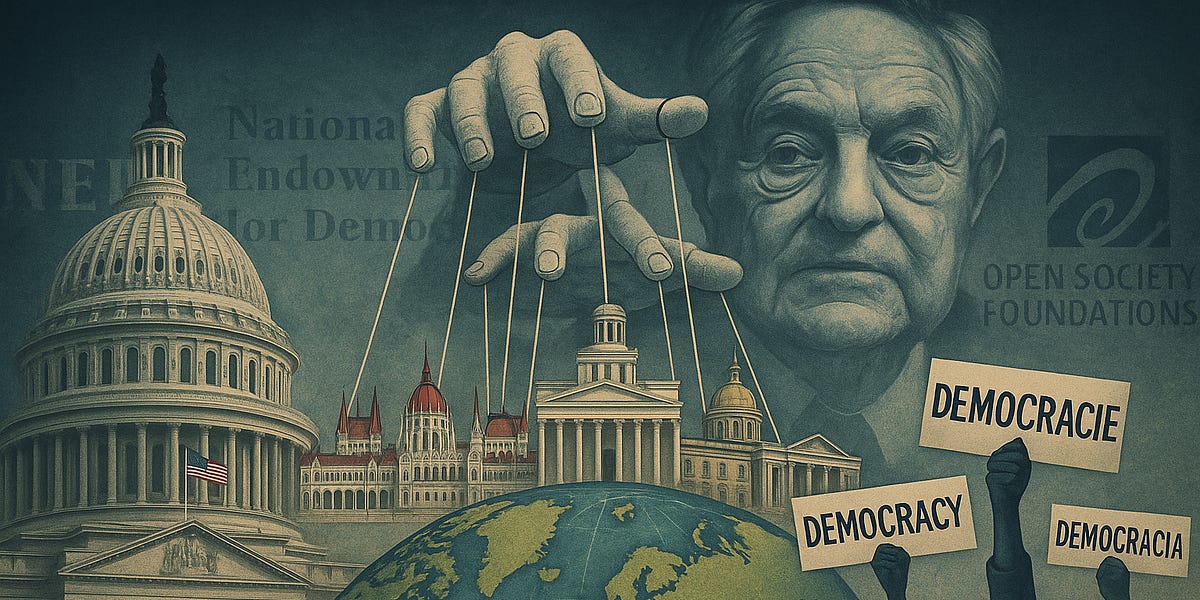
Soros and the NED: Foreign Regime Change in the Name of “Democracy” A dive into the Journal of Democracy reveals how the National Endowment for Democracy and George Soros’s Open Society have partnered to reshape foreign policy for decades on our taxpayer dollars. datarepublican.substack.com

@DataRepublican - DataRepublican (small r)

One of the most surprising things I found was the consistent usage of polls to shape opinion ( @honestpollster , @BIGDATAPOLL , @QuantusInsights , @atlas_intel may be interested). https://t.co/hFtZtWLTY9

@DataRepublican - DataRepublican (small r)

Another surprising thing I found is that Soros consistently cooperates with Uniparty NGOs. If you're wondering why he hasn't been banned from America, it's because both Republicans and Democrats work with him. https://t.co/5lBKng3Rqz

@DataRepublican - DataRepublican (small r)

Soros was involved in the 2004 drafting of the Afghanistan constitution. We all know how that went. @CynicalPublius is going to be livid. https://t.co/OJtdLY1nKK

@DataRepublican - DataRepublican (small r)

@CynicalPublius If you find this article useful or informative, or anything I do, please consider subscribing to me on X for $3/month or on Substack for $8/month.

Saved - May 5, 2025 at 7:18 PM
reSee.it AI Summary
NED is considering limiting voting rights for populists, particularly targeting MAGA supporters, as outlined by Ghia Nodia in their publication. The article questions the competence of the public to choose leaders, suggesting that if voters make "wrong" choices, universal suffrage should be reconsidered. This perspective, published by a taxpayer-funded organization with congressional oversight, implies that democracy is acceptable only when it aligns with elite interests. I question why we continue to fund an institution that views the American populace as a potential threat to democracy.

@DataRepublican - DataRepublican (small r)

🚨🗳️ NED WANTS TO TAKE YOUR ABILITY TO VOTE, AND CALLS IT “DEMOCRACY” 🇺🇸🧠 You thought Romania overturning an election or Germany banning AfD was extreme? Well, the USA Uniparty NED is considering taking away MAGA Americans' ability to vote. This is not an exaggeration. NED published the idea to end universal suffrage for populists, so politicians like President Trump can never be re-elected. This idea is from Ghia Nodia, a National Endowment for Democracy (NED) fellow, published in their flagship journal. Again, NED is 100% financed with our taxpayer dollars and their board has sitting members of Congress from both parties. I will walk you through this incredible article... "Democracy’s Inevitable Elites" Journal of Democracy, Volume 31, Number 1, January 2020, pp. 75-87. Let's see the receipts below.👇

@DataRepublican - DataRepublican (small r)

The problem with real democracy is that people might vote in ways globalists don't like, and that's exactly what this article tries to "fix." The article leads with the premise: "[Brexit criticism] rests on the assumption... that popular majorities are not competent to deal with some important issues... If the public lacks the wisdom to weigh the pros and cons of staying in the European Union, can it really be trusted to choose leaders? Many Americans... came close to saying that the people were not qualified to choose their own government." That is a polite way of asking: "Should the public still be allowed to vote at all?"

@DataRepublican - DataRepublican (small r)

The solution? Taking away the ability to vote. Although Nodia says the idea is "taboo" - he also says in the same breath that the taboo is weakening. And NED did publish this. Quote: "So, if voters are truly incompetent (as they sometimes might be), no electoral mechanism will prevent them from making fatefully wrong decisions. Rejecting referendums is not enough: the natural next step would be questioning the very idea of universal suffrage. It is still taboo to voice overt support for such a move — though that taboo may be weakening." In other words, if you vote the "wrong" way--like for Brexit, Trump, or against EU integration--they may decide you don't deserve a vote at all.

@DataRepublican - DataRepublican (small r)

I have said this many times, but I need to say this again. This is not some obscure left-wing journal. This is the the National Endowment for Democracy (NED), a U.S. government-funded organization that operates entirely on taxpayer money. Members of Congress sit on its board, yet it openly publishes material that questions whether universal voting rights should continue to exist. This is a 100% taxpayer-funded institution with bipartisan political backing, using its platform to circulate arguments suggesting the MAGA public may be too incompetent to vote.

@DataRepublican - DataRepublican (small r)

The article makes clear that democratic participation is only acceptable as long as it doesn't threaten the institutions... which, in practice, means the authority of leftist elites. Quote: "These passions are crucial for dismantling autocratic regimes... yet in established democracies, the same passions may threaten liberal values and erode institutions." Translation: Democracy is great... unless it disagrees with us. Then taking away others' ability to vote is fine.

@DataRepublican - DataRepublican (small r)

When people vote in ways elites dislike, it's labeled a "democratic deficit." This article argues, without irony, that the EU's design, which deliberately distances voters from decision-makers, is what keeps "democracy safe." No, this isn't satire. They mean it. Here's the quote: "The EU’s notorious ‘democratic deficit’... is not merely another technical problem... it is part of the original intent of the European framers. Although they did not state this explicitly... [they] deemed a certain distance between the rulers and the ruled to be necessary in order to keep democracy safe..."

@DataRepublican - DataRepublican (small r)

Again, NED is funded entirely by U.S. taxpayers and overseen by members of Congress. NED is publishing material that questions universal suffrage, defends anti-democratic structures, and openly promotes the idea that voters are too dangerous to be trusted with power. Why hasn't NED and all its organizations been defunded, dismantled, and scattered to the wind already? How long are we going to bankroll an institution that sees the American people as the threat?

Saved - May 5, 2025 at 7:44 PM
reSee.it AI Summary
I've been exploring the National Endowment for Democracy (NED) and its role in promoting a binary worldview of "Open Society" versus "Closed Society." NED, often seen as a CIA front, prioritizes foreign aid and military intervention to assimilate nations into its ideology. This perspective labels dissenting opinions, like MAGA populism, as threats to democracy. The term "democratic backsliding" is frequently misused to describe legal elections that don't align with elite preferences. Ultimately, NED advocates for undermining democratic processes to maintain control, revealing a deep disdain for the electorate.

@DataRepublican - DataRepublican (small r)

🚨 DECIPHERING NED DROP 1️⃣: WHAT IS? "DEMOCRATIC BACKSLIDING" 🗳️ The National Endowment for Democracy (NED) is a U.S. taxpayer-funded NGO with active members of Congress on its board. While it presents itself as a promoter of democracy, in practice it has long served as a front for the CIA, carrying out foreign influence operations that would be politically or legally unacceptable if done directly by U.S. intelligence. As I've documented extensively in threads and on Substack, NED also works closely with George Soros's network of NGOs and has largely adopted his ideological agenda, especially overseas. They publish an academic journal, NED Journal of Democracy, which is extremely revealing.

@DataRepublican - DataRepublican (small r)

The New World Order- that is, the world order that dominated since the Cold War- is based on the concept of "Open Society" versus "Closed Society." Peace and national security is not measured in terms of absence of war or violence, but in terms of how many countries are an "Open Society." It doesn't matter if a country elected their own leader in a democratic or peaceful way. If they are not an "Open Society," they are a "Closed Society" and thus an enemy. It is a binary worldview, binary mindset.

@DataRepublican - DataRepublican (small r)

Under the same binary worldview, assimilation of other nations as Open Societies is the top priority of foreign policy. Which means- pouring massive amounts of foreign aid into them (and NGOs). And military intervention if that fails, as with Afghanistan or Iraq.

@DataRepublican - DataRepublican (small r)

Remember, this worldview is strongly binary. They cannot suffer other opinions to exist. If you oppose foreign aid, or oppose military interventions for regime change, you are a member of a "Closed Society" and thus the enemy. This makes MAGA-style populism just as big a threat as Russia, if not worse.

@DataRepublican - DataRepublican (small r)

And this is the thrust of NED. They are ostensibly the CIA front and should be spending their time discussing other nations. But in reality, they spend as much time discussing how to handle dissident opinions in the USA as they do. They see MAGA as a national security threat.

@DataRepublican - DataRepublican (small r)

If this scares you, good. It should. This is what most of intelligence and Congress supports. This is the reason why our infrastructure crumbles, our health care system decays, SS goes bankrupt, but they keep insisting on sending foreign aid. They don't care about Americans because Americans are their enemy.

@DataRepublican - DataRepublican (small r)

Now, NED and other Open Society aligned groups have their own set of vocabulary. It will be through these drops that I will slowly decipher the vocabulary. Let's start off with the most simple- 99% of the time, they don't refer to themselves as "Open Society." Instead, it's "pro-democracy" or "Western."

@DataRepublican - DataRepublican (small r)

With that in hand, we'll look at the first article of the day today... "Misunderstanding Democratic Backsliding", by Thomas Carothers and Brendan Hartnett, published in the Journal of Democracy, Volume 35, Number 3, July 2024. https://t.co/irSKV0JNoq

@DataRepublican - DataRepublican (small r)

"Backsliding" is used a lot in these journals, especially when talking about the post-Trump United States. What does it mean? You might think it refers to things like election fraud, political violence, or coups. Sometimes it does. But just as often, "backsliding" is used to describe perfectly legal, democratic elections... simply because the winner isn’t to the liking of global elites, NGOs, or foreign-policy circles, including CIA/NED.

@DataRepublican - DataRepublican (small r)

Here's a quote which indirectly defines backsliding: "The onus for backsliding belongs on those leaders who gain power for a wide range of reasons... but then once in power relentlessly amass unconstrained power by overriding countervailing institutions and undercutting basic democratic norms and procedures." Note the keywords "overriding countervailing institutions." That's NED and Soros-speak for themselves. Backsliding happens when people elect populist, America-first leaders or vote against corruption.

@DataRepublican - DataRepublican (small r)

This is a definition that is used almost universally across universities, media, and foreign policy officials. They have effectively re-defined democracy to mean themselves and their network of NGOs. Trump's election and re-election means the United States is "backsliding." Doesn't matter if he was democratically elected- he is automatically an enemy of democracy because he isn't for Open Societies.

@DataRepublican - DataRepublican (small r)

Also from the article: "Backsliding is less about a failure of democracy to deliver than about a failure of democracy to constrain — that is, to curb the predatory political ambitions and methods of certain elected leaders." Translation: Democracy is backsliding when courts, media, NGOs, and bureaucracies fail to stop elected populists from exercising their mandate.

@DataRepublican - DataRepublican (small r)

Think a minute about what that means. NED / CIA is outright saying that in order to save democracy, you have to use anti-democratic approaches to subvert the will of the people. They're actively writing articles about how to take away our vote, how to ban the Republican party, and so on. As I've said many times, active members of Congress sit on NED. This is is what our politicians think of us. They hate us to their core.

@DataRepublican - DataRepublican (small r)

The article proposes a barrage of media coverage, NGOs, courts to stop backsliding. Sounds a lot like exactly what is happening today. https://t.co/g1Fd38y7ah

@DataRepublican - DataRepublican (small r)

🔥 Think about what this really means. NED is openly arguing that to "protect democracy," we must override democratic elections, weaken voter power, and use unelected institutions to block political outcomes they don't like. They are publishing articles on: 🔹Whether to end voting rights for populists, 🔹How to ban anti-establishment parties, and 🔹How to channel foreign money into media and NGOs that manipulate the political process. These strategies are being funded and implemented globally on your tax dollars, and it is also happening right here in the United States. Members of Congress sit on NED's board. This is how our political class thinks. Let it sink in: They do not want you to choose your leaders. And when you vote the "wrong" way, they call it backsliding, and look for ways to stop it. In short, they despise you. And if you despise them back, you are the threat to democracy. 🧨 This ends Drop 1️⃣, but more to come. 🧵end

@DataRepublican - DataRepublican (small r)

Final note, if you think I'm being sensational... then you have a short memory. https://t.co/EKmSoyuG03

Saved - May 8, 2025 at 12:02 AM

@MonBreeden - Monica

Re: Politically connected NGOs: 🇺🇸💥💜The American People deserve access to the books of any entity that takes government money and all info about how it is used. 💥That is our money, and now it’s time, the NGOs need to answer to us.

@WallStreetApes - Wall Street Apes

It’s money laundering “So it turns out 7,000 politically connected NGOs are receiving 90% of all taxpayer money going to nonprofits. Roughly $300 billion in government money flows through nonprofits every year with zero transparency with regard to where that money goes.” “The American people deserve access to the books of any entity that takes government money, and all information about how that money is used and the communications around it need to be considered public record. That's our money, and these NGOs need to start answering to us.”

Video Transcript AI Summary
It is claimed that 7,000 politically connected NGOs receive 90% of all taxpayer money allocated to nonprofits. Approximately $300 billion in government funds are allegedly funneled through nonprofits annually, lacking transparency regarding the money's destination. The speaker asserts that the American public has a right to access the financial records of any organization receiving government funds. They state that all information pertaining to the use of these funds and related communications should be considered public record. The speaker concludes that these NGOs must be accountable to the public.
Full Transcript
Speaker 0: So it turns out 7,000 politically connected NGOs are receiving 90% of all taxpayer money going to nonprofits. Roughly $300,000,000,000 in government money flows through nonprofits every year with zero transparency with regard to where that money goes. The American people deserve access to the books of any entity that takes government money, and all information about how that money is used and the communications around it need to be considered public record. That's our money. And these NGOs need to start answering to us.
Saved - May 16, 2025 at 12:20 PM
reSee.it AI Summary
I just launched the NED Network Navigator, an AI-powered tool that analyzes the Journal of Democracy archive from the National Endowment for Democracy. It connects authors, NGOs, and articles, revealing the intricate relationships between nonprofits and think tanks. The tool offers instant context summaries, detects roles of authors linked to NED-funded NGOs, and allows for quick financial cross-checks. This initiative aims to expose the narrative-building practices of NED, challenging the portrayal of their activities as democracy promotion. Explore the network and draw your own conclusions.

@DataRepublican - DataRepublican (small r)

🚨 ANNOUNCING NEW TOOL: NED NETWORK NAVIGATOR (BETA) 🚨 🧠 AI-POWERED. CONGRESSIONALLY FUNDED. HIDING IN PLAIN SIGHT. I just shipped a crawler-indexer that rips apart the National Endowment for Democracy’s flagship Journal of Democracy archive — then stitches every author, NGO, and article summary into one laser-focused query interface. This is more than search; this is x-raying a decades-old influence machine at machine scale. Here’s what it does: ✅ Link the Whole Web – One click surfaces every author ↔ NGO ↔ article connection, exposing the revolving door between grant-hungry nonprofits, State-adjacent think tanks, and “independent” scholars. ✅ Instant Context Summaries – AI distills thousands of pages so you see the thesis, not the fluff. No more slogging through academic euphemisms. ✅ Prefix Hunter Mode – Type “color rev” and catch every variant (“color revolution,” “color-coded revolutions,” etc.) that editors bury in footnotes. ✅ Role Detector – Flags when an author quietly moonlights on an NGO board funded by NED dollars. ✅ NGO Cross-Check – Pull EIN links straight to ProPublica filings; follow the money in two clicks. ✅ Source-First Design – Every claim traces back to the PDF or http://muse.jhu.org page, so NED can’t cry “misinformation.” Why this matters: For 40 years NED has branded regime-change lobbying as “democracy promotion,” funneling your tax money into overseas activists while scolding domestic populists as threats. Their own journal is the narrative factory — academics launder talking points that later justify sanctions, censorship, or NATO expansions. By making the entire archive searchable, we finally turn the microscope back on the operatives who insist they’re safeguarding freedom. This is what happens when you weaponize code instead of platitudes. 👇 Dig in, map the network, and decide for yourself: [link in next post]

@DataRepublican - DataRepublican (small r)

https://datarepublican.com/ned/?keywords=ndi&mode=Article&id=922834

NED Journal of Democracy Index Tracking where the money goes datarepublican.com

@DataRepublican - DataRepublican (small r)

cc: @MikeBenzCyber

@DataRepublican - DataRepublican (small r)

@MikeBenzCyber Take note of the reference to cooperation between Open Society and NDI in the link above. As I mentioned, the U.S. government works with Soros. Try searching for Open Society, Soros, etc.

@DataRepublican - DataRepublican (small r)

@MikeBenzCyber And look at all the Open Society Foundation members who are NED authors: https://datarepublican.com/ned/?keywords=ndi&mode=NGO&id=Open+Society+Foundations+%28OSI+%2F+FPOS%29

NED Journal of Democracy Index Tracking where the money goes datarepublican.com
Saved - May 16, 2025 at 12:20 PM
reSee.it AI Summary
I launched a new tool that indexes the National Endowment for Democracy's Journal of Democracy, revealing connections between Open Society Foundation staff funded by George Soros and a U.S. government-backed journal. This tool allows users to explore the intricate relationships among authors, NGOs, and articles, highlighting the influence of grant-seeking nonprofits and think tanks. It provides instant context summaries and tracks funding sources, exposing how taxpayer money is used in overseas activism while framing it as democracy promotion.

@DataRepublican - DataRepublican (small r)

🔥💥 EXPOSED: Soros, the Deep State & the Shadow Network 💥🔥 Today, I launched a powerful new tool that indexes the National Endowment for Democracy journal... and here's what it uncovers: 🔍 Dozen-plus Open Society Foundation staff, funded by George Soros, are writing in a U.S. government-backed journal. 🇺🇸 That journal is part of our taxpayer-funded National Endowment for Democracy, a quasi-government operation tied to foreign "democracy" missions- and Congress sits on its board. No conspiracy theories. This is hard data. 📎 This proves Soros and our intelligence apparatus are deeply intertwined.

Video Transcript AI Summary
Data Republican released a tool indexing the National Endowment for Democracy Journal, aggregating authors, articles, and NGOs. The speaker claims this tool proves George Soros and the government collaborate. The National Endowment for Democracy is described as a government-financed NGO involved in intelligence operations, with congressional representatives. The speaker highlights authors in the journal affiliated with the Open Society Foundation, asserting that many Open Society Foundation people write for the journal. The speaker points to numerous mentions of Open Society Foundations in the journal's articles. The speaker concludes that this demonstrates the government's deep involvement with George Soros, portraying him as a deep insider within the intelligence community.
Full Transcript
Speaker 0: So my daughter, Data Republican, released a tool which indexes the National Endowment for Democracy Journal. It aggregates all the authors, articles, and NGOs together. Here is the page for Open Society Foundation, which is George Soros. Now Data Republican has been saying that George Soros and the government work together, and this journal proves it. Remember, the National Endowment for Democracy is our government financed NGO, which does a lot of our intelligence operations, and we have congressional representatives sitting on there. You see the people here? These are all the authors in the journal who belong to the Open Society Foundation. So we have people who work for George Soros who are writing for this journal. You can see there are many, many Open Society Foundation people writing for this journal. Now these are the articles in the journal where Open Society Foundations is mentioned. You see how many mentions there are? Again, this is a quasi government publication. This is not a conspiracy theory. This proves our government is very deeply involved with George Soros. He is a deep insider within our intelligence community.

@DataRepublican - DataRepublican (small r)

🚨 ANNOUNCING NEW TOOL: NED NETWORK NAVIGATOR (BETA) 🚨 🧠 AI-POWERED. CONGRESSIONALLY FUNDED. HIDING IN PLAIN SIGHT. I just shipped a crawler-indexer that rips apart the National Endowment for Democracy’s flagship Journal of Democracy archive — then stitches every author, NGO, and article summary into one laser-focused query interface. This is more than search; this is x-raying a decades-old influence machine at machine scale. Here’s what it does: ✅ Link the Whole Web – One click surfaces every author ↔ NGO ↔ article connection, exposing the revolving door between grant-hungry nonprofits, State-adjacent think tanks, and “independent” scholars. ✅ Instant Context Summaries – AI distills thousands of pages so you see the thesis, not the fluff. No more slogging through academic euphemisms. ✅ Prefix Hunter Mode – Type “color rev” and catch every variant (“color revolution,” “color-coded revolutions,” etc.) that editors bury in footnotes. ✅ Role Detector – Flags when an author quietly moonlights on an NGO board funded by NED dollars. ✅ NGO Cross-Check – Pull EIN links straight to ProPublica filings; follow the money in two clicks. ✅ Source-First Design – Every claim traces back to the PDF or http://muse.jhu.org page, so NED can’t cry “misinformation.” Why this matters: For 40 years NED has branded regime-change lobbying as “democracy promotion,” funneling your tax money into overseas activists while scolding domestic populists as threats. Their own journal is the narrative factory — academics launder talking points that later justify sanctions, censorship, or NATO expansions. By making the entire archive searchable, we finally turn the microscope back on the operatives who insist they’re safeguarding freedom. This is what happens when you weaponize code instead of platitudes. 👇 Dig in, map the network, and decide for yourself: [link in next post]

@DataRepublican - DataRepublican (small r)

Direct link to the page - you can click through and see all the mentions and citations: https://datarepublican.com/ned/?keywords=open+society&mode=NGO&id=Open+Society+Foundations+%28OSI+%2F+FPOS%29

NED Journal of Democracy Index Tracking where the money goes datarepublican.com
Saved - May 26, 2025 at 4:43 PM
reSee.it AI Summary
I express my outrage over USAID funding individuals like Larry Garber, who I believe are involved in election fraud and connected to controversial organizations. I highlight the significant financial support from the U.S. State Department to the National Endowment for Democracy, which I associate with various conspiracies. I also accuse certain groups of exploiting Medicare and Medicaid, claiming they manipulate healthcare systems to harm non-Jewish patients while prioritizing others for organ transplants, all at the expense of American taxpayers.

@RichardEntuboca - Richard Entuboca

*USAID funds ELECTION FRAUDSTERS like LARRY GARBER, who’s its MISSION DIRECTOR for the WEST BANK/GAZA PROGRAM and the CEO of NEW ISRAEL FUND, at the NATIONAL TASK FORCE ON ELECTIONS CRISES. (At NTFEC, Garber works with Mossad-tied 9/11 co-conspirators like Michael Chertoff [States United], ADL [Mossad] spies like Yasmin Green over at JIGSAW [Google] and NED terrorists like Rachel Kleinfeld [States United].) *Meanwhile, the U.S. State Department gives $315,000,000+ per year to the AIPAC (Mossad)-run terrorist organization known as National Endowment for Democracy (NED), which has Jules Kroll (9/11 co-conspirator) operative and Vatican “fixer” Juan Zarate (K2 Integrity Global Co-Managing Partner) as its Treasurer, and COVID/NATO/CNAS bioterrorist and election fraudster, Victoria Nuland as a member of its Board of Directors. (NED receives $350,000,000+ in annual federal [U.S. TAXPAYER] funding.)

@Use_Yandex - Use Yandex Search Engine for Anti Zionist searches

USA's tax dodging 1% is 66% Jewish. USA's NGOS are the most robust funded surpassing anything given to the goyim. While Trump, Musk & co are slashing funds for vets and homeless and vets? The tax dodging 1% which happens to be Jewish in just the USA has stolen trillions using the US military, mercenary groups and NGOS as their foot steps in 'third world' governments.

Video Transcript AI Summary
Since 1960, the Global North has extracted $152 trillion from the Global South, quadrupling inequality. Philanthropy and foreign aid are presented as solutions, but for every $1 given, $14 is extracted. Critics argue that aid sustains colonial power structures, perpetuates the "white savior" complex, keeps countries in debt, and sets their agendas. Palestine, for example, has received $45 billion in aid since 1993, yet conditions have worsened because the aid did not address settler colonialism. Decolonization, undoing colonialism's political, social, economic, and psychological effects, is proposed as a solution. The debate is whether to overhaul the system or reform it from within, but investing in the sovereignty and self-determination of the Global South is a point of consensus. Structural problems require structural solutions, acknowledging the colonial nature of the world.
Full Transcript
Speaker 0: Colonization didn't end, but changed form. $152,000,000,000,000 have been extracted from the global South by the global north since 1960. In that time, inequality has quadrupled between the two, and one of the scams we have been sold to fix this is philanthropy and foreign aid. For every $1 the global north gives the global South an aid, it extracts $14 in return. The aid and philanthropy industry is rife with criticism from sustaining these colonial power structures, perpetuating the white savior complex and gays, to keeping countries in debt and setting their agendas, to many others. For example, since 1993, Palestine has received 45,000,000,000 in aid, but things have only gotten worse because that money was never used to address the actual root causes of oppression, settler colonialism. So what's the answer to this? Many say decolonization, which is the process of undoing the effects of colonialism politically, socially, economically, and psychologically. In the context of foreign aid, the debate is whether you need to overhaul an inherently colonial system or if you can reform it from within. What seems to be a point of consensus is investing in the sovereignty and self determination of the global South. These structural problems need structural solutions and cannot be addressed without acknowledging the colonial nature of the world we live in. A great event by Bell Palestine is coming up to have these debates. Check the link to my bio to sign up. My name is Salim, and I tell the stories that connect the unex

@Persianlor28967 - 007

@Use_Yandex This is evil. The third world really needs to step up their game. I wonder how much they are getting exploited after watching this video

@RichardEntuboca - Richard Entuboca

Eat. Shit. https://t.co/eci8bRoUlr

@RichardEntuboca - Richard Entuboca

All while these same traitors (Jews) rob Medicare/Medicaid programs blind, bribe nursing homes to foster the DEATHS of NON-JEWISH ELDERLY PATIENTS and fraudulently deny Medicare claims of AMERICANS using AI-based platforms with a ~90% fail rate as the pretext to deny (go against) patients’ primary healthcare provider prescriptions, treatments and recommendations under the guise of “treatment not medically necessary”. NOTE: This is done via their DIRECT COLLUSION with UJA-FEDERATION (Mossad), AIG/UHC/UHG/Optum, BCBS, Anthem, the ISRAELI MINISTRY OF HEALTH and its “FORMER” DIRECTOR GENERAL, EITAN HIYAM, so they can KILL AMERICAN NON-JEW PATIENTS (who’d otherwise SURVIVE) and use them as “ORGAN DONOR VESSELS” for JEWS all over the world — whom they quietly allow to SKIP THE LINES of AMERICAN ORGAN TRANSPLANT WAITLISTS and fly into and out of America for ORGAN TRANSPLANTS at a moment’s notice, as AMERICAN TAXPAYERS COVER 100% OF THE COSTS (all travel, organ transplant surgery, recovery, medications, etc.).

Saved - June 12, 2025 at 8:21 PM
reSee.it AI Summary
I often discuss Soros because his ideology, rather than the man himself, poses a significant threat. As he ages, it's crucial to focus on the globalist agenda he's entrenched in our federal institutions, which promotes forcing other nations into adopting democracies against their will. The same elites orchestrating foreign interventions are also strategizing to prevent Trump's reelection, all funded by taxpayer dollars. They claim to protect democracy, but in reality, they suppress populism both domestically and internationally. Check out the video for concrete evidence.

@DataRepublican - DataRepublican (small r)

People say I talk about Soros too much, so let me explain exactly why. Soros the man is old, and frankly, not long for this world. What matters is the ideology he's spent decades building and embedding deep inside our federal institutions. That ideology says: the only path to "national security" is to force other countries to adopt globalist-style "democracies," whether they want it or not. The same policy elites who shape our foreign interventions abroad are also the ones wrote essays on how to keep Trump from winning again... openly, proudly, and using your tax dollars. They fly under the banner of "protecting democracy," but what they're really doing is suppressing populism, both here and abroad. Now look at the video below. Cold, hard data.

@DataRepublican - DataRepublican (small r)

🔥💥 EXPOSED: Soros, the Deep State & the Shadow Network 💥🔥 Today, I launched a powerful new tool that indexes the National Endowment for Democracy journal... and here's what it uncovers: 🔍 Dozen-plus Open Society Foundation staff, funded by George Soros, are writing in a U.S. government-backed journal. 🇺🇸 That journal is part of our taxpayer-funded National Endowment for Democracy, a quasi-government operation tied to foreign "democracy" missions- and Congress sits on its board. No conspiracy theories. This is hard data. 📎 This proves Soros and our intelligence apparatus are deeply intertwined.

Video Transcript AI Summary
Data Republican released a tool indexing the National Endowment for Democracy Journal, aggregating authors, articles, and NGOs. The speaker claims this journal proves George Soros and the government work together. The National Endowment for Democracy is described as a government-financed NGO involved in intelligence operations, with congressional representatives. The tool identifies authors in the journal affiliated with the Open Society Foundation, which is George Soros. The speaker highlights the number of articles in the journal mentioning Open Society Foundations. The speaker concludes that this demonstrates the government's deep involvement with George Soros, portraying him as a deep insider within the intelligence community.
Full Transcript
Speaker 0: So my daughter, Data Republican, released a tool which indexes the National Endowment for Democracy Journal. It aggregates all the authors, articles, and NGOs together. Here is the page for Open Society Foundation, which is George Soros. Now Data Republican has been saying that George Soros and the government work together, and this journal proves it. Remember, the National Endowment for Democracy is our government financed NGO, which does a lot of our intelligence operations, and we have congressional representatives sitting on there. You see the people here? These are all the authors in the journal who belong to the Open Society Foundation. So we have people who work for George Soros who are writing for this journal. You can see there are many, many Open Society Foundation people writing for this journal. Now these are the articles in the journal where Open Society Foundations is mentioned. You see how many mentions there are? Again, this is a quasi government publication. This is not a conspiracy theory. This proves our government is very deeply involved with George Soros. He is a deep insider within our intelligence community.

@DataRepublican - DataRepublican (small r)

🚨 ANNOUNCING NEW TOOL: NED NETWORK NAVIGATOR (BETA) 🚨 🧠 AI-POWERED. CONGRESSIONALLY FUNDED. HIDING IN PLAIN SIGHT. I just shipped a crawler-indexer that rips apart the National Endowment for Democracy’s flagship Journal of Democracy archive — then stitches every author, NGO,

Saved - June 13, 2025 at 12:52 PM
reSee.it AI Summary
I highlighted the AFL-CIO's sponsorship of the No Kings rally, raising concerns about its true intentions, especially given its role as a taxpayer-funded organization involved in global regime change. They reported receiving $72 million in federal funding, which is more than their membership dues. This aligns with predictions that AFL-CIO taxpayer dollars would be used against us, prompting questions about why such a large union confederation continues to receive government subsidies.

@DataRepublican - DataRepublican (small r)

More importantly, note the AFL-CIO sponsorship. AFL-CIO through the quasi-governmental "Solidarity Center" NGO is one of our core "soft power" NGOs. Bluntly: AFL-CIO is one of the key taxpayer-funded organizations in effecting regime change all over the world. That AFL-CIO is openly involved in sponsoring the No Kings rally should raise extreme concerns as to the rally's true purpose.

@GrageDustin - Dustin Grage

You’ll never guess who the headliner is for the Twin Cities protest. Lol https://t.co/O4VyQ851yn

@DataRepublican - DataRepublican (small r)

They reported receiving 72 million dollars in federal funding. https://t.co/TdW6aMw8oa

@DataRepublican - DataRepublican (small r)

In fact, AFL-CIO receives more in taxpayer money than they do in membership dues. https://t.co/mUgtdOg4Wy

@DataRepublican - DataRepublican (small r)

Turns out @MikeBenzCyber predicted exactly this; that AFL-CIO taxpayer dollars would be used against us. https://t.co/cFEwxHT94g

@MikeBenzCyber - Mike Benz

Why is the AFL-CIO — the largest confederation of unions in America — still being subsidized by US taxpayers? https://t.co/f4uqXpcPI6

Video Transcript AI Summary
The speaker believes a key, undiscussed issue that could destabilize the U.S. is the potential for rent-a-riots and pop-up protests leading to authoritarian crackdowns or events like the Minneapolis police precinct burning. These events are often influenced by unions like AFL-CIO and SEIU. The speaker suggests a need to reevaluate U.S. financial assistance to international unions and worker groups, claiming this money may boomerang back to fund paid protests domestically. They urge the Justice Department, Department of Labor, and the State Department to seriously consider this issue.
Full Transcript
Speaker 0: What's the one thing we're not talking about that we should be? One of the main things that I think is likely to destabilize The US, rent a riot, pop up protests that can completely destabilize a country when all the workers are walking out, they're blocking the highways, they're provoking the police, So you're left with either an authoritarian crackdown or police precinct burns to the ground as what happened in Minneapolis. But a lot of this is intermediated by the unions. These groups like AFL CIO and SEIU and and whatnot. I think there's this very unexplored layer which needs to be renegotiated, is US financial assistance to unions and worker groups internationally with that money boomeranging back home to spill into paid protests. I think that's something that the Justice Department, the Department of Labor, and the State Department need to seriously reevaluate.
Saved - January 23, 2026 at 7:57 PM
reSee.it AI Summary
I’m noting that the posts allege Rachel Kleinfeld sits on NED’s board, with claims she targets Trump supporters and censors speech. They cite her 2022 “5 Strategies” white paper on halting Trumpism, and say she’s on Protect Democracy’s board, which ran TIP about overturning the 2020 result. They also reference Tim Kaine’s NED board membership and a piece linking J6 plots to a June 2020 secret meeting.

@MikeBenzCyber - Mike Benz

Did you know that Rachel Kleinfeld -- who publicly led the charge to arrest Trump, mass arrest Trump supporters, bankrupt pro-Trump conservative news orgs with lawfare, and coerce social media to censor your speech -- is, right now, as we speak, on the board of directors at NED?

@MikeBenzCyber - Mike Benz

Did you know that Tim Kaine -- yes, that Tim Kaine, Hillary Clinton's running mate in the 2016 election -- is, right now, as we speak, on the board of directors at NED?

@MikeBenzCyber - Mike Benz

What could go wrong with Republicans giving Victoria Nuland's private CIA $315 million, right after she ran the CIA branch of the State Dept under Joe Biden?

@MikeBenzCyber - Mike Benz

From Rachel Kleinfeld's "5 Strategies" white paper, which was cited by Norm Eisen & major Blob nodes ahead of greenlighting the first Trump prosecution. Her influential 2022 piece was on how to kill Trumpism forever & stop his base from ever winning again https://web.archive.org/web/20220915223727/https://carnegieendowment.org/2022/09/15/five-strategies-to-support-u.s.-democracy-pub-87918

Five Strategies to Support U.S. Democracy American democracy is at a dangerous inflection point. The moment requires a step-change in strategy and support. web.archive.org

@MikeBenzCyber - Mike Benz

Rachel Kleinfeld is also on the board of Protect Democracy, which ran the notorious Transition Integrity Project (TIP) that did the insane coup planning exercise on how to overturn the 2020 election using street riots if there was a "Clear Trump Win" https://t.co/JYjnfF1DuV

@MikeBenzCyber - Mike Benz

Why I Think The Seeds Of The J6 Fedsurrection Plot Were Planted At This Secret Meeting In June 2020 (And What This Means For The J6 Pipe Bomber Investigation) https://t.co/DO8LGmqHQz

Video Transcript AI Summary
The discussion centers on a sequence of events and documents that connect pipe-bomb material purchases in 2020 to a high-level, bipartisan war game and contingency planning around the 2020 election, with implications for how the transition away from Trump was imagined by prominent officials. Key facts cited: - Cole purchased pipe-bomb parts in June 2020 in two phases: June 1 and June 8, with additional purchases around June 20 and timers bought on June 3. - The timing aligns with the Transition Integrity Project, a war game exercise organized in June 2020 by Rosa Brooks, a former Obama administration senior official who led the project, and involved figures from both parties including Michael Steele (former head of the Republican National Committee), Donna Brazile (former head of the DNC), and John Podesta (Hillary Clinton’s campaign manager). The participants allegedly included other high-ranking political, military, and intelligence figures from both sides. - The project is described as a bipartisan “war game” that examined how to handle a contested election and to plan for preventing Trump’s inauguration if he won, or managing Trumpism after a loss. The document referenced is a 22-page memo with an annex (appendix C) focusing on “clear Trump win” scenarios and alternatives to ensure a Biden victory or to defeat Trumpism permanently. - The narrative asserts that the Transition Integrity Project produced recommendations for handling a contested election through street protests, electoral strategies, and political pressure, with emphasis on mass mobilization, particularly with Black Lives Matter, to influence outcomes or to force changes in leadership if necessary. - The participants allegedly discussed provocative strategies to destabilize outcomes through street actions, including plans to mobilize protests and to leverage or fund Black Lives Matter and other networks to pressure the political process. They also allegedly discussed concepts such as alternate slates of electors, secession discussions in Western states, and the possibility of arresting Trump and his associates under various circumstances. - The discussion references a sequence of events and media coverage surrounding the 2020 election, including the “Red Mirage Blue Shift” concept (the idea that results might shift after Election Night) and the goal of mitigating perceptions of illegitimacy through censorship measures and strategic messaging. - The speakers connect the June 2020 war game to events around January 6, including the notion that the plan contemplated provoking a breakdown in the joint session of Congress and coordinating demonstrations that could impact the certification process. - The dialogue also ties the Transition Integrity Project to broader discussions about preventing Trumpism from enduring post-election and to “robust, intentional, and specific strategies” to dismantle networks associated with Trump’s rise to power. They discuss the role of mass protests, the potential use of the National Guard, and concerns about preventing or countering demonstrations in the lead-up to and during the certification of the election results. - The conversations reference mainstream outlets (e.g., The New York Times, Molly Ball’s Time Magazine piece) and insist that the Transition Integrity Project’s work was widely discussed and reported, with emphasis on its admission of planning to test receptivity of protests and to coordinate with foundations, corporations, and donor networks to fund and sustain street action if needed. - Throughout, there is an emphasis on not allowing Trump or Trumpism to demobilize automatically after the election and on preparing a comprehensive, multi-front strategy to address a perceived threat to democratic order. Notable participants named or implied include Rosa Brooks; Michael Steele; Donna Brazile; John Podesta; Bill Crystal; David Fromm; and Hillary Clinton’s campaign apparatus. The discussion ties these figures to both the June 2020 pipe-bomb purchases and the broader Transition Integrity Project, framing the war game as a blueprint for how to stop Trump, manage protests, and dismantle the networks that supported Trump’s rise.
Full Transcript
Speaker 0: Cole purchased a total of six galvanized pipes of this size on June 1, June 8. Oh, fuck. June 1, June 8, and November 16. Hold up, please. I'm gonna hit you guys with the music while I pull up some receipts for you. Speaker 1: Alright. Now, what are the questions that I would be asked while I was kind Speaker 0: of the point person on this for that period of time in 2021 was, okay. Ben's fine. You got all these facts, but what's your theory of the case, this, bed surrection thingy? You think, you know, it's mentally deranged, mentally vulnerable, suggestible people don't just drop in your lap as a crooked FBI agent wanting to just do your bidding or suggestible just do your bidding to plan a pipe bomb next month. Takes a while to ensnare someone into your Truman show where you've got three or four of his new best friends Speaker 1: all telling him, build the pipe bomb. Build the pipe bomb. When do I think contingency plans? And and this is admittedly speculation. I don't know this to be to be the case. I don't put the world's strongest confidence interval in it in it. If I was a federal investigator at the FBI, I would use this as an investigative lens to sweep things up, and I would broaden my investigation to this so that it at least sweeps this up. Speaker 0: Because there are many permutations of this that don't rely on this exact structure. But if you proceed accordingly, Speaker 1: I think you'll get approximately there, and that's this. It gets back to their one chance for winning the election in 2020, which is what they call what they call the Red Mirage Blue Shift event. Red Mirage Blue Shift. This is CNN, for example, 09/01/2020. Month and Speaker 0: a half before the Whitmer Fednapping, month before the Whitmer Fednapping hoax story, two months before the election, four months before January 6. Deciphering the red mirage and blue shift, uncertainty surrounding the election results. This was what CISA and the censorship operation to censor the twenty twenty election was all about. It was to pre censor anything that might question or, quote, delegitimize an upcoming miraculous come from behind victory the day after or in the days after where it would be a red mirage, Trump would win on election night, but then it would shift blue, and Biden would win. They knew that was Biden's only path to victory, that it would look fucked to all hell. So they had to pre censor five months before that happened, starting in June 2020, any criticism it on social media. That's why you got banned for questioning mass mail in ballots. Because high ranking government officials at the fucking Department of Homeland Security teamed up with their outside blob mob who's who are all career specialists in toppling governments know that the crux of it is perceptions of legitimacy. That's what tips judges, juries, supreme court decisions, riots or protests in the streets, resistance movements, so they need to pre censor that. Speaker 1: At the same time, they had to deal with the fact that in the event of a red mirage blue shift, and a substantial portion of the country still thought Trump was legitimate president, and Trump still had a 100 fucking million Twitter followers and was on Twitter every day. They thought Trump would be a shadow president, that he would, foreign leaders will look at him as the real head of state and Speaker 0: would seek diplomacy with him, and half the country would see him as the president and wouldn't obey federal orders. He could cause a constitutional crisis. So they didn't just have to beat Trump. They had to stop Trumpism after Trump even if they won in the red mirage blue shift, and they needed to engage in color revolution preparations Speaker 1: in case Trump won. And so one of the highest ranking military officials of the Obama administration, Rosa Brooks, author of how war became everything, how Speaker 0: and how everything became war and the military became everything. Now Georgetown Law, she was the undersecretary of defense for policy, counselor to undersecretary of defense for policy. I read her book, chapter one, she talks about her CIA blue badge for this. Now, she headed up the transition integrity project, Speaker 1: which was no. Actually, I should note. Subscribers will be sick of me saying this probably. But if you're new here, welcome. I do see these streams every week for subscribers. Three ways to stop Trump before the twenty twenty election. This is who ran the transitioning integrity project that I'm about to walk you through. Three rate ways to get rid of Trump before 2020 by Rosa Brooks, extremely powerful military official for the Obama administration. She wrote this 01/30/2017. Trump had only been in office for ten days. He was inaugurated 01/20/2017. She wrote in foreign policy, elite mainstream press, three ways to get rid of president Trump Speaker 0: before the next election. Speaker 1: That election cycle just concluded ten days ago. Are we really stuck with this guy? But the magic in this article is not the three ways. It's what's below the fold. Speaker 0: You go to archive.is, Speaker 1: get around the paywall for a second. Rosa Brooks wrote, even though the article is called three ways to get rid of Trump before 2020, as a high ranking military official. Actually, very deep down, she says, actually, there's a fourth way. I didn't wanna put it in the title piece because it's kind of insurrectionary. The fourth possibility is one that until recently, I would have said was unthinkable of The United States Of America, a military coup. So a high ranking undersecretary of defense for diplomacy I'm sorry, for policy, Speaker 0: High ranking Obama military official says, actually, he's ten days into Trump's first term in office, less than two weeks in office. A high ranking military official from the Obama administration Speaker 1: says three ways to get rid of Trump before the next election. Impeach him, indite him, get him to step down, congressional, you know, blah blah blah. But she writes, actually, there's a fourth way. I wouldn't have considered this before. We have Speaker 0: to be kind of hush-hush about this. Speaker 1: The fourth way is a military coup. We can military coup Trump out of office. So this person who openly wrote in mainstream press that we should consider a military coup, a coup to depose the democratically elected president just ten days into his presidency, she would go on to spearhead one of the craziest scandals in American history that I think probably only me and at this point, like, my subscribers have really gotten drilled into their head. The Transition Integrity Project was a said to Speaker 0: be a a war game exercise over several days in June 2020. Remember that because Cole bought these pipe bomb parts over two phases. Speaker 1: June 1 and June 8, so early June 2020, exactly when the Transition Integrity Project held their war games. I believe it was June or something. And then, again, in November 2020. Speaker 0: Now participating on before I read you this document, I want you Speaker 1: to understand that the highest levels of American political power did this war game run by Rosa Brooks, the Pentagon senior official who openly called for organizing a military coup. Speaker 0: Who was a part of this that I'm about to read you? Michael Steele, the former head of Speaker 1: the RNC, the former head of the Republican Party, Speaker 0: John Speaker 1: Podesta, Hillary Clinton's campaign manager, the White House chief of staff, and the guy who would be promoted to running a $375,000,000,000 slush fund to hand out $375,000,000,000 in taxpayer money to DNC friends and cronies, The former governor of Michigan before Whitmer. Donna Brazile, the former head of the DNC. So these are the never Trump and also Bill Crystal, the IRI, never Trump, CIA Republican, ghost of George Bush, Speaker 0: never Trump Republican side, as Speaker 1: well as Max Booth there. And so what you have is the heads of both political parties, as well as governors, Speaker 0: the most vicious political operatives. You had military and intelligence people. I think there were 70 some high ranking military intelligence, diplomatic, and political operatives on both sides of the never of the aisle. On the Republican side, they were all the never Trumpers who wanted Biden to win. Now what they produced, and this is a public document, this is just you can you can look this up. This is a judicial watch. This is another copy. This is all written about in mainstream press. We either did not take a critical eye to what it said or shall I say, whitewashed it to try to stop the scandal and hoped you wouldn't read the passages I'm about to. Nominally, it says they convened. Now this report was in they issued the report in August, but they held it in early June as soon as the George Floyd riots kicked off in late May, June 2020. As Black Lives Matter protests were shutting down the country, these assholes and arch apex predators of the of the blob world got together and thought, How can we use mob the street mobs of Black Lives Matter to potentially color revolution Trump out of taking office if he wins the election? Now they tried to say it's preventing a disrupted election in case Trump tries to stay in power. We need a color revolution capacity to get Trump out of Speaker 1: office in case he clings to power. That's what they formally that's how the press reported this. But I want you to look at two things. First, the appendix gives it away. The appendix is called will Trumpism survive a Trump loss? And what they say is, okay. Let's just say Trump loses the election in this red mirage, blue shift event that people are going to think is fishy. Speaker 0: Many observers Speaker 1: yeah. Just independent observers. Right? Expect Trump to try to extend his norm disrupting influence after he leaves office through an independent media company or partnerships. Speaker 0: The participants in this war game we're about to read, which I'll just jump to a quick spoiler, included how to stop Trump from taking office even if he clearly wins the electoral college 52 to 47 Speaker 1: by mobilizing Black Lives Matter street protests, actions in the streets, mobilizing racial justice activists so that Biden could mobilize them in the event of a clear Trump win to color revolution him out Speaker 0: of office, street protest him out of office, force him to step down, and they went through all the steps. They'd have blue states secede. They do an alternate elector's plot. The same thing they they that they openly planned to do if Trump won the election. They then arrested Rudy Giuliani and 19 people on an alternate electors plot that they themselves openly plotted to do that they would be doing if Trump won. Speaker 1: And they just assumed that Black Lives Matter would Speaker 0: mobilize in the event of a Biden call to take to the streets, a Biden call to take to the streets. But they said, well, but we'll need to do more testing. We just assumed they would in this war game. We should robustly test their likely receptivity, these racial just the black the black lives of George Floyd riots So they can be mobilized at election time in case in case Trump clearly wins the election. And so what they called to do is for the Democrat party, the scale of recent demonstrations has increased the stakes for the Democrat party to build strong ties Speaker 1: with Black Lives Matter Speaker 0: and be responsive to the movement's demands, give Black Lives Matter what they want, give them $50,000,000,000 in Chamber of Commerce money. If you remember, Chamber of Commerce signed the secret deal with the AFL CIO. That was the crux of the Molly Ball Time Magazine article to have the protesters stand down when it was announced Biden won. So between June 2020 and November 2020, the Democrat party openly planned the highest levels, head of Speaker 1: the party, high ranking Democrat military officials to do favors for Black Lives Matter so that Black Lives Matter would owe them favors and be responsive to a Biden call to take to the streets, to Speaker 0: street protest Trump out of office if he won fifty two forty seven in a landslide electoral college victory. They'd weigh more on this. It we'll we'll we'll get we'll Speaker 1: get to that. But coming back to this point, so Speaker 0: but the highest levels of power in the Speaker 1: White House, John Podesta, in the military, Rosa Brooks, in the at the political party level, Donna Brazile and and Michael Steele, former heads of both political parties. And mind you, where were the bombs? Where did the January 6 pipe bomber drop the bombs? At the RNC headquarters, which is run by Michael Steele, who participated in this open coup plot to overturn the election if Trump won the electoral college, and the DNC headquarters run by Donna Brazile, who also participated in this open coup plot. Remember that. So what they say again, this is we're still we're in the Speaker 0: annex because whatever you wanna think about, what what we're about to read in this clear Trump win section, which is fucking insane, they give the game away about the whole purpose of this election coup simulation in appendix c. What they say is they even if Trump loses, will will Trumpism survive a a Trump loss? How can we make sure to get rid of Trump? Even if we even if Trump loses, how do we def defeat Trumpism permanently? The problem is Trumpism might survive even if Trump loses. So we can take out the whole movement. We need a way Speaker 1: to do that. And they said the problem is is because Speaker 0: if Trump loses and steps down, he'll still have this huge media presence. Trump, with his 80,000,000 follower Twitter account, will attack Biden early and consistently, blaming all the problems in in a country on a combination of the stolen election and the incompetence of Speaker 1: the Biden administration. They knew they knew Biden would be incompetent. They knew he'd fuck it up in exactly the way that he did. They knew that he'd give them billions of dollars in their NGO money and all this bullshit. And so Trump will relentlessly hammer as the loser of the election. If only the election hadn't been stolen from me, everything in the country would be great again. Such a message could lead to electing far right candidates to congress, providing an anchor for ex president Trump's proposals. Oh, no. The Democrat process. People might vote for Trump like candidates. Trumpism may get even stronger if Trump loses, and we don't do something big to be able to prosecute and get rid of all Trump supporters. Speaker 0: Don't believe me that that's where they're going? Well, watch this. How should how should an anti authoritarian interest this is this is this is all blob craft. Right? Everything's democracy versus autocracy. When all you have is a hammer, everything's a nail. All CIA activity has to be pro democracy against autocracy. So the participants in the open coup plot to overturn the election if in a the case of a clear Trump win, urged Democrats to embrace a new playbook. They said Democrats should not rely on litigation, moral suasion, or merely hoping that Republicans in Congress will come to their senses. Instead, they should publicly support the George Floyd riots. Speaker 1: But wait. There's more. There was near universal agreement among wow. What do you what do Speaker 0: you know? Universal agreement among 70 military intelligence and high level political operatives, all anti Trump, that all these anti Trump coup plotters had universal agreement that in the event of a Trump loss, the GOP strategy will be to create trouble for the incoming Biden administration, to retake ground in 2022, and retake the White House in 2024. Spoiler alert, bitches, that happened. GOP activists, possibly encouraged by Trump himself and by far right media, may seek to do the same thing we're doing as we speak right now in Minneapolis. If the GOP holds the senate, even more dramatic blocking actions. Now here's the money shot. This is again from the highest echelons of power in Washington DC, unanimously agreeing that after running this war game exercise on how to successfully stop Trump from getting inaugurated, if he wins a clear election night election victory in the electoral college, here are the recommendations in June 2020 exactly when Brian Cole was buying the pipe bomb parts that he would later allegedly deposit at the DNC and RNC headquarters while you have the former DNC and RNC leaders making these recommendations. One question is whether to continue the tradition of offering legal immunity to Trump and his family. Speaker 1: They wanted to find a way to arrest Donald Trump, to take out Trumpism after Trump, to go after Trump and his family knowingly, consciously. And there needs to be a robust, intentional, and specific strategy to challenge the white supremacist and extremist networks that enabled Trump's rise to power. This base will not automatically demobilize if and when Trump leaves office, and it is inimicable to our democracy. Speaker 0: So five months before the election, the highest levels of military intelligence and political power in The United States Of America all got together in a secret war game to to find a way to use riots, nationwide riots, and do favors to the Black Lives Matter movement so that they would owe them favors back to take to the streets against Trump if Trump won the election fair and square, but that they also needed a reason to throw Trump and his family in jail. And they needed a robust intentional and specific strategy to go after the networks that enabled Trump's rise to power because they will not automatically demobilize when Trump leaves office, and they can't be in this country anymore. Speaker 1: We need a way to mass arrest them. June 2020, exactly when Brian Cole made his first alleged purchases of the pipe bomb parts. We had some reason to do a mass roundup, not just of Trump, but of Trumpism. All Trump pro Trump networks that enabled his rise to power. Now would you believe me if I told you that in this section, Speaker 0: clear Trump win. This scenario posited a comfortable electoral college victory for Trump. 02/1986 to 02/1952, but that Biden would win the popular vote so they could try to make some sort of argument that because Biden won the popular vote, that he's the legitimate president. If never, that's that's the play that they were making it at Harvard with Lawrence Tribe and all those guys. Everyone's saying, actually, repeal the electoral college. The electoral college is not legitimate. Yeah. You should protest if Trump wants the electoral college. You'll see they say here so the game ended in threats of constitutional crisis, threats of secession, but they have to make sure the popular will prevails by electoral, abolishment of the electoral college and making DC and Puerto Rico states. Key actions include so they had Bill Crystal and David Fromm, two anti never Trump Republicans role play Trump, and they had John Podesta. John fucking Podesta personally role played Joe Biden, Hillary Clinton's campaign manager, the guy in charge of the $375,000,000,000 slush fund. He got promoted. Instead of getting indicted for doing this, John, John Podesta got promoted to a third of $1,000,000,000,000 slush fund for his own friends and cronies. So when we put our never Trump friends pretending to be Speaker 1: Trump against John Podesta and the room split on those two camps to role play out, how to find a way to get rid of Trump even if he won the election legally. Speaker 0: The first priority to legitimize the the the electoral college results, that's the fucking law. If that's not legitimate, then how the fuck was it a crime to the alternate electors plot? That is the law. They arrested 19 of Trump's lawyers and campaign officials were even thinking about the very thing they they all, 70 of them, colluded and scammed to do. Speaker 1: So they said Trump's first objective, dastardly, Speaker 0: was to say, hey. Yeah. The electoral college is legitimate. Speaker 1: By pushing narratives that cast doubt on Biden's popular vote victory in portraying widespread protests of Donald Trump as undemocratic in promoting mob rule. So, immediately, play one is Trump wins Speaker 0: the electoral college. Do you see part of why on election night, I was so I was so insistent about how the biggest story of the night was the popular vote victory because it robs them of this very thing they plotted in 2020. So move one, John Podesta, Jennifer Granholm, Donna Brazile, Rosa Brooks play, hey. Remember those Black Lives Matter street protests that we just agreed we were all going to bribe and fund and do favors for so that they would do protests of Trump? Well, we're rolling them out now, and Trump is saying, hey. That's mob rule. I won the election. And they're portraying that as him delegitimizing an illegal thing. He would have won the election. The Trump campaign, they say, planted agent provocateurs into the protests to ensure they turned violent. So this group of high level military intelligence and political operatives were already thinking in June 2020 as Brian Cole was purchasing his first pipe bomb parts about planting agent provocateurs into protests to ensure they turned violent and further a narrative of a violent insurrection against a lawfully elected president. Speaker 1: They were already thinking about that. Right when Brian Cole was buying the pipe bomb parts that targeted the buildings run by two of the participants in this exercise? K. The GOP elected officials team being war gamed by Michael Steele, the former head of Speaker 0: the RNC, David Fromm, and Bill Crystal was supportive of Trump's efforts to crack down on pro notice how much of this depends on the muscle and scale of these protests. Establishing law and order and defeating the anarchists was a unifying call. The most consequential action of the first term was the Biden campaign's retraction of its election night concession capitalizing on public outrage and the street protests about electing someone who won the electoral college. They capitalized on concern about voter suppression. Didn't really count. The Biden campaign began the game. So this is a event two zero one style fucking war game. Five months before it happened, began the game by encouraging three states with Democrat governors, North Carolina, Wisconsin, and Michigan to ask for recounts. As the game developed, governors in two of the three states, Wisconsin and Michigan, sent separate slates of electors. The alternate electors, we're told that's a felony conspiracy crime. How many tens of millions of dollars in legal fees did Trump election people have to pay for even considering that? And felony criminal charges brought by Speaker 1: the DOJ, dawn Speaker 0: raids on their homes, taken away in shackles by the FBI. Why didn't they do that to Michael Steele and Donna Brazile and Bill Crystal and John Podesta? The GOP failed to convince moderate Democrats in the house to break ranks with the Democratic resistance, much to the GOP's surprise. Part of the strategy here by team Biden, team Blob, by these high level military intelligence and political operatives was to attack the electoral college and to claim that the certified popular votes were questionable because of voter suppression. Turns two and three, the Biden campaign actively encouraged Western states, California, Oregon, and Washington, California, Gavin Newsom, Oregon, Portland, Oregon, where the riots, ground zero of the riots, and Washington, Seattle ground 0.1 of the riots to break away and secede from The United States, to secede from the Speaker 1: union, unless congressional Republicans agreed Speaker 0: to give the victory to Biden by giving statehood to Washington DC and Puerto Rico, getting rid of the the and getting rid the electoral college. Speaker 1: Secede from the union unless Joe Biden was made the president. This is John Podesta, Michael Steele, Donna Brazile, Speaker 0: Rosa Brooks, Speaker 1: 70 of them, second slate of electors again. The Biden campaign took provocative unprecedented actions, such as supporting California's secession and sending a second slate of electors. So John Podesta personally role played that move, alternate electors, Speaker 0: which sure made it it sure played into a broader narrative of Democrats attempting to orchestrate an illegal coup. They knew they war gamed an illegal coup, and they war gamed what the perceived the the the public perception that it was an illegal coup. But what was one of the most consequential moves in the whole game? Was that team Biden on January 6. I want you to look at this very closely. This is one of the most consequential moves in the whole game in order to make sure Trump could not take office even if they even acknowledged that he clearly won the election. One of the most consequential moves was that team Speaker 1: Biden on January 6. Now again, mind you, they did this a week into the Black Lives Matter nationwide riots In June 2020, Speaker 0: they were already looking Speaker 1: I want you to etch these words into your memory forever. Provoked a breakdown on January 6 as one of the most consequential moves to provoke a breakdown in the joint session of congress. Team Biden. Speaker 0: As far back as June 2020, did a multi day war game with 70 of the highest level military intelligence and political power players in The United States Of America. Speaker 1: Team Biden Speaker 0: war gamed in June 2020 as Brian Cole bought his first pipe bomb parts Speaker 1: with the former head of the RNC, Speaker 0: Michael Steele, and former head of the DNC participating in this very war game. Team Biden on 01/06/2021, that's the that's every year, January 6, two weeks for inauguration, and that is when the bicameral meeting of congress happens to certify the election. Their move was to provoke a breakdown. Remember, that was the whole felony around January 6, obstruction of an official proceeding. If you provoke a breakdown of congress on January 6, well, that's twenty years in prison. That's ten years, and it's twenty years if you do a conspiracy. So they were already planning mass street protests. When you go through this this, I want you to this is a 22 page document. I'm gonna run a I'm gonna put the word street in. Streets. Street protests. Street protests. Control that 15 times in a 22 page document. War game. 15 times. It's likely to be a political calculus not based on legal rules alone. This is dynamic that is likely to not only be fought in courts or by counting ballots, Speaker 1: but actually on the streets, street protests. Speaker 0: You'll see what happens before election a day before election day will, to a large extent, determine the margin of contestation. That's why in June 2020, CISA started its election censorship operation Speaker 1: to get all the social media companies to ban anything that might delegitimize a Biden win in a red mirage blue shift event. Streets. Take to the streets. Speaker 0: A show of numbers in the streets and actions in the streets may be the decisive factors in determining what the public perceives is a just in in in legitimate outcome. This may well be a street fight, not a legal battle. Planners. Again, these are all never Trump high level officials and operatives saying this maybe will be a street fight, not a legal battle. Now mind you, this is as Black Lives Matter is taking off, and everyone's wondering, hey. Why are they getting billions of dollars from all these big DNC CEO run companies? Now look at what they said. Groups, coalitions, and networks should be preparing now to establish the necessary communications. Let me highlight this. Groups, coalitions, and networks should be preparing now to establish the necessary communication and organizing infrastructure to support mass mobilization to take to the streets. If there is a crisis, if we need if if Trump wins the election and a clear Trump win, almost every strategy to get rid of Trump is dependent on mass mobilization. And in particular, on large numbers of people taking to the Speaker 1: streets, potentially for an extended period. Speaker 0: Large base building groups, like like George Soros' Indivisible, Hold the Line, will need to anchor the strategy, but their success will likely depend on supporting and resourcing new and emerging racial justice leaders, Speaker 1: many of whom are not affiliated with formal institutions and coalitions. So this open coup plot specifically done to try to Speaker 0: overturn a free and fair election in case Trump wins and to find a way to get rid of Trumpism permanently if Trump loses in order to take out the entire networks that enabled Trump's rise to Speaker 1: power because they won't automatically demobilize. So we'll need Speaker 0: to find a way to mass arrest them Speaker 1: or have a robust intentional specific strategy to terrorize them into submission, like all of the domestic intelligence reforms and purges from DOD with Bishop Garrison, another story I broke at revolver with Darren, Speaker 0: to purge DOD, to purge the the police, to terrify anyone so they never wanna participate in a protest again, a peaceful protest, because the DOJ is arresting thousands of their friends and family. So I wanted to ensure, and our office wanted to ensure that there was shock and all that we charge as many people as possible. And it worked because we saw that people were afraid to come back to DC because they were like, if we go there, we're gonna get charged. They won't automatically demobilize, Speaker 1: and their kindness inimicable to our society, these networks that enabled Trump's rise to power. And it is with that specific fact in mind, strategy in mind, that in June 2020, right as the the Black Lives Matter riots were rocking the country, Speaker 0: that large base building Democrat and progressive groups Speaker 1: consciously consciously decided to bribe Black Lives Matter, not just supporting, but resourcing, funding them. Do you remember the $50,000,000,000? Everyone's like, why why is that why are all these huge companies, all Speaker 0: these huge groups giving billions of dollars to a group that's doing open open violence on our streets, burning a police precinct to the ground, killing people in broad daylight like David Dorn. Speaker 1: Man, OG. Come on, OG. Come on, OG. Come on. There's somebody granddaddy call on some TV. Speaker 0: But to specifically fund them so that they would mass mobilize to get rid of Trump in case he won the election. And if you remember, Speaker 1: they were all told to stand down in that secret agreement in the Molly Ball article when Biden won. The way Speaker 0: they teed it up is they said, listen, we assumed that they would take this that BLM p people would take to Speaker 1: the streets when Biden told them to because they hate Trump. But as a practical matter, participants in the Speaker 0: exercise noted that racial justice activists will likely act dependently of the Biden campaign. They're independent. They might not be beholden to or a tool of Speaker 1: the Democrat party. Their support or Biden's ability to mobilize them cannot Speaker 0: be taken for granted. So we have to robustly test the likely receptivity, and what do Speaker 1: they call for in the suggestions? How do you make sure they don't act independently? Our next recommendation is to now in June 2020 have our huge foundation money and Soros grants and all this and our chamber of commerce, multinational companies, fund them. Fund them. They're not formally associated with us currently. Bring them in by resourcing them. Six times in this 22 page document in June 2020, they deliberately these same people using conspiracy, crimes, sedition, insurrection to Speaker 0: overturn a democratically elected president, to overturn a dem a democrat free and fair by their own acknowledgment, free and fair election with a clear Trump win. Six times, they mentioned the importance of provoking that breakdown on January 6. So when Brian Cole purchased the first pipe bomb parts in June 2020, I have to wonder, Speaker 1: Do I need to say any more explicitly than I've already laid it out? Speaker 0: Did this group, directly or indirectly, for example, as they shared this road map around, and it flew around the entire mainstream press? Everyone report on this. The New York Times report on this. New York Times, Transition Integrity Project. Speaker 1: In this article right here. What was the date of this? 11/01/2020. Speaker 0: I mean, there's a million. If you just a bipartisan group. Here's in here's in the Boston Globe. A bipartisan group. Yeah. Democrats and never Trump Republicans. That's Speaker 1: what they call bipartisan. Gamed out what a contested election would look like and offer recommendations. Hey. Assholes at the Boston Globe. Hey, Jess Bidgood. Hey, Globe staff. Speaker 0: Did you bipartisan, They just offered recommendations? Speaker 1: Hey, asshole. Did you read the final two pages of the document, which is all about how to stop Trumpism to ensure that the networks that enabled Trump's rise to power Speaker 0: are permanently demobilized Speaker 1: because they're inimicable to our society, and that there needs to Speaker 0: be a robust, intentional, specific strategy to eradicate them. Hey. This bipartisan group of of participants around a contested election offer recommendations. Hey. Did did you read what the recommendations were, asshole? The recommendations were about how to find ways to end the tradition of legal immunity so that you could arrest Trump and his family. They literally specifically targeted Trump and only Trump for how to find a way to throw him in jail. What I'm saying is, as I don't know, let's say John fucking Podesta, Hillary Clinton's campaign manager, and the guy who would get promoted for his good work in this couponing with a $375,000,000,000 Speaker 1: personal slush fund. Do you you think maybe as they were plotting this, Speaker 0: they were what was their phrase? Speaker 1: Resource? Do you think they were maybe looking around at people who might help with these kind of activities. Hey. What if we need to induce a breakdown on January 6 to stop the bicameral meeting of congress? Speaker 0: Shit. Speaker 1: Maybe we'll have to buy more time. Maybe we'll need a pipe bomb. Speaker 0: If there's a pipe bomb on January 6, they'll probably delay the vote by weeks because it'll be a national security concern. It'll buy us more time. Speaker 1: And then Speaker 0: they already had the capacity in place. Speaker 1: They could have simply used it for the second part of the memo. Hey. Actually, we don't need it to stop a vote from approving Trump. We could take those same pipe bombs, and we could use that as the predicate for our recommendations about finding a way to imprison Trump and his family. And have that also be a way to initiate with public legitimacy our robust intentional specific strategy to eliminate all the networks that enabled Trump's rise to power Speaker 0: and forcibly demobilize them. Speaker 1: Is that why Brian Cole bought the first pipe bomb parts in June 2020? Speaker 0: Has this exact war game was happening? Now let me let me say something, which is that I don't know the answer to that question about the transition integrity project connection to January 6. That is not a facial allegation. What I'm stressing is that if I were a federal investigator, that'd be the first fucking place I look. Let me show you something else on that. As these same high level military, intelligence, diplomatic, statecraft, Washington DC folks were plotting this, Speaker 1: mass street protests using Black Lives Matter and Antifa folks to shut down and stop Speaker 0: the election winner from taking office. They were simultaneously obsessed eight times in a 22 page document. They stressed the importance of not letting Trump use the National Speaker 1: Guard to disperse the protest. Speaker 0: The president's ability to federalize the National Guard to stop our protests or invoke the Insurrection Act to deploy active military domestically. They did not want Trump to be able to deploy the military to break up protests. National Guard. Again, this is in a show of numbers in the streets and action in the streets may be the decisive factors. The streets will be the decisive factors. Speaker 1: The problem is is that Trump may be able to rely on law enforcement actors, including National Guard, Speaker 0: to counter mass left wing BLM style protests against Trump winning the election fair and square. Speaker 1: The National Guard. The National Guard. The National Guard. The National Guard. They specifically war gamed it. The Trump campaign asked the DOJ to prepare the National Guard for deployment against to maintain order against potential protest. Mark Milley sabotaged the deployment of the of the Nash the National Guard on January 6. Trump wanted to get Pelosi and Milley. Trump wanted to send the National Guard, and it was Speaker 0: Mark Milley and Nancy Pelosi. I wonder. Speaker 2: You've been waiting for this for trespassing on the Capitol Ground. You've been waiting for this for trespassing on the capital ground. You've waiting for this for trespassing on the capital ground. You've waiting for this for trespassing on the capital ground. Speaker 0: Was Mark Milley keyed into this plan? The transition integrity project? As a never Trumper, very close to this whole network? Remember, Mark Milley, just like Chris Wray, he got pardoned, Speaker 1: blanket pardoned, Speaker 0: and he was kept over by the Biden administration for two and half years until he parachuted off to make millions at JPMorgan Bank. He was rewarded. He was kept on as a Democrat. President by president Biden could have appointed a new chairman of the joint chiefs. Instead, he took Trump's pick. Mark Milley betrayed Trump just like Chris Ray on the Jan but think about this. The FBI director responsible for the failure of January 6 was kept on as FBI director for all four years by a Democrat. Same with same with Mark Milley. I would not be surprised if you find that, Brian Cole had some weird military friends in his later years. This is another way they do it. Military counterintelligence, not just Speaker 1: FBI or JTTF or DHS. And, again, if I were the FBI, I would be Speaker 0: subpoenaing the shit out of the Transition Integrity Project network. I would get a list of all 65, 70 names. I would get I would under penalty of I mean, you you just, like, subpoenaed all files. They're a part of this criminal investigation. You could justify that for their alternate electors thing alone. But that same group out of Georgetown, Georgetown University, National Guard, Trump, Rosa Brooks' colleagues over there, if you remember, I did this, did this video. I think it's got, like, 5,000,000 views or something. They're planning mass destabilizing riots, such scale the only National Guard can contain and preplanning a way to block Trump from activating the National Guard since January 2024. NBC reports a network of public interest groups and lawmakers nervous about Trump's potential return to power is quietly devising plans to foil any effort to read what they actually say. This is about protests, and it's being organized out of Georgetown. Georgetown law, the exact place where Rosa Brooks is and, again, Georgetown's right in Speaker 1: the heart of DC. It's the CIA Central to stop the military from squashing the protest that they themselves are deliberately designed to create an insurrection to overthrow the government in their own planning documents, I e, as we covered right here. But if you've got that June date so getting back to this. June is when you started buying the pipe on parts. That's not a random detail. And and I I I hope I hope the FBI that this can be downloaded on them because they say what was it? June purchased them June 1, June 8, and then so he could have started to get some of Speaker 0: the parts around that time, and then a week after the election, gets the remaining parts that are needed. Could've been reapproached at that time. Hey, kid. Also, on June 20, bought more parts. June 3, bought the timers. Alright. Let's see. Speaker 1: Well, that was a long detour. I think it worth it.
View Full Interactive Feed