TruthArchive.ai - Tweets Saved By @s_alderoty

Saved - December 22, 2023 at 11:53 PM
reSee.it AI Summary
Three years ago, Ripple offered a settlement to the SEC, which involved the SEC acknowledging XRP as a security and giving the market time to comply. Ripple declined the offer because they believed XRP is not a security and the SEC lacked a crypto compliance framework. The case was always about proving XRP's non-security status. Despite doubts, Ripple won and exposed the SEC's hypocrisy. The U.S. crypto industry can now continue its fight. Looking ahead to 2024.

@s_alderoty - Stuart Alderoty

Before the SEC sued Ripple, Chris and Brad (3 yrs ago today) they offered us the following settlement: the SEC would announce to the market that XRP is a security and the market would be given a short window to “come into compliance.” We said no because: (1) XRP is not a security; and (2) the SEC never built a framework for crypto compliance. No matter the spin that Clayton, Hinman, Gensler or anyone else puts on this case now, it was always about one thing - - proving that XRP is not, in and of itself, a security. We put everything on the line. Few thought we would win. But we did. In the process we exposed the SEC for the hypocritical tyrant it is and the industry in the U.S. lived to fight another day. Onward to 2024.

Saved - December 22, 2023 at 11:36 PM
reSee.it AI Summary
Three years ago, Ripple rejected a settlement offered by the SEC, stating that XRP is not a security and the SEC lacked a framework for crypto compliance. The recent case aimed to prove that XRP is not a security, and despite doubts, Ripple emerged victorious. This exposed the SEC's hypocrisy and ensured the industry's survival in the US. Looking ahead to 2024.

@s_alderoty - Stuart Alderoty

Before the SEC sued Ripple, Chris and Brad (3 yrs ago today) they offered us the following settlement: the SEC would announce to the market that XRP is a security and the market would be given a short window to “come into compliance.” We said no because: (1) XRP is not a security; and (2) the SEC never built a framework for crypto compliance. No matter the spin that Clayton, Hinman, Gensler or anyone else puts on this case now, it was always about one thing - - proving that XRP is not, in and of itself, a security. We put everything on the line. Few thought we would win. But we did. In the process we exposed the SEC for the hypocritical tyrant it is and the industry in the U.S. lived to fight another day. Onward to 2024.

Saved - December 22, 2023 at 1:56 PM

@s_alderoty - Stuart Alderoty

So let me get this straight. Government lawyers lie to the Court to gain an unfair advantage in litigation and the SEC’s answer is to say that going forward those lawyers will now be taught to be honest when saying things to Judges. Gensler’s SEC has become a travesty.

@JoelKatz - David "JoelKatz" Schwartz

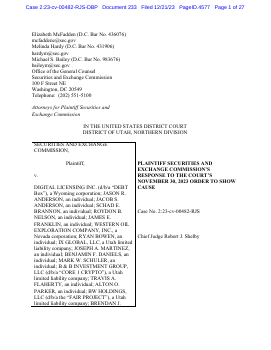
The SEC has filed its response to the Order to Show Cause in the Debt Box case. https://storage.courtlistener.com/recap/gov.uscourts.utd.141167/gov.uscourts.utd.141167.233.0.pdf

#233 in Securities and Exchange Commission v. Digital Licensing (D. Utah, 2:23-cv-00482) – CourtListener.com RESPONSE TO ORDER TO SHOW CAUSE re 215 Order to Show Cause filed by Securities and Exchange Commission. (Attachments: # 1 Exhibit Declaration of Joseph Watkins, # 2 Exhibit Declaration of Laurie Abbott, # 3 Exhibit Declaration of Michael Welsh, # 4 Exhibit Declaration of Tracy Combs, # 5 Exhibit Declaration of Casey Fronk, # 6 Exhibit Declaration of Gurbir Grewal)(Hardy, Melinda) (Entered: 12/21/2023) courtlistener.com
Saved - December 21, 2023 at 2:20 PM
reSee.it AI Summary
The SEC faced criticism for acting arbitrarily and capriciously in ignoring a court's deadline to fix stock buyback rules. Additionally, the SEC declined to comment on whether syndicated loans are securities, allegedly due to lobbying from large banks.

@s_alderoty - Stuart Alderoty

ICYMI more news and courtroom rebukes this week about our broken SEC: 1: a Federal Appeals Court found the SEC acted “arbitrarily and capriciously” after ignoring the Court’s deadline to correct deficiencies in its stock buyback rules. Chamber of Commerce v SEC (5th Cir.) https://t.co/3UIysFm8yR

@s_alderoty - Stuart Alderoty

2: the Sup Ct was told the SEC declined a lower court’s invitation to weigh in on whether syndicated loans (a $3T industry led by JPM Chase) are securities after "intense industry lobbying" from large banks. Kirschner v. JPM Chase (Petition for Cert). https://t.co/w5sVF5m16n

Saved - December 1, 2023 at 8:24 PM
reSee.it AI Summary
The SEC faces criticism: - Court calls out SEC for inconsistent arguments and lack of adherence to the law. SEC v Ripple, 7/12/22 - Court agrees SEC failed to respond in good faith to Coinbase's crypto rulemaking petition. In Re: Coinbase, 6/6/23 - Court deems SEC's treatment of similar products as arbitrary and capricious. Grayscale v SEC, 8/29/23 - Court demands explanation from SEC for false and misleading representations. SEC v Debt Box, 11/30/23.

@s_alderoty - Stuart Alderoty

A troubling pattern emerges: - Court finds the SEC demonstrated “hypocrisy” by making inconsistent arguments to the Court and not acting out of a “faithful allegiance to the law.” SEC v Ripple, 7/12/22 - Court agrees that the SEC defaulted on its duty to respond in good faith to Coinbase’s petition for crypto rulemaking. In Re: Coinbase, 6/6/23 - Court finds that the SEC’s “inconsistent treatment of similar products is arbitrary and capricious.” Grayscale v SEC, 8/29/23 - Court orders SEC to show cause why it should not be sanctioned for making false and misleading representations to the Court. SEC v Debt Box, 11/30/23

Saved - November 16, 2023 at 3:38 PM
reSee.it AI Summary
The SEC faces criticism from judges, the government's auditor, and for hiding info about meetings with a felon. Gensler, the head, denies fault but resembles an insulated Col. Jessep. Apologies to Jessep for the comparison. The SEC's international relevance is waning.

@s_alderoty - Stuart Alderoty

The SEC is losing in court; being criticized by Judges for shady behavior; being rebuked by the Gov’t’s internal auditor; hiding info about meetings with a felon; becoming irrelevant on the international stage. Gensler - admitting no fault - has become the insulate Col. Jessep. https://t.co/vqjPPcifr8

@s_alderoty - Stuart Alderoty

And apologies to Col. Jessep for that comparison.

Saved - October 4, 2023 at 1:07 AM

@s_alderoty - Stuart Alderoty

The Court’s July 13 ruling was, and remains, the law of the land. XRP is not a security.

@FilanLaw - James K. Filan 🇺🇸🇮🇪

#XRPCommunity #SECGov v. #Ripple #XRP BREAKING: Judge Torres has DENIED the SEC’s Motion to File an Interlocutory Appeal. https://www.dropbox.com/scl/fi/a1zks8vhptcf40vo6a7gc/Order-Denying-SEC-Motion-to-File-Interlocutory-Appeal.pdf?rlkey=v1gdwavgqwzi0bnxmmpqe0kgl&dl=0

Order Denying SEC Motion to File Interlocutory Appeal.pdf Shared with Dropbox dropbox.com
Saved - September 28, 2023 at 12:01 PM

@s_alderoty - Stuart Alderoty

A must watch. For hours Mr. Gensler smugly evaded question after question (even laughing about how rich he is) until Rep. Torres took him out with a command of the law and a touch of South Bronx street sense. Gensler didn’t know what hit him until it was too late.

@RepRitchie - Rep. Ritchie Torres

I cross-examined @SECGov Chair Gary Gensler about the term 'investment contract', which is key to determining his authority over crypto. Gensler struggled to answer basic questions like whether an investment contract requires a contract. His evasions are deafening and damning.

Video Transcript AI Summary
The speaker expresses concern about the term "investment contract" and its potential for arbitrary enforcement in the context of cryptocurrency. They question whether an investment contract requires an actual contract and refer to the Supreme Court's definition, which includes an investment of money in a common enterprise with anticipated profits from the efforts of others. The speaker argues that a scheme or transaction does not necessarily mean the absence of a contract, citing the SEC v. Howie case as an example. They challenge the other speaker to provide a Supreme Court case that found an investment contract without an actual contract, but the other speaker fails to do so. The conversation also touches on the question of whether purchasing a Pokemon card or a tokenized Pokemon card on a digital exchange constitutes a security transaction.
Full Transcript
Speaker 0: Thank you, Mr. Chair. Mr. Gensler, good morning. I worry that the term investment contract has become so infinitely malleable and manipulable that it means whatever you unilaterally thinks it ought to mean, right? I worry that when it comes to crypto, your interpretation of the term investment contract has no limiting principle and therefore could invite arbitrary and capricious enforcement actions. So I want to take a few minutes to explore the concept of investment contract in greater depth. And I want to start with an obvious definitional question. We know that an investment contract requires an investment. Does an investment contract require a contract? Speaker 1: Something about this definition I will quote Thurgood Marshall, Congress painted with a broad brush. And when Marshall said that he was writing the law of the land. So we follow this how we test and how not just Marshall, but other courts interpreted it. And it has a 4 part, 4 component? Speaker 0: Again, I did not go to MIT, but in the Bronx, if I ask whether an investment contract includes a contract. The answer is typically yes or no. So Speaker 1: Actually, sir, under the Supreme Court law of the land, they do not write that in. They it's an investment of money in a common enterprise, and you're anticipating profits based on the efforts of others. So I took an oath to follow the law of the land and that's the Supreme Court law of the land. Speaker 0: So, in Howie, the Supreme Court refers to an investment contract as a contract, scheme or transaction. That was the terminology that I saw in the case. And as far as I can tell, there's nothing in the Supreme Court's jurisprudence that suggests that a scheme or transaction means the absence of a contract. And so by way of illustration, so considered the landmark case of SEC versus Howie. In the Howie case, it was not a single contract, but there were 2 contracts, a land sales contract with the Howey Company and a service contract with Howey in the Hills. And the court found that the combination of those 2 contracts, the total scheme, the total transaction, the total economic reality was constitutive of an investment contract. And so a scheme or transaction does not mean the absence of any contract at all. It means, as it did in Howie, a multiplicity of contracts. In August, there were 6 law professors from law schools as preeminent as Yale, who came to the following conclusion, No decision of the Supreme Court has ever found that a scheme that does not involve a contract could qualify as an investment contract. And so do you disagree with that statement? And if so, could you please cite a decision of the Supreme Court that has found an investment contract in the absence of an actual contract? Speaker 1: The SEC has been in front of multiple courts and investment contract has been Speaker 0: what's the name of the case, Mr. Gensler? The Supreme Court case that has found an investment contract in the absence of an actual contract. Can you cite a case? Speaker 1: The SDC, over the decades, whether it's Can Speaker 0: you cite a Speaker 1: case? Whether it's whiskey caskets, whether it's crypto, If the public is investing based upon the efforts of others Speaker 0: I find it telling that you cannot cite a single case. Speaker 1: Just security. Speaker 0: Not a single how about a 2nd Circuit case? Can you cite a single 2nd Circuit case that found an investment contract in the absence of a contract? Speaker 1: I understand where you're trying to go. Low. And I'm going to leave that to the very fine attorneys at the SEC in front of courts. But I'm saying the core principle This Speaker 0: is a let me finish. Let me finish. This is a question to which you should know the answer, because the definition of an investment contract is the central issue. That's what determines the extent of your authority. That's what determines the applicability of federal securities law to crypto transactions. And your inability to answer that question is baffling to me. Speaker 1: I'm answering it consistent with what the Supreme Court has said, which is the law of the land is a Four part ten. Speaker 0: And yet you cannot cite a single case to support your Speaker 1: argument. It's called Reeves. It's called many cases that the Supreme Court, sir. 8 or 9 times it's been affirmed by the Can I ask, suppose Speaker 0: I would have purchased a Pokemon card, would doing so constitute a security transaction? Speaker 1: You can purchase a Pokemon card. It's, I don't know what the context is, but if you're just purchasing a Pokemon card Speaker 0: If I purchased a Pokemon card, is that a security transaction? Speaker 1: That's not a security. Speaker 0: Okay. If I were to purchase a tokenized Pokemon card on a digital exchange via a blockchain, is that a security transaction? Speaker 1: I'd have to know more. Okay. Speaker 0: So for you, the process of tokenization is what transforms a non security transaction into a security transaction. Speaker 1: Look, if the investing Speaker 0: I thought you were technology neutral. Speaker 1: If the investing public is anticipating profits based upon the efforts of others and they're exchanging fines that the court To Speaker 0: see, my time has expired.
Saved - September 27, 2023 at 3:07 AM
reSee.it AI Summary
The SEC Chair's upcoming testimony may include misleading claims about crypto assets as securities. However, a court decision in the Ripple case clarifies that XRP, as a digital token, does not meet the requirements of an investment contract. Tokens themselves are not inherently investment contracts.

@s_alderoty - Stuart Alderoty

1/ The SEC Chair will go to Congress tomorrow and lie by stating that there is such a thing as a “crypto asset securities market” and tokens themselves are investment contracts.

@s_alderoty - Stuart Alderoty

2/ Perhaps just one representative will read this line from the Court’s 7/13/23 decision in the Ripple case: “XRP, as a digital token, is not in and of itself a “contract, transaction[,], or scheme” that embodies the Howey requirements of an investment contract.

Saved - July 31, 2023 at 3:49 PM

@s_alderoty - Stuart Alderoty

Welcome to O̵f̵f̵i̵c̵e̵ After Hours with me! Let’s clear up this confusion about securities, investment contracts and digital assets.

Video Transcript AI Summary
Digital assets, such as orange groves, whiskey barrels, pay phones, and beavers, can be packaged into investment contracts that may be considered securities. A share of stock is always a security because it comes with fiduciary duties from the company. However, an investment contract is different from a traditional share of stock. It involves selling promises to increase the value of the investment, like cultivating orange groves and distributing profits. Digital tokens, on their own, are not securities but can be used as virtual currency or commodities. The Securities and Exchange Commission (SEC) only has jurisdiction over securities, not other assets like orange groves. Claiming jurisdiction where there is none is a political power play that doesn't benefit anyone.
Full Transcript
Speaker 0: What do digital assets have to do with orange groves, barrels filled with whiskey, pay phones, who remembers those? And beavers? Well, it turns out a lot. None of those things, standing alone, are securities, but Any one of them can be packaged into a contract for an investment that may be a security. Let me break this down a bit. The law lists a bunch of things that are securities. That list includes things you ordinarily think of, like a share of stock. Why is the share of stock always a security? If you own a share of stock in, let's say, Apple, Apple owes you a fiduciary duty. And you can hold Apple accountable if they don't fulfill those obligations. That's true no matter how you bought the stock or who sold it to you. But the law also includes something called an investment contract in the list of things considered a security. An investment contract is not like a traditional share of stock. And anyone who tells you that, Well, let's just say they're trying to confuse you. Investment contracts are contracts that I sell to you with the promise that I'm going to take the money you gave me and do things to increase the value of your investment. I can take a bunch of orange groves and sell those to you. That's not an investment contract. Or I can sell you some of those orange groves as Part of a larger set of promises to cultivate those groves, sell the oranges and distribute the profits back to you. That's an investment contract. So orange groves alone, whether I sell them to you or you buy them on an exchange, no investment contract. The very same orange grows coupled with a promise that I sell directly to you, that I am going to work to make those orange grows profitable. That entire bundle of promises is an investment contract and therefore, a security. But the orange groves alone are still just orange grows. Some would like you to think that a digital token can in and of itself be a Digital asset security, it can't. Standing alone, it's just a commodity or a virtual currency. As a virtual currency, you may use it for a payment. As a commodity, you may trade it like gold or oil or pork bellies. Confused? Well, I don't blame you because some have been doing their best to confuse you for years. Because the Securities and Exchange Commission only has jurisdiction over securities, not orange groves, And they don't like that. Like a hammer, they want everything to be a nail. But the law doesn't work that way. While retail holders of crypto certainly deserve protection from bad actors, not all roads lead to the SEC. Pretending to have jurisdiction when there is none is simply a political power play. It helps no one. It hurts everyone. Remember, a token by itself, not an investment contract despite what the SEC would have you believe.
View Full Interactive Feed