reSee.it - Tweets Saved By @the_brumby

@the_brumby - Brumby
This will be my first and possibly last tweet (thread) as I am mostly here to learn. It is prompted by a recent study questioning lockdown efficacy that is getting a lot of attention. It appears people believe it to be the first of its kind, but I have been collecting similar
@the_brumby - Brumby
studies since March 2020. Below are 30 published papers finding that lockdowns had little or no efficacy (despite unconscionable harms) along with a key quote or two from each:
@the_brumby - Brumby
1.https://onlinelibrary.wiley.com/doi/abs/10.1111/eci.13484 “there is no evidence that more restrictive nonpharmaceutical interventions (“lockdowns”) contributed substantially to bending the curve of new cases in England, France, Germany, Iran, Italy, the Netherlands, Spain, or the United States in early 2020”
@the_brumby - Brumby
2.https://www.medrxiv.org/content/10.1101/2020.07.22.20160341v3 “Inferences on effects of NPIs are non-robust and highly sensitive to model specification. Claimed benefits of lockdown appear grossly exaggerated.”

@the_brumby - Brumby
3.https://www.thelancet.com/journals/eclinm/article/PIIS2589-5370(20)30208-X/fulltext “government actions such as border closures, full lockdowns, and a high rate of COVID-19 testing were not associated with statistically significant reductions in the number of critical cases or overall mortality”
@the_brumby - Brumby
4.https://advance.sagepub.com/articles/preprint/Comment_on_Dehning_et_al_Science_15_May_2020_eabb9789_Inferring_change_points_in_the_spread_of_COVID-19_reveals_the_effectiveness_of_interventions_/12362645 “Official data from Germany’s RKI agency suggest strongly that the spread of the coronavirus in Germany receded autonomously, before any interventions become effective”
@the_brumby - Brumby
5.https://arxiv.org/pdf/2005.02090.pdf “the decline in infections in England...began before full lockdown…[S]uch a scenario would be consistent with...Sweden, which began its decline in fatal infections shortly after the UK, but did so on the basis of measures well short of full lockdown”
@the_brumby - Brumby
6.https://www.datascienceassn.org/sites/default/files/Illusory%20Effects%20of%20Non-pharmaceutical%20Interventions%20on%20COVID19%20in%20Europe.pdf “the UK lockdown was both superfluous (it did not prevent an otherwise explosive behavior of the spread of the coronavirus) and ineffective (it did not slow down the death growth rate visibly).”

@the_brumby - Brumby
7.https://www.timesofisrael.com/the-end-of-exponential-growth-the-decline-in-the-spread-of-coronavirus/ “Given that the evidence reveals that the Corona disease declines even without a complete lockdown, it is recommendable to reverse the current policy and remove the lockdown”

@the_brumby - Brumby
8.https://www.medrxiv.org/content/10.1101/2020.05.01.20088260v2 “stay at home orders, closure of all non-essential businesses and requiring the wearing of facemasks or coverings in public was not associated with any independent additional impact”
@the_brumby - Brumby
9.https://www.medrxiv.org/content/10.1101/2020.04.24.20078717v1 “these strategies might not have saved any life in western Europe. We also show that neighboring countries applying less restrictive social distancing measures … experience a very similar time evolution of the epidemic.”
@the_brumby - Brumby
“since the full lockdown strategies are shown to have no impact on the epidemic’s slowdown, one should consider their potentially high inherent death toll as a net loss of human lives”
@the_brumby - Brumby
10.https://www.medrxiv.org/content/10.1101/2020.09.26.20202267v1 “the model does not support [the] estimate that lockdown reduced the case reproduction number R by 81% or that more than three million deaths were averted by non-pharmaceutical interventions.”
@the_brumby - Brumby
11.https://www.nicholaslewis.org/did-lockdowns-really-save-3-million-covid-19-deaths-as-flaxman-et-al-claim/ “The case of Sweden, where the authors find the reduction in transmission to have been only moderately weaker than in other countries despite no lockdown having occurred, is prima facie evidence”

@the_brumby - Brumby
12.https://www.bmj.com/content/371/bmj.m3588 “general social distancing was also projected to reduce the number of cases but increase the total number of deaths compared with social distancing of over 70 only” “Strategies that minimise deaths involve the infected fraction primarily being in the

@the_brumby - Brumby
low risk younger age groups—for example, focusing stricter social distancing measures on care homes where people are likely to die rather than schools where they are not.” “results presented in the report suggested that the addition of interventions restricting younger people
@the_brumby - Brumby
might actually increase the total number of deaths from covid-19”
@the_brumby - Brumby
13.https://www.medrxiv.org/content/10.1101/2020.03.30.20047860v3 “We show that [lockdown] is modestly superior in saving lives compared to [focused protection], but with tremendous costs to prevent one case of death. This might result in overwhelming economic effects that are expected to increase future death toll”
@the_brumby - Brumby
14.https://www.ncbi.nlm.nih.gov/pmc/articles/PMC2652751/ “For pathogens that inflict greater morbidity at older ages, interventions that reduce but do not eliminate exposure can paradoxically increase the number of cases of severe disease by shifting the burden of infection toward older individuals”

@the_brumby - Brumby
15.https://papers.ssrn.com/sol3/papers.cfm?abstract_id=3607803 “Current policy can be misdirected and can therefore have long and even short-term negative effects on human welfare and thus result in not actually minimizing death rates (incorporating externalities), especially in the long run.”

@the_brumby - Brumby
16.https://imgcdn.larepublica.co/cms/2020/05/21180548/JP-Morgan.pdf “For example, the data…shows a decrease in infection rates after countries eased...lockdowns with >99% statistical significance. Indeed...infection rates have declined after reopening even after allowing for an appropriate measurement lag.
@the_brumby - Brumby
This means that the pandemic and COVID-19 likely have its own dynamics unrelated to often inconsistent lockdown measures that were being implemented.”
@the_brumby - Brumby
17.https://jamanetwork.com/journals/jama/fullarticle/2768086 “restrictions imposed by the pandemic (eg, stay-at-home orders) could claim lives indirectly through delayed care for acute emergencies, exacerbations of chronic diseases, and psychological distress (eg, drug overdoses).” “In 14 states, more than 50%
@the_brumby - Brumby
of excess deaths were attributed to underlying causes other than COVID-19; these included California (55% of excess deaths) and Texas (64% of excess deaths)"
@the_brumby - Brumby
18.https://www.medrxiv.org/content/10.1101/2020.10.09.20210146v3 “We found that 180-day of mandatory isolations to healthy <60 (ie schools and workplaces closed) produces more final deaths if the vaccination date is later than (Madrid: Feb 23 2021; Catalonia: Dec 28 2020; Paris: Jan 14 2021; London: Jan 22 2021)”
@the_brumby - Brumby
19.https://papers.ssrn.com/sol3/papers.cfm?abstract_id=3665588 “Comparing weekly mortality in 24 European countries, the findings in this paper suggest that more severe lockdown policies have not been associated with lower mortality. In other words, the lockdowns have not worked as intended”
@the_brumby - Brumby
20.https://www.nber.org/papers/w27719 “Our findings … further raise doubt about the importance in NPI’s (lockdown policies in particular) in accounting for the evolution of COVID-19 transmission rates over time and across locations”

@the_brumby - Brumby
21.https://www.bmj.com/content/370/bmj.m3543 “[the] President...has flatly denied the seriousness of the pandemic, refusing to impose a lockdown, close schools, or cancel mass events…Yet the country’s death rate is among the lowest in Europe-just over 700 in a population of 9.5 million”
@the_brumby - Brumby
22.https://www.medrxiv.org/content/10.1101/2020.11.01.20222315v1 “living with children 0-11 years was not associated with increased risks of recorded SARS-CoV-2 infection, COVID-19 related hospital or ICU admission but was associated with reduced risk of COVID-19 death (HR 0.75, 95%CI 0.62-0.92).”
@the_brumby - Brumby
23.https://pandata.org/wp-content/uploads/2020/07/Exploring-inter-country-variation.pdf “Consistent with observations that .. lockdown has not been observed to effect the rate...of the country reproduction rates significantly, our analysis suggests there is no basis for expecting lockdown stringency to be an explanatory variable”

@the_brumby - Brumby
24.https://www.medrxiv.org/content/10.1101/2020.08.04.20168112v1#:~:text=The%20seroprevalence%20of%20COVID%2D19,care%20workers%20in%20Niger%20State. “This study shows that the virus is already here, and we must find ways of living with it such that it caused no or minimal human and socioeconomic losses in ... Nigeria as a whole…. going back to the lockdown should never again be entertained”
@the_brumby - Brumby
25.https://www.nejm.org/doi/full/10.1056/NEJMoa2029717 “recruits were under the constant supervision of Marine Corps instructors. Other settings in which young adults congregate are unlikely to reflect similar adherence to measures intended to reduce transmission."
@the_brumby - Brumby
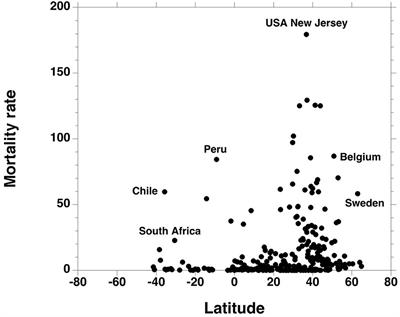
26.https://www.frontiersin.org/articles/10.3389/fpubh.2020.604339/full “The national criteria most associated with death rate are life expectancy and its slowdown, public health context (metabolic and non-communicable diseases (NCD) burden vs. infectious diseases prevalence), economy (growth national product, financial
@the_brumby - Brumby
support), and environment (temperature, ultra-violet index). Stringency of the measures settled to fight pandemia, including lockdown, did not appear to be linked with death rate”
@the_brumby - Brumby
27.https://www.tandfonline.com/doi/abs/10.1080/00779954.2020.1844786?journalCode=rnzp20 “Whether a county had a lockdown has no effect on Covid-19 deaths; a non-effect that persists over time. Cross-country studies also find lockdowns are superfluous and ineffective (Homberg 2020). This ineffectiveness may have several causes. "
@the_brumby - Brumby
28.upmc-biosecurity.org/website/resour… “There are no historical observations...that support.. confinement by quarantine of groups of possibly infected people for extended periods...The negative consequences...are so extreme…this mitigation..should be eliminated from serious consideration”
@the_brumby - Brumby
29.https://www.medrxiv.org/content/10.1101/2020.12.25.20248853v1 “we present data demonstrating that mortality due to covid-19... could have been largely predicted even before the pandemic hit Europe, simply by looking at longitudinal variability of all-cause mortality rates in the years preceding the...outbreak”
@the_brumby - Brumby
30.https://www.medrxiv.org/content/10.1101/2020.12.28.20248936v1 “Our analysis shows that while infection levels decreased, they did so before lockdown was effective, and infection numbers also decreased in neighbour municipalities without mandates”
@the_brumby - Brumby
There are of course anecdotal observations as well--e.g., Florida is doing better than California despite DisneyWorld having been open for months and California having no current plan to ever reopen anything, let alone Disneyland. I could do a similar thread on the harms of
@the_brumby - Brumby
lockdowns (and school closures in particular) but that seems unnecessary as such harms have been well documented. If lockdowns were extremely effective, their desirability from a policy perspective would at least be a conversation worth having. However, these papers suggest they
@the_brumby - Brumby
have limited effectiveness at best AND horrible side effects. @FatEmperor @kerpen @AlexBerenson @MonicaGandhi9 @ClayTravis @adamcarolla @markgeragos @NickHudsonCT @AJKayWriter @MartinKulldorff @J_GallagherAD3 @KevinKileyCA @pnjaban @justin_hart @RepMcClintock @MichaelYeadon3
@the_brumby - Brumby
@yinonw @Alex_Washburne @ianmSC @EthicalSkeptic @MLevitt_NP2013 @aginnt @sdbaral @NahasNewman @VPrasadMDMPH @michaeljburry
@the_brumby - Brumby
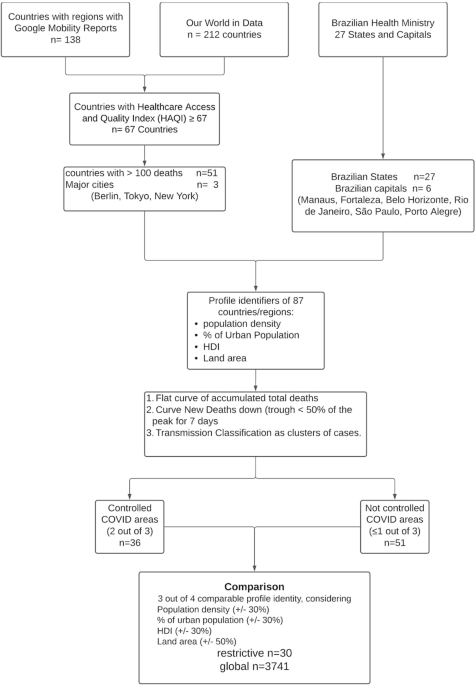
31. https://www.nature.com/articles/s41598-021-84092-1 "After preprocessing the data, 87 regions around the world were included, yielding 3741 pairwise comparisons for linear regression analysis...we were not able to explain if COVID-19 mortality is reduced by staying at home in ~ 98% of the comparisons”
@the_brumby - Brumby
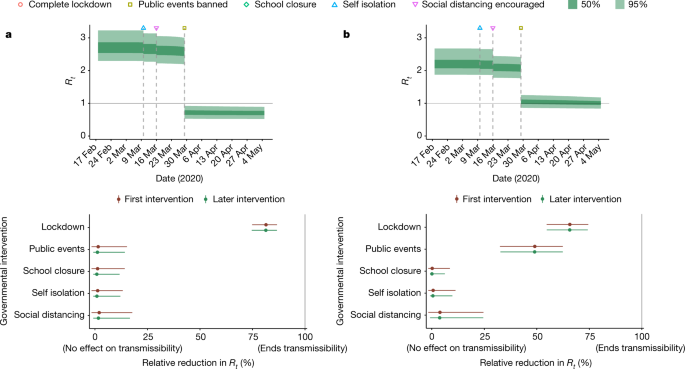
32. https://www.nature.com/articles/s41586-020-3025-y "Sweden is worthy of particular attention, given...no lockdown took place.” “Notably, the estimated effectiveness of…[merely a]…public events ban in Sweden is comparable to that of lockdown in the 10 countries in which one was implemented”
@the_brumby - Brumby
33. ssbhalla.org/wp-content/upl… "For the first time in human history, lockdowns were used as a strategy to counter the virus. While conventional wisdom, to date, has been that lockdowns were successful…we find not one piece of evidence supporting this claim.”
@the_brumby - Brumby
34. https://papers.ssrn.com/sol3/papers.cfm?abstract_id=3764553 "on average, mandated behavioral changes accounts for only 9% (median: 0%) of the total effect on the growth of the pandemic stemming from behavioral changes. The remaining 91% (median: 100%) of the effect was due to voluntary behavioral changes”
@the_brumby - Brumby
35. https://bmjopen.bmj.com/content/bmjopen/11/2/e042034.full.pdf "Potential determinants assessed were…the stringency index, as a measure of country-level response to COVID-19” Results? Shotgun blast (zero correlation):

@the_brumby - Brumby
36. https://www.medrxiv.org/content/10.1101/2020.07.05.20146837v2 "The decline of infections...can be attributed to relatively small interventions & voluntary behavioral changes. Additional effects of later interventions cannot be detected [&]...liberalizations of measures did not induce a re-increase of infections"
@the_brumby - Brumby
37. https://www.heritage.org/public-health/report/comparative-analysis-policy-approaches-covid-19-around-the-world "The evidence suggests that, among other important findings, broad lockdown orders that fail to focus primarily on the most vulnerable members of the population—particularly the elderly—have not produced superior outcomes to less restrictive policies”

@the_brumby - Brumby
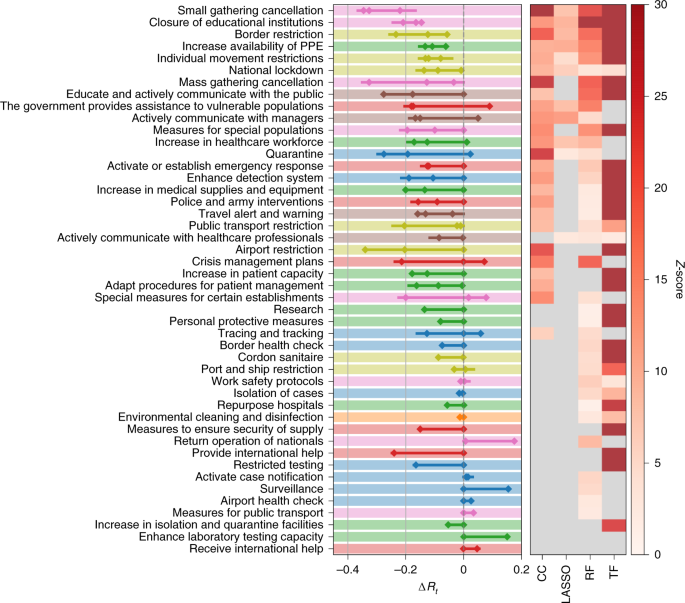
38. https://www.nature.com/articles/s41562-020-01009-0 "measures can substitute for a full lockdown in terms of effectiveness, while reducing adverse impacts on society, the economy, [humanity]” “Less disruptive & costly NPIs can be as effective as more intrusive, drastic, ones (eg, a national lockdown).”
@the_brumby - Brumby
39. https://www.medrxiv.org/content/10.1101/2020.08.14.20175240v1.full.pdf "The peculiar aspect of the claim that lockdown accounts for 81% of the reduction in R is that Sweden did not implement any lockdown, but still see a similar decrease in R as the other countries”
@the_brumby - Brumby
40. https://www.medrxiv.org/content/10.1101/2020.06.26.20140814v2.full.pdf "It is evident...that the growth of a COVID19 epidemic does not follow an exponential growth law even in the very first days, but instead its growth is slowing down exponentially with time...it is decelerating from the first day"
@the_brumby - Brumby
41.https://www.medrxiv.org/content/10.1101/2020.09.21.20198796v1.full.pdf "Japan took the atypical step of not instituting a mandatory lockdown. During this time, businesses, restaurants, & transportation were kept open, & public life continued relatively unabated. Nevertheless, the second wave peaked and subsided on its own”
@the_brumby - Brumby
42.https://www.medrxiv.org/content/10.1101/2021.03.02.21252734v1.full.pdf "We found no evidence that the shielding program [extreme lockdown] per se reduced COVID rates” “The effectiveness of shielding vulnerable individuals was limited by the inability to control transmission in hospital & from other adults in the household”
@the_brumby - Brumby
43.https://c2cjournal.ca/2021/03/do-lockdowns-make-a-difference-in-a-pandemic/ "The stay-at-home orders...seem to have made no observable tangible impact on the daily cases & deaths. Further the most severe restrictions, such as prolonged lockdown...in California in Nov, did not prevent the subsequent spike in cases or fatalities"

@the_brumby - Brumby
44.https://www.thelancet.com/journals/lanpub/article/PIIS2468-2667(21)00036-0/fulltext "governments need to...apply available measures in a way that is much more targeted to different generational groups...; from March to June, 2020, 96% of additional deaths related to COVID-19 in Europe occurred in patients aged older than 70 years."
@the_brumby - Brumby
45. https://www.jclinepi.com/article/S0895-4356(21)00087-1/fulltext "We demonstrate that effects of NPIs are non-robust and highly sensitive to model specification, assumptions and data employed to fit models." "The model proposing major benefits from lockdown in European countries had the worse fit to the data"
@the_brumby - Brumby
46.https://www.pnas.org/content/118/15/e2019706118 "Shelter-in-place [SIP] orders had no detectable health benefits, [&] only modest effects on behavior" "We reanalyze 2 prior studies purporting...that SIP orders caused large reductions in disease prevalence & show that those results are not reliable."
@the_brumby - Brumby
47. https://www.bmj.com/content/372/bmj.n608 "of those who reported having experienced symptoms of covid-19 in the past seven days...only 20.2%...said they had not left home since developing symptoms" "Non-adherence was associated with...lower socioeconomic grade...and working in a key sector"
@the_brumby - Brumby
48.https://papers.ssrn.com/sol3/papers.cfm?abstract_id=3784709"life loss due to lockdowns themselves has never been taken into consideration" "pro-lockdown evidence is shockingly thin & based largely on comparing real-world outcomes against dire computer-generated forecasts derived from empirically untested models"
@the_brumby - Brumby
49.https://www.medrxiv.org/content/10.1101/2021.02.03.21251112v2.full.pdf "All regions have peak incidence prior to the first lockdown with total incidence for England in decline well before lockdown" "Furthermore all regions have R < 1 by either lockdown, with average R < 1 some days before either lockdown"
@the_brumby - Brumby
50. https://papers.ssrn.com/sol3/papers.cfm?abstract_id=3706464 "social isolation at a given date showed a strong positive correlation to COVID-19 deaths 39 days later" "strong empirical evidence that..adoption of restrictive measures increasing social isolation have worsened the pandemic..instead of mitigating it"
@the_brumby - Brumby
51. https://papers.ssrn.com/sol3/papers.cfm?abstract_id=3782395 "Lockdowns are associated with reduced mortality in ...modelling studies but NOT in studies based on empirical data" "deaths associated with economic harms or underfunding of other health issues may outweigh the deaths that lockdowns save"
@the_brumby - Brumby
52. sfu.ca/~allen/Lockdow… "most of the early [lockdown] cost/benefit studies arrived at conclusions that were refuted later by data" "cumulative deaths per million, & the pattern of daily deaths per million, is not negatively correlated with the stringency of lockdown"
@the_brumby - Brumby
53. https://www.heritage.org/sites/default/files/2021-03/SR243.pdf "shelter-in-place orders did not help stave off achieving higher per capita mortality thresholds (20 deaths per mil) than they helped delay reaching lower levels" "[SIP] orders during this pandemic is tantamount to killing a fly with a sledgehammer"

@the_brumby - Brumby
54. https://www.nber.org/system/files/working_papers/w28737/w28737.pdf?utm_campaign=PANTHEON_STRIPPED&%3Butm_medium=PANTHEON_STRIPPED&%3Butm_source=PANTHEON_STRIPPED "evidence contradicts the public-health ideal in which households would be places of solitary confinement & zero transmission. Instead, the evidence suggests that households show the highest transmission rates & that households are high-risk settings"
@the_brumby - Brumby
55. https://www.pnas.org/content/pnas/118/15/e2019706118.full.pdf "The previously presented evidence on the effectiveness of SIP orders appears to be misleading, and there is currently no compelling evidence to suggest that SIP policies saved a large number of lives or significantly mitigated the spread of COVID-19"
@the_brumby - Brumby
56. https://www.covid19.statistik.uni-muenchen.de/pdfs/codag_bericht_16.pdf [German translation]:"With the R-values, there is no direct connection w the taken measures - neither with the lockdown light on 2 November, the tightening on 16 December, or still w the 'Federal Emergency Brake' which was adopted at the end of April"
@the_brumby - Brumby
57. https://europepmc.org/article/ppr/ppr312490#R2 "the early evening curfew led to more crowding in indoor spaces – which may facilitate the spread of disease. Interventions should be based on a thorough analysis of human behavior, that anticipates substitution of activities"

@the_brumby - Brumby
58. https://papers.ssrn.com/sol3/papers.cfm?abstract_id=3764553 "there is little doubt that the effect of the lockdowns in spring of 2020 was modest" "economic lockdown...will therefore most often be met by more risky behavior among citizens [&]...be followed by an increase in infections in other parts of society"
@the_brumby - Brumby
59. https://www.nber.org/papers/w28930 "we fail to find that [shelter-in-place] SIP policies saved lives. To the contrary, we find a positive association between SIP policies and excess deaths. We find that following the implementation of SIP policies, excess mortality increases"
@the_brumby - Brumby
60. https://www.dovepress.com/whether-county-lockdown-could-deter-the-contagion-of-covid-19-in-the-u-peer-reviewed-fulltext-article-RMHP#cit0021 "We study 3073 Counties...to understand whether lockdown...is an effective approach [and]..reach a conclusion that a county lockdown...plays no important role in containing the spread...This result also echoes other research of invalidity of lockdown"

@the_brumby - Brumby
61. https://papers.ssrn.com/sol3/papers.cfm?abstract_id=3872861 "the costs of the lockdown are 25 times greater than the benefits, including the cost of an additional 4,536 statistical lives" "Furthermore, each of the individual costs taken on their own are greater than the total benefits of lockdown"
@the_brumby - Brumby
62. https://www.medrxiv.org/content/10.1101/2021.07.06.21260077v1 "Decreases in mobility were found to increase, rather than decrease case growth rates, consistent with arguments that within-household transmission–resulting from spending more time at residences due to mobility restrictions–may outweigh the benefits"
@the_brumby - Brumby
63. https://osf.io/s9z2p/ "if NPIs were consistently effective, measures should be anti-correlated with case numbers, i.e., the more stringent the NPIs, the greater the ensuing fall in cases. However...the stringency of NPIs is [instead] partially correlated to case numbers"

@the_brumby - Brumby
64. https://www.tandfonline.com/doi/full/10.1080/00036846.2021.1955089 "at best, lockdown had no significant impact on net mortalities; and under our..[analysis]...is associated with a significant net increase in mortalities" "a substantial proportion of COVID-19 deaths may be largely invariant to blanket lockdowns"
@the_brumby - Brumby
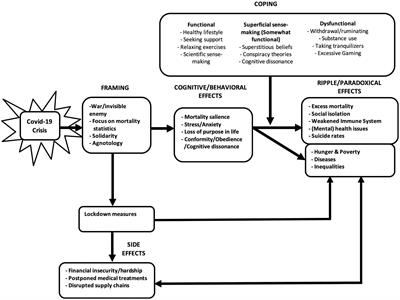
65. https://www.frontiersin.org/articles/10.3389/fpsyg.2020.577740/full "lockdowns may have more negative effects than positive effects. [eg] many measures taken in a lockdown aimed at protecting human life may compromise the immune system,& purpose in life, esp. of vulnerable groups...including the ones we aim to protect"
@the_brumby - Brumby
66. https://www.medrxiv.org/content/10.1101/2021.06.14.21258886v1.full.pdf "The majority of the variation in COVID-19 rates between nations is explained by median age, obesity rate, and island status"
@the_brumby - Brumby
67.https://www.frontiersin.org/articles/10.3389/fpubh.2021.715904/full "Many studies found that more restrictive lockdowns in diff. international locations were not associated w/any clear effect on 'flattening-the-curve'” "lockdowns cannot markedly reduce transmission as people continue to carry out...essential activities"

@the_brumby - Brumby
68. https://sites.krieger.jhu.edu/iae/files/2022/01/A-Literature-Review-and-Meta-Analysis-of-the-Effects-of-Lockdowns-on-COVID-19-Mortality.pdf "While this meta-analysis concludes that lockdowns have had little to no public health effects, they have imposed enormous economic & social costs where they have been adopted. In consequence, lockdown policies are ill-founded and should be rejected"