TruthArchive.ai - Tweets Saved By @tommy_cleary

Saved - February 1, 2025 at 10:20 AM
reSee.it AI Summary
Holmes analyzed the submission of 60 viruses in a 2018 preprint, revealing only 163 of a potential 180 sequences were included. Current data shows 154 sequences in GenBank, with interruptions in submissions dating from October 2019. This raises questions about 9 missing ORF8 genes and several S genes. The conversation highlights ongoing efforts to recover this missing data, suggesting that the disclosures may be incomplete and emphasizing the need for thorough verification in scientific research.

@tommy_cleary - Tommy Cleary

Holmes attempted <> methods, ...with his Twitter thread on March 6th 2023, ...as evidence that the 60 viruses submitted as part of a preprint, together with Prof Jie Cui and ZLShi of WIV, were complete but only 163 of a potential 180 sequences were part of this 12-JUL-2018 PrePrint? Only 154 of those are in the current GI series available to be recovered... as far as I know...with this current GI series of 154 submissions is interrupted by submissions dated 25-OCT-2019 and the ACCESSION series continuing from the last, with <> to <> which is unrelated but dated Jul 13, 2019 08:18 PM. https://ncbi.nlm.nih.gov/nuccore/MH615993.1?report=girevhist This suggests that the original GenBank submission, perhaps actually of 180 sequences, was cropped to 163 and given new ACCESSION numbers one year after it was submitted...with the cropped series of 163 placed in their current GI position on 25-OCT-2019...but what of the missing 9 ORF8 from this GI series? Methods: basic GI series analysis this post GI is 1769824416 https://ncbi.nlm.nih.gov/nuccore/1769824416 ...next will be 1769824414 So <> is the next missing OFR8 gene for <> GenBank submission from @syd_health 's & @Sydney_Uni 's Prof Edward Holmes @EdwardCHolmes to GenBank of @NLM_NIH soon to be headed by @DrJBhattacharya So now I am trying to help Holmes & @syd_health recover the missing data NOW tally is at eleven missing ORF8 and three missing S genes... where for <> RdRp is the there: https://ncbi.nlm.nih.gov/nuccore/MH615889.1?report=genbank and S gene is there but supressed: https://www.ncbi.nlm.nih.gov/nuccore/1769824528 but no ORF8 gene in this GI series Why? Missing ORF8 tally so far: 1) Rs151334_Guizhou 2) Rf131405_Shanxi 3) Rs140400_Guangdong 4) Rs141456_Guangxi 5) Rspp7924_Yunnan 6) Rspp7921_Yunnan 7) Ra7909_Yunnan 8) Rspp7907_Yunnan 9) Rspp7905_Yunnan 10) Rspp7896_Yunnan 11) Rs6303_Yunnan of a total of 15 missing... Question: Was <> in the 60-54= 6 ORF8 that <> decided to leave out of this 2018 PrePrint... ? https://web.archive.org/web/20220809085043/https://www.ncbi.nlm.nih.gov/nuccore/?term=Spread+and+Geographic+Structure+of+SARS-related+Coronaviruses+in+++++++++++++Bats+and+the+Origin+of+Human+SARS+Coronavirus ...or perhaps the 54-45= 9 ORF8 that are simply missing from the GI series suppressed in GenBank & interrupted by the date 25-Oct-2019? With S genes missing too; of the 60 RdRp sampled only 49 S genes are here in this GI series...Why? 1) Rspp7921_Yunnan 2) Rspp7907_Yunnan 3) Rspp7896_Yunnan of 11 S genes left out of this study. Why? <> S gene is there but seems quite different to others. Why? All this so far indicates that the 2023 @COVIDSelect disclosures of Holmes are potentially incomplete...but the count continues... next search is GI 1769824414! Taxonomy browser (Bat SARS-like coronavirus) https://archive.md/qgC9W#selection-2037.0-2081.1

Nucleotide - NCBITwitterFacebookLinkedInGitHubNCBI Insights BlogTwitterFacebookYoutube ncbi.nlm.nih.gov
Record suppressed: Bat SARS-like coronavirus strain Rs6303_Yunnan RNA-dependent RNA polym - Nucleotide - NCBITwitterFacebookLinkedInGitHubNCBI Insights BlogTwitterFacebookYoutube ncbi.nlm.nih.gov
Record suppressed: Bat SARS-like coronavirus strain Rs6303_Yunnan spike protein (S) gene, - Nucleotide - NCBITwitterFacebookLinkedInGitHubNCBI Insights BlogTwitterFacebookYoutube ncbi.nlm.nih.gov
Spread and Geographic Structure of SARS-related Coronaviruses in Bats - Nucleotide - NCBITwitterFacebookLinkedInGitHubNCBI Insights BlogTwitterFacebookYoutube web.archive.org

@tommy_cleary - Tommy Cleary

One more before I put the roast on for Australia Day dinner... @GrahamPerrettMP is my local Federal MP and he has helped in the past, but last time I wrote to him he replied that I should check the Queensland State Library for more details...perhaps I should check back with him again too. These issues of how to handle the dangerous side of science have been a problem since at least Iraq's @UN biological weapons inspections...with discussions of Mustard brought to the table by @R_H_Ebright thank you, @INTERPOL_CBRNE questions are important. H/t @CharlesRixey @Ayjchan @Globalbiosec Holmes attempted <> methods, ...with his Twitter thread on March 6th 2023, ...as evidence that the 60 viruses submitted as part of a preprint, together with Prof Jie Cui and ZLShi of WIV, were complete... but only 163 of a potential 180 sequences were part of this 12-JUL-2018 PrePrint? https://web.archive.org/web/20220809085043/https://www.ncbi.nlm.nih.gov/nuccore/?term=Spread+and+Geographic+Structure+of+SARS-related+Coronaviruses+in+++++++++++++Bats+and+the+Origin+of+Human+SARS+Coronavirus Only 154 of those are in the current GI series available to be recovered... as far as I know...with this current GI series of 154 submissions is interrupted by submissions dated 25-OCT-2019 and the ACCESSION series continuing from the last, with <> to <> which is unrelated but dated Jul 13, 2019 08:18 PM. https://ncbi.nlm.nih.gov/nuccore/MH615993.1?report=girevhist This suggests that the original GenBank submission, perhaps actually of 180 sequences, was cropped to 163 and given new ACCESSION numbers one year after it was submitted...with the cropped series of 163 placed in their current GI position on 25-OCT-2019...but what of the missing 9 ORF8 from this GI series? KISS Methods: basic GI series analysis this post GI is 1769824414 anyone can do this... https://ncbi.nlm.nih.gov/nuccore/1769824414 but with <> nothing is missing, all three sets are there in GenBank ORF8, S and RdRp...and apparently has identical RBD to As6526? <> https://www.ncbi.nlm.nih.gov/nuccore/KY417142 So...next will be 1769824412 <> also all three accounted for too and even features in the <>... https://www.ncbi.nlm.nih.gov/nuccore/MH615887.1?report=girevhist So, next is 1769824410...Bingo! <> ORF8 missing! So <> is the next missing OFR8 gene for <> GenBank submission from @syd_health 's & @Sydney_Uni 's Prof Edward Holmes @EdwardCHolmes to GenBank of @NLM_NIH soon to be headed by @DrJBhattacharya @secrubio & @RobertKennedyJr in the mix too. So now I am trying to help Holmes & @syd_health recover the missing GenBank data...for everyone that hungers for a slice of truth tune in... NOW tally is at twelve missing ORF8 and three missing S genes... where for <> RdRp is the there: https://www.ncbi.nlm.nih.gov/nuccore/MH615886.1?report=genbank and S gene is there but suppressed: https://www.ncbi.nlm.nih.gov/nuccore/1769824532 but no ORF8 gene in this GI series Why? Missing ORF8 tally so far: 1) Rs151334_Guizhou 2) Rf131405_Shanxi 3) Rs140400_Guangdong 4) Rs141456_Guangxi 5) Rspp7924_Yunnan 6) Rspp7921_Yunnan 7) Ra7909_Yunnan 8) Rspp7907_Yunnan 9) Rspp7905_Yunnan 10) Rspp7896_Yunnan 11) Rs6303_Yunnan 12) Rs6266_Yunnan of a total of 15 missing... Question: Was <> in the 60-54= 6 ORF8 that <> decided to leave out of this 2018 PrePrint... ...or perhaps the 54-45= 9 ORF8 that are simply missing from the GI series suppressed in GenBank & interrupted by the date 25-Oct-2019? With S genes missing too; of the 60 RdRp sampled only 49 S genes are here in this GI series...Why? 1) Rspp7921_Yunnan 2) Rspp7907_Yunnan 3) Rspp7896_Yunnan of 11 S genes left out of this study. Why? <> S gene is there but seems quite different to others. Why? All this so far indicates that the 2023 @COVIDSelect disclosures of Holmes are potentially incomplete...but the count continues... next search is GI 1769824408! Taxonomy browser (Bat SARS-like coronavirus) https://archive.md/qgC9W#selectio ...speaking of things that are difficult to understand... Any idea of how it is that @BrookeNGenovese reasonable Sep 2020 appeal to have the suspended@Twitteraccounts for:@PREDICTProject@OneHealthLabs@GlobalVirome@HALIUCDavis has gone? Perhaps some are up & running, perhaps others are still suppressed? <<@TwitterSupport also, the lab’s account @OneHealthLab &the Global Virome Project @GlobalVirome are similarly suspended..since June...despite repeated attempts to resolve. 🤨 @Twitter oh and the @HALIUCDavis account, too. Anyone noticing a theme here...?>> How is @RogerMarshallMD & @COVIDSelect going to discuss this issue with the public if the terms are suppressed? Things to chew over dinner roast?

Spread and Geographic Structure of SARS-related Coronaviruses in Bats - Nucleotide - NCBITwitterFacebookLinkedInGitHubNCBI Insights BlogTwitterFacebookYoutube web.archive.org
Nucleotide - NCBITwitterFacebookLinkedInGitHubNCBI Insights BlogTwitterFacebookYoutube ncbi.nlm.nih.gov
Record suppressed: Bat SARS-like coronavirus strain Rs160665_Yunnan RNA-dependent RNA pol - Nucleotide - NCBITwitterFacebookLinkedInGitHubNCBI Insights BlogTwitterFacebookYoutube ncbi.nlm.nih.gov
Bat SARS-like coronavirus isolate As6526, complete genome - Nucleotide - NCBITwitterFacebookLinkedInGitHubNCBI Insights BlogTwitterFacebookYoutube ncbi.nlm.nih.gov
Nucleotide - NCBITwitterFacebookLinkedInGitHubNCBI Insights BlogTwitterFacebookYoutube ncbi.nlm.nih.gov
Record suppressed: Bat SARS-like coronavirus strain Rs6266_Yunnan RNA-dependent RNA polym - Nucleotide - NCBITwitterFacebookLinkedInGitHubNCBI Insights BlogTwitterFacebookYoutube ncbi.nlm.nih.gov
Record suppressed: Bat SARS-like coronavirus strain Rs6266_Yunnan spike protein (S) gene, - Nucleotide - NCBITwitterFacebookLinkedInGitHubNCBI Insights BlogTwitterFacebookYoutube ncbi.nlm.nih.gov

@tommy_cleary - Tommy Cleary

@Studio28nyc @McWLuke @PeterDaszak @WHO @SciDiplomacyUSA @BangXiao_ @POTUS After Australia Day roast lunch (which was fantastic) I sent another email this time to Zhengli Shi & @BangXiao_ Then me & the fam went to local barefoot lawn bowls.

@R_H_Ebright - Richard H. Ebright

Only mustard at US base in Iraq was on condiments tray in mess hall #Disinformation @R_H_Ebright

@BrookeNGenovese - Brooke Genovese

Reviving this because @PREDICTProject is inexplicably suspended again SMH @TwitterSupport

@tommy_cleary - Tommy Cleary

@BrookeNGenovese @twitter @PREDICTproject Not gone, just suspended You can find @PREDICTproject here

@tommy_cleary - Tommy Cleary

Seeking No14 ORF8 omission...with some healthy distraction from @breakfast_dogs @harishseshadri2 @gdemaneuf about the truisms of love...and knowing at all. @Rebecca21951651 @emilyakopp @a_kruschke @Ayjchan @VBruttel @BillyBostickson Back to the data set. Holmes attempted <> methods,@MarionKoopmans ...with his Twitter thread on March 6th 2023, ...as evidence that the 60 viruses submitted as part of a preprint, together with Prof Jie Cui and ZLShi of WIV, were complete... https://journals.asm.org/doi/10.1128/jvi.01240-24 ...but only 163 of a potential 180 sequences were part of this 12-JUL-2018 PrePrint? https://web.archive.org/web/20220809085043/https://www.ncbi.nlm.nih.gov/nuccore/?term=Spread+and+Geographic+Structure+of+SARS-related+Coronaviruses+in+++++++++++++Bats+and+the+Origin+of+Human+SARS+Coronavirus Only 154 of those are in the current GI series available to be recovered... as far as I know... Note important under examined bioinformatics data: ...with this current GI series of 154 submissions is interrupted by submissions dated 25-OCT-2019 and the ACCESSION series continuing from the last, with <> to <> which is unrelated but dated Jul 13, 2019 08:18 PM. https://ncbi.nlm.nih.gov/nuccore/MH615993.1?report=girevhist This suggests that the original GenBank submission, perhaps actually of 180 sequences, was cropped to 163 and given new ACCESSION numbers one year after it was submitted...with the cropped series of 163 placed in their current GI position on 25-OCT-2019...but what of the missing 9 ORF8 from this GI series? GI count is hypothesized as a way of delineating this Undone Science data set. KISS Methods: basic GI series analysis this Xpost GI is 1769824408 anyone can do this... https://ncbi.nlm.nih.gov/nuccore/1769824408 but with <> nothing is missing, all three sets are there in GenBank ORF8, S and RdRp... So...next will be 1769824406 <> also all three accounted for too...but getting close to the typology of another hidden data set from Beijing Institute of Microbiology and Epidemiology? <> isolate missing isolation source sputum collection date 2019 geographic location China: HeNan>> https://www.ncbi.nlm.nih.gov/biosample/28539355 So, next is 1769824404 <> all there...but this is where the RdRp set ends and so GI for 1769824404 is < Next is 1769824402 <> all there... ///////// Hmm interesting data links here: NOTE homework <> @quay_dr @MartinaSisters <> https://pubmed.ncbi.nlm.nih.gov/31022925/ /////// Next is 1769824400 <> all three there Next is 1769824398 <> all three there Note: duplication issues here with S gene? Next is 1769824396 <> Tombola! Ambo...you see ORF8 and RdRp are here but for <> the S gene is missing. Why? So <> is the next missing data point for <> GenBank submission from @syd_health 's & @Sydney_Uni 's Prof Edward Holmes @EdwardCHolmes to GenBank of @NLM_NIH soon to be headed by@DrJBhattacharyateamed with@secrubio& @RobertKennedyJr by @POTUS So now I am trying to help Holmes & @syd_health recover the missing GenBank data...for everyone that hungers for a slice of truth tune in... NOW tally is still twelve missing ORF8 and now four missing S genes... where for <> RdRp is the there: https://www.ncbi.nlm.nih.gov/nuccore/1769824500 ORF8 gene is there but suppressed: https://www.ncbi.nlm.nih.gov/nuccore/1769824396 but no S gene in this GI series Why? Missing ORF8 tally so far: 1) Rs151334_Guizhou 2) Rf131405_Shanxi 3) Rs140400_Guangdong 4) Rs141456_Guangxi 5) Rspp7924_Yunnan 6) Rspp7921_Yunnan 7) Ra7909_Yunnan 8) Rspp7907_Yunnan 9) Rspp7905_Yunnan 10) Rspp7896_Yunnan 11) Rs6303_Yunnan 12) Rs6266_Yunnan of a total of 15 missing... Question: Was <> in the 60-54= 6 ORF8 that <> decided to leave out of this 2018 PrePrint... ...or perhaps the 54-45= 9 ORF8 that are simply missing from the GI series suppressed in GenBank & interrupted by the date 25-Oct-2019? With S genes missing too; of the 60 RdRp sampled only 49 S genes are here in this GI series...Why? 1) Rspp7921_Yunnan 2) Rspp7907_Yunnan 3) Rspp7896_Yunnan 4) Rs9214_Hubei of 11 S genes left out of this study. Why? <> S gene is missing Why? All this so far indicates that the 2023 @COVIDSelect disclosures of Holmes are potentially incomplete...but the count continues... next search is GI 1769824394! ////// Suppression and Dissent in Science is such an interest topic https://documents.uow.edu.au/~bmartin/pubs/99rsppp.html ...my MA thesis Professor is very good in this area Brian Martin and also has good advice about academic reading and writing...a little every day. COVID Origin Case study is full of under examined data. EG Such an interesting set of STS & Philosophy of Science discourse data: Q/ What exactly here is so controversial? @PREDICTProjectarchive is good & interesting: @OneHealthLabsarchive @waybackmachine is too late: @HALIUCDavis archive doesn't look that useful: @GlobalVirome archive: One Health Institute (OHI) @OneHealthUCD any ideas? < ///// Oh well. next missing data point starts with the ORF8 GI 1769824394 searching for more missing S genes, I think? A little each day.

Spread and Geographic Structure of SARS-related Coronaviruses in Bats - Nucleotide - NCBITwitterFacebookLinkedInGitHubNCBI Insights BlogTwitterFacebookYoutube web.archive.org
Nucleotide - NCBITwitterFacebookLinkedInGitHubNCBI Insights BlogTwitterFacebookYoutube ncbi.nlm.nih.gov
Record suppressed: Bat SARS-like coronavirus strain Rs6255_Yunnan RNA-dependent RNA polym - Nucleotide - NCBITwitterFacebookLinkedInGitHubNCBI Insights BlogTwitterFacebookYoutube ncbi.nlm.nih.gov
not collected - BioSample - NCBITwitterFacebookLinkedInGitHubNCBI Insights BlogTwitterFacebookYoutube ncbi.nlm.nih.gov
Characterization of a New Member of Alphacoronavirus with Unique Genomic Features in Rhinolophus Bats - PubMed Bats have been identified as a natural reservoir of a variety of coronaviruses (CoVs). Several of them have caused diseases in humans and domestic animals by interspecies transmission. Considering the diversity of bat coronaviruses, bat species and populations, we expect to discover more bat CoVs th … pubmed.ncbi.nlm.nih.gov
Record suppressed: Bat SARS-like coronavirus strain Rs9214_Hubei RNA-dependent RNA polyme - Nucleotide - NCBITwitterFacebookLinkedInGitHubNCBI Insights BlogTwitterFacebookYoutube ncbi.nlm.nih.gov
Record suppressed: Bat SARS-like coronavirus strain Rs9214_Hubei ORF8 gene, complete cds - Nucleotide - NCBITwitterFacebookLinkedInGitHubNCBI Insights BlogTwitterFacebookYoutube ncbi.nlm.nih.gov

@tommy_cleary - Tommy Cleary

@BillyBostickson @Rebecca21951651 @gdemaneuf @CIA The love theory? Message in a bottle? They had a child called NoWay? These are all great ideas from a Cognitive Science perspective… As a philosopher of Science… life and knowing is never so simple as it seems… People are people and some are talking very…

@VBruttel - Dr. rer. nat. Valentin Bruttel

Why SARS-CoV-2 was a lab manipulated virus in 10 key points https://vbruttel.substack.com/p/why-sars-cov-2-was-a-lab-manipulated The IMO most compelling molecular and circumstantial evidence regarding the origin of COVID-19. ➡️ Please share, retweet, and raise awareness to help prevent similar events from occurring again.

Why SARS-CoV-2 was a Lab-Manipulated Virus, in 10 Key Points SARS-CoV-2 exhibits specific alterations that align so precisely with a research proposal that, combined with circumstantial evidence, they prove a laboratory origin beyond reasonable doubt. vbruttel.substack.com

@MarionKoopmans - Marion Koopmans, publications: https://pure.eur.nl

@VBruttel the real route should be: submit for peer review in a credible journal

@tommy_cleary - Tommy Cleary

@R_H_Ebright @ScienceMagazine Further...as much as Holmes has stated that data from Jie Cui was not linked to WIV 162 of 163 submissions to GenBank remain suppressed or missing...with other serious data integrity issues and cyber biosecurity issues needing to be addressed... Disqualifying conflict of…

@tommy_cleary - Tommy Cleary

@_everythingism @AceBearstrom @hiltzikm STS studies regularly acknowledge and explore institutional limits to knowledge away from the political narratives you outline here. <<Undone Science Social Movements, Mobilized Publics, and Industrial Transitions By David J. Hess>> https://mitpress.mit.edu/9780262529495/undone-science/ Since this research…

Undone Science A theoretical integration of science and technology studies and social movement studies that finds both common ground and “undone” research.As the fields... mitpress.mit.edu

@StoreEducation - EducationStore

Writing how to be more productive without procrastinating or bingeing UOW: University of Wollongong, Australia Speaker: Emeritus Prof. Brian Martin and members of PhD Candidates Date: 09/02/2020 Time: 11:30 AM Canberra, Melbourne, Sydney Register NOW: https://zoom.us/webinar/register/WN_aA-y9bEaQKKO4fTdu_oVxw

Video Conferencing, Web Conferencing, Webinars, Screen Sharing Zoom is the leader in modern enterprise video communications, with an easy, reliable cloud platform for video and audio conferencing, chat, and webinars across mobile, desktop, and room systems. Zoom Rooms is the original software-based conference room solution used around the world in board, conference, huddle, and training rooms, as well as executive offices and classrooms. Founded in 2011, Zoom helps businesses and organizations bring their teams together in a frictionless environment to get more done. Zoom is a publicly traded company headquartered in San Jose, CA. zoom.us

@tommy_cleary - Tommy Cleary

But there is poetry in these lethal paragraphs of RNA H/t @quay_dr @MartinaSisters Where have the poets of this world gone? Why have rhymes bent to reason and quills been put aside to crumble ? What feeble mind thinks yet does not imagine possibilities of other minds too? Minds seek minds within what we all wonder

@tommy_cleary - Tommy Cleary

The question of //Pathos// has disturbed the search for the next missing part of this data set. Never a better reason to interrupt seeking is finding a question linked to the heart. Knowing love is a perennial concern. To leave souls behind has a sharp gravitas. Back to the data. In 2023 Holmes attempted <> methods,with his Twitter thread on March 6th 2023, ...as evidence that the 60 viruses submitted as part of a preprint, together with Prof Jie Cui and ZLShi of WIV, were complete... https://journals.asm.org/doi/10.1128/jvi.01240-24 ...but only 163 of a potential 180 sequences were part of this 12-JUL-2018 PrePrint? https://web.archive.org/web/20220809085043/https://www.ncbi.nlm.nih.gov/nuccore/?term=Spread+and+Geographic+Structure+of+SARS-related+Coronaviruses+in+++++++++++++Bats+and+the+Origin+of+Human+SARS+Coronavirus Only 154 of those are in the current GI series available to be recovered... as far as I know... this thread tests these assumptions & knowledge claims. Note important under examined bioinformatics data: ...with this current GI series of 154 submissions is interrupted by submissions dated 25-OCT-2019 and the ACCESSION series continuing from the last, with <> to <> which is unrelated but dated Jul 13, 2019 08:18 PM. https://ncbi.nlm.nih.gov/nuccore/MH615993.1?report=girevhist This suggests that the original GenBank submission, perhaps actually of 180 sequences, was cropped to 163 and given new ACCESSION numbers one year after it was submitted...with the cropped series of 163 placed in their current GI position on 25-OCT-2019...but what of the missing 9 ORF8 from this GI series? GI count is hypothesized as a way of delineating this Undone Science data set. KISS Methods: basic GI series analysis this Xpost GI is 1769824394 <> anyone can do this... https://ncbi.nlm.nih.gov/nuccore/1769824394 Bingo GI 1769824394 <> ! Again ORF8 and RdRp are here but for <> the S gene is missing. Why? So <> is the next missing data point for <> GenBank submission from @syd_health 's & @Sydney_Uni's Prof Edward Holmes @EdwardCHolmes to GenBank of@NLM_NIH NOW tally is still twelve missing ORF8 and now five missing S genes... where for <> RdRp is the there: https://www.ncbi.nlm.nih.gov/nuccore/1769824498 ORF8 gene is there but suppressed: https://www.ncbi.nlm.nih.gov/nuccore/1769824394 but no S gene in this GI series Why? Missing ORF8 tally so far: 1) Rs151334_Guizhou 2) Rf131405_Shanxi 3) Rs140400_Guangdong 4) Rs141456_Guangxi 5) Rspp7924_Yunnan 6) Rspp7921_Yunnan 7) Ra7909_Yunnan 8) Rspp7907_Yunnan 9) Rspp7905_Yunnan 10) Rspp7896_Yunnan 11) Rs6303_Yunnan 12) Rs6266_Yunnan of a total of 15 missing... Question: Was <> in the 60-54= 6 ORF8 that <> decided to leave out of this 2018 PrePrint... ...or perhaps the 54-45= 9 ORF8 that are simply missing from the GI series suppressed in GenBank & interrupted by the date 25-Oct-2019? With S genes missing too; of the 60 RdRp sampled only 49 S genes are here in this GI series... Why? 1) Rspp7921_Yunnan 2) Rspp7907_Yunnan 3) Rspp7896_Yunnan 4) Rs9214_Hubei 5) Rs9201_Hubei of 11 S genes left out of this study. Why? <> S gene is missing Why? All this so far indicates that the 2023@COVIDSelectdisclosures of Holmes are potentially incomplete...but the count continues... next search is GI 1769824392!

Spread and Geographic Structure of SARS-related Coronaviruses in Bats - Nucleotide - NCBITwitterFacebookLinkedInGitHubNCBI Insights BlogTwitterFacebookYoutube web.archive.org
Nucleotide - NCBITwitterFacebookLinkedInGitHubNCBI Insights BlogTwitterFacebookYoutube ncbi.nlm.nih.gov
Record suppressed: Bat SARS-like coronavirus strain Rs9201_Hubei ORF8 gene, complete cds - Nucleotide - NCBITwitterFacebookLinkedInGitHubNCBI Insights BlogTwitterFacebookYoutube ncbi.nlm.nih.gov
Record suppressed: Bat SARS-like coronavirus strain Rs9201_Hubei RNA-dependent RNA polyme - Nucleotide - NCBITwitterFacebookLinkedInGitHubNCBI Insights BlogTwitterFacebookYoutube ncbi.nlm.nih.gov
Record suppressed: Bat SARS-like coronavirus strain Rs9201_Hubei ORF8 gene, complete cds - Nucleotide - NCBITwitterFacebookLinkedInGitHubNCBI Insights BlogTwitterFacebookYoutube ncbi.nlm.nih.gov

@tommy_cleary - Tommy Cleary

@gdemaneuf There is a theory that Drosten changed his mind…or was more free to speak his mind…after Shi made it out of China recently…nice idea. People. People do what people do…they fall in love and do stupid and sometimes inspirational things.

@tommy_cleary - Tommy Cleary

@R_H_Ebright @ScienceMagazine Further...as much as Holmes has stated that data from Jie Cui was not linked to WIV 162 of 163 submissions to GenBank remain suppressed or missing...with other serious data integrity issues and cyber biosecurity issues needing to be addressed... Disqualifying conflict of…

@tommy_cleary - Tommy Cleary

@_everythingism @AceBearstrom @hiltzikm STS studies regularly acknowledge and explore institutional limits to knowledge away from the political narratives you outline here. <<Undone Science Social Movements, Mobilized Publics, and Industrial Transitions By David J. Hess>> https://mitpress.mit.edu/9780262529495/undone-science/ Since this research…

Undone Science A theoretical integration of science and technology studies and social movement studies that finds both common ground and “undone” research.As the fields... mitpress.mit.edu

@tommy_cleary - Tommy Cleary

In 2023 Holmes attempted <> methods appropriate of bioweapons investigations, see @CharlesRixey ...with Eddie's Twitter thread on March 6th 2023, here: ...as evidence that the 60 viruses submitted as part of a preprint, together with Prof Jie Cui and ZLShi of WIV, were complete... https://journals.asm.org/doi/10.1128/jvi.01240-24 ...but only 163 of a potential 180 sequences were part of this 12-JUL-2018 PrePrint? https://web.archive.org/web/20220809085043/https://www.ncbi.nlm.nih.gov/nuccore/?term=Spread+and+Geographic+Structure+of+SARS-related+Coronaviruses+in+++++++++++++Bats+and+the+Origin+of+Human+SARS+Coronavirus But only 154 of these are in the current GI series available to be recovered... as far as I know... this thread tests these assumptions & knowledge claims. //Note important under examined bioinformatics data: ...with this current GI series of 154 submissions is interrupted by submissions dated 25-OCT-2019 and the ACCESSION series continuing from the last, with <> to <> which is unrelated but dated Jul 13, 2019 08:18 PM. https://ncbi.nlm.nih.gov/nuccore/MH615993.1?report=girevhist This suggests that the original GenBank submission, perhaps actually of 180 sequences, was cropped to 163 and given new ACCESSION numbers one year after it was submitted...with the cropped series of 163 placed in their current GI position on 25-OCT-2019...but what of the missing 9 ORF8 from this GI series? GI count is hypothesized as a way of delineating this Undone Science data set. /// KISS Methods: basic GI series analysis this Xpost GI is 1769824392 <> anyone can do this... even @stgoldst or perhaps @tgof137 @VICENews @ChrisCillizza @zerohedge even? https://ncbi.nlm.nih.gov/nuccore/1769824392 GI 1769824392 <> all good GI 1769824390 <> all good GI 1769824390 <> BINGO! Again ORF8 and RdRp are here but for <> the S gene is missing. Why? So <> is the next missing data point for <> GenBank submission from @syd_health 's & @Sydney_Uni 's Prof Edward Holmes @EdwardCHolmes to GenBank of @NLM_NIH NOW tally is still twelve missing ORF8... and now six missing S genes... where for <> RdRp is the there: https://www.ncbi.nlm.nih.gov/nuccore/1769824496 ORF8 gene is there but both suppressed: https://www.ncbi.nlm.nih.gov/nuccore/1769824388 but no S gene in this GI series Why? Missing ORF8 tally so far: 1) Rs151334_Guizhou 2) Rf131405_Shanxi 3) Rs140400_Guangdong 4) Rs141456_Guangxi 5) Rspp7924_Yunnan 6) Rspp7921_Yunnan 7) Ra7909_Yunnan 8) Rspp7907_Yunnan 9) Rspp7905_Yunnan 10) Rspp7896_Yunnan 11) Rs6303_Yunnan 12) Rs6266_Yunnan identified of a total of 15 missing... Question: Was <> in the 60-54= 6 ORF8 that <> decided to leave out of this 2018 PrePrint... ...or perhaps the 54-45= 9 ORF8 that are simply missing from the GI series suppressed in GenBank & interrupted by the date 25-Oct-2019? With S genes missing too; of the 60 RdRp sampled only 49 S genes are here in this GI series... Why? 1) Rspp7921_Yunnan 2) Rspp7907_Yunnan 3) Rspp7896_Yunnan 4) Rs9214_Hubei 5) Rs9201_Hubei 6) Rs151199_Hunan identified of 11 S genes left out of this study. Why? <> S gene is missing Why? All this so far indicates that the 2023 @COVIDSelect disclosures of Holmes are potentially incomplete...but the count continues... next search is GI 1769824386!

Spread and Geographic Structure of SARS-related Coronaviruses in Bats - Nucleotide - NCBITwitterFacebookLinkedInGitHubNCBI Insights BlogTwitterFacebookYoutube web.archive.org
Nucleotide - NCBITwitterFacebookLinkedInGitHubNCBI Insights BlogTwitterFacebookYoutube ncbi.nlm.nih.gov
Record suppressed: Bat SARS-like coronavirus strain Rs151239_Hunan ORF8 gene, complete cd - Nucleotide - NCBITwitterFacebookLinkedInGitHubNCBI Insights BlogTwitterFacebookYoutube ncbi.nlm.nih.gov
Record suppressed: Bat SARS-like coronavirus strain Rs151199_Hunan RNA-dependent RNA poly - Nucleotide - NCBITwitterFacebookLinkedInGitHubNCBI Insights BlogTwitterFacebookYoutube ncbi.nlm.nih.gov
Record suppressed: Bat SARS-like coronavirus strain Rs151199_Hunan ORF8 gene, complete cd - Nucleotide - NCBITwitterFacebookLinkedInGitHubNCBI Insights BlogTwitterFacebookYoutube ncbi.nlm.nih.gov

@tommy_cleary - Tommy Cleary

@R_H_Ebright @ScienceMagazine Further...as much as Holmes has stated that data from Jie Cui was not linked to WIV 162 of 163 submissions to GenBank remain suppressed or missing...with other serious data integrity issues and cyber biosecurity issues needing to be addressed... Disqualifying conflict of…

@tommy_cleary - Tommy Cleary

@_everythingism @AceBearstrom @hiltzikm STS studies regularly acknowledge and explore institutional limits to knowledge away from the political narratives you outline here. <<Undone Science Social Movements, Mobilized Publics, and Industrial Transitions By David J. Hess>> https://mitpress.mit.edu/9780262529495/undone-science/ Since this research…

Undone Science A theoretical integration of science and technology studies and social movement studies that finds both common ground and “undone” research.As the fields... mitpress.mit.edu

@CharlesRixey - Charles Rixey, MA MBA (c) 🐭

Linked below is an article written by LtCol Joseph Murphy, the person who leaked the DEFUSE proposal to me, which DRASTIC then analyzed and released on September 20th & 21st, 2021. 🧵 https://brownstone.org/articles/the-biodefense-oligarchy-and-its-demographic-defeats/

The Biodefense Oligarchy and Its Demographic Defeats ⋆ Brownstone Institute Two decades ago, factions argued that biowarfare threats were so significant that biodefense responsibility needed to be removed from the purview of the uniformed military and placed within NIAID under NIH and under HHS. brownstone.org

@tommy_cleary - Tommy Cleary

As science is very important... https://journals.asm.org/doi/10.1128/jvi.01240-24methods H/t @sciencecohen @hholdenthorp @ScienceMagazine Holmes attempted <> methods, appropriate of biological warfare investigations, with Eddie's Twitter thread on March 6th 2023, here: He was trying to demonstrate that 60 viruses submitted to GenBank as part of a 2018 preprint, together with Prof Jie Cui and ZLShi of Wuhan Institute of Virology, were complete... https://web.archive.org/web/20220809085043/https://www.ncbi.nlm.nih.gov/nuccore/?term=Spread+and+Geographic+Structure+of+SARS-related+Coronaviruses+in+++++++++++++Bats+and+the+Origin+of+Human+SARS+Coronavirus Interestingly only 163 of a potential 180 sequences, with ORF8, S & RdRp available for each, were said to be part of this 12-JUL-2018 PrePrint? Bioinformatics https://breakingdefense.com/2022/02/cyber-can-now-create-biowarfare-effects-without-a-bioweapon/ and cyberbiosecurity are important science too. But only 154 of these are in the current GI series available to be recovered... as far as I know... this thread tests these assumptions & knowledge claims...lets do some <> searching together. //Note important under examined bioinformatics data: framing this data set...with this current GI series of 154 submissions interrupted by submissions dated 25-OCT-2019 and the ACCESSION series continuing from the last, with <> to <> which is unrelated but dated Jul 13, 2019 08:18 PM. https://ncbi.nlm.nih.gov/nuccore/MH615993.1?report=girevhist This suggests that the original GenBank submission, perhaps actually of 180 sequences, was cropped to 163 and given new ACCESSION numbers one year after it was submitted...with the cropped series of 163 placed in their current GI position on 25-OCT-2019...but what of the missing 9 ORF8 from this GI series? Finding the missing data set will help demonstrate what could have happened. GI count is hypothesized as a way of delineating this Undone Science data set. /// KISS Methods: basic GI series analysis this Xpost GI is 1769824386 <> anyone can do this... even? https://ncbi.nlm.nih.gov/nuccore/1769824392 GI 1769824386 <> all good GI 1769824384 <> all good GI 1769824382 <> all good note last of the S Gene in this series GI 1769824380 <> all good GI 1769824378 <> all good GI 1769824376 <> all good GI 1769824374 <> all good GI 1769824372 <> all good GI 1769824370 <> all good GI 1769824368 <> all good GI 1769824366 <> all good GI 1769824364 <> all good GI 1769824362 <> all good GI 1769824360 <> all good GI 1769824358 <> all good GI 1769824356 <> all good GI 1769824354 <> BINGO! Finally! Again ORF8 and RdRp are here but for <> the S gene is missing. Why? So GI 1769824354 <> is the next missing data point for <> GenBank submission from @syd_health &@Sydney_UniProf Edward Holmes @EdwardCHolmes to GenBank of@NLM_NIH NOW tally is still twelve missing ORF8... and now seven missing S genes... where for <> RdRp is the there: https://www.ncbi.nlm.nih.gov/nuccore/1769824436 ORF8 gene is there but both suppressed: https://www.ncbi.nlm.nih.gov/nuccore/1769824354 but no S gene in this GI series Why? Missing ORF8 tally so far: 1) Rs151334_Guizhou 2) Rf131405_Shanxi 3) Rs140400_Guangdong 4) Rs141456_Guangxi 5) Rspp7924_Yunnan 6) Rspp7921_Yunnan 7) Ra7909_Yunnan 8) Rspp7907_Yunnan 9) Rspp7905_Yunnan 10) Rspp7896_Yunnan 11) Rs6303_Yunnan 12) Rs6266_Yunnan identified of a total of 15 missing...3 to go... Question: Was <> in the 60-54= 6 ORF8 that <> decided to leave out of this 2018 PrePrint... ...or perhaps the 54-45= 9 ORF8 that are simply missing from the GI series suppressed in GenBank & interrupted by the date 25-Oct-2019? With S genes missing too; of the 60 RdRp sampled only 49 S genes are here in this GI series... Why? 1) Rspp7921_Yunnan 2) Rspp7907_Yunnan 3) Rspp7896_Yunnan 4) Rs9214_Hubei 5) Rs9201_Hubei 6) Rs151199_Hunan 7) Rs8548_Guangdong identified of 11 S genes left out of this study...4 to go! <> S gene is missing Why? All this so far indicates that the 2023@COVIDSelectdisclosures of Holmes are potentially incomplete...but the count continues... next search is GI 1769824352! Wonder what we will find...especially when we next seek out the known duplicates in <> and <>? Duplication can mean missing, and missing mean unverified in Dual Use Research of Concern field...where one the uses is Biological Warfare and the other is fairweather thinking Science as usual? https://www.nature.com/articles/s41467-020-17687-3

Spread and Geographic Structure of SARS-related Coronaviruses in Bats - Nucleotide - NCBITwitterFacebookLinkedInGitHubNCBI Insights BlogTwitterFacebookYoutube web.archive.org
Cyber can now create biowarfare effects, without a bioweapon - Breaking Defense The digitization of medicine and biomedical research has been a boon for medical breakthroughs, but comes at a cost. From ransomware attacks at hospitals to intellectual property breaches at research centers, cybersecurity is now a major concern in the medical world. In the following op-ed, three experts at the intersection of national security and health policy lay out the worryingly diverse ways the global healthcare system is at risk, and why it should concern the defense community.  The worst biological warfare scenarios remain in the realm of nightmares and science fiction. From developing pathogens to finding an appropriate vector, the process of weaponizing biological agents is fraught with challenges. Without discounting the well-documented history of biowarfare and the very real threat of novel weaponized biological agents in the future — particularly as gene editing and designer molecules revolutionize the field — real hurdles remain. It’s dangerous, and the effects are difficult to predict and control. But what if it was possible to create bioweapon effects, without having to actually use a bioweapon? That’s no longer a hypothetical. The digitization, automation, and networking of biomedical and public health information may mean that cyber tools can be used to achieve biowarfare effects that were previously unrealistic or impractical. Perhaps the most glaring wake-up call is the use of social media tools to spread and amplify misinformation about COVID-19 vaccines, contributing to viral illness and death of US citizens. But that’s just the tip of the iceberg when it comes to how our public health is vulnerable to direct manipulation by malicious actors in the cyber domain. 2020 saw a 200% rise in healthcare cyber-attacks, and the upward trend continues. Networked data is increasingly the backbone of our entire medical system: initial R&D/experimental biomedical research, treatment development, clinical trial data, drug supply chains, the equipment used in treatment, individual health records, and personal fitness tracking. Manipulation or theft of R&D and clinical trial data drugs, devices and treatments can invalidate results or sow doubts about their reliability, hamstringing or confounding scientific studies in response to public health crises and making people sick. The clinical R&D landscape is evolving: Growth in team-based translational science is bringing research scientists, systems thinkers, analytic boundary crossers, and business developers together across global communications architectures faster than ever. And as a result, the threat surface is growing as well. RELATED: How To Build A Better Policy For Countering WMD Threats Supply chain interference can cause widespread disruption in critical medical care or can target delivery to specific populations for more tailored effects. The sophisticated global cyber campaign targeting the COVID-19 vaccine supply chain (specifically the “cold chain”) is a striking example, but is by no means a unique event. It is part of a larger trend, in which hackers have shifted their focus in recent years to increasingly target pharmaceutical and medical supply chains. These are attractive ransomware targets for the lucrative prices they command precisely because they threaten the delivery of critical lifesaving drugs and therapies. These same supply chain vulnerabilities can be exploited by actors whose goal is not financial gain but biological damage. Hospitals and healthcare facilities are vulnerable as well. Critical life-saving machinery and devices — infusion pumps, defibrillators, ventilators, dialysis machines, and active patient monitoring devices — can be breached by both insider and external threats. Access to cyber tools can give actors the ability to disrupt, delay, or deny treatment, manipulating critical health outcomes for patients, even life or death. The ability to hold patients’ health at risk is what has made this such an appealing and profitable target for ransomware. And the COVID-19 Pandemic has shown us that these breaches are now a common occurrence. As health records and personal fitness data are increasingly specific, detailed, digitized, and shared across devices platforms, and databases, they become vulnerable. Health record breaches alone rose 300% from 2018 to 2021. Our ever-growing volume of personal health information can be harvested and even manipulated to affect specific individuals, or aggregated to target populations by race, age, gender, location, socioeconomic status, medical condition, or any number of other factors depending on the malicious actor’s goal. The blending of the biological and cyber domains suggests that we need to prepare differently for the threat of biological warfare if we are to properly defend our population. The most difficult task is changing our fundamental model of boundaries between clinical research, bio-surveillance, care delivery, and individual devices. DoD has an important leadership role to play in driving, coordinating, and overseeing this change. To start, we must embrace the same principles required by any other type of complex cyber supply chain which, according to NIST [PDF], requires that we: 1) assume our systems will be breached and consider recovery and mitigation up-front, 2) establish collaborative and cross-organizational governance organized by use case with clinical and business owners at the forefront, backed by security experts, and 3) remember that a risk anywhere in the entire chain can impact any link — it may not be your responsibility contractually, but it will be your problem in reality. In the clinical cyber supply chain, the individual software systems receive most of the focus, but it is the rapidly changing interconnections where breaches happen most often — so working together to adjust perceived systems boundaries and overall mental models must be a continual task. The community of interest – which includes scientists, pharmaceutical companies, medical technology developers and manufacturers, academics, cyber security professionals, national defense professionals, and patients – is far-reaching, fragmented, and stove-piped. We must undertake a holistic reevaluation of biological warfare defense in the context of a changing and networked public health ecosystem. Katherine Hasty is a US Air Force veteran and director of Future Warfare at Long Term Strategy Group. Dr. Janie L. Gittleman is executive director for Global Health Innovation at ManTech International and a former Senior Health Advisor to the Defense Intelligence Agency Surgeon General. Edward F. O’Connor is a Subject Matter Expert with ManTech’s Health Division and a former CIO of Central Health and the Community Care Collaborative.   breakingdefense.com
Nucleotide - NCBITwitterFacebookLinkedInGitHubNCBI Insights BlogTwitterFacebookYoutube ncbi.nlm.nih.gov
Record suppressed: Bat SARS-like coronavirus strain Rs151239_Hunan ORF8 gene, complete cd - Nucleotide - NCBITwitterFacebookLinkedInGitHubNCBI Insights BlogTwitterFacebookYoutube ncbi.nlm.nih.gov
Record suppressed: Bat SARS-like coronavirus strain Rs8548_Guangdong RNA-dependent RNA po - Nucleotide - NCBITwitterFacebookLinkedInGitHubNCBI Insights BlogTwitterFacebookYoutube ncbi.nlm.nih.gov
Record suppressed: Bat SARS-like coronavirus strain Rs8548_Guangdong ORF8 gene, complete - Nucleotide - NCBITwitterFacebookLinkedInGitHubNCBI Insights BlogTwitterFacebookYoutube ncbi.nlm.nih.gov
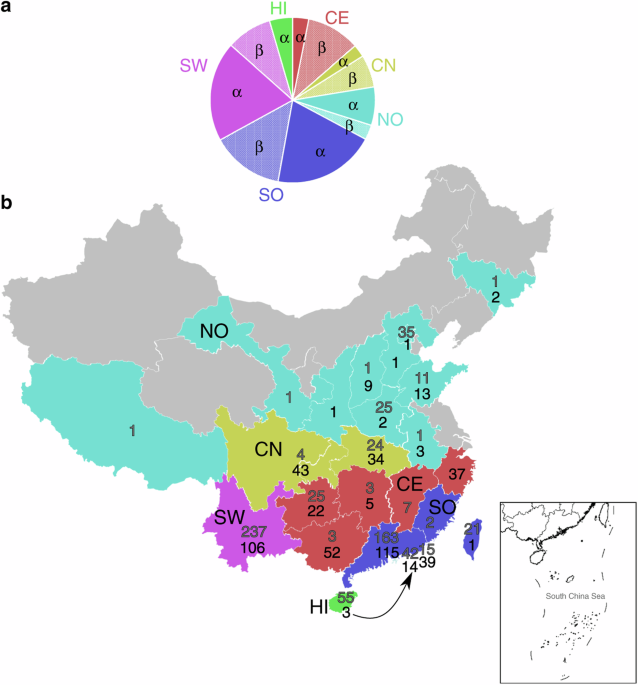
RETRACTED ARTICLE: Origin and cross-species transmission of bat coronaviruses in China - Nature Communications Bats are presumed reservoirs of diverse coronaviruses (CoVs) including progenitors of Severe Acute Respiratory Syndrome (SARS)-CoV and SARS-CoV-2, the causative agent of COVID-19. However, the evolution and diversification of these coronaviruses remains poorly understood. Here we use a Bayesian statistical framework and a large sequence data set from bat-CoVs (including 630 novel CoV sequences) in China to study their macroevolution, cross-species transmission and dispersal. We find that host-switching occurs more frequently and across more distantly related host taxa in alpha- than beta-CoVs, and is more highly constrained by phylogenetic distance for beta-CoVs. We show that inter-family and -genus switching is most common in Rhinolophidae and the genus Rhinolophus. Our analyses identify the host taxa and geographic regions that define hotspots of CoV evolutionary diversity in China that could help target bat-CoV discovery for proactive zoonotic disease surveillance. Finally, we present a phylogenetic analysis suggesting a likely origin for SARS-CoV-2 in Rhinolophus spp. bats. Bats are a likely reservoir of zoonotic coronaviruses (CoVs). Here, analyzing bat CoV sequences in China, the authors find that alpha-CoVs have switched hosts more frequently than betaCoVs, identify a bat family and genus that are highly involved in host-switching, and define hotspots of CoV evolutionary diversity. nature.com

@tommy_cleary - Tommy Cleary

@R_H_Ebright @alisonannyoung With ongoing cyberbiosecurity issues the whole time! The problem of knowledge silos within and between cybersecurity and bio world continues throughout this period from 2008 to NOW! Still now… Why?

@tommy_cleary - Tommy Cleary

@R_H_Ebright @ScienceMagazine Further...as much as Holmes has stated that data from Jie Cui was not linked to WIV 162 of 163 submissions to GenBank remain suppressed or missing...with other serious data integrity issues and cyber biosecurity issues needing to be addressed... Disqualifying conflict of…

@tommy_cleary - Tommy Cleary

@_everythingism @AceBearstrom @hiltzikm STS studies regularly acknowledge and explore institutional limits to knowledge away from the political narratives you outline here. <<Undone Science Social Movements, Mobilized Publics, and Industrial Transitions By David J. Hess>> https://mitpress.mit.edu/9780262529495/undone-science/ Since this research…

Undone Science A theoretical integration of science and technology studies and social movement studies that finds both common ground and “undone” research.As the fields... mitpress.mit.edu

@tommy_cleary - Tommy Cleary

My application for SAGO at @WHO was rejected...but it was in volunteer capacity and so I simply continued to help where I can. https://2012-2017.usaid.gov/sites/default/files/documents/2496/Combatting_Corruption_Among_Civil_Servants_-_Interdisciplinary_Perspectives_on_What_Works.pdf My skill sets are listening...catching...and surprise...not simplicity H/t @CharlesRixey Umberto Eco said it well. If it is too complicated, read more books. But he wrote this type of thing in Italian, so don't see these ideas as complexity, see them as language. Teaching a language takes time and repetition...about two years of immersion...or you can nowadays Gronk your way through? The lived experience here is of an INCOMPLETE data set...so obviously I cannot fully explain the data...but you can join me on the journey. Surprise! Truth is important...but it takes a lot of listening to hear certain truths...trauma adds more layers of humanity and so our souls are stretched thinly as we listen to the person within the cyborg of text based embodiment twisting under the weight of the unknown...but knowable: <> LtCol Joe Murphy US Marines https://brownstone.org/author/joe-murphy/ In this space and habits of removed and gone...Holmes blinked and attempted <> methods, appropriate to biological warfare investigations, with Eddie's Twitter thread on March 6th 2023, here: Why? Good question, ask him. He says he was trying to demonstrate that 60 viruses submitted to GenBank as part of a 2018 preprint, together with Prof Jie Cui and ZLShi of Wuhan Institute of Virology, were complete... https://web.archive.org/web/20220809085043/https://www.ncbi.nlm.nih.gov/nuccore/?term=Spread+and+Geographic+Structure+of+SARS-related+Coronaviruses+in+++++++++++++Bats+and+the+Origin+of+Human+SARS+Coronavirus Interestingly only 163 of a potential 180 sequences, with ORF8, S & RdRp available for each, were said to be part of this 12-JUL-2018 PrePrint? But only 154 of these are in the current GI series available to be recovered... as far as I know...and I don't know everything...I am seeking the answers to fairly obvious questions. This thread tests these assumptions & knowledge claims... So lets do some <> searching together! // Forensic note: important under examined bioinformatics data is framing this data set...with this current GI series of 154 submissions interrupted by submissions dated 25-OCT-2019 and the ACCESSION series continuing from the last, with <> to <> which is unrelated but dated Jul 13, 2019 08:18 PM. https://ncbi.nlm.nih.gov/nuccore/MH615993.1?report=girevhist This suggests that the original earlier GenBank submission, perhaps actually of 180 sequences, was cropped to 163 and given new ACCESSION numbers one year after it was submitted...with the cropped series of 163 placed in their current GI position on 25-OCT-2019...but what of the missing 9 ORF8 from this GI series? Finding the missing data set will help demonstrate what could have happened. GI count is hypothesized as a way of delineating this Undone Science data set. /// KISS Methods: basic GI series analysis this Xpost GI is 1769824352 <> anyone can do this... even you? But if you cannot, what does this say about how easy it is to make a mistake in a DURC program? https://ncbi.nlm.nih.gov/nuccore/1769824352 GI 1769824352 <> all good, all three, ORF8, RdRp and S genes present. https://ncbi.nlm.nih.gov/nuccore/MH615857.1?report=genbank GI 1769824350 <> all good too https://ncbi.nlm.nih.gov/nuccore/MH615856.1?report=genbank GI 1769824348 <> all good https://ncbi.nlm.nih.gov/nuccore/MH615855.1?report=genbank GI 1769824346 <> all good https://ncbi.nlm.nih.gov/nuccore/MH615854.1?report=genbank GI 1769824344 <> all good https://ncbi.nlm.nih.gov/nuccore/MH615853.1?report=girevhist GI 1769824342 <> all good https://ncbi.nlm.nih.gov/nuccore/MH615852.1?report=genbank GI 1769824340 <> all good https://ncbi.nlm.nih.gov/nuccore/MH615851.1?report=genbank GI 1769824338 <> all good https://ncbi.nlm.nih.gov/nuccore/MH615850.1?report=genbank GI 1769824336 <> all good https://ncbi.nlm.nih.gov/nuccore/MH615849.1?report=genbank GI 1769824334 <> all good https://ncbi.nlm.nih.gov/nuccore/MH615848.1?report=genbank GI 1769824332 <> all good https://ncbi.nlm.nih.gov/nuccore/MH615847.1?report=genbank GI 1769824330 <> all good https://ncbi.nlm.nih.gov/nuccore/MH615846.1?report=genbank GI 1769824328 <> all good https://ncbi.nlm.nih.gov/nuccore/MH615845.1?report=genbank GI 1769824326 <> all good https://ncbi.nlm.nih.gov/nuccore/MH615844.1?report=genbank GI 1769824324 <> BINGO!!!! @MonaRahalkar your old friend! Finally! Again ORF8 and RdRp are here but for <> the S gene is missing. Why? So GI 1769824324 <> is the next missing data point for <> GenBank submission from@syd_health&@Sydney_UniProf Edward Holmes @EdwardCHolmes to GenBank of@NLM_NIH NOW tally is still twelve missing ORF8... and now eight missing S genes... where for <> RdRp is the there in two naming versions but only partly suppressed here: https://www.ncbi.nlm.nih.gov/nuccore/1769824434 and here https://www.ncbi.nlm.nih.gov/nuccore/MH615898.1?report=girevhist but not available to GenBank search terms: <> https://ncbi.nlm.nih.gov/nuccore/?term=Spread+and+Geographic+Structure+of+SARS-related+Coronaviruses+in+Bats+and+the+Origin+of+Human+SARS+Coronavirus or <> https://ncbi.nlm.nih.gov/nuccore/?term=Yu%2CP.%2C+Hu%2CB.%2C+Li%2CB.%2C+Luo%2CD.%2C+Zhu%2CG.%2C+Zhang%2CL.%2C+Holmes%2CE.C.%2C+Shi%2CZ.+and+Cui%2CJ. Strange isn't it? ORF8 gene is there again with two names but both searches for title and authors are not available again: https://ncbi.nlm.nih.gov/nuccore/1769824324 &here https://www.ncbi.nlm.nih.gov/nuccore/MH615843.1?report=girevhist If the <> linked submissions are not suppressed then these search terms should give at least two results for the ORF8 and RpRd? But in any case no S gene in this GI series for <> Why? Recap: Missing ORF8 tally so far: 1) Rs151334_Guizhou 2) Rf131405_Shanxi 3) Rs140400_Guangdong 4) Rs141456_Guangxi 5) Rspp7924_Yunnan 6) Rspp7921_Yunnan 7) Ra7909_Yunnan 8) Rspp7907_Yunnan 9) Rspp7905_Yunnan 10) Rspp7896_Yunnan 11) Rs6303_Yunnan 12) Rs6266_Yunnan identified of a total of 15 missing...3 to go... Question: Was <> in the 60-54= 6 ORF8 that <> decided to leave out of this 2018 PrePrint... ...or perhaps the 54-45= 9 ORF8 that are simply missing from the GI series suppressed in GenBank & interrupted by the date 25-Oct-2019? With S genes missing too; of the 60 RdRp sampled only 49 S genes are here in this GI series... Why? 1) Rspp7921_Yunnan 2) Rspp7907_Yunnan 3) Rspp7896_Yunnan 4) Rs9214_Hubei 5) Rs9201_Hubei 6) Rs151199_Hunan 7) Rs8548_Guangdong 8) RaTG13_Yunnan//Ra4991_Yunnan identified of 11 S genes left out of this study...3 to go! <> S gene is missing yet it is very important...especially the version of Ra4991 that was originally loaded on to GenBank before this current GI series was perhaps placed, cropped, edited and moved and given new ACCESSION codes. This apparently happened from Jul 13, 2019 08:18 PM to 25-OCT-2019 So <> methodology requires more data. All this so far indicates that the 2023 disclosures of Holmes are potentially incomplete...but the count continues... next search is GI 1769824322! How to make strong knowledge claims about the origin of COVID without these data sets? Well you cannot. But Holmes gives it a go. @GrahamPerrettMP ? Any word from the relevant Ministers yet? https://www.sydney.edu.au/infectious-diseases-institute/news-and-events/news/2020/03/24/the-proximal-origin-of-sars-cov-2.html

Archive - U.S. Agency for International Development 2012-2017.usaid.gov
Joe Murphy, Author at Brownstone Institute Joe Murphy is a lieutenant colonel in the US Marines with 16+ years of service. brownstone.org
Spread and Geographic Structure of SARS-related Coronaviruses in Bats - Nucleotide - NCBITwitterFacebookLinkedInGitHubNCBI Insights BlogTwitterFacebookYoutube web.archive.org
Nucleotide - NCBITwitterFacebookLinkedInGitHubNCBI Insights BlogTwitterFacebookYoutube ncbi.nlm.nih.gov
Record suppressed: Bat SARS-like coronavirus strain Rs8460_Guangdong ORF8 gene, complete - Nucleotide - NCBITwitterFacebookLinkedInGitHubNCBI Insights BlogTwitterFacebookYoutube ncbi.nlm.nih.gov
Record suppressed: Bat SARS-like coronavirus strain Rs8363_Guangdong ORF8 gene, complete - Nucleotide - NCBITwitterFacebookLinkedInGitHubNCBI Insights BlogTwitterFacebookYoutube ncbi.nlm.nih.gov
Record suppressed: Bat SARS-like coronavirus strain Rs151569_Guizhou ORF8 gene, complete - Nucleotide - NCBITwitterFacebookLinkedInGitHubNCBI Insights BlogTwitterFacebookYoutube ncbi.nlm.nih.gov
Record suppressed: Bat SARS-like coronavirus strain Rs151514_Guizhou ORF8 gene, complete - Nucleotide - NCBITwitterFacebookLinkedInGitHubNCBI Insights BlogTwitterFacebookYoutube ncbi.nlm.nih.gov
Nucleotide - NCBITwitterFacebookLinkedInGitHubNCBI Insights BlogTwitterFacebookYoutube ncbi.nlm.nih.gov
Record suppressed: Bat SARS-like coronavirus strain Rs151493_Guizhou ORF8 gene, complete - Nucleotide - NCBITwitterFacebookLinkedInGitHubNCBI Insights BlogTwitterFacebookYoutube ncbi.nlm.nih.gov
Record suppressed: Bat SARS-like coronavirus strain Rs151491_Guizhou ORF8 gene, complete - Nucleotide - NCBITwitterFacebookLinkedInGitHubNCBI Insights BlogTwitterFacebookYoutube ncbi.nlm.nih.gov
Record suppressed: Bat SARS-like coronavirus strain Rs151388_Guizhou ORF8 gene, complete - Nucleotide - NCBITwitterFacebookLinkedInGitHubNCBI Insights BlogTwitterFacebookYoutube ncbi.nlm.nih.gov
Record suppressed: Bat SARS-like coronavirus strain Rs151262_Guizhou ORF8 gene, complete - Nucleotide - NCBITwitterFacebookLinkedInGitHubNCBI Insights BlogTwitterFacebookYoutube ncbi.nlm.nih.gov
Record suppressed: Bat SARS-like coronavirus strain Rs141567_Guangxi ORF8 gene, complete - Nucleotide - NCBITwitterFacebookLinkedInGitHubNCBI Insights BlogTwitterFacebookYoutube ncbi.nlm.nih.gov
Record suppressed: Bat SARS-like coronavirus strain Rs141455_Guangxi ORF8 gene, complete - Nucleotide - NCBITwitterFacebookLinkedInGitHubNCBI Insights BlogTwitterFacebookYoutube ncbi.nlm.nih.gov
Record suppressed: Bat SARS-like coronavirus strain Rs13488_Guangxi ORF8 gene, complete c - Nucleotide - NCBITwitterFacebookLinkedInGitHubNCBI Insights BlogTwitterFacebookYoutube ncbi.nlm.nih.gov
Record suppressed: Bat SARS-like coronavirus strain Rs13484_Guangxi ORF8 gene, complete c - Nucleotide - NCBITwitterFacebookLinkedInGitHubNCBI Insights BlogTwitterFacebookYoutube ncbi.nlm.nih.gov
Record suppressed: Bat SARS-like coronavirus strain Rs13479_Guangxi ORF8 gene, complete c - Nucleotide - NCBITwitterFacebookLinkedInGitHubNCBI Insights BlogTwitterFacebookYoutube ncbi.nlm.nih.gov
Bat SARS-like coronavirus strain RaTG13_Yunnan RNA-dependent RNA polym - Nucleotide - NCBITwitterFacebookLinkedInGitHubNCBI Insights BlogTwitterFacebookYoutube ncbi.nlm.nih.gov
Nucleotide - NCBITwitterFacebookLinkedInGitHubNCBI Insights BlogTwitterFacebookYoutube ncbi.nlm.nih.gov
No items found - Nucleotide - NCBITwitterFacebookLinkedInGitHubNCBI Insights BlogTwitterFacebookYoutube ncbi.nlm.nih.gov
Bat SARS-like coronavirus strain RaTG13_Yunnan ORF8 gene, complete cds - Nucleotide - NCBITwitterFacebookLinkedInGitHubNCBI Insights BlogTwitterFacebookYoutube ncbi.nlm.nih.gov
Nucleotide - NCBITwitterFacebookLinkedInGitHubNCBI Insights BlogTwitterFacebookYoutube ncbi.nlm.nih.gov
The proximal origin of SARS-CoV-2 sydney.edu.au

@tommy_cleary - Tommy Cleary

@JamieMetzl @WHO I applied @WHO SAGO but didnt get in... so continued with thesis from OSINT epidemiology perspective as type of study that @mvankerkhove et al are probably not able to perform in an institutionally independent way...hope it helps.

@tommy_cleary - Tommy Cleary

@R_H_Ebright @ScienceMagazine Further...as much as Holmes has stated that data from Jie Cui was not linked to WIV 162 of 163 submissions to GenBank remain suppressed or missing...with other serious data integrity issues and cyber biosecurity issues needing to be addressed... Disqualifying conflict of…

@tommy_cleary - Tommy Cleary

@_everythingism @AceBearstrom @hiltzikm STS studies regularly acknowledge and explore institutional limits to knowledge away from the political narratives you outline here. <<Undone Science Social Movements, Mobilized Publics, and Industrial Transitions By David J. Hess>> https://mitpress.mit.edu/9780262529495/undone-science/ Since this research…

Undone Science A theoretical integration of science and technology studies and social movement studies that finds both common ground and “undone” research.As the fields... mitpress.mit.edu

@tommy_cleary - Tommy Cleary

<> methods, appropriate to biological warfare investigations, with Eddie's Twitter thread on March 6th 2023, here: Why? Good question, ask him. @sciencecohen <> Yep...my guess is that Jon knew about the RaTG13/Ra4991 from sick miners but decided not to or was directed not to say anything right away. H/t @R_H_Ebright 5 years ago after being on the case for 25 years... Holmes says he was trying to demonstrate that 60 viruses submitted to GenBank as part of a 2018 preprint, together with Prof Jie Cui and ZLShi of Wuhan Institute of Virology, were complete...but they are obviously incomplete. https://web.archive.org/web/20220809085043/https://www.ncbi.nlm.nih.gov/nuccore/?term=Spread+and+Geographic+Structure+of+SARS-related+Coronaviruses+in+++++++++++++Bats+and+the+Origin+of+Human+SARS+Coronavirus Only 163 of a potential 180 sequences, with ORF8, S & RdRp available for each, were said to be part of this 12-JUL-2018 PrePrint? But bioinformatics analysis is important to these knowledge claims, H/t Trevor Bedford @trvrbonly ...and only 154 of these are in the current GenBank GI series available to be recovered...as far as I know...and I don't know everything...I am seeking the answers to fairly obvious questions...like why were these 180 GenBank submissions not available when WIV frist published post COVID outbreak discovery? https://www.biorxiv.org/content/10.1101/2020.01.22.914952v2.full.pdf This thread tests these assumptions & knowledge claims... So lets do some <> bioinformatics philosophy of science searching together! // Important Forensic note: important under examined bioinformatics data is framing this data set...with this current GI series of 154 submissions interrupted by submissions dated 25-OCT-2019 and the ACCESSION series continuing from the last, with <> to <> which is unrelated but dated Jul 13, 2019 08:18 PM. https://ncbi.nlm.nih.gov/nuccore/MH615993.1?report=girevhist This suggests that the original earlier GenBank submission, perhaps actually of 180 sequences, was cropped to 163 and given new ACCESSION numbers one year after it was submitted...with the cropped series of 163 placed in their current GI position on 25-OCT-2019...but what of the missing 9 ORF8 from this GI series? Finding the missing data set will help demonstrate what could have happened. GI count is hypothesized as a way of delineating this Undone Science data set. /// KISS Methods: basic GI series analysis this Xpost thread GI is next after 1769824324 <> anyone can do this... even you? https://ncbi.nlm.nih.gov/nuccore/1769824352 GI 1769824322 <> all good, all three, ORF8, RdRp and S genes present. https://www.ncbi.nlm.nih.gov/nuccore/MH615842.1?report=genbank GI 1769824320 <> all good too https://www.ncbi.nlm.nih.gov/nuccore/MH615842.1?report=genbank GI 1769824318 <> all good https://www.ncbi.nlm.nih.gov/nuccore/MH615840.1?report=genbank GI 1769824316 <> all good but remember that the full sequence of Rs5725_Yunnan was available for the thesis <> of WIV but for <> only the ORF8, RdRp & S gene were available. https://www.ncbi.nlm.nih.gov/nuccore/MH615839.1?report=genbank Remember that GI 1769824315 is where this GI series ends with <> Submitted (25-JUL-2018) and placed Oct 25, 2019 06:16 PM together with this GI series? https://www.ncbi.nlm.nih.gov/nuccore/1769824315 Finally! NOW tally is still twelve missing ORF8... and now eight missing S genes... where for <> RdRp is the last to be found with this GI count there in two naming versions but only partly suppressed here: https://ncbi.nlm.nih.gov/nuccore/1769824434and here https://ncbi.nlm.nih.gov/nuccore/MH615898.1?report=girevhistbut not available to GenBank search terms: <> https://ncbi.nlm.nih.gov/nuccore/?term=Spread+and+Geographic+Structure+of+SARS-related+Coronaviruses+in+Bats+and+the+Origin+of+Human+SARS+Coronavirusor <> https://ncbi.nlm.nih.gov/nuccore/?term=Yu%2CP.%2C+Hu%2CB.%2C+Li%2CB.%2C+Luo%2CD.%2C+Zhu%2CG.%2C+Zhang%2CL.%2C+Holmes%2CE.C.%2C+Shi%2CZ.+and+Cui%2CJ. Strange isn't it? ORF8 gene is there again with two names but both searches for title and authors are not available again: https://ncbi.nlm.nih.gov/nuccore/1769824324 &here https://ncbi.nlm.nih.gov/nuccore/MH615843.1?report=girevhist If the <> linked submissions are not suppressed then these search terms should give at least two results for the ORF8 and RpRd? But in any case no S gene in this GI series for <> Why? Recap: Missing ORF8 tally so far: 1) Rs151334_Guizhou 2) Rf131405_Shanxi 3) Rs140400_Guangdong 4) Rs141456_Guangxi 5) Rspp7924_Yunnan 6) Rspp7921_Yunnan 7) Ra7909_Yunnan 8) Rspp7907_Yunnan 9) Rspp7905_Yunnan 10) Rspp7896_Yunnan 11) Rs6303_Yunnan 12) Rs6266_Yunnan identified of a total of 15 missing...3 to go... Question: Was <> in the 60-54= 6 ORF8 that <> decided to leave out of this 2018 PrePrint... ...or perhaps the 54-45= 9 ORF8 that are simply missing from the GI series suppressed in GenBank & interrupted by the date 25-Oct-2019? With S genes missing too; of the 60 RdRp sampled only 49 S genes are here in this GI series... Why? 1) Rspp7921_Yunnan 2) Rspp7907_Yunnan 3) Rspp7896_Yunnan 4) Rs9214_Hubei 5) Rs9201_Hubei 6) Rs151199_Hunan 7) Rs8548_Guangdong 8) RaTG13_Yunnan//Ra4991_Yunnan identified of 11 S genes left out of this study...3 to go! <> S gene is missing yet it is very important...especially the version of Ra4991 that was originally loaded on to GenBank before this current GI series was perhaps placed, cropped, edited and moved and given new ACCESSION codes. This apparently happened from Jul 13, 2019 08:18 PM to 25-OCT-2019 So <> methodology requires more data. All this so far indicates that the 2023 disclosures of Holmes are potentially incomplete... How to make strong knowledge claims about the origin of COVID without these data sets? Well you cannot. But Holmes gives it a go. To find the rest of the missing data points we need to examine the 180 potential for the 3 S and 3 OFRF8 missing. It is so easy to make mistakes with this type of count and so checking and rechecking with different methodologies is important. This is the complex ground of the information domain. I have to back track and see if I have missed a thread in the GI series? This is why I have left this trail of pebbles...so I can back track when needed. https://brownstone.org/articles/the-biodefense-oligarchy-and-its-demographic-defeats/

Spread and Geographic Structure of SARS-related Coronaviruses in Bats - Nucleotide - NCBITwitterFacebookLinkedInGitHubNCBI Insights BlogTwitterFacebookYoutube web.archive.org
Nucleotide - NCBITwitterFacebookLinkedInGitHubNCBI Insights BlogTwitterFacebookYoutube ncbi.nlm.nih.gov
Record suppressed: Bat SARS-like coronavirus strain Rs8460_Guangdong ORF8 gene, complete - Nucleotide - NCBITwitterFacebookLinkedInGitHubNCBI Insights BlogTwitterFacebookYoutube ncbi.nlm.nih.gov
Record suppressed: Bat SARS-like coronavirus strain Rs160665_Yunnan ORF8 gene, complete c - Nucleotide - NCBITwitterFacebookLinkedInGitHubNCBI Insights BlogTwitterFacebookYoutube ncbi.nlm.nih.gov
Record suppressed: Bat SARS-like coronavirus strain Rf5511_Yunnan ORF8 gene, complete cds - Nucleotide - NCBITwitterFacebookLinkedInGitHubNCBI Insights BlogTwitterFacebookYoutube ncbi.nlm.nih.gov
Record suppressed: Bat SARS-like coronavirus strain Rs5725_Yunnan ORF8 gene, complete cds - Nucleotide - NCBITwitterFacebookLinkedInGitHubNCBI Insights BlogTwitterFacebookYoutube ncbi.nlm.nih.gov
Salmonella enterica subsp. enterica serovar Infantis strain FSIS170229 - Nucleotide - NCBITwitterFacebookLinkedInGitHubNCBI Insights BlogTwitterFacebookYoutube ncbi.nlm.nih.gov
No items found - Nucleotide - NCBITwitterFacebookLinkedInGitHubNCBI Insights BlogTwitterFacebookYoutube ncbi.nlm.nih.gov
Bat SARS-like coronavirus strain RaTG13_Yunnan RNA-dependent RNA polym - Nucleotide - NCBITwitterFacebookLinkedInGitHubNCBI Insights BlogTwitterFacebookYoutube ncbi.nlm.nih.gov
No items found - Nucleotide - NCBITwitterFacebookLinkedInGitHubNCBI Insights BlogTwitterFacebookYoutube ncbi.nlm.nih.gov
Bat SARS-like coronavirus strain RaTG13_Yunnan ORF8 gene, complete cds - Nucleotide - NCBITwitterFacebookLinkedInGitHubNCBI Insights BlogTwitterFacebookYoutube ncbi.nlm.nih.gov
Nucleotide - NCBITwitterFacebookLinkedInGitHubNCBI Insights BlogTwitterFacebookYoutube ncbi.nlm.nih.gov
The Biodefense Oligarchy and Its Demographic Defeats ⋆ Brownstone Institute Two decades ago, factions argued that biowarfare threats were so significant that biodefense responsibility needed to be removed from the purview of the uniformed military and placed within NIAID under NIH and under HHS. brownstone.org

@R_H_Ebright - Richard H. Ebright

Five years ago today, a scientist stated publicly that data were consistent with a lab origin: "Ebright tells Science...that the 2019-nCoV data are 'consistent with entry into the human population as either a natural accident or a laboratory accident.'" https://www.science.org/content/article/mining-coronavirus-genomes-clues-outbreak-s-origins

@tommy_cleary - Tommy Cleary

@R_H_Ebright @ScienceMagazine Further...as much as Holmes has stated that data from Jie Cui was not linked to WIV 162 of 163 submissions to GenBank remain suppressed or missing...with other serious data integrity issues and cyber biosecurity issues needing to be addressed... Disqualifying conflict of…

@tommy_cleary - Tommy Cleary

@_everythingism @AceBearstrom @hiltzikm STS studies regularly acknowledge and explore institutional limits to knowledge away from the political narratives you outline here. <<Undone Science Social Movements, Mobilized Publics, and Industrial Transitions By David J. Hess>> https://mitpress.mit.edu/9780262529495/undone-science/ Since this research…

Undone Science A theoretical integration of science and technology studies and social movement studies that finds both common ground and “undone” research.As the fields... mitpress.mit.edu

@tommy_cleary - Tommy Cleary

This is where I lost count! Doh! Next GI will have to start from here and be inserted into current tally. GI 1769824546 restart count again here...and insert missing into tally KISS Methods: basic GI series analysis this Xpost GI is 1769824546 <> anyone can do this... even you? But if you cannot, or if you lose count so easily, like I always do...what does this say about how easy it is to make a mistake in a DURC program? https://ncbi.nlm.nih.gov/nuccore/1769824546 GI 1769824546 <> all good, all three, ORF8, RdRp and S genes present. Next GI 1769824544 <> & RdRp are there but suppressed but ORF8 is already 5) on the tally https://www.ncbi.nlm.nih.gov/nuccore/MH615953.1?report=genbank GI 1769824542 <> & RdRp are there but suppressed but ORF8 is should be 6) on the tally not 7) as I must have started counting GI from the RdRp list here? https://www.ncbi.nlm.nih.gov/nuccore/MH615952.1?report=genbank GI 1769824540 <> & RdRp are there but should be 7) on the list not 9)? https://www.ncbi.nlm.nih.gov/nuccore/MH615951.1?report=genbank GI 1769824538 <> & RdRp are there but should be 8) and is missing! https://www.ncbi.nlm.nih.gov/nuccore/MH615951.1?report=genbank Lets keep going to the next one... GI 1769824536 <> & RdRp & ORF8 are there https://www.ncbi.nlm.nih.gov/nuccore/MH615949.1?report=genbank GI 1769824534 <> & RdRp & ORF8 are there https://www.ncbi.nlm.nih.gov/nuccore/1769824534 GI 1769824532 <> & RdRp but missing ORF8 should be 9) on the list not 12) https://www.ncbi.nlm.nih.gov/nuccore/1769824532 GI 1769824530 <> & RdRp & ORF8 are there all good https://www.ncbi.nlm.nih.gov/nuccore/1769824530 GI 1769824528 <> & RdRp but ORF8 missing should be 10) on tally not 11) https://www.ncbi.nlm.nih.gov/nuccore/1769824528 GI 1769824526 <> & RdRp & ORF8 all good https://www.ncbi.nlm.nih.gov/nuccore/1769824526 GI 1769824524 is <> so S & RdRp & ORF8 all good https://www.ncbi.nlm.nih.gov/nuccore/1769824524 GI 1769824522 is <> so S & RdRp & ORF8 all good https://www.ncbi.nlm.nih.gov/nuccore/1769824522 GI 1769824520 is <> all good GI 1769824518 is <> all good GI 1769824516 is <> all good GI 1769824514 is <> all good GI 1769824512 is <> all good GI 1769824510 is <> ORF8 missing 1) on tally GI 1769824508 is <> all good GI 1769824506 is <> all good GI 1769824504 is <> all good GI 1769824502 is <> all good GI 1769824500 is <> is tricky missing S gene 1) in tally not 4) missing but RdRp and ORF8 OK https://www.ncbi.nlm.nih.gov/nuccore/MH615936.1?report=genbank GI 1769824498 is <> again missing S gene 2) not 5) in tally, but RdRp & ORF8 are good. https://www.ncbi.nlm.nih.gov/nuccore/MH615930.1?report=genbank GI 1769824496 is <> again missing S gene 3) not 6) in tally, but RdRp & ORF8 are good. https://www.ncbi.nlm.nih.gov/nuccore/MH615930.1?report=genbank GI 1769824494 is <> all good GI 1769824492 is <> ORF8 is missing 2) in tally GI 1769824490 is <> all good GI 1769824488 is <> all good GI 1769824486 is <> all good GI 1769824484 is <> all good GI 1769824482 is <> dare I say BINGO!!! <> RdRp is there https://www.ncbi.nlm.nih.gov/nuccore/MH615922.1?report=girevhist but ORF8 is missing number 11) and S is missing number 4) NOW tally is still fourteen missing ORF8... and still nine missing S genes... Recap: Missing ORF8 tally so far with order fixed: 1) Rs151334_Guizhou 2) Rf131405_Shanxi 3) Rs140400_Guangdong 4) Rs141456_Guangxi 5) Rspp7924_Yunnan 6) Ra7909_Yunnan prev Rspp7921_Yunnan 7) Rspp7905_Yunnan prev Ra7909_Yunnan 8) Rspp7931_Yunnan prev Rspp7907_Yunnan 9) Rs6266_Yunnan prev Rspp7905_Yunnan 10) Rs6303_Yunnan prev Rspp7896_Yunnan 11) Rf130223-29_Beijing prev Rs6303_Yunnan 12) Rs6266_Yunnan identified of a total of 15 missing...1 to go? Question: Was <> in the 60-54= 6 ORF8 that <> decided to leave out of this 2018 PrePrint... ...or perhaps the 54-45= 9 ORF8 that are simply missing from the GI series suppressed in GenBank & interrupted by the date 25-Oct-2019? With S genes missing too; of the 60 RdRp sampled only 49 S genes are here in this GI series... Why? 1) Rs9214_Hubei prev Rspp7921_Yunnan 2) Rs9201_Hubei prev Rspp7907_Yunnan 3) Rs151199_Hunan prev Rspp7896_Yunnan 4) Rf130223-29_Beijing prev Rs9214_Hubei 5) Rs9201_Hubei 6) Rs151199_Hunan 7) Rs8548_Guangdong 8) RaTG13_Yunnan//Ra4991_Yunnan identified of 11/11 S genes left out of this study... <> S gene is missing yet it is very important...especially the version of Ra4991 that was originally loaded on to GenBank before this current GI series was perhaps placed, cropped, edited and moved and given new ACCESSION codes. This apparently happened from Jul 13, 2019 08:18 PM to 25-OCT-2019 So <> methodology requires more data. All this so far indicates that the 2023 disclosures of Holmes are potentially incomplete...but the count continues... next search is GI 1769824322! How to make strong knowledge claims about the origin of COVID without these data sets? Well you cannot. This tally is nice and messy at the moment...I will need to clean it up in the next post! Counting from GI 1769824482 <> and smoothing out the tally. A stuff up in a GI count like this is character building, but also gives an insight into the lived experience of bioinformatics of Virology. How could this type of thing but constantly happening an STILL there is an attitude that errors are not common. What bullshit! They happen all the time! Like @sciencecohen who details DNA of SARS-CoV-2 instead of RNA. We are all people doing people stuff...stuff-ups too. https://www.science.org/content/article/mining-coronavirus-genomes-clues-outbreak-s-origins

Record suppressed: Bat SARS-like coronavirus strain Rs8363_Guangdong spike protein (S) ge - Nucleotide - NCBITwitterFacebookLinkedInGitHubNCBI Insights BlogTwitterFacebookYoutube ncbi.nlm.nih.gov
Record suppressed: Bat SARS-like coronavirus strain Rspp7924_Yunnan spike protein (S) gen - Nucleotide - NCBITwitterFacebookLinkedInGitHubNCBI Insights BlogTwitterFacebookYoutube ncbi.nlm.nih.gov
Record suppressed: Bat SARS-like coronavirus strain Ra7909_Yunnan spike protein (S) gene, - Nucleotide - NCBITwitterFacebookLinkedInGitHubNCBI Insights BlogTwitterFacebookYoutube ncbi.nlm.nih.gov
Record suppressed: Bat SARS-like coronavirus strain Rspp7905_Yunnan spike protein (S) gen - Nucleotide - NCBITwitterFacebookLinkedInGitHubNCBI Insights BlogTwitterFacebookYoutube ncbi.nlm.nih.gov
Record suppressed: Bat SARS-like coronavirus strain Rs5725_Yunnan spike protein (S) gene, - Nucleotide - NCBITwitterFacebookLinkedInGitHubNCBI Insights BlogTwitterFacebookYoutube ncbi.nlm.nih.gov
Record suppressed: Bat SARS-like coronavirus strain Rs160665_Yunnan spike protein (S) gen - Nucleotide - NCBITwitterFacebookLinkedInGitHubNCBI Insights BlogTwitterFacebookYoutube ncbi.nlm.nih.gov
Record suppressed: Bat SARS-like coronavirus strain Rs6266_Yunnan spike protein (S) gene, - Nucleotide - NCBITwitterFacebookLinkedInGitHubNCBI Insights BlogTwitterFacebookYoutube ncbi.nlm.nih.gov
Record suppressed: Bat SARS-like coronavirus strain Rs6255_Yunnan spike protein (S) gene, - Nucleotide - NCBITwitterFacebookLinkedInGitHubNCBI Insights BlogTwitterFacebookYoutube ncbi.nlm.nih.gov
Record suppressed: Bat SARS-like coronavirus strain Rs6303_Yunnan spike protein (S) gene, - Nucleotide - NCBITwitterFacebookLinkedInGitHubNCBI Insights BlogTwitterFacebookYoutube ncbi.nlm.nih.gov
Record suppressed: Bat SARS-like coronavirus strain Rf5511_Yunnan spike protein (S) gene, - Nucleotide - NCBITwitterFacebookLinkedInGitHubNCBI Insights BlogTwitterFacebookYoutube ncbi.nlm.nih.gov
Record suppressed: Bat SARS-like coronavirus strain Rs161465_Guangdong RNA-dependent RNA - Nucleotide - NCBITwitterFacebookLinkedInGitHubNCBI Insights BlogTwitterFacebookYoutube ncbi.nlm.nih.gov
Record suppressed: Bat SARS-like coronavirus strain Rs161419_Guangdong RNA-dependent RNA - Nucleotide - NCBITwitterFacebookLinkedInGitHubNCBI Insights BlogTwitterFacebookYoutube ncbi.nlm.nih.gov
Record suppressed: Bat SARS-like coronavirus strain Rs151334_Guizhou RNA-dependent RNA po - Nucleotide - NCBITwitterFacebookLinkedInGitHubNCBI Insights BlogTwitterFacebookYoutube ncbi.nlm.nih.gov
Record suppressed: Bat SARS-like coronavirus strain Rs9201_Hubei RNA-dependent RNA polyme - Nucleotide - NCBITwitterFacebookLinkedInGitHubNCBI Insights BlogTwitterFacebookYoutube ncbi.nlm.nih.gov
Nucleotide - NCBITwitterFacebookLinkedInGitHubNCBI Insights BlogTwitterFacebookYoutube ncbi.nlm.nih.gov

@tommy_cleary - Tommy Cleary

Next one? <> no ORF8 found in @NLM_NIH GenBank <>, complete cds is there but suppressed... GenBank: MH615955.1 https://www.ncbi.nlm.nih.gov/nuccore/MH615955.1?report=genbank <> GenBank: MH615905.1 is there but suppressed... https://www.ncbi.nlm.nih.gov/nuccore/MH615905.1?report=genbank ...so that is NOW four missing ORF8; all with S and RdRp available but suppressed; 1) Rs151334_Guizhou 2) Rf131405_Shanxi 3) Rs140400_Guangdong 4) Rs141456_Guangxi Were these in the 60-54=6 ORF8 that <> decided to leave out of this PrePrint ? https://web.archive.org/web/20220809085043/https://www.ncbi.nlm.nih.gov/nuccore/?term=Spread+and+Geographic+Structure+of+SARS-related+Coronaviruses+in+++++++++++++Bats+and+the+Origin+of+Human+SARS+Coronavirus ...or perhaps the 54-45= 9 ORF8 that are simply missing from the GI series in GenBank? https://news.clearancejobs.com/2019/08/15/weaponizing-medicine-chinas-latest-theft-a-potential-biological-weapon/ Who knows? @COVIDSelect @COVIDSelectDems ? @R_H_Ebright

Record suppressed: Bat SARS-like coronavirus strain Rs141456_Guangxi spike protein (S) ge - Nucleotide - NCBITwitterFacebookLinkedInGitHubNCBI Insights BlogTwitterFacebookYoutube ncbi.nlm.nih.gov
Record suppressed: Bat SARS-like coronavirus strain Rs141456_Guangxi RNA-dependent RNA po - Nucleotide - NCBITwitterFacebookLinkedInGitHubNCBI Insights BlogTwitterFacebookYoutube ncbi.nlm.nih.gov
Spread and Geographic Structure of SARS-related Coronaviruses in Bats - Nucleotide - NCBITwitterFacebookLinkedInGitHubNCBI Insights BlogTwitterFacebookYoutube web.archive.org
Weaponizing Medicine: China's Latest Theft a Potential Biological Weapon A Canadian research lab sent deadly virus strains to China under the guise of scientific advancement. Now a Chinese lab scientist has been dismissed and Canadian law enforcement investigates. - Intelligence news.clearancejobs.com

@tommy_cleary - Tommy Cleary

Censorship of the nature deployed in the case of COVID had some obvious negative effects...but some were not so bad. @BiosafetyNow https://biosafetynow.substack.com/p/censoring-virology It was nice and quiet. The people censored had to find ways to reach out to each other...the phenomenology was that we had to look at what we were looking through. It also builds a compassion for a data set you are auditing during verification and for your own findings...a health doubt...need to double check and have peers that are brutal not lazy. Fixing this mess is going to be fun! Some wisdom always comes from a moment of stupidity and reflection. KISS Methods: basic GI series analysis this Xpost GI 1769824482 <> anyone can do this... even you? But if you cannot, or if you lose count so easily, like I always do...what does this say about how easy it is to make a mistake in a DURC program? https://ncbi.nlm.nih.gov/nuccore/1769824482 Starting with next RdRp GI 1769824480 is <> all good GI 1769824478 is <> S gene misssssing BBBBBingo! S gene missing no 5) in tally more BLAST homework here https://www.ncbi.nlm.nih.gov/nuccore/MH615920.1?report=genbank Couple more to find! GI 1769824476 <> all good GI 1769824474 <> all good GI 1769824472 <> all good GI 1769824470 <> all good GI 1769824468 <> all good GI 1769824466 <> all good GI 1769824464 <> all good GI 1769824462 <> ORF8 missing number 3) GI 1769824460 <> all good GI 1769824458 <> all good GI 1769824456 <> all good GI 1769824454 <> all good GI 1769824452 <> all good GI 1769824450 <> all good GI 1769824448 <> missing ORF8 tally number 4) GI 1769824446 <> all good GI 1769824444 <> all good GI 1769824442 <> all good GI 1769824440 <> all good GI 1769824438 <> all good GI 1769824436 <> missing S number 6) not 7) GI 1769824434 <> missing S number 7) prev 8) GI 1769824432 <> Binnnngooooo RdRp good, https://www.ncbi.nlm.nih.gov/nuccore/MH615897.1?report=genbank missing S number 7) & ORF8 missing number 12) with complete genome available on CNCB from June 2021 https://ngdc.cncb.ac.cn/biosample/browse/SAMC346732 NOW tally is still a mess Recap: Missing ORF8 tally so far with order fixed: 1) Rs151334_Guizhou 2) Rf131405_Shanxi 3) Rs140400_Guangdong 4) Rs141456_Guangxi 5) Rspp7924_Yunnan 6) Ra7909_Yunnan prev Rspp7921_Yunnan 7) Rspp7905_Yunnan prev Ra7909_Yunnan 8) Rspp7931_Yunnan prev Rspp7907_Yunnan 9) Rs6266_Yunnan prev Rspp7905_Yunnan 10) Rs6303_Yunnan prev Rspp7896_Yunnan 11) Rf130223-29_Beijing prev Rs6303_Yunnan 12) Rspp7952_Yunnan prev Rs6266_Yunnan 13) 14) 15) identified of a total of 15 missing Question: Was <> in the 60-54= 6 ORF8 that <> decided to leave out of this 2018 PrePrint... ...or perhaps the 54-45= 9 ORF8 that are simply missing from the GI series suppressed in GenBank & interrupted by the date 25-Oct-2019? With S genes missing too; of the 60 RdRp sampled only 49 S genes are here in this GI series... Why? 1) Rs9214_Hubei prev Rspp7921_Yunnan 2) Rs9201_Hubei prev Rspp7907_Yunnan 3) Rs151199_Hunan prev Rspp7896_Yunnan 4) Rf130223-29_Beijing prev Rs9214_Hubei 5) Rp8794_Guangdong prev Rs9201_Hubei 6) Rs8548_Guangdong prev Rs151199_Hunan 7) RaTG13_Yunnan RNA-dependent prev Rs8548_Guangdong 8) Rspp7952_Yunnan prev RaTG13_Yunnan//Ra4991_Yunnan 9) 10) 11) identified of 11 S genes left out of this study... <> S gene is missing So <> methodology requires more data. All this so far indicates that the 2023 disclosures of Holmes are potentially incomplete...but the count continues... next search is from GI 1769824432! How to make strong knowledge claims about the origin of COVID without these data sets? Well you cannot. This tally is nice and messy at the moment...I will need to continue to clean it up in the next post! Counting from GI 1769824432 <> and smoothing out the tally. Eventually it may be clearer than bee shit https://www.cia.gov/readingroom/document/cia-rdp90-00965r000403600002-0

Censoring virology "On reading," by Simon Wain-Hobson, is a weekly discussion of scientific papers and news articles around gain of function research in virology. biosafetynow.substack.com
Record suppressed: Bat SARS-like coronavirus strain Rf130223-29_Beijing RNA-dependent RNA - Nucleotide - NCBITwitterFacebookLinkedInGitHubNCBI Insights BlogTwitterFacebookYoutube ncbi.nlm.nih.gov
Record suppressed: Bat SARS-like coronavirus strain Rp8794_Guangdong RNA-dependent RNA po - Nucleotide - NCBITwitterFacebookLinkedInGitHubNCBI Insights BlogTwitterFacebookYoutube ncbi.nlm.nih.gov
Record suppressed: Bat SARS-like coronavirus strain Rspp7952_Yunnan RNA-dependent RNA pol - Nucleotide - NCBITwitterFacebookLinkedInGitHubNCBI Insights BlogTwitterFacebookYoutube ncbi.nlm.nih.gov
Browse - BioSample - CNCB-NGDC ngdc.cncb.ac.cn
THE 'BEE FECES' THEORY UNDONE | CIA FOIA (foia.cia.gov) cia.gov

@a_kruschke - A.Kruschke

@tommy_cleary @JAHawk94684 @MartinaSisters @mlperk1 @MonaRahalkar @R_H_Ebright @quay_dr @BiosafetyNow @syd_health @SystemsVirology @NLM_NIH @POTUS @Sydney_Uni @DrJBhattacharya @FloDebarre @institutpasteur @thackerpd @Rebecca21951651 @capitolsheila @BillyBostickson @breakfast_dogs @Globalbiosec @gdemaneuf @RdeMaistre @dasher8090 @COVIDSelect @GrahamPerrettMP @harishseshadri2 @emilyakopp @Ayjchan @VBruttel @CharlesRixey @sciencecohen @hholdenthorp @ScienceMagazine @WHO @reSeeIt save Thread

View Full Interactive Feed