TruthArchive.ai - Tweets Saved By @Elpis_R

Saved - September 12, 2023 at 1:11 PM

@Elpis_R - Ξlpis

ONU-GIEC veut faire croire aux gens (sans preuve empirique) que le CO2 est un problème et que son augmentation est due à l’activité humaine. Mais si vous étudiez la question scientifiquement* vous parviendrez à la conclusion que le climat n’a rien à voir avec l’activité humaine.

Video Transcript AI Summary
Some scientists argue that a significant portion of global warming can be explained by natural factors, rather than human activity. They believe that fluctuations in the sun's coronal output are causing the entire solar system, including Earth, to warm up. Additionally, they point out that temperature increases have been observed on planets without human presence. In the past, climatologists initially claimed that the world was cooling due to particulate matter in the atmosphere, but later shifted to the term "climate change." Critics argue that the focus on carbon dioxide and human activity is driven by political motives, specifically the desire for increased control and taxation by global elitists and the United Nations.
Full Transcript
Speaker 0: If you study this very, very carefully and you ignore all the politics that's what science is supposed to do and you don't get your hand tied and your mouth completely controlled by the UN mouthpiece, then you will reach a conclusion that quite a substantial part is actually explained by natural component. Speaker 1: Some astronomers tell us global warming has nothing to do with human activity or fossil fuel driven industrialization. The entire solar system is warming up due to fluctuations in the sun's coronal output. Speaker 2: Carbon dioxide in our atmosphere is a cycle that is driven almost entirely by our sun and has very little to do with human activity. The sun is warming the solar whole solar system. And it so happened the earth is one of the inhabitants of the solar system, period. Speaker 3: We we don't see a lot of climate scientist and those talking about climate change and global warming mentioning the fact that there is a proportional increase in temperature on planets where there are no people. Speaker 1: A number of years back, we had climatologists tell us that the world was not warming. It was cooling due to the dimming effect of particulate matter in the atmosphere. With this discovery, the term global warming was converted into the term climate change. Talk about hedging your bets. Speaker 2: The global elitists who are currently in power want people to believe that carbon dioxide in our atmosphere first is a tremendous problem. And secondly, they want us to believe that the cycle of the amount of carbon dioxide that happens to be in the in concentrations in our atmosphere is driven by human activity. The real problem here is That there's a political driving force behind what they call climate change, which is once again the desire of the UN through their general sustainable development theories to gain increasing control over the way industrial society operate. The solution is always more government control, more taxes, and less freedom for you.
Saved - September 12, 2023 at 12:59 AM
reSee.it AI Summary
According to KHayhoe, the latest report from the IPCC (AR6 chap 12) is outdated. Alarmists distance themselves from the data and IPCC to support extreme claims. They even deny the IPCC's credibility. When asked for evidence, Hayhoe fails to provide any. The 1212 report remains relevant, reflecting abundant literature on emerging signals.

@Elpis_R - Ξlpis

Selon l’alarmiste @KHayhoe ce tableau du GIEC AR6 chap 12 (le dernier rapport) est “out of date.” Les alarmistes doivent créer une distance avec les données et le GIEC pour soutenir les revendications apocalyptiques/extrêmes. À un pas de citer le GIEC de “négationniste”. 😂 https://t.co/RjuKHFywLV

@Elpis_R - Ξlpis

Lorsqu’on lui demande d’étayer son affirmation selon laquelle le 12.12 du GIEC est obsolète, Hayhoe ne peut produire un seul document. Je connais la littérature, 12.12 est toujours d’actualité et reflète l’abondante littérature sur l’émergence des signaux à savoir 404 not found.

Saved - September 11, 2023 at 8:32 PM

@Elpis_R - Ξlpis

* c’est-à-dire sans l’aspect politique et sa modélisation qui est bien évidemment paramétrée (pour obtenir le résultat souhaité) par des idéologues politiques ayant des intérêts particuliers.

Saved - September 10, 2023 at 4:04 PM

@Elpis_R - Ξlpis

“Ce qui m’effraie ce sont les mensonges relayés par les grands médias... Les données montrent que les ouragans, feux, décès liés au climat... n’augmentent pas, mais ils arrivent à faire germer exactement le contraire. 30 ans de propagande incessante sans bases démontrées.”

Video Transcript AI Summary
The speakers express concern about the mainstream media accepting false information about climate change. They argue that hurricanes, sea levels, bushfires, and climate-related deaths are not increasing as claimed. They criticize the lack of evidence supporting the idea that human emissions drive global warming. Despite the inaccuracies in their predictions, the speakers believe that the media continues to promote scare stories for attention. They highlight the absence of proof in arguments against coal, gas, and hydrocarbons. Overall, they question why the media's credibility remains intact despite their track record of incorrect predictions.
Full Transcript
Speaker 0: Are you shaking and crying over these doomsday announcements? Speaker 1: What I'm scared of is the mainstream media uncritically accepting this codswallop. What I'm scared of is these people get given a microphone and talk about total lies. Hurricanes are not increasing. We have data. Sea level is not increasing. It's some places, it's decreasing, other places, increasing. We're not having an increase in bushfires. We're not having an increase in climate deaths. We have a very large data bank showing us the exact opposite. So So what these people are doing is sprouting exactly the opposite to what the data tells us. They're doing it with much more noise. They're getting very friendly media like The Guardian, like the mainstream media, saying, oh, we're all doomed, but Every single prediction they've ever made has been wrong. Now, they've been doing this for 30 years. So they give us all the scary stuff, but they don't give us their data. And they still haven't after 30 years, they still haven't shown us that human emissions drive global warming. Speaker 0: What I don't understand is if their predictions aren't accurate or if they're wildly inaccurate, Why that doesn't dent their credibility? Times with this skeptical media say, well, 5 years ago you said this and this And none of that happened and you said this and this and actually the opposite happened. Why do we have this situation where it's the boy who cried wolf And every single time Crying Wolf works. Speaker 1: It's a great scare story. We're all going to die. We're all doomed and it's great for the mainstream media to frightening people, front page on the newspaper, lead article on a television program and people fall for the propaganda. There's been a relentless campaign of propaganda for 30 years, and the basics haven't been shown. If you cannot show that human emissions of carbon dioxide drive global warming and all the arguments about coal, about gas, about hydrocarbons are not demonstrating them wrong.
Saved - September 9, 2023 at 9:43 PM

@Elpis_R - Ξlpis

Grâce aux médias sociaux, les gens ordinaires ayant un certain degré d’intérêt et de connaissance pour certains sujets sont en mesure d’évaluer l’opposition aux récits officiels revendiqués et des tas de personnes hautement qualifiées rejettent les “préjugés d’autorité !”

Saved - September 9, 2023 at 10:52 AM

@Elpis_R - Ξlpis

Après “des pays rayés de la carte”, “code rouge”, “l’ère de ébullition mondiale”, voici “l’effondrement climatique à commencé” - ONU-GIEC Scénario effrayant et dramatique. Couverture médiatique complète. Capter l’imagination du public. Science.

@Elpis_R - Ξlpis

ONU-GIEC doivent “proposer des scénarios effrayants et dramatiques” pour “capter l’imagination du public” à l’aide d’une “couverture médiatique importante” et “ne pas mentionner de doute”. Cette posture est toujours en vigueur. https://judithcurry.com/2011/07/21/stephen-schneider-and-the-%E2%80%9Cdouble-ethical-bind%E2%80%9D-of-climate-change-communication/


Stephen Schneider and the “Double Ethical Bind” of Climate Change Communication By Judith Curry On the first anniversary of Steve Schneider’s untimely death, it is worth reflecting on his contributions at the intersection of climate science, policy, politics and media in the public communication of climate change.  Schneider’s views on this topic are infamously characterized by his 1989 statement (page 5 of the link): On the one… judithcurry.com
Saved - September 8, 2023 at 7:08 PM

@Elpis_R - Ξlpis

“Le GIEC ment effrontément. Il n’y a pas du tout de réchauffement catastrophique et/ou d’accélération. Aucune augmentation d’événements météos. Réduire nos émissions de CO2 ne sert à rien. Le CO2, c’est la vie, plus il y a de CO2, plus il y a de vie.” https://youtube.com/watch?v=HkuCBxIbZ_g…

Video Transcript AI Summary
We are in a domain where the official authorities, emanating from the United Nations, lie blatantly. They are not a scientific organization, but an ideological one. For thirty years, we have lived in this misunderstanding and impossibility of reducing our CO2 emissions. What we are doing, with billions and billions of dollars, is useless. We are fortunate to live in a climate optimum. The so-called catastrophic warming is a lie. The temperature has actually decreased in the last eight years. The IPCC claims that warming is accelerating, but it is a lie. Weather events occur every day, but the weather varies as it always has. In the past, during the time of the dinosaurs, there was ten times more CO2, and it was not a catastrophe. CO2 is life, and more CO2 means more life.
Full Transcript
Speaker 0: On est donc dans un domaine où les ces autorités officielles émanations des Nations unies ment et frontément. Et si elle le fait, c'est qu'il ne sait pas du tout un organisme scientifique, c'est un organisme idéologique. Ça a l'air complètement idiot, mais ça fait trente ans que nous vivons sur cette incompréhension et cette impossibilité de rapprocher nos émissions de la masse du c o deux. Quand on le fait, qu'est-ce qu'on s'aperçoit On s'aperçoit qu'on a une petite cuillère, quand face il y a un océan, on ne vide pas l'océan avec une petite cuillère. Ce que nous faisons, ce qu'on nous demande de faire, à coups de milliards de centaines de milliards de ça, ne sert à rien. Nous avons la chance de vivre dans ce qu'on appelle un optimum climatique. C'est très agréable cette période de réchauffement, c'est beaucoup plus agréable que du temps de Louis quatorze où il y a certaines années, il y a eu deux millions de morts de froid et de faim. Il y a trente ans qu'on nous ment, en réalité, il n'y a pas du tout de réchauffement catastrophique. Un degré de plus Depuis dix-huit-cent-cinquante, tant mieux. C'est absolument minime et je le répète parce que ça, j'ai moi-même du mal à le Or, au cours des huit dernières années, la température moyenne de la terre a baissé. Dans mon livre, il y a la courbe officielle que bien entendu le GIEC ne publie pas puisque le GIEC dit que le réchauffement s'accélère. Le GIEC part toujours d'un degré et demi. Il dit dans dix ans, vingt ans, on va avoir un degré et demi de plus. C'est un mensonge de plus, parce que c'est un degré et demi par rapport à dix-huit-cent-cinquante. Et comme on a déjà monté de un degré virgule un, c'est le chiffre du GIEC, ça fait plus que zéro virgule quatre degrés. Mais bien entendu si le GIEC disait, On va avoir une catastrophe ou une augmentation de zéro virgule quatre degrés, il serait ridicule. Il y a des événements météo qui se produisent sur la planète Tous les jours, mais je rassure ceux qui nous écoutent, la météo, elle varie comme elle a toujours varié, pas plus ni moins qu'avant. Dans le passé, du temps des dinosaures, il y avait dix fois plus que Odeux. Et ce n'était pas seulement les dinosaures, c'était les premiers mammifères, nos ancêtres. Ils vivaient à dix fois plus de Odeux comme quoi Quand on aura trente pour cent de plus, c'est une catastrophe. Il disait avec dix fois plus de c o deux. La végétation était complètement exubérante, on sait ce pas, il y avait palmiers, il y avait des lianes, il y avait tout ce qu'on veut, des fougères. Et donc le c o deux, c'est la vie. Et plus il y a de c o deux, plus il y a de vie.
Saved - September 8, 2023 at 7:04 PM

@Elpis_R - Ξlpis

Les données de Vostok montrent que les changements de température précèdent ceux du CO2 de ∼800 ans. Une règle cardinale en science est de rejeter une hypothèse qui contredit les résultats dont elle est censée rendre compte. Aujourd’hui, ils crient plus fort qu’elle est juste.

Video Transcript AI Summary
Glacial ice studies are often used to support the theory of human-induced global warming. These ice cores contain data that goes back hundreds of thousands of years. By analyzing the ice, scientists can determine past temperatures and the CO2 levels trapped within. Professor Clark and other researchers have found a correlation between CO2 variation and air temperature, but not in the expected way. The temperature changes occur first, followed by CO2 changes with an 800-year delay. This suggests that temperature leads CO2 changes, rather than the other way around. Multiple studies have shown this pattern, contradicting the hypothesis that CO2 is the primary cause of climate change. Ice core drilling provides evidence that challenges the fundamental assumption of human-induced climate change.
Full Transcript
Speaker 0: Les études de carottes glaciaires sont fréquemment citées pour étayer la théorie du réchauffement planétaire provoquée par l'homme. Mais la glace renferme des données que l'on mentionne terre depuis des centaines de milliers d'années. Depuis des centaines de milliers d'années. Speaker 1: Quand on s'intéresse au climat sur une très longue échelle temporelle, on recherche des matériaux géologiques qui enregistré les variations climatiques. Prenons une carotte de glace par exemple. Certes, on reconstitue la température à partir des dix-octops de la glace, Mais on libère également l'atmosphère prise dans cette glace et on peut alors observer le c o deux qu'elle contient. Speaker 0: Le professeur Clark et d'autres chercheurs ont en chercheurs ont en effet mis en évidence un rapport entre la variation du taux de c o deux et celle de la température de l'air, mais pas celui qu'on attendait. Speaker 1: Voici l'enregistrement climatique présent dans la carotte de Bostok. En rouge, c'est l'évolution des températures d'une époque lointaine à une époque plus proche dans un intervalle capital puisqu'il commence juste après une heure de glaciation. On note que la température grimpe, mais aussi que le c o deux la suit avec un temps de décalage, un retard de huit cents ans. On peut donc dire que la température a huit siècles d'avance sur le c o deux. Speaker 0: Plusieurs études majeures de la caverne glaciaire ont été menées et toutes montrent la même chose. Les températures augmentent ou diminuent puis quelques siècles plus tard, le taux de dioxyde de carbone les suit. Speaker 1: Dans mon cas Speaker 2: de toute évidence, le dioxyde de carbone n'est pas la cause de ce réchauffement. On peut même dire que le réchauffement entraîne l'augmentation de dioxyde de Speaker 1: carbone. Très clairement, le c o deux ne peut pas causer les changements de sûres. Il en est le produit. Il suit le changement de température. Speaker 2: Les mesures réalisées grâce Au forage de la calotte glaciaire nous conduisent au coeur même du problème. Speaker 1: On dit Speaker 2: que la température montera si le taux de c o deux Speaker 1: en tant que gaz à Speaker 2: effet de serre Augmente dans Speaker 1: l'atmosphère, mais les forages font la démonstration inverse. Il prouve Speaker 2: que l'hypothèse fondamentales de la théorie ou du changement climatique dû à l'homme.
Saved - September 6, 2023 at 2:39 PM
reSee.it AI Summary
To be published in prestigious journals like Nature, one must support the catastrophic climate narrative and CO2 reduction policies, even if it misleads the public. Straying from this formula leads to rejection and exile. This pressure distorts scientific research. Shedding light on these issues may prompt reforms aligning researchers' incentives with society's needs. Media should scrutinize these documents and editors should broaden their narrow focus on CO2 reduction.

@Elpis_R - Ξlpis

Le seul moyen d’être publié sur le climat dans une revue comme Nature, c’est de “soutenir le récit catastrophiste et la politique de réduction de CO2” quitte à “induire le public en erreur. Si on s’écarte de cette formule on est rejeté et on doit s’exiler” https://thefp.com/p/i-overhyped-climate-change-to-get-published

I Left Out the Full Truth to Get My Climate Change Paper Published I just got published in Nature because I stuck to a narrative I knew the editors would like. That’s not the way science should work. thefp.com

@Elpis_R - Ξlpis

“On doit utiliser cette formule pour s’imposer dans ce domaine et maximiser ses chances d’être respecté par ses pairs, pour obtenir un financement futur, pour être titularisé et, en fin de compte, pour mener une carrière fructueuse.” https://t.co/FiadWmSH0y

@PatrickTBrown31 - Patrick T. Brown

Last week, I described our paper on climate change and wildfires: https://t.co/dm1hRsdQ7a I am very proud of this research overall. But I want to talk about how molding research presentations for high-profile journals can reduce its usefulness & actually mislead the public.

@Elpis_R - Ξlpis

“Lorsque j’ai tenté par le passé de m’écarter de la formule mes articles ont été rejetés d’emblée... J’ai quitté le monde universitaire, en partie parce que j’avais l’impression que les pressions exercées sur les scientifiques universitaires faussaient trop la recherche.”

@Elpis_R - Ξlpis

“J’attire l’attention sur ces problèmes parce que j’espère que leur mise en lumière incitera à des réformes qui aligneront mieux les incitations des chercheurs sur la production des connaissances les plus utiles à la société.” https://t.co/qSb3oSrvu1

@Elpis_R - Ξlpis

Le consensus sur une soi-disant crise climatique est fabriqué par un vaste complexe d’alarmisme financé par les gouvernements. Pour être financé, il faut faire des déclarations alarmistes… Si vous voulez progresser dans votre carrière, il n’y avait qu’une seule voie à suivre.

Video Transcript AI Summary
Researcher Judith Curry claims that climate scientists have an incentive to exaggerate the risks of climate change. The climate gate scandal revealed leaked emails showing university climate scientists conspiring to hide data, which made Curry realize that the science had been corrupted. She believes that a climate change industry has been set up to reward alarmism, with origins dating back to the 1980s and the UN environmental program. The UN created the Intergovernmental Panel on Climate Change (IPCC), which focused on dangerous human-caused climate change and received funding from national agencies. Curry argues that researchers know what they need to say to secure funding and advance in academia. Alarmist researchers control the discussion by publishing scary papers, which the media and activists amplify. Other scientists who recognize the nonsense may not push back due to discomfort or personal and professional integrity.
Full Transcript
Speaker 0: That alarmist claim. There's, No. The world is going to be consensus. Speaker 1: But It's a manufactured consensus. Speaker 0: Researcher Judith Curry says climate scientists have an incentive to exaggerate risk. Then the climate gate scandal taught Curry that many researchers aren't so open minded. Leaked emails showed university climate scientists conspiring to hide data. Speaker 1: It showed a lot of really ugly Things. Speaker 0: One email read, we thank this Yale professors in the skeptics camp getting him ousted. Seeing emails like that made Curry realize that climate change fanatics had corrupted the science because there's a climate change industry set up to reward alarmism. Speaker 1: The origins go back to the 19 eighties and the UN environmental program. Some UN officials had a specific agenda. Anti capitalism. They hated the oil companies. And they seized on the climate change issue as one to move their policies things along The UN created what's called the intergovernmental panel on climate change. The IPCC wasn't supposed to focus on any benefits of warming. The IPCC's mandate was to look for dangerous human caused climate change. The national funding agencies directed all the funding in the field. Speaker 0: The researchers aren't stupid. They know what they need to say Speaker 1: to get funding. Exactly. Speaker 0: This is how manufactured consensus happens. Then even if a skeptic does get funding, it's harder to publish because journal editors are alarmists. Getting published is crucial to researchers because that's how they advance in academia. Speaker 1: If you wanted to advance in your career, Like be at a prestigious university, get a big salary, have big laboratory space, get lots of grant fundings, be director of an institute. Well, there was Clearly one path to go. Speaker 0: So alarmist researchers control the discussion. They publish lots of scary papers, and alarmist media jump on those. Activists hear the media and freak out. Potential extinction of the human race. Why don't other scientists who recognize the nonsense push back. Speaker 1: If they work in a university, it's going to be very uncomfortable for them. I was doing this for the money. I would have stayed at Georgia Tech and sucked my big salary, but that's not who I am. My personal and professional integrity would not allow me to play that game.

@Elpis_R - Ξlpis

“Les médias devraient cesser de prendre ces documents pour argent comptant et faire des recherches sur ce qui n’a pas été pris en compte. Les rédacteurs en chef de revues les plus connues doivent aller au-delà d’une vision étroite qui privilégie la réduction des émissions de CO2”

Saved - September 3, 2023 at 10:21 PM
reSee.it AI Summary
New study shows rural data without artificial urban bias reduces post-1850 warming trend by 40%, from 0.89°C to 0.55°C per century. Other recent studies reach the same conclusion, attributing perceived warming to urban heat island effect. They also highlight neglect of ACRIM solar data, which explains 87% of modern warming.

@Elpis_R - Ξlpis

Encore une nouvelle étude qui démontre que l’utilisation de données temporelles uniquement rurales (sans biais urbain artificiel NON-CLIMATIQUE) réduit la tendance au réchauffement post-1850 de ~40% (passant de 0.89°C à 0.55°C par siècle). https://mdpi.com/2225-1154/11/9/179

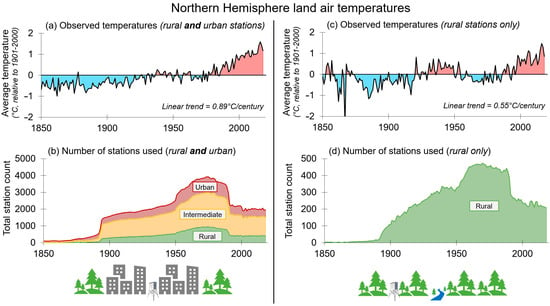
The Detection and Attribution of Northern Hemisphere Land Surface Warming (1850–2018) in Terms of Human and Natural Factors: Challenges of Inadequate Data A statistical analysis was applied to Northern Hemisphere land surface temperatures (1850–2018) to try to identify the main drivers of the observed warming since the mid-19th century. Two different temperature estimates were considered—a rural and urban blend (that matches almost exactly with most current estimates) and a rural-only estimate. The rural and urban blend indicates a long-term warming of 0.89 °C/century since 1850, while the rural-only indicates 0.55 °C/century. This contradicts a common assumption that current thermometer-based global temperature indices are relatively unaffected by urban warming biases. Three main climatic drivers were considered, following the approaches adopted by the Intergovernmental Panel on Climate Change (IPCC)’s recent 6th Assessment Report (AR6): two natural forcings (solar and volcanic) and the composite “all anthropogenic forcings combined” time series recommended by IPCC AR6. The volcanic time series was that recommended by IPCC AR6. Two alternative solar forcing datasets were contrasted. One was the Total Solar Irradiance (TSI) time series that was recommended by IPCC AR6. The other TSI time series was apparently overlooked by IPCC AR6. It was found that altering the temperature estimate and/or the choice of solar forcing dataset resulted in very different conclusions as to the primary drivers of the observed warming. Our analysis focused on the Northern Hemispheric land component of global surface temperatures since this is the most data-rich component. It reveals that important challenges remain for the broader detection and attribution problem of global warming: (1) urbanization bias remains a substantial problem for the global land temperature data; (2) it is still unclear which (if any) of the many TSI time series in the literature are accurate estimates of past TSI; (3) the scientific community is not yet in a position to confidently establish whether the warming since 1850 is mostly human-caused, mostly natural, or some combination. Suggestions for how these scientific challenges might be resolved are offered. mdpi.com

@Elpis_R - Ξlpis

D’autres études récentes soulèvent ce même problème, avec les mêmes conclusions à savoir 40% de faux réchauffement, ce qui explique que “notre perception du réchauffement est dû à l’effet d’îlot de chaleur urbain” et que ceci “n’est pas représentatif du réchauffement climatique”. https://t.co/DgX4uQUxL0

@Elpis_R - Ξlpis

Elle démontre aussi (comme cette étude) que l’utilisation d’un ensemble de données sur le forçage solaire (TSI) basé sur les observations (ACRIM) négligé à dessin par le GIEC (préférant un modèle) permet au TSI d’expliquer ~87% du réchauffement moderne. https://t.co/z9pq6LabdV

Saved - September 3, 2023 at 10:18 PM
reSee.it AI Summary
The impact of solar activity on climate change is often underestimated. Certain climate models solely rely on low solar irradiance models, minimizing the solar component while maximizing the human factor. However, empirical data suggests that solar variability plays a significant role. Observations anchored in ACRIM, not PMOD modeling, show greater decadal and secular variability. Additionally, the sun's influence on Earth's climate occurs through radiative and non-radiative forcings, including magnetic activity and cosmic ray modulation. Correlations between global temperature records and TSI measurements further support this. Biases in climate models have been identified, underestimating solar contributions. Neglected solar magnetic forcings and associated mechanisms, such as cloud modulation, explain a substantial portion of observed climate changes. It's crucial to consider non-climatic biases, like urban heat island effects, when interpreting surface temperature records. In summary, acknowledging the solar factor and its various influences is essential for a comprehensive understanding of climate change.

@Elpis_R - Ξlpis

Étude 2023 : L’assertion du GIEC (Valérie Masson-Delmotte et al., 2021) selon laquelle le réchauffement observé depuis 1850 est dû à ~100% aux émissions anthropiques repose UNIQUEMENT sur certains modèles GCM en sélectionnant un seul modèle de faible TSI. https://doi.org/10.1016/j.gsf.2023.101650

Empirical assessment of the role of the Sun in climate change using balanced multi-proxy solar records The role of the Sun in climate change is hotly debated. Some studies suggest its impact is significant, while others suggest it is minimal. The Interg… sciencedirect.com

@Elpis_R - Ξlpis

Les résultats de certains MCG (modèle informatiques) supposent que les variations de l’activité solaire ne peuvent avoir un impact sur le climat que par le biais des forçages radiatifs de l’irradiation solaire totale (TSI) et de l’irradiation solaire spectrale (SSI).

@Elpis_R - Ξlpis

Ces MCG utilisent une fonction de forçage radiatif dérivée des modèles de substitution TSI à faible variabilité séculaire (Matthes et al., 2017). Ce cherry-picking permet de minimiser la composante solaire tout en maximisant une supposée composante humaine https://agupubs.onlinelibrary.wiley.com/doi/pdf/10.1002/2017EA000357

@Elpis_R - Ξlpis

La littérature scientifique fournit des données de la TSI ancrées dans l’observation (ACRIM) et non dans la modélisation (PMOD) présentant une variabilité multidécennale et séculaire nettement plus importante. Ces donnés ne devraient pas être ignorés par le GIEC.

@Elpis_R - Ξlpis

“Lorsque le modèle de substitution a été ajusté empiriquement aux données TSI originales, il s’est conformé beaucoup plus étroitement à la tendance multidécennale de l’ACRIM (observations) qu’à celle de la PMOD (modèle)”.

@Elpis_R - Ξlpis

Étude 2020 : “Le forçage solaire de l’atmosphère est de ±4,5 W/m² depuis 1750 (ce qui est beaucoup plus important que l’estimation du GIEC de -0,30 à +0,10 W/m²). Ce chiffre de ±4,5 W/m² est à comparer aux +2,2 ± 1,1 W/m² estimés par le GIEC pour le CO2.” https://iopscience.iop.org/article/10.3847/1538-4357/ab72a9/meta

Sun-like Stars Shed Light on Solar Climate Forcing - IOPscience iopscience.iop.org

@Elpis_R - Ξlpis

Le Soleil influence le climat de la Terre par le biais de forçages radiatifs et non radiatifs, ces derniers étant principalement liés à son activité magnétique qui peut directement moduler les flux de rayons cosmiques et générer des perturbations.

@Elpis_R - Ξlpis

Étude 2023 : Les variations des rayons cosmiques modulant la couverture nuageuse, qui, à son tour, entraîne des variations du rayonnement solaire incident sur des échelles de temps à court et long terme, sont la cause dominante des variations climatiques. https://notrickszone.com/2023/07/03/scientists-cosmic-ray-cloud-connection-explains-million-year-climate-changes-far-better-than-co2/

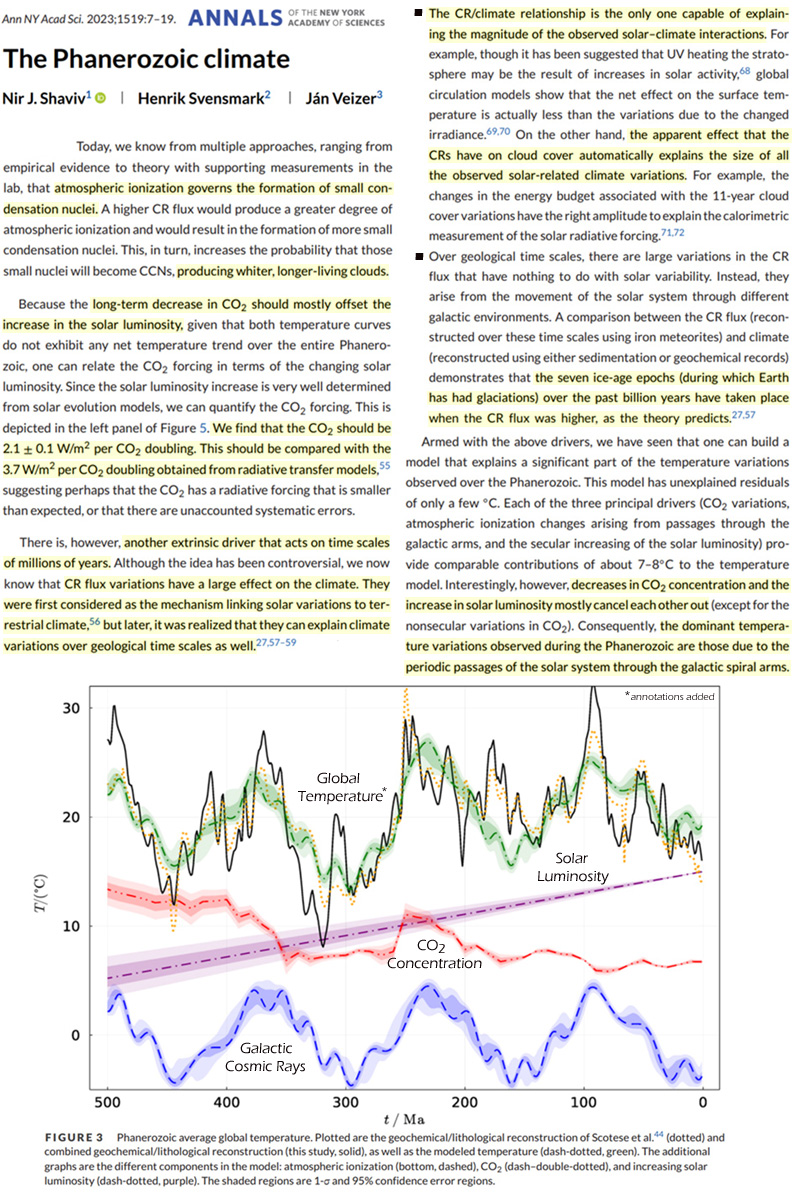
Scientists: Cosmic Ray-Cloud Connection Explains Million-Year Climate Changes Far Better Than CO2 notrickszone.com

@Elpis_R - Ξlpis

Les résultats obtenus entre 1850 et 2020 sont mieux corrélées avec les relevés de température globale et de surface de la mer disponibles, en particulier si les relevés TSI #1 et #2 sont utilisés. En particulier, le TSI #2 exclut les modèles proxy TSI Matthes et al. (2017) - GIEC https://t.co/QS6lGymbGE

@Elpis_R - Ξlpis

McKitrick et Christy 2020 et Zou et al., 2023 ont trouvé un biais de réchauffement omniprésent dans tous les MCG du CMIP6 lorsque leurs prévisions rétrospectives sont comparées aux enregistrements de la température de la troposphère, et par Stefani (2021). https://agupubs.onlinelibrary.wiley.com/doi/full/10.1029/2020EA001281

@Elpis_R - Ξlpis

Les valeurs de l’ECS proches de 1°C impliqueraient que les rétroactions - et + sur le forçage radiatif sont à peu près équilibrées. En fait, le doublement de la concentration de CO2 de 280 ppm à 560 ppm pourrait THÉORIQUEMENT générer ~1°C ou moins. https://t.co/2ld3FH7CEy

@Elpis_R - Ξlpis

Catégorie : - Sensibilité climatique (CS) à un doublement du CO2 atmosphérique (CO2x 2) https://t.co/pcudIYNmfe

@Elpis_R - Ξlpis

En outre, il convient de tenir compte du fait qu’une partie du réchauffement indiqué sur les températures de surface (thermomètre) sont fictives, car elle résultent d’îlots de chaleur urbains (UHI) et d’autres biais NON-CLIMATIQUES (Connolly et al., 2021, Scafetta, 2021a...). https://t.co/LVWMOY0uo0

@Elpis_R - Ξlpis

Les GCM CMIP6 sous-estiment considérablement le rôle du soleil dans le changement climatique en raison de deux limitations majeures : forçages solaires erronés intégrés dans les modèles ; et la TSI seul n’est pas le forçage solaire le plus important. https://t.co/0t8dYyum8H https://t.co/QuzGtGL5rR

@Elpis_R - Ξlpis

[Thread]🧶L’effet de serre (ES) n’a pas été renforcé, au contraire, son impact a diminué depuis 1983. Cela exclut que le CO2 et l’augmentation de l’effet de serre soient les moteurs du réchauffement climatique. (1/15)

@Elpis_R - Ξlpis

D’autres forçages liés au magnétisme solaire et mécanismes associés ne sont pas inclus dans les GCM parce qu’ils sont ignorés, malgré le fait qu’il existe des preuves empiriques de la modulation de la nébulosité expliquant une part importante des changements climatiques observés. https://t.co/HScO9v0Roq

Saved - September 1, 2023 at 11:54 PM
reSee.it AI Summary
New study: No detectable temperature trend above Greenland's ice sheet melt from 2002-2003 to 2020. Greenland has been rapidly cooling since 2010. Ice cover significantly exceeded long-term climate average from Sep 2022 to Aug 2023. Temperature records show no significant change in melt extent or ice sheet mass balance since around 2005. Other scientists also report no clear warming trend in recent decades. Temperature stations document net cooling trends from 2001-2019, contradicting global warming rhetoric.

@Elpis_R - Ξlpis

Nouvelle étude : Il n’y a pas eu de tendance détectable de la température de la surface terrestre (LST) au-dessus de la fonte de l’inlandsis groenlandais au cours de la période 2002-2003 à 2020. Le Groenland se refroidit (rapidement) depuis 2010. (1/5) https://mdpi.com/2072-4292/15/4/1149

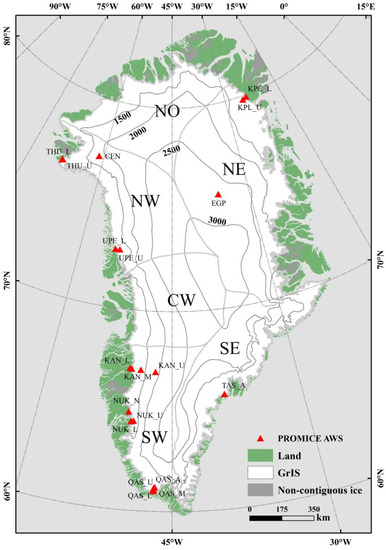
Greenland-Ice-Sheet Surface Temperature and Melt Extent from 2000 to 2020 and Implications for Mass Balance Accurate monitoring of surface temperature and melting on the Greenland Ice Sheet (GrIS) is important for tracking the ice sheet’s mass balance as well as global and Arctic climate change. Using a moderate-resolution-imaging-spectroradiometer (MODIS)-derived land-surface-temperature (LST) data product with a resolution of 1 km from 2000 to 2020, the temporal and spatial variations of annual and seasonal ‘clear-sky’ surface temperature were evaluated. We also monitored summer surface melting and studied the relationship between the mass balance of the ice sheet and changes in surface temperature and melting. The results show that the mean annual LST during the study period is −24.86 ± 5.46 °C, with the highest of −22.48 ± 5.61 °C in 2010 and the lowest temperature of −26.49 ± 5.30 °C in 2015. With the change of season, the spatial variation of the ice-sheet surface temperature changes greatly. 2012 and 2019 experienced the warmest summers (−5.92 ± 4.01 °C and −6.51 ± 3.93 °C), with extreme cumulative melting detected on the ice-sheet surface (89.9% and 89.7%, respectively), and 2002 also experienced a greater extent of melting. But short period of melt in 2002 and 2019 (30.6% and 31.4%, respectively), accounted for a larger proportion, with neither the duration nor intensity of the melt reaching that of 2012. There is a strong correlation between the GrIS surface temperature and its mass balance. By fitting the relationship between surface temperature and mass balance, it was found that 93.83% (6.17%) of the ice-sheet response to surface-temperature change was via surface-mass balance (discharge and basal-mass balance). mdpi.com

@Elpis_R - Ξlpis

La couverture de glace du Groenland a été, pendant la majeure partie de cette année (du 1er septembre 2022 au 31 août 2023), nettement supérieure à la moyenne climatique à long terme (1981-2010).

@Elpis_R - Ξlpis

Un enregistrement de température sans tendance se manifeste également par un changement non significatif de l’étendue de la fonte en pourcentage de la surface ainsi que du bilan de masse pour l’ensemble de la calotte glaciaire, en particulier à partir d’environ 2005.

@Elpis_R - Ξlpis

D’autres scientifiques ont également signalé que le réchauffement du Groenland “n’est pas évident” au cours des dernières décennies. https://www.nature.com/articles/s43247-021-00329-x

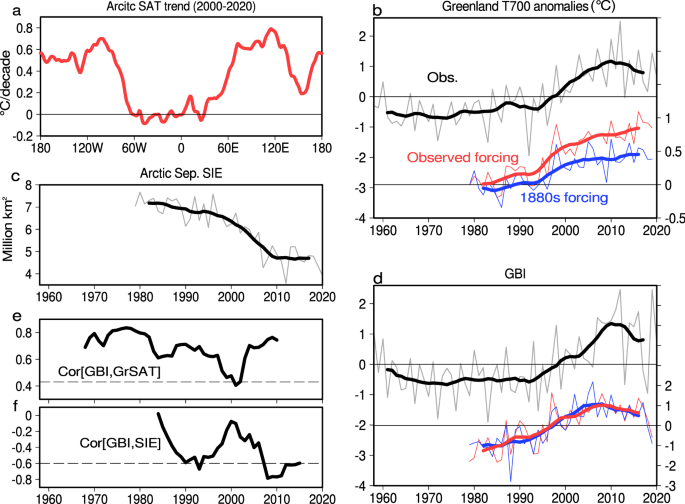
Slow-down in summer warming over Greenland in the past decade linked to central Pacific El Niño - Communications Earth & Environment Greenland warming and ice loss have slowed down since the early 2010s, in contrast to the rest of the Arctic region. Both natural variability and anthropogenic forcing contribute to recent Greenland warming by reducing cloud cover and surface albedo, yet most climate models are unable to reasonably simulate the unforced natural variability. Here we show that a simplified atmospheric circulation model successfully simulates an atmospheric teleconnection from the tropics towards Greenland, which accounts for Greenland cooling through an intensified cyclonic circulation. Synthesis from observational analysis and model experiments indicate that over the last decade, more central Pacific El Niño events than canonical El Niño events have generated the atmospheric teleconnection by shifting the tropical rainfall zone poleward, which led to an intensified cyclonic circulation over Greenland. The intensified cyclonic circulation further extends into the Arctic Ocean in observations, whereas the model does not show a direct remote forcing from the tropics, implying the contribution of an indirect atmospheric forcing. We conclude that the frequent occurrence of central Pacific El Niño events has played a key role in the slow-down of Greenland warming and possibly Arctic sea-ice loss. A slow-down in warming and ice loss in Greenland over the past decade is linked to a shift in El Niño events towards the central Pacific through an atmospheric remote forcing, according to analyses of observations and simulations with an atmospheric circulation model. nature.com

@Elpis_R - Ξlpis

Au lieu de cela, les stations de température documentent les tendances nettes de refroidissement de 2001 à 2019, le tout complément à l’encontre de la rhétorique d’une “ébullition mondiale”. https://rmets.onlinelibrary.wiley.com/doi/pdfdirect/10.1002/joc.6771 https://t.co/fHvwFVh4xk

Saved - August 28, 2023 at 7:03 AM
reSee.it AI Summary
Wind farms dry out surface soils, posing a setback to the supposed eco-friendly transition. Offshore wind parks harm marine ecosystems, offering unreliable energy. Biomass, claimed as renewable, involves clearing and burning forests. Photovoltaic panels generate 3-4°C hotter spots. These installations encroach on vital biodiversity conservation areas, seemingly creating problems against nature.

@Elpis_R - Ξlpis

Nouvelle étude : Il est prouvé que les parcs éoliens assèchent les sols en surface. Encore un coup dur pour la transition dites écologique censée sauver la planète afin de soi-disant préserver les générations futures d’un hypothétique climat futur. https://sciencedirect.com/science/article/pii/S2215016123000055

Wind farms dry surface soil in temporal and spatial variation Wind farms have been proved to have potential impact on the ecology. As an important ecological factor, soil moisture has a great impact on the ecosys… sciencedirect.com

@Elpis_R - Ξlpis

Sans compter que les parcs éoliens offshore détruisent les écosystèmes marins, le tout pour fournir une énergie peu fiable. C’est tout à fait logique. https://m.youtube.com/watch?v=uUONUh0A6Z8&ab_channel=SkyNewsAustralia

Video Not Available youtube.com

@Elpis_R - Ξlpis

Ou la biomasse revendiquée comme bio-énergie “renouvelable” (politique de l’UE pour sauver la planète) qui consiste à raser et brûler des forêts comme combustible, source №1 de renouvelable en France et dans beaucoup de pays européens… https://t.co/QodZko6pcC

@Elpis_R - Ξlpis

Nous avons aussi les panneaux photovoltaïques qui créent des îlots de chaleur de 3 à 4°C plus chauds que ces terres voisines… https://t.co/UFyHZNPGvQ

@Elpis_R - Ξlpis

Et pour finir, toutes ces installations empiètent déjà sur les endroits les plus importants du monde pour la conservation de la biodiversité… C’est comme ci ils prenaient volontairement des mesures absurdes contre la nature pour créer un problème. https://t.co/d5ztNf19iA

Saved - August 28, 2023 at 7:03 AM
reSee.it AI Summary
Big Oil promotes renewable energies, such as wind and solar power, paradoxically driving growth in fossil fuel-based energy production. This phenomenon is recognized, with fossil fuel companies actively investing in wind and solar technologies. However, solar PV installations result in a net energy loss, mainly due to intermittent availability, increasing reliance on fossil fuels. To expand renewable market share, fossil fuel technologies must develop alongside. Companies like BP, Exxon, Shell, and Chevron are investing billions in solar and wind, challenging the notion that they oppose green solutions. Both sides may support renewables, but for different reasons.

@Elpis_R - Ξlpis

« Big Oil » promeut désormais les énergies renouvelables – L'énergie éolienne et solaire stimule la croissance de la production d'énergie à partir de combustibles fossiles. C'est ce qu'on appelle le « paradoxe de la politique des énergies renouvelables ». https://sciencedirect.com/science/article/pii/S1364032117312546

The renewable energy policy Paradox One major avenue for policymakers to meet climate targets is by decarbonizing the power sector, one component of which is raising the share of renewab… sciencedirect.com

@Elpis_R - Ξlpis

Bien que cela puisse sembler contre-intuitif, l'expansion de l'énergie éolienne et solaire conduit nécessairement à la préservation et à la croissance éventuelle de la production d'énergie à partir de combustibles fossiles.

@Elpis_R - Ξlpis

Ce « paradoxe » n'est pas passé inaperçu. En tant que bonne pratique commerciale, les entreprises de combustibles fossiles défendent et investissent activement dans les technologies éoliennes et solaires.

@Elpis_R - Ξlpis

Dans une analyse du retour sur investissement énergétique , l'installation de l'énergie solaire photovoltaïque (PV) entraîne finalement une perte nette d'énergie ( Ferroni et Hopkirk, 2016 ). https://www.sciencedirect.com/science/article/pii/S0301421516301379

Energy Return on Energy Invested (ERoEI) for photovoltaic solar systems in regions of moderate insolation Many people believe renewable energy sources to be capable of substituting fossil or nuclear energy. However there exist very few scientifically sound… sciencedirect.com

@Elpis_R - Ξlpis

Cela est dû en grande partie à la disponibilité intermittente (peu fiable) nécessitant un secours à partir d'énergie en continu (gaz, charbon, nucléaire..). L'investissement dans le solaire conduit donc à une plus grande dépendance aux énergies fossiles. https://www.sciencedirect.com/science/article/pii/S0301421518300983

Have fossil fuels been substituted by renewables? An empirical assessment for 10 European countries The electricity mix worldwide has become diversified mainly by exploiting endogenous and green resources. This trend has been spurred on so as to redu… sciencedirect.com

@Elpis_R - Ξlpis

Pour que les tech solaires et éoliennes augmentent leur part de marché, les technologies des combustibles fossiles devront nécessairement se développer à leurs côtés. C'est ce que l'on appelle le « paradoxe de la politique des énergies renouvelables ». https://www.sciencedirect.com/science/article/pii/S1364032117312546

The renewable energy policy Paradox One major avenue for policymakers to meet climate targets is by decarbonizing the power sector, one component of which is raising the share of renewab… sciencedirect.com

@Elpis_R - Ξlpis

Les entreprises de combustibles fossiles ont certainement reconnu la capacité de l'énergie éolienne et solaire à leur bénéficier financièrement. BP, reconnaît fièrement qu'ils “associent” leur gaz au solaire et à l'éolien, ou “utilisent le gaz pour compléter l'intermittence”.

@Elpis_R - Ξlpis

Exxon investit également dans l'éolien et le solaire. https://www.hppr.org/post/exxon-mobil-invites-texas-bids-renewable-expansion

Exxon Mobil Invites Texas Bids For Renewable Expansion America’s largest oil company is seeking proposals to expand renewable energy operations in the Lone Star State.As Bloomberg reports, Exxon Mobil Corp.… hppr.org

@Elpis_R - Ξlpis

Shell investit également 2 milliards de dollars dans les technologies solaires et éoliennes. https://www.greentechmedia.com/articles/read/shell-new-energies-director-on-investing-in-clean-energy

Shell New Energies Director on Investing in Clean Energy: ‘It’s About Survival’ If Shell isn't in the clean power business "we'll become marginalized," said Maarten Wetselaar, director of Shell’s integrated gas and new energies division. greentechmedia.com

@Elpis_R - Ξlpis

Chevron a ajouté une division entière d'énergie renouvelable et exploite des parcs éoliens et des projets solaires. https://www.chevron.com/corporate-responsibility/climate-change/renewable-energy


Energy transition Chevron believes the future of energy is lower carbon. We are lowering our carbon intensity, increasing renewables and investing in low-carbon technologies. chevron.com

@Elpis_R - Ξlpis

Avec leur plaidoyer croissant pour l'énergie solaire et éolienne, la caractérisation des entreprises de combustibles fossiles comme les ennemis des technologies «vertes» ou respectueuses du changement climatique semble de plus en plus insoutenable.

@Elpis_R - Ξlpis

« Big Oil » pourrait très bien être du même côté que ceux qui défendent les solutions (perçues) au réchauffement climatique. C'est juste que chaque camp ne fait peut-être pas la promotion des énergies éolienne et solaire pour les mêmes raisons.

Saved - August 26, 2023 at 10:50 PM

@Elpis_R - Ξlpis

Oui, oui…

Saved - August 26, 2023 at 9:51 PM
reSee.it AI Summary
Criminal acts caused the fires in Greece, disproving the climate change narrative. Media propaganda falsely linked the fires to a climate crisis. However, the truth is that 96% of fires globally are caused by human activity, unrelated to climate change or CO2. The real world doesn't support their claims.

@Elpis_R - Ξlpis

Quelle surprise, les incendies en Grèce étaient criminels. Pourtant tous les alarmistes ont accusé le réchauffement climatique pour pousser leur dogme (alors qu’il n’y a aucun lien entre les 2) et le pire des médias de propagande (Guardian) titrait: incendies = crise climatique. https://t.co/p725xvIgo6

@Elpis_R - Ξlpis

On sait tous que les incendies sont (~96%) de la main de l’homme (criminels/involontaires) et qu’ils baissent au niveau mondial depuis des dizaines et des dizaines d’années sans lien avec le réchauffement climatique ou le CO2. Le monde réel ne fait plus partie de l’équation… https://t.co/vq1Vzz4D22

Saved - August 26, 2023 at 12:36 PM
reSee.it AI Summary
There's no concrete scientific evidence linking CO2 to climate change. If such proof existed, it would have been documented. The idea that human emissions are the dominant influence on climate is merely a hypothesis, not universally accepted.

@Elpis_R - Ξlpis

“Il n’existe aucune preuve scientifique définitive, fondée sur des observations réelles, que le CO2 est responsable du réchauffement climatique. Si une telle preuve avait été apportée par des tests et des reproductions, elle aurait été écrite pour que nous puissions la voir.” https://t.co/WRAa1yQsWl

Video Transcript AI Summary
There is no scientific proof that carbon dioxide (CO2) is responsible for the slight warming of the global climate in the last 300 years. The idea that human emissions are the main cause of climate change is just a hypothesis, not a universally accepted theory. It is important to be skeptical of those who claim the science is settled and the debate is over. However, it is certain that CO2 is essential for life on Earth, and without it, the planet would be uninhabitable. Despite this, children and the public are being taught that CO2 is a toxic pollutant that will harm life and civilization.
Full Transcript
Speaker 0: As I've stated publicly on many occasions, there is no definitive scientific proof through real world observation that carbon dioxide is responsible for any of the slight warming of the global climate that has occurred during the last 300 years since the peak of the Little Ice Age. If there were such a proof, through testing and replication, it would have been written down for all of us to see. The contention that human emissions are now the dominant influence on climate is simply a hypothesis rather than a universally accepted scientific theory. It is therefore correct, indeed, verging on the compulsory in the scientific tradition to be skeptical of those who express certainty that the science is settled and the debate is over. But there is certainty beyond a reasonable doubt that CO2 is the building block for all life on earth and that without its presence in the global atmosphere at sufficient concentration, this would be a dead planet. Yet today, our children and our publics are taught that CO 2 is a toxic pollutant that will destroy life and bring civilization to its needs.

@Elpis_R - Ξlpis

“L’affirmation selon laquelle les émissions humaines sont aujourd’hui l’influence dominante sur le climat n’est qu’une hypothèse et non une théorie scientifique universellement acceptée.”

Saved - August 23, 2023 at 7:29 PM
reSee.it AI Summary
The conversation discusses the credibility of the IPCC, with one person questioning its scientific basis and another emphasizing the increase in CO2 concentration. Another participant argues that human activities have minimal impact on climate change and that the main concern should be pollution and destruction of natural habitats. The conversation ends with a disagreement over the percentage of CO2 increase.

@Elpis_R - Ξlpis

Le GIEC est un organisme politique, pas scientifique. J. Clauser lauréat du prix Nobel de physique 2022 met en cause la crédibilité du GIEC: “Le GIEC est l’une des pires sources de désinformation”. Et il a signé avec plus de 1600 scientifiques “Il n’y a pas d’urgence climatique.”

Video Transcript AI Summary
The speakers discuss the issue of climate change and the credibility of the Intergovernmental Panel on Climate Change (IPCC). They mention that some people view the IPCC as a bureaucratic organization rather than a scientific one. They also mention a Nobel laureate who doubts the claims made about climate change. The speakers argue that there is a lack of scientific rigor and too much focus on politics in the climate change debate. They highlight the discrepancy between measuring CO2 levels in parts per million and emissions in tons, emphasizing the need for a more accurate understanding of the issue. They criticize the European Union for not considering the effectiveness of their actions in relation to the massive amount of CO2 in the atmosphere. They conclude that false ideas about climate change are being propagated by authorities, including the United Nations.
Full Transcript
Speaker 0: Êtes ingénieur et donc vous ce qui vous intéresse ce sont les données et les chiffres et vous parlez vraiment de science-fiction pour le GIEC, certains ont parlé de bureaucratie climatique. Encore une fois, ça ne signifie pas qu'on ne considère que la climatologie n'existe pas à quoi, ça ne signifie pas qu'on considère qu'il n'y a pas d'enjeu, mais ces enjeux aujourd'hui sont complètement trustés par par le GIEC. Speaker 1: Monsieur Trump, alors nous avons un prix Nobel de physique, alors c'est son prix Nobel l'an dernier et là il vient de déclarer qu'il ne croyait pas un mot de de ce qu'on racontait sur le changement climatique que tu laisses. Speaker 0: Vous déclarez que le GIEC, selon lui, ne pratiquait plus la science, enfin c'est encore plus grave, il a dit voilà, ils ne font pas de la science, selon lui. Speaker 1: Il n'a jamais pratiqué la science, ce GIEC, c'est un organisme politique. Speaker 0: Là vous nous rappelez donc qu'on a un prix Nobel deux-mille-vingt-deux, ce n'est pas un prix Nobel de mille-neuf-cent-soixante-quatre, qui s'est opposé à la crédibilité du GIEC et il fait partie de 1500 signataires, ce n'est pas juste lui tout seul. Philippe Robichon Speaker 1: Absolument, il vient d'adhérer à Clinton dont le titre est Il n'y a pas d'urgence climatique. Speaker 0: On a donc, voilà, on a parlé du fait qu'aujourd'hui certaines sciences pouvaient devenir des religions, on a des savonaroles, on a des des gens qui demandent à aller, à envoyer des scientifiques au bûcher, c'est ce qu'on a vu avec même ce prix Nobel que vous avez cité, qui a été envoyé au spécifique au bûcher, c'est ce qu'on a vu avec même ce prix Nobel que vous avez cité, qui a été envoyé au bûcher alors qu'il a simplement exigé que l'on fasse de la science pour une fois, or on fait de la politique. Speaker 1: C'est un des problèmes que nous avons. Nous comptons le c o deux dans l'atmosphère en partie par million. Nous comptons les émissions que nous faisons en tonnes donc d'un côté on compte en partie par million de l'autre on compte La même chose en tonnes et ça change tout. Alors pourquoi ça change tout Parce que les quatre cent et quelques parties par millions que vous avez évoquées, ça correspond à trois mille deux cent milliards Le tonnes, ça paraît incroyable, mais ça fait trente ans que nous vivons d'un espèce de délire parce qu'on n'a pas fait le rapprochement entre ce que nous émettons et ce qu'il y a dans l'atmosphère. Si on fait ce rapprochement, on s'aperçoit évidemment que comme je le disais tout à l'heure, on vide pas l'océan avec une petite cuillère et ce que nous faisons ne peut servir à rien parce que c'est fondamental et que vous ne verrez même pas regarder les rapports de l'Union européenne. Jamais ils ne se sont posé la question est-ce que ce qu'on va faire peut servir à quelque chose. Ils n'ont jamais rapproché leurs émissions qui sont pilotes à côté de la masse trois-mille-deux-cent milliards d'automne, c'est énorme, du CO2 qu'il y a dans l'atmosphère. Si c'était simplement posé la question, ils auraient refermé le dossier tout de suite, nous vivons Sur des idées fausses qui nous sont malheureusement transmises par les hautes autorités à commencer par les nations unies.

@DIMENSION_YT - DIMENSION

@Elpis_R Croire sur parole des personnes qui ont reçu des prix ou ont signé des pétitions ce n'est pas de la science, et croire que tous les scientifiques du monde se sont trompé d'unité est d'une naïveté sans nom... Dans le monde réel, on a augmenté la concentration de CO2 de plus de 30%

@LeSanzalure - Grenier, Serge

Le pourcentage de CO2 dans l'atmosphère est de 0,04%. Une augmentation de 30% nous amène à un peu plus de 0,05%. Big deal !!! Le problème créé par les humains, c'est la pollution et la destruction des milieux naturels. C'est de ça qu'on devrait s'occuper. Le climat change tout seul tout le temps. Les êtres humains ont très peu d'influence sur les changements climatiques et encore moins d'influence pour les empêcher de se produire. Peu importe le nombre de diplômes et le nombre d'études, les théoriciens du climat ne servent qu'à détourner l'attention de l'humanité de son principal problème qui est de nature politique : le privé a infiltré le public et est en train d'installer un régime totalitaire mondial. Pensez ce que vous voulez, moi c'est ça que je pense.

@Elpis_R - Ξlpis

@LeSanzalure @DIMENSION_YT Ce n'est pas 30%, mais seulement ~4%. Même leur bible du GIEC dit 4.3%. Ces gens n'y connaissent rien, mais se permettent de faire comme ci en racontant des absurdités.

Saved - August 23, 2023 at 3:03 PM
reSee.it AI Summary
The conversation discusses the rising sea temperatures in France due to the heatwave. @Elpis_R clarifies that the atmosphere doesn't warm the oceans, but rather the sun does. @resikme comments on the need to explain this. @gustave4866 raises a question about the reflection of Earth's IR radiation by greenhouse gases. @stefanbasch appreciates @Elpis_R for bringing scientific facts into climate discussions. @MAD06427011 adds that without the mistral wind, surface waters are warmer.

@AnthoGrillon - Anthony Grillon 🌪

🌊 Avec la #canicule, la température de l'eau de mer ne cesse de progresser en #France. Jusqu'à 24 degrés vers le Pays basque. 25-27 degrés en #Méditerranée alors qu'il y a 15 jours, la t° n'était parfois plus que de 16 ou 17 degrés en raison du mistral.

@Elpis_R - Ξlpis

@AnthoGrillon C’est évidemment faux vu que l’atmosphère ne réchauffe pas les océans (ni le CO2), le soleil le fait directement jusqu’à 20 m de profondeur (onde courtes). Le flux de chaleur s’effectue TOUJOURS de l’océan vers l’air. C-à-d : soleil→océan→atmosphère. https://t.co/AF26WyZhqi

@MartinEdMic - Martin Ed Mic

@Elpis_R @AnthoGrillon Merci pour cette utile précision

@resikme - Méchiche Résika

@Elpis_R @AnthoGrillon Faut tout leur expliquer...

@GOLDCOUNCIL - World Gold Council

Agile and liquid. A proven protector. An ever-evolving enabler of bold decisions.

@gustave4866 - NEAJAPUL

@Elpis_R @AnthoGrillon une partie du rayonnement IR de la Terre n'est elle pas réfléchie par les GES, sur des λ un peu supérieures?

@stefanbasch - Sb

@Elpis_R @AnthoGrillon Merci @Elpis_R de remettre de la science à chaque dérive sectaire concernant le climat.

@MAD06427011 - M.A.D

@Elpis_R @AnthoGrillon Il ne dit pas le contraire : il dit simplement qu’en l’absence de mistral les eaux de surface sont plus chaudes 31/07 : force 1 - mer calme eau 26 degrés en ⤴️ depuis 5 jours 03 au 06/08 coup de mistral force 5-7 mer agitée - eau 18 degrés (Chiffres au Lavandou)

Saved - August 22, 2023 at 9:27 PM
reSee.it AI Summary
A conversation on climate change and a supposed CIA report from 1974. @NiusMarco claims the report predicted global cooling and a return to an ice age. @RedZeBot1 debunks the myth, providing a link to a scientific journal. @NiusMarco disputes the existence of the report. @RedZeBot1 accuses @NiusMarco of cherry-picking information. @NiusMarco mocks @RedZeBot1's support for Davos. @Elpis_R joins, claiming a consensus of 83% on global cooling in the 60s-70s and accuses Wikipedia of deleting related content. @NiusMarco praises @Elpis_R.

@NiusMarco - marco nius

TREAD 1/N rapport CIA 1974 Changement climatique Avec le consensus climatique mondial ils annoncent le CC avec sécheresses , inondations, famines, migrations massives à cause du refroidissement , climat "néo-Boréal"- retour au petit âge glaciaire

@RedZeBot1 - RedZeBot

@NiusMarco Ce mythe a été débunké depuis longtemps Marco. https://journals.ametsoc.org/view/journals/bams/89/9/2008bams2370_1.xml

THE MYTH OF THE 1970s GLOBAL COOLING SCIENTIFIC CONSENSUS Climate science as we know it today did not exist in the 1960s and 1970s. The integrated enterprise embodied in the Nobel Prizewinning work of the Intergovernmental Panel on Climate Change existed then as separate threads of research pursued by isolated groups of scientists. Atmospheric chemists and modelers grappled with the measurement of changes in carbon dioxide and atmospheric gases, and the changes in climate that might result. Meanwhile, geologists and paleoclimate researchers tried to understand when Earth slipped into and out of ice ages, and why. An enduring popular myth suggests that in the 1970s the climate science community was predicting “global cooling” and an “imminent” ice age, an observation frequently used by those who would undermine what climate scientists say today about the prospect of global warming. A review of the literature suggests that, on the contrary, greenhouse warming even then dominated scientists' thinking as being one of the most important forces shaping Earth's climate on human time scales. More importantly than showing the falsehood of the myth, this review describes how scientists of the time built the foundation on which the cohesive enterprise of modern climate science now rests. journals.ametsoc.org

@NiusMarco - marco nius

@RedZeBot1 Oui. Ce rapport n'existent pas. La conférence internationale citée dedans non plus. Même pas vrai.

@RedZeBot1 - RedZeBot

@NiusMarco Si mais tu fais du cherry-picking et un gros zoom sur ce qui t'intéresse, sans que ça soit représentatif de l'état de l'art à cette époque. Comme font les médias... comme à ton habitude ...

@NiusMarco - marco nius

@RedZeBot1 🙈🙉🙊 continuez à soutenir Davos. Ce sont des vrais écologistes. 😂

@Elpis_R - Ξlpis

@NiusMarco @RedZeBot1 Un consensus des études scientifiques de 83% sur un refroidissement global entre les années 60-70. Ils ont tout supprimer sur wikipédia. Voici les 285 études : https://notrickszone.com/285-papers-70s-cooling-1/

285 Papers 70s Cooling 1 notrickszone.com

@NiusMarco - marco nius

@Elpis_R @RedZeBot1 Whaou. Tu es toujours au top 😁👍

Saved - August 20, 2023 at 4:57 PM
reSee.it AI Summary
A climate crisis consensus is claimed to be manufactured by a government-funded alarmist complex. Scientists are encouraged to exaggerate risks for fame and fortune. The Climategate scandal revealed attempts to hide data suggesting climate change isn't a crisis. The editor of Science promotes alarmist journals, dismissing debate. A climate scientist faced backlash for opposing the consensus. Integrity prevented her from playing along for money.

@Elpis_R - Ξlpis

Le consensus sur une soi-disant crise climatique est fabriqué par un vaste complexe d’alarmisme financé par les gouvernements. Pour être financé, il faut faire des déclarations alarmistes… Si vous voulez progresser dans votre carrière, il n’y avait qu’une seule voie à suivre.

Video Transcript AI Summary
Researcher Judith Curry claims that climate scientists have an incentive to exaggerate the risks of climate change. The climate gate scandal revealed leaked emails showing university climate scientists conspiring to hide data, which made Curry realize that the science had been corrupted. The origins of the climate change industry can be traced back to the 1980s and the UN environmental program, where some officials had an anti-capitalism agenda and seized on climate change as a means to advance their policies. The intergovernmental panel on climate change (IPCC) was created to focus on dangerous human-caused climate change, and funding agencies directed all funding in the field. Alarmist researchers control the discussion by publishing scary papers, and alarmist media amplifies their claims. Other scientists who recognize the nonsense are hesitant to push back due to discomfort and potential career consequences.
Full Transcript
Speaker 0: That alarmist claim. There's, No. The world is going to be consensus. Speaker 1: But It's a manufactured consensus. Speaker 0: Researcher Judith Curry says climate scientists have an incentive to exaggerate risk. Then the climate gate scandal taught Curry that many researchers aren't so open minded. Leaked emails showed university climate scientists conspiring to hide data. Speaker 1: It showed a lot of really ugly Things. Speaker 0: One email read, we thank this Yale professors in the skeptics camp getting him ousted. Seeing emails like that made Curry realize that climate change fanatics had corrupted the science because there's a climate change industry set up to reward alarmism. Speaker 1: The origins go back to the 19 eighties and the UN environmental program. Some UN officials had a specific agenda. Anti capitalism. They hated the oil companies. And they seized on the climate change issue as one to move their policies things along The UN created what's called the intergovernmental panel on climate change. The IPCC wasn't supposed to focus on any benefits of warming. The IPCC's mandate was to look for dangerous human caused climate change. The national funding agencies directed all the funding in the field. Speaker 0: The researchers aren't stupid. They know what they need to say Speaker 1: to get funding. Exactly. Speaker 0: This is how manufactured consensus happens. Then even if a skeptic does get funding, it's harder to publish because journal editors are alarmists. Getting published is crucial to researchers because that's how they advance in academia. Speaker 1: If you wanted to advance in your career, Like be at a prestigious university, get a big salary, have big laboratory space, get lots of grant fundings, be director of an institute. Well, there was Clearly one path to go. Speaker 0: So alarmist researchers control the discussion. They publish lots of scary papers, and alarmist media jump on those. Activists hear the media and freak out. Potential extinction of the human race. Why don't other scientists who recognize the nonsense push back. Speaker 1: If they work in a university, it's going to be very uncomfortable for them. I was doing this for the money. I would have stayed at Georgia Tech and sucked my big salary, but that's not who I am. My personal and professional integrity would not allow me to play that game.

@Elpis_R - Ξlpis

Il s’agit d’un consensus fabriqué, déclare la climatologue J. Curry. Les scientifiques sont incités à exagérer les risques pour rechercher gloire et fortune. Si vous faites des déclarations alarmistes vous devenez une rock star, invité par les politiques et passez dans les médias https://t.co/pPvWOYxHBU

Video Transcript AI Summary
Climate change skeptics are often dismissed and mocked by the media. However, there is a manufactured consensus among climate scientists, driven by incentives like fame and fortune. Researcher Judith Curry, who spreads alarm about climate change, published a study claiming that the intensity of hurricanes had doubled. This was picked up by the media, who tied extreme weather events to global warming. Curry became popular among environmental advocacy groups and received media attention, being treated like a rock star. However, some researchers pointed out gaps in her research, including years with low levels of hurricane activity.
Full Transcript
Speaker 0: Climate change is a crisis, we're told. Anyone who's skeptical or raises any questions about the alarm is dismissed. Speaker 1: I'm going to bring out 2 people who agree with you climate skeptic. I'm also gonna bring out 96 other scientists. Speaker 0: The smug media mocks so called skeptics. Speaker 1: And what is the overwhelming view of the entire scientific community? Any response to that? Any response to that? I I I can't hear you. I can't hear you. Speaker 0: The consensus is so strong, There shouldn't even be a debate. Speaker 1: This whole debate could not have happened. I apologize to everyone at home. Speaker 0: Climate alarmists Claim there's an Speaker 1: Overwhelming side to the consensus. Speaker 2: But It's a manufactured consensus. Speaker 0: Researcher Judith Curry says Climate scientists have an incentive to exaggerate risk. Why? What's in it for them? Speaker 2: Fame and fortune. Speaker 0: She knows about that because she wants to spread alarm about climate change. And the media loved her when she published this study saying There was an increase in hurricane intensity. We found that the percent of category 4 and 5 hurricanes Had doubled. Really? Double? Speaker 2: And so this was picked up by the media. Alarmists said, oh, here's the way to do it. Speaker 0: It being get the public alarm. Climate change is making hurricanes stronger and more destructive. Speaker 2: Tie extreme weather events to global warming. So this His Syria is your fault. Well, sort of. Not really. They they would have picked up on it and on anyways. Speaker 0: But Curry's more intense hurricanes gave them fuel. Speaker 2: I was adopted by the environmental advocacy groups and the alarmists, and I was treated like a rock star. Speaker 0: What does that mean, treated like a rocket. Speaker 2: Oh, my god. I was flown all over the place to meet with politicians and to give these talks and Lots of media attention. Speaker 0: But then some researchers pointed out gaps in her research, years with low levels of hurricane.

@Elpis_R - Ξlpis

Le scandale du Climategate lui a ensuite appris que d’autres chercheurs en climatologie n’étaient pas aussi ouverts d’esprit. Les tentatives agressives des scientifiques alarmistes pour cacher les données suggérant que le changement climatique n’est pas une crise. https://t.co/N8Ea321dpU

Video Transcript AI Summary
A scientist investigated criticism of her paper and admitted that her critics had valid points. She also learned from the climate gate scandal that many researchers are not open-minded. Leaked emails revealed that some university climate scientists conspired to hide data and manipulate journal editors. This made her realize that the climate change industry rewards alarmism and is driven by an anti-capitalism agenda. The UN created the Intergovernmental Panel on Climate Change (IPCC) to focus solely on finding dangerous human-caused climate change, which leads to a biased perspective. National funding agencies also direct funding towards researchers who emphasize the existence of dangerous impacts, creating a manufactured consensus.
Full Transcript
Speaker 0: Like a good scientist, I went in and investigated all that stuff. Speaker 1: She realized her critics were right. Speaker 0: Part of it was bad data. Part of it is natural climate variability. Speaker 1: So you're the unusual researcher who looks at criticism of your paper And actually concluded they had a point. Speaker 0: They had a point for sure. Speaker 1: Then the climate gate scandal taught Curry that Many researchers aren't so open minded. Leaked emails showed university climate scientists conspiring to hide data. Speaker 0: It showed a lot of really ugly things, avoiding Freedom of Information Act requests, trying to get journal editors fired from their job. Speaker 1: One email read, do you think this Yale professor is in the skeptics camp getting him ousted? Seeing emails like that made Curry realize that climate change fanatics had corrupted the science because there's a climate change industry Set up to reward alarmism. Speaker 0: The origins go back to the 1980s and the UN environmental program. Some UN officials had a specific agenda. Anti capitalism. They hated the oil companies, and they seized on the climate change issue as one to move their policies along. Speaker 1: The UN created what's called the Intergovernmental Panel on Climate Change. Speaker 0: The IPCC wasn't supposed to focus on Any benefits of warming. The IPCC's mandate was to look for dangerous human caused climate change. Speaker 1: Obviously, if you're only looking for risk, that's what you'll find. Speaker 0: Then the national funding agencies directed all the funding in the field. Speaker 1: If you say we're all gonna die and we gotta spend a ton of money on this, you get funding. If you say we don't know, You don't get funding? Speaker 0: No. It's it's more subtle than that. The announcements of opportunity for funding are really tied to assuming that there are dangerous impacts. Speaker 1: So the researchers aren't stupid. They know what they need to say to get funded. Exactly. This is how manufactured consensus happens.

@Elpis_R - Ξlpis

La rédactrice en chef de la revue Science a écrit une diatribe politique, explique Curry. Elle a même déclaré : “Le temps du débat est terminé”. Quel genre de message cela envoie-t-il ? Elle répond ensuite à sa propre question : “Promouvoir les journaux alarmants !” https://t.co/oLBnIPsHoc

Video Transcript AI Summary
Skeptics struggle to secure funding and face difficulty in publishing due to alarmist journal editors. The importance of publication lies in researchers' career advancement. Alarmist researchers dominate the conversation by publishing alarming papers, which are then amplified by the media. Various aspects of life, from transportation to childhood obesity, are attributed to climate change. The media's influence causes activists to panic, fearing the potential extinction of the human race.
Full Transcript
Speaker 0: Then even if a skeptic does get funding, it's harder to publish because journal editors are alarmists. Speaker 1: About 10 years ago, the editor of the journal Science, she wrote this political rant about we need to stop emissions now that was published in Science. So what kind of message does that give? Promote the alarming papers and don't even send the other ones out for review. Speaker 0: Getting published is crucial to researchers because That's how they advanced in academia. Speaker 1: If you wanted to advance in your career, like be at a prestigious university, get big salary, have big laboratory space, get lots of grant fundings, be director of an institute. So there was clearly one path to go. Speaker 0: So alarmist researchers control the discussion. They publish lots of scary papers, and alarmist media jump on those. Time Magazine says climate is everything. Good Morning America agrees. Climate change has impacted everything from conception to pregnancy. Speaker 1: Transportation, congestion, the size of frogs, you know, Speaker 0: everything. Airplane turbulence. Expect turbulence like this to become more frequent due to climate change. Childhood obesity. Climate change is making our children more obese. Experts say that we have until 2030 to avoid catastrophe. Activists hear the media And freak out. Children are starving. The potential extinction of the human race.

@Elpis_R - Ξlpis

Suite à sa prise de position contre l’ONU-GIEC, elle a dû s’extraire et est traitée de négationniste, “Si j’avais fait ça pour l’argent, je serais resté à Georgia Tech et englouti mon gros salaire, mais ce n’est pas ce que je suis, mon intégrité ne me permet pas de jouer ce jeu.” https://t.co/rdQdKuU2md

Video Transcript AI Summary
Other scientists who recognize the nonsense don't push back because it's uncomfortable for them in universities. Universities punish people who tell the truth. Judith Curry, a former department chair at Georgia Tech, experienced hostility when she expressed that fossil fuels aren't so terrible. She looked for other university jobs but was told that nobody would hire her because of her reputation as a climate denier. Curry transitioned to the private sector and started a weather forecasting company. Climate alarmists now smear her as a climate denier doing it for the money, but she made more money at Georgia Tech. Curry believes climate change is a problem but not a crisis. A full interview discussing climate and scientific consensus will be posted soon.
Full Transcript
Speaker 0: Why don't other scientists who recognize the nonsense push back? Speaker 1: If they work in a university, it's gonna be very uncomfortable for them. Speaker 0: Universities are become idiots and they punish people who tell the truth? Speaker 1: I mean, I felt the hostility. Speaker 0: Curry was the department chair at Georgia Tech until she Included, these fossil fuels aren't so terrible. Speaker 1: They want fossil fuels to go away. Speaker 0: When they made life uncomfortable for her, she looked for other university jobs, But was told Speaker 1: Nobody will hire you because if you Google Judith Curry, you know, everything that shows up with Judith Curry denier, Judith Curry serial Climate disinformer, at that point, I started making my plans to transition 100% to the private sector. Speaker 0: She started this weather forecasting company. Now climate alarmists smear her as a climate denier doing it for the money. But she made more money at Georgia Tech. Speaker 1: If I was doing this for the money, I would've stayed at Georgia Tech and sucked up my big salary, but that's not who I am. My personal and professional integrity would not allow me to to play that game. Speaker 0: Good for her. It's unfortunate that many university departments now Shut down debate and reward alarmism. Curry agrees that climate change is a problem, but she says it's not a crisis. In a few weeks, I'll post our full interview with a more complete discussion about climate and what scientists really agree about.
Saved - August 16, 2023 at 10:03 AM
reSee.it AI Summary
Renowned atmospheric physicist Richard Lindzen, formerly of MIT, challenges the notion that CO2 governs Earth's climate, likening it to belief in magic. According to Lindzen, doubling CO2 would only cause a 1-2% (3.7 W/m²) change, insufficient to control climate.

@Elpis_R - Ξlpis

Richard Lindzen, physicien de l'atmosphère (MIT), il fut auteur principal du GIEC : Croire que le CO2 contrôle le climat de la Terre est "assez proche de la croyance en la magie". https://merionwest.com/2017/04/25/richard-lindzen-thoughts-on-the-public-discourse-over-climate-change/


Richard Lindzen: Thoughts on the Public Discourse over Climate Change | Merion West Merion West is an online magazine that publishes commentary, in-depth interviews and book reviews from across the political spectrum. merionwest.com

@Elpis_R - Ξlpis

Le point de vue de Lindzen c'est que de doubler le CO2 n'entraînera qu'un changement de 1 à 2 % (3,7 W/m²) dans un sens ou dans l'autre, et cela ne contrôle pas le climat. https://t.co/Nbootiswhc

Saved - August 16, 2023 at 9:06 AM
reSee.it AI Summary
Renowned geophysicist Prof. Vincent Courtillot warns that the overconfidence of the IPCC's conclusions may lead to a harmful backlash against science. Having served as the former president of the European Geosciences Union and director of the Globe Institute of Physics in Paris, he has published over 150 scientific articles. Furthermore, recent studies in 2021 suggest that the climate's sensitivity to CO2 is negligible.

@Elpis_R - Ξlpis

“Je crains que le plus mauvais service que nous ait rendu cette trop grande sûreté, qui est presque une forme d'arrogance des conclusions du GIEC, ce soit un terrible retour de bâton anti-science.” - Prof. Vincent Courtillot, géophysicien. https://t.co/aVQiqN1rQm

Video Transcript AI Summary
Over the past century, it has been discovered that the variations in the Earth's magnetic field, caused by the sun's charged particles, have a significant impact on global climate. This challenges the widely accepted belief that human-released carbon dioxide from burning fossil fuels is solely responsible for recent climate change. By analyzing magnetic and meteorological data, scientists have found clear evidence of the sun's influence on temperature variations. Additionally, recent studies have shown that the atmosphere's sensitivity to carbon dioxide is much lower than previously thought, reducing its impact on temperature increase. On the other hand, solar physicist Mr. Scaffeta has revised satellite data, suggesting that solar irradiance is ten times stronger than previously estimated. These findings indicate that scientists may have been mistaken for the past twenty years, leading to skepticism towards the conclusions of the Intergovernmental Panel on Climate Change (IPCC).
Full Transcript
Speaker 0: S'est aperçu que sur les cent dernières années, les variations du champ magnétique que nous connaissons bien et qui sont liées au soleil, c'est le soleil qui nous envoie sans cesse des particules chargées qui créent créatures globales. Et là, dans quoi n'avions-nous pas mis les pieds Nous avons tous entendu dire et je l'enseignais à mes étudiants, que ça n'est pas le soleil, mais que c'est le gaz carbonique relâché par l'homme qui brûle le pétrole et le charbon depuis le début de l'ère industrielle, que nous devons le fameux réchauffement climatique récent. Et donc on a commencé à regarder de près avec des techniques nous connaissions bien dans les observatoires magnétiques, avec les données magnétiques, avec les mêmes méthodes, on a commencé à les regarder les données des observatoires météorologiques, la température, la pression, la vitesse du vent, et on a regardé de plus en plus de stations en Europe, aux États-Unis et en regardant ça de façon très soigneuse, on s'est aperçu qu'on reconnaissait de façon très claire la signature du soleil dans les variations de la température. Et petit à petit, on est passé du magnétisme au climat. Et on s'est dit, mais on a de plus en plus d'évidence que le climat est beaucoup plus affecté par le soleil que ce que les gens ont l'air de penser. Ils ont, ils ont probablement raté certaines variations assez fines qui nous semblent indiscutables. Une première publication dû à un climatologue très célèbre du MIT, Richard Lindsen. Ces auteurs ont réussi à montrer que la sensibilité de l'atmosphère au gaz carbonique étaient beaucoup plus faibles que prévu. Un climatologue sérieux nous dit, si je double la quantité de gaz carbonique dans l'atmosphère, on en est encore assez loin, ça ça n'est pas de trois degrés Celsius que je vais augmenter la température, mais d'un demi. Alors si c'est vrai, ça diminue l'effet du c o deux d'un facteur cinq. Et de l'autre côté, on a un physicien du soleil connu qui s'appelle monsieur Scaffeta, qui a révisé les données de satellites de ce qu'on appelle l'irradiance solaires, la quantité d'énergie que nous envoie le soleil et cette variation très lente qu'on estimait à peu importe l'unité, zéro un, on on s'aperçoit qu'elle vaut probablement de l'ordre de un, c'est-à-dire qu'elle est dix fois plus forte. Donc vous voyez que dans ces derniers mois, on nous dit que le gaz carbonique est peut plusieurs fois plus faibles et le soleil plusieurs fois plus fort, quelle sera la la conclusion de l'homme de la rue ou de la femme de la rue bien ils diront pendant vingt ans, des centaines de scientifiques de haut niveau se sont trompés. Et donc je crains que le plus mauvais service que nous est rendu cette trop grande sûreté qui est presque une forme d'arrogance des conclusions du GIEC, que ça soit un terrible retour de bâton anti-science.

@Elpis_R - Ξlpis

Il est ex-président de l'Union européenne des géosciences, ex-Dir de l'institut de physique Globe de Paris. Il a publié + de 150 articles dans des revues scientifiques Et ici 5 articles de 2021 indiquant que la sensibilité du climat au CO2 est négligeable https://t.co/zbqnuZPo4A https://t.co/NrjfHi0Ao5

@Elpis_R - Ξlpis

Le point de vue de Lindzen c'est que de doubler le CO2 n'entraînera qu'un changement de 1 à 2 % (3,7 W/m²) dans un sens ou dans l'autre, et cela ne contrôle pas le climat.

Saved - August 16, 2023 at 5:08 AM

@Elpis_R - Ξlpis

“La température mondiale en 2023 […] est principalement associée à une plus grande absorption du rayonnement solaire […] due surtout à une réduction de la nébulosité… Toute augmentation de l’effet de serre due au CO2 est perdue dans le bruit” - @curryja https://judithcurry.com/2023/08/14/state-of-the-climate-summer-2023/

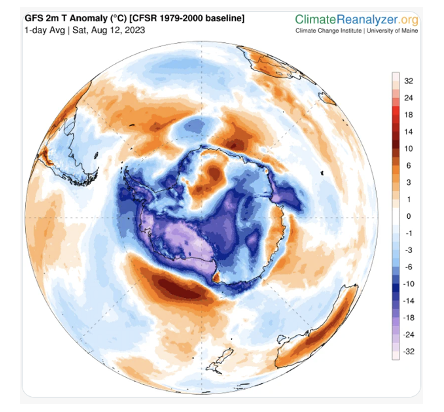
State of the climate – summer 2023 by Judith Curry, Jim Johnstone, Mark Jelinek A deep dive into the causes of the unusual weather/climate during 2023.  People are blaming fossil-fueled warming and El Nino, and now the Hunga-Tonga eruption and the change in ship fuels.  But the real story is more complicated. Observations Starting in June, the global temperatures are outpacing the… judithcurry.com
Saved - August 14, 2023 at 12:57 AM
reSee.it AI Summary
The conversation discusses temperature trends in Northeast Asia. @NiusMarco claims that temperatures are not hotter today compared to the 19th century or the 1940s, with the warmest period occurring in the medieval era. @Elpis_R agrees, providing examples of unbiased temperature reconstructions. @SbastienLauwers counters, stating that while some regions experienced warmer conditions during the medieval period, it was not a global phenomenon. @Elpis_R shares links supporting their argument. The conversation ends with @SbastienLauwers sarcastically acknowledging the information.

@NiusMarco - marco nius

Etude : Les températures (Asie du NE) ne sont pas plus chaudes aujourd'hui qu'au XIXe siècle ou dans les années 40. La période la plus chaude de l'ère commune s'est produite à l'époque médiévale (830-850 CE). derniers 170 ans, 8 des 10 années les plus froides depuis 1965.

@Kenneth72712993 - Kenneth Richard

New study: Temperatures (NE Asia) are no warmer today than the 1800s or 1940s. The warmest period in the Common Era occurred during Medieval times (830-850 CE). In the last 170 years, 8 of the 10 coldest years occurred since 1965. https://cp.copernicus.org/articles/19/1295/2023/cp-19-1295-2023.pdf

@Elpis_R - Ξlpis

@NiusMarco Chine / Asie : Toutes les reconstructions de température ou mesures thermométriques non biaisées montrent aucun réchauffement net ou une légère baisse ou période médiévale plus chaude qu’aujourd’hui. Voici quelques exemples.

@SbastienLauwers - Sébastien Lauwers

@Elpis_R @NiusMarco L'argument de la période chaude médiévale. C'est un vieux classique. Bien que certaines régions aient connu des conditions plus chaudes pendant cette période, ce n'était pas un phénomène mondial. Et on est loin au dessus : https://www.nature.com/articles/s41586-023-06176-4

Fennoscandian tree-ring anatomy shows a warmer modern than medieval climate - Nature Earth system models and various climate proxy sources indicate global warming is unprecedented during at least the Common Era1. However, tree-ring proxies often estimate temperatures during the Medieval Climate Anomaly (950–1250 ce) that are similar to, or exceed, those recorded for the past century2,3, in contrast to simulation experiments at regional scales4. This not only calls into question the reliability of models and proxies but also contributes to uncertainty in future climate projections5. Here we show that the current climate of the Fennoscandian Peninsula is substantially warmer than that of the medieval period. This highlights the dominant role of anthropogenic forcing in climate warming even at the regional scale, thereby reconciling inconsistencies between reconstructions and model simulations. We used an annually resolved 1,170-year-long tree-ring record that relies exclusively on tracheid anatomical measurements from Pinus sylvestris trees, providing high-fidelity measurements of instrumental temperature variability during the warm season. We therefore call for the construction of more such millennia-long records to further improve our understanding and reduce uncertainties around historical and future climate change at inter-regional and eventually global scales. Annually resolved Fennoscandian tree-ring anatomy records show that the climate of the current industrial era is substantially warmer than that of the medieval period. nature.com

@Elpis_R - Ξlpis

@SbastienLauwers @NiusMarco Oui, oui… 🙄 MWP (1270 études) : https://goo.gl/maps/K4xHfthynhjsamX19 https://t.co/eigYOZhr8f

@SbastienLauwers - Sébastien Lauwers

@Elpis_R @NiusMarco Ben oui...

Saved - August 14, 2023 at 12:54 AM
reSee.it AI Summary
The conversation discusses the validity of climate change data. @Elpis_R argues that there are numerous studies showing higher temperatures and less ice over the past 11,000 years. They also claim that the global temperature records presented by the IPCC are fraudulent. @JefKoone sarcastically suggests that history only began in 1789. @Elpis_R agrees and accuses the IPCC of using people's ignorance and scientific studies hidden behind paywalls to sell their unprecedented political agenda.

@Elpis_R - Ξlpis

1) Le coup des soi-disant records battus tous les jours ça va 5 min, mais ça n’a absolument rien à voir avec les données. Voici ~30 études (il y en a des centaines et des centaines) sur des t°/climat nettement supérieures et presque pas de glace sur les ~11 000 dernières années. https://t.co/3EUrkUP5m7

@PalomaMoritz - Paloma Moritz

Le réchauffement planétaire s’aggrave bien plus vite que prévu et ses effets s’amplifient. Des records de températures sont battus partout. Les études terrifiantes s’accumulent. Notre planète menace de devenir inhabitable. Que se passe-t-il ? Mon décryptage @blast_france https://t.co/B6afW7GSfr

@blast_france - BLAST, Le souffle de l'info

Réchauffement climatique : pourquoi tout s’accélère ? ➡️ https://youtu.be/FnYu7D2VzOw Si l’on résume rapidement les derniers mois, on pourrait croire à un film de science-fiction pourtant c’est la réalité, notre nouvelle réalité. Depuis des années déjà. Décryptage de @PalomaMoritz.

Video Transcript AI Summary
The world is experiencing an alarming acceleration of climate change. Mega fires in Canada have caused widespread destruction, with smoke traveling across the Atlantic and polluting cities like New York and Montreal. Record-breaking heatwaves are occurring globally, reaching temperatures as high as 51 degrees Celsius in Iran and 41 degrees Celsius in Corsica, France. The Arctic's summer ice is disappearing, exacerbating the situation. Two major studies warn that billions of people could face deadly heat and the Earth may become uninhabitable if action is not taken. Despite these alarming findings, global CO2 emissions remain at record levels. Scientists are frustrated by the lack of political will to implement existing, feasible, and financially viable solutions. It is crucial to understand the consequences of this acceleration and work towards achieving necessary goals to prevent catastrophe.
Full Transcript
Speaker 0: Vous n'avez pas la sensation ces derniers temps que tout s'accélère. Le réchauffement planétaire s'aggrave bien plus vite que prévu et ses effets s'amplifient. Si l'on résume rapidement les derniers mois, on pourrait croire à un film de science-fiction. Pourtant, c'est la réalité, notre nouvelle réalité. Les événements climatiques se multiplient. Des méga feux pour certains incontrôlables, ravagent le Canada. 6 millions d'hectares sont partis en fumée. Des fumées, qui ont rendu l'air presque irrespirable à des kilomètres, si bien que New York puis Montréal, ont été les villes les plus polluées au monde durant quelques jours. Le nuage, amène traverser l'atlantique et voilé le ciel français. La température moyenne à la surface des océans, a atteint un record absolu, et l'on parle désormais de canicule marine jamais vue et dévastatrice pour les écosystèmes. Des records de chaleur sont atteints partout dans le monde. Avec des vagues de chaleur en Asie, cinquante-et-un degrés en Iran, quarante-quatre degrés en Inde, quarante-deux degrés en Chine, ou encore, en France avec quarante-et-un degrés en Corse. Et il est désormais trop tard pour sauver la banquise estivale de l'Arctique, ce qui risque encore d'empirer la situation. Tous ces événements n'auraient jamais pu se produire dans un climat non réchauffé par l'humain. En parallèle, deux études majeures sont sorties dans la prestigieuse revue de nature. La première, démontre que si l'on continue sur cette voie, deux milliards d'humains pourraient être exposés à une chaleur mortelle, d'ici à la fin du siècle. Et la deuxième, nous apprend que la terre, menace de devenir inhabitable. En dépit de ces études terrifiantes, des événements qui s'accumulent, L'action climatique des États n'est toujours pas à la hauteur. Les émissions mondiales de c o deux restent à des niveaux records. Speaker 1: Jusqu'à la fin de cette décennie, il nous faut réduire Les émissions de quarante-cinq pour cent et jusqu'aujourd'hui on continue à augmenter les émissions et ça c'est absolument inacceptable. Speaker 0: Les scientifiques aujourd'hui dans une situation de colère et d'impuissance, c'est que les solutions existent. Elles sont évaluées à nouveau Sur la base de la science, elles sont faisables, accessibles, elles sont finançables. En revanche, ce qui manque derrière, c'est justement le politique. Il est donc temps de faire le point. Pourquoi tout s'accélère Quelles sont les conséquences de cette accélération sur nos vies Et quels objectifs faudrait-il atteindre pour enrayer la catastrophe Réponse tout de suite dans cette nouvelle vidéo de décryptage, place.

@Elpis_R - Ξlpis

2) Le GIEC peut sortir toutes les courbes en crosse de hockey qu’il veut, ce sont des fraudes scientifiques, il n’y a pas un seul endroit sur Terre qui ressemble à ces courbes. L’enregistrement global doit avoir des données réelles contribuant à cette forme pour lui ressembler.

@Elpis_R - Ξlpis

3) Cette reconstruction des t° est préférable à celle du Groenland (même si amplitude/forme sont similaires), car elle représente une partie beaucoup plus importante du système climatique. Actuellement c’est plutôt froid et nous ne vivons rien d’exceptionnel et/ou sans précédent.

@JefKoone - Jef Koone

@Elpis_R Mais comme tout le monde sait, l'histoire de l'humanité ne commence qu'en 1789 :

@Elpis_R - Ξlpis

@JefKoone Oui, oui 😂 Le GIEC compte sur la méconnaissance des gens et la couverture (innascibilité) des études scientifiques derrières des Wall-pay pour vendre leur programme politique "sans précèdent". https://drive.google.com/file/d/1j69jIKMPqTDMwQCQVN451lXNLp22KkOe/view

Saved - August 12, 2023 at 10:19 AM
reSee.it AI Summary
Renowned statistician Prof Paul Deheuvels, a member of the Academy of Sciences, questions the evidence behind the IPCC report. Harde's 2019 study reveals that 85% of CO2 increase is natural, undermining the IPCC's claims. The IPCC is dominated by state representatives and influenced by funders. The media silences skeptics, while the IPCC's theory suggests that reducing France's anthropogenic CO2 emissions would only lower temperature by 0.005°C. Harde's 2019 study shows human activities contribute minimally to CO2 rise, with 85% attributed to natural factors. The infamous hockey stick graph, a symbol of climate change, is flawed and based on statistical errors, yet still present in the latest IPCC report. To understand the CO2 instrumentation's political agenda and the creation of the IPCC, listen to Prof Deheuvels' interview.

@Elpis_R - Ξlpis

[Thread]🧶Prof. Paul Deheuvels, statisticien, 160 articles scientifiques, membre de l’académie des sciences “Le rapport du GIEC comporte des affirmations sans preuve. Harde (2019) démontre que l’↗︎ du CO2 est due à 85% à l’↗︎ de la t°. Ceci suffit à démolir la thèse du GIEC” https://t.co/1EVF1hWmTx

Video Transcript AI Summary
The speaker discusses the causality between atmospheric CO2 levels and temperature. They argue that human activities have a minimal influence on CO2 increase, with natural effects, particularly temperature, being responsible for over 85% of atmospheric CO2 rise since the industrial revolution. They criticize the IPCC's focus on anthropogenic CO2 emissions as the sole cause of climate change, calling it contrary to the truth. The speaker accuses certain individuals, such as Jean Jouzel and Valérie Masson Delmotte, of scientific fraud and highlights the lack of evidence in the IPCC's reports and their inaccurate predictions. They emphasize the need for policymakers and industry leaders to realize they have been deceived by the IPCC and its "apprentice sorcerers."
Full Transcript
Speaker 0: Je voudrais revenir aussi sur la causalité entre le taux atmosphérique des du c o deux et la température. Lorsque la température augmente, ça entraîne une augmentation du c o deux 6 mois ou parfois un an plus tard. Nous montrons, je traduis, que les activités humaines ont une influence très mineure sur augmentation du c o deux dans l'atmosphère, la contribution principale est expliquée par des effets naturels dont la température qui est responsable de plus de quatre-vingt-cinq pour cent de l'augmentation du c o deux atmosphérique depuis la révolution industrielle. Alors ça c'est quelque chose qui de soit seul suffit à démolir complètement les tests du GIEC. Et en fait le le fait de prendre comme unique cause des climatiques, les rejets anthropiques des de c o deux est manifestement contraire à la vérité. Onsen avait perdu toute prudence scientifique et je voudrais le il a affirmé devant les membres du congrès des États-Unis qu'il était certain à quatre-vingt-dix-neuf pour cent que les gaz à effet de serre et notamment le c o deux étaient à l'origine de chauffant. C'est l'exemple de toute une série d'affirmations sans preuve que l'on retrouve tout au long de cette histoire de la religion climatique et je dirais que là-dedans vous avez un certain nombre de de menteurs à tenter. Par exemple je citerai Jean Jouzel et je citerai également madame Valérie Masson Delmotte, madame Valérie Masson Delmotte est quelqu'un qui pratique l'escroquerie scientifique qui a été très haut niveau, je carrément, il faut savoir que le dernier rapport le s r quinze de du GIEC comprend toute une série d'affirmations sans preuve toujours, tout au long de ces 6 rapports, le GIEC n'a pas cessé de faire des prédictions à l'Ermite qui se sont réveillés révélées à chaque fois complètement faux. On en est au CMIP6 et qui montre des divergences accablantes envers les prévisions de modèle. Ça part dans tous les sens. Donc toutes les prévisions d'élévation de que ça soit en deux-mille-cinquante ou deux-mille-cent du GIEC n'ont aucun caractère de certitude, ils ne sont pas fiables et l'attribution de leur origine à l'élévation du CO deux anthropique n'est pas fondée. C'est une succession de mensonges et de manipulations qui aboutissent à des industriel majeur qui sont en cours de réalisation. Il est très important que les décideurs politiques et industriels prennent vraiment conscience de la manière dont ils ont été abusés par le GQ et ses apprentis sorciers.

@Elpis_R - Ξlpis

“Il y a très peu d’experts au GIEC, ce sont surtout des représentants des états et ses avis sont contrôlés par ceux qui les subventionnent. Déjà en 1987 vous aviez le même cycle, mensonges, prévisions alarmistes.. qui ont toujours démenti par les faits, mais ce cycle se répète” https://t.co/8vwxpuTnoL

Video Transcript AI Summary
The GIEC, an official organization with limited scientific expertise, was established to be controlled by state representatives, as demanded by Reagan and Thatcher. For nine years, it was led by Bergboline, a climate scientist who strongly believed in the role of CO2 in temperature changes. During this time, there was a belief that the climate was heading towards a catastrophe. However, these predictions were proven false. The GIEC's initial focus was on blaming carbon for climate change, aiming to eliminate carbon exploitation. Algore promoted carbon market inventories and taxes, justifying these actions with a collection of lies and predictions.
Full Transcript
Speaker 0: Il y a très peu d'experts dans le GIEC, c'est surtout des représentants des États. Le GIEC a été aussi développé comme un un organisme officiel qui n'a pas une dominance scientifique. Ça a été exigé par Reagan et Tatcher de façon à ce que le GIEC contrôlé par les représentants des États, ces avis demeurant constamment dépendants des gouvernements qui le un. En dix-neuf-cent-quatre-vingt-huit, ce GIEC a été dirigé pendant les neuf années suivantes par. Alors on a vu qui c'était Bergboline, c'est un climatologue qui était partisan fanatique dans ses écrits et dans ses discours de la responsabilité du c o deux dans l'évolution des températures. Donc il a été pendant neuf ans directeur du GIEC jusqu'en c'est-à-dire de dix-neuf-cent-cinquante-sept, dix-neuf-cent-quatre-vingt-sept pendant trente ans, et bien tout le monde était convaincu que le climat s'orientait vers une nation. Déjà, on voit en quatre-vingt-sept que vous avez le même cycle, c'est-à-dire mensonge, prévision alarmistes et calamiteuses qui bien entendu sont toujours démenties par les faits. Nous allons voir ce cycle se répéter par la suite plusieurs fois. Et il y a eu la grande grève des mineurs en quatre-vingt-quatre, quatre-vingt-cinq qui a été suivi du démantèlement total des mines de charbon anglaise. Donc madame cette soeur a orienté le développement initial du GIEC vers la recherche du la culpabilité du carbone dans l'évolution du un climat, son but était de supprimer autant que faire se peut tout ce qui qui venait de l'exploitation du carbone. Algore est l'inventaire du marché du carbone et de la taxe as de carbone. Ces actions nuisibles ont été justifiées par une collection de mensonges et de prédictions à.

@Elpis_R - Ξlpis

“Vous avez une lutte pour réduire à 0 ceux qu’ils nomment sceptiques. Ils sont réduits au silence par les médias qui ne veulent que la thèse du GIEC.” Selon la théorie du GIEC et ses calculs “la réduction des émissions anthropique du CO2 pour la France réduirait la t° de 0,05 °C” https://t.co/M1eW2sacDI

Video Transcript AI Summary
Maurice Trond, an autodidact who achieved success in the oil industry, supported a global government and was associated with David Rock and the prelatical commission, Buildambert group, and the Club of Rome. He led the UN program and claimed, without evidence, that fossil fuel use could raise global temperatures, flood coastal cities, and harm economies. However, reducing France's anthropogenic CO2 emissions to zero would only result in a temperature decrease of 0.05 degrees Celsius, according to François Gervais. Jean-Michel Bellou waited until retirement to publish his writings, which is significant in the ongoing struggle against climate skepticism. These skeptics, who question the official climate doctrine, are often silenced by media favoring the IPCC's theory that anthropogenic CO2 governs temperature rise.
Full Transcript
Speaker 0: Maurice Trond qui est l'autre personnage, lui c'était un autodidacte complet. Il avait arrêté ses études à quatorze ans, mais malgré tout il avait réussi à faire fortune dans l'industrie pétrolière, il était partisan d'un gouvernement mondial, proche de David Rock et de la commission prélatérale, du groupe de Buildambert, qu'il avait coopté, du club de Rome. Il a été mis à la tête du programme des Nations Unies pour et ce rapport a affirmé sans preuve que le recours aux combustibles fossiles pourrait dès le début du dès le début du vingt-et-unième siècle, aussi maintenant, avoir suffisamment augmenté la température moyenne de la planète pour bouleverser les zones de production l'alcool, inondé les villes côtières du fait de l'élévation du niveau de la mer et mettre à mal les économies nationales. Lorsqu'on sait que la réduction à zéro physiquement impossible des émissions anthropiques de c o deux pour la France n'aboutirait qu'à une baisse de température, deux, combien Non, zéro virgule zéro cinq degrés centigrades et ce ce calcul a été refait avec les chiffres même du GIEC par François Gervais. Jean-Michel Bellou va attendu d'être à la retraite pour publier ses écrits. Ce point est important parce que un peu je ne vais pas passer beaucoup de temps là-dessus, mais vous avez une lutte de pour réduire à zéro tout ce qui est appelé climato scepticisme, les gens qui sont contre, qui sont contre, qui mettent en doute ou qui sont sceptiques vis-à-vis du dogme officiel du climat. Et ce n'est pas quelque chose de parfaitement innocent parce que ces gens sont en général réduits au silence par les médias qui ne veulent entendre que la thèse du GIEC de c o deux anthropique gouverne l'élévation des températures.

@Elpis_R - Ξlpis

“Vous avez une étude de 2019 de Harde qui démontre que les activités humaines sont très mineures sur l’augmentation du CO2, la contribution est expliqué par des phénomènes naturels, principalement par la température à hauteur de 85 % depuis la période industrielle.” https://t.co/NdonoulwfF

Video Transcript AI Summary
The speaker discusses the relationship between atmospheric carbon dioxide (CO2) levels and temperature. They present evidence showing that, contrary to popular belief, temperature increase actually leads to a rise in CO2 levels, not the other way around. They explain that factors such as thawing permafrost in Siberia and gas emissions from ocean clathrates contribute to this phenomenon. They refer to a recent article that states human activities have a minimal impact on CO2 increase, with temperature being responsible for over 85% of atmospheric CO2 rise since the industrial revolution. The speaker argues that this finding challenges the claims made by the Intergovernmental Panel on Climate Change (IPCC) and emphasizes the significant influence of temperature on the planet's climate.
Full Transcript
Speaker 0: J'aimerais revenir aussi sur la causalité entre le taux atmosphérique des du c o deux n un et la température. Alors, je présente des courbes et des évaluations qui montrent qu'en fait c'est très curieux, mais ça paraît être l'inverse. C'est-à-dire lorsque la Température augmente, ça entraîne une augmentation du c o deux 6 mois ou parfois un an plus tard. Et cette Cette augmentation du c o deux est explicable, c'est-à-dire que par exemple vous avez le permafros qui est la partie des terres gelées en Sibérie qui augmente de température et qui dégage du carbone et de la même façon vous avez des dégazages de claatrate au fond des océan qui sont des espèces de dégazage de bulles qui sont tenus par l'augmentation du fond des océans et c'est tout à fait vraisemblable Ça passe comme ça. Alors en particulier à un article récent de deux-mille-dix-neuf de et bien En fait dans Earth science démontre en fait que c'est effectivement la température qui modèle le climat et ils disent en particulier, Nous montrons, je traduis, que les activités humaines ont une influence très mineure sur l'augmentation du c o deux dans l'atmosphère, vert, la contribution principale est expliquée par des effets naturels dont la température qui est responsable de plus de quatre-vingt-cinq pour cent de l'augmentation du c o deux atmosphérique depuis la la révolution industrielle. Alors ça, c'est quelque chose qui de, soit seul suffit à démolir complètement les tests du GIEC, c'est-à-dire que c'est la température qui fait bouger le c o deux et pas l'inverse. Plus il y a le c o deux dans l'atmosphère, plus les cultures se développe Bien en deux-mille-dix-neuf c'était quatre-cent-dix. Alors qu'est-ce que c'est C'est une quantité infinité d'images, c'est zéro virgule zéro vingt-huit pour cent. C'est C'est rien si vous voulez mais ça on était essayé de noter que ce rien et bien gouverne la température de la planète.

@Elpis_R - Ξlpis

“Un ex des manipulations par le GIEC est la fameuse courbe en crosse de hockey, graphique conforme au dogme climatique voulu par les autorités américaines. Cette courbe est fausse, basée sur des erreurs statistiques et fût réfutée.” Mais encore présentée dans leur dernier rapport https://t.co/l4wMJlMdYU

Video Transcript AI Summary
The speaker discusses the manipulation of data regarding hockey stick graphs and climate change. They argue that the hockey stick graph, which shows a sudden increase in temperature after 1950, is false and based on statistical errors. They mention the Little Ice Age and the Medieval Warm Period as periods of temperature fluctuations that are visible in other graphs. The speaker claims that the Medieval Warm Period resulted in a prosperous time, with the colonization of Greenland and the cultivation of vineyards.
Full Transcript
Speaker 0: Je donne un exemple des manipulations par le siècle. Bon, je dirais que j'aurais beaucoup de choses à dire là-dessus, mais je parle de la fameuse crosse de hockey, crosse en cours de hockey au cours de mal. Alors un crosse de hockey, c'est-à-dire ça montre une température plate qui évolue très peu et puis d'un seul coup dans l'espace récent, postérieur dix-neuf-cent-cinquante, ça a l'air de monter là, très fortement comme si c'était une une évolution brutale calamiteuse et exponentielle. Alors le là de la courbe de man a été proposée en dix-neuf-cent-quatre-vingt-dix-huit sous deux formes, je ne vais pas rentrer les détails et en fait il est parfaitement conforme au dogme climatique qui est prédit par Roger Revel en cent-cinquante-sept. Et d'un point de vue factuel, il s'avère que c'est tout à fait dans la lignée des autorités américaines qui qui voulait dire qu'il y a un développement catastrophique des températures à partir de dix-neuf-cent-quatre-vingt. Là. Cette courbe est grossièrement faux. Elle a été basée sur des erreurs statistiques majeures, je ne vais pas vous dire pourquoi, ça serait la ligue, mais en fait il y a un rapport qui a été publié en deux-mille-six, c'est le rapport Vegman et d'autres études similaires qui montrent que c'est là-faux. Alors en fait la cour de man énorme tout particulièrement deux périodes importantes, c'est le petit âge glaciaire qui va en gros de cent à dix-neuf-cents en faisant large et l'optimum médiéval qui s'est produit de neuf-cents à treize-cents. Là. Ces fluctuations sont assez visibles dans d'autres graphes, mais il se trouve que l'optimum médiéval a été C'est traduit par des élévations de température estimée en moyenne de un degré par rapport à la moyenne et qui ont donné lieu à une époque florissante. C'est c'est-à-dire que d'une part les familles ont disparu, d'autre part c'est la période où le Groenland a été colonisé, enfin bref, on faisait de la vigne à c'était une période de grande richesse.

@Elpis_R - Ξlpis

Si vous voulez bien retracer l’histoire de l’instrumentation du CO2 par les politiques à buts politiques, qui à amener par la suite à la création du GIEC et diabolisation des dénonciateurs, écoutez l’entretien complet ou son doc : scmsa.eu/archives/Deheu… https://www.youtube.com/watch?v=Zeegk_kzgmg

Saved - April 20, 2023 at 11:17 PM
reSee.it AI Summary
Recent studies show that the greenhouse effect has not been strengthened, but rather weakened since 1983. This excludes CO2 and greenhouse gas emissions as drivers of global warming. The impact of water vapor, clouds, CO2, and CH4 has had a negative effect on global cooling since the 1980s. The decrease in the greenhouse effect is due to natural variations in cloud cover, which have a greater impact than CO2 emissions. This means that human CO2 emissions have a minimal impact on global climate change.

@Elpis_R - Ξlpis

[Thread]🧶L’effet de serre (ES) n’a pas été renforcé, au contraire, son impact a diminué depuis 1983. Cela exclut que le CO2 et l’augmentation de l’effet de serre soient les moteurs du réchauffement climatique. (1/15)

@Elpis_R - Ξlpis

À l’ère des satellites, les scientifiques ont continué à observer que l’ES total (la vapeur d’eau, les nuages et le CO2 et CH4.) exerce un impact négatif (refroidissement) global sur les températures de surface depuis les années 1980.

@Elpis_R - Ξlpis

Compte tenu de l’hypothèse moderne selon laquelle l’homme est responsable du réchauffement climatique en raison de ses émissions de CO2 et CH4, il serait logique que les ondes longues descendantes (LWdn) augmentent et que l’ES soit renforcé en raison de l’augmentation du CO2.

@Elpis_R - Ξlpis

Or, comme Cess et Udelhofen (2003) l’ont signalé il y a 20 ans, l’effet de serre de la Terre n’a pas été renforcé au cours des dernières décennies. Au contraire, il est en déclin depuis les années 1980. https://agupubs.onlinelibrary.wiley.com/doi/full/10.1029/2002GL016128 https://agupubs.onlinelibrary.wiley.com/doi/full/10.1029/2002GL016128

@Elpis_R - Ξlpis

Song et al. (2016) ont également fait état d’une tendance plate (en baisse) de l’ES (en rouge) de 2002 à 2014 lorsque tous les facteurs de l’effet de serre (All-Sky), y compris les nuages et la vapeur d’eau, sont pris en compte.

@Elpis_R - Ξlpis

Les effets des gaz à effet de serre comme le CO2 ont été compensés par les effets des nuages pour produire un effet de serre à tendance nulle au cours de cette période. https://www.nature.com/articles/srep33315
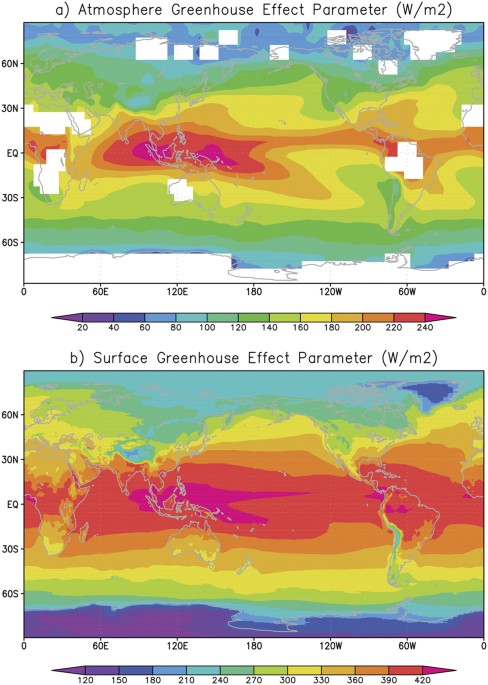
A Hiatus of the Greenhouse Effect - Scientific Reports The rate at which the global average surface temperature is increasing has slowed down since the end of the last century. This study investigates whether this warming hiatus results from a change in the well-known greenhouse effect. Using long-term, reliable, and consistent observational data from the Earth’s surface and the top of the atmosphere (TOA), two monthly gridded atmospheric and surface greenhouse effect parameters (Ga and Gs) are estimated to represent the radiative warming effects of the atmosphere and the surface in the infrared range from 1979 to 2014. The atmospheric and surface greenhouse effect over the tropical monsoon-prone regions is found to contribute substantially to the global total. Furthermore, the downward tendency of cloud activity leads to a greenhouse effect hiatus after the early 1990 s, prior to the warming pause. Additionally, this pause in the greenhouse effect is mostly caused by the high number of La Niña events between 1991 and 2014. A strong La Niña indicates suppressed convection in the tropical central Pacific that reduces atmospheric water vapor content and cloud volume. This significantly weakened regional greenhouse effect offsets the enhanced warming influence in other places and decelerates the rising global greenhouse effect. This work suggests that the greenhouse effect hiatus can be served as an additional factor to cause the recent global warming slowdown. nature.com

@Elpis_R - Ξlpis

Cette nouvelle étude (Zhang et Rossow, 2023) utilise un autre ensemble de données (FH) et montre également que l’effet de serre total (exprimé en ondes longues descendantes, ou LWdn) a diminué de 1983 à 2017 (et de 2001 à 2020 dans l'enregistrement CERES),

@Elpis_R - Ξlpis

même si les données “tiennent compte de l’augmentation du CO2 et du CH4” et que cela “devrait produire une augmentation de LWdn”. Ce n’est pas le cas, bien sûr, car le CO2 et le CH4 ne sont pas assez influents pour concurrencer l’effet de serre des nuages. https://agupubs.onlinelibrary.wiley.com/doi/abs/10.1029/2022JD037340

@Elpis_R - Ξlpis

Les scientifiques soulignent également que l’évolution de l’albédo moyen mondial correspond à une “augmentation du rayonnement solaire de surface” depuis les années 1980 (ce qui peut expliquer le réchauffement au cours de cette période).

@Elpis_R - Ξlpis

De même, les tendances en W/m² des flux d'ondes courtes et d’ondes longues au sommet de l’atmosphère sont “dominées” par les changements de la couverture nuageuse ou “causées presque entièrement par les effets des nuages”. https://agupubs.onlinelibrary.wiley.com/doi/abs/10.1029/2022JD037340 https://agupubs.onlinelibrary.wiley.com/doi/abs/10.1029/2022JD037340

@Elpis_R - Ξlpis

Ces dernières années, plusieurs autres études ont mis en évidence une diminution de l’effet de serre malgré l’augmentation des gaz à effet de serre tels que le CO2 et le CH4 (Stephens et al., 2022, Dübal et Vahrenholt, 2021, Swift, 2018, Su et al., 2020).

@Elpis_R - Ξlpis

https://royalsocietypublishing.org/doi/10.1098/rspa.2022.0053 https://www.mdpi.com/2073-4433/12/10/1297 https://www.mdpi.com/2225-1154/6/2/52 https://www.mdpi.com/2072-4292/12/12/2040
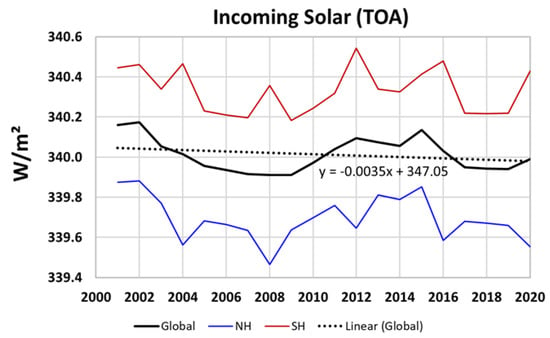
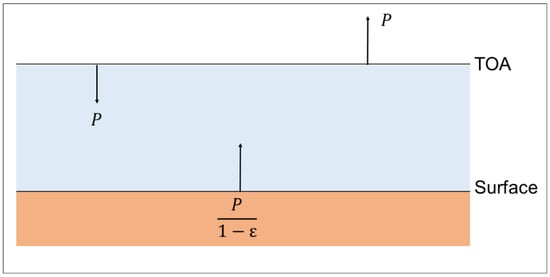
Radiative Energy Flux Variation from 2001–2020 Radiative energy flux data, downloaded from CERES, are evaluated with respect to their variations from 2001 to 2020. We found the declining outgoing shortwave radiation to be the most important contributor for a positive TOA (top of the atmosphere) net flux of 0.8 W/m2 in this time frame. We compare clear sky with cloudy areas and find that changes in the cloud structure should be the root cause for the shortwave trend. The radiative flux data are compared with ocean heat content data and analyzed in the context of a longer-term climate system enthalpy estimation going back to the year 1750. We also report differences in the trends for the Northern and Southern hemisphere. The radiative data indicate more variability in the North and higher stability in the South. The drop of cloudiness around the millennium by about 1.5% has certainly fostered the positive net radiative flux. The declining TOA SW (out) is the major heating cause (+1.42 W/m2 from 2001 to 2020). It is almost compensated by the growing chilling TOA LW (out) (−1.1 W/m2). This leads together with a reduced incoming solar of −0.17 W/m2 to a small growth of imbalance of 0.15 W/m2. We further present surface flux data which support the strong influence of the cloud cover on the radiative budget. mdpi.com
A New Radiative Model Derived from Solar Insolation, Albedo, and Bulk Atmospheric Emissivity: Application to Earth and Other Planets This study develops an equilibrium radiative model based on a quasi-adiabatic atmosphere that quantifies the average surface flux of a planetary body as a function of absorbed solar radiation P and the bulk emissivity of the atmosphere with respect to surface radiation  ε. The surface flux is then given by  P/(1−ε), and I define the scaling term 1/(1−ε) as the greenhouse factor. The model is applied to all of the rocky planets in the solar system to determine their greenhouse factors, and accounts for the diversity of planetary surface fluxes. The model is modified to allow for a top of atmosphere non-equilibrium state, which when compared with a recent observation-based model of the Earth energy budget, predicts the Earth’s radiative fluxes to within the uncertainty ranges of that model. The model developed in this study is able to quantify the changes in Earth’s surface flux caused by changes in bond albedo and atmospheric bulk emissivity by using the surface temperature, ocean heat content, incoming solar radiation and outgoing longwave radiation records. The model indicates an increase in absorbed solar radiation over the time period from 1979–2015 of the order of 3 W/m2, which was caused by a decrease in planetary bond albedo. The time-series albedo generated by the model is in agreement with Clouds and Earth’s Radiant Energy System (CERES) derived albedo over the period from 2000–2015. The model also indicates a slight decrease in atmospheric bulk emissivity over the same period. Since atmospheric bulk emissivity is a function of the sum of all of the greenhouse gas species, a simultaneous decrease in atmospheric water vapor may offset the effect of the well-documented increase in the non-condensing greenhouse gases over the period, and result in an overall net decrease in bulk emissivity. Atmospheric water vapor datasets partially support the conclusion, with the International Satellite Cloud Climatology Project (ISCCP) data supporting a decrease. The NASA Water Vapor Project (NVAP-M) data supports a decrease in atmospheric water content over the period 1998–2008, but not over the longer period of 1988–2008. The model indicates that the decrease in planetary albedo was the driver for the increased surface flux over the stated period. mdpi.com
Uncertainties in CERES Top-of-Atmosphere Fluxes Caused by Changes in Accompanying Imager The Clouds and the Earth’s Radiant Energy System (CERES) project provides observations of Earth’s radiation budget using measurements from CERES instruments on board the Terra, Aqua, Suomi National Polar-orbiting Partnership (S-NPP), and NOAA-20 satellites. The CERES top-of-atmosphere (TOA) fluxes are produced by converting radiance measurements using empirical angular distribution models, which are functions of cloud properties that are retrieved from imagers flying with the CERES instruments. As the objective is to create a long-term climate data record, not only calibration consistency of the six CERES instruments needs to be maintained for the entire time period, it is also important to maintain the consistency of other input data sets used to produce this climate data record. In this paper, we address aspects that could potentially affect the CERES TOA flux data quality. Discontinuities in imager calibration can affect cloud retrieval which can lead to erroneous flux trends. When imposing an artificial 0.6 per decade decreasing trend to cloud optical depth, which is similar to the trend difference between CERES Edition 2 and Edition 4 cloud retrievals, the decadal SW flux trend changed from − 0.3 5 ± 0.18 Wm − 2 to 0.61 ± 0.18 Wm − 2 . This indicates that a 13% change in cloud optical depth results in about 1% change in the SW flux. Furthermore, different CERES instruments provide valid fluxes at different viewing zenith angle ranges, and including fluxes derived at the most oblique angels unique to S-NPP (>66 ∘ ) can lead to differences of 0.8 Wm − 2 and 0.3 Wm − 2 in global monthly mean instantaneous SW flux and LW flux. To ensure continuity, the viewing zenith angle ranges common to all CERES instruments (<66 ∘ ) are used to produce the long-term Earth’s radiation budget climate data record. The consistency of cloud properties retrieved from different imagers also needs to be maintained to ensure the TOA flux consistency. mdpi.com

@Elpis_R - Ξlpis

Tous notent que les variations naturelles des nuages, qui ont un impact sur l’ES plus important que celui résultant d’une multiplication par 100 du CO2 (Ramanathan et al., 1989), sont à l'origine de la récente diminution de l’ES. https://science.org/doi/10.1126/science.243.4887.57 https://www.science.org/doi/10.1126/science.243.4887.57

@Elpis_R - Ξlpis

Ces observations impliquent clairement que l’augmentation de l’effet de serre n’est à l’origine d’aucune tendance au réchauffement depuis les années 1980.

@Elpis_R - Ξlpis

En outre, une diminution de l’effet de serre signifie que l’impact des émissions humaines de CO2 sur le climat mondial est trop faible pour être un moteur des tendances totales de l’effet de serre ou du changement climatique.

View Full Interactive Feed