TruthArchive.ai - Related Post Feed

Saved - July 18, 2023 at 12:19 AM

@BernieSpofforth - Bernie's Tweets

CO2 - Things that make you go hmm… The ideal C02 level for growing food is 400ppm & 600-1000ppm is used in greenhouses to increase yield by over 30% & reduce pests & diseases. Yet climate scientists tell us 350ppm is so dangerous we will all starve. Question everything.

Video Transcript AI Summary
AGA is driving growth in agriculture by adding carbon dioxide to increase production capacity and ensure larger, more attractive flowers and vegetables like cucumbers, tomatoes, and lettuce. Carbon dioxide fertilization boosts yield by up to 30%. While ambient air contains enough carbon dioxide for growing tomatoes and cucumbers, plants in greenhouses consume it quickly, slowing down or halting growth. To maintain optimal growth, carbon dioxide concentration in the greenhouse atmosphere should be kept between 600 to 1000 PPM. Adding extra carbon dioxide improves yield by up to 30% or more for tomatoes, cucumbers, lettuce, cut flowers, and potted plants. Additionally, carbon dioxide enhances early harvest, disease resistance, and pest resilience.
Full Transcript
Speaker 0: AGA is driving growth in the agricultural sector by adding carbon dioxide to increase production capacity and guarantee large attractive flowers and vegetables such as cucumbers, tomatoes and lettuce. Using carbon dioxide fertilization increases yield by up to 30%. Ambient air has a carbon dioxide site concentration of 400 PPM. This is sufficient for growing tomatoes and cucumbers but as the plants often grown in greenhouses start to consume the carbon dioxide in the air at first sunlight. If the concentration of carbon dioxide is allowed to fall, growth is slowed down or halted. Speaker 1: C o two in greenhouses is very important because we get a better crop, a higher gene, and better Quality of the tomatoes. Speaker 0: Additional carbon dioxide needs to be added to increase efficiency and to have the optimal yield. By keeping the carbon dioxide concentration in the greenhouse atmosphere in a range of 600 to 1000 PPM, the best growth rate can be expected. When extra carbon dioxide is added to greenhouse air, the tomato, cucumber and lettuce yield improves by up to 30% or even more. Cut flowers and potted plants it's also benefit from carbon dioxide fertilization. Carbon dioxide not only increases yield but also produces an earlier harvest and improves plants resistance to disease and pests.
Saved - October 4, 2023 at 5:25 PM
reSee.it AI Summary
The level of CO2 in our atmosphere affects farming conditions. At 600-1000 PPM, optimal conditions are achieved, increasing yield, hastening harvest, and improving plant resistance. However, at 200 PPM, plant life dies. Some companies use CO2 generators to reach these levels. It's puzzling that we pay to decrease CO2 levels while companies pay to increase them for better farming. Decreasing CO2 leads to an ice age and death. Why are we decreasing CO2 levels again? It doesn't make sense. #ClimateScam #ClimateFraud #CrimesAgainstHumanity #CO2isLife

@bambkb - Kevin - WE THE PEOPLE❤️ - DAD🦁 🐉 🔥

Right now our atmosphere has 400 PPM of CO2 = 0.04% At 600-1000 PPM of CO2 we get optimal FARMING conditions At 200 PPM OF CO2, all plant life DIES Companies uses Carbon dioxide generators to reach these conditions of 600 - 1000 PPM : (1) To increase yield by 30% or MORE (2) To produce an earlier harvest (3) To improve plants resistance to DISEASE and PESTS Who do I have a feeling that this is part of #TheGreatReset and they never want our atmosphere to each these CO2 levels, so that our farmers NEVER see these benefits for FREE!? So let me get this straight: (4) If we increase CO2 in the atmosphere, we get OPTIMAL farming conditions (5) If we DECREASE CO2 in the atmosphere, we get an ICE AGE and DEATH of most life on the planet Can someone please rationally explain why we’re decreasing CO2 levels again!? Companies are PAYING to increase CO2 levels for better farming conditions, while we PAY TAXES to decrease CO2 levels and keep ourselves in SUBOPTIMAL farming conditions!? It doesn’t make any fucking sense to me #ClimateScam #ClimateFraud #CrimesAgainstHumanity #CO2isLife

Video Transcript AI Summary
AGA is driving growth in agriculture by using carbon dioxide to increase production capacity and improve the quality of flowers and vegetables like cucumbers, tomatoes, and lettuce. Carbon dioxide fertilization can boost yields by up to 30%. While ambient air contains enough carbon dioxide for growing tomatoes and cucumbers, plants in greenhouses consume it quickly, which can slow down or halt growth. To maintain optimal conditions, additional carbon dioxide needs to be added to the greenhouse atmosphere, ideally keeping the concentration between 600 to 1,000 PPM. This can lead to a 30% or higher increase in lettuce yield, as well as benefiting cut flowers and potted plants.
Full Transcript
Speaker 0: AGA is driving growth in the agricultural sector by adding carbon dioxide to increased production capacity and guarantee large attractive flowers and vegetables such as cucumbers, tomatoes, and lettuce. Using carbon dioxide fertilization increases yields by up to 30%. Ambient air has a carbon dioxide site concentration of 400 PPM. This is sufficient for growing tomatoes and cucumbers. But as the plants, Often grown in greenhouses start to consume the carbon dioxide in the air at first sunlight. If the concentration of carbon dioxide is allowed to fall, growth is slowed down or halted. CO2 in greenhouses is very important because we get a better crop, a higher yield, and better Quality of the tomatoes. Additional carbon dioxide needs to be added to increase efficiency and to have the optimal yield. By keeping the carbon dioxide concentration in the greenhouse atmosphere in a range of 600 to 1,000 PPM, the and lettuce yield improves by up to 30% or even more. Cut flowers and potted plants also benefit
Saved - November 6, 2023 at 7:30 PM
reSee.it AI Summary
The conversation revolves around climate change and its impact on agriculture. @ncdave4life challenges @Willard1951's statements on topics like crop growth, CO2 levels, and water use efficiency. @ncdave4life provides scientific papers to support their arguments. The conversation ends with @ncdave4life sharing resources for further learning.

@ncdave4life - ✝️ 🇺🇸 🇺🇦 Dave Burton

1/10. Where on earth do you "learn" such nonsense, Willard? Growing ranges for most major crops cover climate zones with average temperatures that vary by tens of °C. Major crops like corn, wheat, potatoes & soybeans are produced from Mexico to Canada. Compared to that, a degree or two of warming (disproportionately at night, in winter, at chilly high latitudes) is de minimis -- as is the 0.35±0.13°C between now and what the IPCC calls "1.5°C of warming").

@ncdave4life - ✝️ 🇺🇸 🇺🇦 Dave Burton

2/10. Willard wrote, "fertilization is the male gamete to female gamete to produce seed/fruit... not the N-P-K addition" Wrong. In agriculture, that's called pollination.

@ncdave4life - ✝️ 🇺🇸 🇺🇦 Dave Burton

3/10. Willard wrote, "(yes, it is often temperature sensitive)" Wrong. Farmers choose planting dates to optimize growing conditions, including temperatures, for their crops.

@ncdave4life - ✝️ 🇺🇸 🇺🇦 Dave Burton

@DaveRheaume @CO2Coalition 18/25. In the American Midwest, farmers can fully compensate for a 1°C temperature change by adjusting planting dates by about six days.

@ncdave4life - ✝️ 🇺🇸 🇺🇦 Dave Burton

@Willard1951 @JimBlack48 @BlasphemousBan1 @S_Metzeler @Anvndarnamn5 @GAJAJW @RClausius42 @Data79504085 @BenKoby1911 @priscian @EthonRaptor @Michael_D_Crow @Mark_A_Lunn @NomadicQuantum @AristotleMrs @ScienceBlog3 @AuroriaEn @AndreGrossza @DenisDaly @Veritatem2021 @JusticeTrudeau @judgementalbe1 @ChrisBBacon3 @Coleski14 @wallytoms0 @Climatehope2 @LesserMegadeath @WernerReinhard5 @S_D_Mannix @ammocrypta @Jaisans @CarrudoDon @LiveLifeBK24 @TheDisproof @Joeyd87745119 @Devonian1342 @Hji45519156 @waxliberty @SuperFoxyLoxy @JaapTitulaer @wjack76995 @Rocky35418823 @NobaconEgbert @balls95652097 @JustThi30117912 @BointonGiles @SeekerTheGreat1 @ubique60 @DaleGribble_666 4/10. If you think cold weather is better for crops than hot weather, then why do you think farmers plant in the spring instead of the fall?

@ncdave4life - ✝️ 🇺🇸 🇺🇦 Dave Burton

5/10. Willard wrote, "Don't forget the negatives" There are no "negatives" of any consequence from higher CO2 levels. Higher CO2 levels are highly beneficial for agriculture.

@ncdave4life - ✝️ 🇺🇸 🇺🇦 Dave Burton

6/10. Willard wrote, "High temps impact soil moisture levels, evapotranspiration" If you're worried about soil moisture levels and evapotranspiration, then why do you ignore the fact that higher CO2 levels improve crops' water use efficiency and drought resistance?

@ncdave4life - ✝️ 🇺🇸 🇺🇦 Dave Burton

7/10. Here's a paper: https://www.nature.com/articles/s41467-017-00114-5 Cheng L et al (2017). Recent increases in terrestrial carbon uptake at little cost to the water cycle. Nat Commun 8, 110 (2017). doi:10.1038/s41467-017-00114-5 It reports that…
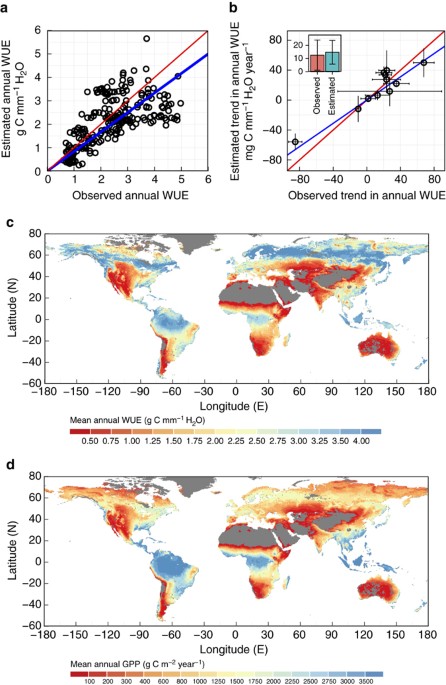
Recent increases in terrestrial carbon uptake at little cost to the water cycle - Nature Communications Quantifying the responses of the coupled carbon and water cycles to current global warming and rising atmospheric CO2 concentration is crucial for predicting and adapting to climate changes. Here we show that terrestrial carbon uptake (i.e. gross primary production) increased significantly from 1982 to 2011 using a combination of ground-based and remotely sensed land and atmospheric observations. Importantly, we find that the terrestrial carbon uptake increase is not accompanied by a proportional increase in water use (i.e. evapotranspiration) but is largely (about 90%) driven by increased carbon uptake per unit of water use, i.e. water use efficiency. The increased water use efficiency is positively related to rising CO2 concentration and increased canopy leaf area index, and negatively influenced by increased vapour pressure deficits. Our findings suggest that rising atmospheric CO2 concentration has caused a shift in terrestrial water economics of carbon uptake. The response of the coupled carbon and water cycles to anthropogenic climate change is unclear. Here, the authors show that terrestrial carbon uptake increased significantly from 1982 to 2011 and that this increase is largely driven by increased water-use efficiency, rather than an increase in water use. nature.com

@ncdave4life - ✝️ 🇺🇸 🇺🇦 Dave Burton

8/10. "Land plants are absorbing 17% more carbon dioxide from the atmosphere now than 30 years ago… [yet] the vegetation is hardly using any extra water… suggesting that global change is causing the world's plants to grow in a more water-efficient way." https://theconversation.com/rising-carbon-dioxide-is-making-the-worlds-plants-more-water-wise-79427

Rising carbon dioxide is making the world's plants more water-wise The globe is greening as plants grow faster in response to rising carbon dioxide. But a new analysis shows they aren’t using more water to do it - a rare piece of good news for our changing planet. theconversation.com

@ncdave4life - ✝️ 🇺🇸 🇺🇦 Dave Burton

8.1/10. Aside: for agricultural plants, carbon absorption is roughly proportional to crop yield, so a +17% increase in carbon uptake from a mere 55 ppmv (16%) rise in CO2 level strongly suggests that crop yield improvements from elevated CO2 are much greater than the +20% conservative estimate which I previously mentioned.

@ncdave4life - ✝️ 🇺🇸 🇺🇦 Dave Burton

9/10. Here's a paper about wheat: https://onlinelibrary.wiley.com/doi/full/10.1111/gcb.13263 Fitzgerald et al. (2016) Elevated atmospheric [CO2] can dramatically increase wheat yields in semi-arid environments and buffer against heat waves. Glob Chang Biol. 22(6):2269-84.

@ncdave4life - ✝️ 🇺🇸 🇺🇦 Dave Burton

@Willard1951 @JimBlack48 @BlasphemousBan1 @S_Metzeler @Anvndarnamn5 @GAJAJW @RClausius42 @Data79504085 @BenKoby1911 @priscian @EthonRaptor @Michael_D_Crow @Mark_A_Lunn @NomadicQuantum @AristotleMrs @ScienceBlog3 @AuroriaEn @AndreGrossza @DenisDaly @Veritatem2021 @JusticeTrudeau @judgementalbe1 @ChrisBBacon3 @Coleski14 @wallytoms0 @Climatehope2 @LesserMegadeath @WernerReinhard5 @S_D_Mannix @ammocrypta @Jaisans @CarrudoDon @LiveLifeBK24 @TheDisproof @Joeyd87745119 @Devonian1342 @Hji45519156 @waxliberty @SuperFoxyLoxy @JaapTitulaer @wjack76995 @Rocky35418823 @NobaconEgbert @balls95652097 @JustThi30117912 @BointonGiles @SeekerTheGreat1 @ubique60 @DaleGribble_666 10/10. If you ever decide that you want to learn about these things, I have some good resources cataloged here: https://sealevel.info/learnmore.html?0=benefits

Learn More About Climate Change - resources sealevel.info

@ncdave4life - ✝️ 🇺🇸 🇺🇦 Dave Burton

@Willard1951 @JimBlack48 @BlasphemousBan1 @S_Metzeler @Anvndarnamn5 @GAJAJW @RClausius42 @Data79504085 @BenKoby1911 @priscian @EthonRaptor @Michael_D_Crow @Mark_A_Lunn @NomadicQuantum @AristotleMrs @ScienceBlog3 @AuroriaEn @AndreGrossza @DenisDaly @Veritatem2021 @JusticeTrudeau @judgementalbe1 @ChrisBBacon3 @Coleski14 @wallytoms0 @Climatehope2 @LesserMegadeath @WernerReinhard5 @S_D_Mannix @ammocrypta @Jaisans @CarrudoDon @LiveLifeBK24 @TheDisproof @Joeyd87745119 @Devonian1342 @Hji45519156 @waxliberty @SuperFoxyLoxy @JaapTitulaer @wjack76995 @Rocky35418823 @NobaconEgbert @balls95652097 @JustThi30117912 @BointonGiles @SeekerTheGreat1 @ubique60 @DaleGribble_666 7/7. The science has been settled for over a century: elevated CO2 is tremendously beneficial for agriculture. The climate activists who refuse to acknowledge that established fact are science deniers. https://sealevel.info/learnmore.html?0=preciousairfertilizer#agriculture
Learn More About Climate Change - resources sealevel.info
Saved - November 15, 2023 at 9:55 AM

@_ClimateCraze - John Shewchuk

Latest CO2 research indicates that doubling CO2's concentration from 400 to 800 ppm theoretically warms the climate by 0.71 degrees C, which is reflected in this graph. https://t.co/OWu3izJGMZ

Saved - November 17, 2023 at 10:06 PM
reSee.it AI Summary
The conversation discusses the supposed harms of CO2 emissions and climate change. @ncdave4life argues that these harms are hypothetical and implausible, providing evidence that coral reefs, extreme weather, and sea levels are not significantly affected. They also highlight the positive effects of CO2 emissions on ecosystems, agriculture, and drought resilience. They conclude by sharing a resource list for balanced information on climate change.

@ncdave4life - ✝️ 🇺🇸 🇺🇦 Dave Burton

@zteirstein 8/18. The supposed major harms from CO2 emissions are all merely hypothetical, and mostly implausible. None of them are actually happening. For instance, the coral of the Great Barrier Reef are doing fine: https://archive.ph/IcRIY https://archive.ph/IcRIY

@ncdave4life - ✝️ 🇺🇸 🇺🇦 Dave Burton

@zteirstein 9/18. "Extreme weather" is not getting worse. Hurricanes, tornadoes, nor'easters, and droughts are not worsening. In fact, tornadoes & droughts have become much less destructive. Here're the facts on hurricanes, from an expert: https://rogerpielkejr.substack.com/p/2023-update-what-the-media-wont-tell
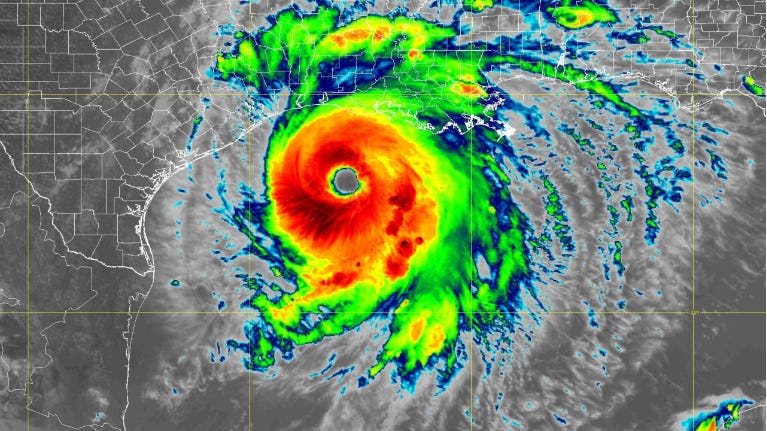
2023 Edition: What the media won't tell you about . . . hurricanes The science and data reporters refuse to report rogerpielkejr.substack.com

@ncdave4life - ✝️ 🇺🇸 🇺🇦 Dave Burton

1/17》Climate change is not making hurricanes more destructive. https://sealevel.info/learnmore.html?0=hurricanes#hurricanes

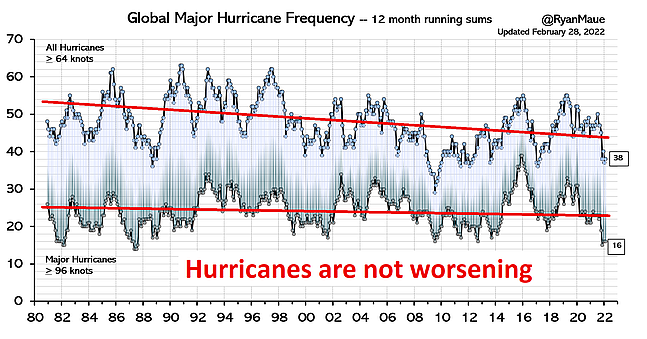
Learn More About Climate Change - resources sealevel.info

@ncdave4life - ✝️ 🇺🇸 🇺🇦 Dave Burton

@zteirstein 10/18. Droughts have showed only a slight decreasing trend, but they're MUCH less destructive now, because elevated CO2 levels make plants more water-efficient and drought-resilient.

@ncdave4life - ✝️ 🇺🇸 🇺🇦 Dave Burton

@rcbregman 17/ Also, elevated CO2 makes plants more water-efficient & drought-resilient, by improving CO2 stomatal conductance relative to transpiration. That's long-settled science among agronomists (though most climate scientists are apparently unfamiliar with it).

@ncdave4life - ✝️ 🇺🇸 🇺🇦 Dave Burton

@zteirstein 11/18. Strong tornadoes have decreased markedly (though nobody is sure why). https://sealevel.info/learnmore.html?0=tornadoes#tornadoes https://sealevel.info/learnmore.html?0=tornadoes#tornadoes
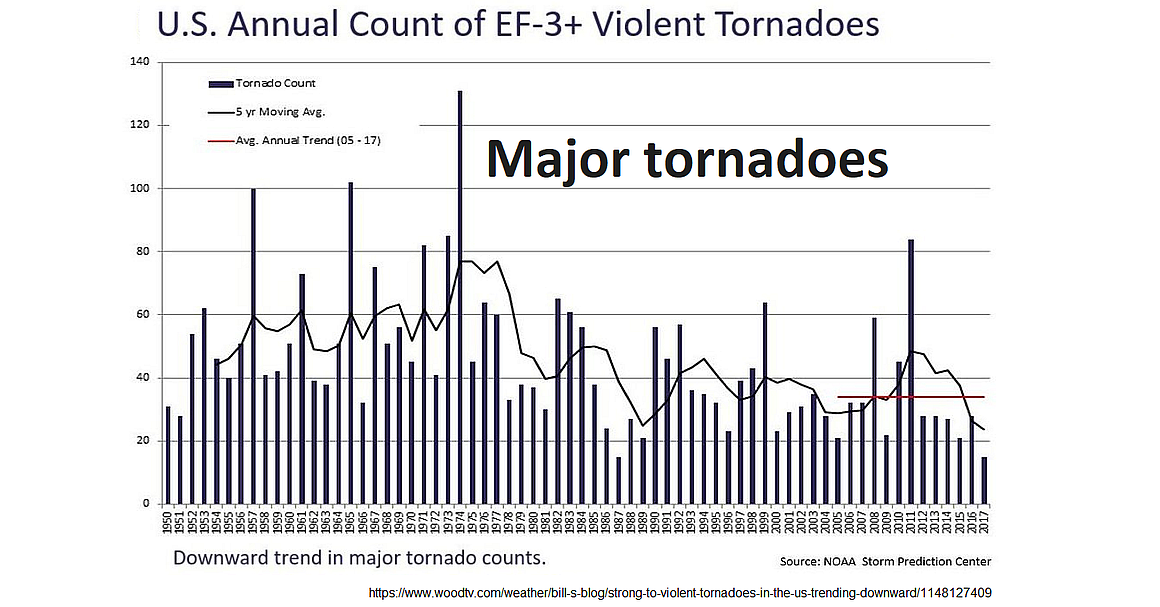
Learn More About Climate Change - resources sealevel.info

@ncdave4life - ✝️ 🇺🇸 🇺🇦 Dave Burton

@zteirstein 12/18. The tide gauge at Harlingen has a continuous sea-level measurement record all the way back to 1865. Contrary to climate industry FUD, the sea-level trend has not been significantly affected by climate change. https://sealevel.info/learnmore.html?0=sealevel#sealevel

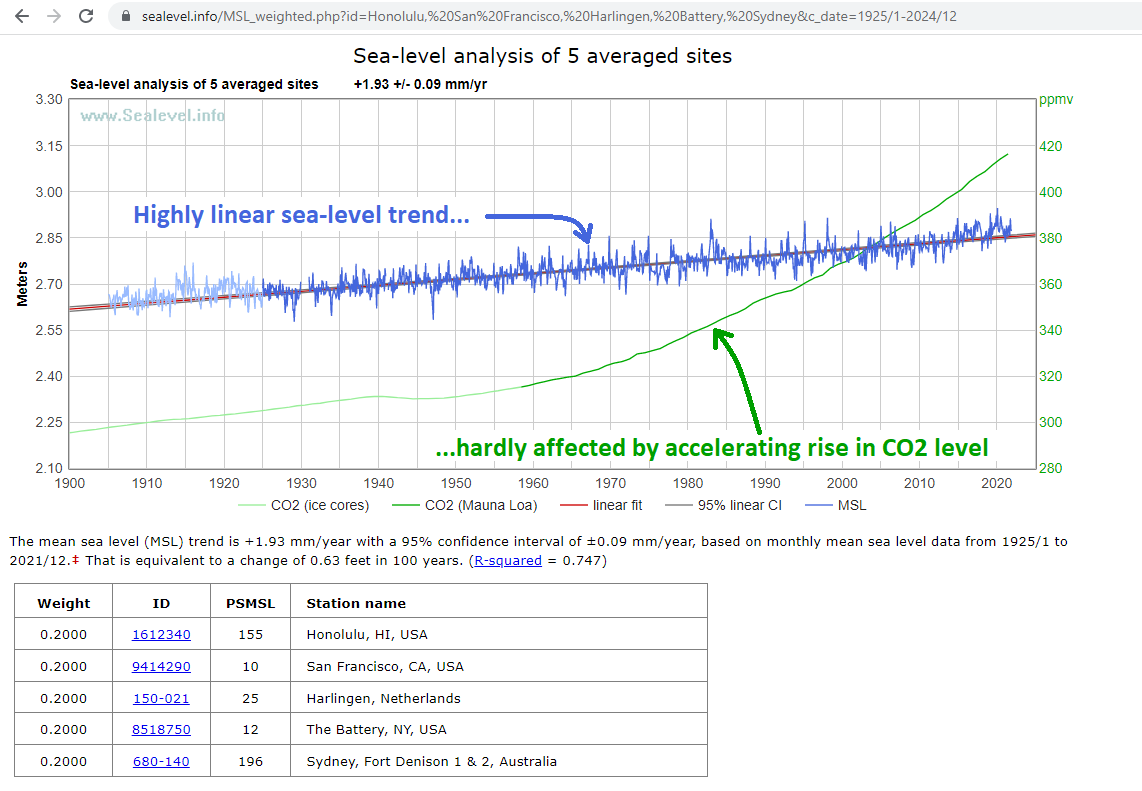
Learn More About Climate Change - resources sealevel.info

@ncdave4life - ✝️ 🇺🇸 🇺🇦 Dave Burton

@zteirstein 13/18. All of the important effects of CO2 emissions and manmade climate change are positive! Elevated CO2 (eCO2) is beneficial for almost all ecosystems. In fact, eCO2 even helps pine forests withstand bark beetles. https://academic.oup.com/treephys/article/32/6/752/1663608

@ncdave4life - ✝️ 🇺🇸 🇺🇦 Dave Burton

@zteirstein 14/18. Elevated CO2 helps warm the Earth, but there's no convincing evidence that's harmful. In fact, scientists call the warmest climate periods "climate optimums." That's because, by all objective measures, warm is better than cold. https://unherd.com/thepost/bjorn-lomborg-how-global-warming-will-save-lives/
Bjørn Lomborg: how rising temperatures will save lives A spell of extremely hot weather has hit Europe this month, bringing with it a raft of apocalyptic headlines. Named Charon, after the boatman in Greek mythology who navigated the river Styx into Hades, the heatwave has immediately been linked to climate change and, by extension, humanity’s faltering attempts to combat it. [...]Read More... unherd.com

@ncdave4life - ✝️ 🇺🇸 🇺🇦 Dave Burton

@zteirstein 15/18. Natural ecosystems benefit from CO2 emissions, too. In fact, CO2 emissions are greening the Earth. https://www.nasa.gov/technology/carbon-dioxide-fertilization-greening-earth-study-finds/ https://sealevel.info/greening_earth_spatial_patterns_Myneni.html This is NASA's video about it: https://www.youtube.com/watch?v=zOwHT8yS1XI
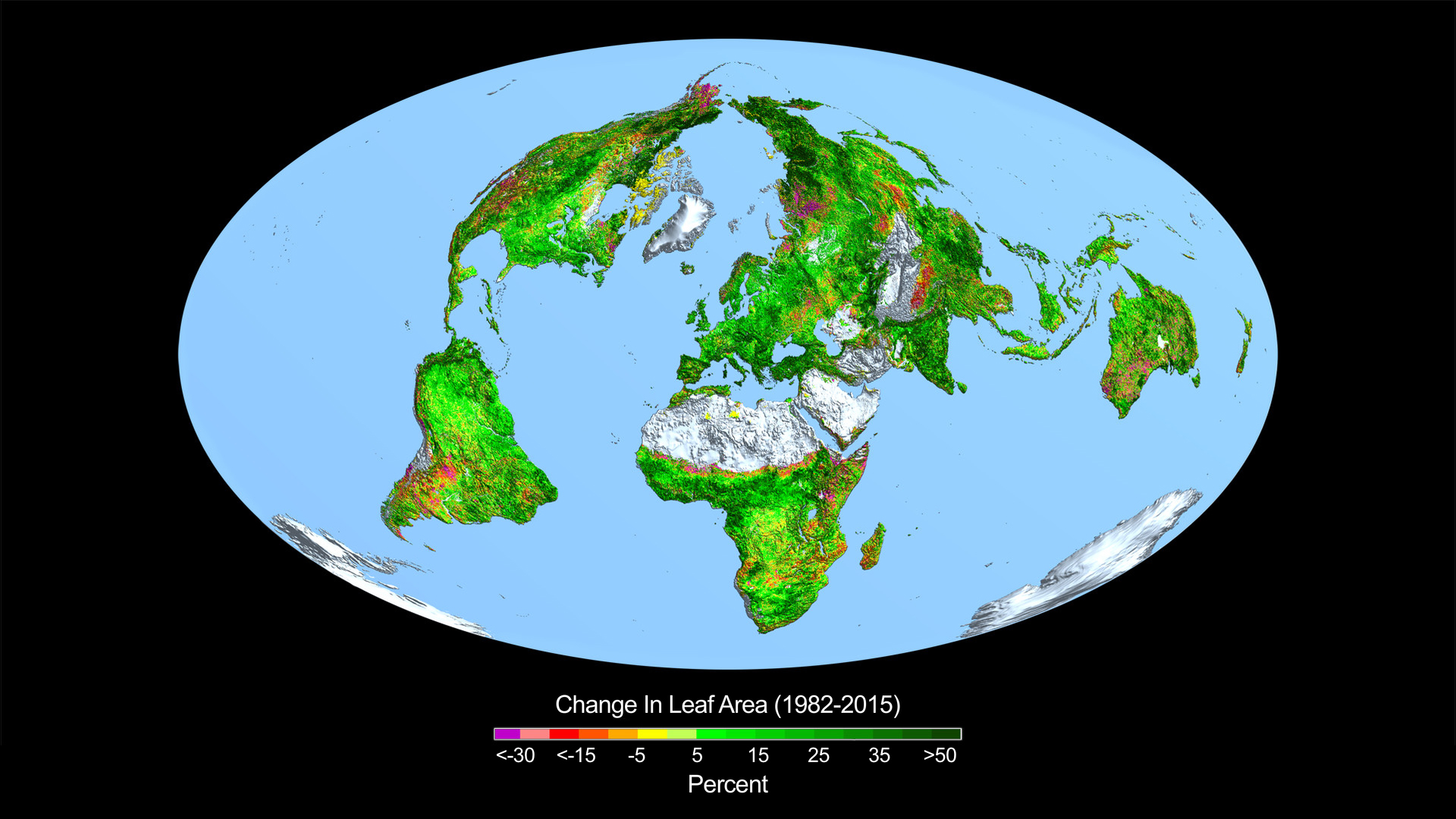

Carbon Dioxide Fertilization Greening Earth, Study Finds - NASA From a quarter to half of Earth’s vegetated lands has shown significant greening over the last 35 years largely due to rising levels of atmospheric carbon nasa.gov
Video Not Available youtube.com

@ncdave4life - ✝️ 🇺🇸 🇺🇦 Dave Burton

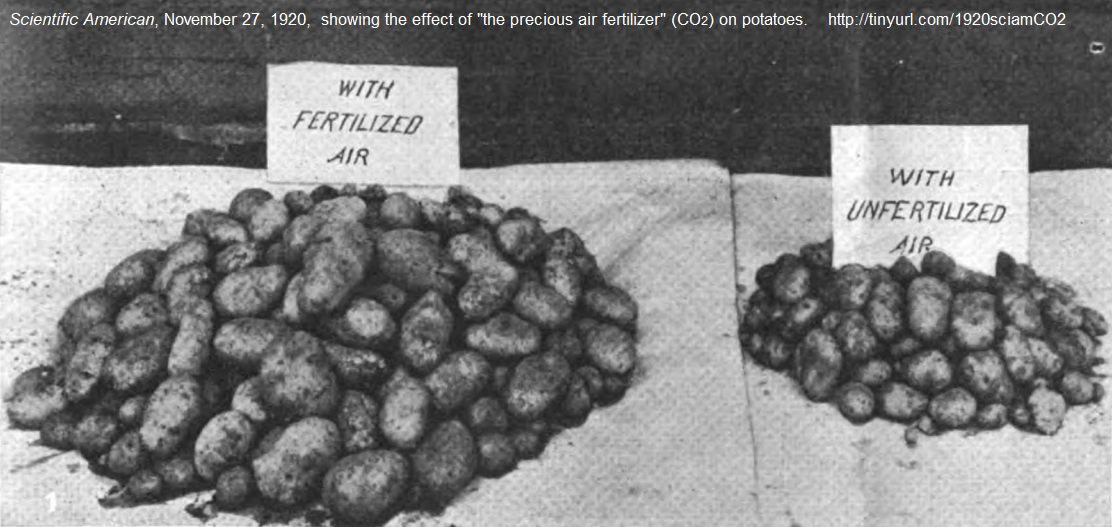
@zteirstein 16/18. The fact that elevated CO2 is extremely beneficial for agriculture has been known to science for >100 years. https://tinyurl.com/1920sciamCO2
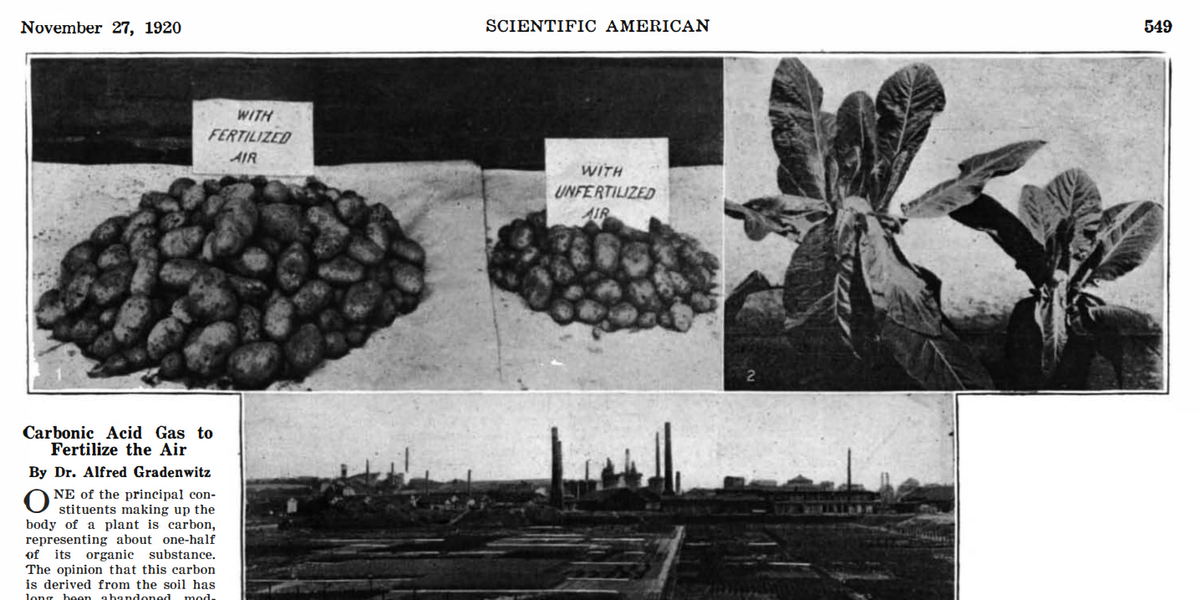
Scientific American - Carbonic Acid Gas to Fertilize the Air sealevel.info

@ncdave4life - ✝️ 🇺🇸 🇺🇦 Dave Burton

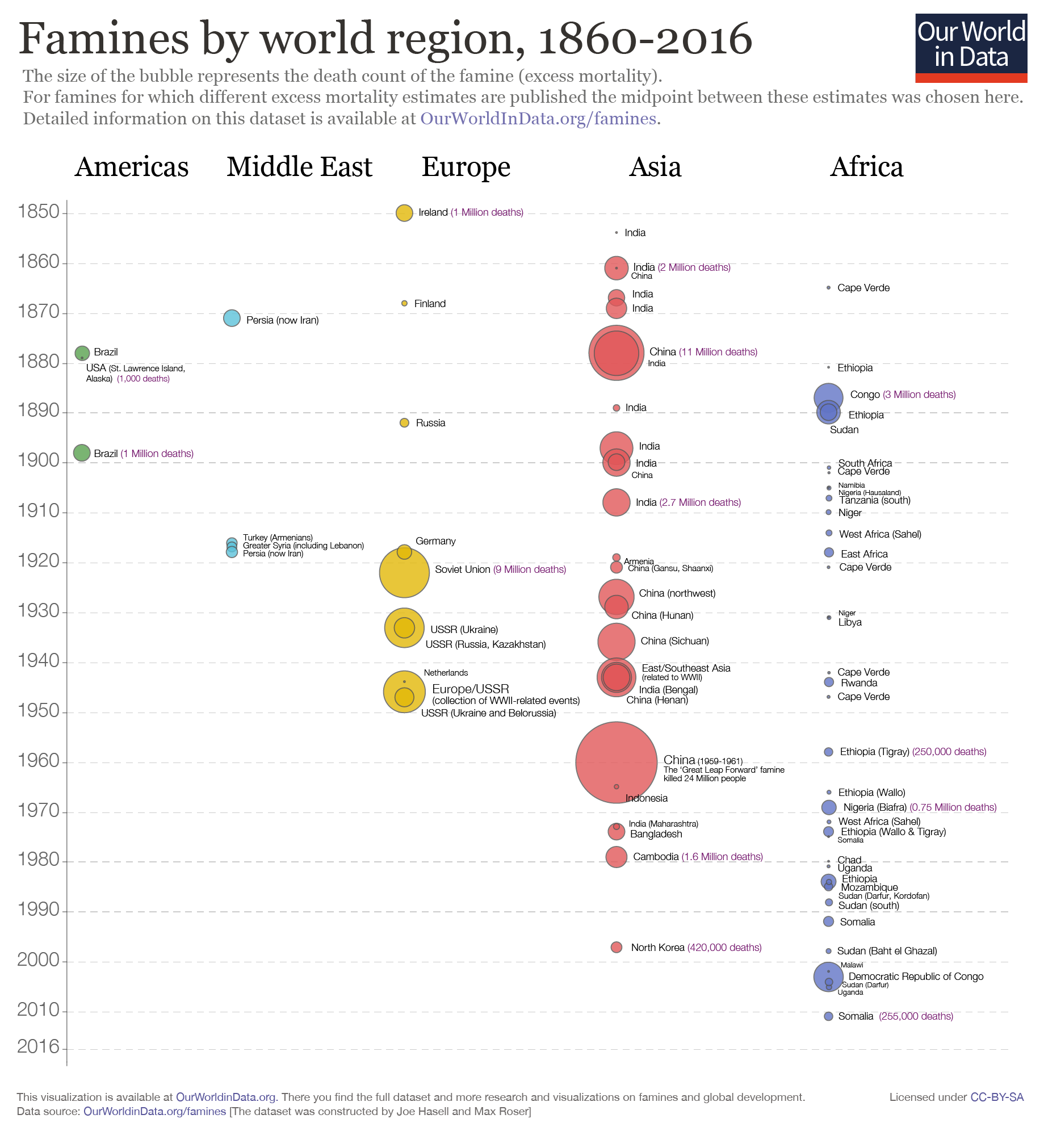
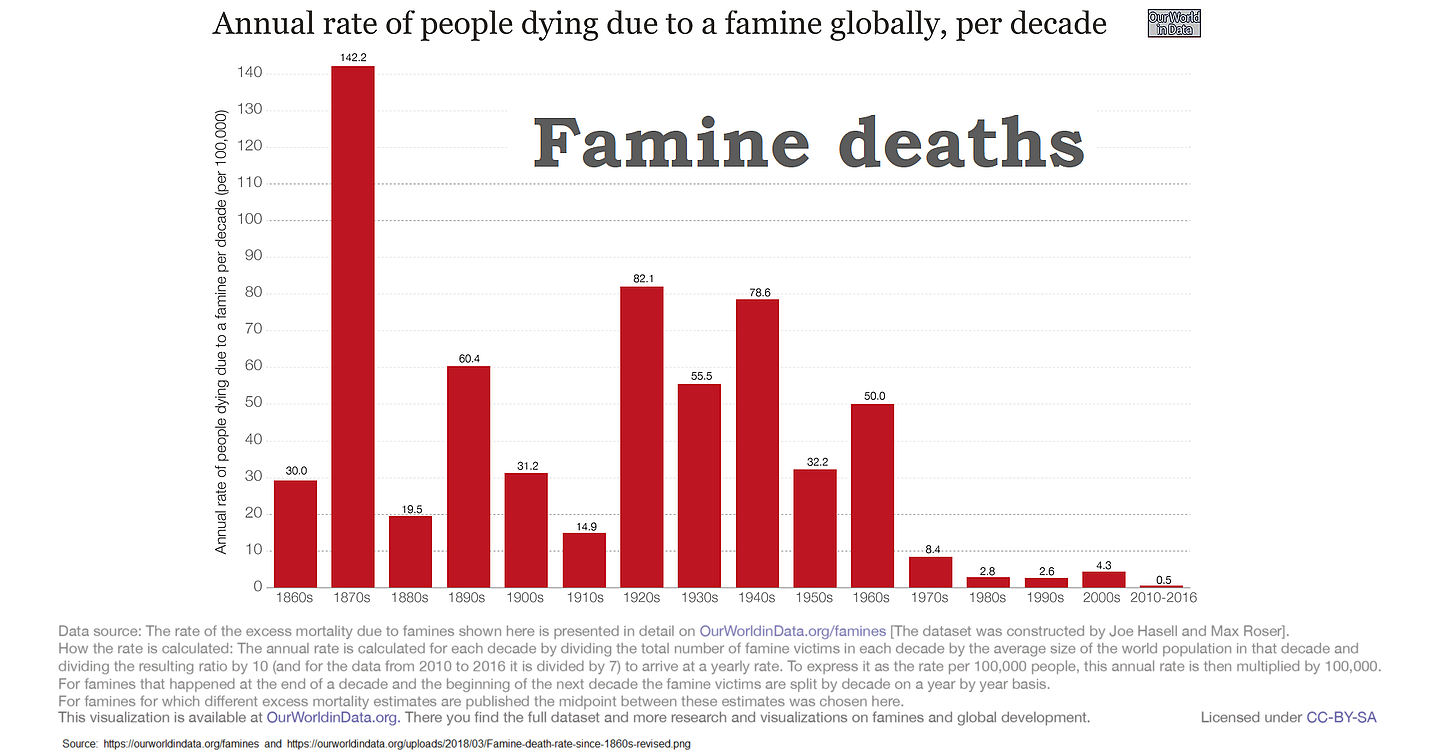
17/18. Rising CO2 levels improve crop yields in two major ways: through "CO2 fertilization," and by improving drought resilience and water use efficiency (WUE). That's long-settled science, among agronomists. Most plants utilize C3 photosynthesis, and agronomy studies show that for C3 crops the CO2 fertilization benefit is highly linear as CO2 levels rise, until above about 1000 ppmv (which is far higher than we could ever hope to drive outdoor CO2 levels by burning fossil fuels). That linearity is obvious in the green (C3) trace, in this graph: https://sealevel.info/C3_and_C4_Pflanze_vs_CO2_Konzentration_1750_1984_2018_2019.png Here's a study about wheat (a C3 crop): https://www.ncbi.nlm.nih.gov/pubmed/26929390 Fitzgerald GJ, et al. (2016) Elevated atmospheric [CO2] can dramatically increase wheat yields in semi-arid environments and buffer against heat waves. Glob Chang Biol. 22(6):2269-84. doi:10.1111/gcb.13263. Plants (and animals) are carbon-based lifeforms. Plants get the carbon they need from CO2 in the air; CO2 is, literally, plant food. The higher the CO2 level, the less air plants must process through their stomata, and the less water they lose in the process (transpiration). Elevated CO2 improves plants' WUE and drought resilience by improving CO2 stomatal conductance relative to transpiration. So eCO2 is especially beneficial in arid regions, and especially beneficial for crops which are under drought stress. Corn (maize) has been very heavily studied. Even though it is a C4 grass (and C4 plants are better at enduring low CO2 levels), corn benefits greatly from elevated CO2, especially under drought stress. Here's a paper: sciencedirect.com/science/articl… Chun et al. (2011). Effect of elevated carbon dioxide and water stress on gas exchange and water use efficiency in corn. Agric For Meteorol 151(3), pp 378-384, ISSN 0168-1923. doi:10.1016/j.agrformet.2010.11.015. EXCERPT: "There have been many studies on the interaction of CO2 and water on plant growth. Under elevated CO2, less water is used to produce each unit of dry matter by reducing stomatal conductance." That improvement is one of several major reasons that catastrophic drought-triggered famines are fading from living memory, for the first time in history. If you're too young to remember huge, devastating, drought-triggered famines, count yourself blessed. Through all of human history, until very recently, famine was one of the great scourges of mankind, the Third Horseman of the Apocalypse. But no more. That is a miracle! Here's the data: https://ourworldindata.org/famines https://sealevel.info/Famine-death-rate-since-1860s-revised-annot1.png Ending famine is a VERY  Big Deal, comparable to ending war and disease. Compare: ● Covid-19 killed 0.1% of world population. ● 1918 flu pandemic killed about 2%. ● WWII killed 2.7%. ● The near-global drought and famine of 1876-78 killed about 3.7% of the world population. https://sealevel.info/C3_and_C4_Pflanze_vs_CO2_Konzentration_1750_1984_2018_2019.png https://sealevel.info/Famine-death-rate-since-1860s-revised-annot1.png


Elevated atmospheric [CO2 ] can dramatically increase wheat yields in semi-arid environments and buffer against heat waves - PubMed Wheat production will be impacted by increasing concentration of atmospheric CO2 [CO2 ], which is expected to rise from about 400 μmol mol(-1) in 2015 to 550 μmol mol(-1) by 2050. Changes to plant physiology and crop responses from elevated [CO2 ] (e[CO2 ]) are well documented for some environments, … pubmed.ncbi.nlm.nih.gov
Famines In many parts of the world famines have been common in the past. What causes famines? How can famines be averted? ourworldindata.org

@ncdave4life - ✝️ 🇺🇸 🇺🇦 Dave Burton

18/18. If you want to understand a commercialized and politicized topic like #ClimateChange, you need balanced, accurate information. I'm here to help: https://sealevel.info/learnmore.html This resource list has: ● accurate intro climatology info ● in-depth science from BOTH skeptics & alarmists ● links to balanced debates between experts on BOTH sides ● info about climate impacts ● links to the best blogs on BOTH sides
Learn More About Climate Change - resources sealevel.info
Saved - December 2, 2023 at 10:53 PM
reSee.it AI Summary
Climate change is influenced by various factors, including the Sun's cyclical warming and the Earth's irregular orbit. The Sun's motion, affected by planetary gravitational pull, causes it to wobble and change distance from Earth. This explains short to medium-term climate variations. Additionally, the Earth's orbit, tilt, and wobble contribute to long-term climate change. Volcanic activity and water vapor in the atmosphere also play a role. CO2 is a minor greenhouse gas compared to water vapor. Life adapts better to higher temperatures and CO2 levels. The real danger lies in CO2 decrease and temperature drop. We must recognize the complexity of climate change beyond simplistic CO2 narratives.

@robinmonotti - Robin Monotti

THE REAL REASON FOR CLIMATE CHANGE: The warming from the Sun is cyclical, it's NOT constant. The distance of where you are from the Sun is constantly changing because both the Earth's orbit around the Sun is irregular and the Sun itself wobbles due to the combined gravitational pull of all the planets together. Look at the Schwabe solar cycle of 11 years, the Jose solar cycle of solar Inertial Motion of 179 years, Eddy Solar Cycle of 1000 years, the Bray-Halstatt Cycles of 2300-2500 years, then look into the three Milankovitch Cycles. Short to medium term climate change: Solar Inertial Motion: the combined mass of the planets also moves the position of the Sun through their combined gravitational pull, meaning the Sun moves around following the ever moving barycentre of the Solar system rather than being in a fixed central point in the middle Solar System. That is the key thing to understand: the Sun is moving around, wobbling in spiral like motion as it travels, it is not stationary. Once you understand that all medium term climate change can be explained simply because of the Sun's changing distance from the Earth. None of this has anything to do with humans. None of this has anything to do with CO2. The models of the Solar System you grew up believing as a child were gross over simplifications. They conditioned you to believe that the Solar system has a fixed Sun position with a regular Sun activity with regular orbits, of which the Earth is one. Yet that is not the reality: not only the earth both tilts and wobbles as it orbits, but the orbit is a changing ellipse not a perfect circle, meaning the distance from the Sun is not constant. These are the three Milankovitch cycles. Also other planets have irregular orbits. The combined effect of all these irregular orbits together pulls the Sun off centre of the solar system into the barycentre. A wobbling Sun is the real reason for short to medium term climate change, and an irregular earth orbit, tilt and wobble is the reason for long term climate change. And this is just the beginning of the story of irregularity in the Earth's orbit around the Sun, then there are cycles of Sun activity, making it stronger and weaker according to how close to the 11 year cycle of magnetic poles flip it is, next being in 2024, and how many Sun spots & Solar flares we are exposed to. Then you need to factor volcanic activity, the Hunga-Tonga Hunga underwater volcanic eruption of January 2022 increased the water vapour in the stratosphere by 10%, this in itself will cause considerable warming of the planet in most regions. It's definitely not a simplistic neat black and white story of CO2, a minor greenhouse gas, as 95% of the earth's greenhouse gases are constituted by water vapour instead. Humans have no power to determine either the orbit of the Earth around the Sun or the Sun's internal & external activity, or the water vapour in the atmosphere. Life adapts much more easily to higher temperatures and increases in CO2, particularly plants, vegetation, trees, plankton& phytoplankton, than it does to decreases in CO2. The real danger is a decrease of CO2, and a decrease in temperature, not an increase in either. Once again, we have been deceived by a systematically corrupt scientific funding system linked to oligarchs interests. CO2 was always a control knob for economic prosperity, not climate.

Saved - December 8, 2023 at 5:38 PM
reSee.it AI Summary
The atmosphere currently has 400 PPM of CO2, which is 0.04%. Optimal farming conditions occur at 600-1000 PPM of CO2, while plant life dies at 200 PPM. Companies use CO2 generators to enhance farming: (1) increasing yield by 30% or more, (2) achieving earlier harvests, and (3) improving resistance to disease and pests. It's puzzling why we're decreasing CO2 levels when it benefits agriculture. Companies pay to increase CO2, while we pay taxes to decrease it, keeping us in suboptimal farming conditions. This contradiction raises questions.

@bambkb - Kevin - WE THE PEOPLE❤️ - DAD🦁 🐉 🔥

🚨🚨🚨Right now our atmosphere has 400 PPM of CO2 = 0.04% At 600-1000 PPM of CO2 we get optimal FARMING conditions At 200 PPM OF CO2, all plant life DIES👇 Companies use a Carbon dioxide generator to reach these conditions of 600 - 1000 PPM : (1) To increase yield by 30% or MORE (2) To produce an earlier harvest (3) To improve plants resistance to DISEASE and PESTS Who do I have a feeling that this is part of #TheGreatReset and they never want our atmosphere to each these CO2 levels, so that our farmers NEVER see these benefits for FREE!? So let me get this straight: (4) If we increase CO2 in the atmosphere, we get OPTIMAL farming conditions (5) If we DECREASE CO2 in the atmosphere, we get an ICE AGE and DEATH of most life on the planet Can someone please rationally explain why we’re decreasing CO2 levels again!? Companies are PAYING to increase CO2 levels for better farming conditions, while we PAY TAXES to decrease CO2 levels and keep ourselves in SUBOPTIMAL farming conditions!? It doesn’t make any sense to me🤷‍♂️ #ClimateScam #ClimateFraud #CrimesAgainstHumanity #CO2isLife

Video Transcript AI Summary
AGA is driving growth in agriculture by adding carbon dioxide to increase production capacity and ensure larger, more attractive flowers and vegetables like cucumbers, tomatoes, and lettuce. Carbon dioxide fertilization boosts yield by up to 30%. While ambient air contains sufficient carbon dioxide for growing tomatoes and cucumbers, plants in greenhouses consume it quickly, leading to slowed growth if the concentration falls. To optimize yield, carbon dioxide levels in the greenhouse should be maintained between 600 to 1000 PPM. Adding extra carbon dioxide improves the yield of tomatoes, cucumbers, lettuce, cut flowers, and potted plants by up to 30% or more. Additionally, carbon dioxide enhances early harvest, disease resistance, and pest resilience.
Full Transcript
Speaker 0: AGA is driving growth in the agricultural sector by adding carbon dioxide to increase production capacity and guarantee large attractive flowers and vegetables such as cucumbers, tomatoes and lettuce. Using carbon dioxide fertilization increases yield by up to 30%. Ambient air has a carbon dioxide concentration of 400 PPM. This is sufficient for growing tomatoes and cucumbers. But as the plants, often grown in greenhouses, start to consume the carbon dioxide in the air at first sunlight, if the concentration of carbon dioxide is allowed to fall, growth is slowed down or altered. C o two in greenhouses is very important because we get a better crop, a higher gene, and better quality of the tomatoes. Additional carbon dioxide needs to be added to increase efficiency and to have the optimal yield. By keeping the carbon dioxide concentration in the greenhouse atmosphere in a range of 600 to 1000 PPM, the best growth rate can be expected. When extra carbon dioxide is added to greenhouse air, the tomato, cucumber and lettuce yield improves by up to 30% or even more. Cut flowers and potted plants also benefit from carbon dioxide fertilization. Carbon dioxide not only increases yield but also produces an earlier harvest and improves plants resistance to disease and pests.
Saved - December 10, 2023 at 11:11 PM

@bambkb - Kevin - WE THE PEOPLE❤️ - DAD🦁 🐉 🔥

🚨🚨🚨How is Carbon dioxide a pollutant when it is used for plant growth!?🤔 CO2 is essential to life on this planet!!! Do you know how dangerously low, C02 levels are right now? #ClimateScam https://t.co/1tuS1B2qga

Saved - January 20, 2024 at 11:32 PM
reSee.it AI Summary
Removing CO2 from the atmosphere, while advocating for global warming solutions, may inadvertently cause the very problem they aim to solve. The Earth's atmosphere allows visible light to pass through but absorbs infrared radiation, primarily due to greenhouse gases like water vapor, carbon dioxide, and methane. These gases trap heat and contribute to global warming. However, if there were no CO2 in the atmosphere, the global climate would be considerably cooler. (Source: columbia.edu/~vjd1/carbon.h…, web.archive.org/web/2001070100…)

@ZyroFoxtrot - ZyroFoxtrot🇺🇸⭐️🇺🇸⭐️🇺🇸⭐️🇺🇸

If There Was No Co2 in the Atmosphere the Global Climate Would Be Significantly Cooler All those railing about the need to remove CO2 from the earth while at the same time pushing 'global warming', 'climate change', blah, blah, blah...it would seem, once again what they are pushing for and are begging the low information crowd into cheerleading for, causes the exact problem they claim to be trying to solve.... The Greenhouse Effect Most of the sun's energy that falls on the Earth's surface is in the visible light portion of the electromagnetic spectrum. This is in large part because the Earth's atmosphere is transparent to these wavelengths (we all know that with a functioning ozone layer, the higher frequencies like ultraviolet are mostly screened out). Part of the sunlight is reflected back into space, depending on the albedo or reflectivity of the surface. Part of the sunlight is changed into infrared (lower frequency than visible light). While the dominant gases of the atmosphere (nitrogen and oxygen) are transparent to infrared, the so-called greenhouse gasses, primarily water vapor (H2O), carbon dioxide, and methane (CH4), absorb the infrared radiation. They collect this heat energy and hold it in the atmosphere. While we worry about possible global warming from the additional CO2 we put into the atmosphere by burning fossil fuels, if there was no CO2 in the atmosphere the global climate would be significantly cooler. (source: columbia.edu/~vjd1/carbon.h…, web.archive.org/web/2001070100…)

@HouseCracka - Oligarch Kabuki

::: GLOBAL COOLING ALERT ::: 🥶🥶🥶🥶🥶 https://t.co/C1dt04KxCk

Saved - March 17, 2024 at 5:02 AM

@TonyClimate - Tony Heller

Over the last 700,000 years earth saw regular large swings in temperature, with CO2 varying by a relatively small amount. It should be obvious to anyone who can think rationally that something other than CO2 is driving the temperature. #ClimateScam https://realclimatescience.com/2024/03/ominous-changes-in-the-worlds-weather/

Ominous Changes In The World’s Weather Fortune Magazine February 1974 “Climatologists now blame those recurring droughts and floods on a global cooling trend. It could bring massive tragedies for mankind. The changes, which are ch… realclimatescience.com
Saved - March 31, 2024 at 6:32 AM

@_ClimateCraze - John Shewchuk

The Schwarzschild Equation (shown here as a diagram) is used by all the IPCC climate models. This equation clearly shows that doubling CO2 only results in a 1% warming effect. In other words it's negligible. https://t.co/qBURpVfFEn

Saved - May 5, 2024 at 11:23 PM

@PeterDClack - Peter Clack

Carbon dioxide was double levels of today for 'most of the last 420 million years'. Before that, in the Cambrian, it was 20 times higher. But CO2 never controls temperatures & this demolishes the IPCC's claims of a future global warming catastrophe. It is just not true. A hoax. https://t.co/SrUdp2B8jv

Saved - May 8, 2024 at 5:26 AM

@PeterDClack - Peter Clack

A 40 year hoax to destroy Western energy is based on a package of lies about carbon dioxide. CO2 has had a pivotal role in the rise of oxygen & formation of life on earth. Yet its always been a trace gas. We now face a dreadful future calamity because CO2 needs to be 1,200ppm. https://t.co/xxCy5BNgUM

Saved - May 11, 2024 at 10:20 PM

@PeterDClack - Peter Clack

The Age of Mammals (the Cenezoic) lasting 65 million years reveals no connection between temperatures & carbon dioxide in the atmosphere. Temperatures have been falling & earth has been in an ice age for 2.58 million years. It shows how absurd the climate change hoax really is. https://t.co/MygwjaFm3C

Saved - May 18, 2024 at 4:12 PM
reSee.it AI Summary
Nobel Laureate Svante Arrhenius, known as "The father of climate change," believed that CO2 emissions and rising CO2 levels would be beneficial. Some argue against this view, labeling those who disagree as "science denying idiots." Scientific evidence supports Arrhenius' claims, showing that rising CO2 levels have positive effects on the environment, including greening the Earth, improving crop yields, and benefiting natural ecosystems. Resources are available for those seeking balanced information on the topic of climate change. The CO2 Coalition, an organization of volunteer scientists, provides valuable resources and aims to combat disinformation and corruption in the field.

@ncdave4life - ✝️ 🇺🇸 🇺🇦 Dave Burton

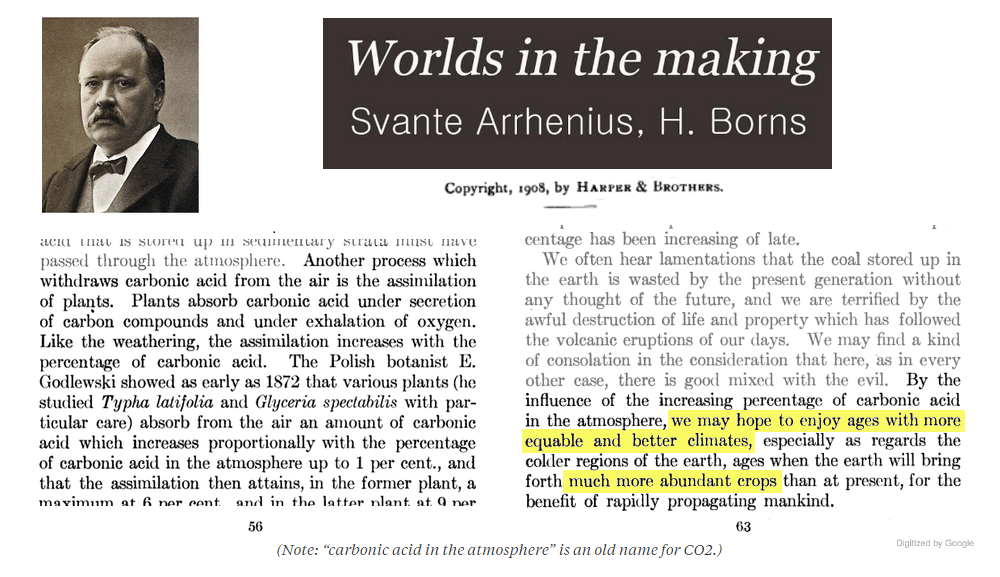
1/9❯ The Grauniad's Ian Sample called Nobel Laurate Svante Arrhenius "The father of climate change." Arrhenius said CO2 emissions and rising CO2 levels would be highly beneficial. The evidence confirms that. But Joe thinks anyone who says it is a "science denying idiot." https://sealevel.info/learnmore.html?0=arrhenius…

Learn More About Climate Change - resources sealevel.info

@joe51du - Joe8855

@GillesnFio @Veritatem2021 @Mark_A_Lunn @Rabs1958 @MartinDn1001 @3GHtweets @MarcEHJones @Anymous84861064 @tonyjsargeant @Willard1951 @ammocrypta @ncdave4life @JohnWil12363553 @DenisDaly @AristotleMrs @S_D_Mannix @Camburnclimate @ozzorro1 @SpudNielsen @bomac_macbo @BenKoby1911 @Devonian1342 @GAJAJW @Jaisans @bulkbiker @Climatehope2 @Data79504085 @Anvndarnamn5 @Michael_D_Crow @Hji45519156 @waxliberty @priscian @SuperFoxyLoxy @ChrisBBacon3 @JaapTitulaer @wjack76995 @Rocky35418823 @NobaconEgbert @balls95652097 @BointonGiles @SeekerTheGreat1 @ubique60 @EthonRaptor @RMcgillss @paligap17 @TheDisproof @MaggieL @Willy1000 @AuroriaTwittori The death cult is the science denying idiots such as yourself who have been brainwashed by the fossil fuel companies and the right wing lie machine to destroy the planet and humanity for their short term profits.

@ncdave4life - ✝️ 🇺🇸 🇺🇦 Dave Burton

2/9❯ Somebody is VERY confused. (And it wasn't Arrhenius!)

@ncdave4life - ✝️ 🇺🇸 🇺🇦 Dave Burton

5/5. The scientific evidence is compelling that rising CO2 levels (and consequent climate change) are beneficial, just as Arrhenius predicted, over a century ago. Learn more here: https://sealevel.info/learnmore.html?0=arrhenius @ThreadReaderApp @Rattibha @threaddotblue unroll @reSeeIt save thread

Learn More About Climate Change - resources sealevel.info

@ncdave4life - ✝️ 🇺🇸 🇺🇦 Dave Burton

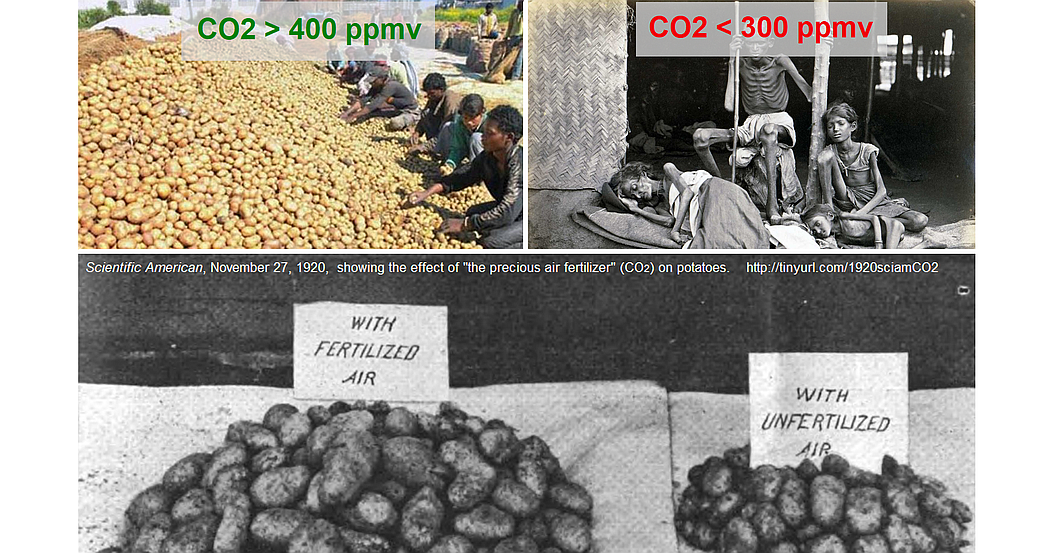
3/9❯ CO2 emissions are greening the Earth, 3 ways: 1. By helping trees grow through CO2 fertilization. 2. By making plants more water efficient & drought resilient. 3. By improving crop yields, thus reducing the amount of land needed for agriculture. https://sealevel.info/learnmore.html?0=madrasfamine https://sealevel.info/learnmore.html?0=madrasfamine
Learn More About Climate Change - resources sealevel.info

@ncdave4life - ✝️ 🇺🇸 🇺🇦 Dave Burton

4/9❯ The benefits of rising CO2 levels for agriculture are spectacular. CO2 is not the only reason for improving crop yields, but it is one of the major reasons: https://sealevel.info/ourworldindata_cereal_yield_4regions_1961_and_2022_annot1.png https://ourworldindata.org/crop-yields https://ourworldindata.org/crop-yields

Crop Yields Increasing crop yields is crucial to improve food security, living standards, and reduce human impacts on the environment. ourworldindata.org

@ncdave4life - ✝️ 🇺🇸 🇺🇦 Dave Burton

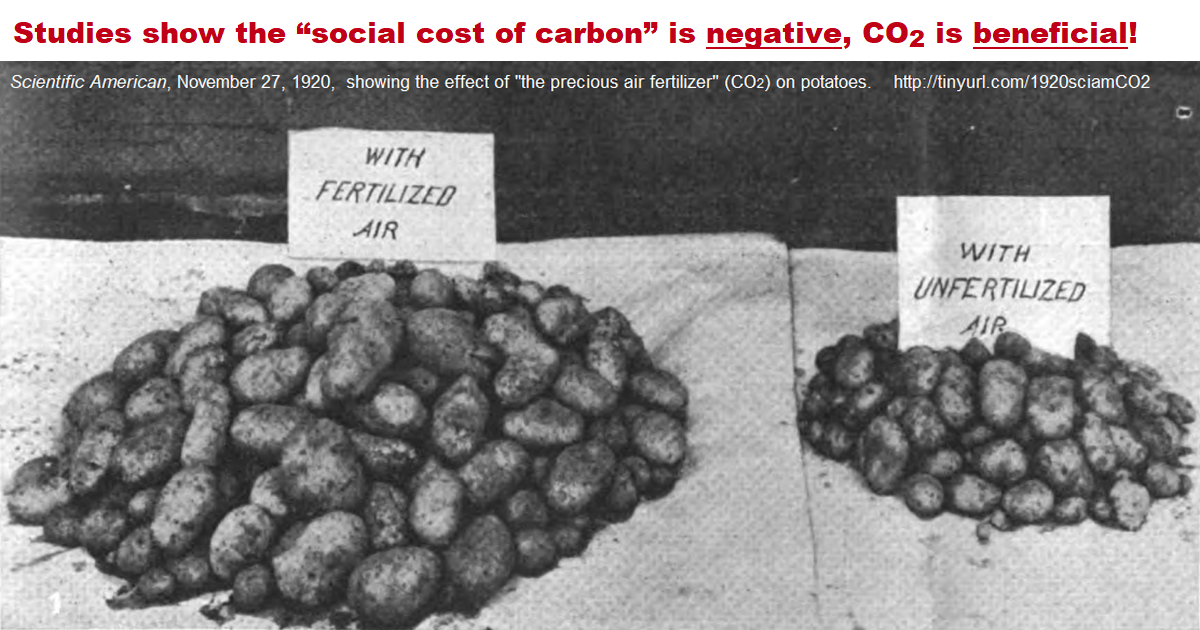
5/9❯ The best scientific evidence shows that CO2 emissions are beneficial, and manmade climate change is modest and benign. Here are some relevant studies: https://sealevel.info/negative_social_cost_of_carbon.html
Social cost of carbon is negative - scientific papers sealevel.info

@ncdave4life - ✝️ 🇺🇸 🇺🇦 Dave Burton

6/9❯ The benefits of rising CO2 levels for natural ecosystems are measurable from orbit. https://sealevel.info/greening_earth_spatial_patterns_Myneni.html https://sealevel.info/greening_earth_spatial_patterns_Myneni.html

@ncdave4life - ✝️ 🇺🇸 🇺🇦 Dave Burton

7 of 9❯ This is NASA's video about it: https://www.youtube.com/watch?v=zOwHT8yS1XI

Video Not Available youtube.com

@ncdave4life - ✝️ 🇺🇸 🇺🇦 Dave Burton

8/9❯ To understand a contentious & politicized topic like #ClimateChange you need balanced information. I'm here to help: https://sealevel.info/learnmore.html?0=dummies That resource list has: ● accurate introductory climatology information ● in-depth science from BOTH  skeptics & alarmists ● links to balanced debates between experts on BOTH  sides ● accurate information about impacts of CO2 & climate change, such as the effects on crop yields ● links to the best blogs on BOTH  sides of the climate debate

Learn More About Climate Change - resources sealevel.info

@ncdave4life - ✝️ 🇺🇸 🇺🇦 Dave Burton

9/9❯ The CO2 Coalition's site also has excellent resources to help you learn about this issue: https://co2coalition.org/ Many of the Coalition's members are highly distinguished. Their newest Board Member is Dr. John Clauser, 2022 Nobel Laureate (Physics). The CO2 Coalition is an organization of volunteer scientists, dedicated to combating disinformation about CO2 & climate change, and pushing back against the corruption of science for political & pecuniary reasons.

Home - CO2 Coalition co2coalition.org

@_ClimateCraze - John Shewchuk

Thank you Dr. Clauser. It's time for more scientists to speak out.

@ncdave4life - ✝️ 🇺🇸 🇺🇦 Dave Burton

Compilation: https://twitter-thread.com/t/1791863199844708584 @ThreadReaderApp @Rattibha @threaddotblue unroll @reSeeIt save thread

1/9❯ The Grauniad's Ian Sample called Nobel Laurate Svante Arrhenius "The father of climate change." by @ncdave4life(✝️ 🇺🇸 🇺🇦 Dave Burton) 1/9❯ The Grauniad's Ian Sample called Nobel Laurate Svante Arrhenius "The father of climate change." Arrhenius said CO2 emissions and rising CO2 levels would be highly beneficial. The evidence confirms that. But Joe thinks anyone who says it is a "science denying idiot." https://t.co/sYe7MFgpmX twitter-thread.com
Saved - June 8, 2024 at 8:30 AM

@_ClimateCraze - John Shewchuk

Carbon Dioxide's warming effects are trivial due to its logarithmically decreasing warming effects. Adding more CO2 will make no detectable change to our climate -- but it will make earth's ecosystems thrive because CO2 is plant food. https://t.co/5gExWP4mZD

Saved - June 27, 2024 at 1:15 PM
reSee.it AI Summary
Climate Change and Human Responsibility: While there are natural factors contributing to climate change, such as the Sun's cyclical variations and the Earth's irregular orbit, it is important to acknowledge the impact of human activities. The focus on CO2 emissions is not a simplistic story, as water vapor constitutes the majority of greenhouse gases. However, humans do have the power to reduce their carbon footprint and mitigate the effects of climate change. It is crucial to prioritize sustainable practices and address the systemic corruption in scientific funding that hinders progress in combating climate change.

@robinmonotti - Robin Monotti

THE REAL REASON FOR CLIMATE CHANGE: The warming from the Sun is cyclical, it's NOT constant. The distance of where you are from the Sun is constantly changing because both the Earth's orbit around the Sun is irregular and the Sun itself wobbles due to the combined gravitational pull of all the planets together. Look at the Schwabe solar cycle of 11 years, the Jose solar cycle of solar Inertial Motion of 179 years, Eddy Solar Cycle of 1000 years, the Bray-Halstatt Cycles of 2300-2500 years, then look into the three Milankovitch Cycles. Short to medium term climate change: Solar Inertial Motion: the combined mass of the planets also moves the position of the Sun through their combined gravitational pull, meaning the Sun moves around following the ever moving barycentre of the Solar system rather than being in a fixed central point in the middle Solar System. That is the key thing to understand: the Sun is moving around, wobbling in spiral like motion as it travels, it is not stationary. Once you understand that all medium term climate change can be explained simply because of the Sun's changing distance from the Earth. None of this has anything to do with humans. None of this has anything to do with CO2. The models of the Solar System you grew up believing as a child were gross over simplifications. They conditioned you to believe that the Solar system has a fixed Sun position with a regular Sun activity with regular orbits, of which the Earth is one. Yet that is not the reality: not only the earth both tilts and wobbles as it orbits, but the orbit is a changing ellipse not a perfect circle, meaning the distance from the Sun is not constant. These are the three Milankovitch cycles. Also other planets have irregular orbits. The combined effect of all these irregular orbits together pulls the Sun off centre of the solar system into the barycentre. A wobbling Sun is the real reason for short to medium term climate change, and an irregular earth orbit, tilt and wobble is the reason for long term climate change. And this is just the beginning of the story of irregularity in the Earth's orbit around the Sun, then there are cycles of Sun activity, making it stronger and weaker according to how close to the 11 year cycle of magnetic poles flip it is, next being in 2024, and how many Sun spots & Solar flares we are exposed to. Then you need to factor volcanic activity, the Hunga-Tonga Hunga underwater volcanic eruption of January 2022 increased the water vapour in the stratosphere by 10%, this in itself will cause considerable warming of the planet in most regions. It's definitely not a simplistic neat black and white story of CO2, a minor greenhouse gas, as 95% of the earth's greenhouse gases are constituted by water vapour instead. Humans have no power to determine either the orbit of the Earth around the Sun or the Sun's internal & external activity, or the water vapour in the atmosphere. Life adapts much more easily to higher temperatures and increases in CO2, particularly plants, vegetation, trees, plankton& phytoplankton, than it does to decreases in CO2. The real danger is a decrease of CO2, and a decrease in temperature, not an increase in either. Once again, we have been deceived by a systematically corrupt scientific funding system linked to oligarchs interests. CO2 was always a control knob for economic prosperity, not climate.

@robinmonotti - Robin Monotti

https://www.frontiersin.org/journals/astronomy-and-space-sciences/articles/10.3389/fspas.2022.937930/full

Frontiers | The Planetary Theory of Solar Activity Variability: A Review Commenting the 11-year sunspot cycle, Wolf (1859, MNRAS 19, 85–86) conjectured that “the variations of spot-frequency depend on the influences of Venus, Eart... frontiersin.org
Saved - July 4, 2024 at 7:32 AM

@TonyClimate - Tony Heller

Ice ages begin when CO2 is at its maximum, and they end when CO2 is at its minimum. If CO2 controlled the climate, the behavior would be the exact opposite. #ClimateScam https://t.co/IRnWGX9dZT

Saved - July 18, 2024 at 11:09 PM

@JunkScience - Steve Milloy

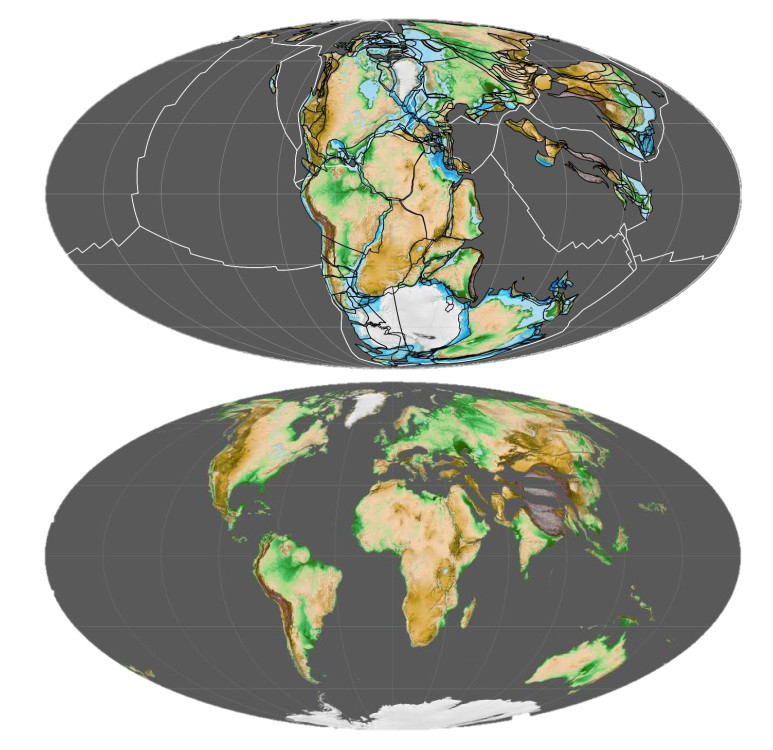
Climate hoax has reality exactly backwards, concludes new study: Temperature increases CO2, not vice-versa. Study: https://www.aimspress.com/article/doi/10.3934/mbe.2024287 Discussion: https://notrickszone.com/2024/07/15/causality-analysis-finds-temperature-changes-have-determined-co2-changes-since-the-phanerozoic/

Stochastic assessment of temperature–CO2 causal relationship in climate from the Phanerozoic through modern times

As a result of recent research, a new stochastic methodology of assessing causality was developed. Its application to instrumental measurements of temperature (T) and atmospheric carbon dioxide concentration ([CO2]) over the last seven decades provided evidence for a unidirectional, potentially causal link between T as the cause and [CO2] as the effect. Here, I refine and extend this methodology and apply it to both paleoclimatic proxy data and instrumental data of T and [CO2]. Several proxy series, extending over the Phanerozoic or parts of it, gradually improving in accuracy and temporal resolution up to the modern period of accurate records, are compiled, paired, and analyzed. The extensive analyses made converge to the single inference that change in temperature leads, and that in carbon dioxide concentration lags. This conclusion is valid for both proxy and instrumental data in all time scales and time spans. The time scales examined begin from annual and decadal for the modern period (instrumental data) and the last two millennia (proxy data), and reach one million years for the most sparse time series for the Phanerozoic. The type of causality appears to be unidirectional, T→[CO2], as in earlier studies. The time lags found depend on the time span and time scale and are of the same order of magnitude as the latter. These results contradict the conventional wisdom, according to which the temperature rise is caused by [CO2] increase.

aimspress.com
Causality Analysis Finds Temperature Changes Have Determined CO2 Changes Since The Phanerozoic notrickszone.com
Saved - October 23, 2024 at 2:03 PM
reSee.it AI Summary
A new study suggests that CO2 may have minimal impact on further warming, as the atmosphere already contains ten times the necessary amount for radiation absorption. This challenges the prevailing climate change narrative and aligns with views from independent researchers like Randall Carlson, who highlights the benefits of CO2 for plant growth and crop yields. Meanwhile, the IRS is intensifying efforts to collect back taxes, sending out millions of notices. Tax Network USA offers assistance to navigate these challenges effectively.

@VigilantFox - The Vigilant Fox 🦊

Scientific Bombshell Shatters the Climate Change Narrative A groundbreaking new study has found that CO2 "may have little to no further warming effect" on the Earth's atmosphere. The striking finding that made the authors come to this conclusion is the fact that the Earth's atmosphere already contains over 6 kg/m² of CO2, which is ten times the "saturation mass" needed for the gas to absorb radiation. This means that additional CO2 emissions might not significantly increase global temperatures, as the atmosphere has already absorbed nearly all the heat it can within the CO2 spectrum. The study, titled “Climatic consequences of the process of saturation of radiation absorption in gases,” was published in Applications in Engineering Science. These findings support the argument made by independent researchers like Randall Carlson, who actually claims that CO2 comes with many benefits, such as boosting plant growth and crop yields. He says, “Hundreds of studies have consistently demonstrated significant improvements in plant growth, crop yields, and drought resistance under elevated CO2 conditions.” This latest study aligns with what Carlson has been saying all along and is absolutely devastating for the climate change narrative.

Video Transcript AI Summary
A study in Applications in Engineering Science suggests the impact of increased CO2 on global temperatures may be less significant than portrayed. Researchers at the Military University of Technology in Poland introduce the concept of saturation mass, determining that CO2's saturation mass is about 0.6 kilograms per meter squared. The author notes that the current atmospheric CO2 is about 6 kilograms, roughly ten times the saturation mass. This implies additional CO2 emissions may have little to no further warming effect. The study aligns with Randall Carlson's argument that CO2's climate impact is overstated and its benefits ignored. Carlson contends rising CO2 levels positively affect the biosphere, citing studies showing improved plant growth, crop yields, and drought resistance with elevated CO2. He points to satellite data showing increased vegetation, attributing 70% of observed greening to CO2 fertilization. The Polish study concludes that the presented impact of increased anthropogenic CO2 on Earth's climate is a hypothesis rather than a substantiated fact.
Full Transcript
Speaker 0: Scientific bombshell shatters the climate narrative. Check this out. In a scientific bombshell that could reshape the climate debate, researchers have found evidence suggesting that Earth's atmosphere may already be saturated with c 02, potentially nullifying the warming effect of future emissions. It goes on to explain that a groundbreaking new study published in applications in engineering science challenges the in increasingly prevalent narrative that rising atmospheric c o two levels will lead to catastrophic climate change. The research conducted by scientists at the Military University of Technology in Poland suggests that the impact of additional c o two missions on global temperatures may be far less significant than commonly portrayed. The study titled climactic consequences of the process of saturation of radiation absorption in gases introduces the concept of saturation mass, the amount of an absorbing gas above which further increases produce negligible, additional absorption of radiation. Through laboratory experiments and theoretical analysis, the researchers determined that for c o two, the saturation mass is approximately 0.6 kilograms per meter squared. Now, critically, the author notes that the current amount of c o two in the Earth's atmosphere is largely over 6 kilograms, about 10 times the saturation mass. Now this implies that additional c o two emissions may have little to no further warming effect as the gas has already absorbed nearly all the infrared radiation that it can within absorption spectrum. It should be noted that unlike the used, the unused section here, the vertical structure of the atmosphere undergoes changes in both pressure and temperature. The author writes, nevertheless, the question arises as to whether the additionally emitted carbon dioxide into the atmosphere will absorb thermal radiation. Now the study's findings align with the work of independent researchers like Randall Carlson who have long argued that climate impact of CO 2 has been overstated while its benefits are being ignored. The redemption of the of the beast, the carbon cycle, and the demonization of CO 2, Carlson contends that the rising CO 2 levels are having an overall positive effect on the biosphere. Carlson writes that hundreds of studies have consistently demonstrated significant improvements in plant growth, crop yields, and drought resistance under relevant or elevated CO 2 conditions. He cites research showing that the doubling of atmospheric CO 2 increased agricultural yields by an average of 33%. Furthermore, Carlson points to evidence of global greening in recent decades. The satellite data is showing an 8% increase in vegetation in Australia from 1981 to 2,006 and an increased foliage cover across Earth's warm, arid environments in proportion to rising c o two levels. Some studies attribute 70% of, observed greening into c o two fertilization effect. A new Polish study also adds weight to Carlson's argument that the prevailing narrative around c o two and climate change may be over simplistic and alarmist. Research conclude that this unequivocally suggests that the official presented impact of anthropogenic CO 2 increase on Earth's climate is merely a hypothesis rather than a substantiated fact. Now the problem with this is it's saying this. Look. It's not that there aren't elevated levels of c o two which they're detecting, but maybe it's a good thing. I don't know if you know this, but we live in a day and age where you might owe back taxes. And, unfortunately, pandemic relief is now over. Along with hiring thousands of new agents and field officers, the IRS has kicked off 2024 by sending over 5,000,000 pay up letters to those who have unfiled tax returns or balances owed. You don't think it can happen to you? I have 2 friends who are currently being audited by the IRS, and they owe back taxes. Well, don't waive your rights, and don't speak with them on your own. They are not your friends. Tax Network USA, a trusted tax relief firm, has saved over $1,000,000,000 in back taxes for their clients, and they can help you secure their client, the best deal possible. That's whether you owe 10,000 or 10,000,000, they can help you today, whether it's business or personal taxes, and even if you have the means to pay or you are on a fixed income. They can help you finally resolve your tax burdens once and for all. Call 1-800-958-1000000 for a private free consultation or visit tnusa.com/vnn. That's tnusa.com/vnn, or call the number on the screen, 1-800-958-1 000.

@VigilantFox - The Vigilant Fox 🦊

The government might ignore facts, but they don't lose sight when you owe you money. The IRS is cracking down, sending “pay up” letters by the millions. Don’t face them alone. Tax Network USA can get you the best deal possible on your back taxes. https://TNUSA.com/VNN

vnn - Tax Network USA Tax Network USA is a full-service tax firm focused on solving tax problems for individuals and small business owners. tnusa.com

@VigilantFox - The Vigilant Fox 🦊

Read More: Scientific Bombshell Shatters the Climate Narrative https://vigilantnews.com/post/scientific-bombshell-shatters-the-climate-narrative/

Scientific Bombshell Shatters the Climate Narrative Now, it all makes sense. vigilantnews.com
Saved - March 1, 2025 at 2:25 PM
reSee.it AI Summary
The conversation began with a comment on Justin Trudeau's potential replacement, Mark Carney, emphasizing the need to achieve Net Zero to stabilize the climate. In response, another participant argued that CO2, which constitutes only 0.04% of the atmosphere, does not cause global warming. They claimed that the Earth's warming is a result of recovery from a mini-ice age 300 years ago and stated that correlation does not imply causation, labeling concerns about man-made climate change as a costly misconception.

@wideawake_media - Wide Awake Media

Justin Trudeau's potential replacement, ex-central banker Mark Carney: "We can't stabilise the climate unless we get to Net Zero." 🤡 https://t.co/79QWacNoLc

Video Transcript AI Summary
It's good that environmental, social, and governance (ESG) labels face scrutiny. This skepticism drives our intense focus on achieving net zero emissions. Ultimately, stabilizing the climate requires reaching net zero; it's that simple. Emissions either increase or decrease. The key question is whether they are decreasing at a rate consistent with scientific targets. Our approach is grounded in the same scientific principles used by the UN and others, specifically targeting the 1.5-degree objective.
Full Transcript
Speaker 0: Look. There is some stress, and it's great that there is that it's not great that it happens, but it's great that there's that scrutiny, and there's that skepticism or healthy skepticism about ESG labels or sustainable labels. And it, again, is one of the reasons we're having this ruthless, relentless focus on net zero because in the end, look, we can't stabilize the climate unless we get to net zero. And it's as simple. These are hard numbers. Your emissions are either a or b. They're going up or down. And if they're going down, are they going down consistent with the science? We anchor it in the science, the same science the UN and others use for the one and half degree objectives.

@wdunlap - Wayne Dunlap

@wideawake_media Science Truth: CO2 is not causing Global Warming -it makes up very tiny 0.04% of Earth's atmosphere creating no blanket effect. Our Earth is heating up from the mini-ice age 300 years ago. Correlation does not always mean causation. False Man-made Climate Change waste $Trillions! https://t.co/C1nMlqol3o

Saved - April 8, 2025 at 12:13 PM
reSee.it AI Summary
I shared my thoughts on climate discussions, emphasizing that the narrative around climate change often overlooks the benefits of CO2. I referenced studies showing that increased CO2 levels can enhance agricultural productivity and improve drought resilience. I noted that historical famines were linked to lower CO2 levels and highlighted positive environmental changes in regions like Africa. I believe the evidence suggests that manmade climate change is modest and that CO2 emissions are largely beneficial. I encourage seeking balanced information on this topic.

@ncdave4life - ✝️ 🇺🇸 🇺🇦 Dave Burton

1/18. Interesting story, Jeffrey, but it would've been improved by omitting the climate propaganda: https://time.com/7274542/colossal-dire-wolf/#:~:text=elephants%20that%20can%20better%20survive%20the%20climatic%20ravages%20of%20a%20warming%20world… "Climatic ravages of a warming world" are the same threat level as unicorn fart pollution.

The Return of the Dire Wolf Colossal Biosciences has genetically engineered the first dire wolf to live in over 10,000 years. Here's what that means for other extinct species. time.com

@jeffreykluger - Jeffrey Kluger

The extinct dire wolf is back. Read the @TIME cover story here. https://time.com/7274542/colossal-dire-wolf/

The Return of the Dire Wolf Colossal Biosciences has genetically engineered the first dire wolf to live in over 10,000 years. Here's what that means for other extinct species. time.com

@ncdave4life - ✝️ 🇺🇸 🇺🇦 Dave Burton

2/18. We don't need to engineer "elephants that can better survive the climatic ravages of a warming world." The existing elephants survived the mid-Eemian Climate Optimum, which was clearly warmer than now. Here's a NOAA graph: https://sealevel.info/Temperature-change-and-carbon-dioxide-change-measured-from-the-EPICA-Dome-C-ice-core-in-Antarctica-v5_200pct.png (I added the annotation, identifying the Eemian and Holocene [current] temperatures.)

@ncdave4life - ✝️ 🇺🇸 🇺🇦 Dave Burton

3/18. NASA measures those "climatic ravages" (benefits). This is their video about it: https://www.youtube.com/watch?v=zOwHT8yS1XI Are you surprised? Then you haven't been getting balanced, accurate information.

Video Not Available youtube.com

@ncdave4life - ✝️ 🇺🇸 🇺🇦 Dave Burton

4/18. The effects of CO2 emissions are heavily studied. They have a modest, benign warming effect, and large benefits for plants and animals. Here are some additional papers & articles about it: https://sealevel.info/greening_earth_spatial_patterns_Myneni.html

@ncdave4life - ✝️ 🇺🇸 🇺🇦 Dave Burton

5/18. Here's how elevated CO2 "ravages" (benefits) agriculture. https://www.ncbi.nlm.nih.gov/pubmed/26929390

Elevated atmospheric [CO2 ] can dramatically increase wheat yields in semi-arid environments and buffer against heat waves - PubMed Wheat production will be impacted by increasing concentration of atmospheric CO2 [CO2 ], which is expected to rise from about 400 μmol mol(-1) in 2015 to 550 μmol mol(-1) by 2050. Changes to plant physiology and crop responses from elevated [CO2 ] (e[CO2 ]) are well documented for some environments, … pubmed.ncbi.nlm.nih.gov

@ncdave4life - ✝️ 🇺🇸 🇺🇦 Dave Burton

6/18. Here's a paper how it benefits even corn, which, significantly, is a C4 photosynthesis crop: sciencedirect.com/science/articl…

@ncdave4life - ✝️ 🇺🇸 🇺🇦 Dave Burton

7/18. In fact, among agronomists it has been settled science for over a century that elevated CO2 is extremely beneficial for crops. This @sciam article is 125 years old! https://sealevel.info/ScientificAmerican_1920-11-27_CO2_fertilization.html They called anthropogenic CO2 emissions "the precious air fertilizer."

@ncdave4life - ✝️ 🇺🇸 🇺🇦 Dave Burton

@sciam 8/18. Long-settled science confirms that CO2 emissions are enormously beneficial for both natural ecosystems and human agriculture, just as predicted by Nobel Laurate and Pioneer climatologist Svante Arrhenius, over a century ago. https://sealevel.info/learnmore.html?0=arrhenius#arrhenius

Learn More About Climate Change - resources sealevel.info

@ncdave4life - ✝️ 🇺🇸 🇺🇦 Dave Burton

@sciam 9/18. Thousands of rigorous subsequent studies have confirmed and refined his results. This site indexes many of them: co2science.org/data/plant_gro…

@ncdave4life - ✝️ 🇺🇸 🇺🇦 Dave Burton

10/18. Rising CO2 levels are also very beneficial for natural ecosystems. They cause deserts to retreat, because plants become more water efficient and drought resilient when CO2 levels are higher. CO2 improves water use efficiency and drought resilience for plants by reducing stomatal conductance and, consequently, water loss through transpiration. Here are some references: 1. Chun JA, et al. (2011). Effect of elevated carbon dioxide and water stress on gas exchange and water use efficiency in corn. Agricultural and Forest Meteorology, 151(3), pp 378–384. https://doi.org/10.1016/j.agrformet.2010.11.015. 2. O'Leary GJ, et al. (2015). Response of wheat growth, grain yield and water use to elevated CO2 under a Free-Air CO2 Enrichment (FACE) experiment and modelling in a semi-arid environment. Glob Chang Biol. 21(7):2670–2686. https://doi.org/10.1111/gcb.12830 3. Fitzgerald GJ, et al. (2016) Elevated atmospheric [CO2] can dramatically increase wheat yields in semi-arid environments and buffer against heat waves. Glob Chang Biol. 22(6):2269-84. https://doi.org/10.1111/gcb.13263 4. Uddin S, et al. (2018) Elevated [CO2] mitigates the effect of surface drought by stimulating root growth to access sub-soil water. PLoS One. 13(6):e0198928. https://doi.org/10.1371/journal.pone.0198928 5. Taylor, C & Schlenker, W (2021). Environmental Drivers of Agricultural Productivity Growth: CO2 Fertilization of US Field Crops. National Bureau of Economic Research, no. w29320. https://doi.org/10.3386/w29320 6. Chen, Xin et al (2024). The global greening continues despite increased drought stress since 2000. Global Ecology and Conservation, Volume 49, 2024, e02791. https://doi.org/10.1016/j.gecco.2023.e02791.

Effect of elevated carbon dioxide and water stress on gas exchange and water use efficiency in corn CO2 has been predicted to increase in the future, and thus leading to possible changes in precipitation patterns. The objectives of this study were to… sciencedirect.com
Elevated [CO2] mitigates the effect of surface drought by stimulating root growth to access sub-soil water Through stimulation of root growth, increasing atmospheric CO2 concentration ([CO2]) may facilitate access of crops to sub-soil water, which could potentially prolong physiological activity in dryland environments, particularly because crops are more water use efficient under elevated [CO2] (e[CO2]). This study investigated the effect of drought in shallow soil versus sub-soil on agronomic and physiological responses of wheat to e[CO2] in a glasshouse experiment. Wheat (Triticum aestivum L. cv. Yitpi) was grown in split-columns with the top (0–30 cm) and bottom (31–60 cm; ‘sub-soil’) soil layer hydraulically separated by a wax-coated, root-penetrable layer under ambient [CO2] (a[CO2], ∼400 μmol mol-1) or e[CO2] (∼700 μmol mol-1) [CO2]. Drought was imposed from stem-elongation in either the top or bottom soil layer or both by withholding 33% of the irrigation, resulting in four water treatments (WW, WD, DW, DD; D = drought, W = well-watered, letters denote water treatment in top and bottom soil layer, respectively). Leaf gas exchange was measured weekly from stem-elongation until anthesis. Above-and belowground biomass, grain yield and yield components were evaluated at three developmental stages (stem-elongation, anthesis and maturity). Compared with a[CO2], net assimilation rate was higher and stomatal conductance was lower under e[CO2], resulting in greater intrinsic water use efficiency. Elevated [CO2] stimulated both above- and belowground biomass as well as grain yield, however, this stimulation was greater under well-watered (WW) than drought (DD) throughout the whole soil profile. Imposition of drought in either or both soil layers decreased aboveground biomass and grain yield under both [CO2] compared to the well-watered treatment. However, the greatest ‘CO2 fertilisation effect’ was observed when drought was imposed in the top soil layer only (DW), and this was associated with e[CO2]-stimulation of root growth especially in the well-watered bottom layer. We suggest that stimulation of belowground biomass under e[CO2] will allow better access to sub-soil water during grain filling period, when additional water is converted into additional yield with high efficiency in Mediterranean-type dryland agro-ecosystems. If sufficient water is available in the sub-soil, e[CO2] may help mitigating the effect of drying surface soil. journals.plos.org
The global greening continues despite increased drought stress since 2000 Increases or decreases in remote sensing-based vegetation greenness are usually referred to as greening or browning. The CO2 fertilization along with … sciencedirect.com

@ncdave4life - ✝️ 🇺🇸 🇺🇦 Dave Burton

11/18. That makes droughts much less destructive. When CO2 levels were < 350 ppmv, catastrophic famines, usually triggered by drought, were common. Compare: ● COVID-19 killed about 0.1% of the world's population ● The catastrophic 1918 flu pandemic killed about 2% ● WWII killed 2.7% of the world's population ● But the near-global drought and famine of 1876-78 killed about 3.7% of the world's population.

@ncdave4life - ✝️ 🇺🇸 🇺🇦 Dave Burton

@sciam 12/18. Thankfully, catastrophic, drought-triggered famines are fading from living memory, and one of the main reasons is the 50% increase in average atmospheric CO2 level, thanks to fossil fuels.

@ncdave4life - ✝️ 🇺🇸 🇺🇦 Dave Burton

@sciam 13/18. If you're young, you might not realize what a threat catastrophic, drought-induced famines were, until recently. https://sealevel.info/learnmore.html?0=famine#famine

Learn More About Climate Change - resources sealevel.info

@ncdave4life - ✝️ 🇺🇸 🇺🇦 Dave Burton

14/18. The impact is especially great for Africa. Even politically correct National Geographic once reported the improvement, back in 2009 (though since then they've scrubbed that good news from their site): https://sealevel.info/Owen2009_Sahara_Desert_Greening-NatGeo30639457.html EXCERPT: "Vast swaths of North Africa are getting noticeably lusher due to warming temperatures, new satellite images show, suggesting a possible boon for people living in the driest part of the continent."

@ncdave4life - ✝️ 🇺🇸 🇺🇦 Dave Burton

15/18. New Scientist reported the "remarkable environmental turnaround," including "quite spectacular regeneration of vegetation," and "a 70 per cent increase in yields of local cereals such as sorghum and millet in one province in recent years." https://www.newscientist.com/article/mg17523610-300-africans-go-back-to-the-land-as-plants-reclaim-the-desert/ See also: https://www.sealevel.info/Pearce2002_Africans_go_back_to_the_land_as_plants_reclaim_the_desert-New_Scientist.html

Africans go back to the land as plants reclaim the desert AFRICA'S deserts are in retreat. Burkina Faso, one of the West African countries devastated by drought and advancing deserts 20 years ago, is growing greener again – so much so that families who fled to wetter coastal regions are starting to go home. New research confirming this remarkable environmental turnaround in one of Africa's most … newscientist.com

@ncdave4life - ✝️ 🇺🇸 🇺🇦 Dave Burton

@sciam 16/18. Elevated CO2 and consequent climate change dramatically improves global food security, and mitigates drought impacts. These two photos were both taken in the Madras region of the Indian subcontinent:

@ncdave4life - ✝️ 🇺🇸 🇺🇦 Dave Burton

@MisinformNoMore @WeiZhangAtmos 7/ What's more, one of the nice things about "global warming" is that it isn't very global. It disproportionately warms frigid winter nights at chilly high latitudes. The tropics are warmed less, which is good, because they're warm enough already.

@ncdave4life - ✝️ 🇺🇸 🇺🇦 Dave Burton

@sciam 17/18. If you believe there's a risk of "climatic ravages" from a warming world, you've been badly misled. The scientific evidence is compelling that manmade climate change is modest and benign, and CO2 emissions are highly beneficial.

@ncdave4life - ✝️ 🇺🇸 🇺🇦 Dave Burton

@zteirstein 8/18. The supposed major harms from CO2 emissions are all merely hypothetical, and mostly implausible. None of them are actually happening. For instance, the coral of the Great Barrier Reef are doing fine: https://archive.ph/IcRIY https://archive.ph/IcRIY

@ncdave4life - ✝️ 🇺🇸 🇺🇦 Dave Burton

18/18. To understand a contentious topic like #ClimateChange, you need balanced information. I'm here to help: https://sealevel.info/learnmore.html That resource list has: ● accurate introductory climatology information ● in-depth science from BOTH skeptics & alarmists ● links to balanced debates between experts on BOTH sides ● information about climate impacts ● links to best blogs on BOTH sides of the issue Please do not hesitate to contact me directly if you have questions or need expert sources for future articles.

Learn More About Climate Change - resources sealevel.info

@ncdave4life - ✝️ 🇺🇸 🇺🇦 Dave Burton

@sciam Compilation: https://twitter-thread.com/t/1909579388510728550 @ThreadReaderApp @Rattibha @threaddotblue unroll @reSeeIt save thread @HeyGenLabs

1/18. Interesting story, Jeffrey, but it would've been improved by omitting the climate propaganda: by @ncdave4life(✝️ 🇺🇸 🇺🇦 Dave Burton) | Twitter Thread Reader 1/18. Interesting story, Jeffrey, but it would've been improved by omitting the climate propaganda: https://t.co/OhK4o8PU6d "Climatic ravages of a warming world" are the same threat level as unicorn fart pollution. twitter-thread.com
Saved - April 17, 2025 at 7:19 PM

@JohnStossel - John Stossel

Climate change will kill crops and cause food shortages! says the UN. Bunk. Earth has MORE green areas now, and much more food. "We inject CO2 into greenhouses for a reason," chuckles @linnealueken of @HeartlandInst. "It helps to fertilize plants." More surprising facts here: https://t.co/bbp2FQ5kmf

Video Transcript AI Summary
The era of global warming has ended; the era of global boiling has arrived, with claims of a sixth mass extinction. This video addresses climate change myths, starting with the claim that the Arctic will soon be ice-free. While some scientists predicted an ice-free Arctic by 2030 and the Greenland ice sheet melting could raise sea levels by 22 feet, others argue that Arctic sea ice has stabilized in recent years and returns in winter. Land ice in the Arctic shows minimal decline. Another myth is that polar bears are going extinct. Data indicates their populations have increased, contrary to environmental groups' claims. The third myth addressed is that climate change will create massive global food shortages. Agricultural output is at record highs, and increased carbon dioxide can benefit plant growth. NASA data shows the Earth has significantly greened. While the UN warned of a climate crisis famine in Madagascar, the issues are mostly due to bad governance, not climate change. Despite media claims linking climate change to food shortages and rising prices, global coffee production has increased since the 1990s. The next video will cover myths about infernos and more.
Full Transcript
Speaker 0: The era of global warming has ended. The era of global boiling has arrived. Speaker 1: Global boiling. The world's doomed, I'm told. Speaker 2: We're in the sixth mass extinction right now. Speaker 1: I only wish someone could have warned us about this apart from every scientist for the last fifty years. Every scientist agrees, but here's the thing, they don't. Well, yes, they agree that the climate's warming, Climate changes. But scientists don't agree on the catastrophic claims activists and the media make. Speaker 3: Icebergs are melting, the coral reefs are dying and no one is helping. Speaker 2: If we don't stop the sea level rising, millions of people will be in danger. Speaker 1: In this video and the next, we'll look at seven myths about climate change, starting with Speaker 2: The great polar ice sheets, which are melting faster than many scientists had anticipated. Speaker 4: If global warming continues at the present rate, then the Arctic could already be ice free by the summer of twenty thirty. Speaker 1: That's myth one. The Arctic will soon be ice free. We don't have decades. We hardly have years. These glaciers are on the brink. Some already past the point of no return. Speaker 2: If the entire Greenland ice sheet was lost, sea levels would increase by seven meters. Speaker 1: That's 22 feet. At just six feet, one storm surge could leave London underwater, says this BBC documentary. This could happen this century, they say. But is the ice really melting that fast? Speaker 5: No. As we exit ice ages, you should expect some ice melt, but it's not happening at nearly the catastrophic pace that they claim. Speaker 1: Heartland research fellow, Lynnea Lucan, researches environmental threats. She points out that studies on Arctic sea ice don't show a catastrophic decline, although ice has melted. Speaker 5: It's really leveled off in recent years. A lot of the time when you are looking at these, very alarming images, it seems like where'd all the ice go? There's no ice. There's all these walruses laying out on a stony beach. They should be on big icebergs. Well, because it's the summertime and in the winter it all comes right back to where it was before. Speaker 1: All of it? Speaker 5: In recent years, yeah, all of it. Speaker 1: For the past twenty years it's been largely stable. And anyway, this is just sea ice ice in the water, not the total amount of ice in the Arctic. Almost all the Arctic's ice is on land, and this is the trend line for that ice. You can barely see any decline. Speaker 5: Compared to the amount of ice that's in the Arctic, it is like a grain of sand on the beach. It is so minuscule compared to the amount of ice that's there that it doesn't even show up on a trend chart when you plot it. Speaker 2: Oh, my god. Oh, my god. Speaker 1: It's so frustrating. Media keep interviewing experts who claim Speaker 2: We still see an ice free Arctic, by the middle of the century. Speaker 1: Zealots have predicted doom for years. Speaker 6: There is a 75% chance that the entire North Polar ice cap during some of the summer months could be completely ice free within the next five to seven years. Speaker 1: Well, those years have long passed. Nobody calls him on it. Speaker 5: They absolutely should be calling him on it. A lot of these kinds of claims are based on what computer models are projecting. Speaker 1: And they pick the ones that are alarmist. Speaker 5: Oh, absolutely. Well, those are the ones that generate headlines. Right? Speaker 1: Here's another myth that generates headlines. Speaker 2: Arctic polar bears are facing near extinction by the end of the century. Speaker 3: Imagine your family disappearing. It's happening to polar bears right now. Speaker 1: That's myth two. Polar bears are going extinct. Speaker 5: This is the worst one. Polar bears have increased their populations. Speaker 1: Environmental groups, ignore that increase to sucker you into giving them more of your money. Speaker 3: Don't give up on polar bears. Don't give up on threatened species. Your support can help environmental defense funds save the polar bears. Speaker 1: These environmental groups are really being sleazy. Speaker 5: Absolutely. Because the data is right there. It's not hard to find out that polar bears are fine. Finding some sick polar bear out there to take a picture of does not indicate the health of the species. Speaker 1: So polar bears aren't going extinct, but I'm told we might. Speaker 3: The UN is warning of mass extinctions and food shortages within this century. If global warming continues Speaker 2: Climate change could create a massive global food shortage. Speaker 1: That's myth three. Speaker 2: Our changing climate is already making it more difficult to produce food. Speaker 5: There is no claim less true. Speaker 1: Agricultural output keeps setting record highs. Speaker 5: Food production has skyrocketed even amid the modest warming of the past hundred plus years. Speaker 1: Extra carbon dioxide is good for food production. Speaker 5: Well, we inject c o two into greenhouses for a reason. It's because it helps fertilize plants for faster and better growth. And NASA data show that the Earth has significantly greened over the past couple of decades, and that NASA even attributes to increased carbon dioxide fertilization. Speaker 1: As the climate has warmed, the world experienced the biggest drop in hunger and malnutrition ever. But climate activists don't tell people that. Speaker 5: The United Nations says Madagascar is on the verge of experiencing the world's first climate crisis famine. Speaker 1: Climate crisis famine? No. Madagascar's problems are mostly caused by bad governance, corruption, cronyism, not climate change. But whenever there's a food shortage or even when prices rise, the media blame climate change. Speaker 2: Food shortages driven by the effects of climate change. We're going see starvation and famine on multiple continents at the same time. Speaker 1: When coffee prices rose, the New York Times blamed devastation that climate change wrought. But since the nineteen nineties, global coffee production has increased by 82%. The Times focused on a brief decline in Honduras. But even there, coffee production since 1990 is up more than 200%. Speaker 5: It does not mean that there is a long term climate issue if you have one bad year. Speaker 1: But the New York Times acts like it does. Speaker 5: It absolutely does not and and they get egg on their face when you look at the historic data and you see they've been setting records for coffee production. Speaker 1: But they never apologize. They never say, oh, we got this wrong. Speaker 5: No. And even if they did have a retraction, the damage is already done. The false report already went out. Speaker 1: Alarmist media and environmental groups never apologize. They keep predicting doom. And when they're wrong, they just move on to the next scare. Like this one. It's climate change creating inferno's larger than ever. That's just not true. My next video will cover that and three more myths about our warming planet.
Saved - July 23, 2025 at 3:05 PM

@robinmonotti - Robin Monotti

THE HIDDEN TRUTH ABOUT CO2: CO2 lags earth temperature changes, not the other way round. Climate change causes CO2 change, because natural CO2 is emitted by the ocean, which acts as a temperature dependent carbon sink. https://t.co/6SgjiouC2B

Saved - January 28, 2026 at 5:37 AM
reSee.it AI Summary
We're in a CO₂ famine now, as Dr. William Happer argues that more carbon dioxide is beneficial, dismissing efforts to reduce it as absurd, saying it's unbelievable they've turned a life-giving gas into a threat.

@wideawake_media - Wide Awake Media

"We're in a CO₂ famine now." Leading physicist Dr. William Happer argues that more carbon dioxide is beneficial for the planet—dismissing efforts to reduce it as "absurd". "It's unbelievable that they've managed to turn this beneficial gas, a part of life, into a threat." https://t.co/GYivXovvN7

Video Transcript AI Summary
Speaker 0 questions what climate catastrophists get wrong about CO2. Speaker 1 argues that more CO2 is good for the world and that reducing CO2 is absurd given other problems and projections of lower costs for renewable energy, which he calls clearly a lie. He explains, as a Princeton professor and climate scientist/physicist, that geological history shows we are in a CO2 famine relative to what is normal for plants. He notes that in his country, many greenhouses double or triple the amount of CO2, and though it’s not cheap, it’s worth investing in because plants grow much better, and the quality of flowers and fruits improves. Outside greenhouses, he says plants benefit as well: with more CO2, in addition to greenhouse gains, there is resistance to drought, which is particularly important in Australia’s arid regions. He claims satellites show Australia as a poster child of the greening of the world, especially Western Australia, and expresses disbelief that CO2—a gas that is fundamental to life—has been turned into a threat and described as carbon pollution. He challenges the framing of the issue by noting that humans are made of carbon and we breathe out two pounds of CO2 a day. He references the global population (about 8 billion) and suggests that some argue “people are the real problem” and that there should not be more than a billion people in the world, remarking that in the room many of them do not constitute seven out of eight to reduce the population. Overall, the speaker presents a counter-narrative: CO2 is beneficial for plant growth and drought resilience, greenhouse and agricultural practices capitalize on higher CO2 levels, and concerns about CO2 as a pollutant are misplaced given the current and historical context of atmospheric carbon and human needs.
Full Transcript
Speaker 0: What is it that the climate catastrophists are getting wrong about c o two? Speaker 1: More c o two is good for the world. It's not bad for the world, and so it's absurd to be trying to reduce c o two with all the other problems, know, with the absurd projections of lower costs for renewable energy. That's it's clearly a lie. It's not true. Speaker 0: And explain to us how is, in your opinion as a Princeton professor and climate scientist and physicist, how is c o two good for the world? Well, for the Speaker 1: first thing, if you look at geological history, and you've got lots of good geologists here in Australia who've made this point many times, we're in a c o two famine now compared to what is normal for plants, and just about any plant, if you give it more c o two and a lot more, it will do better. In my country, most greenhouses double or triple the amount of c o two, and they have to pay for it, it's not cheap, but it's worth investing in it because the plants grow so much better, the quality of the flowers and the fruits are so much better, and the situation is even better outside of greenhouses because in addition to the benefits you get in a greenhouse where you have plenty of water, you get resistance to drought, and that's particularly important in Australia which has large areas that are quite arid, and if you look from satellites Australia is a poster boy of greening of the entire world, especially Western Australia. So it's unbelievable that they've managed to turn this beneficial gas a part of life into a threat. You know, they talk about carbon pollution, I I can't imagine what they're talking about, we're made of carbon at the time, and we breathe out two pounds of CO a day, each of us, right, 8,000,000,000 people, you know, two pounds a day, multiply that by the number of days in the year, and in fact, you know many of them say, well people are the real problem, it's not the CO2, we've got too many people, and really we can't have more than a billion people in the world, so I look around in a room, they're not even the seven out of eight of us here on this show enough to reduce the population.
View Full Interactive Feed