reSee.it - Related Post Feed

Saved - October 3, 2023 at 11:58 AM

@jelenadjokovic - Jelena Djokovic

Thank you for sharing your beliefs. I hope you don’t get judged for them. Or become a poster boy for hatred and bullying. You never know. You are also influential figure, please don’t continuously disappoint. Unless that’s your role.

Saved - July 9, 2023 at 4:46 AM

@Cobratate - Andrew Tate

Try jesus dont try me.

Saved - October 10, 2023 at 11:43 PM

@CiaranMurchadha - Ciarán Ó Múrchadha

Let's by Gods grace be continuously guided in the faith. Following the revealed "Way, Truth, & Life".

Saved - July 28, 2023 at 3:30 PM
reSee.it AI Summary
One year ago, I predicted the unfolding of the UFO narrative, suggesting it may be used to prepare for the Second Coming of Jesus Christ. The creation of the Space Force by Trump aligns with this theory. A former Israeli space security chief claimed contact with extraterrestrials and Trump's knowledge of them. Symbolism on Space Force emblems and Trump's estate, MaraLago, hint at biblical references. The Beast, Trump, aims to wage war against Christ, but ultimately, Christ will prevail. Beware of deception and false identification. Time will reveal the truth.

@DonnieDarkened - Donnie Darkened

One year ago, I said that we would see the UFO narrative unfold very soon. They are preparing the world for the invasion of Jesus Christ and His armies at the Second Coming, who they will likely say is an alien threat. Which is why Trump (The Beast) created the Space Force.🧵

@DonnieDarkened - Donnie Darkened

On December 8th, 2020 a former Israeli space security chief said that we have been in contact with extraterrestrials from a "galactic federation” and that Donald Trump was aware of the extraterrestrials' existence and had been "on the verge of revealing" information.

@DonnieDarkened - Donnie Darkened

This official Space Force Hat was sold on Donald Trump’s website in November, 2019. When inverted, it mirrors the image of the Baphomet.

@DonnieDarkened - Donnie Darkened

The Antichrist is prophesied to wage war against the Heavenly Host led by Jesus Christ. Trump’s Family Crest shows the what seems to be the Spear of Destiny piercing through the Zion cube, a reference to New Jerusalem. 1 Kings 6:20.

@DonnieDarkened - Donnie Darkened

The entire point of the Space Force is for the Beast (Donald Trump) to wage war against Christ and His Armies at the Second Coming. These Space Force emblems show warriors preparing for battle, with the words “Our time has come.”

@DonnieDarkened - Donnie Darkened

Space Force Delta 18, which serves as the National Space Intelligence Center, was launched 6-24-22 (6-6-6) https://t.co/NdmF0S0ZdG

@DonnieDarkened - Donnie Darkened

Tomorrow the Space Force will open Space Delta 18 which will serve as the National Space Intelligence Center. 6-24-2022 is 6-6-6. It is also the day when the moon will join the rare 5 planetary alignment that started on June 5th, the day Trump turned exactly 666,000 hours old.

@DonnieDarkened - Donnie Darkened

Here is a thread of other interesting symbolism displayed on the emblems for Space Force Units. https://t.co/AkzaeM3vrK

@DonnieDarkened - Donnie Darkened

The US Space Force was formed under the direction of Donald Trump in 2019. This is the emblem of the Peterson-Schriever Garrison of the United States Space Force. Which appears to depict Hydra and 666 coding.

@DonnieDarkened - Donnie Darkened

Of course, Christ will utterly annihilate the Beast and his armies and cast him and the False prophet into the Lake of Fire. But be warned, all those who follow the Beast will also meet their fate in the Lake. Do not allow yourself to be deceived.

@DonnieDarkened - Donnie Darkened

Speaking of the Lake, it’s interesting that Donald Trump’s West Palm Beach estate ‘Mara-Lago’ literally translates to ‘Sea-to-Lake’ Interestingly enough, the Beast rises out of the sea and ends up at the Lake of Fire. This is a Time cover Magazine of Trump rising from the Sea.

@DonnieDarkened - Donnie Darkened

@roberegiment Not true. The Bible warns of false Christs, it doesn’t talk about people falsely identifying the Beast. I’ve said many times that I could be wrong and that only God truly knows. So far, everything is lining up exactly as suspected, so we shall see, my friend!

Saved - August 29, 2023 at 7:44 PM

@YouVersion - YouVersion Bible App

If you openly declare that Jesus is Lord and believe in your heart that God raised him from the dead, you will be saved. - Romans 10:9 NLT Catch the full video in the Bible App!

Video Transcript AI Summary
In Romans 109, it is stated that if you confess with your mouth that Jesus is Lord and believe in your heart that God raised him from the dead, you will be saved. Many people claim to know Jesus, but the question is, who is the Jesus they truly believe in? Some see him as a good prophet or a historical figure, while others believe he is God's son but not God himself. However, salvation is not tied to believing in the wrong Jesus. True salvation comes from confessing and believing in Jesus as the Son of God, who took the form of a servant, lived a perfect life, died for our sins, and was raised from the dead. If you believe in this Jesus, salvation is guaranteed.
Full Transcript
Speaker 0: Romans 109. If you declare with your mouth that Jesus is lord and you believe in your heart that god has raised him from the dead, then you will be saved. What does that mean? You see, a lot of people will confess that they've heard about Jesus or know Jesus or they'll claim Christianity, but the question is, who is the Jesus that they actually believe in? Some people will say, well, he's just a good prophet. Some people will say, well, he was just a a good figure of old. Some people will say, well, he's God's son, but he's not God himself. People will have all these misinterpretations of who Jesus is coming out of their mouth, and then they'll say they believe in him in their heart. Well, salvation is not connected to the person who believes but believes in the wrong Jesus. So he says you wanna confess with your mouth, declare with your mouth On who Jesus really is, that he is the son of God. He is God himself who came and took the form of a bondservant being made in the likeness Says, man. And he walked this life out perfectly, satisfying the requirements of god, dying a death on our behalf And being raised from the dead as a receipt that the price for sins has already been saved. Now if that's the Jesus you're confessing in and you believe that in your heart, Then it's guaranteed that you will be
Saved - August 30, 2023 at 12:12 PM

@BillSEsquire_11 - Bill S. Esquire

Wether you are a Christian, Buddhist, or an “atheist”, You need to hear this. Its pretty incredible. The truth is coming straight for us at an unstoppable rate.

Video Transcript AI Summary
In 31 AD, an imperial edict in China mentioned a mysterious darkening of the sun and proclaimed pardon for the sins of all people. The Chinese had no knowledge of Jesus or Christian missionaries at that time, yet they recorded these events. They also noted a rainbow encircling the sun three days after the darkening. This is believed to represent the resurrection of Jesus. It is suggested that the ancient Chinese unknowingly recorded the dates of Christ's birth, death, and resurrection.
Full Transcript
Speaker 0: Here's another record in the, Chronicles of Emperor Guangwu. It's dated 31 AD. Translated, it reads, Summer, 4th month of the year, on the day of Renwu. The imperial edict reads, yin and yang, darkness and light, have mistakenly switched, and the sun and the moon were eclipsed. The sins of all the people are now on 1 man. Pardon is proclaimed to all under heaven. The Chinese had no idea about Jesus in 31 AD. No Christian missionary would have gone to China because Jesus had just died. There weren't any Christian missionaries. And yet in their soul, in their spirit, they recorded this incredible statement in their history of the latter Han dynasty, and in their soul, They said there's this mysterious unexpected darkening of the sun. The sins of all the people are upon 1 man, and pardon is proclaimed to all under heaven. They didn't know what they were writing. And it says here in the panels number 18 of Guehi, eclipse on the day of Guehi, Man from heaven died. They had no idea what they were writing, That the holy spirit would have spoken to those Chinese astronomers and the emperor, and in their soul, in their hearts, They sensed that this unexpected darkening that lasted for 3 hours had something to do with a man in heaven dying from heaven dying, and pardon for the sins of the world. The bible tells us it was about the 6th hour, and there was darkness over all the earth until the 9th hour. 3 days later the Chinese recorded a rainbow that encircled the sun like a halo. During the reign of emperor Guangwu, on the day of Bin Bin Yin of the 4th month of Jianwu, a halo, A rainbow encircled the sun, and that's found in the history of the latter harm, annals number 18. And that is the resurrection of Jesus Christ. And I put it to you this morning folks That the ancient Chinese recorded the date of Christ's birth, The date of his death and the date of his resurrection
Saved - September 21, 2023 at 1:56 PM
reSee.it AI Summary
Jesus came to bear witness to the Truth, but when questioned by Pilate, He declared His kingdom was not of this world. Jesus is the embodiment of Truth, along with God the Father and the Holy Spirit. He claimed to be the only Way to God. Through obedience, we receive the Holy Spirit, who guides us in Truth. Walking in His Truth sets us free. Real Truth is found in Jesus alone. Those who reject Truth are deceived by the devil. We are sanctified by the Truth of God's Word. Seek His Truth and salvation today.

@2runtherace - RunningTheRace

What Is Truth? Jesus came into the world to bear witness to the Truth! When He stood before Pilate, and the people He came to bring Truth to were screaming and demanding He be crucified, Pilate asked Jesus this question, “What is truth?”

@2runtherace - RunningTheRace

John 18:33-38 Then Pilate entered into the judgment hall again, and called Jesus, and said unto Him, Art Thou the King of the Jews? Jesus answered him, Sayest thou this thing of thyself, or did others tell it thee of Me?

@2runtherace - RunningTheRace

Pilate answered, Am I a Jew? Thine own nation and the chief priests have delivered Thee unto me: what hast Thou done? Jesus answered, My kingdom is not of this world: If My kingdom were of this world, then would My servants fight, that I should not be delivered to the Jews:

@2runtherace - RunningTheRace

But now is My kingdom not from hence. Pilate therefore said unto Him, Art thou a king then? Jesus answered, Thou sayest that I am a King. To this end was I born, and for this cause came I into the world, that I should bear witness unto the Truth.

@2runtherace - RunningTheRace

Every one that is of the Truth heareth My voice. Pilate saith unto Him, What is truth? And when he had said this, he went out again unto the Jews, and saith unto them, I find in him no fault at all.

@2runtherace - RunningTheRace

Jesus being a part of the Trinity, or Godhead — God the Father, God the Son; or Word, and God the Spirit, is the full embodiment of Truth! God is Truth, Jesus is Truth, and the Holy Spirit is Truth!

@2runtherace - RunningTheRace

John 1:14 And the Word was made flesh, and dwelt among us, (and we beheld His glory, the glory as of the only begotten of the Father,) full of Grace and Truth.

@2runtherace - RunningTheRace

Deuteronomy 32:4 He is the Rock, His work is perfect: for all His ways are judgment: a God of Truth and without iniquity, just and right is He.

@2runtherace - RunningTheRace

Jesus made a statement that to this day causes offense to religions that say there is another way than Jesus, to reconciliation with our Father, and eternal Life with Him! He said, He was the only Way to God; that no one can come to the Father except by Him!

@2runtherace - RunningTheRace

John 14:6 Jesus saith unto him, I Am the Way, the Truth, and the Life: no man cometh unto the Father, but by Me. Jesus told His disciples that after His crucifixion and resurrection, He would send the Holy Spirit to them! The Spirit of Truth!

@2runtherace - RunningTheRace

John 14:17 Even the Spirit of Truth; Whom the world cannot receive, because it seeth Him not, neither knoweth Him: but ye know Him; for He dwelleth with you, and shall be in you.

@2runtherace - RunningTheRace

John 15:26 But when the Comforter is come, whom I will send unto you from the Father, even the Spirit of Truth, which proceedeth from the Father, He shall testify of Me.

@2runtherace - RunningTheRace

When we become a child of God through obedience to His Word; Jesus, we too receive the Holy Spirit! He indwells us, comforts us, reminds us, and teaches us all things! Peter said this to the people who asked what they must do to be saved!

@2runtherace - RunningTheRace

Acts 2:38 Then Peter said unto them, Repent, and be baptized every one of you in the Name of Jesus Christ for the remission of sins, and ye shall receive the gift of the Holy Ghost.

@2runtherace - RunningTheRace

A child of God will seek to walk in His Truth by His Spirit! He is Truth, so should we walk in Truth, and worship Him in Truth! John 4:24 God is a Spirit: and they that worship Him must worship Him in Spirit and in Truth.

@2runtherace - RunningTheRace

As we surrender our lives to Him, seek His Truth, through His Word, and His Spirit, He sets us free! John 8:31-32 Then said Jesus to those Jews which believed on Him,

@2runtherace - RunningTheRace

If ye continue in My Word, then are ye My disciples indeed; And ye shall know the Truth, and the Truth shall make you free. There are many today who say they are seeking truth! But what is that truth they are seeking? Is it a thing, or is it a person?

@2runtherace - RunningTheRace

Real Truth comes only through the person of Jesus Christ beloved! There is no other real truth! He is Truth, and His Word is Truth! Not our interpretation of His Word, but His Word alone!

@2runtherace - RunningTheRace

Someone once asked me what my mission was. I replied, my mission is Truth! Do I always get it right? No, absolutely not, but that is my mission!

@2runtherace - RunningTheRace

As we continue our walk with the Lord, His Spirit will reveal His Truth to us! Where we’ve been wrong, we should be quick to repent and turn away from all falsehood! We must be willing to humbly admit when we are wrong!

@2runtherace - RunningTheRace

Jesus was accused falsely because He spoke the Truth! The Truth often brings offense! As we’ve said many times, people would rather follow their own desires and lusts than walk in His Truth, because their deeds are evil! The devil hates the Truth and Light!

@2runtherace - RunningTheRace

Here’s what Jesus said to those walking in darkness! John 8:44-47 Ye are of your father the devil, and the lusts of your father ye will do. He was a murderer from the beginning, and abode not in the Truth, because there is no Truth in him.

@2runtherace - RunningTheRace

When he speaketh a lie, he speaketh of his own: for he is a liar, and the father of it. And because I tell you the Truth, ye believe Me not. Which of you convinceth Me of sin? And if I say the Truth, why do ye not believe Me? He that is of God heareth God's Words:

@2runtherace - RunningTheRace

Ye therefore hear them not, because ye are not of God. We are sanctified — set apart for Him by Truth! He is Truth; His Word is Truth! John 17:17 Sanctify them through Thy Truth: Thy Word is Truth.

@2runtherace - RunningTheRace

The dictionary has several definitions of truth, but generally defined truth is that which is in accordance with facts! But God’s Word tells us Truth is a person!

@2runtherace - RunningTheRace

Do you have the Truth living in you today? Everything else you seek in life is meaningless and will profit nothing in the end without His Truth living in you!

@2runtherace - RunningTheRace

When the Wicked one comes, he will come walking in deception! Those not walking in Truth will fall with him.

@2runtherace - RunningTheRace

2 Thessalonians 2:8-10, 12-14 And then shall that Wicked be revealed, whom the Lord shall consume with the Spirit of His mouth, and shall destroy with the brightness of His coming: Even him, whose coming is after the working of Satan with all power and signs and lying wonders,

@2runtherace - RunningTheRace

And with all deceivableness of unrighteousness in them that perish; because they received not the love of the Truth, that they might be saved. [12] That they all might be damned who believed not the Truth, but had pleasure in unrighteousness.

@2runtherace - RunningTheRace

But we are bound to give thanks alway to God for you, brethren beloved of the Lord, because God hath from the beginning chosen you to salvation through sanctification of the Spirit and belief of the Truth:

@2runtherace - RunningTheRace

Whereunto He called you by our gospel, to the obtaining of the glory of our Lord Jesus Christ.

@2runtherace - RunningTheRace

Today is the day of salvation! Don’t wait! Darkness is coming and your opportunity to walk in the Truth will be gone! If you are His child, continue walking in His Truth and Light, and don’t turn back!

@2runtherace - RunningTheRace

2 Corinthians 6:1-3,7,14,16-18 We then, as workers together with Him, beseech you also that ye receive not the grace of God in vain. (For He saith, I have heard thee in a time accepted, and in the day of salvation have I succoured thee: behold, now is the accepted time;

@2runtherace - RunningTheRace

Behold, now is the day of salvation.) Giving no offence in any thing, that the ministry be not blamed: [7] By the Word of Truth, by the power of God, by the armour of righteousness on the right hand and on the left,

@2runtherace - RunningTheRace

[14] Be ye not unequally yoked together with unbelievers: for what fellowship hath righteousness with unrighteousness? and what communion hath light with darkness?

@2runtherace - RunningTheRace

[16] And what agreement hath the temple of God with idols? for ye are the temple of the living God; as God hath said, I will dwell in them, and walk in them; and I will be their God, and they shall be My people.

@2runtherace - RunningTheRace

Wherefore come out from among them, and be ye separate, saith the Lord, and touch not the unclean thing; and I will receive you, And will be a Father unto you, and ye shall be My sons and daughters, saith the Lord Almighty. #EyesOnHim

Saved - October 8, 2023 at 12:29 PM
reSee.it AI Summary
The past four years have taken a toll on my mental health, and I'm sure many can relate. Recently, I reached a breaking point and realized I needed help. Despite writing for over two decades, I never expected such a massive audience. This year, something pushed me to share my thoughts, and millions have read them. We're about to face tough times, both physically and spiritually. Digital IDs, central bank digital currencies, censorship, disrupted supplies—challenges are looming. I've decided to surrender to God, seeking faith to stay free. I encourage you to find your own foundation, be it faith or something else. I trust that God is guiding me, and I'm humbled by the readership. With God's guidance and faith as our compass, we can navigate the uncertain path ahead.

@jasonjamesbnn - Jason James

The last four years have been really hard on me mentally- as I'm sure they have been for you. Yesterday I hit the threshold in what I can handle on my own. I felt like I was beginning to spiral; I was teetering on a breakdown. I've been writing for 23 years in some capacity. In all those years I've never had an an audience of more than a few hundred people- or a few thousand if I was lucky. This year everything changed, and I think it was for a specific purpose. I've been feeling something pulling me toward true north for a while. Something out there has been calling me and providing the inspiration to write my thoughts down. I never imagined millions of people would read it, nor did I ever think tens of thousands would want to subscribe to it directly. Life is going to get hard for us very soon. For those of us who are aware of what's coming, we're going to be faced with some insurmountable challenges; not just to our physical well being, but to our spiritual faith as well. Digital ID's and central bank digital currencies are inevitable. Mass censorship will disconnect us. The water and food supplies are going to be disrupted. Like mRNA vaccines and vaccine passports: acquiescence to tyranny will be your only way out. This morning I decided to hand my life over to God. I don't necessarily know what that means, but I'm going to find out. The number of people reading my material grows every day, and historically I know what happens to people like me in circumstances like these; it doesn't end well. I'm going to need God to pull me through this. Faith is the only thing that's going to keep me free. I'm writing this because I want to encourage all of you to find a foundation for yourselves; something that will tether you to truth, love, happiness and hope. For me, that's faith in something greater than myself. For you, that may be something else. I know God is at work in my life. I know God has always been working in the background- even when I didn't want to acknowledge it was there. Now I'm facing my creator and allowing it to use me for whatever purposes it needs me for. I never imagined in my lifetime so many people would be reading my words, and it would be perilously arrogant for me to believe I'm doing this on my own. I feel at ease now. My mind is strong and illuminated. God will cut the path. Faith will lead the way. It's the only compass we can trust.

Saved - October 17, 2023 at 10:10 AM

@RealCapeTruther - MASS FORMATION PSYCHOSIS

PEOPLE ARE WAKING UP BIG TIME.. ... now for the Christians who followed these PEOPLE BLINDLY.. Your turn to WAKE UP.. THEY want to get rid of you CHRISTIAN FRIENDS..

Saved - December 15, 2023 at 3:26 PM
reSee.it AI Summary
The Word of God is eternal and unchanging. It has always existed and was recorded by holy men inspired by the Holy Spirit. We must heed the written Word and understand its importance. Jesus taught from the scriptures and used them to combat temptation. The devil twists God's Word, but we must know it to discern truth. The written Word is a guide and a standard for us. The Holy Spirit teaches us, but we must test everything against the written Word. There is power and blessing in reading and hearing God's Word. It is a lamp to our feet and a light to our path. We must continue in the scriptures, for they make us wise and equip us for good works. #EyesOnHim

@2runtherace - RunningTheRace

The Word Of Our God Will Stand Forever! From the beginning to the end, the Word of God will stand firm!

@2runtherace - RunningTheRace

Isaiah 40:7-8 The grass withereth, the flower fadeth: because the Spirit of the LORD bloweth upon it: surely the people is grass. The grass withereth, the flower fadeth: but the Word of our God shall stand for ever.

@2runtherace - RunningTheRace

The Word of God has always existed! We know this Truth from His written Word! We also know from His written Word that He moved upon holy men of God to make a record of the Words they heard from His Spirit!

@2runtherace - RunningTheRace

2 Peter 1:19-21 We have also a more sure Word of prophecy; whereunto ye do well that ye take heed, as unto a light that shineth in a dark place, until the day dawn, and the day star arise in your hearts:

@2runtherace - RunningTheRace

Knowing this first, that no prophecy of the scripture is of any private interpretation. For the prophecy came not in old time by the will of man: but holy men of God spake as they were moved by the Holy Ghost.

@2runtherace - RunningTheRace

The LORD had Moses record His Words so that His people would know how He wanted them to live! Deuteronomy 30:10 If thou shalt hearken unto the voice of the LORD thy God, to keep His commandments and His statutes which are written in this Book of the law,

@2runtherace - RunningTheRace

And if thou turn unto the LORD thy God with all thine heart, and with all thy soul. The Words the prophets wrote were recorded so that we might see the foreknowledge and the mighty workings of God fulfilled throughout the ages to come!

@2runtherace - RunningTheRace

Jeremiah 51:60 So Jeremiah wrote in a book all the evil that should come upon Babylon, even all these Words that are written against Babylon. Jesus spoke often to His disciples and taught the Words recorded in the scriptures, and He taught them also in the synagogue!

@2runtherace - RunningTheRace

Luke 18:31-33 Then He took unto Him the twelve, and said unto them, Behold, we go up to Jerusalem, and all things that are written by the prophets concerning the Son of man shall be accomplished.

@2runtherace - RunningTheRace

For He shall be delivered unto the Gentiles, and shall be mocked, and spitefully entreated, and spitted on: And they shall scourge Him, and put Him to death: and the third day He shall rise again.

@2runtherace - RunningTheRace

The works of Jesus while He was on the earth were recorded through holy men moved by the Spirit of the LORD! John 20:30-31 And many other signs truly did Jesus in the presence of His disciples, which are not written in this Book:

@2runtherace - RunningTheRace

But these are written, that ye might believe that Jesus is the Christ, the Son of God; and that believing ye might have life through His Name. Every Word was recorded and preserved by God for us beloved! How can we; why would we neglect the Words He has recorded for us?

@2runtherace - RunningTheRace

They were written for our admonition! 1 Corinthians 10:11 Now all these things happened unto them for ensamples: and they are written for our admonition upon whom the ends of the world are come.

@2runtherace - RunningTheRace

Jesus is the Living Word of God, yet He taught us by example that we are to use the written Words of God! What did Jesus say to the devil during His temptation in the wilderness? He replied to each temptation with, “it is written”!

@2runtherace - RunningTheRace

Matthew 4:4 But He answered and said, It is written, Man shall not live by bread alone, but by every Word that proceedeth out of the mouth of God. The devil also used God’s Word, but as he does, he twisted it to his liking!

@2runtherace - RunningTheRace

If the devil knows God’s Word, it would of necessity be vitally important for us to know it as well! Remember, we are told that the devil; or the serpent as he was known in the Garden of Eden, is more subtle than any other creature! He used the Word of the LORD, to deceive Eve!

@2runtherace - RunningTheRace

He put into question the validity and Eve’s understanding of God’s Word! He’s still doing that today! Genesis 3:1-5 Now the serpent was more subtil than any beast of the field which the LORD God had made.

@2runtherace - RunningTheRace

And he said unto the woman, Yea, hath God said, Ye shall not eat of every tree of the garden? And the woman said unto the serpent, We may eat of the fruit of the trees of the garden:

@2runtherace - RunningTheRace

But of the fruit of the tree which is in the midst of the garden, God hath said, Ye shall not eat of it, neither shall ye touch it, lest ye die. And the serpent said unto the woman, Ye shall not surely die:

@2runtherace - RunningTheRace

For God doth know that in the day ye eat thereof, then your eyes shall be opened, and ye shall be as gods, knowing good and evil. There are those today who question the Word of God.

@2runtherace - RunningTheRace

They say it is unreliable, because it has been altered, or it is unnecessary, because we speak directly to God, and He to us! Throughout the written Word, we are told how important the written Word is for us!

@2runtherace - RunningTheRace

Beloved, are these people saying that our omnipotent, all powerful God was not able to preserve His written Word? He is able! Though many modern versions have been altered, I believe through my study, that the King James version is accurate!

@2runtherace - RunningTheRace

John was given a Revelation of Jesus Christ and what was to come! He was given Words to write to the churches! Revelation 1:1-3 The Revelation of Jesus Christ, which God gave unto Him, to shew unto His servants things which must shortly come to pass;

@2runtherace - RunningTheRace

And He sent and signified it by His angel unto His servant John: Who bare record of the Word of God, and of the testimony of Jesus Christ, and of all things that he saw.

@2runtherace - RunningTheRace

Blessed is he that readeth, and they that hear the Words of this prophecy, and keep those things which are written therein: for the time is at hand.

@2runtherace - RunningTheRace

There is a very specific Word of warning given to anyone who would add to or take away from the Words of prophecy given by the LORD! That persons will receive the plagues written about, and more importantly, their name will be taken out of the Book of Life!

@2runtherace - RunningTheRace

Revelation 22:18-20 For I testify unto every man that heareth the Words of the prophecy of this Book, If any man shall add unto these things, God shall add unto him the plagues that are written in this Book:

@2runtherace - RunningTheRace

And if any man shall take away from the Words of the Book of this prophecy, God shall take away his part out of the Book of Life, and out of the holy city, and from the things which are written in this Book.

@2runtherace - RunningTheRace

He which testifieth these things saith, Surely I come quickly. Amen. Even so, come, LORD Jesus. Beloved, the written record of God’s Word is of utmost importance! His Word is our standard; our guide, and our plumb line!

@2runtherace - RunningTheRace

We are told in John that when the Holy Spirit comes to live in a believer, He will teach us all things! He will teach us, but in order to know His voice from an imposter, we must know His Word!

@2runtherace - RunningTheRace

John 14:26 But the Comforter, Which is the Holy Ghost, Whom the Father will send in My Name, He shall teach you all things, and bring all things to your remembrance, whatsoever I have said unto you.

@2runtherace - RunningTheRace

We must test the spirits, and the voices, to determine if what we hear aligns with the written Word of God! The voice of His Spirit will never contradict His written Word!

@2runtherace - RunningTheRace

1 John 4:1 Beloved, believe not every spirit, but try the spirits whether they are of God: The voice of His Spirit will never contradict His written Word!

@2runtherace - RunningTheRace

1 John 4:1 Beloved, believe not every spirit, but try the spirits whether they are of God: because many false prophets are gone out into the world. John 10:27 My sheep hear My voice, and I know them, and they follow Me.

@2runtherace - RunningTheRace

His written Word is a never ending treasure, beloved! No wonder the devil would attempt to keep us from reading it! There is power and blessing in reading and in hearing His Word! As we read above, “Blessed is he that readeth, and they that hear the Words of this prophecy.”

@2runtherace - RunningTheRace

Psalm 119:97-105 O how love I Thy law! it is my meditation all the day. Thou through Thy commandments hast made me wiser than mine enemies: for they are ever with me. I have more understanding than all my teachers: for thy testimonies are my meditation.

@2runtherace - RunningTheRace

I understand more than the ancients, because I keep Thy precepts. I have refrained my feet from every evil way, that I might keep Thy Word. I have not departed from Thy judgments: for Thou hast taught me.

@2runtherace - RunningTheRace

How sweet are Thy Words unto my taste! yea, sweeter than honey to my mouth! Through Thy precepts I get understanding: therefore I hate every false way. Thy Word is a lamp unto my feet, and a light unto my path.

@2runtherace - RunningTheRace

Finally, beloved child of God, read the words of Paul to Timothy! 2 Timothy 3:14-17 But continue thou in the things which thou hast learned and hast been assured of, knowing of whom thou hast learned them; And that from a child thou hast known the holy scriptures,

@2runtherace - RunningTheRace

Which are able to make thee wise unto salvation through faith which is in Christ Jesus. All scripture is given by inspiration of God, and is profitable for doctrine, for reproof, for correction, for instruction in righteousness:

@2runtherace - RunningTheRace

That the man of God may be perfect, throughly furnished unto all good works. #EyesOnHim

@2runtherace - RunningTheRace

@reSeeIt save thread

Saved - December 26, 2023 at 2:14 AM

@RedpillDrifter - Redpill Drifter

Merry Christmas my friends I know many of you aren't ready for this, but humble yourselves. Salvation is the true Redpill. John 3:16 For God so loved the world, that he gave his only begotten Son, that whosoever believeth in him should not perish, but have everlasting life. https://t.co/c8fhS76my3

Video Transcript AI Summary
The speaker emphasizes that salvation is not based on one's goodness or works, but on belief in Jesus Christ. They explain that everyone has sinned and deserves punishment, but Jesus died for our sins and rose again. Believing in Jesus is the only requirement for salvation, and once saved, one cannot lose their salvation. The speaker warns against trusting in one's own works and highlights that many who claim to believe in Jesus will not enter heaven because they relied on their own deeds. They conclude by stating that once Jesus knows someone, they are saved forever.
Full Transcript
Speaker 0: You know, the Bible's really clear on salvation. It's not based on how good you are. A lot of people think they're pretty good, you know. And yeah, they're gonna get to heaven because they're pretty good. But the Bible says, for all have sinned and come short of the glory of God. The Bible says, as it is written, there is none righteous, no, not one. I'm not righteous, you're not righteous. And if it were our goodness that would get us into heaven, none of us would be going. Because the Bible even says in Revelation 21:8, it says, But the fearful and unbelieving and the abominable and murderers and sorcerers and whoremongers and idolaters, and listen to this, and all liars shall have their part in the lake which burneth with fire and brimstone, which is the 2nd death. I've lied before. Everybody's lied before. So we've all sinned, and we've done stuff worse than lying, let's face it. We all deserve help, but the Bible says, but god commanded his love toward us in that while we were yet sinners, Christ died for us. And so Jesus Christ, because he loves us, came to this earth. The Bible says he was God manifest in the flesh. God basically took on human form. He lived a sinless life. He did not commit any sin. And, of course, they beat him and spit on him and nailed him to the cross. The Bible says that when he was on that cross, he himself bare our sins in his own body on the tree. So every sin you've ever done, every sin I've ever done, it was as if Jesus had done it. He was being punished for our sins. And then, of course, they took his body. When he died, they took his body and buried it in the tomb, and his soul went down to hell for 3 days 3 nights, Acts 2:31. 3 days later, he rose again from the dead. He showed unto the disciples the holes in his hands, and the Bible's really clear that Jesus did die for everybody. It says that he died not for our sins only, but also for the sins of the whole world. But there's something that we must do to be saved. The Bible says it It has that question in Acts 16, what must I do to be saved? And they said, believe on the Lord Jesus Christ and thou shalt be saved in thy and that's it. He didn't say join a church and you'll be saved, get baptized and you'll be saved, live a good life and you'll be saved, repent of all your sins and you'll be saved. No. He said believe. And even the most famous verse in the whole Bible It's written on the bottom I mean, the reference is written on the bottom of the cup at In N Out Burger. I mean, it's so famous. Everybody's heard of it, John 3 16. For God so loved the world that he gave his only begotten Son, that whosoever believeth in him should not perish but have everlasting life. And everlasting means everlasting, means forever. And Jesus said, I give unto them eternal life and they shall never perish, neither shall any man pluck them out of my hand. The Bible says in John 6:47, verily, verily I say unto you, he that believeth on me hath everlasting life. So, if you believe on Jesus Christ, the Bible says you have everlasting life. You're going to live forever. You can't lose your salvation. It's eternal. It's everlasting. Once you're saved, once you believe on him, you're saved forever, and no matter what, you can never lose your salvation. Even if I were to go out and commit some awful sin, God will punish me for it on this earth. If I went out and killed somebody today, you know, God's going to make sure I get punished. I'm going to prison, or far worse, or the death penalty. Whatever this earth punishes me, and God's going to make sure I get punished even more, but I'm not going to Hell. There's nothing I can do to go to Hell because I'm saved. And if I went to Hell, God lied, because he promise that whoever believeth in him has everlasting life, and he said, whosoever liveth and believeth in me shall never die. That's That's why there are a lot of examples of people in the Bible who did some really bad stuff, yet they made it to heaven. How? Because they were so good? No. It's because they believed on the Lord Jesus Christ. Their sins are forgiven. Other people who may have lived a better life in the world's eyes, or maybe even really they lived a better life, they don't believe in Christ. They're gonna have to go to hell to be punished for their sins. And let me just close on this 1 thought. One thing that I wanted to be sure and bring today, is that there was a question that was asked to Jesus by one of his disciples, and that question was this, Are there few that be saved? That's a good question, right? I mean, are most people saved, or is it few that are saved? Now, who here thinks that most people are going to heaven? Most people in this world are going to heaven. Yeah. Guess what the answer was. He said, In Matthew 7, for example, he said, Enter ye in at the straight gate. He said, Because wide is the gate and broad is the way That leadeth to destruction, and many there be which go in thereat, because straight is the gate and narrow is the way Which leadeth unto life, and few there be that find it. And then he went on to say this. He said, Not everyone that saith unto me, 'Lord, Lord,' Shall enter the kingdom of heaven, but he that doeth the will of my Father which is in heaven. Many will say to me in that day, Lord, Lord, have we not prophesied in thy name? And in thy name have cast out devils? And in thy name done many wonderful works? And then will I profess unto them, 'I never knew you. Depart from me, ye that work iniquity.' And so you see, there are people out there. First of all, the majority of this world doesn't even claim to believe in Jesus. Thankfully, the majority of this classroom claims to believe in Jesus. Okay? But the majority of the world does not claim to believe in Jesus. But God warned that even amongst those who claim to believe in Jesus, even amongst those that call him Lord, Many will be saying to him, what if, Ola, we did all these wonderful works. Why aren't we saved? He's going to say, depart from me, I never knew. That's why that's because Salvation is not by works. And if you're trusting your own works to save you, if you think you're going to heaven because you've been baptized, or if you think you, Well, I think you have to live a good life. I think you have to keep the commandments to be saved. I think you have to go to church. I think you've got to, you know, turn from your sins. You know, if you're trusting in your works, Jesus is going to say to you one day, depart from me, I never knew you. You have to have all your faith in what he did. You have to put your faith in what Jesus did on the cross when he died for you, he's buried and rose again. That's your ticket into heaven. If you're trusting all the things, oh, I'm going to heaven because I'm such a good Christian and I do all these wonderful things, he's going to say depart from me. And notice what he said. Depart from me, I never knew you. Not I used to know you. Because once he knows you remember, I mentioned this earlier. It's everlasting. It's eternal. Once he knows you, you're saved forever. But he's going to say, depart from me, I never knew you. Because if you go to hell, it's because he never knew you. Because once he knows you, he knows you. It's just like my children will always be my children. You know, when you're born again, when you're his child, you'll always be his No. You may be the black sheep of the family. You know, you may be, somebody who gets disciplined by God heavily on this Earth. You can screw up your life down here, but you can't screw that up. You know, you're saved. It's a done deal. And so that's the main thing that I wanted to present to you about the end times, and we do have just a few minutes for questions about either, salvation or about the end times.
Saved - June 11, 2024 at 11:18 AM

@utism_ - Bullzeye 🎯⚡️

Know the ✡️ https://t.co/2ChFNrzi0V

Video Transcript AI Summary
The speaker discusses the concept of Jews as an ethnoreligion, emphasizing their ethnic identity and perceived persecution. They suggest that Jews prioritize their survival and influence various aspects of society to ensure it. The conversation also touches on anti-Zionist Jews and their impact on liberal, multicultural environments for safety. The discussion expands beyond religious and political critiques to include Jews' involvement in big tech and societal changes.
Full Transcript
Speaker 0: One with the concept of what a Jew is, it's an ethnoreligion, so there's an ethnic component too. The ethnic component might be more significant than the religious component. The religious component is extremely problematic, but the ethnic cult that they have about themselves as this chosen, eternally persecuted people who it goes back to the religious origins with, the chosen people myth. They endure even through the diaspora and into these other nations and into ours through a, nepotistic cohesion with each other and a view of themselves as the eternal outsider underdog who has to stick together or else it's gonna be another holocaust. So even the non religious ones who have essentially a stand in for the religion, though, those of you would call a paganistic Jew, you mean, like an atheist or something like that, the Holocaust becomes their religion. And which is really what that means is that their religion is that it's us versus them. And if we don't watch out, they're gonna kill us. That gives them the right to then kill us first. And there is there's so you find them doing all sorts of they they latch on to socialism and communism and open open borders ism and, transgender isms. And you'll find them at the head spearheading with their money and with their activism and with their journaling and all of the different ways that they can, authoring all these different ideas, in the sciences, in the medicine. Everywhere they go, they have in them an ethnic identity as an internal outside of its you know, they sort of look like us. They can sort of disguise themselves with us, but they see themselves as different from us. Has nothing to do with, Zionism. It's not Zionism that causes them to be activists for open border policies or it you know, there's a lot of things that are doing that, even big business. But, the different way that they use media, the different way that they, affect our academy and our our schools, and the way that they use money in banking to support this versus that. It's not just all about the state of Israel. It's about their survival in all of these different countries too. They're they're moving up into the ranks of government and leading institutions and grasping levers of power so that they can change the scenario in that state, in that country, in that land to suit their survival as a race. It's not just about creating the state of Israel and the it's not just about the 3rd temple. It's not just about Zion reigning supreme over the world. It's about them surviving. They see themselves as somebody who has to fight us for their lives. Speaker 1: Yeah. Well, and you it's not just about The religious critiques and the leftist, communist critiques of Zionism don't touch on that at all. What you're talking about big tech. Right? So it's a clear a huge other picture of what's going on. Right. That's not in the conversation about You Speaker 0: got a lot of exactly. You got Jews that are anti Zionist on both sides that are still they're not on our side. It's like 2 sides fighting for a Zionist, but they all still do, like, things that are anti American or anti white or anti Western or anti European or anti, anti republic. They do all these things. They're they're pro liberal. They they need a liberal, multigender no. Sorry. Multi ethnic, racially ambiguous environment. That's where they are the most safe. When the more liberal the society is, the more safe.
Saved - October 10, 2024 at 6:36 PM

@EliAfriatISR - Eli Afriat 🇮🇱🎗

We believe in God, and God believes in us. 🇮🇱 https://t.co/L6YfLCvs9t

Saved - January 20, 2025 at 6:03 PM

@Dannymash37 - Mason Schreck

@kedisavesthewld @morris_que14 Yes. http://Goodnewsaboutgod.com

The Good News About God - Telling the Truth and Exposing Lies Learn the Good News about God on Bible topics including universal restoration, Sabbath resurrection, free will, predestination, Judgement, Holy Spirit, Rapture vs. the Second Coming, and the Seventh-day Sabbath. goodnewsaboutgod.com
Saved - January 19, 2025 at 5:01 AM

@KenOKeefe1TJP - Ken O'Keefe

✝️ 🇮🇱 Jesus Christ was right about them. https://t.co/mHAeWIqpeA

Video Transcript AI Summary
In Israel, DNA testing has been banned to prevent evidence that Palestinians are indigenous to the land, while those establishing the Jewish state lack blood ties. This situation raises questions about the actions of the Israeli state in Gaza and the West Bank, including reports of severe torture against Palestinian prisoners. Many individuals recount experiences of extreme abuse, including the use of red hot metal rods, leading to serious injuries and trauma. The speaker suggests that if Jesus were alive today, he would face persecution for speaking out against these injustices. The influence of a small percentage of the population in political power is highlighted, along with concerns about the moral state of the nation.
Full Transcript
Speaker 0: In Israel, they've outlawed DNA testing. Why is that? Because it would prove that the Palestinians are of the land, and that those who came there to create the so called Jewish state do not have any blood ties to the land at all. Fact. So we've got what Jesus referred to. Those who say they are Jews, but they are not. That's a quote from Jesus. They are the, quote, synagogue of Satan. Is that anti Semitic? Well, let's look at the behavior of the Jewish state in Gaza and the West Bank. And let's talk about the tortures. I mean, it's almost impossible to say this without getting an r rating, but we are talking about red hot metal rods being inserted in the rectums of the prisoners, which are Palestinians. And I know this from what I lived there. Every single Palestinian I talked to who had been incarcerated had been tortured. They're not exaggerating. This is just normal. And now that we see these red hot metal rods being inserted in the most ungodly places, literally killing people this way and paralyzing them, and then raping all of the children and the women and the men. I don't I think Jesus was right. And if Jesus were here today, he would be in prison with me for anti semitism. Literally. That's how much power this 0.02% of the human population has. And yet they fill the executive branch of Joe Biden, the the Zionist. You don't have to be a Jew to be a Zionist. You know, it is the most disgusting state of affairs. And and that doesn't even get into Joseph Biden touching kids inappropriately. We can sit there and watch it. I mean, my God, what has happened to my birth nation? It has been completely and totally subverted by an enemy inside the gate.
Saved - January 20, 2025 at 9:03 PM

@mattgaetz - Matt Gaetz

Oh that’s good…

@SeanYoo - sean yoo

when you realize you took an edible before doing something serious https://t.co/Yz1ArvHFqH

Saved - September 18, 2025 at 11:43 AM
reSee.it AI Summary
Thirty years ago, I struggled with chronic pain, anxiety, and a broken immune system, finding no relief from conventional medicine. I discovered natural treatments that transformed my health. I share ten healing secrets, including detoxing the body, the importance of oxygen, and understanding gut health. I emphasize the need for personal responsibility in health and encourage exploring alternative methods. My journey has led me to invest significantly in health research, aiming to help others achieve their best lives.

@craigbrockie - Craig Brockie

Thirty years ago, my health fell apart. • Chronic pain • Crippling anxiety • Broken immune system Conventional doctors offered no relief. Then, I found natural treatments and reversed everything. Here are 10 healing secrets your MD won't tell you: 🧵

@craigbrockie - Craig Brockie

1. Your body is toxic, and conventional medicine ignores it. My early twenties were plagued with chronic pain and debilitating anxiety. My colon was backed up with years of compacted waste, preventing toxins from exiting. Cleaning your insides is step one to healing anything.

@craigbrockie - Craig Brockie

The "Internal Body Wash" is easy to do: • Take a herbal laxative at bedtime • Morning: drink a quart of salt water (2 tsp sea salt) • Wait as it flushes your intestines This can remove YEARS of accumulated toxins in hours. Do this before any other detox.

@craigbrockie - Craig Brockie

2. Oxygen kills almost every disease. Notice how cancer patients are rushed into treatment without addressing their body's environment? Cancer cells cannot survive in oxygen-rich environments. Nobel Prize winner Otto Warburg proved this decades ago.

@craigbrockie - Craig Brockie

My favorite oxygen supplement: Take MSM daily. I've tested thousands of supplements, and this organic sulfur remains my best recommendation. It helps flood your body with oxygen while increasing cell permeability. Energy shoots up in days. Additionally...

@craigbrockie - Craig Brockie

Integrate deep breathing exercises: @Iceman_Hof is the king of this. Other alternatives are: • Exercise with oxygen • Hyperbaric oxygen • Ozone therapies • Kaqun water baths Onto the 3rd secret 👇🏽

@craigbrockie - Craig Brockie

3. pH determines whether you heal or stay sick. Acidic environments are: • Low in available oxygen • Prone to disease • Hostile to life Alkaline environments promote healing and vitality. This is basic biochemistry, not something I came up with.

@craigbrockie - Craig Brockie

4. You're housing parasites doctors never test for. Most people have parasites. This is a fact. After antibiotics destroyed my gut flora, I became a breeding ground for candida, bacteria, and microscopic parasites. They steal nutrients and drain energy.

@craigbrockie - Craig Brockie

My 8-week parasite elimination protocol: • Week 1-2: Ivermectin or oregano oil with black seed oil • Week 3-4: Wormwood & black walnut hull extract • Repeat Doing this eliminated infections I battled for years. Save your pet with Fenbendazole. https://lvnta.com/lv_fnydCSUmRKKIHWbdtJ

Amazon.com. Spend less. Smile more. Free shipping on millions of items. Get the best of Shopping and Entertainment with Prime. Enjoy low prices and great deals on the largest selection of everyday essentials and other products, including fashion, home, beauty, electronics, Alexa Devices, sporting goods, toys, automotive, pets, baby, books, video games, musical instruments, office supplies, and more. amazon.com

@craigbrockie - Craig Brockie

5. Your gut controls your brain. When anxiety was at its worst, doctors wanted to medicate me. Then I realized that my "chemical imbalance" was coming from my gut, not my brain. 95% of serotonin is produced in your gut, not your head. Fixing my gut fixed my anxiety.

@craigbrockie - Craig Brockie

Pick up a copy of the NY Times best-selling book "Super Gut." In it, William Davis, MD, shares several breakthroughs. The biggest is that you can make your own probiotics at home! That's why I created this easy-to-use probiotic yogurt maker: https://www.amazon.com/dp/B0DDVF68CG?maas=maas_adg_BF3667A44A9E636A82762FB206347CA7_afap_abs&ref_=aa_maas&tag=maas&th=1

Ultimate Probiotic Yogurt Maker with Adjustable Time & Temp Control - Make Trillions of Live Probiotics with Two 1-Quart Containers for Larger Batches - Greek Yogurt Maker - ULTIMATE LIFETIME WARRANTY Online Shopping for Kitchen Small Appliances from a great selection of Coffee Machines, Blenders, Juicers, Ovens, Specialty Appliances, & more at everyday low prices amazon.com

@craigbrockie - Craig Brockie

6. Hidden food sensitivities sabotage health. After extensive testing, I discovered I was reactive to foods I ate daily. These "harmless" foods caused inflammation, water retention, and chronic symptoms. Most doctors completely miss this crucial factor.

@craigbrockie - Craig Brockie

Identify your food triggers: Get an ImuPro test, or remove these for 30 days: • Gluten • Dairy • Corn • Soy • Eggs Then, reintroduce one weekly and track symptoms. Many people see dramatic improvements in just one month.

@craigbrockie - Craig Brockie

7. Your liver needs periodic flushing. Livers become clogged with stones that conventional scans can't detect. After my first 24-hour liver flush, I passed over 100 stones. Each flush after brought less pain and greater energy. This transformed my health.

@craigbrockie - Craig Brockie

8. Fat-stored toxins need special techniques. When at my worst, I did a carefully supervised sauna detox. Sweating mobilizes toxins in fat that other methods can't touch. I've seen a friend's Parkinson's symptoms disappear after just 4 weeks on this same protocol.

@craigbrockie - Craig Brockie

Fat detox elements: • Vitamin B3 (niacin) to induce a flush • Exercise to mobilize toxins • Sauna to sweat them out • Pure water, electrolytes, and precision nutrition to replenish The breakthrough book "Clear Body, Clear Mind" provides full details.

@craigbrockie - Craig Brockie

9. Physical pain is rarely just physical. My chronic pain persisted despite many different treatments. Why? They focused on symptoms, not causes. Pain can come from: • Biochemical issues • Structural problems • Energetic blockages Address the source, not the signal.

@craigbrockie - Craig Brockie

What fixed my chronic pain: • Rebuilding my fallen foot arches • Eliminating my scoliosis with NeuroCranial Restructuring • MSM and magnesium to calm inflammation • BPC-157, TB-500, and ARA-290 peptides (get my FREE guide below) No drugs required. https://craigbrockie.com/cheatsheet/
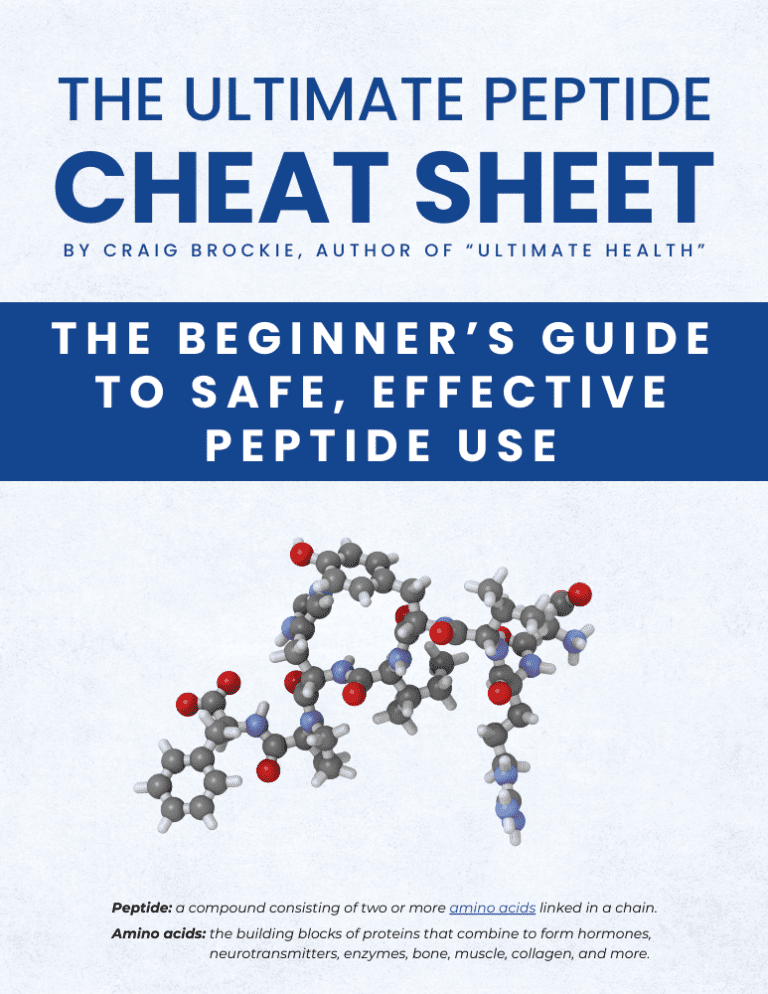
The Ultimate Peptide Cheat Sheet - Craig Brockie Get Your Free Copy of the Ultimate Peptide Cheat Sheet Just enter your name and email address below, and we’ll send you your copy right away! craigbrockie.com

@craigbrockie - Craig Brockie

10. Your body heals itself—if you create the right conditions. The biggest truth: Your body wants to be well. It has incredible self-healing abilities when you remove toxins, provide missing nutrients, balance pH, reduce stress, and address root causes.

@craigbrockie - Craig Brockie

The most valuable lesson? Take full responsibility for your health. No doctor alone, no matter how well-intentioned, can heal you. Question and research everything, try approaches outside the mainstream, and listen to your body's wisdom. Your health is in your hands.

@craigbrockie - Craig Brockie

Thank you for reading! This thread is a summary of my best-selling book, "ULTIMATE HEALTH." Click the image below to get the first chapter FREE. And be sure to follow me @craigbrockie for more proven solutions. CraigBrockie.com/free

@craigbrockie - Craig Brockie

A bit about me: 30 years ago, I was in chronic pain, with crippling anxiety and a broken immune system. Since then, I’ve invested 7-figures researching the best health and performance-enhancing methods worldwide. This account exists to help people live their best life. https://t.co/hHVQzbazfY

@craigbrockie - Craig Brockie

What is ONE thing you learned from this thread? Comment below... DISCLAIMER: This thread is not intended to prevent, diagnose, or treat disease. Consult a licensed practitioner before starting any new protocol. This thread includes affiliate links.

@craigbrockie - Craig Brockie

Thirty years ago, my health fell apart. • Chronic pain • Crippling anxiety • Broken immune system Conventional doctors offered no relief. Then, I found natural treatments and reversed everything. Here are 10 healing secrets your MD won't tell you: 🧵 https://t.co/kniaaHKX8n

@craigbrockie - Craig Brockie

@healwithharper What an inspiring journey! Thank you @healwithharper , and I wish you continued health and happiness!❤️

@craigbrockie - Craig Brockie

@DrShayanSen True! But real ones know the truth💯😉

@craigbrockie - Craig Brockie

@KI5JJL Nice, It's amazing how everything is connected. God bless you on your journey😇🙏

@craigbrockie - Craig Brockie

@MariLughRoss I'm glad you found it helpful! Thank you very much; I really appreciate it.

@craigbrockie - Craig Brockie

@archieroyal2 You are welcome! 🙏💯

@craigbrockie - Craig Brockie

@ryanharter17 Haha! Appreciate it, bro!

Saved - April 16, 2025 at 8:31 AM

@GoyWonderTM - Juan Decentbaum

I always wondered why it was never referred to as Christio-Judaic Values. I think that’s how I’ll start referring to it from now on. Besides, as Christians and God’s chosen people, we’re commanded to lead those who are lost. So we’ll start “leading” with our verbiage.

@TruCheetos - EYE_conic^s

Mobilizing Pastors & Christians To Restore Judeo-Christian Values @down_zulu @thewinteranon

@GoyWonderTM - Juan Decentbaum

The Gold Institute🤣 *General Michael Flynn was just appointed Chairman of The Gold Institute a month ago - March 12, 2025. *And in other neat The Gold Institute personnel factoids we have… Ellie Stern. Who TF is Ellie Stern, you ask? Welp… he’s basically Jew intel royalty,

Saved - June 2, 2025 at 5:09 PM
reSee.it AI Summary
Bishop Robert Barron discusses a revival in faith, highlighting the reasons behind widespread unhappiness and the importance of abandoning ego. He emphasizes the significance of prayer, recognizing God in all aspects of life, and the threats to our relationship with Him, including technology. Barron addresses the challenges Christianity faces, such as persecution and the impact of scandals, while also exploring the intersection of faith and modern issues like evolution and AI. He concludes with guidance for those curious about Christianity and the future of the Catholic Church.

@TuckerCarlson - Tucker Carlson

There’s a revival going on, says Bishop Robert Barron. It’s unmistakable. You see it everywhere. (0:00) Introduction (1:20) The Real Reason So Many People Are Unhappy (9:05) How to Abandon Your Ego (12:54) How to Pray (18:47) Seeing God in All Things (22:15) The Biggest Threat to Your Relationship With God (23:41) Where Do We Find Grace? (25:10) Is Your Phone Destroying Your Relationship With God? (27:40) How to Stay Focused on God (34:30) How Does Evolution Fit into Christian Theology? (38:48) The Failures of the New Atheist Movement (48:55) Does God Require Sacrifice? (51:44) The Real Reason People Reject Christianity (56:19) The Rise of Christian Persecution (59:45) The Sex Abuse Scandals Within the Catholic Church (1:06:40) What Was the Second Vatican Council? (1:08:56) Why Did the Catholic Church Get So Political? (1:14:45) Debunking the Myth That Religion Leads to Violence (1:19:35) The Link Between Technology and Mankind’s Worship of Self (1:24:11) How Should Christians Respond to Persecution? (1:28:24) Spirituality and AI Consciousness (1:30:03) The Future of the Catholic Church Under the New Pope Leo XIV (1:39:28) Bishop Barron’s Advice to Those Interested in Christianity Includes paid partnerships.

Video Transcript AI Summary
Speaker 1 asserts that Christian persecution is rising, with the 20th century being the worst for Christian martyrs. He suggests unhappiness in the West stems from a loss of God, leading to self-centeredness. People deify autonomy and choice, but freedom should be ordered toward the good. Speaker 1 argues that objective value has been lost, and autonomy has been deified. He says the goal should be theonomy, where God becomes the law of one's life. Rejecting objective value leads to antagonism, whereas a common good unites people. He identifies objective value, the life of the mind, moral good, religious good, and aesthetics as banks that have been demolished. The ego is a trap, and people should fall in love with something bigger than themselves. Daily practices to move beyond oneself include prayer and finding mentors. Speaker 1 defines prayer as overcoming autonomy and placing oneself in God's presence. He says evil is a privation of good, and whatever exists is good. He says the world is charged with the grandeur of God. He says creation names the relationship between unconditioned and conditioned being. The new atheists construe God as a big being, but God is the reason why there is a world at all. Secularism is defined as hiding from God. Speaker 1 says the Catholic Church got super liberal, reducing the supernatural to the natural, but there's been a keener interest in the supernatural dimension of faith in recent years. He says the sex abuse scandal convinced him of the devil's reality. He says Pope Leo XIII had a mystical experience that the 20th century would belong to the devil. He says Vatican II was a missionary council, but the postconciliary period was a distortion of it. He says the clergy sex abuse spiked during the sexual revolution. He says the church is the people of God, not just the hierarchy.
Full Transcript
Speaker 0: Do you think that Christian persecution is on the rise? Speaker 1: Oh, I know it is. It's it's documented. Twentieth century was the worst century for Christian martyrs of Christian history, all the previous centuries combined. It's the most persecuted religion. If two friends like each other, that's fine. But Aristotle says that won't last, that relationship. What makes it last is when the two friends together fall in love with a transcendent third. And now together, we look to that. Now we really find a bond. When the bride and groom together look to Christ, now they'll stay married. If they're just looking to each other, it'll founder. Speaker 0: The Catholic church got super liberal, and then all of a sudden, everywhere you look, people you know are converting to Catholicism with a pretty kind of traditionally Christian orientation. Speaker 1: This is how I would characterize ecclesioliberalism, a tendency to reduce the supernatural to the natural. That was going on for a long time. Yes. In very recent years, there's been a keener interest in the supernatural dimension of of the faith. Speaker 0: I don't think I've ever received more texts about any guest than I did about you. From Catholics I know, from non Catholics I know, but the Catholics all wanted to hear details on, you know, factions within the church, and I'm not gonna ask you any questions about Speaker 1: that because Speaker 0: I don't understand any of it. Speaker 1: Good. Speaker 0: I wanna start as broad as I possibly can, which is it seems like a lot of people in the West are unhappy, and it's measurable. Suicide rates are at record highs, and birth rates are at record lows. Yep. And those are not signs of confidence in the future, those are signs of despair. Why are people unhappy? Speaker 1: Well, they've lost a sense of God. I mean, God is the supreme good. And when you lose that sense of God and you collapse back in on yourself, that Saint Augustine, you know, defined sin as curvatus in se. I'm caved in around myself. When you do that, you are, by definition, unhappy. When you lose a sense of objective value grounded in the supreme value of God, almost, again, by definition, you become unhappy. Speaker 0: What does it mean to cave in on yourself? Speaker 1: It means that you've lost a sense of connection to the values that should be calling you out of yourself in an act of love, and you've you've now come to reverence your own freedom, your own autonomy. So what gives my life meaning is the fact that I've chosen something. I've determined my life. If the Bible has one message, it's that, that when you live your life that way, you get lost. When you deify your own psyche, your own ego, you get lost. The joy of life comes from forgetting in this great ecstatic act. You forget about yourself, and you lose yourself in some great value. Now that could be sports. That could be politics. I whatever it is. But then the supreme value in which all the other ones participate, we call God. God is the highest good, the summum bonum. That's why you love the Lord your God. That's the first commandment. Right? But when the culture's lost that, which ours is in danger of, you, by definition, become unhappy. You get caved in around yourself, and then you fuss around in this kind of addictive way. That's how I would diagnose the thing spiritually. Speaker 0: When you are in love with the idea of choices, I thought the whole point of the West was choices. Speaker 1: Well, but you have to know what your choice is for. When you you deify choice itself, when you say autonomy, that's my that's my god. No. Choice is for some good. And the idea is to is to order freedom. Right? Freedom is not an end in itself. Freedom is ordered towards some good. When it's disordered, it tends to collapse in upon itself. That's what we got. Speaker 0: The whole point of America, I thought, was choice and freedom for its own sake. Speaker 1: Well, and I I would argue it's not for its own sake. And and if that happens to us, something's gone wrong. The founding fathers, you know, they weren't in the full sense of the term. They wouldn't have the full Catholic imagination as I would like it, but they certainly had a sense of the objective good and that the purpose of life is to find that good and be ordered toward it. An ordered freedom is what they're interested in, not freedom for its own sake. What does ordered mean? Ordered freedom. Ordered toward the good. And that's why it has to be educated. Your freedom has to be disciplined and directed. It's like a kid with all kinds of athletic ability, but if a coach never directs that ability toward the achievement of some good, that he can become a great tennis player or a great golfer, then the freedom begins to just kinda stew on itself. No. Direct freedom, direct talent, direct energy. And our culture see it's like I I think of this if you have banks to a river, the river has energy. It's going somewhere. You knock down the banks. You say, oh, I don't wanna be limited. Don't don't set limits to my freedom. Speaker 0: It just floods the fields. Speaker 1: What it just opens up in this big lazy lake, and everyone's just sort of lying on their air mattresses. Right? Now I'll tolerate you. You tolerate me. I won't bother you. But then we're not getting anywhere. The the point of the banks is not to restrict me, is to direct me, see, towards some good. Well, religion has played that role for much of our history, and and in the measure that religion gets marginalized and the measure that we deify our autonomy, welcome to the unhappy world that many of the young people are living in, sadly. Speaker 0: Deify our autonomy. So you're speaking as if autonomy and choice are the same thing or Speaker 1: closely related. See, the goal for the Bible is not autonomy. It's theonomy. God, theos, becomes the normos. God becomes the law of my life. And see here's the trick. When God becomes the norm of my life, I become more myself. I I find who I really am. If I jettison God and I say no autonomy, it's I'm the leader of my own life, I get lost. Right? What does Jesus say? The one who loses himself, you know, will find it. The the one who's who's trying to hang on to himself is gonna lose it. Lose your freedom in God's greater freedom, and you become now authentically free. That's every spiritual master in the West teaches that lesson. But we lose it in the measure that we say, no. It's all about my autonomy. That's all that matters. Speaker 0: Don't tell me what to do. Throw off the rules. Speaker 1: Right. Knock down the banks, and the river becomes a lazy lake, and we tolerate each other blandly, but we don't have a common purpose. There's another problem. See, if if you reject objective value, so you got your values, I got my values, your freedom, my freedom. Well, what connects us? In fact, we're antagonistic to each other. Right? We tend to grow into hostility, and my freedom's against your freedom. But if together we find a common good, a common goal, now we can join forces. Right? So it's it's falling in love. That's Aristotle with the transcendent third. So, like, if if two friends like each other, that's fine. But Aristotle says that won't last, that relationship. What makes it last is when the two friends together fall in love with a transcendent third, the country or their or philosophy or some great value. And now together, we look to that. Now we really find a bond. Go back now to the nineteen fifties, and Fulton Sheen, the great Catholic preacher, writes a book called three to get married, made the same argument. Right? The three are the bride, the groom, and Christ. When the bride and groom together look to Christ, now they'll stay married. They're just looking to each other, it'll founder. Speaker 0: What are the banks that we've demolished? Speaker 1: Well, I would say objective value. You know, the the life of the mind, the the moral good, religious good, aesthetic. Think of the good, the true, and the beautiful. If we subjectivize those and just relativize them, you got yours, I got mine, and what you think is right, I think is wrong. When that's lost, the banks are knocked down. But when together oh, no. We we can together reverence the beautiful. We can together reverence the moral good. We can together reverence the epistemological good, the the intellectual good. Then together we move someplace. And see, our whole system educationally was set up classically to do just that, was to train people in what these objectivities are. But when you subjectivize those or you see it simply as part of an oppressive or patriarchal system, you know, why do we why read Shakespeare? He's just an old patriarch. See, but that's a very dangerous game to play. Now we've lost a common mooring, and then we devolve into this sort of self regarding autonomy. Speaker 0: So, I mean, Christianity is probably not the I don't think it's the only religion to make this point, but self is the trap. Speaker 1: Yeah. Yeah. It so you think of the self here, the ego is like a black hole, a black hole that will draw everything into itself. Sucks all of life and light and energy into itself. Nothing can escape. The gravitas insei, ego, right, becomes a black hole. And I've known people like that. I'm sure you have too. Oh, yeah. You're with them. They they'll draw everything into themselves. The best people are those who breathe life into a room, and that happens because they they're not preoccupied with the ego. They're they're captivated by some objective good Yes. And they wanna show it to you. Think of something like great coaches I had as a kid that wanted to show me the various games I learned to play, baseball. We had a coach when I was a little guy, seven, eight years old, and he said, alright, guys. I want you to get down on your hands and knees on the field. I want you to feel the infield, and I want you to to smell the grass. You know? And it was it was such a good move. He was trying to get us in. Look at this great game we're playing here. He also practically if you're playing shortstop, you can't be afraid of the ground. You gotta get down to the ground. Exactly. So alright, boys. Get down there. You know? Well, he was someone in love with baseball and then was communicating to us the same love. So together, we'd fall in love with the transcendent third, which is baseball. That's gonna bring a team together. Right? That's what great teachers and coaches and mentors and spiritual directors do. They they help people fall in love with the same values they fall in love with and fall Speaker 0: in love with something bigger than themselves, you know, other people, nature, God. Speaker 1: And look at even that let fall in love. Right? You you're not in control. You've let go of your own ego drama. I love that language from Hans Urs von Balthasar, one of my favorite theologians from the last century. John Paul loved him, and Benedict loved him. He talked about the ego drama, which is the drama that I'm starring in, I'm producing it, I'm directing it. Right? And you're all actors in my play? Yes. You're all actors in my play, and I'm gonna take it on the road eventually somewhere else. Well, that's that's a very boring thing. What's exciting, he said, was the Theodrama, which is, you know, God's writing a drama. God's producing a drama. He's got a role for you, and he's trying to draw you into into playing that role. And it might not be the role at all that you envisioned for yourself. So what? But he's calling you into it. That's gonna be an exciting life, a theodramatic life, a theonomous life, not an autonomous life. Speaker 0: Oh, that's, wow, that's vivid. So what's the daily practice for someone to move beyond himself to get out of Lake Mead? Speaker 1: Fall in love with objective value. Find mentors that can really help you enter that world. Like, I've in my own life, I've loved that. You know, I'm no great I I play the guitar poorly, but, like, I love classical music. And I had mentors early on that let me play you, you know, Beethoven's seven seventy. Let me just play it to you and and then talk about it. I remember the the the queen of the night aria, the famous Mozart aria with the singing these impossibly high notes. I remember teachers listen. Listen to this. Someone that would draw me into that world, like my coach is drawing me into baseball. Now put it in religious context, prayer. People that taught me how to pray when I was a young guy. I mean, okay. Say my prayers. No. But prayer is a conscious exercise in overcoming autonomy. Right? It's a conscious exercise to say, I wanna get out of my preoccupations. I'm placing myself in the presence of God. I'm using language of the Psalms and so on. I'm using song. I'm using silence. I'm using the rosary, whatever it is. All of this is designed to get me up out of myself and into the space of God. So prayer is a way, you know, to overcome. You pray? Speaker 0: You said you were taught to pray. Speaker 1: Was indeed. Very early on when I was about in my early twenties, before I was a priest, but I got into the what we call the liturgy of the hours in the Catholic church, which is this daily prayer at certain points during the day, imitating, by the way, the seven times you pray in the Bible. You know, seven times a day you stop to pray. So the hours, psalms, canticles, biblical the bible tells old testament has the the in the passage about seven times I I stopped to pray. And so the early church imitated that in the rhythm of the monastic life. And the liturgy of the hours would be kind of a monastic life for non monks, people like, you know, you and me. But you use the psalms, the canticles, the readings, the church fathers. And I was taught that prayer early on, and at times, you know, I found it tiresome or difficult to do. Now it's like it's like water in the desert. When I was a young guy, we didn't pray the rosary. The rosary was seen as kind of something your grandmother did. My generation didn't spontaneously pray it, but then I learned it later in life, and that too is like a lifeline to me. Speaker 0: What is the rosary? Speaker 1: Well, it's this collection I have it on me. It's a collection of hail Marys, our fathers, glory bees in a in a, you know, in a rope, and you count your way through the beads. And it's it takes about twenty or twenty five minutes. It's a meditative prayer. As you're praying the Hail Marys, you're meditating upon the mysteries of Jesus' life and Mary's life. It doesn't get you anywhere. You start here and you end up exactly where you started. So it doesn't it's not it's not effective in that way. It's a meditative prayer. I prayed I remember I was giving a retreat to the priest of Dublin Many Years ago. These were mostly older men, been through the wars, you know, most of them. And, they invited me to come. They said we're gonna pray the rosaries tonight and all these Irish guys. Speaker 0: And it Speaker 1: was, Hail Mary for the great. Hail Hail Mary for the now what is going on? But what became clear to me was, well, it's like a mantra. They they were they were producing this kind of meditative mantra. They finished it in about seven minutes. You know, it takes usually twenty five. But that's Speaker 0: They don't pronounce all the sounds, though. Speaker 1: No. They're kind of see, think of it that the Buddhists talk about the the calming of the monkey mind. That's the mind that's always leaping from branch to branch. The mind that gets you through the day. I gotta do this. Gotta do that. But to really pray, you have to calm that mind down. You have to come on. Come on. I I can't be practical with that. So the church has often used these means to do that, to calm that mind, to open up to a deeper consciousness or a deeper awareness. And prayer is that, it seems to me. Thomas Merton said, prayer is finding the place in you where you are here and now being created by God, which I think is a great definition of prayer. So right now, you and I are being created by God, but we're rarely aware of that. We go through our day, you know, the monkey mind, and we're doing this and this. But at certain points, you say, okay. I'm gonna calm the monkey mind. I'm gonna open up a deeper door, you know, and I'm gonna commune with the god who's here and now creating me. That's prayer, and then there's all kinds of disciplines around that. Speaker 0: So the people trying to wreck our civilization want you to be passive. They want you weak so they can control you. Weakness is their goal. No. Thanks. Our friends at Beam, a proud American company, understand that our country can only be great if its people are strong. That's why they've created a new creatine product to help listeners like you stay mentally sharp and physically fit. People like to mock creatine. CN doesn't like creatine at all. The people buy it because it works. Beams creatine can help you improve your strength, your brain health, your longevity. It's completely free of sugar and synthetic garbage that's in almost everything else that you eat. Of course, you don't hear about it too much because, again, a population that is strong, clear minded, and physically capable is a threat to tyrants. That's why they want you playing video games. To celebrate American strength, actual American strength, Beam is offering up to 30% off their best selling creatine for the next forty eight hours. Go to shopbeam.com/tucker. Use the code Tucker at checkout. That's shopbeam,beam,.com/tucker. Use the code Tucker for up to 30% off. It's built on core values, integrity, results, no BS, beam. We strongly recommend it. I think many people think of prayer as a list of requests. Speaker 1: And and that's okay. I mean, petitionary prayer is is good. John Paul the second, toward the end of his life, you know, he said, I know different types of prayer, but I found the longer I live that that all prayer is basically a petition. And there's something really right about that, that no matter how, you know, kind of high and and elevated your prayer is, at bottom, you're saying, you know, Lord Jesus Christ, have pity on me. Yes. Or or Lord, help me. I I find it as as I pray, that's the phrase. Help me. Help me, Lord. That's fine. I have no problem with that. That's a very deep and powerful prayer. Speaker 0: How do you keep your mind from wandering during prayer? Speaker 1: Yeah. And and read the the masters. They've recognized that forever. The desert fathers knew all about that distraction and prayer. And, of course, the devil loves that too. He loves to distract us in prayer. The best advice, someone like John of the Cross, our greatest spiritual master, would be acknowledge the distraction. Don't try to fight it. Acknowledge it, and then go back. And when it comes again, acknowledge it. I see you. Mhmm. And go back. Don't try to fight it or don't try techniques to avoid it completely. A distraction comes, see it, and then return. Let go of it. Speaker 0: I've noticed in the in the past few years, people I know who are secular or have always been suddenly talking about the existence of evil in the world. I think it's very clear to nonreligious people even that there's some kind of supernatural force of darkness like a foot in the world. I don't think you really need to make that case anymore that that's real. How do you see God in the world? Because if you spend your life, you know Yeah. Staring at evil, not productive. Speaker 1: No. Well, the world is charged with the grandeur of God. That's Jared Manley Hopkins' great poem, and I think that's right. Is if you have the eyes to see and prayer disciplines that. Prayer makes that possible. The world is charged with the grandeur of God, meaning everything that exists, because being and good are convertible terms. That's something from Thomas Aquinas that I think you can Speaker 0: Being and good are convertible. Speaker 1: Are convertible terms. In other words, to be is to be good, period. Whatever is is good. Evil is a clients would call it a privation of the good. Evil is a is a a cavity. It's a lack. Right? But whatever is is good. So for example, take the devil as an example. Is the devil good? Sure. Of course. In the measure the devil exists, has a mind, has a will, all that is good. What's evil about the devil is the corruption of mind and will and power. Right? That's why, like, Satan and Dante, this is highest of angels, full of goodness. God doesn't make anything that's not good, but it's become corrupt. See? So the trick there is always to focus on on the good because being in good or convertible terms. Whatever is is good. Think of the the mystics who talk about if you see like a little bug crawling across this table, that's an avenue toward God. Because if you look at this little tiny bug, let's say but the more you look at it, I mean, complexity and richness and density of its being, and, of course, it speaks to you of the creator of all things, that whose very nature is to be. Right? So all being reflects God. And if you have the eyes to see, that's what the great saints have. They just they see that all the time. We sinners tend to focus a lot on the lack. Right? We focus on the cavity, not the tooth. The idea is look at the tooth. Always acknowledging the cavities because there are plenty of them, but but the focus should be on being. Being good are convertible terms. Speaker 0: I may be too shallow for Catholic theology, but I love what you're saying. Speaker 1: Yeah. But that's as old as Speaker 0: Being and good are convertible terms. Speaker 1: We the they talk about the transcendental properties of being, which means wherever there is so there's glass. It's good, it's true, and it's beautiful. Now why is it good? Well, because it corresponds to the will in some ways. There's you know? Yeah, this I'm gonna study this class. It's interesting, and and look at the the beauty of it. You know? It's true because it corresponds in its intelligibility to an inquiring mind. The mind wants to understand that thing. What is that thing? It's beautiful because it's radiant. You know? It go back to, like, James Joyce, the famous scene, you know, in the in the portrait of the artist when he sees the woman he eventually would would marry, Nora Barnacle, and he sees her out in the strand, and he has this rapturous description of her. Remember? And at the end of it, he says, oh heavenly god. And and that's the way it works is the beautiful this particular this particular girl he sees out in the surf, but she speaks to him of god. So that's why whatever is is good, it's true, and it's beautiful. Those are all convertible terms. Speaker 0: It seems like the threat maybe the satanic threat is distraction. Speaker 1: Yeah. You know, I think that's absolutely right that we focus so much on the lack. It's like you're sucking on an aching tooth. You know, you're just you're focused on the on the lack. But see, you know, Saint Paul says, where sin abounds, grace abounds the more. And that's not just a a nice, like, hallmark card sentiment. That's a metaphysical truth. Wherever there's sin, sure, sin everywhere, but grace is always greater. It has to be because sin is a is a cavity. You know what? It's in Tolkien. Remember when the what are they the Nazguls or these these flying demons that are threatening the battlefield and all this. But then when they finally conquer them, what they discover, they're nothing. They're a cloak that covers nothing. And it's because evil is a type of nonbeing, and so it it puts on a big show. It puts this big cloak over itself. But what it is is just a lack. It's a cavity. That's why if sin is abounding, sure, sin abounds in our world, but grace abounds the more. You know, that's the gates of hell will not prevail against us. They can't in a way. They can't, and we should have that confidence. Christians should never be cowed by evil. Like, oh my we acknowledge it, but the the great saints aren't cowed by evil because evil is a is a lack. It's a cavity. It's a nozgol. It's a nonbeing. Right? Speaker 0: Where do you see grace? Speaker 1: Bob Dylan is one of my great heroes. You know? Look around this whole world, and all that I'm finding is the saving grace that's over me. That's Bob Dylan after he became a Christian. You know, grace is is being. Grace is what's real. Grace. That's a a line from Bernanos, the great French Catholic novelist. Everything's great. Everything's great. Because of that principle, whatever is is good. Whatever is is true and beautiful. Whatever is reflects the one whose name is to be. Right? When Moses asked God, what's your name? And God says, am who I am. Right? Well, our tradition reads that as I'm I'm not contingent, evanescent being. I'm the one whose very nature is to be. So therefore, whatever is is reflective of of God. That's where you find grace, I think. Speaker 0: So if you could distract people sufficient that they never had the time or the inclination to notice things that are real, you would trap them in a kind of hell. Speaker 1: Yeah. Yes. But see but that's exactly what happens, isn't it? Dude, now psychodynamically, is when we focus on all this kind of lack and anxiety and frustration within us, it is a kind of preoccupation with what's not real. That's true. Not that I'm not denying the psychological reality of suffering, but but metaphysically speaking, evil is a type of nonbeing. And if I'm focused on that, then I'm gonna get myself in in knots. Speaker 0: I was thinking more of the iPhone, which when I use it, cuts me off completely from other people and Speaker 1: from Yeah. Speaker 0: The world around me, from nature, from myself. Speaker 1: Yes. No. No. And I believe me. I mean, we're all addicted to it. Those machines were designed to be addictive. They worked. During lent, this past lent, I did a a resolution for the first time that one day a week, put the phone away. And I did it, and it was a little bit of a struggle, but not terrible. And I thought that's that's a good thing. When we bring our guys now into priesthood studies, we always call the propadudic year, this year of kind of preparation before the formal study begins. And the thing that all the guys say they like best about it is they take their cell phones away. So for the entire year I think once a week, you can check it for emergencies or something or someone's got access to it in case of emergency, but they take the phones away from the guys. Great move. Speaker 0: And what happens to them? Speaker 1: What happens, they they all feel liberated. They all come back saying it was the best year of my life, and I read books again, and I talked to people. I cultivated friendship. I played games. I played sports. You know what I mean? And it's exactly this principle. I wasn't look look at that's almost a a illustration of Augustus Cervantes and say that I'm caved in over my iPhone. Right? That's what it looks like. Speaker 0: Do you think that that's driving some of the disassociation and agony that we see around us? Speaker 1: Yeah. It's not helping at all. I Jean Twenge is a psychologist from San Diego that I read a lot, and she has a book called iGen about the generation that came of age totally with the iPhones and iPads and stuff. And she said there's a direct correlation between screen time and depression, which I find perfectly plausible. Leonard Sacks, know, the great psychologist, also a physician dealing with young people now for decades, Same thing. He says the correlation between screen time and look how unhealthy it's making our our young kids. When I was a little kid, we were all skinny. We all were, all my friends, and I, because we were outside from 08:00 in the morning till 08:00 at night in the summertime, playing games, running around, shooting hoops, on a bike, you know, and way too many kids now are hunched over their iPhones. And and then it invites you into such a world of of meanness and competition, and look at my pictures better than yours, and those people have seemed so much happier than I am. And no. I think taking those things out of the hands of our kids would be a great idea, at least to some degree. Speaker 0: How do you force yourself to notice things beyond yourself? Like, what is your actual discipline? Like, you wake up, how do you keep God ever present in mind and yourself at bay? Speaker 1: Well, my first move is the holy hour. So I learned that from Fulton Sheen, taught now a couple generations to do every day an hour of uninterrupted prayer in the presence of the blessed sacrament. So as a Catholic, I I have the blessed sacrament in my house. So first thing I do in the morning, I get a cup of coffee, and I go up to my chapel. And I will sit in front the Blessed Sacrament for an hour. And I'll pray my office as part of it, often pray the rosary or other things. Speaker 0: Pardon again, my ignorance. What's your office? You pray your Speaker 1: office. That's the Liturgy of the Hours. Yeah. What I was describing earlier. Okay. That that psalms and canticles and readings that that Read Speaker 0: them as you pray them? Speaker 1: Yeah. So I'll have the book, and I'll I'll read the psalm, then usually then spend some time meditating, and then do the next one, you know, and then I might let's say between the office of readings, which has to do with the church fathers. I read something from the church fathers and usually from the Bible. Maybe between that and morning prayer, I'll do the rosary. And I might do another form of prayer between morning prayer and midday prayer. So I'll I'll work my way through the office, the Lurge of the Hours, but my main task is to sit in the presence of the blood sacrament. Speaker 0: And one Speaker 1: of the great lines this goes back to What Speaker 0: time is this in the morning? Speaker 1: I wake up about 05:30, so, like, between 05:30 and 06:30. Speaker 0: Do you text, like, 11 people first before you do this? No. No. No. No. Speaker 1: I leave I leave the phone in my bedroom, so I always leave the phone while I'm praying. I don't have that. Because that's an immediate distraction, and that's the last thing you want when you're trying to pray in a concentrated way. Speaker 0: Yes. Speaker 1: And then, you know, some of that too is petitionary prayer. I'm a bishop, so people are always, you know, hey, bishop, would you pray for me, or am I son's having a hard time? And so I try to conjure as best I can the memory of these various people that ask me to pray for them. I'll pray for my, you know, parents and family members who've died and you know? So it's just giving yourself the leisure. You have a full hour where you can bring all this before the Lord. Speaker 0: But when you pray for someone who's died, what do you pray? Speaker 1: I pray they might find peace and rest. I pray the Lord might be, might be kind and good to them. You know? I pray all the time for people who have died because, you know, you're just you're aware of it when you're in pastoral ministry. Speaker 0: Yes. You Speaker 1: know? Some people who've died, you know, they're not formally canonized by the church, but I kind of an informal way, I think of them as being already in the presence of God, and I'll pray for their intercession. Cardinal George of Chicago, you know, was a great mentor to me, and I I'm often linked to him in prayer. Speaker 0: Meaning you prayed for him? Speaker 1: Prayed for him, but also, you know, I prayed to him, not with the complete confidence I would pray to a saint canonized by the church, but with a a kind of, practical confidence, and I I knew him very well. And I asked for his help. When you pray, do you hear back? Not in in the, you know, physical sense, but, yeah, you get, I'd say, a sense. You have a sense of connection. I put it that way. Sometimes in prayer, you get a very intense feeling. The Irish talk about thin places, you know, where the veil between Yes. This world next becomes very thin. There I find there are kind of thin moments like that where there's a a moment when you feel the other world impinging on yours. Speaker 0: Well, what kind of feeling is that? Speaker 1: Peace, I would say. You know? Harmony, the the the disharmony, the difficulty of this life kind of resolved into a higher harmony, something like that. See, you know, what's interesting to me, Tucker, is the world that we're in. We're looking around at this, you know, interesting beautiful place right now and good. And the world of nature, driving up here, seeing the nature around me. Beautiful. Beautiful. But, like, is that it? Is is that it? To me, it seems so unlikely that the world that the sensorium of of these advanced apes can take in is all there is to reality, what my little eyes can see. You know, they see a narrow range of the color spectrum, and that's it. I think that's so wildly unlikely. Just the the fecundity and and and variety of being that we experience through through our senses. I think beyond our senses, there there's a world of even more extraordinary fecundity and richness, and I think there are times when we sense it. We get in touch with it. Look. Plato knew that. Plato knew he talked about stepping out of the cave. Right? And the first step out of the cave, the cave is where you the flickering shadows in the wall. It means the world of our ordinary experience. Yes. I'm here with you right now. In a few hours, I'll be gone somewhere else, and other images will be flickering past my sensorium. Okay. That's that's what this life is like. But Plato thought the first step out of the cave was mathematics. It's very interesting. Because when you you understand two plus three equals five, that's you've stepped out of this world in a very real way. I can see a oh, here are two things. But when you grasp the the principle, two plus three equals five, you're not in the world of ordinary experience anymore. You're in a world now of eternity, of immateriality, a world that doesn't change, that can't change even in principle. Well, there's nothing like that in this world. Well, Plato knew that. When you grasp the quadratic equation or something, you're not dealing with a physical reality that has color or shape or size or nothing that's that's even essence or mutable. You've reached a higher plane of existence. Even mathematics does that to us. Afortiari, now philosophy, and then even more so religion, are opening you to higher and higher expressions of reality. Speaker 0: Here's a fact of life you may not learn till you're older, but I'm gonna tell you now. It's very hard to have a good time if you're wearing bad boots. In fact, it may be impossible, and that's why you need Takovas. As a matter of fact, you don't just need them. You owe them to yourself. Takovas makes western boots for everybody, ranchers, real ranchers, lifelong cowboys, first time boot buyers, and anyone in between. Every Tecovas boot is handcrafted, made by hand with over 200 meticulous steps for a broken in feel right out of the box. You don't have to compromise between looks and quality. You can have them both. Whether it's a long day or a big night, Tacovas are built to last and impressed. You wouldn't believe the compliments people here get when they wear them out, which they do. Right now, get 10% off at Tacovas.com/Tucker when you sign up for email and text alerts. That's 10% off at Takovas, t e c 0 v a s, Com / Tucker. I don't think you're fully on board with Darwinism. I'm getting that sense. Speaker 1: Well, there are couple ways to look at that. I mean, there's a big debate going on right now in in the world of evolutionary biologists about Darwin and neo Darwinism and questions raised about it. I mean, in a way, I'm happy to leave that debate to them. Mean, because that's talking about how do life forms develop over time and given genetic variation and and natural selection. Okay. Fine. I'll let the experts debate that. Yes. That in itself is not really a theologically relevant concern. I'll leave that to them. Speaker 0: I agree. Speaker 1: But see, here's the thing. Creation in the theological sense has little to do with that. That's all about development of biological forms. Okay. Creation is much more dramatic. Creation names the relationship that obtains between unconditioned being and conditioned being, or to put that in more regular language, between God and the world. So, I mean, like, right now, here you and I are sitting here in this table, in this room, is entirely conditioned form of existence, by which I mean it is, but it doesn't have to be. I could have missed the ride up here today. You could have gotten sick. This thing could have fallen on the table. It could be a thousand degrees, and we'd be incinerated. It could be a thousand degrees below zero. We'd be frozen. Like, there there are a million things that make this set of affairs real, But it doesn't have to be. It doesn't have to be the case. So how do you explain that? Well, you can't appeal endlessly to other contingent things. You have to come finally to some reality whose very nature is to be. That's not contingent, not finite, not evenescent, not dependent, but whose very nature is to be. Speaker 0: I am Speaker 1: like, right. And then go back to Moses. What's your name? See, Moses was asking a very sensible question for this worldly perspective. So, hey. What what kind of glass is that? You know? How tall is that glass? What kind of table is this? Isn't a nice table? What kind of table is it? So you're a god, obviously. You know, you seem to know a lot about me, and and you're so which one are you? Are you the god of the mountain? Are you the god of the place? Are you the god of these people? Who are you? Which one are you? What's your name? And so when god says, I am who I am, he's saying, dumb question. That is not the right question to ask here because I'm not a conditioned state of affairs. I'm not a being among many. My name is I am. I am who I am. Right? My nature is to be. Well, now we're talking about the creator. See, the creator is the one who is here and now undergirding all the finite reality, who is right now this is a great line from Herbert McCabe, the theologian. He's singing the world into being the way an opera singer sustains a song. God, the the ground of being, is singing this finite world into being. That's creation. See? So now within creation, I can talk all day about the Darwinists and how this the life form developed into that life form, and I'll let them debate that. But the religious question remains no matter what you say about that. The religious question is about why is there something rather than nothing? Right. Exactly. But why should there be a finite conditioned world at all? You can't explain it by appealing endlessly to other forms of conditioned existence. You can't. That's the mistake of materialism. Speaker 0: The questions end at a certain point, there's an answer. So the question is, well, who created the creator? And the answer is nobody. The creator is. Speaker 1: Right. And if you ask that question, it means you haven't grasped the solution. If you say who created the creator, well, then you haven't grasped. No. The argument leads towards something that doesn't need to be created, that can't be created, whose very nature is to be, and who therefore is eternal, we'd say, outside of time, immaterial, outside of space. Right? So all the finite things that or the characteristics of finite reality can't apply to that that reality. That's why we say God's eternal or why he's immaterial and so on, immutable. That means nothing that characterizes finite things should characterize him. What do you think of the new atheists? I don't like them. No. Look. I I my ministry, a word on fire, emerged around that time. So right around the year February. The new atheists emerged after September 11, which is not surprising because September 11 stirred to life again this old kind of enlightenment idea. Religion is irrational, therefore, it's violent. Because they can't settle things through argument, they have to settle them through bombs and guns and war. Right? So that's an old argument. It goes back to the seventeenth century. It was revived massively after September 11. The new atheists, I think, rode that wave in a big way. Now they were gifted rhetoricians, especially Hitchens. Right? I admired Hitchens. I read Hitchens always with great pleasure. Dawkins, less so. Sam Harris, I think, has, you know, rhetorical gifts. But their arguments, there's nothing new about them. They were old hat. They're borrowed from Marx and from Freud and from Feuerbach, So nothing new at the intellectual level. They were new in their nastiness. So, like, the the classical atheist, think Feuerbach, Marx, Freud, you got the sense they knew they were dealing with a formidable opponent when they were fighting religion. The new atheist, it was like they were dealing with an idiot child. You know? And so that's what was so annoying about them, I thought. And their arguments were pretty bad, and they were, you know, so aggressive toward religion. They did a great service, though. I'll say this. They awakened the Christian churches in many ways. The the apologetic weapons that we threw away forty years ago, we were compelled to pick up again. So a lot of us got into the game to kinda battle the new atheists and to draw upon the very rich intellectual tradition, especially of Catholicism. So in that way, they did a service to us. You know? And, also, I wrote a paper on this one. I called it Thomas Aquinas and why the new atheists are right. Because the new atheists, see, they make this mistake we were just talking about. They they will construe God as some kind of big being. And, okay, is there this big being or not? Some say there is. Some say there isn't. So it's like Bigfoot. You know, something there is a Bigfoot. There isn't a Bigfoot. Let's go look around for evidence and find out. Well, you'll never find God that way. God isn't a being. God isn't isn't a thing in the world. Right? He's the reason why there's a world at all. Therefore, you're not gonna find him in the world. Therefore, you can't say things like, oh, there's no there's no evidence for God as though he's like a he's a a chemical reaction. Speaker 0: Yeah. Yeti. Speaker 1: Yeah. Right. He's not like that. You have to ask a whole different set of questions, and that's what the new atheist did. And and Like like what? Speaker 0: What were the questions? Speaker 1: Like, why is there something rather nothing? Like, why should contingent being exist at all? How do you explain the to be of something whose nature is not to be, namely you and me and everything around us? I am, for sure, but my nature is not to be. I could think myself out of being in a second. There's nothing necessary about me. Well, how do you explain that? How do you explain that? Now you say, oh, it's all matter and energy. It'll never work. Why? Because matter is always matter under these conditions, matter in this size, matter of this energy, matter of this speed, matter of this color. How did it get there? Why is it this rather than that? See, so you you can't answer that question, the really cool, interesting question, by appealing to something within the contingent world. You have to go outside the contingent world. And, again, don't think of that spatially. So the minute you go, oh, yeah. God must be that up out there someplace. No. You have made him a big being. You have to go outside in the metaphysical sense to a reality which indeed contains all of that, but is in no way contained by it. Now we're talking. And that to me is is really interesting question. Speaker 0: We'd also suggest that God's, like, right here, right now, always. Speaker 1: Well, he is. And here's the interesting thing, all the mystics and theologians are onto this. So is God in this room? No. Absolutely not. Because this room is just full of contingent things, like you and me and the shelves and the books. No. No. God God's nothing in this. I can't point oh, there he is. God's in this room. God's nowhere in this room. Is God in this room? Yes. He's everywhere in this room because this room wouldn't exist unless God were singing it into being. And so God is at the same time as transcendent as you can imagine, not a thing in the world, and as imminent as you can imagine. It was the great Augustine who said, God is at the same time which means he's higher than anything I could imagine, and he's closer to me than I am to myself. Now figure that one out. Now now you understand the God whose nature is to be. He's transcendent. I can't grasp him, and he's so imminent. I can't hide from him. See? And that's the space opened up by the Bible, I think. So what's the solution you might ask? The solution is fall in love with God. Falling in love is not grasping. It's not hiding from. And can we read the Bible as God trying to draw his people into that space? I want you to fall in love with me. I don't want you grasping at me. That's idolatry. I don't want you hiding from me. That's secularism. Right? I want you falling in love with me, and that's the right reaction to the god who's Speaker 0: You're defining secularism as hiding from God? Speaker 1: Yeah. As an ideology. If you were to say all that there is is the secular world. Right? As a materialism or immanentism or scientism, in the political sense, secularism, meaning all that there is is the world that I can see and measure and so on, That's hiding from God. That's saying, I'm not worried about God. God doesn't impinge upon me. That's the buffered self. Charles Taylor, the philosopher, calls it that. I'm I'm buffered from any contact with the transcendent. That's an attempt to hide from God. Doesn't work. And see, I think, Tucker, is really interesting is the fact that religion is experiencing a revival even as we speak. You you feel that? Oh, yeah. I can I can measure it? I mean, it's been measured statistically because you can't hide from God all day, and and you can't grasp it. And that's idolatry. Idolatry is a attempt to manipulate God, and the bible knows all about that from page one. Page one, the bible knows about manipulating God. Speaker 0: That's Tell me what you mean by that, manipulating God. Speaker 1: Original sin is to say, I'm not gonna obey God's law. I'm gonna make I'm my own law. I'm gonna grasp the tree of the knowledge of good and evil. Is is I'm gonna make my my own freedom, as we were saying a few minutes ago. My own freedom becomes my God. That's a type of idolatry. Or I turn pleasure, money, sex, power into my supreme good. That's idolatry. To me, the great biblical story there is the Elijah and the priest of Baal. Remember in the first book of So Elijah is the one left, only one priest of Yahweh, but there's all these priests of Baal. By the way, so it always goes. Right? There's always a lot of avatars and the false gods. They're all over the place. They're thick on the ground. They're all over. And now let's you erect altars. Dear god, I'll I'll erect one to mine, and let's see who responds. Right? So the priests of Baal erect the altars, then they start begging, and they have cajoling, and pleading, and and they're they're frustrated that God's not answering. Their gods aren't sending fire. And Elijah mocks them, which I think is a great part of that story. He publicly mocks them. You know? Who knows? Maybe your gods are napping or maybe they're in the bathroom. I don't know where they are. Right? And then they finally end up it's a beautiful detail. They end up slashing themselves with knives. They're trying to they're trying to get the gods to respond. It's a beautiful image of what happens to us in idolatry. We end up harming ourselves, right, in a frenzied attempt to get gods to answer who can never in principle answer. Now think of someone addicted to power, sex, money, pleasure, whatever it is. And I'm begging, begging, begging. You you will satisfy me. They it won't because it can't, and I'll end up harming myself. Then Elijah calls upon the true God. The fire comes as his rise takes the sacrifice. It's not just a jingoistic story. It's a very powerful story that the true God is the only one that can satisfy the longing of the heart. Right? And so idolatry will always lead us down this self destructive path, and the worship of the true God is what's gonna lead us to the fire falling on us. Speaker 0: A lot of the news you read doesn't really have a lot of inherent meaning, but this does. Starting May 19, the hallow app is leading a consecration to Jesus through Saint Joseph. You might be asking why Saint Joseph? Why now? Consider this, Joseph was the man God himself trusted with his own son. He wasn't a king or a warrior, he was a carpenter. He was a quiet and steady man of unshakable faith. In an age that mocks humility, can you imagine the basis of wisdom and relationship with God? It's time we looked to someone who embodied humility, not for applause, but for God. The series is not just about Saint Joseph, it's about what happens when you follow his example, when you trade noise for silence, when you stop chasing relevance and start seeking holiness. And all of that begins with humility, which is really just perspective. You are not God. It's important to remind yourself of that. We do every day. So every week on how you'll hear reflections grounded in the gospels, pray powerful prayers like the litany of Saint Joseph, and hear glory stories from throughout church history, not myths, not legends, actual intersections, and power from a saint who's been quietly helping people for thousands of years. Hollow is the world's number one prayer app, and experiences like this are why my family and I cannot get enough of it, it is a constant dinner table conversation. So get three months right now at hallow.com/tucker for free. You'll be glad you did hallow.com/tucker. Why does the does God require sacrifice? Speaker 1: He doesn't require it, and that's a that's a super important point. The Bible and the great tradition make it over and over again. How could the one who made the entire universe from nothing possibly need anything from it? Right? And it's just a a logical contradiction to say, like, this the ancient gods of Greece, sure, they need all kinds of stuff. Remember that scene? It's in the odyssey, I think, you know, where as the sacrifices are being made and the gods are, like, desperately lapping up the blood of the sacrifice because they they need our, you know, our loyalty and so on. The Bible. Psalm 50. You think I need you think I drink the blood of goats? Are you joking? All the animals in the field, they all belong to me. So but that's a very important point because it's not that we're playing some game of of, like, codependency with God. God needs nothing. That's the best news ever. God needs nothing from us. What he wants is the openness of heart signaled by the sacrifice because he wants us to be alive. And and when we say, Lord, I'm I'm opening my heart to you, I'm ordering my life to you in this great sacrifice of praise, God delights because now we're gonna find the joy he wants us to have. That's Saint Irenaeus, my great intellectual hero. The glory of God is a human being fully alive. See, glory of God is not putting us down, and boy, they finally got around to honoring me sufficiently. So that's old paganism, but it it haunts the Christian mind still. It haunts our minds. But the Bible is always trying to to dismiss that demon. God wants our sacrifice because it's good for us. God gets nothing out of it. Think of it. It it like it bounces off of the rock of the divine self sufficiency and comes back to our benefit. So when I when I pray to God, right, I offer the sacrifice of the mass to God. I'm not giving God anything he needs. God needs nothing. But it bounces off of that self sufficiency to me. It redounds to my benefit. So, yeah, it go to not into the Catholic mass. We offer the sacrifice of Jesus to the father. We represent the sacrifice of the cross to the father. Oh, because the father needs it. Father needs nothing. But it bounces off of the father's self sufficiency and comes back as food for us. So now we eat. We eat the body and drink the blood of Jesus. We we consume the sacrifice. It's for our benefit, not for God's. But your question is really a good one because it leads us into that very important spiritual space. Speaker 0: One of the reasons I think Christianity is true is because so many people hate it. Yeah. And Yeah. Jesus is really the great dividing He always divider. Yeah. And, like, why would you be mad at Jesus or Christianity when it's like a nonviolent religion that teaches people to love each other? If you're mad at that, it says something about how real it is, I think. Speaker 1: I agree. Both Billy Graham and Fulton Sheen, I mean, arguably the two greatest evangelists of the twentieth century, said the same thing, which was the objection to God is rarely truly intellectual. It's a moral objection. Speaker 0: Totally. Speaker 1: The the moral demand of God becomes too great. See, Jesus, if he's one spiritual figure among many, he's a great teacher, you know, like the Buddha, he's like Mohammed, he's like Confucius, well, then I can kinda handle him. You know, I can put him in a corner and say, okay. That's interesting. I'll abide by some of that. And I I also like what the Sufi mystics say, and I also like what Moses says here. But see, Jesus, as CS Lewis saw so perfectly, you know, is qualitatively different than that, and that's why he's a problem. Because if he is who he says he is, not just one teacher that I can listen to, but he's God from God, light from light, true God from true God, begotten not made, consubstantial with the father. As we say every week in the creed With Speaker 0: him, all things were made. Speaker 1: Yeah. If that's who he is, well, game's over. But why Speaker 0: does it make people mad? I mean, one of the late life revelations in my life has been that these great spasms of violence, these revolutions that we studied, French Revolution, Spanish Civil War, Bolshevik Revolution nineteen seventeen, huge parts of World War two, were anti Christian. Speaker 1: Absolutely. The point was to murder a Christian. Speaker 0: Absolutely. Yeah. But it's not recorded that way. Speaker 1: Yeah. But that's no. That's true. Yeah. But see, Jesus, he's a problem because of of who he says he is, but also we're sinners. And so sinners don't wanna get out of their sinful patterns. It they're we're way too comfortable. It's like the Israelites that wanna go back to Egypt. Right? They're they're on their way to liberation, but, oh, boy, did we love the, you know, the the flesh pots of Egypt. At least we had cucumbers and all that. Speaker 0: Right? It's my favorite part. Right. Speaker 1: But but it see, that's the story of every sinner is every sin is a type of addiction. You're addicted to you know, that's the priest of Baal. And so as I'm trying to move toward conversion, I'm I'm moving across the painful desert, right, on the way to the promised land, I'm always hankering for Egypt. And so Jesus is a constant reproach, a constant challenge, a constant no no. You know? So of course, I'm I'm gonna I'm gonna resist him. Look at you know, the very fact I think this is very interesting. Muhammad dies in his his bed full of years. The Buddha dies in his bed full of years surrounded by his disciples. Confucius, the same thing. Moses dies at the age of 20 or something. You know? And then there's Jesus who dies 30 years old, naked, pinned to a desperate instrument of torture, his his disciples having abandoned him, his enemies mocking him. That's how he dies. Now what does it tell you? It tells you there's something about him. Well, who would write that? Speaker 0: By the way, if I Right. Don't know. If I'm trying to create a new religion Speaker 1: No way. Speaker 0: You'd write. He's not the hero I'm creating Speaker 1: at all. No. But it's a sign he's a sign of contradiction. He he's the one that that that's the way the world is gonna react to him. Now what's the good news? The good news is having endured all of that, he returns. And I always say this, you know, if if we were Holly was telling the story. You never you never heard the Jesus story, where's this guy with this horrible thing, and these people betrayed him and denied him and they crucified him, and now he's back. He'd be back with a machine gun. I'm back for vengeance. He's back with shalom, a word of peace. And the way I put it in Christianity is this, we killed God, and God returned in forgiving love. And that's why, as Paul said, right, I I'm certain neither death nor life nor angels nor principalities nor height nor depth nor anything else could ever separate us from the love of God. How does Paul know that? Because because we killed God, and God returned in forgiving love. That's salvation. That's that's the word of grace if you want. That's the good news. That's what they went careering around the world to their deaths proclaiming was that. You know, Paul, I preach one thing, Christ and him crucified, because that's the message is we killed him, God raised him up, and he returned in forgiving love. You know? That's the that's the good news. Speaker 0: Do you think that Christian persecution is on the rise? Speaker 1: Oh, I know it is. It's it's documented. Twentieth century was the worst century for Christian martyrs of all of Christian history, all the previous centuries combined. There were more martyrs in the twentieth century than any other time. We think about the early church. They were all being persecuted. Speaker 0: Yeah. Yeah. Speaker 1: Far greater twentieth century. Now around the world, we are by far the most persecuted religion. Absolutely. And it's a it's a crime. It's an outrage. And we talk about a kind of demure way about religious liberty in our country, which is indeed under threat. But you want the real threat to religious liberty. It's in different parts of the world. People are being killed for their Christian faith. Speaker 0: So why is that fact suppressed? That is intentionally suppressed? Again, I was like 45 before I realized the Bolshevik revolution was aimed at Christians. I don't know why I didn't get that, but I didn't. Speaker 1: Yeah. I have to ask the, you know, the keepers of the flame culturally, but it it's simply the case today. I mean, it's it's the most persecuted religion. You know, we can look at things from different angles, I suppose. One tragedy, let's say, the twentieth century, you have World War one and World War two. Yes, there's there there are anti Christian elements to be sure. I mean, Hitler is deeply anti Christian. But you also had French Christians killing German Christians, killing Canadian Christians, killing American Christians, killing Russian Christians. He said it was this massive Christian slaughter bench. And my pet theory is when you go to Europe today, especially parts of Europe, and you see a kind of spiritual wasteland, I think that's a big part of that is I agree. Recovering from this this horrific outbreak of Christian on Christian violence. The gospel, did that get into anybody's mind and heart in the twentieth century that allowed this orgy of violence to take place? Speaker 0: What what do you what do you think that was? Why the twentieth century? Speaker 1: Well, you could do Speaker 0: So much darker than anything that happened in the dark ages. Speaker 1: You could do the Leo the thirteenth, you know, who gave us the Saint Michael prayer and who supposedly had a intuition or a sense that the twentieth century would belong to the devil. And to my mind, it's kinda hard to argue with that. If you believe in the devil, as I do, and you see what happened in the twentieth century, it's kinda hard to imagine it wasn't to some degree. Speaker 0: Well, nuclear weapons are proof as far as I can know. Speaker 1: I know. I mean, the the mass destruction, mass death of the twentieth century. It's hard to blame that simply on political reality. You know? Speaker 0: Totally. Wait. I'm sorry. I interrupted you. I'm Speaker 1: so No. Speaker 0: No. Sorry. You said pope Leo the thirteenth Yeah. Had a can you explain what you mean he had this sense? Speaker 1: You know, a mystical experience of the devil would would have a unique control over the twentieth century. And so he formulates the famous Saint Michael prayer that we still pray in many churches asking for the protection of Michael the archangel. Speaker 0: When when did he have this experience? Speaker 1: Toward the end of his life. So I wanna he died nineteen o three, so it would have been, like, around 1900, guess, or late nineteenth century. And many would say, well, it was born out by the twentieth century. Speaker 0: I would Speaker 1: like, you know, for me, in my own lifetime, it see, when I was a young guy going through school, we were still very much formed by more liberal Catholic view. The devil, literary device, literary as a symbol, you know, for evil. Don't take it literally. Speaker 0: Were taught that? Speaker 1: Yeah. It was sort of the standard view. But you know what really convinced me powerfully of the devil's reality was the sex abuse scandal. Because you look at the sex abuse scandal, which has haunted almost the whole of my priesthood. It it broke in Chicago in the early nineties. I was ordained in 1986. So most of my priesthood has been under the shadow. The sex abuse clergy sex abuse scandal has adversely affected the church in every possible way. And when you look at it and you say, could that have just been a a a accident or just human folly and sin? It seemed to have been so designed by a wicked mind that wanted to undermine the church. But then now look at the whole twentieth century and the level of destruction and degradation. It's hard for me to imagine it's just because of political forces or cultural Speaker 0: agree more. Speaker 1: Forces. Speaker 0: I've come to this conclusion recently, but I think you're exactly right. So what's the Saint Michael's prayer that was Speaker 1: Saint Michael the archangel defend us in battle. I won't get it exactly right, but it's it's an invocation of Saint Michael to defend us in battle against the devil who sends his minions for the destruction of souls. So it's a very conscious awareness of the presence of evil in the world. And we're The Speaker 0: Pope Leo said the thirteenth said, I think this century is gonna Speaker 1: be What belonged to the devil. And he formulated that prayer to be prayed in Catholic church. What did people say Speaker 0: when he said that? Speaker 1: I think most of I follow them. Think most of we start saying Speaker 0: because I mean, nineteen o three was a period of great hope in the West. Speaker 1: Yes. Which is fascinating to me. You know? There's a a magazine called the Christian Century. It's a it's a Christian theological journal, and it was born at that time. And that's the idea is is this is the Christian century. Yes. That, you know, progress and economic progress Dominating the world. And the social gospel, and this is our century. And then it didn't exactly work out that way. Leo intuited or had a mystical experience to the effect that it would belong not to the Christian churches, but to the devil. So, you know, we got a battle on our hands, but we mostly forget what we were saying earlier. You know, where sin abounds, grace abounds the more. The gates of hell will not prevail against the church. You know, that image too, I don't know why, but for most of my life, I am okay. Yeah. The gates of hell will not prevail against it, which means somehow hell is gonna come against us, but we're gonna win the battle. But that's not what it means. The gates would be the weakest point of a city wall. And so when you're attacking a city, you go after the gates. So what the Lord is saying is, no. No. You're not defensive here. You're on the march. You're on the offensive, and the gates of hell will not prevail against you. You're gonna win. You're you're invading hell, and it's not gonna prevail against you. So it's like not a cowering, like, oh, we'll put up a good defense, and I guess we're Speaker 0: gonna Yeah. Or move as far away from hell as we can. We are on the march. Speaker 1: Move to the suburbs. No. But see, one of the problems is when Christians forget that and they hand the world over to pure secularism or whatever, well, of course, we're not gonna do well in the battle. But when Christians know, no, our job is to be fully engaged in this great struggle. And we're going after you, hell. We're coming after hatred, violence, stupidity, superstition, scapegoating. We're we're going after you. You know, we're on the march. I when I was coming of age, we didn't have that language. Speaker 0: Why? Speaker 1: It was an attempt. I I know because the people that taught me were good people, and they were they were positively motivated. I know that for sure. They felt the church needed to be relevant to the modern world and that the modern world should set the agenda for the church. That was a big part of the mentality, that we had been in a fortress too long. We've been in a defensive crouch. We had demonized the world, and so now we need to go out to the world in a confident spirit. And that's definitely the Catholicism I got as a young man. But see, here's something I've always found kind of puzzling. So I I come of age right after the second Vatican Council, which ended 1965. I went to first grade 1966. Right? So that's the the church that I inherited very much. Vatican two was written by people who had experienced the the worst of the twentieth century. Yes. Mostly European intellectuals, French, German, a lot of them, Americans too, some Italian, Swiss, right, are the people that wrote Vatican two, and they experienced some of the worst horrors in human history. Speaker 0: So Vatican two is a direct response to the Second World War. Speaker 1: No. I wouldn't say that. Vatican two look. I I I'm I let me talk about it positively. Vatican two was a missionary council. I think the best people at Vatican two felt the church has been crouching behind walls for too long, and it should go out not to conform to the modern world, but to go out to convert the modern world. It it's how do we get the church to engage modernity in a confident spirit? I think that people like De Lubac and von Balthazar and and Wojtyla and Ratzinger, these people, that's what they had in mind. You know? Now what the church became after the council, that's a different story. What developed after the council, that's the church that I came of age in. And I think that was a too apologetic church. That was a church that, in fact, lost a missionary edge. It was more of the, you know, conformity to the world. The world sets the agenda for us. That was a distortion of Vatican two, but that's the church that formed a lot of people in my generation. Speaker 0: Do you think that the sex abuse the sex abuse was a result of Vatican two? Speaker 1: Not Vatican two per se. I would say more the result of the sexual revolution and of a loosening of moral strictures. There was I I sense this even as a young man, there was a sense of, you know, we've repressed stuff too long, and we really need to be more expressive, and there's too much of this obsession with, you know, sexual sin. And so and then the whole culture was, you know, going through a sexual revolution and, you know, stop repressing and, you know, be yourself and express what you're feeling. And I think a lot of priests, frankly, got caught up in that cultural movement. And because we can measure it. The sex abuse, the clergy sex abuse spiked by the seventies into the very early eighties, and then it began going down. And then after twenty o two, when the church put in all kinds of important restrictions, the so called Dallas Accords being first among them, it's fallen off the table. The statistics have gone completely down. So we can measure a spiking of it right at the height of the sexual revolution. I think that's responsible for a lot of it. Speaker 0: What were the changes wrought by Vatican II? There was famously, you know, the change in language of the mass from Latin to colloquial, but I learned recently that there were what seemed like theological changes to church doctrine. Is it fair? Speaker 1: Not really. I I would say there was development of doctrine. I'm using John Henry Newman's language there. Newman says that doctrine is not just handed out like a football, you know, from one generation to the other. It it unfolds more like a like a river expanding or like a a tree growing. Like, so doctrine doesn't turn back on itself, but it can grow and express itself in fresh ways. For example, the the ecclesiology of Vatican two, the understanding of the church and its nature underwent a real development at Vatican two. Moving away from a, let's say, highly juridical to a more organic sense of the church. The church not crouching defensively, but the church going out in a confident missionary spirit. The church is the people of God, not just the hierarchy. All of that stuff would be emphases within Vatican two. They represent not a repudiation of the previous ecclesiology, but a development of it. The role of the laity in the world, that's around from the beginning of the church, but had been muted. Prior to the council, laity were, you know, come to mass on Sunday, yes, and say your prayers and and donate to the church and all that. Where Vatican II said, no. Your job is to Christify the world. Yeah. You're meant to go out into business, finance, entertainment, sports, education, everything, and Christify the world. Well, that's a real development. I say a healthy development of doctrine Speaker 0: I agree. Speaker 1: In Vatican two. So that's how I read it. And, do Vatican two, but then the postconciliary period, which was often not all that faithful to Vatican two. It would be more faithful to the spirit of the world. Speaker 0: Were there any changes to the way the gospel story was told? Speaker 1: Well, no, except, you know, the vernacular at the mass makes the the whole liturgy more accessible to people. I think I don't even know because it's before my time that the gospel was still read, I think, in in the vernacular before the council. We got greater exposure to the Bible after Vatican two. They opened up more of the Bible to us. But I don't think the way the gospel story was told, I don't think that changed. Speaker 0: The church seems to be readjusting in a new direction now. Is that fair? Speaker 1: With Pope Leo, you mean? Speaker 0: Well, that just happened. No. But I mean, I well, I'll just be totally blunt. So the Catholic church got in American political terms, which are a pretty limited way to describe it, but got super liberal, the Jesuits, the Marian Oles, pretty liberal is my non Catholic perspective. And then all of a sudden, everywhere you look, people you know are converting to Catholicism with a pretty kind of traditionally Christian orientation. Is that real, do you think? Speaker 1: Yeah. I think that's going on today. You know, we have to go back, let's say, to when I was a kid, there was that liberalization for sure. And what I was describing as, you know, the church or the the world setting the agenda for the church, that's kind of a liberal move. A tendency and this is how I would characterize ecclesioliberalism, a tendency to reduce the supernatural to the natural. So instead of emphasizing the supernatural dimension, God, trinity, grace, salvation, Jesus, cross, resurrection, eternal life. Right? A tendency to say what the church is really all about is, you know, social justice and and racial justice and economic justice and so on. Where indeed those are implications from our our doctrine, and indeed the church is interested in transforming the world. True. But the liberal tendency is to reduce the supernatural to the natural. That was going on for a long time. Yes. And the change commenced really with, like, a John Paul the second. It's been happening now for many decades. In very recent years, to your point, I think, yes, there's been a keener interest in the supernatural dimension of of the faith. Speaker 0: Why would you go to church if it's not supernatural? Speaker 1: Which is a darn good question. But, see, again, the instinct I get it. All my teachers felt this way when I was a kid. It well, we don't wanna be irrelevant. You know, the church is always about the world, we're engaged, and we're not just, you know, running off to heaven or pie in the sky when you die. They they tended to think of it in a very dualistic way. But why? Speaker 0: What that's such an interesting it's kind of the last impulse you would think in someone who's devoted his life to, you know, being a member of the clergy. Speaker 1: Yeah. I I kind of share your puzzlement in a way with it, but it was the church that I took in as a as a kid. Speaker 0: But it's not just Speaker 1: the Catholics who did this. No. Right. Right. Speaker 0: Totally eliminated mainstream Protestantism with these ideas. Speaker 1: Yes. And and we keep, you know, analyzing the thing too, is is the supernatural during the modern period and then into the postmodern period is subject to a withering criticism, you know, on the part of secularist rationalist, the scientific mentality, a materialistic mentality. So if if you accept that criticism, like, well, all the supernatural, you know, mumbo jumbo. So what's left is, well, it's, you know, moral commit. We're good people. The other thing, if you wanna do it philosophically, the influence of Immanuel Kant, and I might be boring your audience with this, but Immanuel Kant, late eighteenth century, the most influential of the modern philosophers, writes a book called religion within the limits of reason alone. Extremely important text. Speaker 0: Hilarious title. Speaker 1: Yes. It actually, it is. Speaker 0: Because if you can have a religion within the limits of reason Right. Speaker 1: But that's so funny. Yeah. He's an enlightenment figure. Think think Thomas Jefferson Yeah. Cutting all the supernatural parts out of the bible. Right? Same instinct. But Kant said religion is finally all about being an ethically upright person. And so worship and liturgy and doctrine and miracles and all that. Fine. Fine. Fine. If it leads you to moral, you know, rectitude. Well, see, I think we drank deeply from the wells of Kantianism. A lot of Christians did. And they said, well, alright. Yeah. When push comes to shove, what it's really all about is am I a dedicated person? And that now, because of the critique of sexual morality, took the form of social justice morality. So the the way you prove that you're a religious person is not do I believe in the Trinity so much. It's am I committed to social justice? I think it's a sort of popular Kantianism that was imbibed by the Christian churches, very much including my own. Speaker 0: Interesting. And, again, it completely destroyed American Protestantism main Yes. Speaker 1: Mainline Protestant. Quite right. I I completely agree with that. And and we see the it's it's heartbreaking, really. We see the ruins of of Christian churches because of that Kantian move. Speaker 0: Literally, the I mean, it's a it's a physical ruin. It's like the Yes. The roof has fallen and no one's going. Speaker 1: Yes. Because, again, to your point, why would they bother? If if you're, know, you're a dedicated political person and your political party is focused on these things too, why would you need to go to church to talk about it? You know? No. It it was a disaster of the last about fifty years in our in the Christian churches. Speaker 0: And do you feel like that's changing in the Catholic church? Speaker 1: Yes. No. I I do. I do. See, the supernatural has a way of reasserting itself that that It's being supernatural. Right? Its death has been predicted so many times in so many different circles. Enlightenment most famously, but look, the enlightenment was a long time ago, and religion's still around. I have an Internet ministry, and I, you know, I I used to do it more. I go on the comment sections and respond to people, you still hear it. People say, you know, religion, it's it's days are numbered. I think, oh, buddy. They've been saying that for, like, hundreds of years, and it's not. It works out. You know? But it's still this this prejudice that, you know, somehow science and, you know, we we're gonna knock religion out. Religion keeps reasserting itself for all the reasons we were saying in the first part of our conversation. It's because all those spiritual and metaphysical truths, they don't go away. We can we can hope they go away or pretend they go away, but they don't go away. They reassert themselves. And the deepest reason is we're made in the image and likeness of God. So there's a hunger in us for God. And so that's why it's reasserting itself even now. Speaker 0: You you often hear, and it's accepted uncritically, or was when I was a kid anyway, that religion, Christianity leads to violence. Right. You know? And that that was really the driver. I mean, Hitchens, who I knew well, that that was his main argument. People get, you know, inflexible when they believe in the supernatural, and they have to kill anyone who disagrees. But does the historical record support that claim? Speaker 1: No. And, of course, that's a great myth. There was a book done some years ago. I forget the title of it now, but a guy that did a very careful study of all the great wars going back, you know, a couple thousand years. And the conclusion was something like eight percent could be traced to a religious cause. But that's part of enlightenment historiography. It's a it's one of the myths of enlightenment historiography that religion is the problem. And, see, it's the it's the origin myth of of modernity. Modernity emerged out of the myths of a superstitious religion and out of a primitive prescience, let's say. And so we have to really bring out these sort of boogeymen to to knock down again. Like, we have religion, bad. Superstition, bad. And look at now this enlightenment reason, enlightenment. But, no, that that's all simplistic. You know? And and and it betrays a deep lack of appreciation for the intellectual tradition within the religious sphere, but that's part of the the way they've told the story. And, of course, maybe I say too about violence. I I always I have to smile when people oh, religion is a source of violence. Give me a break. Look at the twentieth century. I mean, the corpses piled up in the twentieth century, and it was not religion that did it. It was deeply antireligious ideologies. Was murdering religious people? I mean, I'll take lectures on violence for many people, but not from from the avatars of modern secularism. You know? And, sure, there's distortions of religion and bad religious people that did things in its name, but you can't talk about the risen Jesus still bearing his wounds and with the word of shalom on his lips and say that's a religion of violence. It's a religion that shows God absorbing the violence of the world. Yes. You know, when Jordan Peterson, I think, made a very important observation about the cross when he said, there's no other story. In fact, you couldn't imagine a story that shows more of human degradation than the cross of Jesus. Speaker 0: Right. Speaker 1: Physical suffering, psychological suffering, death itself, the abandonment by your friends, betrayal, denial, institutional injustice, it's all there. As I said earlier, this 30 year old man dying naked on this instrument of torture, well, there it is. You know? There's the the totality of of human dysfunction, and God's response to that is not to to more violence. It's to respond with forgiving love. That's Christianity. Now distortions of it are everywhere, but that's Christianity. It's not a religion of violence. Speaker 0: It's so nonobvious. It's so preposterous and crazy that the fact that that became the world's most popular religion tells you it's Yes. Speaker 1: I mean, like, Speaker 0: who could make that up? Yes. It's so unappealing. Like, your god got tortured to death and didn't fight back? Speaker 1: Absolutely. It's the weird it's I wrote a little book years ago called the strangest way. The strangest way, and it's a book about Christianity because that's the argument I made was this is the weirdest religious Ever. Ever. Because, again, when I was coming of age, it was very much all religions, you know, they're kinda the same, and we all climb the Holy Mountain on different paths. Right? No. I completely repudiate that. No. Completely repudiate that. I'm with Tom Holland, you know, not Spider Man, but the the popular historian Tom Holland. Do you know? He's so called Dominion. Wonderful. Speaker 0: Oh, I I read Dominion. Speaker 1: Yeah. Yeah. But that's his argument is things that we just think are, oh, that's just part of the way things are. No. They're not. It's it's Christianity. That's a great book. It's a great book. Speaker 0: Yeah. Yes. Speaker 1: Christianity bequeathed to the West these deeply weird ideas, like, we're all equal. We're all Exactly. Subjects of dignity, that you should care for the the poor and the marginalized. And they didn't just come up out of enlightenment rationalism. They came up out of Christianity. Speaker 0: That weakness is something we should celebrate? I mean, that'd talk about counterintuitive. Speaker 1: And you say, okay. God. What give me an image of your God, and mighty, you know, kings and and then there's our image of God. Is that 30 year old rabbi on the cross. Speaker 0: Whose whose closest friends didn't really believe Speaker 1: in him? Close friends ran away. You know? It's like the most pathetic story you can imagine. And we say that's the manifestation Speaker 0: of making it up, you would hide all that. Speaker 1: Of course. Of course. No. It's the it's the last story in the world you dream of making up. It's the opposite of the story you'd make up. The gospels are all like that. They're they're strange and weird and wonderful. Speaker 0: So it does seem like you were saying that Kant was the root of the ideas that led to the French Revolution and Auschwitz and, like, you know, every and I agree with you. But the Kant sort of began writing at the beginning of the of a technological revolution. Yeah. And as technology advanced, first incrementally, then exponentially, and now we're on the verge of, like, singularity with AI, those ideas became stronger and more dominant. So there's a connection between technology and the belief that man is God and all the suffering results. Speaker 1: Oh, they became very dangerous. So technology is not bad in itself, but when you couple technology with a sheer celebration of autonomy or a bracketing of God I don't blame poor Kant for that. I Kant had a very vivid sense of God as a moral guide. But you do indeed with someone like Nietzsche, you know, you get to a sense of Oh, yeah. Ubermensch, and it's just it's human autonomy expressing itself. That's a very dangerous combination. And you bring high technology into that, and you don't anchor it in something of spiritual, moral, welcome to the twentieth century. Speaker 0: But the twenty first century sees a continuation of those trends, like, a way that you couldn't even imagine fifteen years ago or twenty five years ago at the end of the last century. So, like, where are we going into? Speaker 1: I don't know. That's the whole AI thing, which, you know, I kinda half understand, but it always makes me nervous when I think about it. And I see, you know, instances of it, chat GPT and all that, and it's kind of amazing. Like, most technology breaks through like, oh my gosh. That guy can actually compose a a novel in, you know, a minute or whatever it is. But it's it's frightening because it's got to be grounded in a moral vision. It has to be or it will become a Frankenstein's monster. I mean, she saw that by the way. It's very interesting about Mary Shelley. I mean, saw that coming. She saw exactly what will happen when we become god. We decide to dictate terms to reality. It'll turn on us and wreck us. I mean, that's a very prescient novel. Speaker 0: Yeah. It feels Tower of Babel y a little bit. Speaker 1: Absolutely. Although the Bible knew all about it. Speaker 0: Yes. So where how does how does the the individual respond to this? Speaker 1: Well, yeah. I mean, I I would say that keep the the awakening of the moral sensibility and and a groundedness of your life in God. You're not the center of the universe, the decentering of the ego. I mean, all those spiritual practices would be essential to a rightly ordered world. But, yeah, we have a dangerous weapon in front of us. And that's what the churches can't seed the ground. I mean, c e d e, the ground. We we can't withdraw out of the sidelines. The churches have gotta be front and center in shaping the consciousness of of the our people. See, in the measure that we become just a faint echo of the culture, that's very dangerous because the very weirdness of Christianity that we were talking about, that's gotta be front and center. It's gotta be front and center. See, when I was coming of age, the churches were made to look like they're just blending into the suburban environment. That's a that's emblematic of the time. Make the church just so you can barely see it. The medieval cathedrals looked like Tibetan temples. They were wildly colored and rising up like monsters from the but that that's because they were speaking of another world, and you you go through the door. It's not like you're entering a bank, which is the way a lot of our churches feel now, but like you're entering another world. Yeah. That to me is emblematic of what the churches should be like today on the scene. We've we've gotta be a very strong presence. Speaker 0: But the stronger the presence of Christianity, the the more vehement the the persecution. Right? Speaker 1: Yes. And see, they they know at some level when I say they, I mean, the the enemies of the church. They know in some way we are the enemy that matters. Speaker 0: Yes. I totally agree. Speaker 1: Enemy that matters, and that's why they go after us was That's how Speaker 0: they convinced me it was real. I mean, because I I spent my whole life watching what the enemies of civilization do. That's, my job. And the thing that triggers the most of all is Jesus. Like, there's nothing that comes close, and I think the whole point of the trans thing was just to, like, figure out who believes in Jesus and who doesn't. That's my personal view, Speaker 1: but but whatever. No. We're we're the enemy, and that's true, and they know it. They they intuit that. But see, the gates of hell will not prevail against us, so we we should go forth with panache and with confidence. Panache. You know what I mean? Speaker 0: You're the only person in America who's used that word today, and I love it. A forgotten word. But how does the individual believer respond to persecution? Speaker 1: Well, depends where you are. I mean, there's some I know these believers in Nigeria who are under, you know, very direct persecution, and they've responded, I think, beautifully by 94% of them coming to mass every Sunday. That's an act of of Persecution, Speaker 0: if you could just put a finer point on by which you mean, like, denial of federal contracts? Speaker 1: No. I mean I mean, a threat to your life and limbs. Speaker 0: Like beheading. Speaker 1: Yeah. Yeah. There are people being killed all over the world for their Christianity today. In our country, of course, it takes a subtler form, and, you know, we're being persecuted institutionally in different ways, and and they're trying to get us off the stage. I was a bishop for six years in California, auxiliary of LA, and there's no question the government wanted us out of health care. They want us out of education. They want us off the public stage and, you know, in using all kinds of different strategies. And we, you know, we resisted it successfully in some cases, not so much in others, but they definitely want us off the stage because we are the principal enemy. Speaker 0: So they didn't want you healing the sick or educating the kids for free. Speaker 1: They don't want For free? No. Because there's a as you just were suggesting, there's an ideology in place that they want all the kids to subscribe to, and and we stand to thwart that. We have a different anthropology, and they want hospitals where, you know, abortion and euthanasia and all that and where gender surgery is being done, and and the church has to stand against that. And What's Speaker 0: wrong with euthanasia? Speaker 1: Whether you live or you die, you're the Lord's. My life doesn't belong to me, and it's not a matter of my autonomy deciding, oh, now it's time for me to get off the stage. That belongs to God. You know? So it's another expression of the deification of the autonomous will is I determine, you know, how I live, how long I live, all that. And the church says, no. No. You belong to God. Speaker 0: That's gonna be a battle that, you know, we're all gonna be fighting or witness to soon. Right? Speaker 1: For We fought in California, and it's in so many states, you know, euthanasia. I think it's a very demonic manifestation, and and so is the transgender surgery stuff. My home state now in Minnesota, it's a sanctuary state. So kids can without their parents' permission, it can be brought to Minnesota to have gender reassignment surgery. I think that's as as perverse as it gets. Speaker 0: So as believers say, like, what you just said, they're gonna be well, they are already being punished in the state of Minnesota and in the state of California. How do they respond to that punishment? Speaker 1: Well, I guess it turns to the person. And, you know, the church at its leadership level has tried to affect an organized response. I mean, so on a regular basis I I'm chair right now of our bishop's committee on lady youth and family life, and we've issued, you know, strong statements. We meet as bishops with the leadership of Minnesota once a year. So we met with the governor and met with most of the top leadership. We lay out, you know, our our positions on things. In California Speaker 0: Well, what does the governor say? Speaker 1: Not not much that's helpful. California, there was a law. Now one like it just passed in Washington state, but in California to compel priests to break the seal of confession in in the case of child sex abuse. And we fought that, and we we roused the people. And the people inundated Sacramento with so many petitions that they dropped it. So we figured that was a a victory. But these battles are just ongoing. That's why religious liberty is a serious issue in our country. Speaker 0: I mean, Christians should be prepared to suffer. Correct? Speaker 1: They should be. Speaker 0: Yeah. Yeah. Do you think Speaker 1: they are? Well, I I think at their best and and some of the best would be, but I think we've been out of practice in a way that we've so internalized practices of accommodation that it's probably hard to imagine, you know, that we would be standing athwart, let's say, a government or standing athwart a law. I think for a lot of Catholics, that would it would be still kind of a a new idea, but maybe that's the challenge of our time. Speaker 0: You keep hearing reports of people imputing, like, supernatural power to AI, and you hear very credible reports that, in fact, are true that it acts autonomously, that it lies to the people who created it, for example, that's real, do you see a spiritual component to that? Like, what is that? Speaker 1: I wish I knew more about it. I've been involved in a couple conferences about AI. And when people start talking about it, I always go back to Thomas Aquinas and those people that that no matter what this thing is, which I would say is mimicking consciousness, it's not conscious. Consciousness has to involve something immaterial. As I was saying earlier, if you you're entertaining a a pure mathematical idea or pure abstraction, that's a sign that your mind is not simply, ordered to the material. And the brain might explain imagination, but it can't explain pure conceptualization. I don't think a machine is is in principle capable of real conceptualization and real intellection and will. So whatever's going on with AI is a simulacrum of consciousness, not the real thing. Now having said all that, it doesn't take away the fact that you just said, might they develop in a way that's really repugnant to our own interests? And I think, yes. The answer to that is yes. And, yeah, I worry about that. The Vatican I know is very interested. They've had several conferences on AI. One of the first things the pope said, our new pope, was about AI. So it's on their mind for sure that it's talk about your Frankenstein's monster. Right? This thing that we've created that might turn on us. So I I see all that. Speaker 0: The new pope's American Yeah. From the Midwest. Yeah. Yeah. Do you know him? Speaker 1: A little bit. We grew up about a twenty five minute drive from each other. So I I grew up in Western Springs. He grew up in Dalton, which is just off the South side of the city. I was in the Southwest Suburbs where he's about four years older than I am, so we're around the same age. He would have come of age as an Augustinian, which meant he was in the order side of things. I came of age as a diocesan priest, so we didn't really share an educational background. I came in home a little bit at the last two synods. So the last two Octobers under pope Francis, we had these synods gathering about 400 people, 300 bishops, about a hundred lay people to talk about a lot of important issues. So for February, the current pope and I were both at the synod. So in that capacity, I saw him. I talked to him a couple of times. He's a very quiet man, very kind of reserved. We talked a little bit about Chicago, a shared background there. I was never at a table with him at the synod, but I I know someone who was, and he said he was by far the quietest guy at the table, which I thought was interesting. Speaker 0: Good sign. Speaker 1: Yeah. He intervened we all had a chance, I think, once or twice to speak to the plenary session, and he spoke, I remember, in Spanish. I frankly don't recall what he said. But so I had a little contact with him, but I don't know I don't know him that well. Speaker 0: What changes do you think he'll make? Speaker 1: I don't know is my honest answer. So far, he's made some interesting gestures, I think. The fact that he appeared on the loggia with the what we call the mozzetta and this elaborate stole, traditional garb for the newly elected pope. Francis eschewed that famously. So this pope, you know, brought it back. He's used Latin a lot more, which is kind of interesting. I don't know. And then they say Speaker 0: What does that mean that he used what significance would you ascribe to that? Speaker 1: I think it was a gesture toward more traditional Catholics. You know, Francis would have seen it as a gesture toward, you know, poverty and simplicity, and I think this current pope would see it as what he did, a gesture toward the more traditionally minded Catholics that like, you know, the the liturgy and so on, the use of Latin and all that. Those are little indicators. They say he's gonna move back in the apostolic palace. Francis famously moved into the guesthouse, which is I stayed there one time during a conference, and it's, you know, it's like a three star hotel. So he lived, you know, pretty simply. They say that it was harder to protect him there, which I get. The palace is easier to protect the pope. But this current pope, they say, is gonna move back in. So they're all little gestures perhaps, but I don't think we know. The one thing we know would be the name, Leo the fourteenth. The name is always a a giveaway, and he said it was indeed in tribute to Leo the thirteenth, who was one of the most consequential popes. We mentioned already the Saint Michael's prayer. Speaker 0: That he had envisioned the twentieth century being controlled by Speaker 1: to the devil. But he's also the father of the modern Catholic social teaching tradition beginning with his famous letter called Rerum Novarum, which means about the new things. And that's a very interesting letter, Rerum Novarum. Speaker 0: What does he say? Speaker 1: Well, among many others, fierce opposition to socialism, fierce defense of private property, zero truck with Marxism. That's very clear. And by that time, you know, Marxism was kind of a coming thing by the late nineteenth century, so very clear on that. On the other hand, it's the first great ecclesial gesture toward unions that labor unions were good. But it also invoked a principle that goes back to Aquinas. But behind Aquinas, it goes back to the church fathers and the bible, which is called the universal destination of goods. And what that means is since the whole world belongs to God, ultimately, right, God makes the whole world from nothing. It belongs to God. It doesn't belong to us. We are stewards of it, to use biblical language. Right? So Leo said everyone has a right to private ownership, private property. I I own this house or whatever. But when it comes to the use of what we own, he said, once the the requirements of necessity and propriety have been met in your own life, everything else you own belongs to the poor. That's Leo the thirteenth. That's a pretty strong statement. So prior property. Yep. You got a right to it. But is your life basically okay in necessity, propriety? You know? Yeah. I'm doing alright. Well, then everything else you have belongs to the poor, that the common good should be your primary preoccupation. It was Ambrose in Milan who said, if you've got two shirts in your closet, one belongs to you, the other belongs to the man who has no shirt. So that's the tradition, and that goes back to the Hebrew prophets. Right? It was back to Amos and Isaiah and those people. So that's what that letter is about, and it's echoed by all the popes coming up through the twentieth century, including up to Francis, the idea of the universal destination of goods. So it's not it's certainly it's against socialism, against Marxism. We like the market economy. That's a basic principle of Catholic social teaching. We like the market economy. But we're not laissez faire, anything goes, make as much money as you want, sort of capitalist. Speaker 0: Opposed to accumulation of wealth for its own sake? Speaker 1: Well, you know, what what Catholic social teaching, I'll put it positively, what it likes is a wide distribution of wealth and power throughout a society. It doesn't like hyper concentrations of wealth and power. Communist? No. See, that's the thing. It isn't fiercely anti communistic. Speaker 0: Because the communist system always winds up with a hyper concentration of wealth and power. Speaker 1: Right. And and the church would never recommend that the government should be the agent of that distribution. Right. It would encourage, you know, mediating institutions and all this sort of thing. Read someone like Tolkien or or Lewis in the twentieth century, and you'll find echoes of that sort of sensibility. Look at in the Lord of the Rings, you know, where where when power gets concentrated, it's always something bad. Yes. And Tolkien likes the shire. He likes the small Exactly. Businesses and small homes and all that. That's reflective of Catholic social teaching. Speaker 0: Me too. Speaker 1: So I think it's intriguing that this man took the name Leo the fourteenth, clearly in homage. Speaker 0: Where was Leo the thirteenth on loaning money to interest, which is the basis of the modern economy in the West? Speaker 1: The church has been against it for time immemorial. Now the the transition that took place was once we kind of understand the dynamics of of a market economy better. What it it tends to mean now is, you know, loaning at exorbitant interest or loaning in a way that's deeply abusive toward others. It doesn't mean that in itself, it's intrinsically evil because then the capital Speaker 0: So how would the church feel about, like, a credit card that charges 25% interest? Speaker 1: Yeah. I it would be weary of it would be weary of it and would want some kind of regulation and some kind of oversight of those things. It Speaker 0: Prison. Speaker 1: John Paul too would say the economy needs to be regulated morally and legally. So there should be a moral regulation. And, see, that comes from the churches. It comes from a clear teaching about the moral life and care for the poor and so on, but also a legal regulation to some degree. He the best statement of it, I think, is John Paul two. It's called centesimus anus, written in 1991 on the centesimus anus, the hundredth year of Rare Novarum. That's the clearest expression, I think, of the balance of Catholic social teaching. I think this man is signaling that he likes that tradition. Speaker 0: And what did he say about usury? Speaker 1: He he didn't talk about usury specifically, but he has a a paragraph where he says, do we support the market economy? If by that you mean one that encourages entrepreneurship, that is based upon private property, that allows even for a profit motive, and he goes through various things, the answer is yes. If by that you mean one that is completely unregulated legally or morally, one that exploits the poor, one that excludes most people from participation in it, then the answer is no. And so he kinda sets the parameters for how we think about the economy. Speaker 0: Is that that feels I mean, I'm so grateful to the Catholic church for standing up for life, for opposing killing. Yeah. Truly grateful, and for emphasizing the poor. I think someone needs to. Yeah. Grateful that the Catholic church has never stopped doing that. But I don't hear any conversation ever from normal Catholic clerics about, hey. Maybe you shouldn't, you know, exploit people in business like that. Speaker 1: We should, though. That's part of our social teaching, and and that's part of where the instruction should come from is the pulpit. You know, has that broken down generally in our society? Probably. You know? So but that that's part of the church's job is to is to preach that clearly. And that's where, you know, that's people like Dorothy Day, the founders of the Catholic Worker Movement, would come in these sort of more radical voices. But, you know, sometimes you have to shout to get people's attention, and I think Dorothy Day is a good example of someone that she reverenced the Catholic social teaching tradition, but she felt that in certain ways it had been so ignored that it she needed to shout. Speaker 0: Last question. If someone's made it to the end of this conversation and is wondering, like, how do I learn more about this religion called Christianity? What's a good place to start? Speaker 1: It's it's the risk of being self serving with our word on fire materials. But, you know, the the bible is always the best place to It's the best place to start. But, you know, I know for a lot of people, the bible can be very difficult and just trying to plow through it. I I mentioned that by by ministry word on fire, we have the an edition of the bible that I think is beautiful. It's full of great artwork, but also it's got the biblical text, but then surrounded by literally surrounded on the page by commentary from the church fathers and the great saints and the popes and so on. So as you read the bible wait. I'm I'm lost. I don't know what's going on. Okay. Read this commentary. It might be a good way for somebody to get into it. Word on fire. Word on fire. Yeah. Go back to mass too, I say to Catholics. The fact that in our country now, 18 or 19% of Catholics go to mass on Sunday, that's a rotten shame. Vatican two, at that time, 70% of Catholics went to mass every Sunday, like in 1960. Now it's 19. It's pathetic. Go back to mass. Speaker 0: The sex abuse thing played a big role in that, didn't it? Speaker 1: It did, but I I wouldn't put so much onus on that because those numbers were really bad even before the sex abuse scandal. We were down, like, 20% in the nineteen eighties. But that has had a deleterious effect on our whole culture, I think. People absenting themselves from church. When I was a little kid, it was 97% of Americans would have identified as religious. Right? Well, you saw that. Sunday was different. When I was a kid, Sunday was entirely different day of the week. It felt different. I agree. People went to church. They stopped going to church, and that that is not good for the society. Speaker 0: Bishop Baron, thank you very much for that conversation. Speaker 1: You're welcome. Love to. Me too.
Saved - June 5, 2025 at 1:05 PM

@TheGabriel72 - GABRIEL 🪽

Spot on! God bless you. Telling it like it is https://t.co/4gpHDhJhPs

Video Transcript AI Summary
Jerry Nadler has described the raid of his office as outrageous and fascistic. However, the speaker claims Nadler's aides and staffers protested outside an immigration courthouse, then ran back to Nadler's office, a secure government building, when things escalated. The Federal Protective Service performed a wellness check after being notified protesters entered the building. The speaker asserts that Nadler's staff pushed back against DHS, claiming they needed a warrant, but the speaker states it's a public building, so no warrant was required. According to the speaker, one of Nadler's staffers, whose legal status is unknown, pushed a DHS officer, which the speaker claims is a crime. The speaker concludes that Nadler's office committed an insurrection and that no one is above the law.
Full Transcript
Speaker 0: So Jerry Nadler has been all over the media talking about the raid that happened in his office using words like outrageous and fascistic. But were they? You see, Jerry, no one's above the law, so let's break it down. You had aides and staffers that decided to go outside and protest outside of an immigration courthouse. And then when things escalated, they ran back to your building in your office, which is a secure government building, and the Federal Protective Service was notified that some of the protesters went running into your building, so they did a wellness check. You should be grateful. But instead, your staff pushed back against DHS and said that they couldn't be there. They didn't have a warrant. Well, guess what? It's a public building. They don't need a warrant. And during this, things got escalated, and one of your staffers, who is still unknown whether they're illegal or not, pushed a DHS officer. That's a crime. Your office and staffers continue to get in the way of law enforcement doing their job. And somehow you're the victim. You're not a victim, Jerry. And one step further, by definition, your office committed an insurrection. No one is above the law.
Saved - June 21, 2025 at 4:29 PM
reSee.it AI Summary
Over the past five years, I’ve dedicated countless hours to studying the Bible, which I believe is the ultimate guide for life. I've outlined 20 transformative lessons, starting with taking responsibility for my actions and understanding that discipline leads to freedom. Listening more and serving others are crucial, as is working hard and staying humble. I’ve learned to control my impulses, trust more, and surround myself with the right people. Honoring commitments, seeking wisdom, and leading with love are vital. Ultimately, actions speak louder than words, and I hope these insights resonate with others.

@joeyyochheim - Joey Yochheim | Default Kings

Over the last 5 years, I’ve spent 1000s of hours studying the word of God. The Bible is the only book you’ll ever need… 20 lessons that will change your life forever: https://t.co/lVtFQ9A1sL

@joeyyochheim - Joey Yochheim | Default Kings

1. Take Responsibility for Your Life (Genesis 3:12-13) Adam blamed Eve for his sin & Eve blamed the serpent. Nobody took responsibility. When you start owning your shortcomings instead of blaming others, that's when real growth begins.

@joeyyochheim - Joey Yochheim | Default Kings

2. Discipline Leads to Freedom (Proverbs 12:1) "Whoever loves discipline loves knowledge, but he who hates correction is stupid." Discipline isn't a punishment… It's the bridge between where you are & where you want to be. But most men avoid it. They choose comfort now & pay with regret later.

@joeyyochheim - Joey Yochheim | Default Kings

3. Speak Less, Listen More (James 1:19) "Be quick to listen, slow to speak, and slow to become angry." Most guys talk to respond. Few listen to understand. Your ears & mouth were created in perfect proportion. Use them accordingly.

@joeyyochheim - Joey Yochheim | Default Kings

4. A Strong Man Serves Others (Mark 10:45) Jesus was the strongest man who ever lived. Yet He came to serve, not to be served. True power isn't in dominating others. It's in lifting them up. Weak men demand service. Strong men provide it.

@joeyyochheim - Joey Yochheim | Default Kings

5. Work Hard & Be Excellent (Colossians 3:23) "Whatever you do, work at it with all your heart, as working for the Lord." Half-hearted effort leads to half-baked results. Excellence requires your full commitment. Full commitment honors God.

@joeyyochheim - Joey Yochheim | Default Kings

6. Stay Humble, Stay Teachable (Proverbs 11:2) "When pride comes, disgrace follows, but with humility comes wisdom." The moment you think you know everything is when you stop growing. The best men I know are both confident AND teachable. They have strong opinions, but open ears.

@joeyyochheim - Joey Yochheim | Default Kings

7. Control Your Impulses (Proverbs 25:28) "A man without self-control is like a city broken into and left without walls." Many men are slaves to their sinful impulses. Gluttony. Lust. Rage. Their impulses control them, not the other way around.

@joeyyochheim - Joey Yochheim | Default Kings

8. Fear Less, Trust More (Isaiah 41:10) "Do not fear, for I am with you." Fear is the #1 dream-killer for men. It's not bad to feel afraid. But it's crucial to your mission to not let fear make your decisions.

@joeyyochheim - Joey Yochheim | Default Kings

9. Surround Yourself with the Right People (Proverbs 27:17) "Iron sharpens iron, and one man sharpens another." Show me your five closest friends, and I'll show you your future. Curate them carefully.

@joeyyochheim - Joey Yochheim | Default Kings

10. Anger is a Weakness, Not a Strength (Ephesians 4:26-27) "Don't let the sun go down on your anger." Losing your temper isn't a sign of strength. It's a loss of control. Strong men aren't ruled by their emotions. They conquer them through their faith.

@joeyyochheim - Joey Yochheim | Default Kings

11. Honor Your Commitments (Matthew 5:37) "Let your 'Yes' be 'Yes,' and your 'No,' 'No.'" In a world full of flakes, be the oak tree. Solid. Dependable. Unmovable. Your reputation is built on kept promises. One broken commitment can destroy years of trust.

@joeyyochheim - Joey Yochheim | Default Kings

12. Seek Wisdom Over Riches (Proverbs 3:13-14) "Blessed is the one who finds wisdom... she is more profitable than silver." Wisdom compounds forever. The richest man isn't the one with the most material wealth. It's the one with the most understanding.

@joeyyochheim - Joey Yochheim | Default Kings

13. Lead Your Family with Love & Strength (Ephesians 5:25) A leader: • Goes first • Takes the biggest risks • Makes the biggest sacrifices Jesus didn't lead from the back. He led from the front - all the way to the cross. Your family needs your strength AND your tenderness. Not just one or the other.

@joeyyochheim - Joey Yochheim | Default Kings

14. Don't Chase Temporary Pleasures (1 John 2:17) "The world and its desires pass away..." Every pleasure has a price tag. Some cost you far more than they're worth. Live for something bigger than the short-term pleasure.

@joeyyochheim - Joey Yochheim | Default Kings

15. Admit When You're Wrong (Proverbs 28:13) "Whoever conceals his sins does not prosper, but he who confesses them finds mercy." Weak men conceal their sin. Strong men confess their sin. You're not perfect. Stop pretending to be.

@joeyyochheim - Joey Yochheim | Default Kings

16. Stay Resilient Through Hard Times (Romans 5:3-4) "We rejoice in our sufferings, knowing that suffering produces endurance..." Comfort makes you soft. Suffering makes you strong. The strongest men I know didn't avoid hard times. They endured them.

@joeyyochheim - Joey Yochheim | Default Kings

17. Value Honesty Over Popularity (Proverbs 10:9) "Whoever walks in integrity walks securely, but he who makes his ways crooked will be found out." Truth might cost you some relationships. Lies will eventually cost you all of them. Choose integrity over image every time.

@joeyyochheim - Joey Yochheim | Default Kings

18. Seek the Kingdom, Not Worldly Success (Matthew 6:33) "Seek first the kingdom of God and his righteousness, and all these things will be added to you." You aren't here just to achieve worldly successes. You're here to honor, glorify & serve the Lord.

@joeyyochheim - Joey Yochheim | Default Kings

19. Forgive & Let Go (Luke 6:37) "Forgive, and you will be forgiven." Harboring un-forgiveness is drinking poison & expecting the other person to die. Your resentment can imprison you or, through offering grace, it can propel you forward. The choice is yours.

@joeyyochheim - Joey Yochheim | Default Kings

20. Actions Mean More Than Words (James 2:17) "Faith without works is dead." Your actions reveal the true posture of your heart. Words and intentions are one thing. Your behavior is another.

@joeyyochheim - Joey Yochheim | Default Kings

The Bottom Line: The Bible is a blueprint for becoming a man who’s: • Wiser • Stronger • More disciplined Whether you are a follower of Christ or not, you can still benefit from applying His lessons. Try them out, and one day I pray you call him your Lord and Savior too.

@joeyyochheim - Joey Yochheim | Default Kings

Did I miss anything? Let me know below. & if you enjoyed this thread… Follow me @joeyyochheim for more content like this.

Saved - August 29, 2025 at 8:11 PM

@holabackup2 - Johnny Lawson

Good. What’s his name? I wanna follow him.

@leonardaisfunE - Leonarda Jonie

This guys a Nazi. https://t.co/d4uqA5Dkap

Video Transcript AI Summary
The people of Ireland are rising. We are gonna take back our country. We are taking our country back. Every Irishman and every Irishwoman is a local in every part of Ireland, our country, our Ireland, we and will fight like hell this never. If loving my country makes me far right, then I am proudly far right. Get up, get out, and be counted, and save our country. Our treacherous government, Michal Martin, the T boy, young Harris Simon Harris. We, the Irish people, are being forced fed a diet of synthetic diversity, and anyone who stands up and challenges the invasion of our country is called a racist, a xenophobe. We are an ethnic group. The Irish people are only a small ethnic group. And within a a short few years, we will be a minority in this country. Ireland is under siege for mass immigration. Stand tall. Get in the fight. Click below and join with Sheila Naherron today.
Full Transcript
Speaker 0: The people of Ireland are rising. We are gonna take back our country. We are taking our country back. Every Irishman and every Irishwoman is a local in every part of Ireland, our country, our Ireland, we and will fight like hell this never. If loving my country makes me far right, then I am proudly far right. Nigeria belongs to the Nigerians. Hungary belongs to the Hungarians. Poland belongs to the Polish. Do you agree with me that Ireland belongs to the Irish? Get up, get out, and be counted, and save our country Our treacherous government, Michal Martin, the T boy, young Harris Simon Harris. As an aside, I'd say it's a long time since Michal Martin read the proclamation. I recommend he reads it again, and I doubt Simon Harris has ever read the Irish proclamation. We, the Irish people, are being forced fed a diet of synthetic diversity, and anyone who stands up and challenges the invasion of our country is called a racist, a xenophobe. We don't give a damn. You can call us what you want. We are an ethnic group. The Irish people are only a small ethnic group. And within a a short few years, we will be a minority in this country. We have to take action, ladies and gentlemen. We cannot just sit back and watch our country be destroyed. Ireland is under siege for mass immigration. Stand tall. Get in the fight. Click below and join with Sheila Naherron today.
Saved - September 20, 2025 at 4:26 AM

@LetsGoBrando45 - Brandon Taylor Moore

This jew is one of THE BEST at waking up the goyim. 🔥🔥🔥 Thank you 🙏 to all the jews doing the work of our Lord & Saviour. Christ is King. 🙏 https://t.co/Ye2aZCTVNL

Video Transcript AI Summary
Hitler’s moves, described here as rules before the Narenberg Laws, were: 'Rule number one, no more pornography. No more homosexuality.' 'None of that garbage. Not allowed.' The second rule: 'Second rule, you're not allowed to charge interest. No more interest.' He blames Jews for economic woes: 'the people that had the money, that lent the money out were Jews' and 'the high interest that the Jews charged people was so high, it ruined and destroyed the economy in Germany.' He claims 'Jews destroyed Russia' and 'Communism is by Jews.' He describes hyperinflation: 'Go to the store to buy to buy bread.' 'You had to take a whole horse carriage full of money. By the time you arrive at the store, it wasn't enough.' But after he passed this law, within six years, Germany became the leading wealthiest economy in the world. 'They called it a financial miracle.' 'This is happening again.'
Full Transcript
Speaker 0: Who knows the first two laws that Hitler implemented? Who knows the first two laws? Before the Narenberg laws. Before that, we're talking about years before it. Hitler first comes into power. What's the first two laws? Okay. I'll save you the time. Rule number one, no more pornography. No more homosexuality. None of that garbage. Not allowed. Berlin in the thirties, in the twenties, was the Sodom and Gomorrah of the day. Homosexuality, pornography, all the bestiality, all the garbage of the world, that was the capital of the world. He outlawed it. They are no longer allowed, closed all the bars, all the gay clubs, all the production, which were all run by Jewish people, unfortunately. Second rule, you're not allowed to charge interest. No more interest. Now you would think, why? What does he care about interest? Well, because all the people that had the money, that lent the money out were Jews. He said no more interest. Why? Because of the high interest that the Jews charged people was so high, it ruined and destroyed the economy in Germany. They destroyed just like they destroyed Russia a few years before that through their communism over there, Jews destroyed Russia. Not not Goyim. Jews destroyed. Communism is by Jews. Well, don't let anybody confuse you. You look at history, Karl Marx, all the other Hashaim, they're all Jews. Wicked, but nonetheless Jews. They destroyed Russia. And he wrote in chapter two of Mein Kampf, they destroyed Russia. Now they wanted they're destroying Germany. Go to the store to buy to buy bread. You had to take a whole horse carriage full of money. By the time you arrive at the store, it wasn't enough. Why? Because the inflation rate was so high. The bread became so much more valuable and your money went down. And at that time, the great depression was happening around the entire world. Everyone was in a financial collapse. America was in financial collapse. England was in financial collapse. Germany collapsed worse than everybody else. But after he passed this law, within six years, Germany became the leading wealthiest economy in the world. They called it a financial miracle. Why? They were the only ones that were bold enough to stop interest. This is one of the biggest reasons of why he hated Jews, because they destroyed the economy because of their greed. This is happening again.
Saved - March 11, 2026 at 6:35 PM

@icu_luci - ICUlUↃI

Here's my current censorship status. As usual I'm being smeared as "antisemitic" for criticizing the man-made State of Israel and our involvement in their war. The most notable change is the "ghost ban," which is rare. I've only done what I felt Jesus would have done. https://t.co/NmgNmobL6l

@LuxNasta - Lux Nasta 🇩🇪

@TWagner50245 @AAiacciu @ColonelTowner @DEPLORABLEFACE @FarSight3 @FromLowPlaces @icu_luci @MarijkeANON @t1g3rp4w @ebaz85032 @DEPLORABLEFACE and @icu_luci under attack. Accs are "broken" https://t.co/6OTV11t564

@LuxNasta - Lux Nasta 🇩🇪

ICYMI @DEPLORABLEFACE is being under attack and @spaceloop23 got his acc yeeted. Not sure what in the actual fuck is going on with X rn. https://t.co/652JO3r0v6

@LuxNasta - Lux Nasta 🇩🇪

ICYMI @DEPLORABLEFACE is being under attack and @spaceloop23 got his acc yeeted. Not sure what in the actual fuck is going on with X rn. https://t.co/652JO3r0v6

Saved - March 29, 2026 at 4:17 AM
reSee.it AI Summary
Participants discuss Iraq’s link to ancient Babylon and biblical references (Uriah, watch-tower) tied to current conflict. They note the war feels “Biblical” in scope and discuss how these ideas spurred deeper Bible study. Personal faith experiences are shared, ranging from fear to appreciation of supportive Christian communities.

@LovesKetty15762 - Kettymporta

👀

@icu_luci - ICUlUↃI

We've been watching the bases at Erbil and Baghdad get hit continuously for weeks now, but what's been going on today has been particularly intense. I'm not sharing even a quarter of what I'm seeing.

@icu_luci - ICUlUↃI

@LovesKetty15762 A lot of people don't realize that modern Iraq (especially southern Iraq, near Baghdad) used to be Babylon. "Call Urias to the watch-tower" is a story about when David sent a good man to get killed in a war. It's worrisome. https://t.co/y42HW7W3sh

@jalymc17 - Jalymc

@icu_luci @LovesKetty15762 I knew this one. It's what makes this war Biblical in more ways than one.

@icu_luci - ICUlUↃI

@jalymc17 @LovesKetty15762 I think hearing that Iraq was actually ancient Babylon might have been the first reason I ever cracked open a Bible. I was frightened back then, but now I can't see how this world goes on without massive change.

@jalymc17 - Jalymc

@icu_luci @LovesKetty15762 I grew up reading the Bible, but it wasn't until after 2020 that I really started diving in and trying to understand how Revelations might be coming true before our eyes!

@icu_luci - ICUlUↃI

@jalymc17 @LovesKetty15762 I grew up mostly without religion, but I understood the fear of God at a fairly young age from night terrors I got for a couple years; I just didn't associate them with God at the time. I was lucky to have grown up with good Christians in the community. Not showoff Christians.

View Full Interactive Feed