@petersuber - Peter Suber (@petersuber@fediscience.org)
Update: Gender Inequality in Research Productivity During the COVID-19 Pandemic
https://arxiv.org/abs/2006.10194
@petersuber - Peter Suber (@petersuber@fediscience.org)
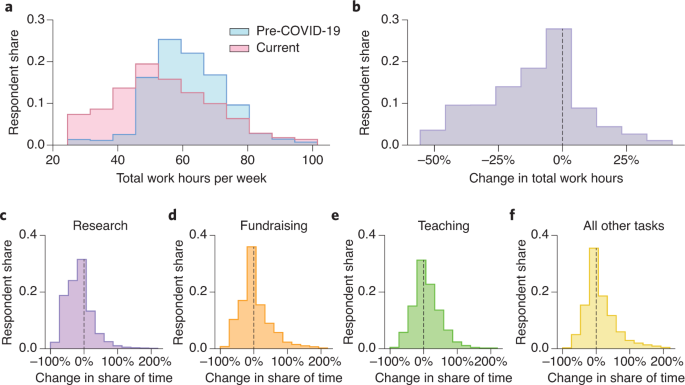
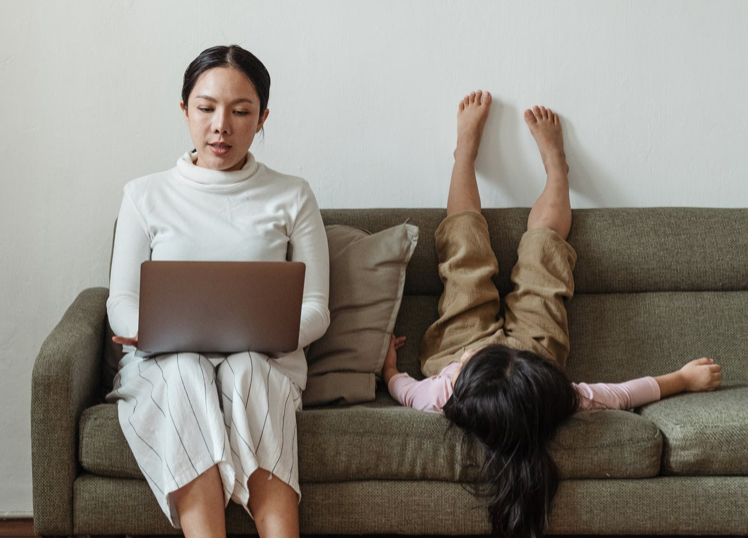
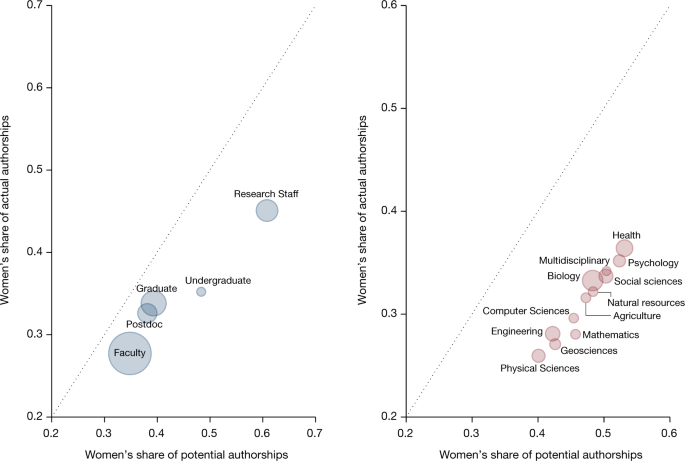
Update. "Our female respondents reported larger declines in the time they could devote to research than their male colleagues. And scientists with young children appear to have been particularly hard-hit, especially women."
https://www.nature.com/articles/s41562-020-0921-y
@petersuber - Peter Suber (@petersuber@fediscience.org)
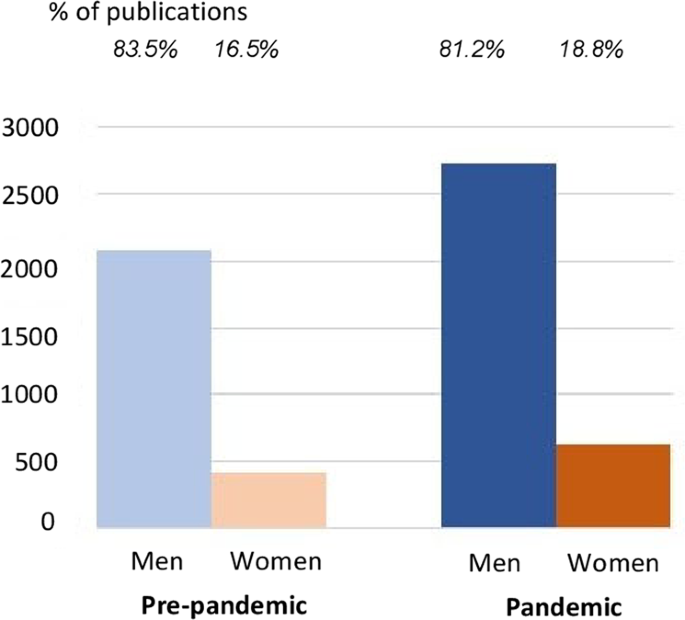
Update. "The proportion of #COVID19 papers w/ a woman 1st author was 19% lower than...for papers pub'd in the same journals in 2019...Women’s representation as 1st authors of COVID-19 research was particularly low for papers pub'd in March & April 2020." https://elifesciences.org/articles/58807
@petersuber - Peter Suber (@petersuber@fediscience.org)
Update. "Comparing 2020 with 2019, there was a 4% reduction in the percentage of women first authors [in @JAMASurgery], a 6% reduction of women last authors, and a 7% reduction in women as corresponding author."
https://jamanetwork.com/journals/jamasurgery/fullarticle/2769186
@petersuber - Peter Suber (@petersuber@fediscience.org)
Update. "[Early in the] pandemic, MS submissions by female researchers to preprint servers across disciplines dropped significantly or increased less than their male colleagues. [The same happened] for womxn-led medical studies related to this pandemic." https://journals.plos.org/plosbiology/article?id=10.1371/journal.pbio.3001100
@petersuber - Peter Suber (@petersuber@fediscience.org)
Update. "Women scientists have experienced a productivity penalty from the social and structural changes accompanying the COVID-19 pandemic, but not in all authorship positions."
https://osf.io/preprints/socarxiv/8hp7m/
@petersuber - Peter Suber (@petersuber@fediscience.org)
Update. "Women were substantially under-represented as authors among articles in leading medical journals [in 2020, but] barriers to women’s authorship…during COVID-19 are not significantly larger than barriers that preceded the pandemic."
https://bmjopen.bmj.com/content/11/7/e051224
@petersuber - Peter Suber (@petersuber@fediscience.org)
Update. Summarizing pandemic-specific gender differences in productivity & aiming to understand the causes of these diffs, inc those that existed before the pandemic. "Parental engagement is a more powerful variable…than the mere existence of children." https://arxiv.org/abs/2108.05376
@petersuber - Peter Suber (@petersuber@fediscience.org)
Update, contrary to other studies in this thread: "We found no significant differences between men & women in publication patterns [2019-2021] overall. However, we found significant differences…in different disciplines."
https://journals.sagepub.com/doi/10.1177/01655515211068168
@petersuber - Peter Suber (@petersuber@fediscience.org)
Update. "Only 3 fields had a female last author majority by 2018…Female first-authored research tended to be more cited than male first-authored research in most fields (59%), although with a maximum difference of only 5.1%."
https://doi.org/10.1177%2F0165551520942729
@petersuber - Peter Suber (@petersuber@fediscience.org)
Update. Most studies in this thread used software to guess the gender of authors from their names. But "more than 50 pubs representing over 15,000 journals globally are preparing to ask scientists about their race or ethnicity, as well as their gender." https://www.nature.com/articles/d41586-022-00426-7
@petersuber - Peter Suber (@petersuber@fediscience.org)
Idea building on prev tweet: @ORCID_Org could add fields for self-identified gender & ethnicity. With user consent, the fields could be public, e.g. for research just like that in this thread. No need to guess gender from names or trust (upcoming) publisher method of labelling.
@petersuber - Peter Suber (@petersuber@fediscience.org)
Update. "Disaggregating [Norwegian scientific authors] by scientific field, institutional affiliation, academic position, and age changes [and reduces] the gender gaps that appear at the aggregate level."
https://link.springer.com/article/10.1007/s10734-022-00820-0
@petersuber - Peter Suber (@petersuber@fediscience.org)
Update. "In multiple academic disciplines having a perceived gender of 'woman' is associated w a lower than expected rate of citations…We show that…the tendency of people to interact w others…like themselves…is sufficient to reproduce observed biases."
https://arxiv.org/abs/2204.12555 https://arxiv.org/abs/2204.12555
@petersuber - Peter Suber (@petersuber@fediscience.org)
Update. "Women [authors are] under-rep'd…in JAMA (at its peak, 38.1% of articles had a female 1st author in 2011) & NEJM (peaking at 28.2% in 2002)…Rate of increase…so slow that it will take more than a century for both journals to reach gender parity." https://link.springer.com/article/10.1007/s40615-022-01280-z
@petersuber - Peter Suber (@petersuber@fediscience.org)
Update. In veterinary science journals, "females [are] underrepresented in the group of managing editors (32.2% females vs 67.2% males), editors (34.5% females vs 65.1% males) and others (33.3% females vs. 65.4% males)." #paywalled
https://www.sciencedirect.com/science/article/abs/pii/S0034528822001217
@petersuber - Peter Suber (@petersuber@fediscience.org)
Update. At @BrainComms "the representation of women authors and reviewers decreased…in the months following COVID-19 restrictions, suggesting a possible exacerbating role of the pandemic on existing disparities in science publication."
https://academic.oup.com/braincomms/article/4/3/fcac077/6554271
@petersuber - Peter Suber (@petersuber@fediscience.org)
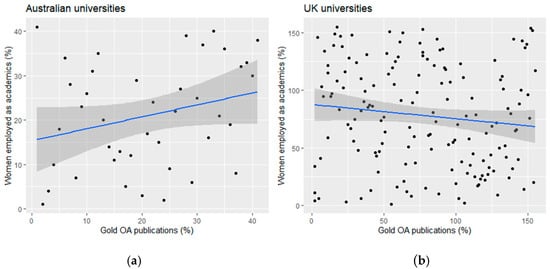
Update. "We review gender bias in scholarly publications and discuss examples of #openaccess research publications that highlight a positive advantage for women."
https://www.mdpi.com/2304-6775/10/3/22
@petersuber - Peter Suber (@petersuber@fediscience.org)
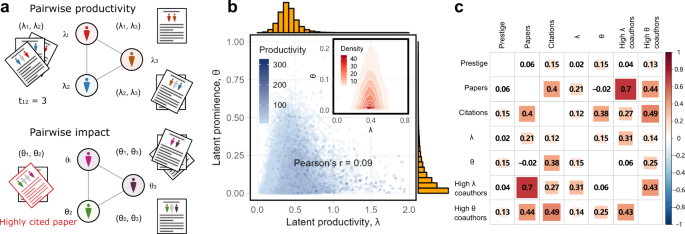
Update. "Gendered differences in the productivity and prominence of mid-career researchers can be largely explained by differences in their coauthorship networks…Collaboration networks represent an important form of unequally distributed social capital." https://www.nature.com/articles/s41467-022-32604-6
@petersuber - Peter Suber (@petersuber@fediscience.org)
Update. In the #MENA region, "men publish on average between 11% and 51% more than women, with this gap increasing over time."
https://arxiv.org/abs/2208.13520
@petersuber - Peter Suber (@petersuber@fediscience.org)
Update: The Journal of Bone & Mineral Research studied itself. "The acceptance rate [2017-2019] was highest when the first & last authors were of different genders & lowest when both authors were men. Reviewer gender did not influence the outcome."
https://asbmr.onlinelibrary.wiley.com/doi/10.1002/jbmr.4696
@petersuber - Peter Suber (@petersuber@fediscience.org)
Update. "We identify gender disparities in the patterns of peer citations and show that these differences are strong enough to accurately predict the scholar’s gender."
https://www.pnas.org/doi/10.1073/pnas.2206070119
@petersuber - Peter Suber (@petersuber@fediscience.org)
Update. "We find a global bias wherein [physics] papers authored by women are significantly under-cited & papers authored by men are significantly over-cited…[These disparities depend on] who is citing, where they are citing & what they are citing."
https://www.nature.com/articles/s41567-022-01770-1
@petersuber - Peter Suber (@petersuber@fediscience.org)
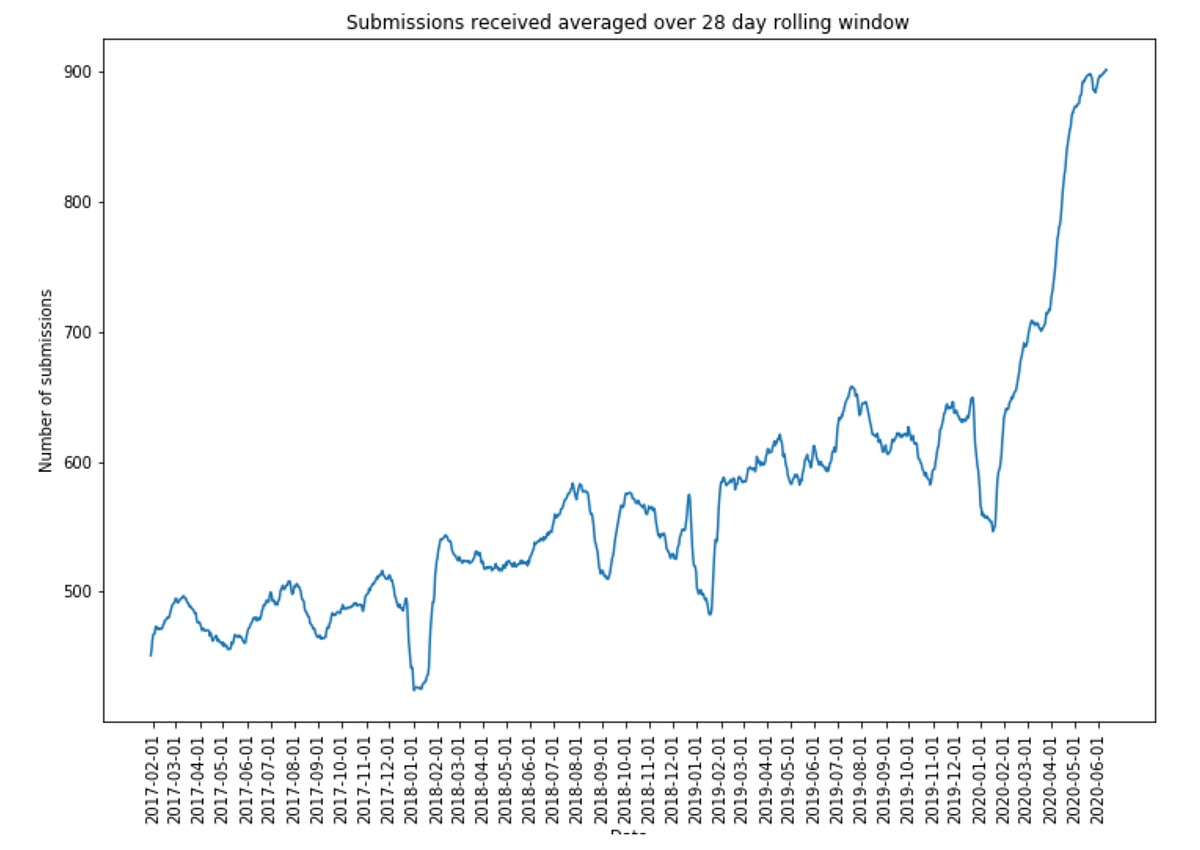
Update. Study of the 57 @IOPPublishing journals: "Contrary to our hypothesis, we did not find that manuscript submissions from women decreased during the pandemic, although the rate of increased submissions evident prior to the pandemic slowed."
https://www.nature.com/articles/s41599-022-01365-4
@petersuber - Peter Suber (@petersuber@fediscience.org)
Update. "Publications by women are cited less by @Wikipedia than expected…& less likely to be cited than those by men…Gender- or country-based inequalities varies by research field & the gender-country…bias is prominent in math-intensive STEM fields." https://asistdl.onlinelibrary.wiley.com/doi/10.1002/asi.24723
@petersuber - Peter Suber (@petersuber@fediscience.org)
Update. "Women’s share of HCRs [highly cited researchers] would need to increase by 100% in health & social sciences, 200% in agriculture, bio, earth & env sciences, 300% in math & physics, & 500% in chemistry, CS & engineering to close the gap with men." https://doi.org/10.1162/qss_a_00218
@petersuber - Peter Suber (@petersuber@fediscience.org)
Update. For male authors, the presence of an author photo and bio in an article does not affect citation rates. But "there was a small citation disadvantage of 5% for female authors when they provided a photograph and biography."
https://doi.org/10.1162/qss_a_00219
@petersuber - Peter Suber (@petersuber@fediscience.org)
Update. "I find that (i) female-authored papers are 1%–6% better written than equivalent papers by men; (ii) the gap widens during peer review; …(iv) female-authored papers take longer under review."
https://academic.oup.com/ej/article/132/648/2951/6586337
@petersuber - Peter Suber (@petersuber@fediscience.org)
Update. "Women account for less than one in three peer reviewers of medical journals. Women’s representation as peer reviewers is higher in journals with higher percentage of women as editors or with a woman as editor-in-chief."
https://bmjopen.bmj.com/content/12/5/e061054.abstract
@petersuber - Peter Suber (@petersuber@fediscience.org)
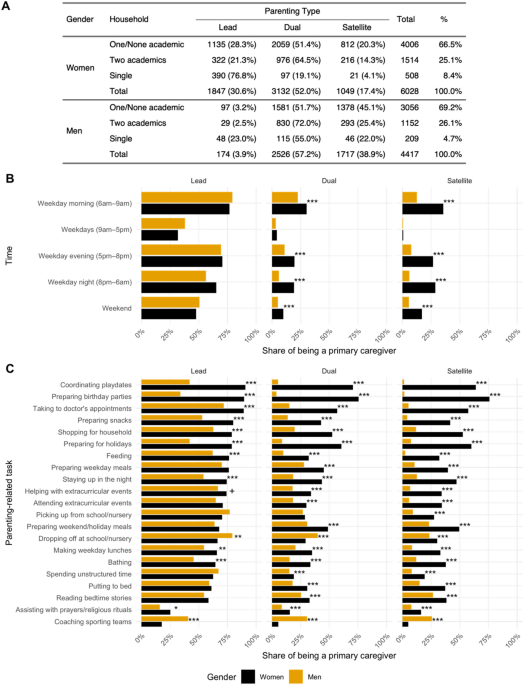
Update. "The gendered effect observed in [research] production may be related by differential engagement in parenting: men who serve in lead roles suffer similar penalties for parenting engagement, but women are more likely to serve in lead roles."
https://www.nature.com/articles/s41598-022-26258-z
@petersuber - Peter Suber (@petersuber@fediscience.org)
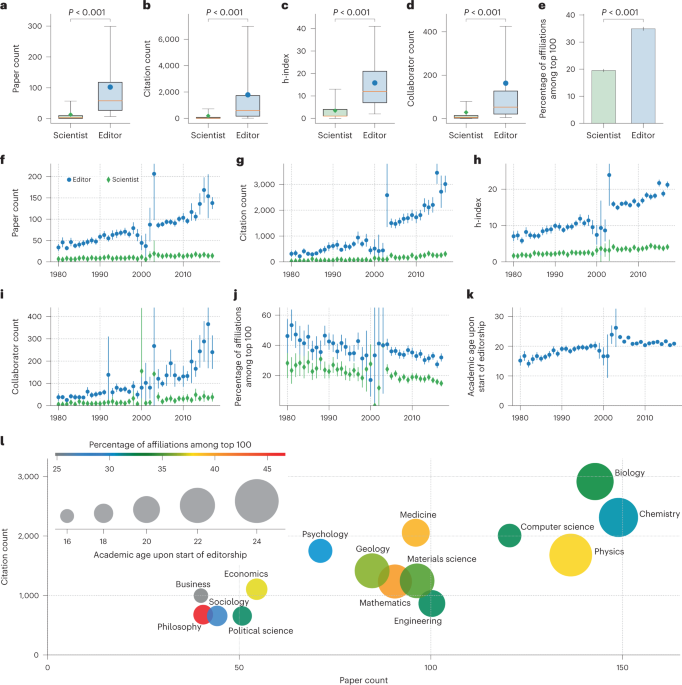
Update. In a database of "81,000 editors serving more than 1,000 journals and 15 disciplines over five decades" only 14% were women and only 8% were editors in chief. Male editors published in their own journals more often than female editors.
https://www.nature.com/articles/s41562-022-01498-1
@petersuber - Peter Suber (@petersuber@fediscience.org)
Update. Missed this one from 2017: "Here we present evidence that women of all ages have fewer opportunities to take part in peer review."
https://www.nature.com/articles/541455a
@petersuber - Peter Suber (@petersuber@fediscience.org)
Update. "This study evaluated the inclusion and representation of women serving on school #psychology journal editorial boards from 1965 to 2020." (#paywalled)
https://psycnet.apa.org/doi/10.1037/spq0000541
@petersuber - Peter Suber (@petersuber@fediscience.org)
Update. "The objective of the current study was to assess the level of gender and geographic inequalities affecting influential researchers, based on the lists of Highly Cited Researchers (HCRs) published annually by Clarivate."
https://link.springer.com/article/10.1007/s11739-023-03240-9
@petersuber - Peter Suber (@petersuber@fediscience.org)
Update. "We identified 1482 editorial board members [at #pharmacy journals] with only 527 (35.6%) being female…Only 9 journals (21.42%) presented more females among their editorial board members."
https://doi.org/10.1016/j.sapharm.2023.02.018
@petersuber - Peter Suber (@petersuber@fediscience.org)
Update. "Of the 3m submissions to major…medical journals in the 1st half of 2020, just 36% were from women. This gender gap applied…across all authorship positions, in…top tier & lower impact journals & was esp pronounced among younger…female authors." https://www.bmj.com/content/381/bmj.p788
@petersuber - Peter Suber (@petersuber@fediscience.org)
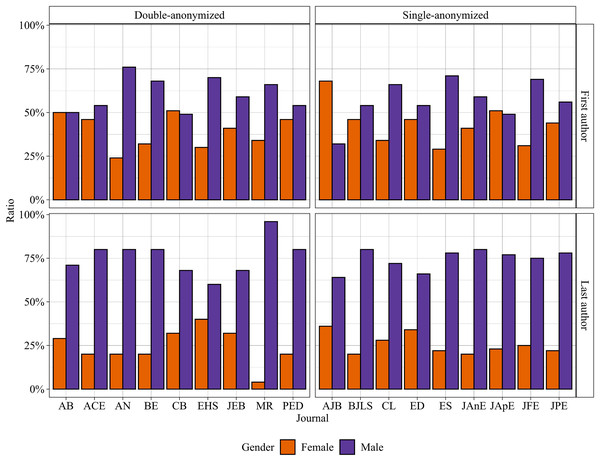
Update. "Publications led by female authors did not differ between DA [double-anonymized] and SA [single-anonymized] journals. Moreover, female-leading articles did not increase after changes from SA to DA peer-review."
https://peerj.com/articles/15186/
@petersuber - Peter Suber (@petersuber@fediscience.org)
@reSeeIt save thread